Structure of this study
- Introduction and Page 1: Pre-writing instruments.
- Page 2: Shadow-observation instruments (this page).
- Page 3: Celestial-observation instruments.
- Page 4: Flow- or combustion-based instruments.
- Page 5: Clocks and modern instruments.
Shadow-observation instruments
No need to hide it: this page will be mostly about sundials, in the broadest sense, while keeping our main goal in view, tracing the evolution of time-measuring instruments. The aim is neither to catalog sundials worldwide nor to explain in detail how to build them.
We will still make one small exception by including instruments based on observing a light spot rather than a shadow.
One final note before we continue: if your astronomy basics are rusty, I suggest a quick refresh here. Done? Then let's begin our journey into the realm of shadows.
Sundials
When a stick becomes a gnomon
Plant a stick vertically in the sand on a flat beach. I say beach because it is easier, but if you prefer driving the stick into your concrete terrace, I have no objection.
Now observe the stick's shadow cast by the Sun and mark the tip of that shadow at different times of day. We have just performed our first trick: the stick has become a gnomon.
While we are here, let's settle once and for all what a gnomon is:
“Littre: Gnomon (Latin gnomon, from Greek): a kind of large style used by astronomers to determine the Sun's height; the pin or style of a sundial.
“Le Petit Robert: Gnomon (1547, from Latin via Greek): ancient astronomical instrument consisting of a vertical rod (style) casting a shadow on a flat surface.
“French Academy Dictionary, 5th edition (1798): GNOMON. Astronomy term. A kind of large style used by astronomers to determine the Sun's height, especially at solstice. Ancient gnomons were obelisk-like structures topped with a sphere. Also used for the style of a sundial.
“French Academy Dictionary, 8th edition: GNOMON. Astronomy term. Any instrument marking hours by the direction of the shadow cast by a solid body on a plane or curved surface.
Also, gnomon comes from Greek and means indicator.
So, sometimes gnomon means the “stick,” sometimes the “instrument.” Which instrument? To keep it simple: one made of a shadow-maker and a shadow-receiver.
Current usage often calls a straight shadow-maker a gnomon and an inclined one a style. Or sometimes the reverse. For us, we will simply call the shadow-making object the style.
What is the difference between a gnomon (as instrument) and a sundial? Think of the old joke about tennis and table tennis: in tennis, you play on the table. The gnomon instrument relates to the sundial as tennis to table tennis. In fact, in gnomonics (the art of constructing sundials) and among dialists, the shadow-receiving surface is called the table.
Good. Quietly, we have put most definitions in place and can move on.
Back to our stick. Over one day, its cast shadow changes in both position and length. When the shadow is shortest, it is noon, and in the Northern Hemisphere the Sun indicates south.
Over several years, one may see that once or twice a year the shadow tip traces a straight line during a single day. Shadow at sunrise and shadow at noon form a 90° angle; likewise in the evening, with sunset exactly west. Those are equinox days.
Simply by marking those privileged moments in sand or elsewhere, one can mark equinoxes, noon, south, east and west.
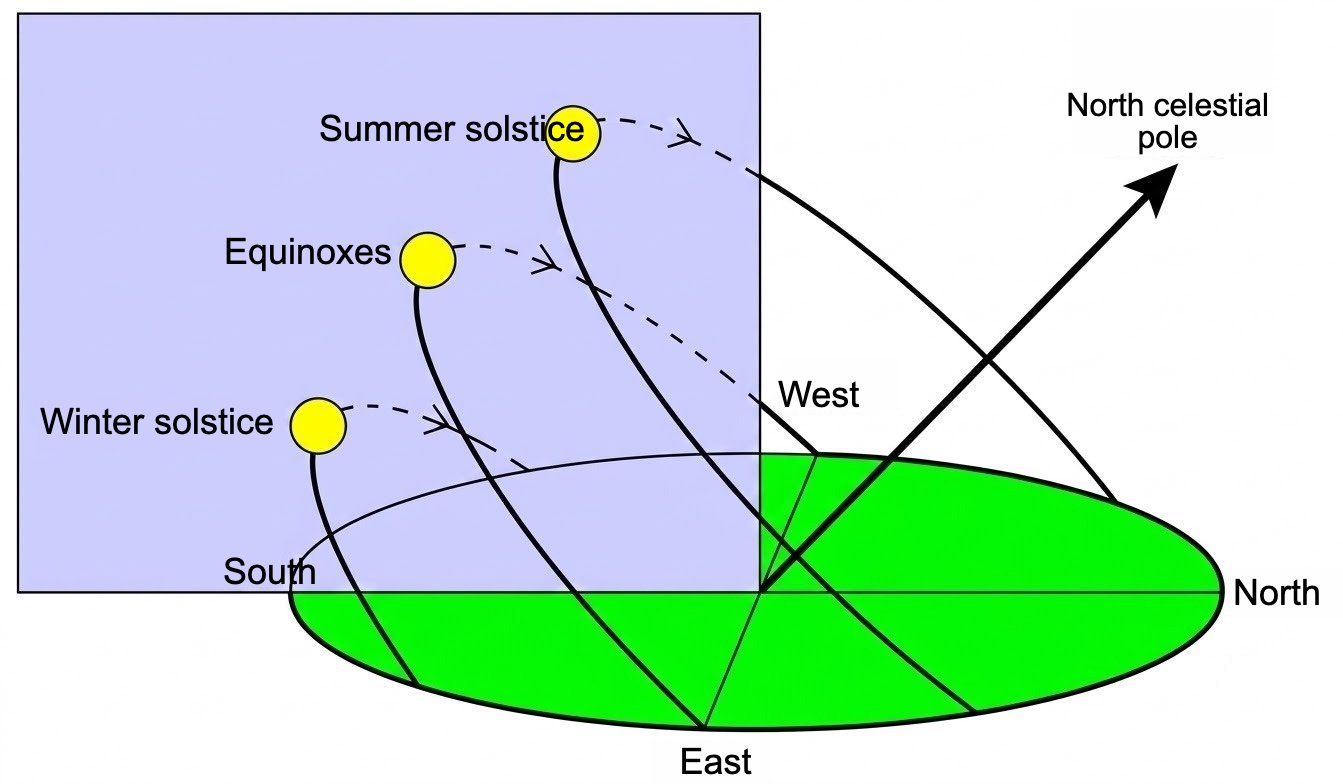
Assume our location with the stick is flat. If we turn around ourselves, our line of sight traces a circle, the horizon, and the sky looks like a hemisphere. Let's sketch that situation.
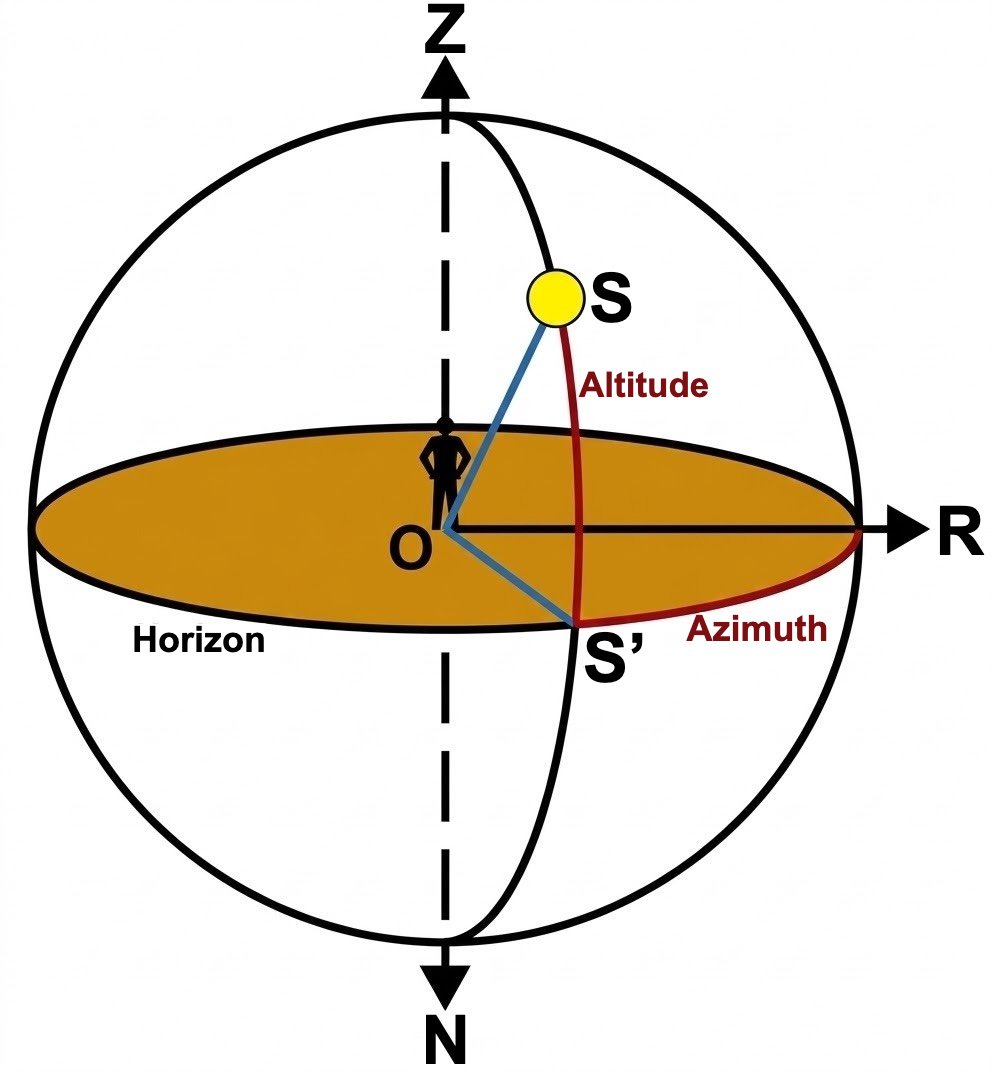
We stand at center O of the horizon circle.
Vertically above the stick is point Z, the zenith. Opposite lies N, the nadir.
The half-plane through line ZN and Sun S is called the vertical of S. It cuts the horizontal circle at S'.
On that same horizontal plane, point R marks south.
The azimuth of S is arc RS' (angle S'OR), and altitude is arc SS' (angle SOS').
As seen above, both azimuth and altitude vary continuously depending on site latitude, solar declination (date), and hour.
If, for a given location, we use full shadow position to measure time, we build an azimuth gnomon.
If instead we use shadow length by marking its tip, we build an altitude gnomon.
Such gnomons have existed at least since 2000 BCE, likely earlier if one does not strictly distinguish observing from measuring instruments.
In India, as early as the 4th century BCE, there may have been shadow tables based on altitude-gnomon principles, where the style was the person themselves: measure a person's shadow and read time from the table. The first portable dial.
Gnomon and obelisks
We have just seen that a simple stick's shadow can already help orientation in time. Before addressing problems of the vertical style, let's ask the obvious question: if any vertical object can be used for a “sundial,” were Egyptian obelisks sundial styles?
Very unlikely, for several reasons:
- No known ground reference marks.
- Huge height (10 to 20 meters) casting shadows up to 200 meters or more (with blurred tips).
- Square section producing discontinuous shadow behavior.
- Section changing along height (sloping edges).
With such instruments, one might at best identify solstices and equinoxes approximately. It would underestimate Egyptian intelligence to assume they would not have used better methods if they knew them.
That said, at least one Egyptian obelisk was adapted as a sundial style. Was it used that way? It was in Rome, in the northern Campus Martius: brought from Heliopolis in 10 BCE on Augustus's order and erected there.
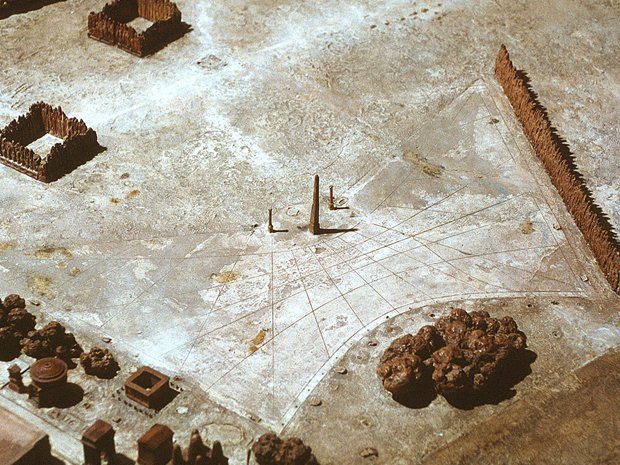
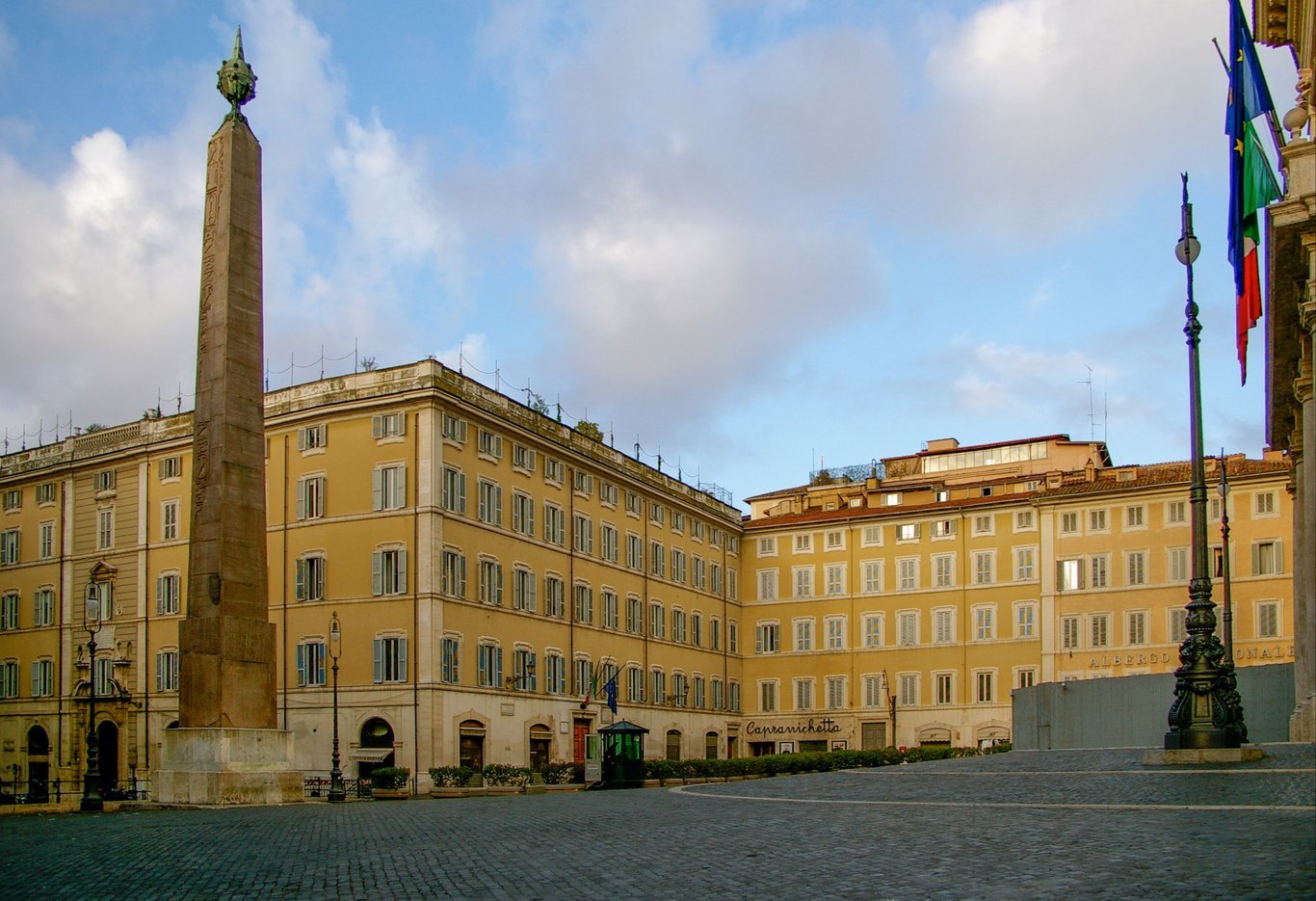
Horologium Augusti: reconstruction above. Right: today's obelisk on Piazza Montecitorio.
Polos and scaphe
As seen, azimuth and altitude depend on three variables: latitude, declination, hour. For an azimuth dial, except at noon, the shadow of a vertical style never points in the same direction. So you cannot divide the dial into fixed equal sectors to measure hours.
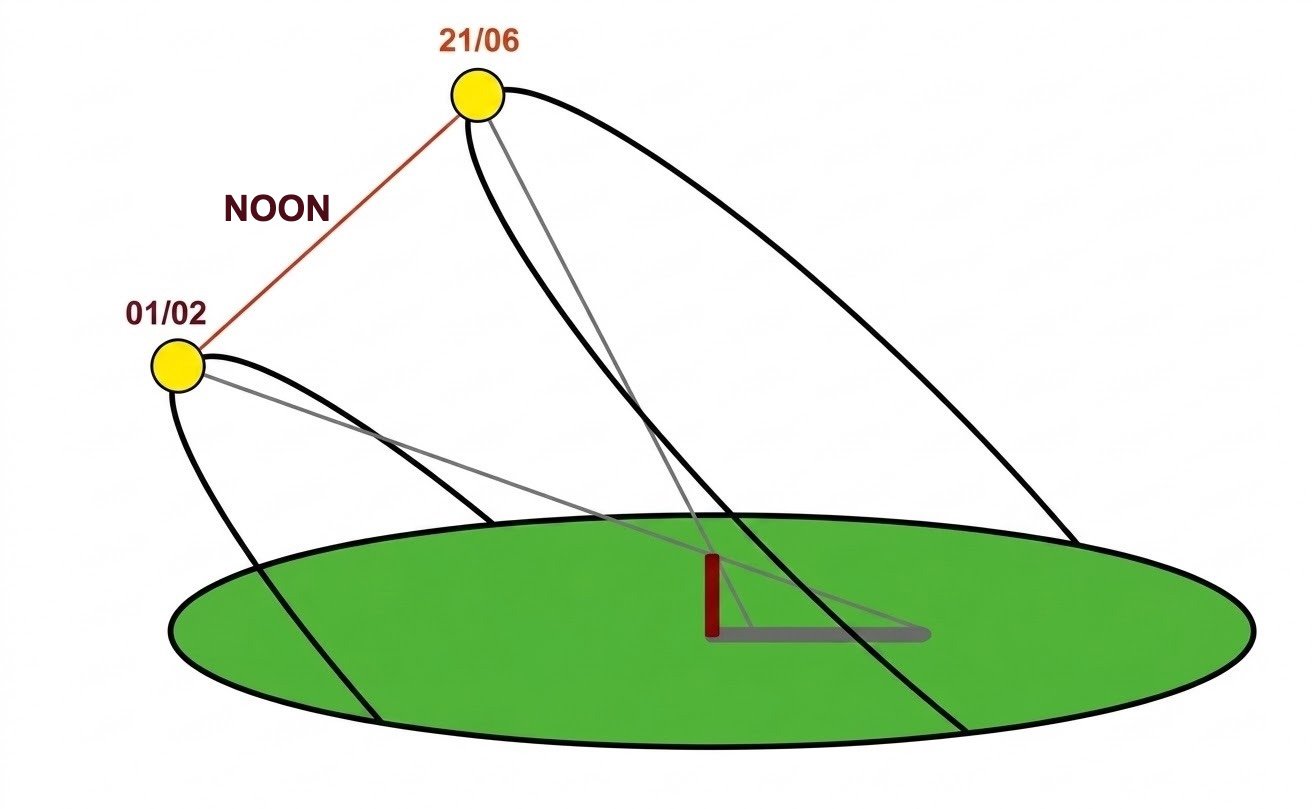
With a vertical style, the shadow is always in the same place at noon (top image), but not at other times of day (bottom image).
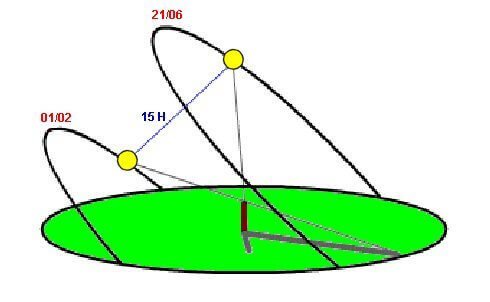
For an altitude dial, the shadow tip is never in the same place, so a single line with hour marks is impossible.
The scaphe solves this. It may date back nearly 3,000 years, but since the first certainly attested instruments date to around 600 BCE in Greece, we will keep that more modest date. We will not discuss its ancestor, the polos, which likely existed but has not survived.
The scaphe principle is as simple as it is remarkable: represent the celestial hemisphere seen from our sandy beach inside a hollowed hemisphere (scaphe means boat) carved in stone, and represent the Sun by the shadow of a sphere placed at its center. Then draw a few lines to measure time.
There were two kinds: Greek scaphe (full hemisphere) and Roman scaphe (partial hemisphere). Principle is the same, and truncation does not change operation.
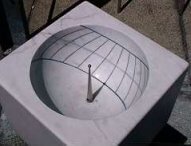
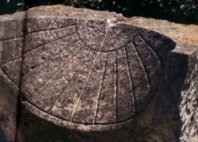
Left: Greek scaphe. Center: Greek scaphe principle. Right: Roman scaphe.

From the bottom of the Greek scaphe rises a straight style toward local zenith, often ending in a sphere. Inside, on the north side, Greeks engraved three parallel lines for the two solstices (2 lines) and two equinoxes (1 line). Hours were then shown by 11 lines plus the scaphe's two edges, dividing the hemisphere into 12 sectors.
Since the sphere shadow naturally evolves between the two extreme solstice lines, it is clear why Romans kept only a hemisphere segment bounded by those lines. Another Roman change: a horizontal style above the noon line, allowing use of its full shadow as indicator.
Is the scaphe a time-measuring instrument? Yes, even if not precise to the hour. It at least locates season within the year and rough day period.
Note also the Greek invention by Eudoxus of Cnidus and Apollonius of the Arachne, an azimuth dial whose hour curves resemble a spider web, hence the name, around 400 BCE.
Decisive turning point: the polar style
Take our initial stick again, but this time instead of planting it vertically, point it toward Polaris, so it is parallel to Earth's axis. What happens to the cast shadow?
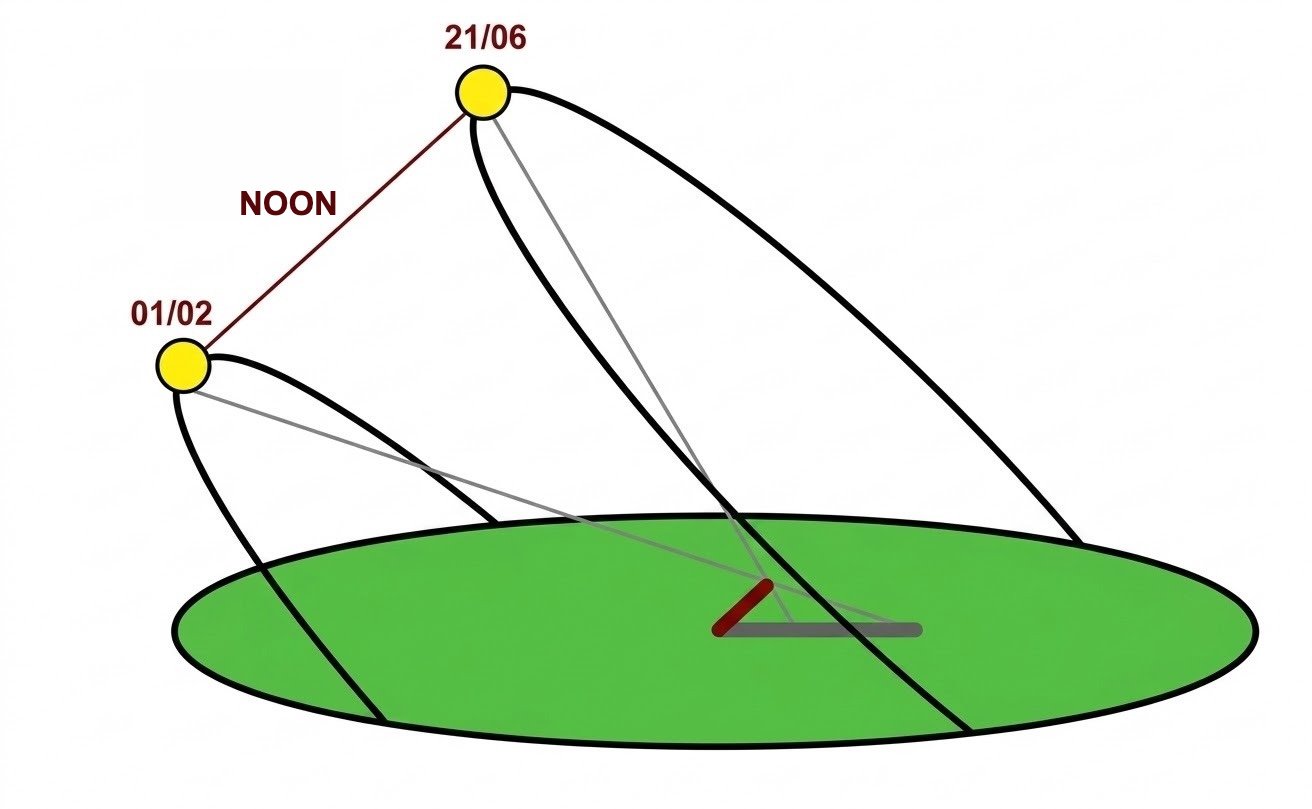
With a polar style, the shadow is always in the same place at noon (top image), and likewise at other hours (bottom image).
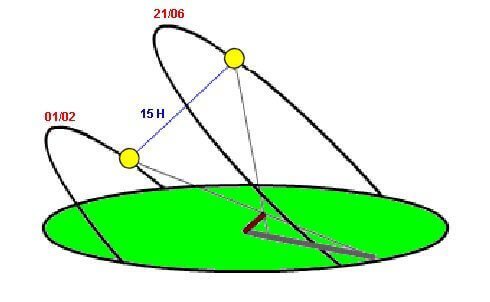
Now the shadow, though still varying in length, always follows the same positions regardless of day of year.
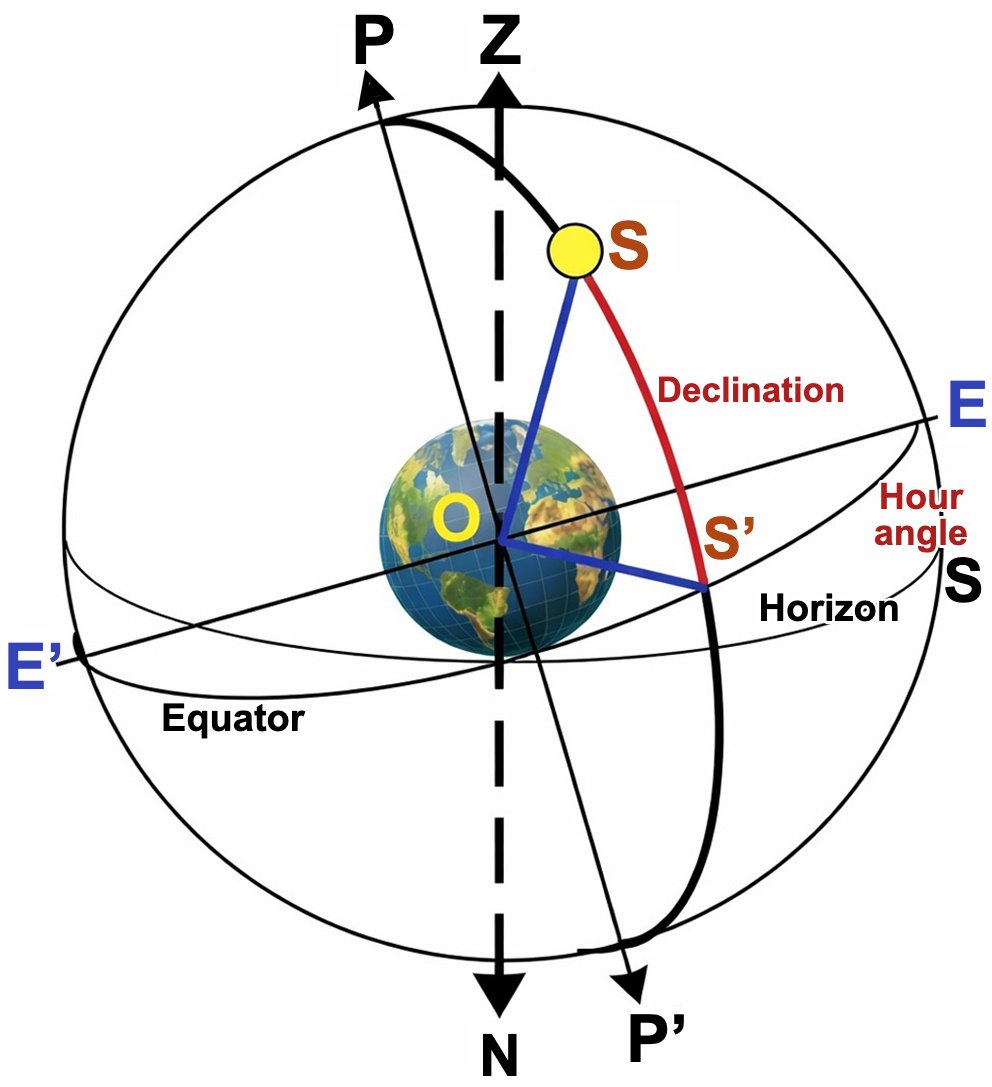
Why?
Because this time we are in a hour-angle coordinate system. The celestial equator is simply the extension of Earth's equatorial plane.
The perpendicular through O to that plane is pole line PP'. The plane formed by that line and ZN (local vertical) is the local meridian plane. The half-plane PSP' through pole line and S is S's hour circle. It cuts the equator at S'.
Arc ES' (angle EOS') is S's hour angle. Arc SS' (angle SOS') is S's declination.
A polar-style dial measures the hour angle, which does not depend on date.
We will not detail every possible polar-style dial type; that part of gnomonics is outside this study.
If we walk through nearby towns and villages, we are very likely to find on an old house or church facade a polar-style dial. They are indeed the most common. Take care not to confuse them with canonical dials (discussed below).
When do the first polar-style dials date from?
Hard to answer precisely. Was the polos itself a polar-style scaphe, as its name suggests? Some think so, but there is no certainty.
Failing that, we date polar style to around 300 BCE, matching a Greek polar-style dial discovered in Afghanistan in 1975, consistent with Alexander the Great's campaigns.
They appear much later in Europe: the oldest known dates only to 1477, in a cloister at Alpirsbach in the Black Forest.
The oldest known in France is at Strasbourg Cathedral, around 1493.
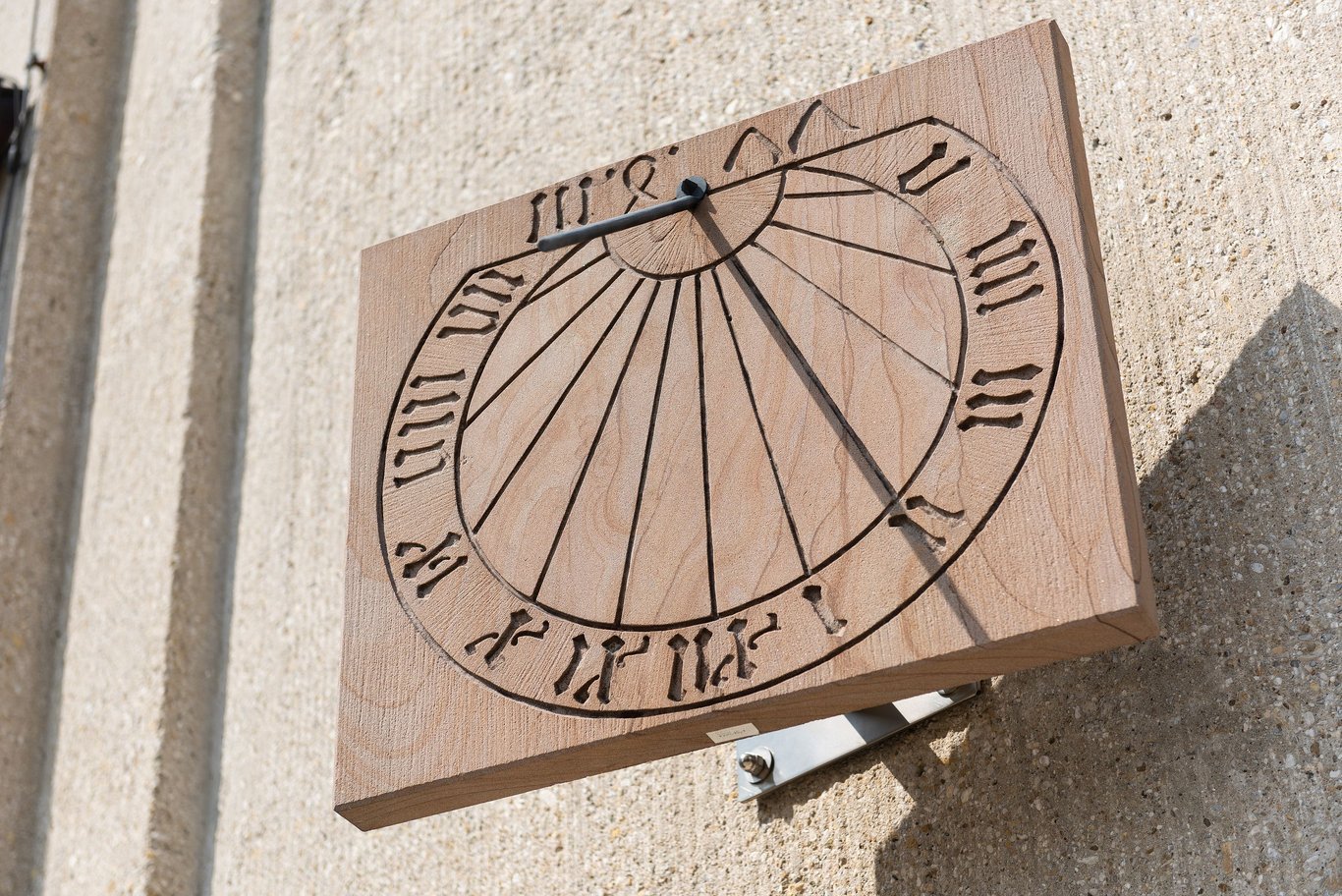
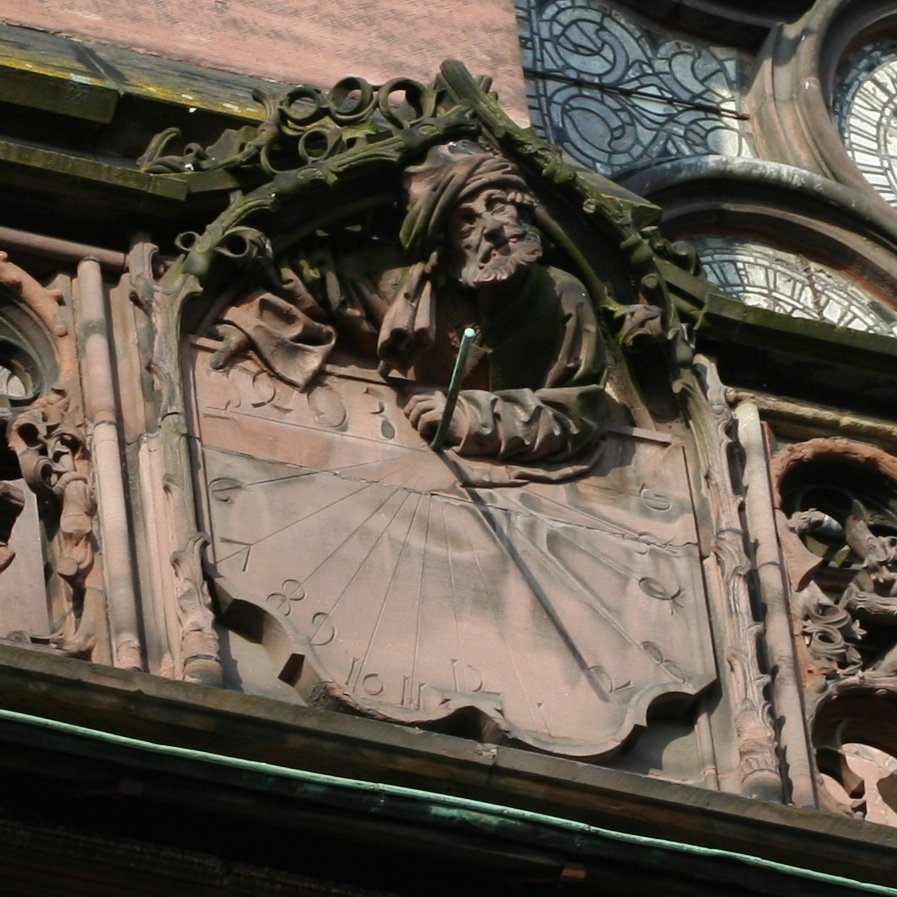
The “purest” polar-style sundials are horizontal dials and south-facing vertical dials.
Without entering detail:
- The horizontal dial, as its name says, has a horizontal table. Its style, parallel to the pole axis, is placed on the noon line. Left-side hour lines are symmetric to right-side lines. In our hemisphere, morning hours are on the right, afternoon on the left. It can indicate time from sunrise to sunset.
- The vertical dial has a vertical south-facing table. Its style, parallel to the pole axis, is placed on the noon line, always vertical. In our hemisphere, morning hours are on the left, afternoon on the right. It indicates only from 6:00 to 18:00.
Since not all walls face due south, many variants appeared to compensate wall orientation:
- Dials declining southeast or southwest
- North-facing dials
- Northeast or northwest declining dials
- and others. For more, see Philippe Langlet's excellent site, and his “about me” proves he knows the topic deeply: here.
And others followed
Sundial history does not end with the polar style, it continues today. Other types followed, which we will not cover because by then other instruments had arrived.
With the polar-style sundial, we have a true time-measuring instrument whose precision is limited mainly by readability compromises. Otherwise, minutes could also be engraved.
Too precise, perhaps? Maybe, since there is a difference between the local apparent time it gives and the mean time we seek for continuity. The analemma provides corrections. See time scales.
Before ending this page with light-spot instruments, we will, for fun, examine an event-marker dial, the canonical dial, then try to establish a chronology of instruments studied so far.
Event marker: the canonical dial
This dial may date to Egyptian use around 300 BCE. In China, possibly around 1100 BCE.
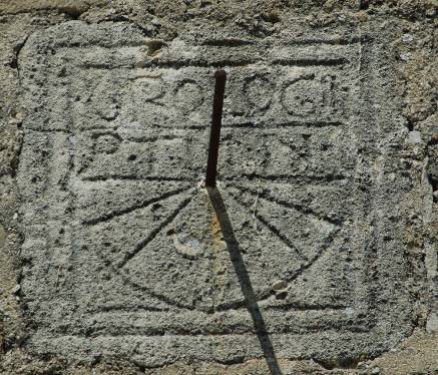
Let's be clear: this is a straight-style dial. So why mention it? First, as said, for fun. Second, because it structured everyday life for some of our ancestors for nearly 1,500 years.
Its role was mainly to mark prayer moments through the day, so it is found mainly on monastery, church and cathedral walls.
No need to say these prayer “moments,” with a straight style, shifted over the day, but that mattered little. As someone said in other contexts, “the important thing is to participate”...
Why “canonical”? Because in the 9th century divine office was fixed at eight prayer moments governed by canons (rules).
They were first set at five by Benedict of Nursia around 530: Matins (sunrise), Terce (mid-morning), Sext (noon), None (mid-afternoon), Vespers (sunset).
Later they became eight: Matins, Lauds, Prime, Terce, Sext, None, Vespers, Compline.
Now let's look at a few canonical dials.
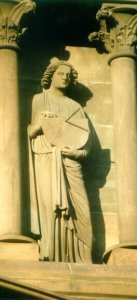
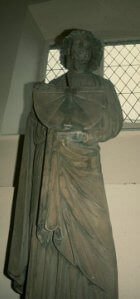
Copy (left) and original (right) of the “Adolescent with dial” at Strasbourg Cathedral, likely carved between 1225 and 1235. One can distinguish seven hour lines on the canonical dial itself.
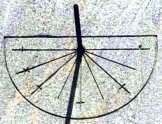
Canonical dial of unknown location. Prayer hours are marked with short dashes.
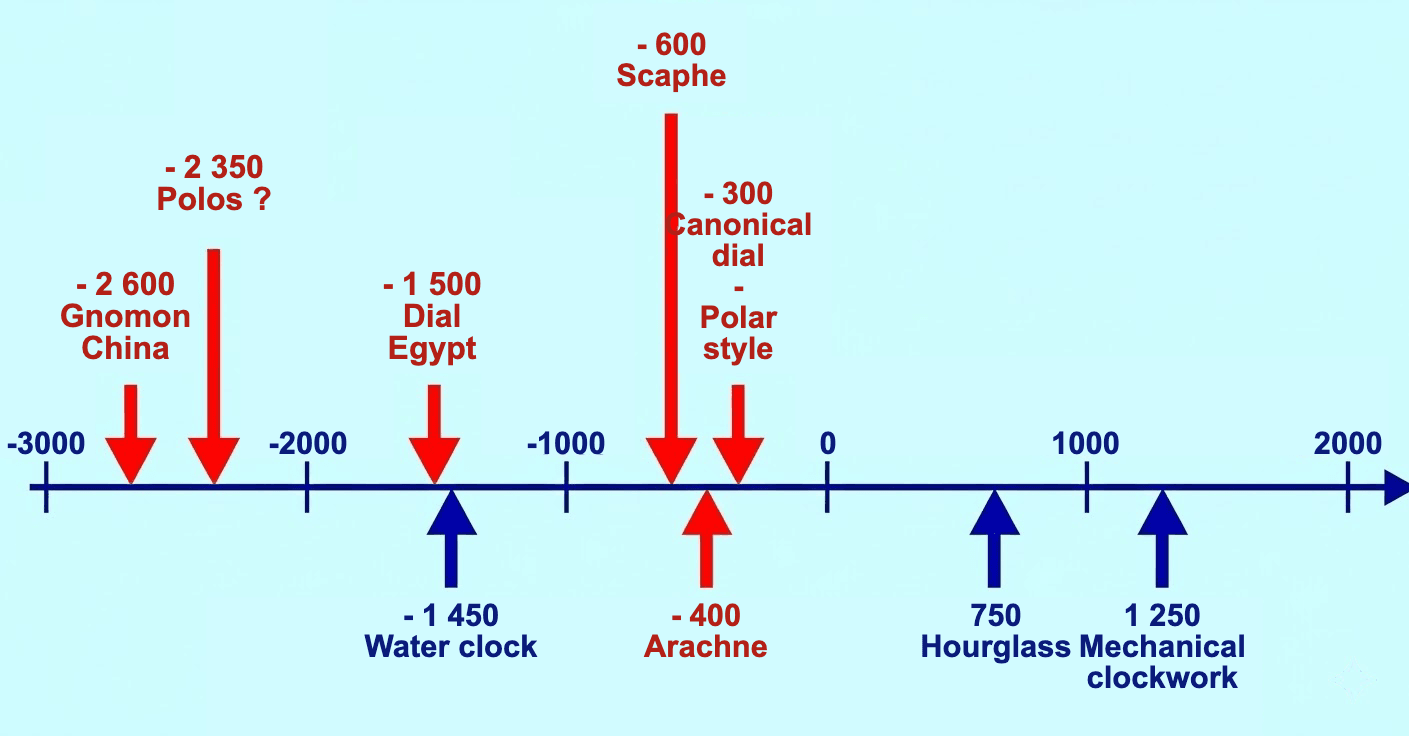
Chronology of instrument appearance
Light-spot observation instruments
Scaphe with pinhole
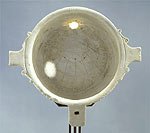
At the Louvre one can see a scaphe of a different design from those discussed above: a Roman scaphe, 73 cm in diameter, from the 1st or 2nd century CE.
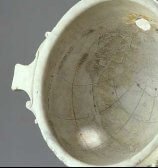
Its difference is that it has no style. The style is replaced by a pinhole through which sunlight enters and projects a bright spot inside. Originally, spot size was likely reduced by a perforated bronze plate.
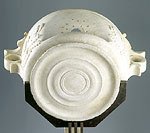
Left photo: the scaphe almost in “working” position. On its upper part one can partly see the light-entry hole.
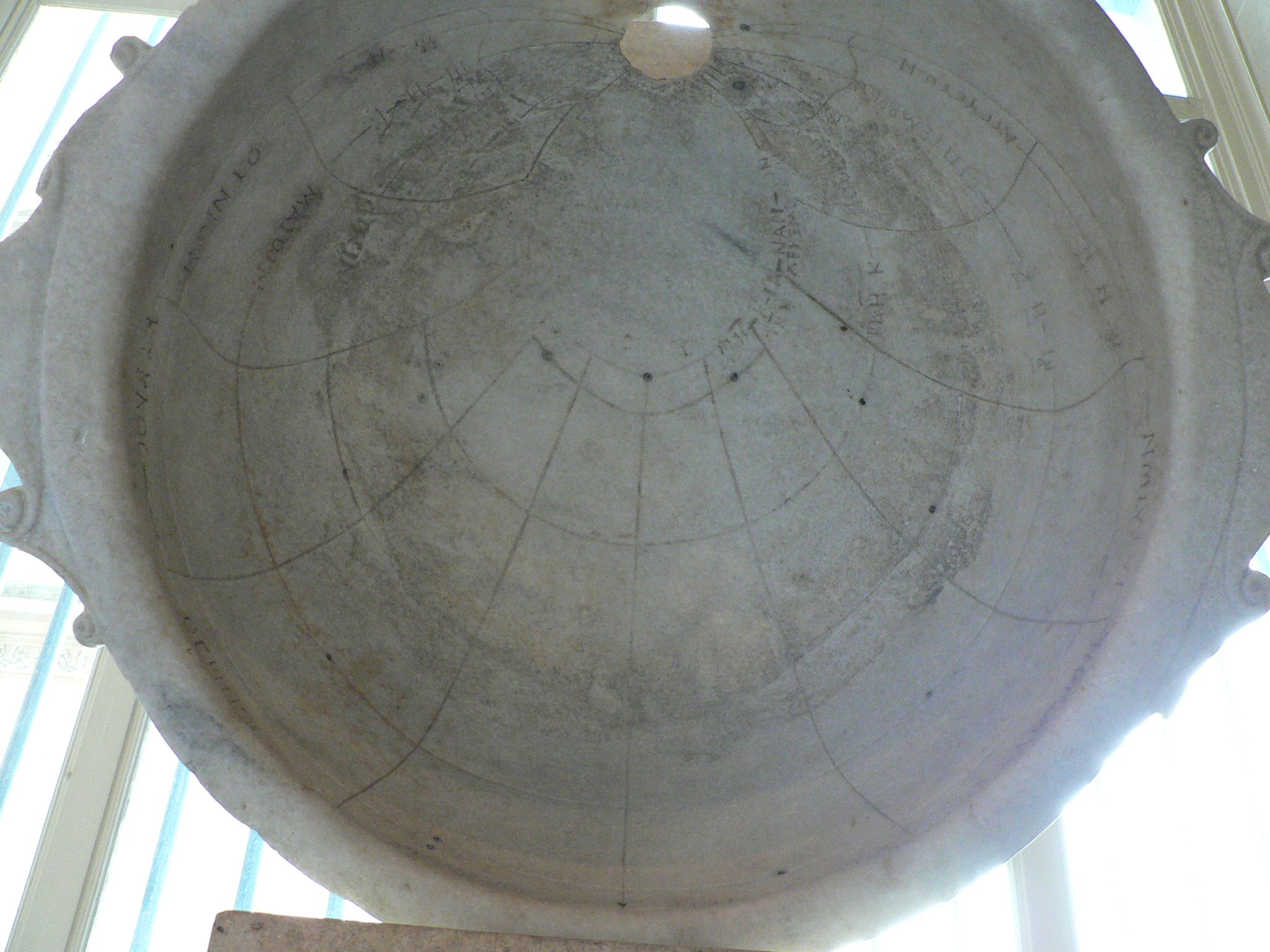
Center photo: interior of the scaphe, whose true position rests on the flat surface visible below. The hole on that flat part likely served to fix a vertical support rod. At top, the light-entry aperture; lower left, the light spot projected through it. At the back, one can distinguish traditional hour lines and circles for solar declinations. That area is enlarged in the right photo for better visibility.
Astronomical ring
We will end this sundial-based study with what I personally find the most elegant instrument for many reasons: purity of form, long history, craftsmanship and engraving quality, materials used (copper, brass, silver, gold), and its perfect representation of what we saw above, hour-angle coordinates.
This instrument is the astronomical ring, later the equinoctial ring.
Its story begins with antiquity's greatest astronomer, Hipparchus of Nicaea (or Hipparchus of Rhodes, first quarter of the 2nd century BCE, after 127 BCE).
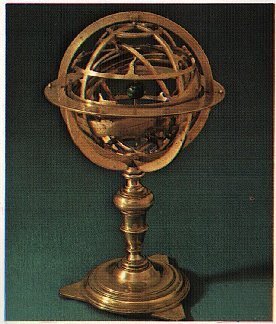
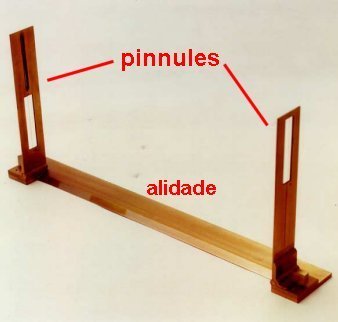
Around 150 BCE he invented the armillary sphere, resembling the instrument shown above left. His version measured two to three meters in diameter and consisted of five rings (armillae). The first two, ecliptic and solstice-containing meridian (colure), intersect at right angles. Two movable circles around the axis perpendicular to the ecliptic center are linked to the colure (one outside, one inside). These four rings carry Babylonian graduations introduced to Greece by Hipparchus: 360 degrees, each subdivided, under Mesopotamian sexagesimal practice, into 60 and 60 subdivisions. A fifth ring, carrying two pinnules at ends of its diameter (right image), is inscribed inside the inner colure circle and pivots in its own plane. A frame supports the whole assembly, rotating on two lateral pivots passing through the colure ring at celestial poles. The system measures ecliptic coordinates: celestial longitudes by moving rings linked to the colure; latitudes by sighting with the alidade ring. This is more an observing instrument than a time-measuring one, but the seed is there.
It remains so until the 15th century, when German astronomer Johannes Muller, known as Regiomontanus (1436-1476), describes in 1471 an equatorial armillary sphere (annulus sphaericus) with three rings. Later, Dutch astronomer Gemma Frisius (1508-1555), in 1534, publishes Usus annuli astronomici, fixing construction standards for the astronomical ring.
Initially with three rings (outer to inner: meridian, equator, declination), astronomical rings later became equinoctial rings, with two rings (meridian, equator) plus graduated rule (world axis), simplifying design.
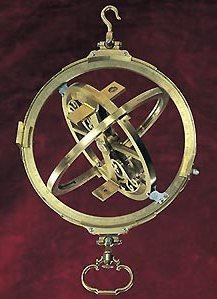
The ring above left, designed by Paul d'Albert de Luynes and made by Jacques-Nicolas Baradelle for Cardinal de Luynes, Archbishop of Sens, around 1760-1774, is a small masterpiece.
One immediately notices the similarity between photo and diagram in terms of rings and circles.
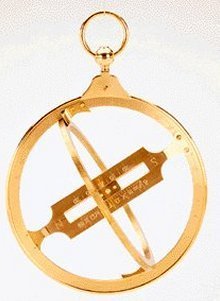
The right instrument, an equinoctial ring, has only two rings, the declination ring replaced by a graduated rule. At the rule center sits a movable cursor with an aperture through which sunlight enters.
Operation is theoretically simple. The instrument is suspended vertically by hook or ring (bail) after setting local latitude by sliding the outer degree-engraved ring in the bail.
The inner ring is positioned parallel to the equator (see right figure) and carries hour graduations.
The central rule is graduated by days of months and must be oriented north-south. In the lower photo, one can indeed see letters N and S.
Then rotate the instrument so sunlight enters through the cursor aperture and strikes the equatorial ring where time is read... except at noon, when sunlight strikes the outer part of the equatorial ring, preventing entry through the cursor hole. One then sees only the ring's shadow on the cursor aperture.
Because keeping the instrument in exact position was delicate, pedestal-mounted versions were designed.
Final wink: from China to the Moon
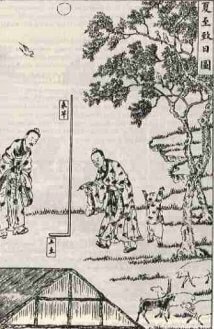
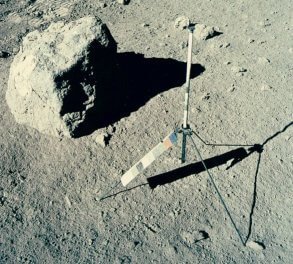
The gnomon appears both in China as early as 2600 BCE and on the Moon during Apollo 17, used to determine sample positions and calibrate instruments. A photographic calibration chart is visible on the left arm.