Structure of this study
- Introduction and Page 1: Pre-writing instruments.
- Page 2: Shadow-observation instruments.
- Page 3: Celestial-observation instruments (this page).
- Page 4: Flow- or combustion-based instruments.
- Page 5: Clocks and modern instruments.
Celestial-observation instruments
The nocturnal
On the previous page, we saw that time, and especially moments of the day, can be measured with sundials or similar tools. So daytime is covered. But how do you measure hours at night by observing the stars?
Of course, the Sun has set, and the Moon is not always useful since it is regularly invisible (new moon) or only partly visible. Its light is often too weak to cast usable shadows.
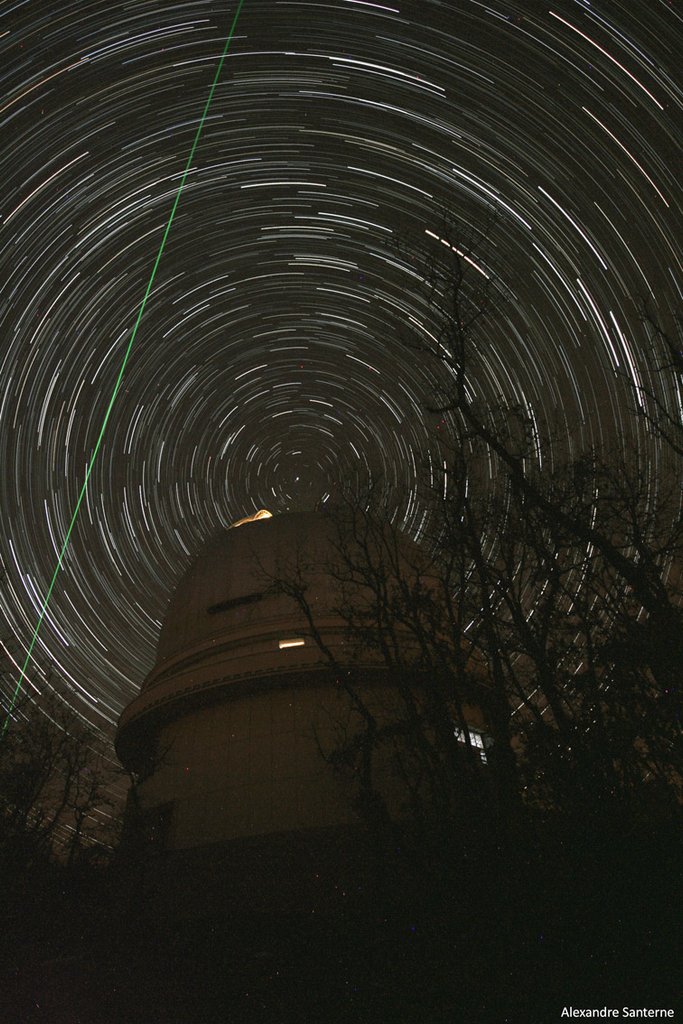
So what remains in the night sky apart from stars? The issue is that, because of Earth's motions, stars seem to move, but not around Earth itself. Fortunately, they appear to rotate around a fixed point, and around a clearly identifiable star: Polaris.
Because of Earth's motions, stars seem to turn around a fixed point.
That fixed point is Polaris. Each star appears to complete a full turn around Polaris in 24 hours.
A fixed point and a regular star motion. That was enough to imagine and build a measuring instrument that still keeps many mysteries: the nocturnal.
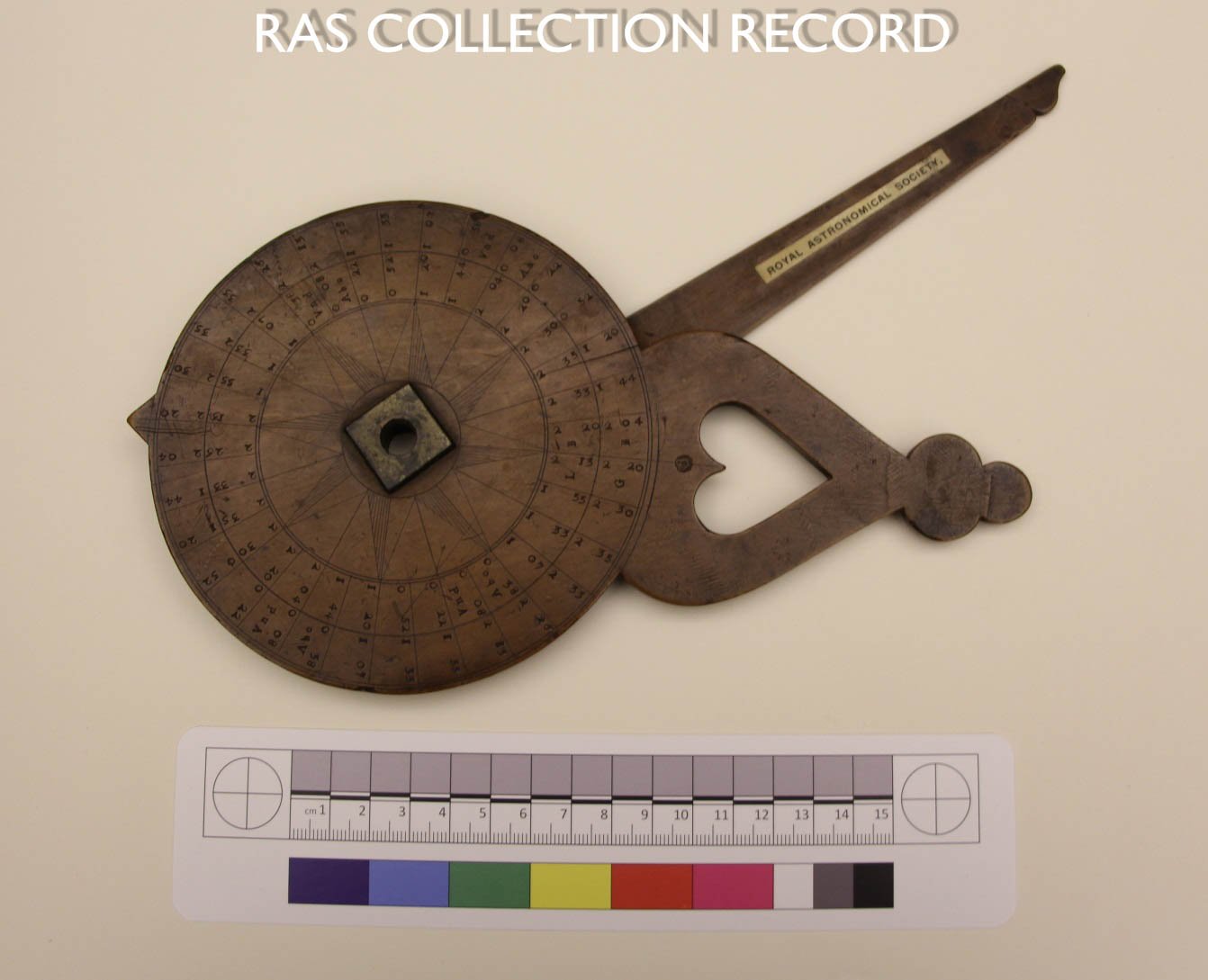
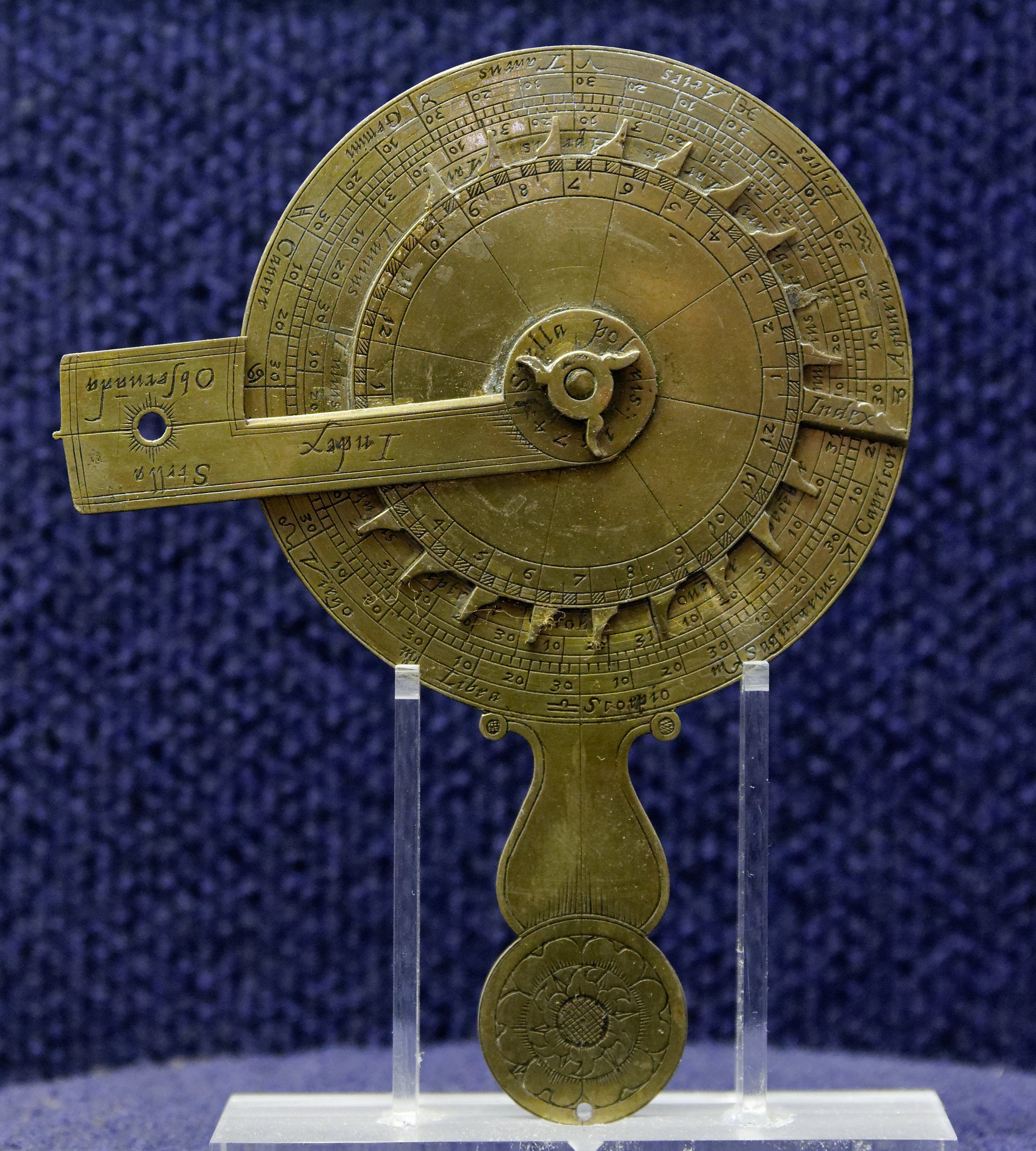
Mysterious because, while we know it lasted throughout the Middle Ages, we are far from knowing exactly when it was born (early 9th century?) and even further from knowing who invented it.
Mysterious also because many subtleties of its use are still not fully understood.
It consists of two or three circular plates. The largest has a handle so it can be held vertically. It may show engraved month names and sometimes zodiac signs. The smaller plate has 24 teeth corresponding to hours, with one larger tooth marking midnight.
You set midnight opposite the observation day of the month, then held the instrument at arm's length and sighted Polaris through the central hole. You then moved the alidade (the large “arm” visible in photos) until it seemed to touch a chosen reference star. The time could then be read on the central plate at the alidade's position.
What was the reference star? Naturally, one visible throughout the night and year, close enough to Polaris given the alidade's limited length. Some say a star of Ursa Minor. Others point to the two “Guards” of Ursa Major.
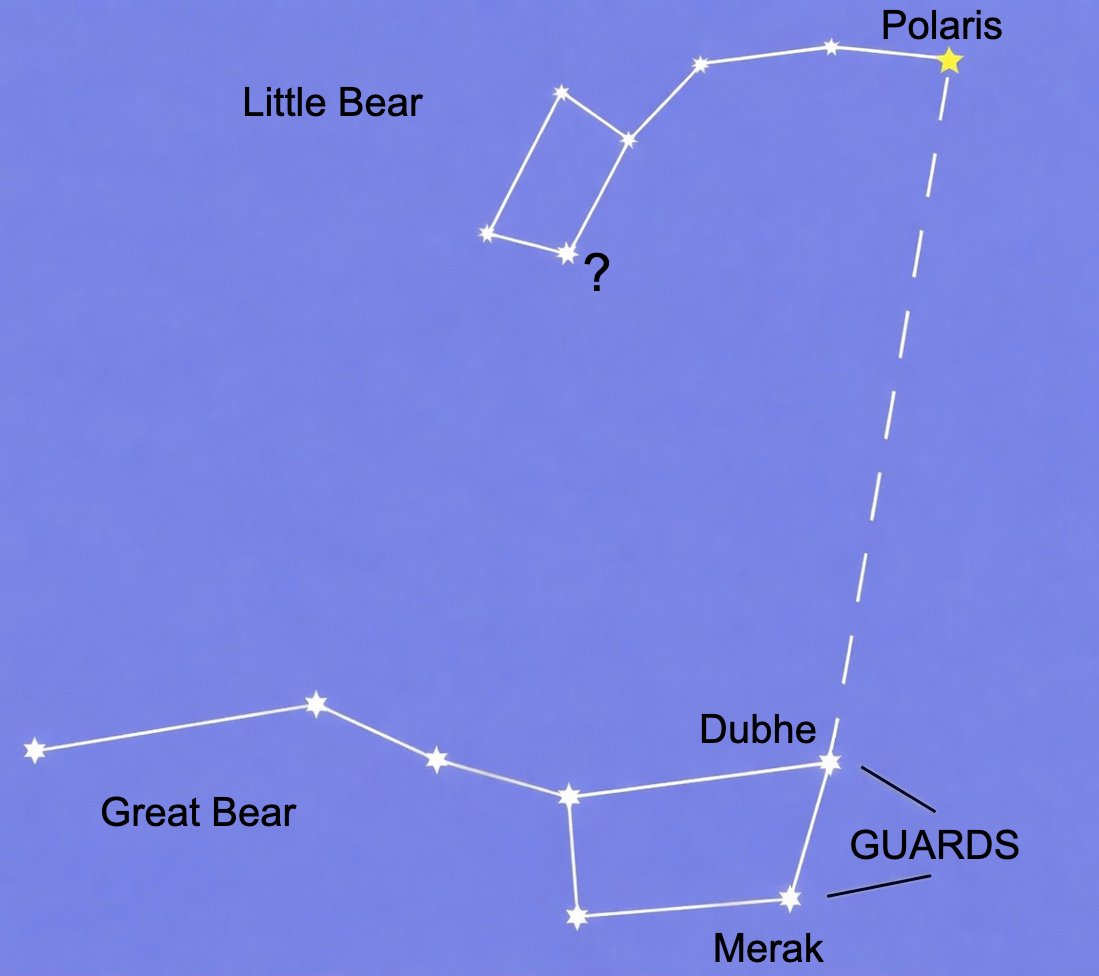
Which reference star was the alidade set on? A star of Ursa Minor (as hinted in the image above), or the Guards of Ursa Major?
The second hypothesis may be right if one trusts a drawing by Apianus (below, 1539) showing instrument use. Nothing prevents the reference from changing between nocturnals.
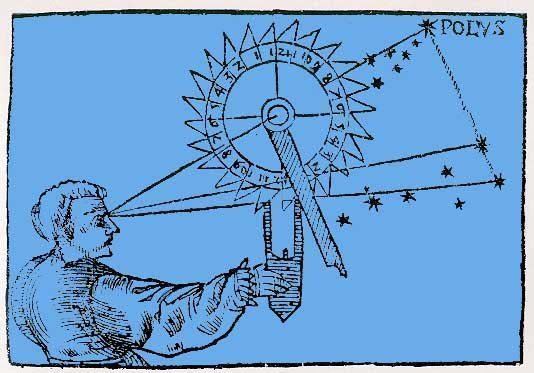
To close this section, note that the measured time was sidereal time (see astronomy), slightly shorter than mean solar time.
The astrolabe
The second sighting instrument we now examine is much better known than the nocturnal, thanks to its success in Greece and, above all, in Muslim countries.
Its capabilities are broad enough for both daytime and night-time timekeeping. It can therefore perform both sundial and nocturnal functions. Whether it was truly used for instant hour measurement is another story.
And since we are talking history, we will follow it from its origins to its expected decline when other instruments arrived.
But before that history, let's take a quick look at what the instrument looks like.
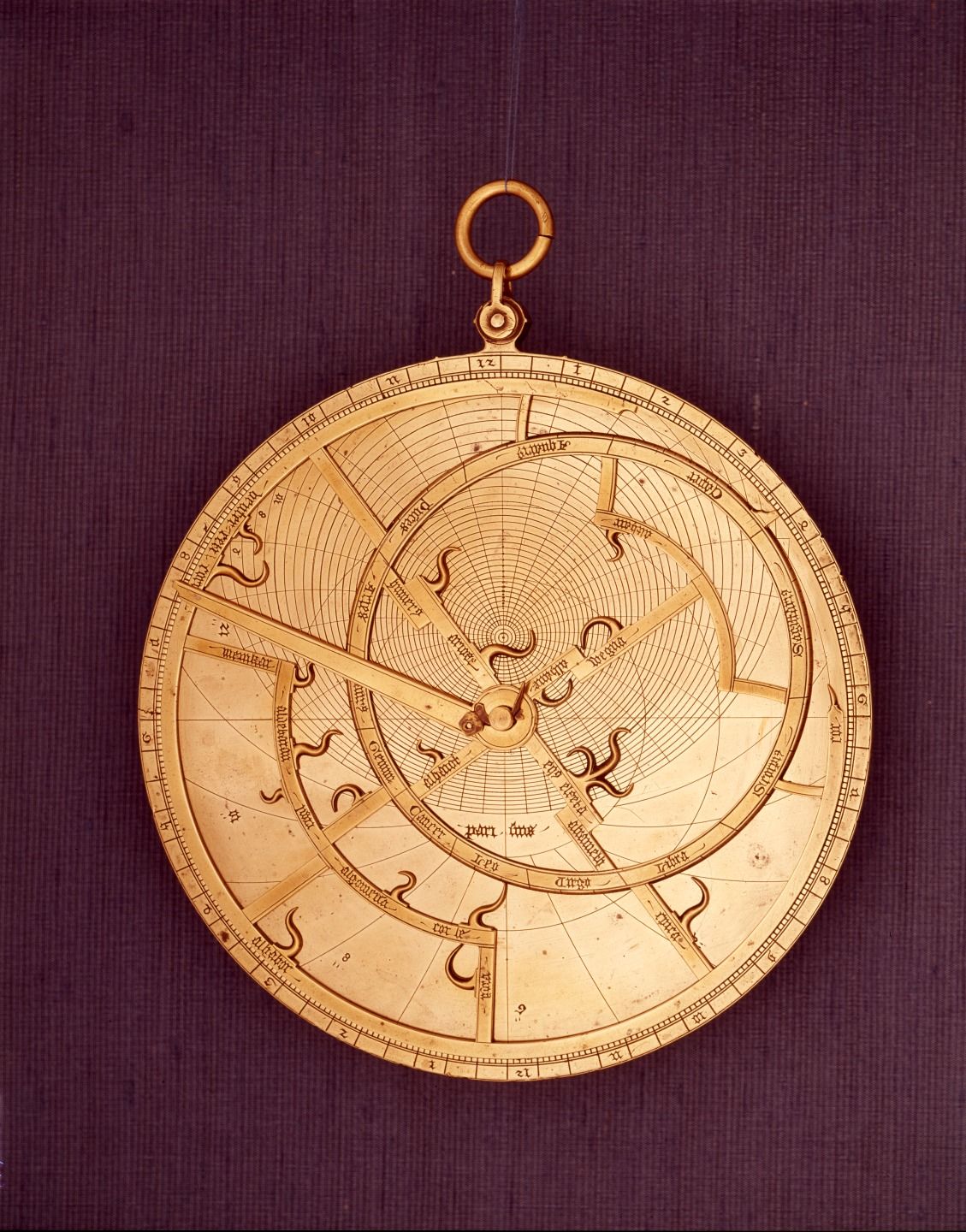
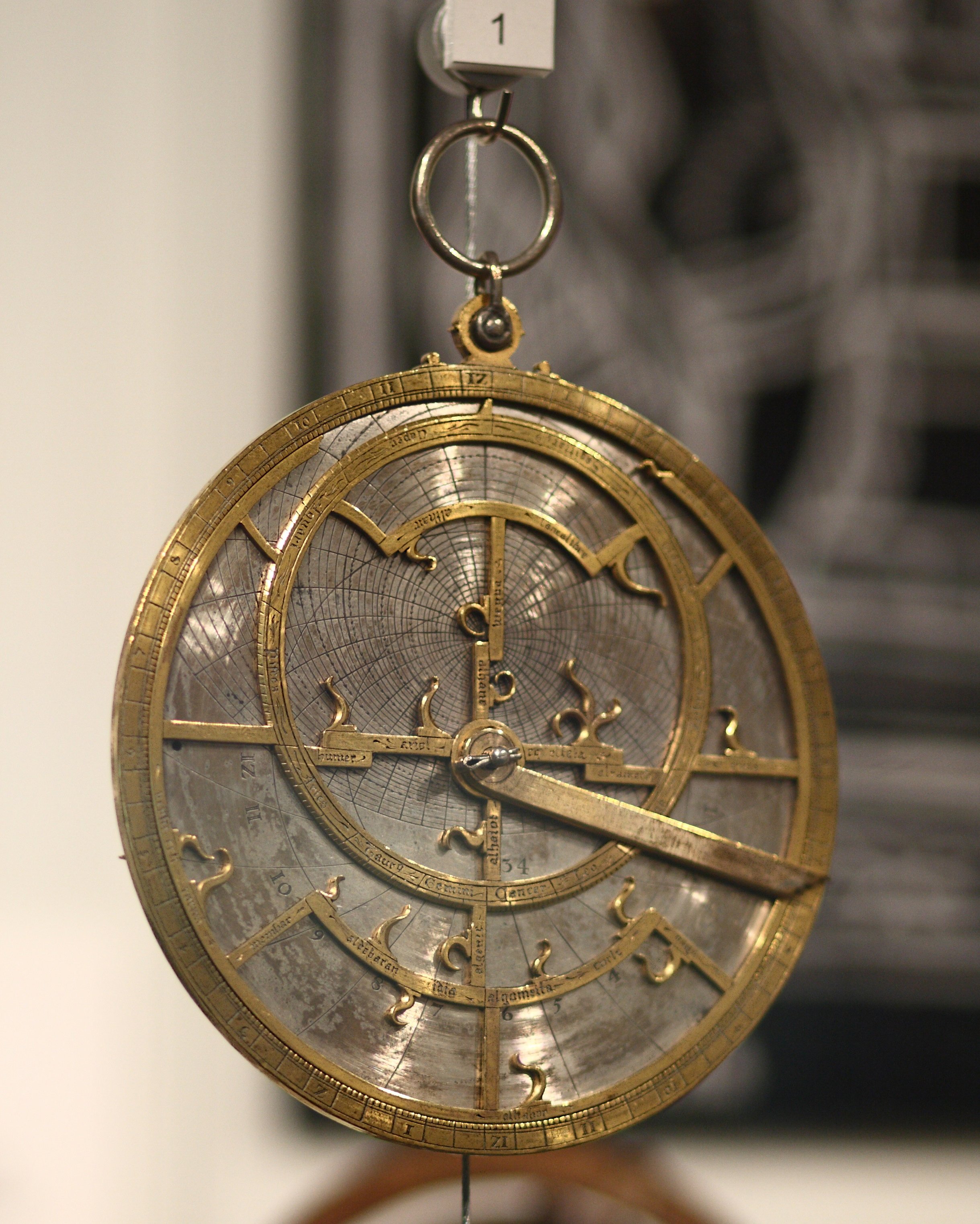
Made by Jean Fusoris (1365-1436), first a scientific-instrument maker, then Canon of Reims in 1404 and Paris in 1411, and author of several treatises on the instrument.
A short history of the astrolabe
As we will see when examining the instrument closely, its principle relies on stereographic projection.
So once again (as on the previous page), we mention Hipparchus (second half of the 2nd century BCE), since he is credited with that principle. But despite what is often repeated, he did not invent the astrolabe.
We must wait for Claudius Ptolemy (2nd century CE) to see the appearance of a horoscope instrument (astralobon organon), a distant relative of the astrolabe in principle, but unrelated to the planispheric astrolabe.
The word astrolabe comes from Greek astrolabos, “star-taker”. Who coined the word? Unknown. The oldest surviving treatise on the astrolabe is by John Philoponus (between 475/480 and after 565), a Christian grammarian and philosopher born in Alexandria (Egypt).
From Greece it passed to Muslim lands in the 8th century, where it became extremely popular, likely because it could determine unequal hours (and therefore prayer times) and, with modifications, indicate the direction of Mecca. Recall that an unequal hour is one twelfth of daytime duration, that is, for simplicity, one twelfth of the sunlit part of the day, which varies through the year.
It reached Western Europe via Spain thanks to Gerbert, who shortly before 999 wrote a Book of the Astrolabe based on translations of Arabic treatises (where the instrument is called walzagora or Ptolemy's planisphere) coming from Spain. Incidentally, this Gerbert became Pope in 999 as Sylvester II.
In both East and West, the astrolabe reached peak refinement and use in the 16th and 17th centuries. A universal astrolabe (we will later see that the “classic” astrolabe is not universal) appeared in the 16th century, built by Gemma Frisius (1508-1555), but described much earlier by al-Zarqalluh of Toledo in the 11th century. After a phase of astrolabic clocks, it declined in the West in the 18th century as mechanical clocks became accurate enough. In Muslim countries, however, it remained in use almost up to the 20th century, at the Mosque of Fez among others.
Description of the astrolabe
Once again, apologies to anyone expecting a construction manual here. That is not our purpose. We only want to verify that this is indeed a time-measuring instrument. The short description below is there solely to understand its operation in our context.
Since we will use it twice, let's quickly review stereographic projection.
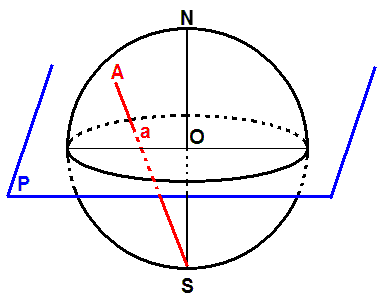
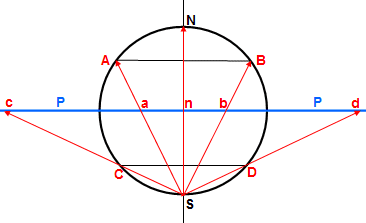
In the top image, imagine a sphere cut by its equator with a plane P. Under stereographic projection, point A on the sphere maps to point a, at the intersection of line SA with plane P.
In the lower image, a cross-section through poles N and S, perpendicular to the equator, shows that every point on the circle (say, the meridian) can be stereographically projected except point S. Of course, I use words like poles, meridian and equator by chance and with no hidden agenda... or maybe not.
Stereographic projection is easy, right? Everything is easy when someone else invented it and we avoid angle measurement details.
Its double advantage is preserving angles (two curves with a given angle on S have the same angle on P) and mapping circles on S to circles on P.
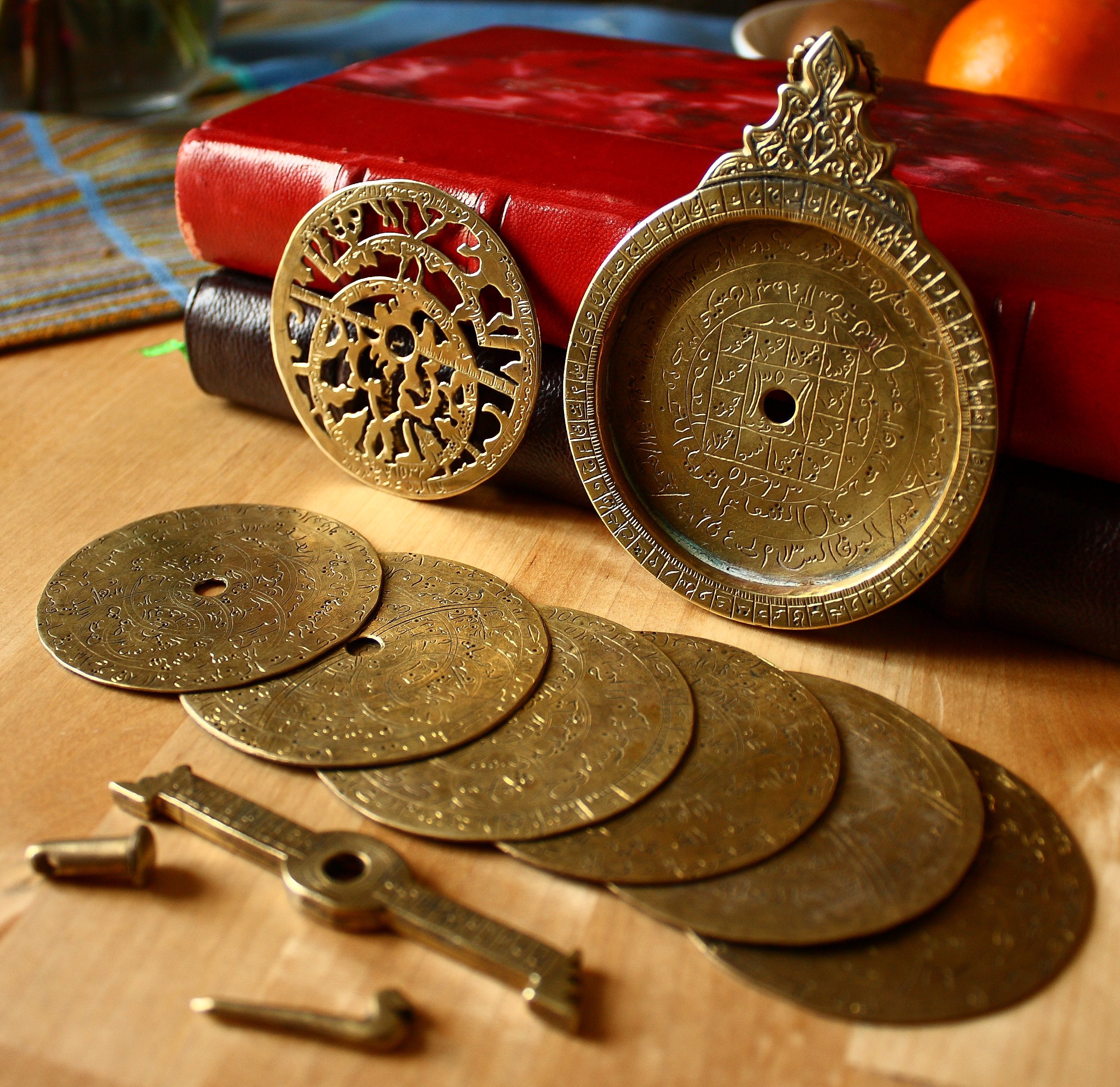
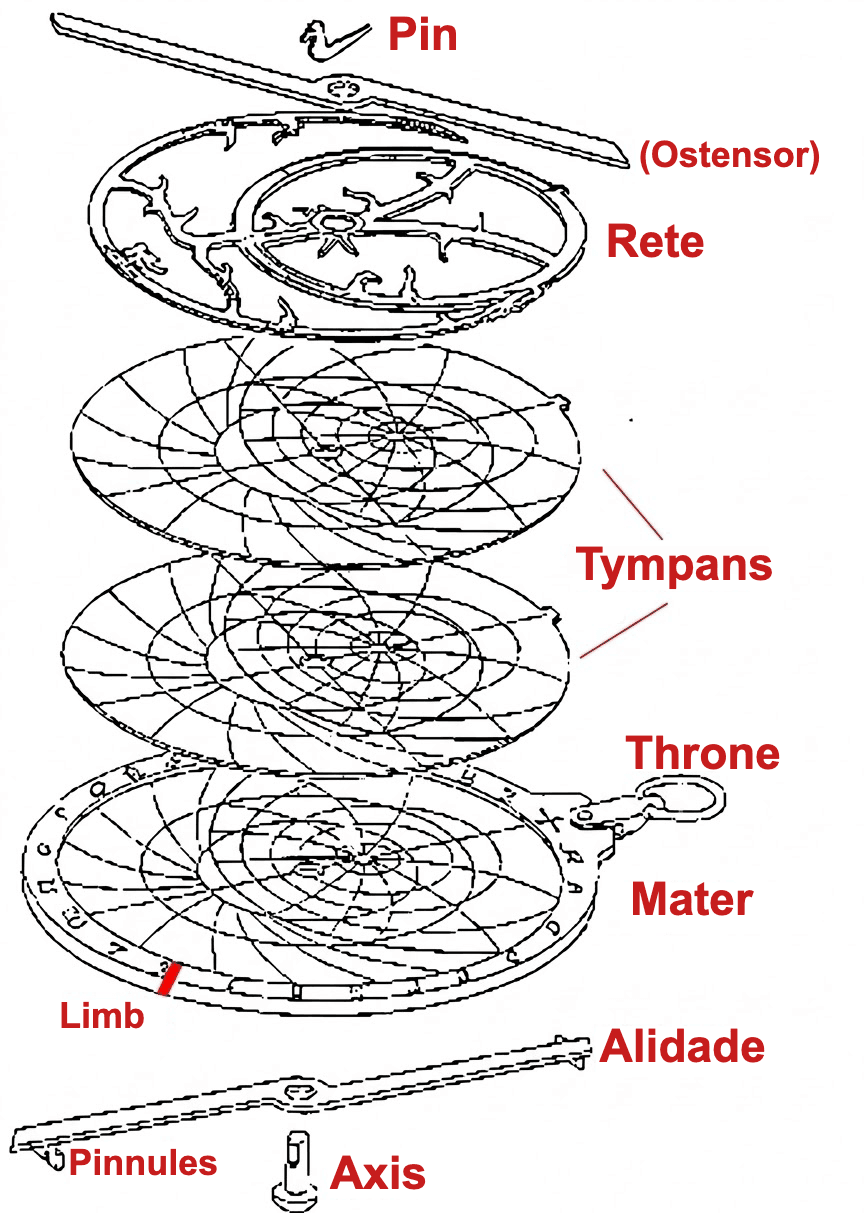
- An axle and pin (before screw technology), keeping the instrument assembled.
- The alidade, a sighting arm often fitted with two pinnules.
- The mother (umm in Arabic astrolabes), the hollow main body whose outer edge is the limb, and whose cavity can hold several tympans. The instrument hangs from a ring (God's throne, or kursi in Arabic).
- Various removable tympans.
- The rete (ankabut in Arabic).
- An index rule (ostensor), not present on all astrolabes.
Now that we have named the parts, let's see what each contains before looking at time measurement itself.
The mother
First things first. The mother is the base of the instrument. It is a metal or wooden plate, usually over ten centimeters wide, slightly hollowed to receive different tympans that the observer swaps depending on location. We will come back to that. Naturally, only one tympan (the right one) is used at a time. Depending on the astrolabe tradition (Western or Arabic), the mother's rim (limb) is engraved in degrees and/or hours. There are 24 hours: top to bottom on the right side for afternoon hours, and top to bottom on the left side for morning hours.
As the instrument is used vertically for altitude measurements of stars or Sun, it includes a suspension ring (throne).
Back side: this served as a memo surface and could include conversion aids (shadow square for surveying, legal hours, unequal hours...). We focus here on timekeeping, but one Arab author listed 1,761 problems solvable with the instrument. In any case, the back side's outer part included at least two mandatory scales: a degree scale to determine an object's altitude with the alidade, and a zodiac calendar giving the Sun's daily zodiac position through the year.
The alidade
Pointed at a celestial object, the alidade lets you sight a star through its two pinnules. For the Sun, orientation is adjusted so sunlight passes through both pinnules (only one valid position).
The tympan
It is essentially a sky grid used to place an object according to its exact sky position and, in our case, determine exact time.
What does this grid include?
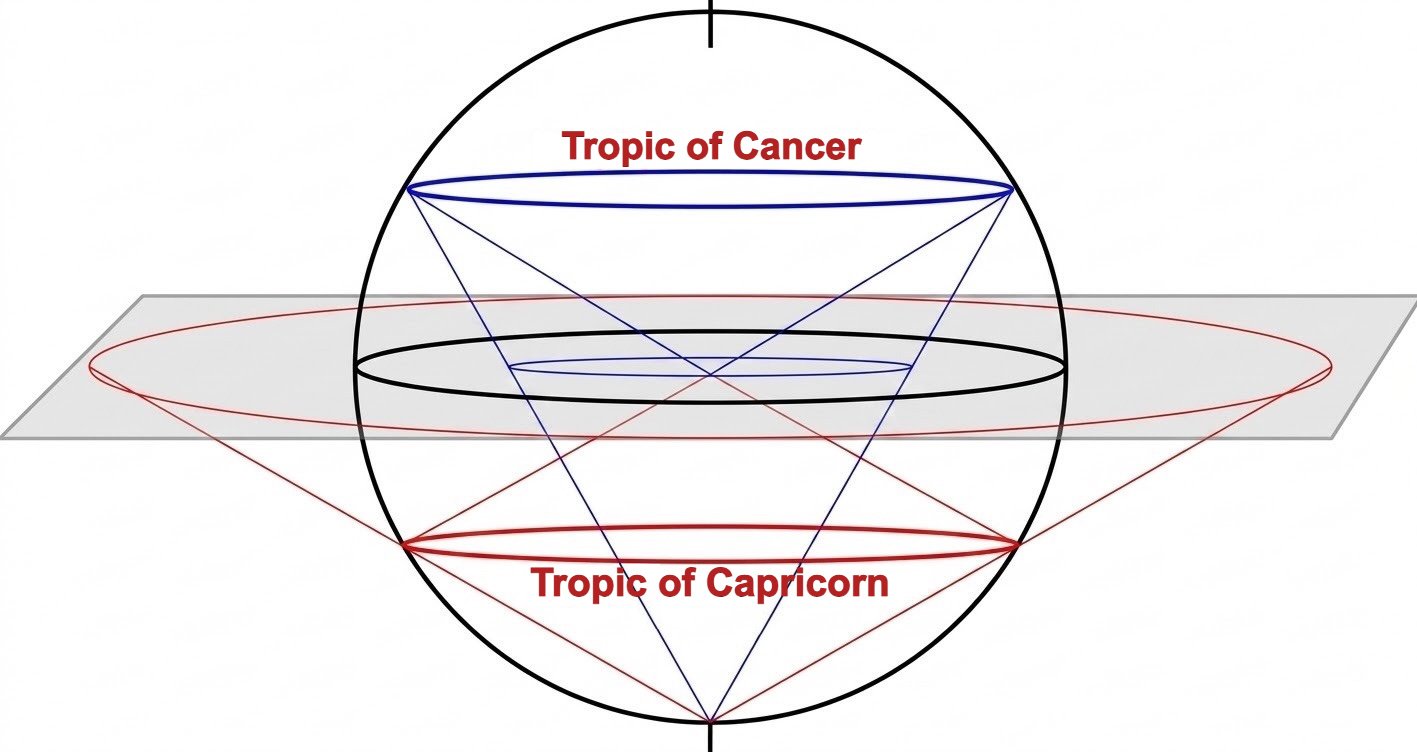
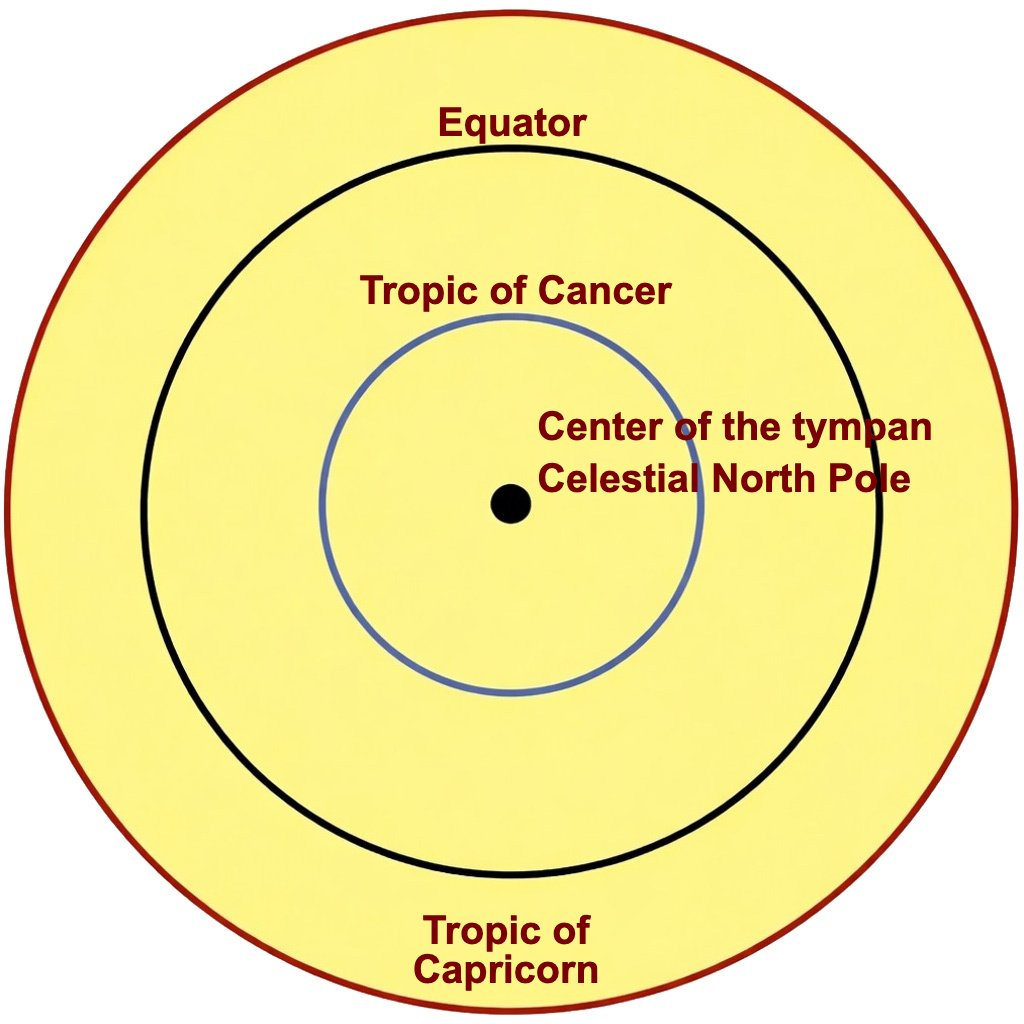
A) First, a stereographic projection of Earth with its standard latitude circles: Tropic of Cancer, equator, Tropic of Capricorn.
A-1) Earth sphere: latitude lines
A-2) Earth sphere: unequal-hour lines
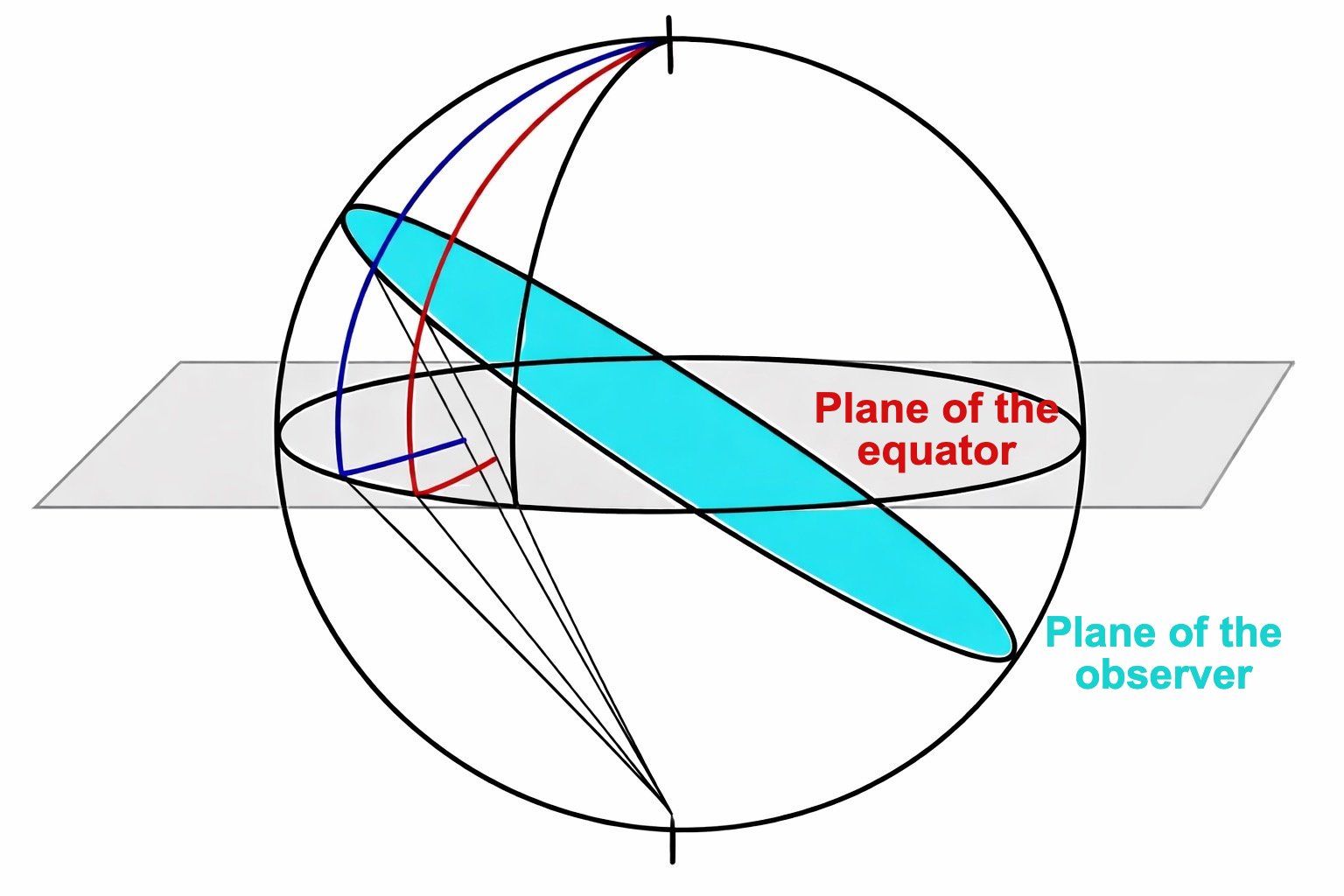
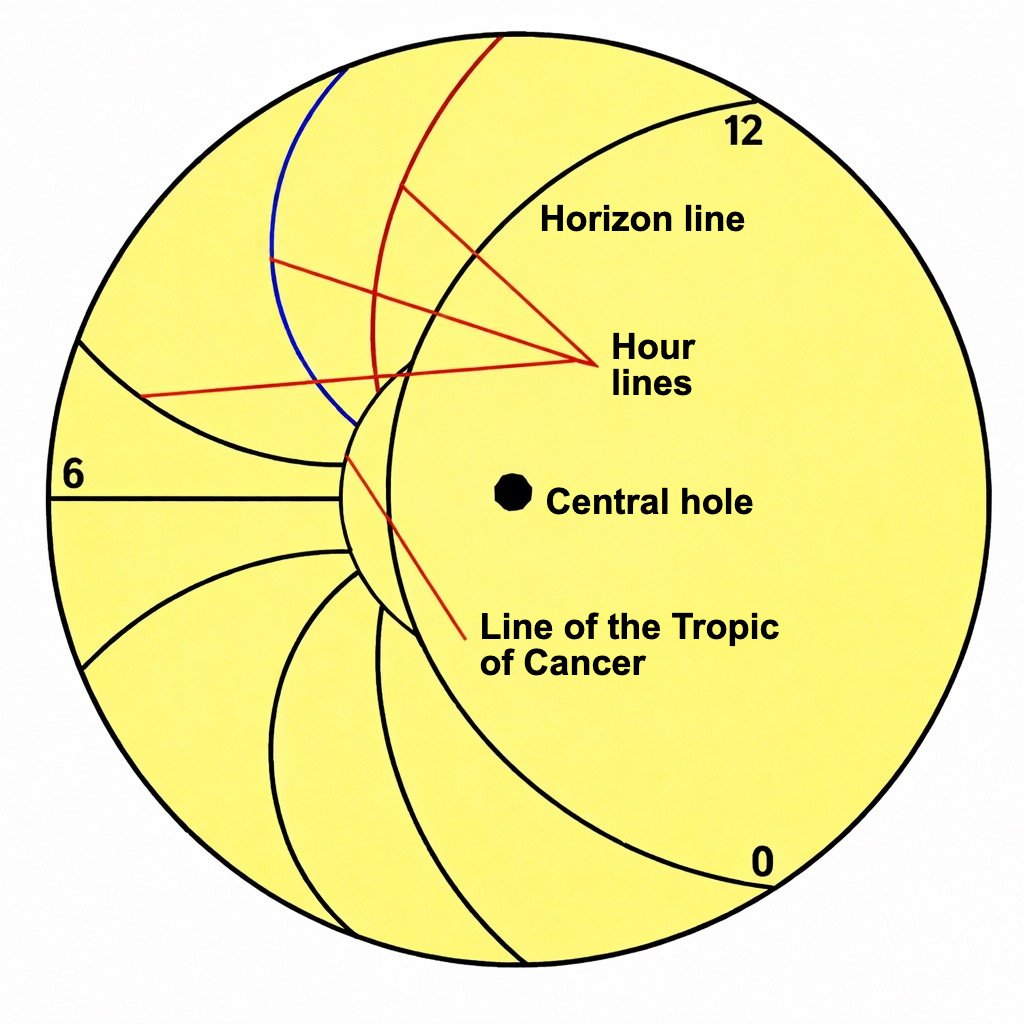
Not all lines are drawn. There are 11, dividing this tympan zone into 12 sectors. They mark unequal hours because they divide daylight into 12 hours whose lengths vary through the year.
B) Second, a stereographic projection of the local sphere (see part 2 of this study) as seen by an observer at a given latitude. Since this projection varies with latitude, we now understand why you must change tympans when moving along a meridian. Tympans are engraved with the latitude they are designed for.
B-1) Local sphere: altitude lines (almucantars)
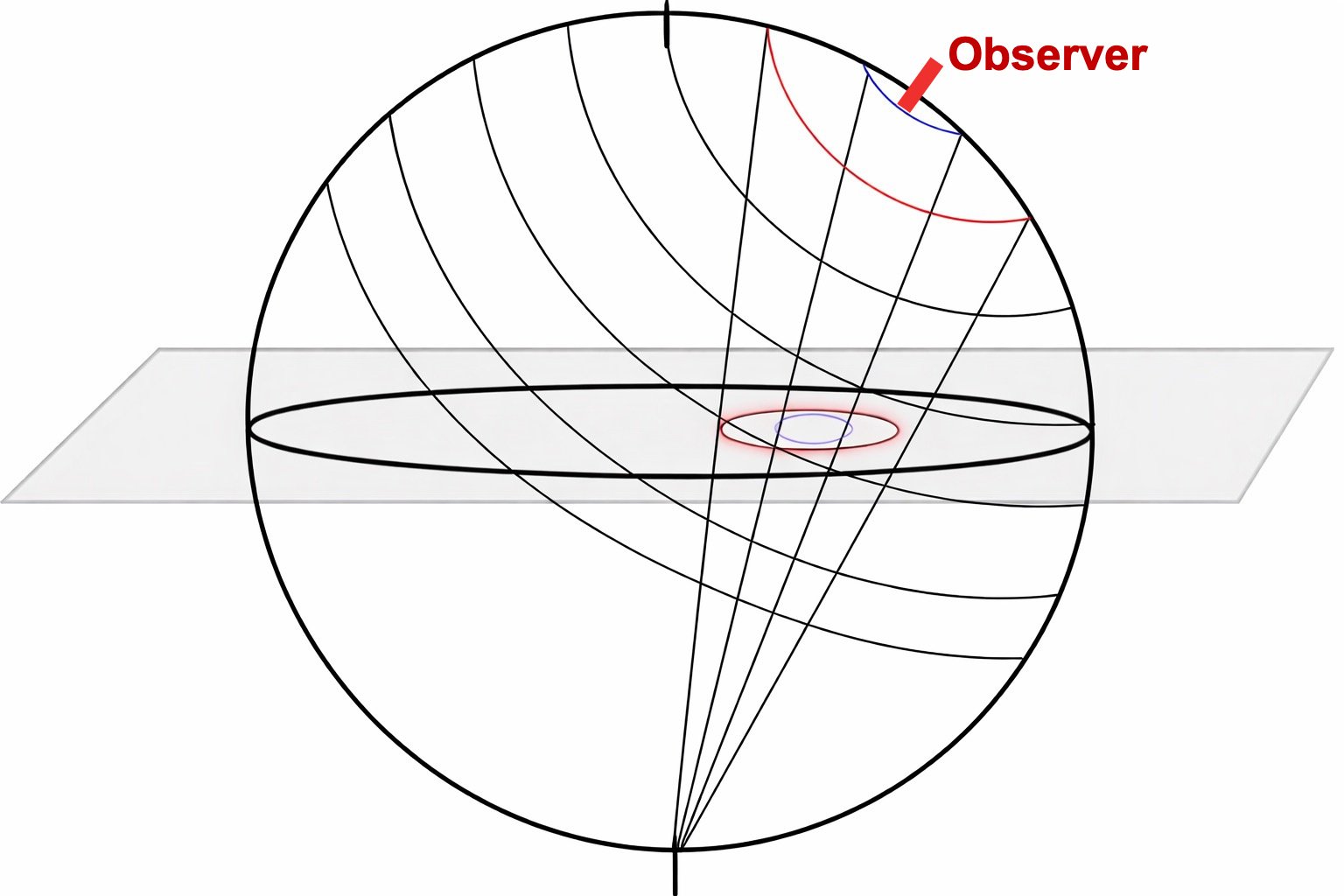
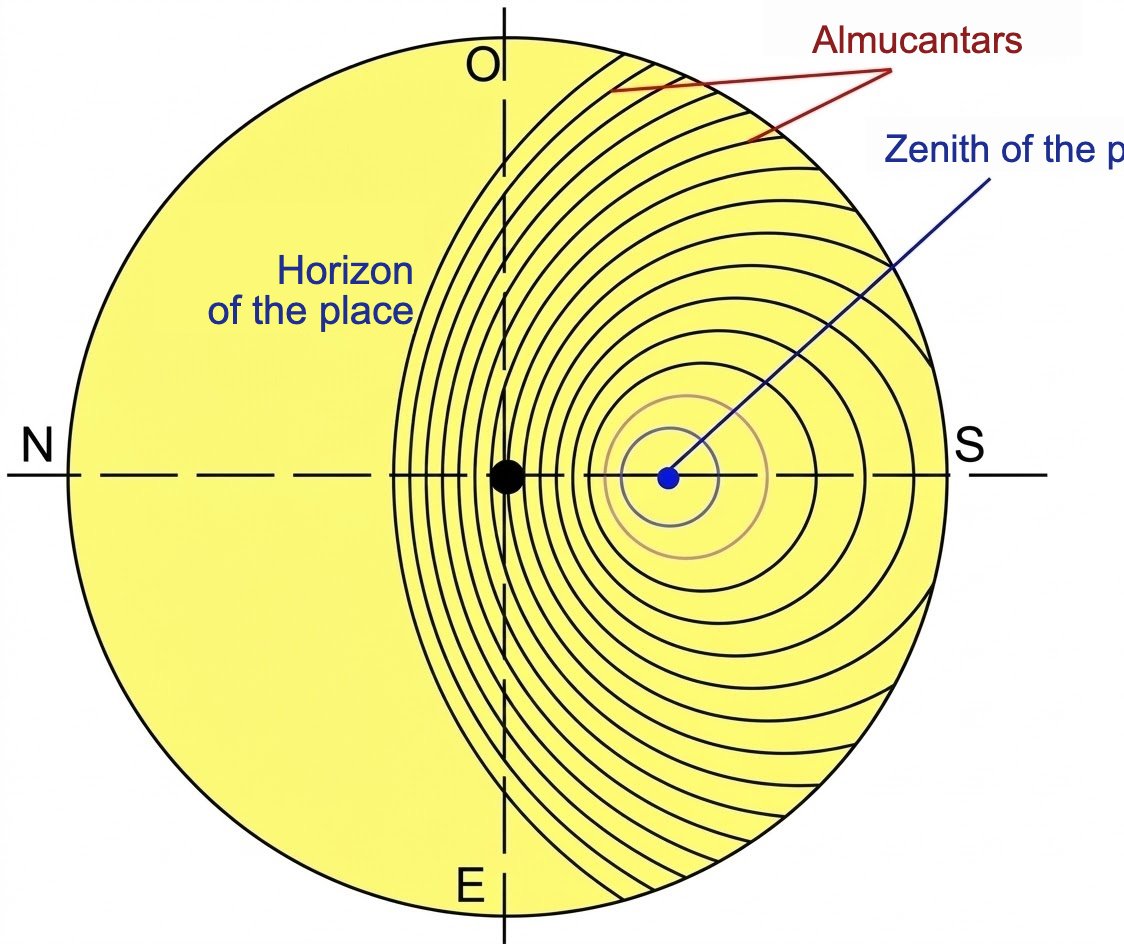
These almucantars are engraved in degrees, with one line every 2, 3 or 5 degrees. Since they sit in the upper part of a vertically held astrolabe, cardinal points appear inverted: south at top, north at bottom, east on the left and west on the right. All almucantars are circles, as required by stereographic projection, though some are truncated due to tympan size limits.
B-2) Local sphere: equal-azimuth lines
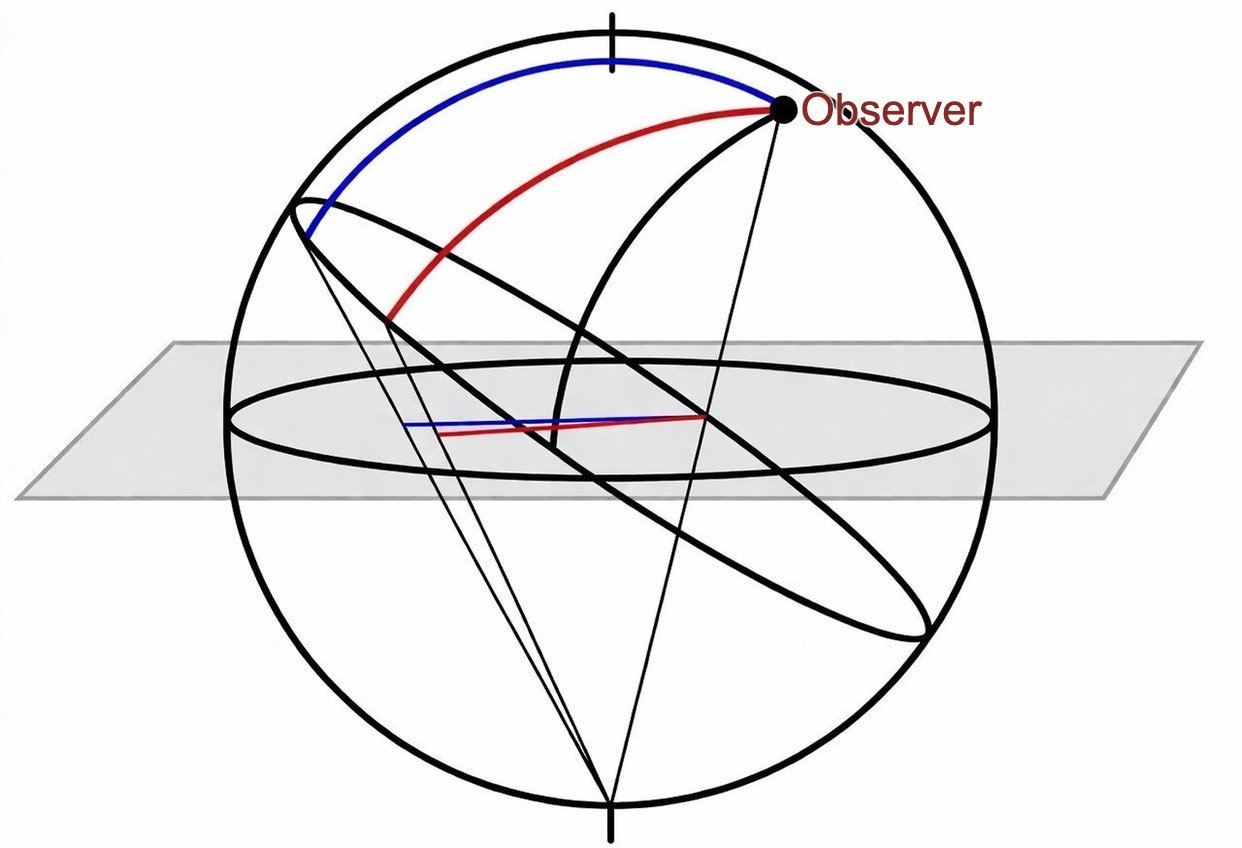
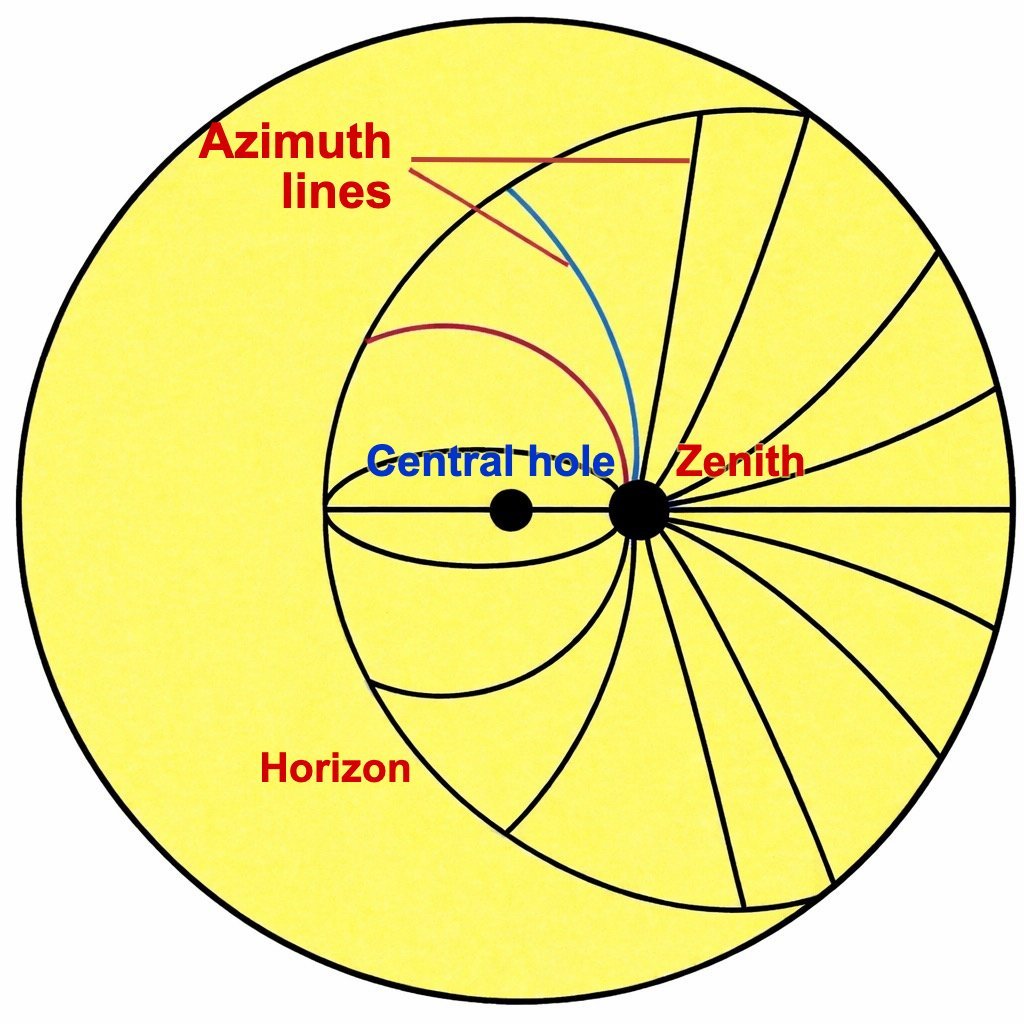
Let's recap all these traces on one drawing of mother + tympan.
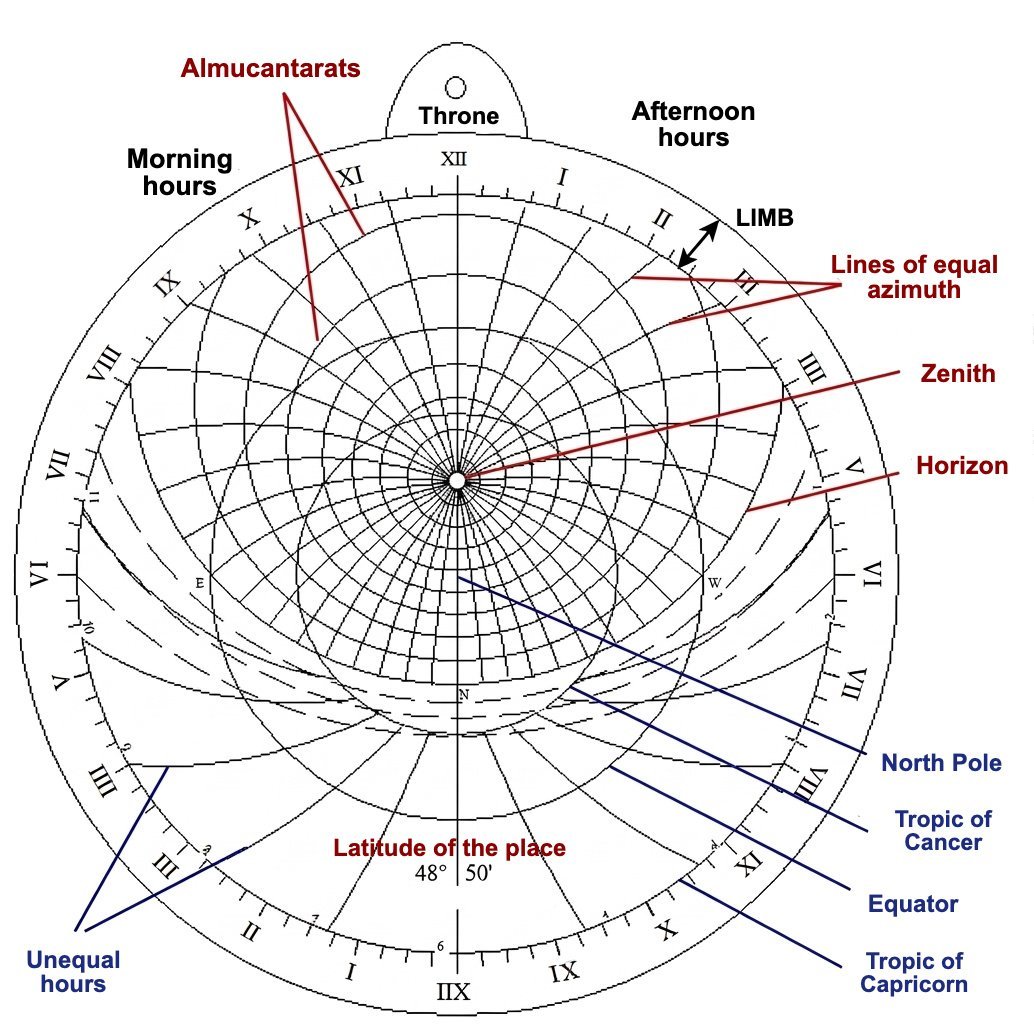
As seen at the bottom, this tympan was calculated for latitude 48°50'. I will let you guess which city that is. Local data appears in red, the rest in blue. Here the limb is graduated in hours.
The rete
Let's look at it closely.
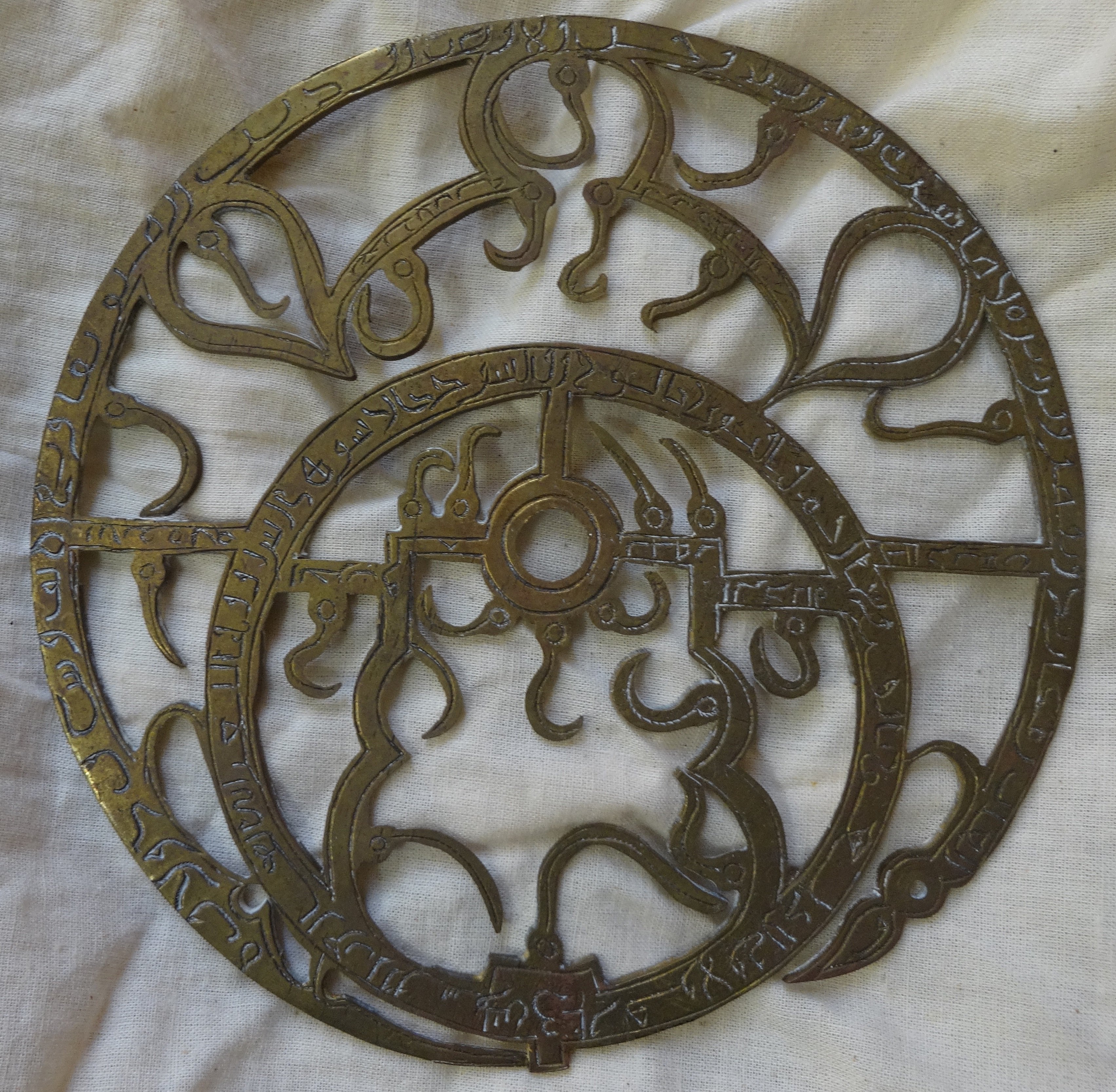
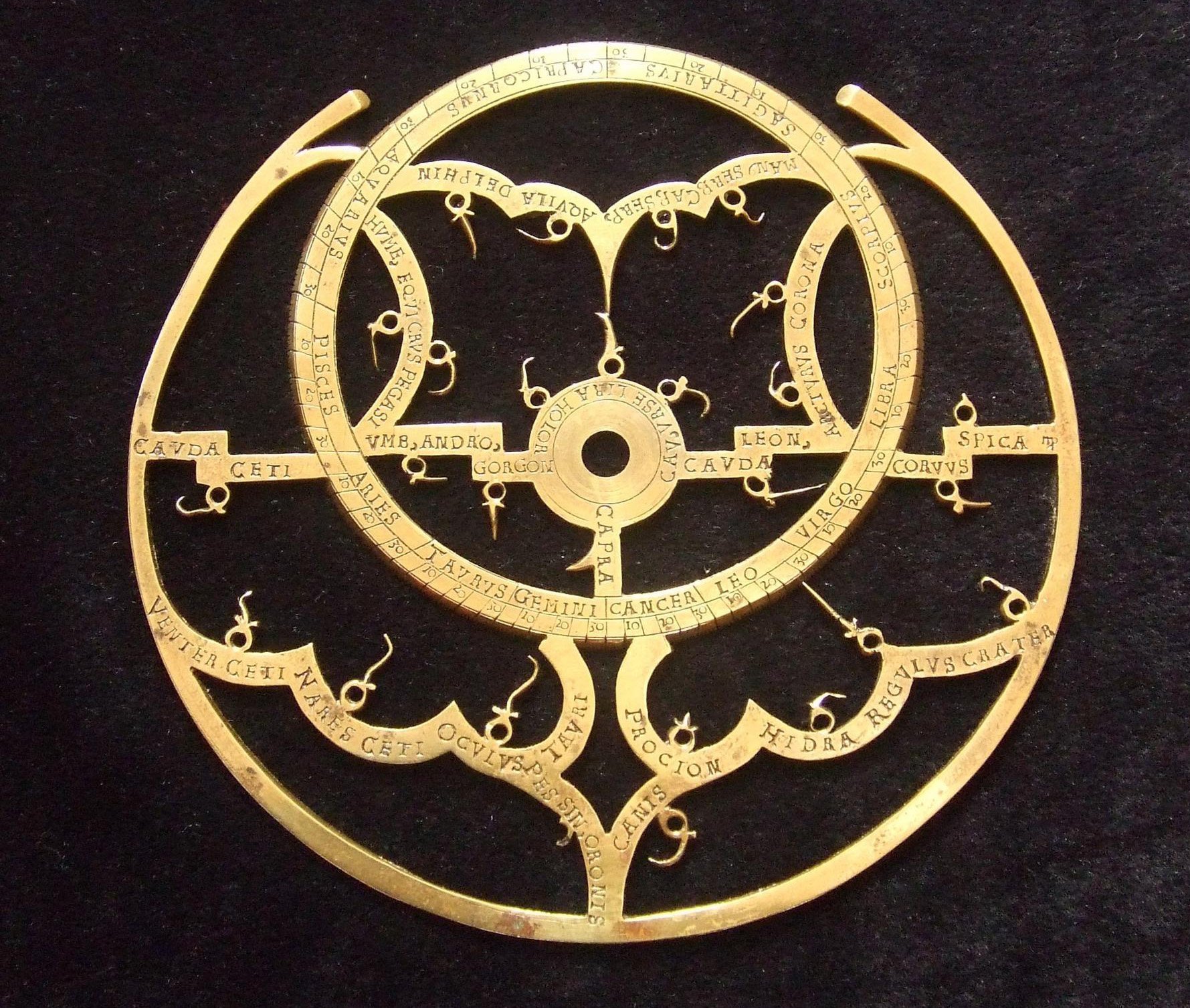
Two rete types. The rete moves relative to the mother and tympan by rotating around the central axis.
The rete itself represents two stereographic projections. Yes, again.
- First, a stereographic projection of the celestial vault with known star positions. Since transparent materials were not available when astrolabes were made, another solution was needed: an openwork metal frame where each point marks an object's position. As those positions vary through the year, the rete rotates around the central axis to place stars correctly on coordinates provided by the tympan.
- Second, a stereographic projection of the ecliptic (the Sun's path). This is the off-center circle relative to the central axis, engraved with zodiac solar positions.
At the top of the rete, a small protruding pointer (visible in photos) indicates on the limb the vernal point (the ecliptic location of the Sun at the spring equinox).
Astrolabe and time measurement
We saw the astrolabe can be used in many contexts. For us, let's quickly see how it can measure time, namely hours.
In part II, we saw that azimuth and altitude both vary continuously, depending on latitude, solar declination (date), and hour. So we have three parameters: altitude, day, hour. If two are known, we can find the third. That is the astrolabe's hour-computation principle.
Example: we want the time on a specific day at a specific moment.
Using the alidade, we first measure the Sun's altitude at that moment. We know the day either through a date-zodiac conversion table or directly. We locate that day on the rete's ecliptic circle and rotate the rete until that point lies on the almucantar matching the measured altitude. We then align the ostensor with that day and read the time directly on the limb. Easy, right?
Without an ostensor (Arabic astrolabes), one extra intermediate reading step was required from the rete index.
For night hours, the principle was the same, using a known star on the rete instead of the Sun.
So, is the astrolabe a time-measuring instrument? Certainly. And more than that: surveying tool, compass, prayer-time indicator, qibla indicator, and much else. But that is another story.