The purpose of any calendar is to measure time. Every measurement system needs a unit.
It is by observing celestial motions that we can define that (or those) unit(s).
Three cycles can be used as reference points: the Earth's rotation on its axis, the Moon's revolution around the Earth, and the Earth's revolution around the Sun.
Note: rotation takes place around a celestial body's own axis. Revolution takes place around another celestial body.
Let's take a closer look.
What we all know
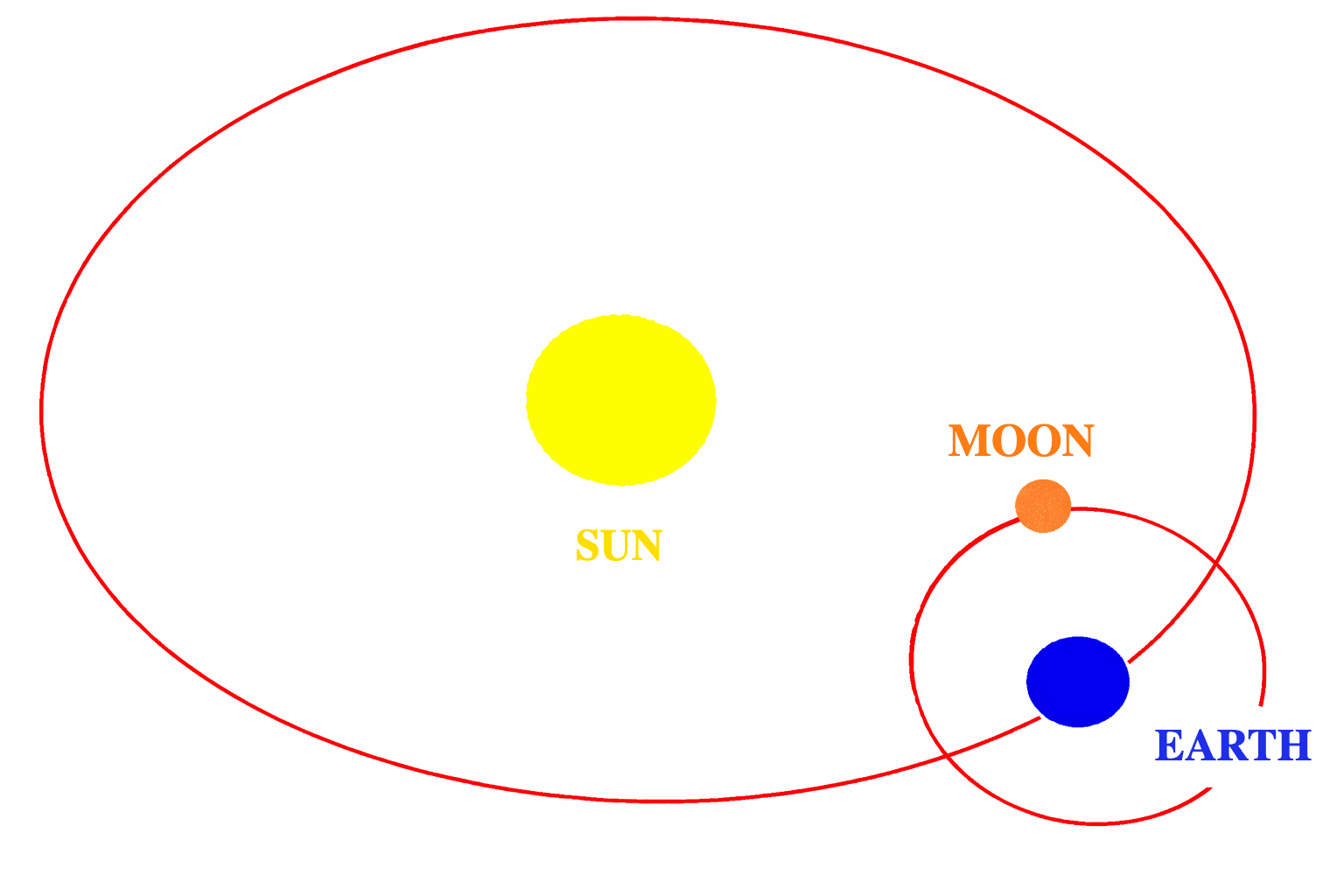
The Earth and the Moon rotate on their axes. The Moon revolves around the Earth. The Earth revolves around the Sun. Everything would be simple if all equators were in the same plane, if orbits were circular, if...
As we will see, that is not the case. We therefore need to define a few terms and set out a few durations.
Earth's rotation
The Earth rotates on its axis, anticlockwise, in... one day. Here, by day, we mean the full day-night cycle, i.e. roughly 24 hours. Astronomers use several terms for this 24-hour period: sidereal day, stellar day, true solar day, mean solar day. Their lengths are not the same.
Astronomers mainly use the sidereal day, whose duration is 23 h 56 min 4.09 s.
The solar day is the time elapsed between two passages of the Sun across the meridian. Because the Earth's orbit is elliptical, the length of the solar day varies slightly over the year (from 23 h 59 min to 24 h 0 min 30 s).
For our purposes, we will use the mean solar day. It is determined by measuring the time interval between two passages of the center of the mean (fictitious) Sun across the meridian at a given location (solar noon). In short, it is the average solar day over a one-year period.
When should a day begin? Across periods and cultures, several methods have existed: sunrise, sunset, noon (the moment when the shadow of a stick is shortest on a given plane), midnight (the current civil convention). We will come back to this in the study of individual calendars.
Since calendars are used to measure spans longer than a day, we will stop there on this point.
Earth's revolution
The celestial equator is the imaginary circle perpendicular to the Earth's axis, lying in the plane of the Earth's equator.
The ecliptic is the plane of the Earth's orbit around the Sun. Seen from Earth, it appears as though the Sun were tracing a path across the sky; for the Earth-bound observer, the ecliptic appears as the Sun's “path” across the year. The name of this orbital plane is linked to the term “eclipse”: a solar or lunar eclipse can occur only when the Moon is at a point in its orbit close to the ecliptic. The ecliptic plane is tilted by an average of 23° 26' relative to the Earth's equatorial plane.
The ecliptic plane intersects the celestial equator plane along a line called the line of equinoxes.
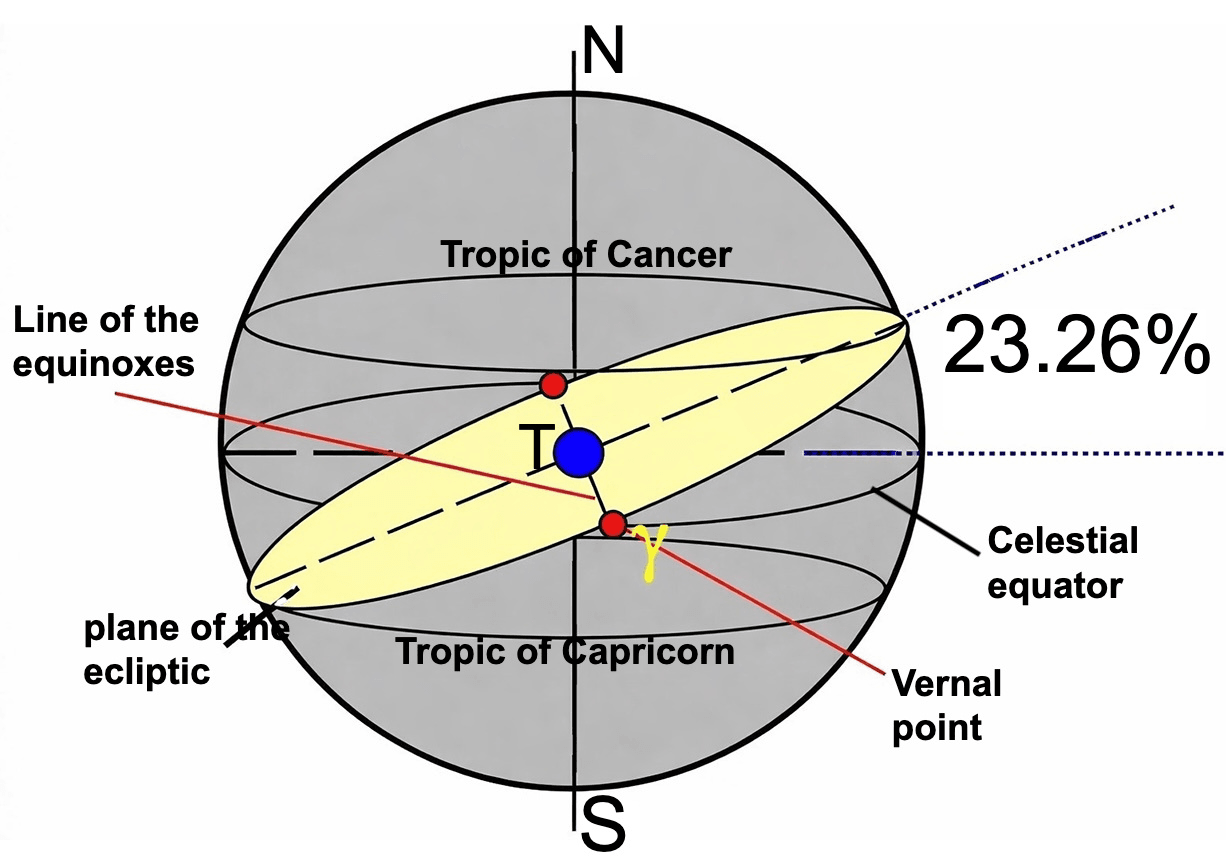
The equatorial plane and the ecliptic plane form an angle of 23° 26'. The vernal point marks where the ecliptic crosses the celestial equator. It is denoted by the Greek letter gamma. In the past, the vernal point coincided with the start of the constellation Aries (also symbolized by gamma), around the 2nd century BC. Today it is no longer at 0° Aries, but in Pisces, and later it will be in Aquarius (see below for precession of the equinoxes).
To set the scene clearly, note at once that the Earth does not trace a circle around the Sun, but an ellipse of which the Sun occupies one focus. This ellipse is very close to a circle: perihelion (closest point to the Sun) is 147,092,900 km, while aphelion (farthest point from the Sun) is 152,102,900 km. The Earth travels this ellipse anticlockwise at an average speed of about 29,000 m/s. It is indeed an average speed because, according to Kepler's laws, a planet moves faster at perihelion than at aphelion (which partly explains the variable length of solar days).
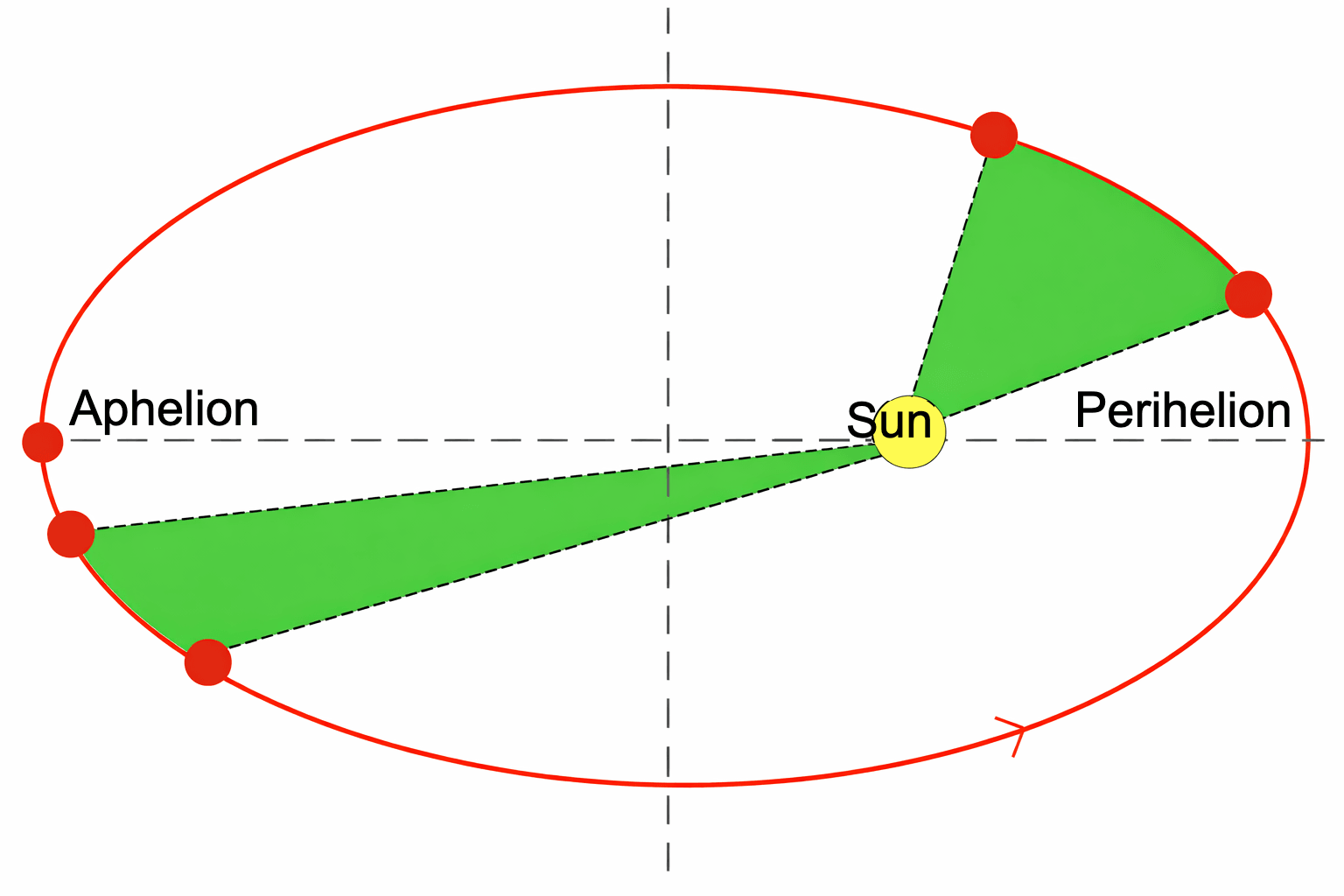
Illustration of Kepler's area law (proportions exaggerated).

If we combine the Earth's revolution around the Sun with the tilt of its axis relative to the ecliptic plane, we can explain the seasons. Four reference points are notable during one full revolution of the Earth along its orbit: two equinoxes and two solstices.
Naturally, everything we say here concerns the Northern Hemisphere; for seasons, the logic is reversed in the Southern Hemisphere.
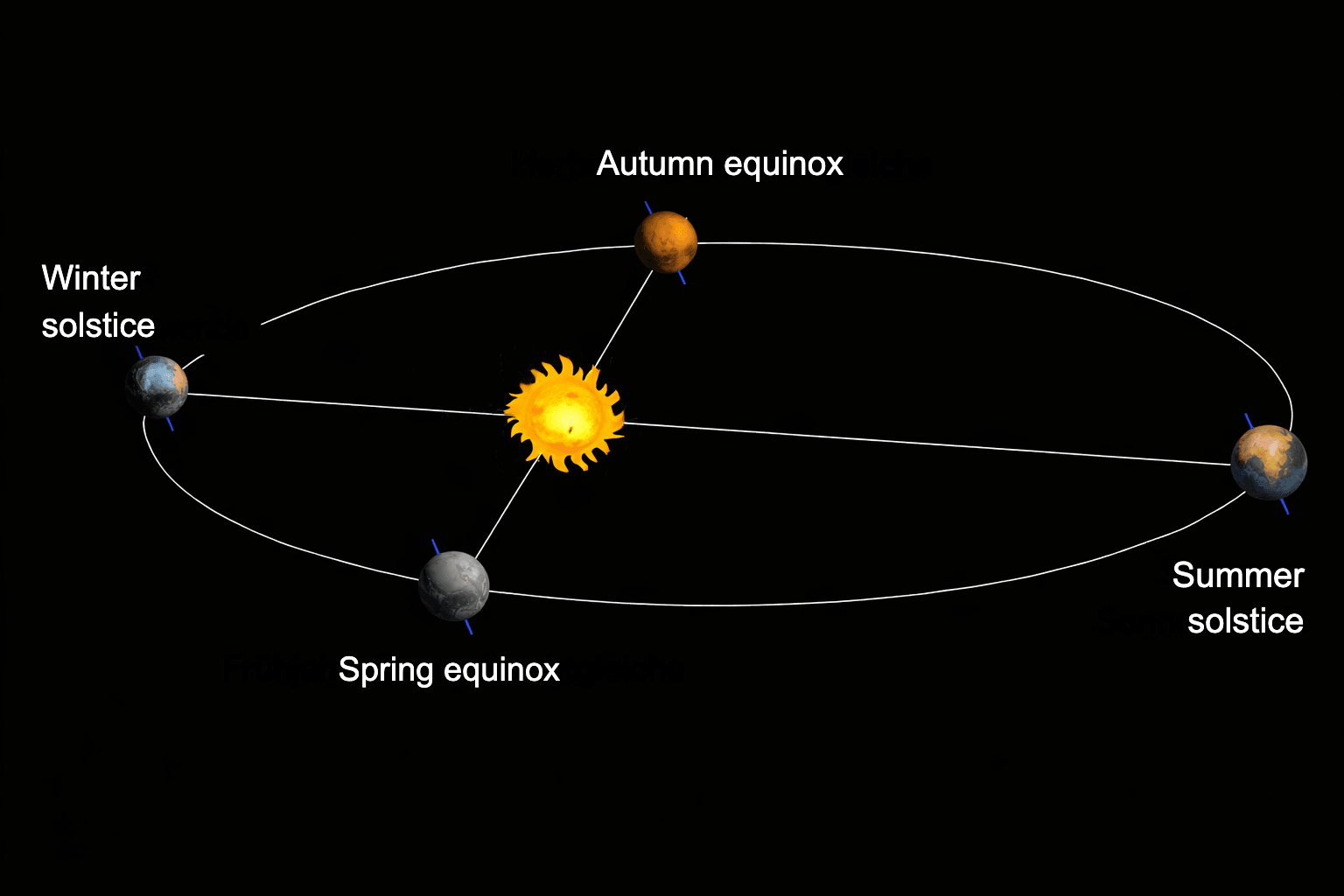
What happens when the Earth passes through these points?
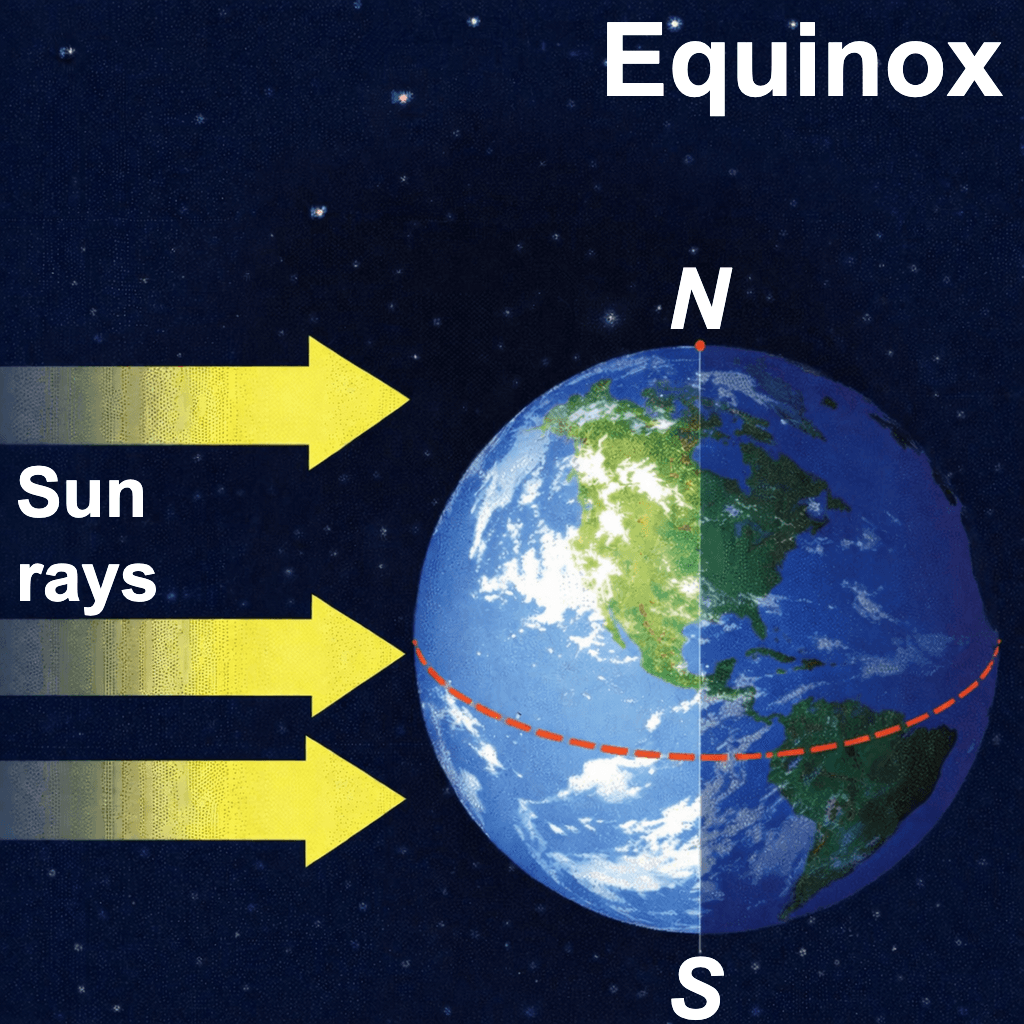
At the equinoxes, the Sun is exactly above the equator. Its rays (and therefore the line of equinoxes) are perpendicular to the Earth's axis and are distributed evenly across both hemispheres, so day and night are of equal length. The spring equinox occurs around 21 March and the autumn equinox around 22 September.
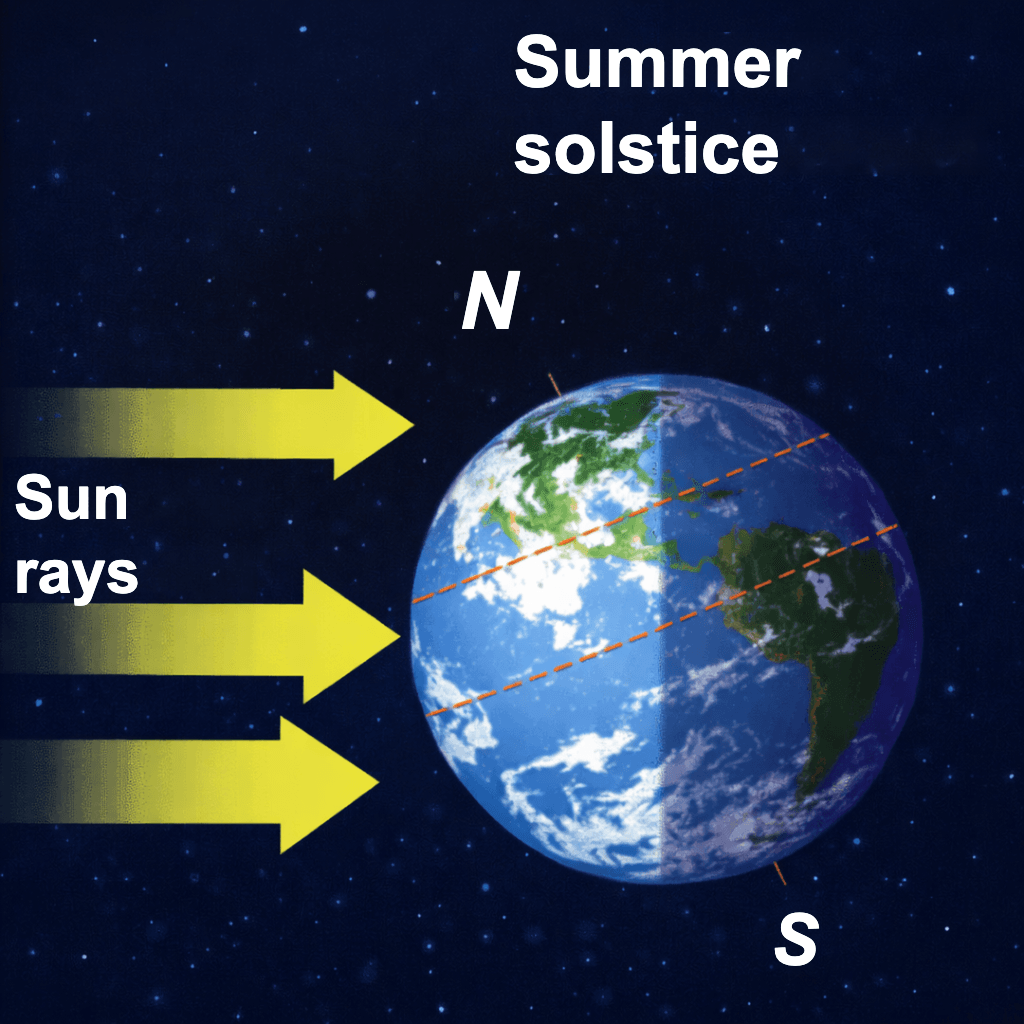
At noon, the Sun is at zenith for locations on the Tropic of Cancer. This is when days are longest in the Northern Hemisphere, and regions near the North Pole remain continuously lit. The summer solstice occurs around 21 June.
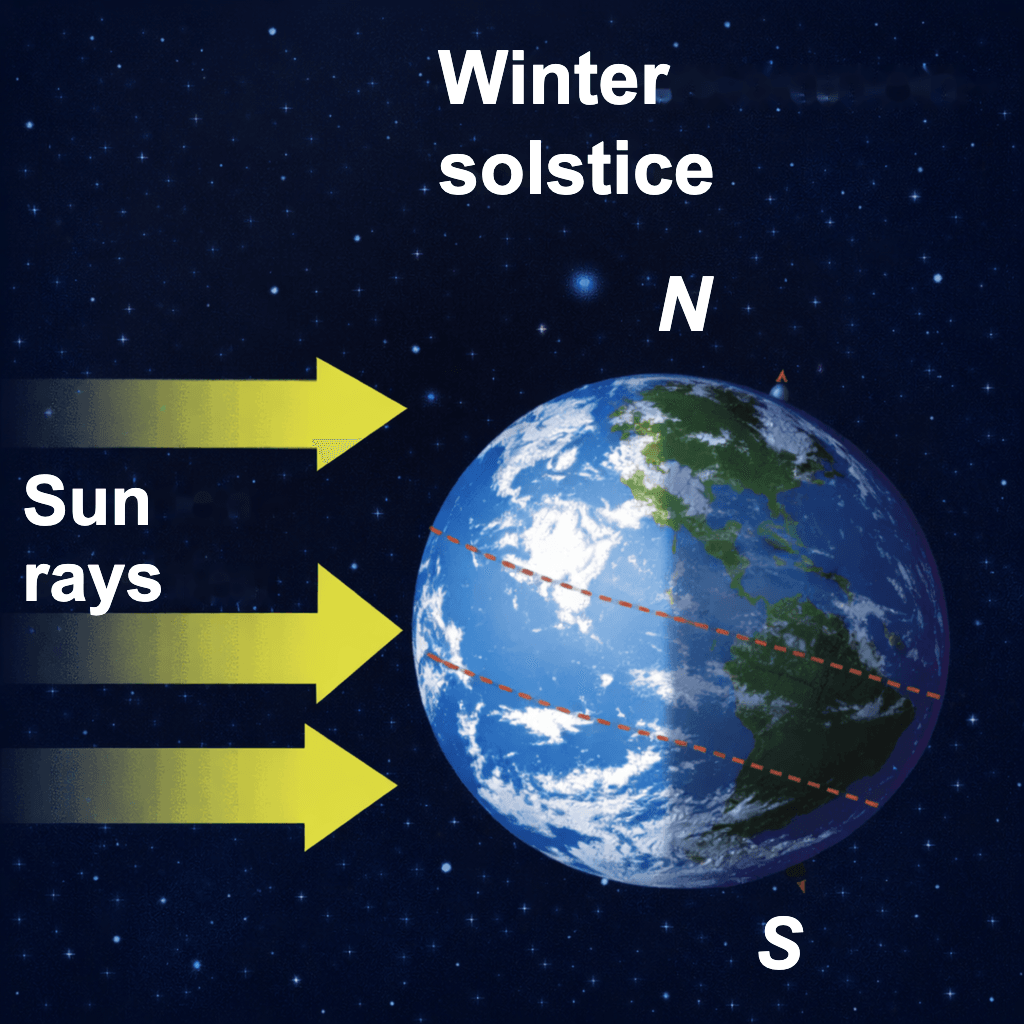
At noon, the Sun is at zenith for locations on the Tropic of Capricorn. This is when days are shortest in the Northern Hemisphere, and regions near the North Pole are no longer lit. The winter solstice occurs around 22 December.
In its apparent motion around the Earth, the Sun passes through the Zodiac constellations.
The Zodiac is "an imaginary belt on the celestial sphere, extending roughly 8° of latitude on either side of the ecliptic, within which lie the paths of the Sun, the Moon, and the five planets (Mercury, Venus, Mars, Jupiter, and Saturn) of the solar system, excluding Pluto. Since Antiquity, the zodiac has been divided into 12 sections, each spanning 30° of longitude, called zodiac signs. Starting from the vernal equinox and then moving eastward along the ecliptic, each section bears the name of the constellation with which it coincided around 2,000 years ago. The names of the zodiac signs are: Aries, the Ram; Taurus, the Bull; Gemini, the Twins; Cancer, the Crab; Leo, the Lion; Virgo, the Virgin; Libra, the Scales; Scorpio, the Scorpion; Sagittarius, the Archer; Capricornus, the Goat; Aquarius, the Water Bearer; and Pisces, the Fish." (source: Microsoft Encarta)
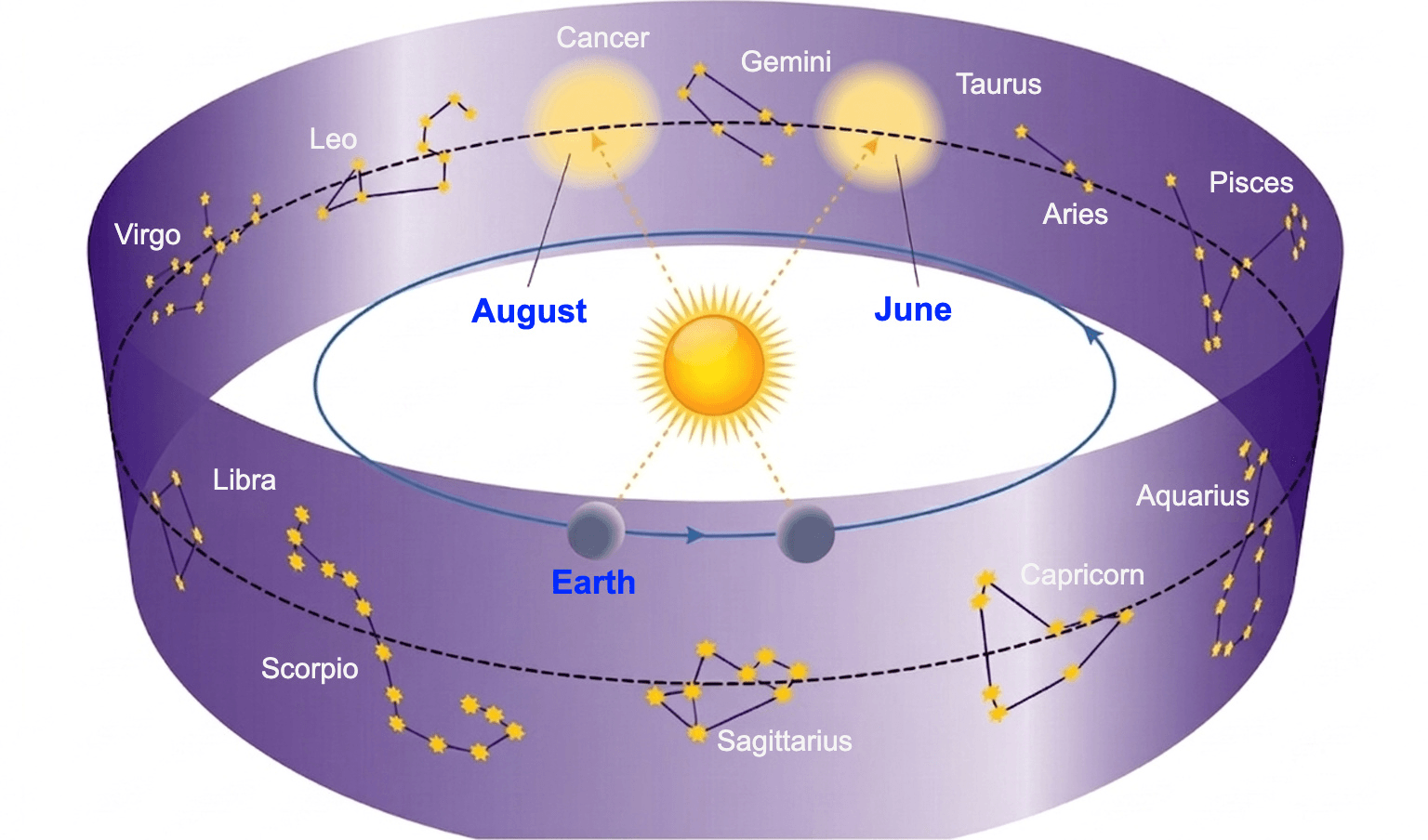
Solar motion through Zodiac constellations Length of one revolution (year): As with Earth's rotation, the length of its revolution is defined in several different ways.
The mean tropical year (the one relevant for calendars), which for simplicity is measured from one passage of the Sun at the vernal point to the next. Its value is 365.2421904 days, i.e. about 365 d 5 h 48 min 45 s.
The true sidereal year is the time interval between two consecutive passages of the Sun through the same point of its orbit on the ecliptic (that point being defined in relation to three axes from the Sun toward three distant stars assumed fixed). Its value is 365.256365574 days, i.e. about 365 d 6 h 9 min 10 s.
The anomalistic year is the duration between two consecutive passages of the Earth at perihelion. Its value is 365.259636 days, i.e. about 365 d 6 h 13 min 53 s.
The draconic year is the time interval between two consecutive passages of the Sun through the ascending node of the lunar orbit. Its value is 346.620007 days, i.e. about 346 d 12 h 52 min 54 s.
We cannot finish this brief overview of the Earth's revolution around the Sun without mentioning two phenomena that make everything change continuously: precession and nutation.
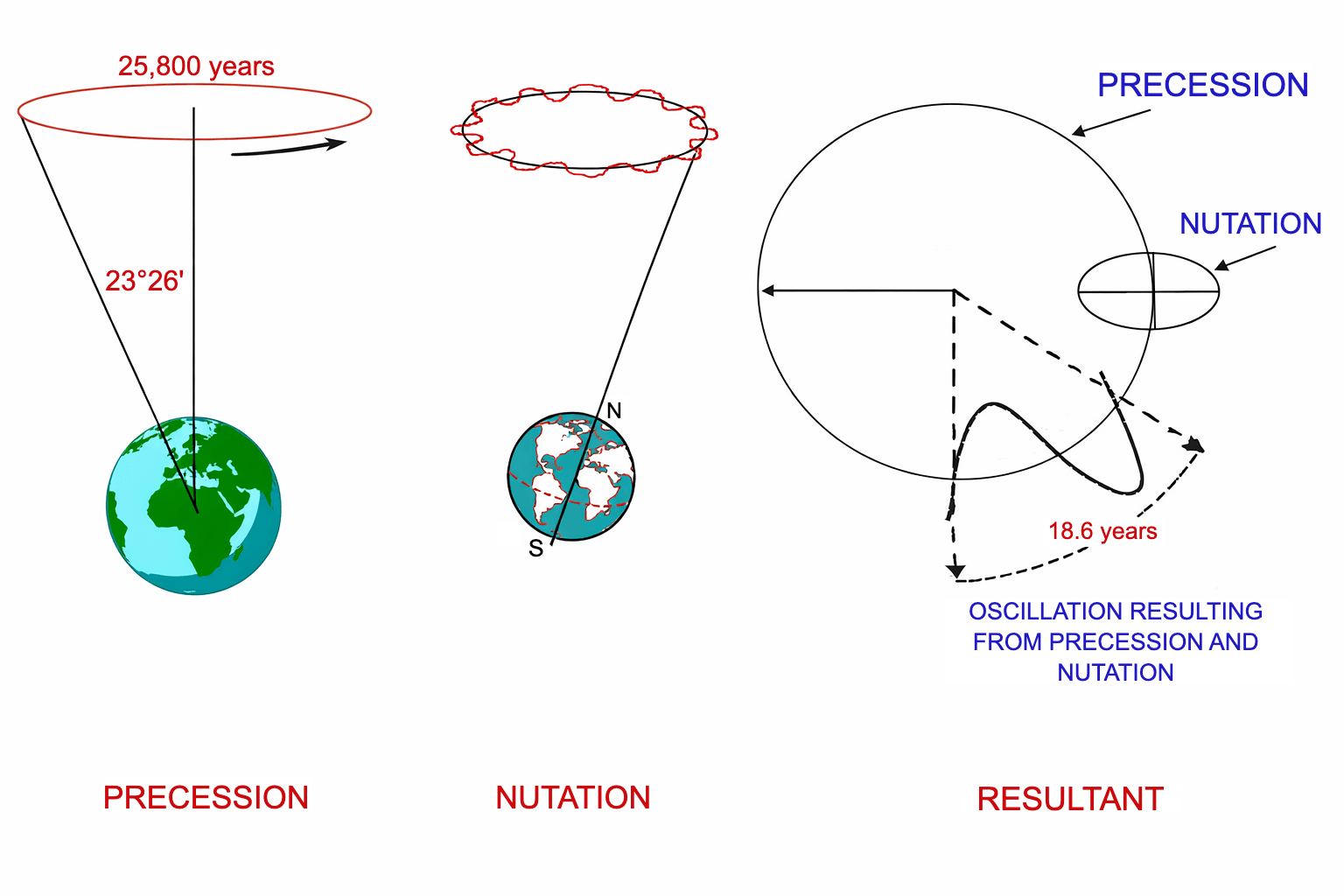
Precession of the equinoxes: credit where it is due to Hipparchus (Greek astronomer and mathematician, c. 190 BC - 120 BC). The Earth is not perfectly spherical; it has an equatorial bulge. As a result, under combined lunar and solar gravitational attraction, the Earth's axis traces an approximate cone with the Earth at its apex. This is often compared to a spinning top.
This conical motion shifts both the Earth's equator and the celestial equator. The gamma point therefore changes position along the ecliptic, which it traverses in 25,765 years in the retrograde (indirect) direction, i.e. clockwise, corresponding to a speed of 50.27 arcseconds per year.
Consequences of precession:
- Shift of the north pole: it is currently very close to Polaris (in Ursa Minor). About 4,000 years ago, in the time of Mesopotamian astronomers, the north pole lay in Draco (star Alpha Draconis), and in about 5,500 years the new “pole star” will be Alpha Cephei.
- As the vernal point moves by 50.26 arcseconds per year in the retrograde direction, the Sun does not always rise at the same point on the horizon on the spring equinox. Today it rises in Pisces; about 3,000 years ago it rose in Aries; and around 2100 it will rise in Aquarius.
Nutation: this also results from the equatorial bulge. Forces exerted by the Moon mean that the Earth's rotational axis does not keep a fixed direction in space; therefore the vernal point is not fixed on the ecliptic, and the angle between the equator and the ecliptic, called obliquity, varies over time.
Combined with precession, nutation produces a wave-like motion with a period of about 18.6 years.
Moon's revolution
The Moon orbits the Earth on an ellipse with perigee at 356,375 km and apogee at 406,720 km. The plane of its orbit is tilted by 5.1453° relative to the ecliptic.
As with the Sun, the length of one revolution varies depending on the chosen reference:
The sidereal period, corresponding to two passages of the Moon through the same position in the sky relative to the stars: 27 d 7 h 43 min 11.5 s, i.e. 27.3216609 days.
The synodic period, corresponding to two passages of the Moon through the same position in the sky relative to the Sun: 29 d 12 h 44 min 2.8 s, i.e. 29.5305882 days. This is the period that interests us. It is also called a lunation.
The tropical period, corresponding to two passages of the Moon through the same position in the sky relative to the vernal point: 27 d 7 h 43 min 4.7 s, i.e. 27.3215816 days.
The anomalistic period, corresponding to two passages of the Moon at perigee: 27 d 13 h 18 min 33.1 s, i.e. 27.5545502 days.
The draconic period, corresponding to two passages of the Moon at the ascending node: 27 d 5 h 5 min 35.8 s, i.e. 27.2122178 days.
We all know the different lunar phases:
| Phase name | Illustration |
|---|---|
| New Moon (invisible) |  |
| Waxing crescent |  |
| First quarter |  |
| Waxing gibbous |  |
| Full Moon |  |
| Waning gibbous |  |
| Last quarter |  |
| Waning crescent |  |
Key figures to remember for calendars
- Earth's axial tilt relative to the ecliptic: 23°26'
- Tropical year: 365 d 5 h 48 min 45 s, i.e. 365.2421904 days
- Lunation: 29 d 12 h 44 min 2.8 s, i.e. 29.5305882 days
Heliacal rising and setting of a star
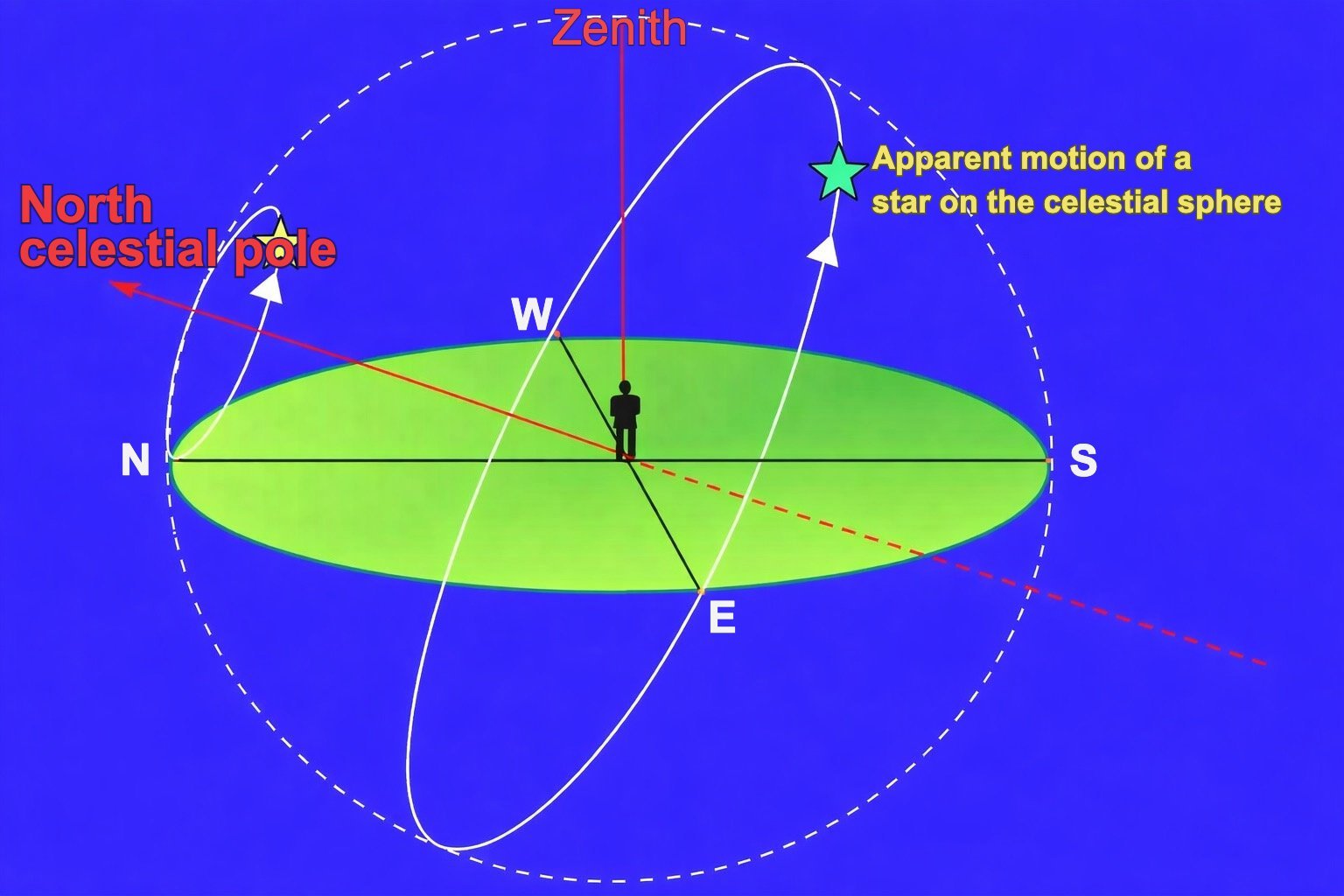
For an observer on Earth, stars move across the sky during the night.
If that observer (us, in the diagram) watches the stars carefully through the night, they will notice that some stars are always visible, even throughout the year. These are circumpolar stars (yellow star in the diagram). The stars of Ursa Major, for example, are circumpolar.
The others appear to move from east to west during the night, rising above the horizon and then descending. Circumpolar or not, they all move as a single block. After 24 hours, they return to their initial position. This overall 24-hour motion is called the diurnal motion of the celestial sphere.
What we perceive as motion is in fact a consequence of the Earth's rotation on its axis.
At first glance, stars behave like the Sun: those that are not circumpolar rise in the east, climb above the horizon, descend, and set in the west. Not exactly. Over the year, the Sun rises and sets at points that shift around east and west. Stars, by contrast, always rise and set at the same points on the horizon. And because they move as a block, they keep the same relative spacing between one another.
As for the Moon and the Sun, to name only those two, even though they participate in diurnal motion, they do not preserve that relative spacing. They are said to have proper motion.
Another feature of non-circumpolar stars is that they are not always visible in the sky. This time, the cause is the Earth's revolution around the Sun. As on holiday, the scenery changes. It is the same on our journey around the Sun. That is why, at our latitudes, the constellation Canis Major is visible only in winter, and rather low over the southern horizon.
And heliacal rising in all this? We are getting there.
A star's rising refers to the moment that body appears above the horizon. It also refers to the date in the year when that first appearance occurs.
But we have seen that the Sun “wanders” on either side of absolute east over the year. It may therefore lie visually very close to a rising star (this is called a conjunction when two bodies have the same longitude), so close that its brightness prevents the star from being seen. We must therefore wait until the star rises sufficiently before the Sun, so that it can be seen for a few minutes at dawn before the Sun's glare masks it. This is what is called the heliacal rising of a star.
If a star rises (or sets) at the same time as the Sun, we call it cosmic rising (or setting). Naturally, it will not be visible.
If it rises when the Sun sets (and vice versa), we call it acronychal rising (or setting).
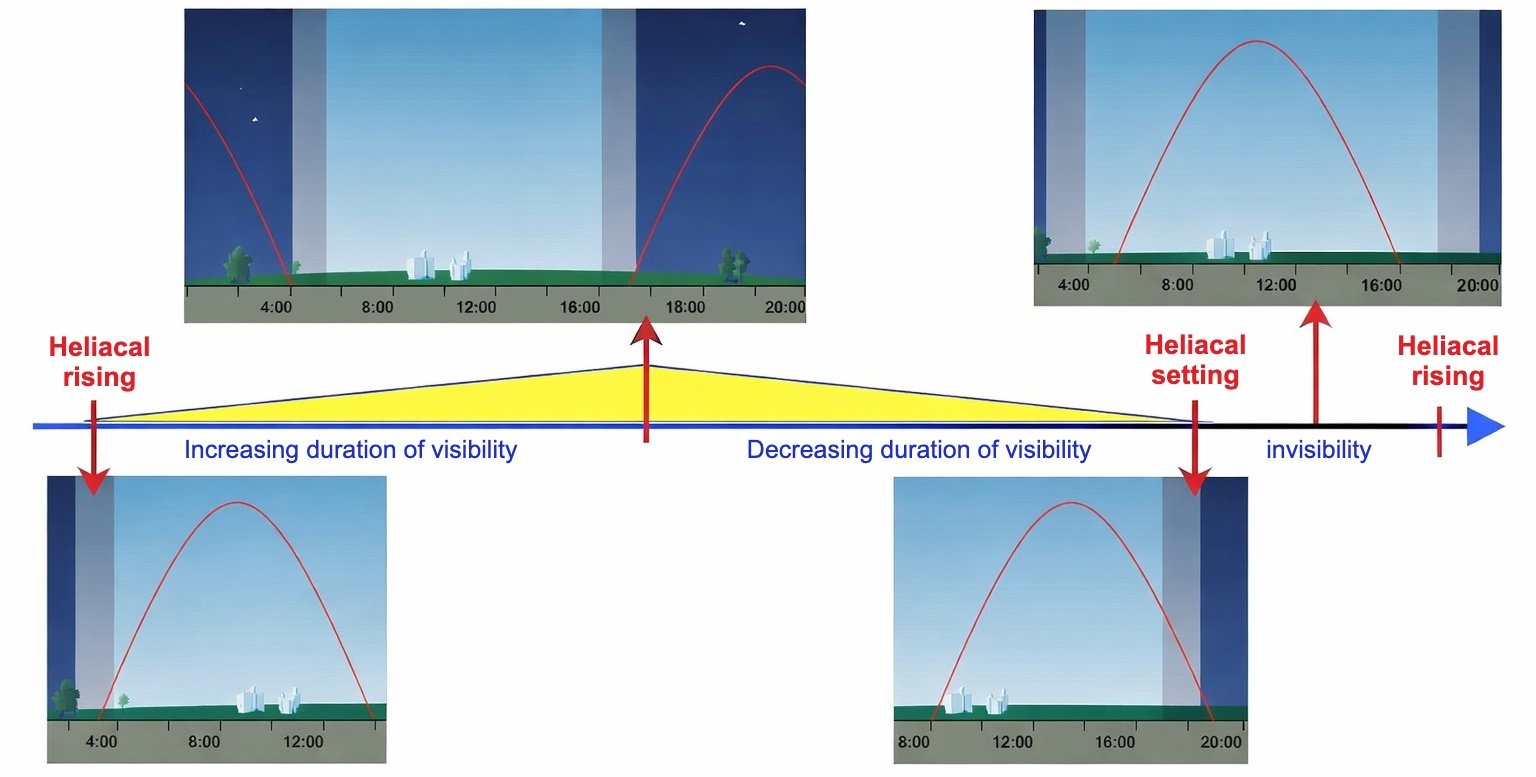
At its heliacal rising, a non-circumpolar star appears only briefly, just before the Sun is fully up (bottom-left image). Then, month by month, it remains visible for longer, until it is visible throughout the night (top-left image). After that, its visibility decreases until its heliacal setting (bottom-right image), when it is visible only briefly as it sets after the Sun has fully set.
Between its heliacal setting and its next heliacal rising, it remains invisible for a certain number of days, during which it rises after the Sun and sets before the Sun (top-right image).
A little astrology: tropical zodiac (or tropic zodiac) and sidereal zodiac
The tropical zodiac is a theoretical zodiac, while the sidereal zodiac is the natural one.
To “construct” a tropical zodiac, you simply place a zero point on a circle and divide it into 12 sectors of 30°. The zero point is always the vernal point (spring equinox), and each 30° arc anticlockwise corresponds to one zodiac sign, with zero marking the start of Aries.
The sidereal zodiac corresponds to the true position of zodiac constellations relative to the vernal point. From that position, the ecliptic is divided into 360°, and the twelve zodiac figures are placed on it. At present, the start of Aries is about 29° north of the vernal point, which lies in Pisces.
As we saw above, because of precession of the equinoxes, the vernal point moves continuously along the zodiac, and it takes about 25,800 years to return to the same sign. In 100 BC, the vernal point lay around 0° Aries, and the two zodiacs coincided.
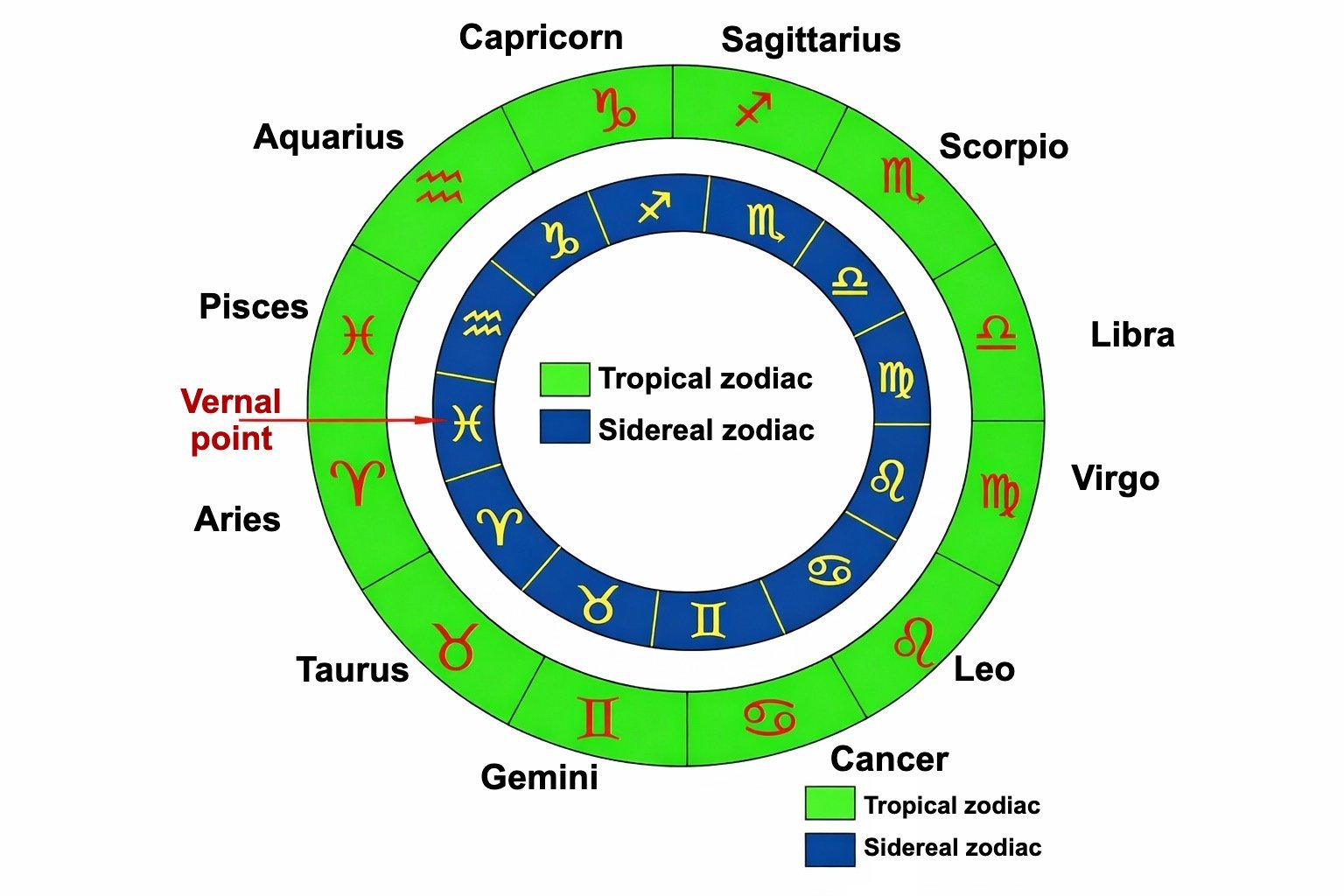
At the pace of precession of the equinoxes, the tropical and sidereal zodiacs drift apart by about 1 degree every 72 years.