Structure of this study
- Introduction and Page 1: Pre-writing instruments.
- Page 2: Shadow-observation instruments.
- Page 3: Celestial-observation instruments.
- Page 4: Flow- or combustion-based instruments (this page).
- Page 5: Clocks and modern instruments.
Flow-based instruments
After looking extensively at the sky in previous pages, we will now focus, on this page and the next, more on earthly resources.
Clepsydras and water clocks
Before reviewing the evolution of clepsydras and then water clocks through time, a few general preliminary questions are useful:
What is the etymology of the word? It comes from two Greek terms: kleptein (to steal) and udor (water). A clepsydra is therefore a “water thief”. Since early clepsydras worked by letting water flow from one vessel to another through a small opening, one may suppose the receiving vessel “steals” water from the first. Incidentally, the root KLEPT appears in both clepsydra and... kleptomania, the impulse to take things that do not belong to you.
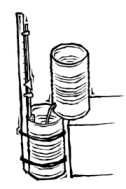
The clepsydra principle is simple: water flows from one vessel to another, the second “stealing” it from the first. You then measure water lost from the first, or gained by the second, and convert that into elapsed time. We will see it is less simple than it sounds.
When and where was the first clepsydra, and for how long was it used? Depending on sources, invention dates range from 3000 BCE to 1500 BCE. What is certain is that the oldest known one was discovered in 1904 in the ruins of Thebes (Temple of Amun at Karnak) and is thought to date to Amenhotep III (13th century BCE), for whom it may have been made. It was probably not the first and likely has older origins. Its disappearance is slightly later than the 18th century, when drum clepsydras were still in use.
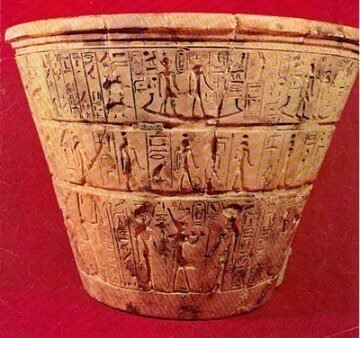
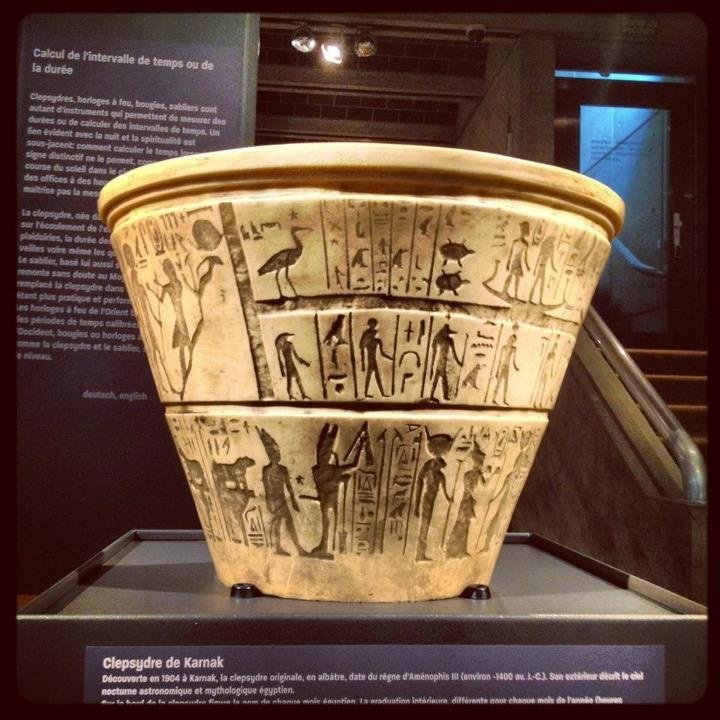
The whole history of the clepsydra in two images: above, the Karnak clepsydra dated to the 13th century BCE (Cairo Museum). Below, a drum clepsydra from the 18th-19th centuries.
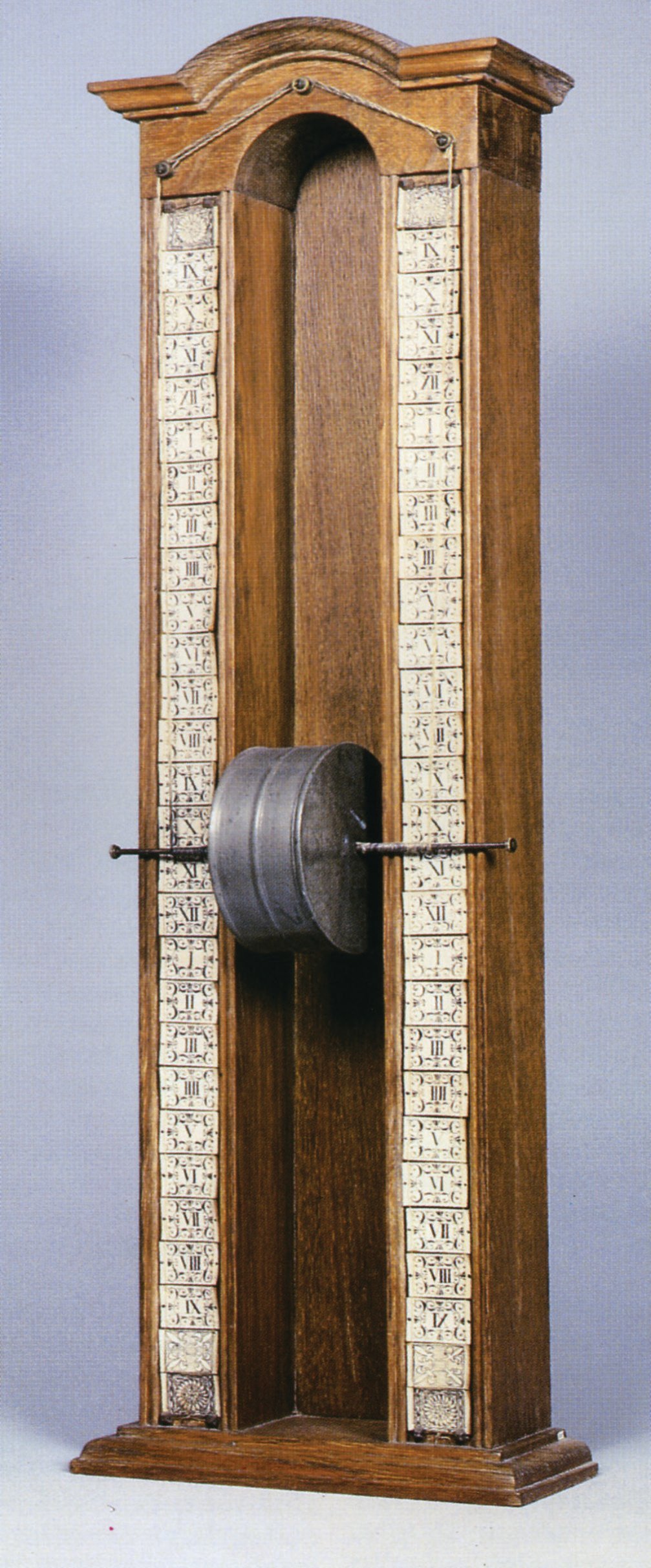
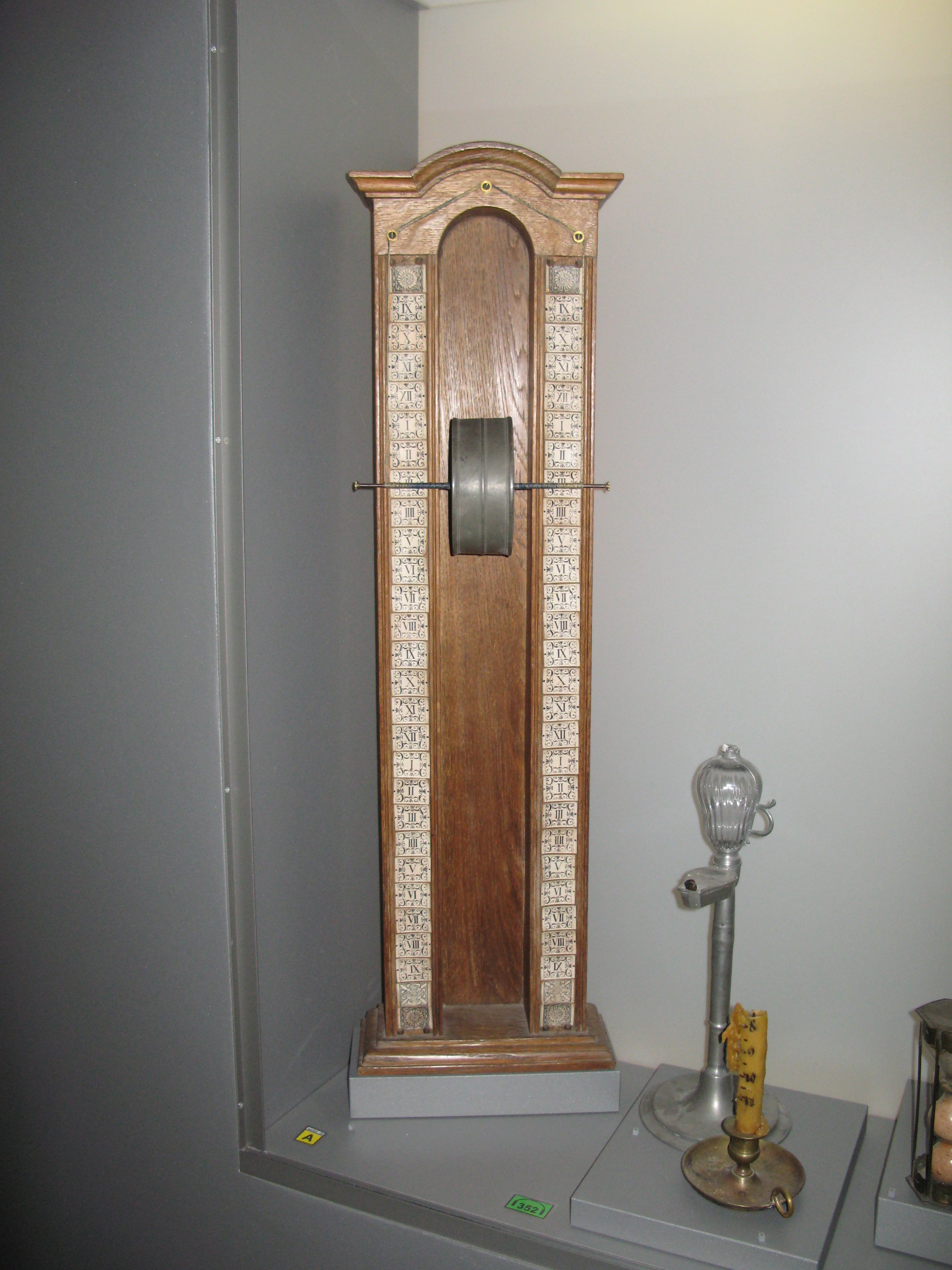
Is the clepsydra worth studying? Certainly. Yet one must note how little research has been done on it. A pity. As we will see, it already contains the seeds of mechanical clockmaking.
Is the clepsydra a time-measuring instrument? A key question for us. If yes, we continue. If not, we move on.
If by time measurement we mean independently determining the current hour, the answer is NO. It is neither an astrolabe nor a sundial.
At best, a clepsydra is a timekeeper over a more or less limited period, but it cannot recover time once stopped. Note that our sophisticated watches do not do better in that respect. And speaking of watches: compared with a sundial, the clepsydra is more like a stopwatch, often starting at zero and measuring relatively short durations.
As everyone knows, Greeks and Romans in antiquity loved long debates, especially in political and judicial assemblies. Let us not ask whether this has changed much... and not only in Greece or Italy...
So let's reread a passage from Aristotle's Constitution of Athens: "In the court there are clepsydras fitted with outflow pipes. Water is poured into them, and its amount determines speaking time. Ten choes (one chous = 3.24 liters) are allotted to cases above five thousand drachmas, and two for reply [...]. In cases lasting the whole day in several sessions, the official in charge of water does not stop the pipe; but the same quantity is allotted to prosecution and defense. The day's measure is calculated based on the days of Poseideon (December-January), when days are shortest."
We will return to this passage because it highlights an issue that created real design challenges for clepsydras.
I will also open a small parenthesis to ask etymologists about the origin of chous/conge in this context and whether it relates to the modern French word conge.
So, to answer the question: YES, the clepsydra is a time-measuring instrument. Let's continue and follow its evolution across centuries.
Clepsydra evolution
The evolution of clepsydras, then water clocks, depends mainly on two points:
- For several centuries, one had to cope with unequal hours (see the astrolabe text) and engrave water-level markers based on the date within the year.
- The laws governing water flow. Without entering full hydraulics, flow in instruments like the two-vessel one above is not constant. It depends on water viscosity (temperature), outlet size (which may widen by wear or narrow by clogging), and changing water level in the source vessel.
We will not discuss purely aesthetic developments that produced automaton water clocks. Arab engineers became masters of such designs, some very large, such as the monumental Fez clock in Morocco. We should at least name the leading figure, al-Jazari (d. 1206). Also note that in 807, a hydraulic clock was offered to Charlemagne by envoy of caliph Harun al-Rashid.
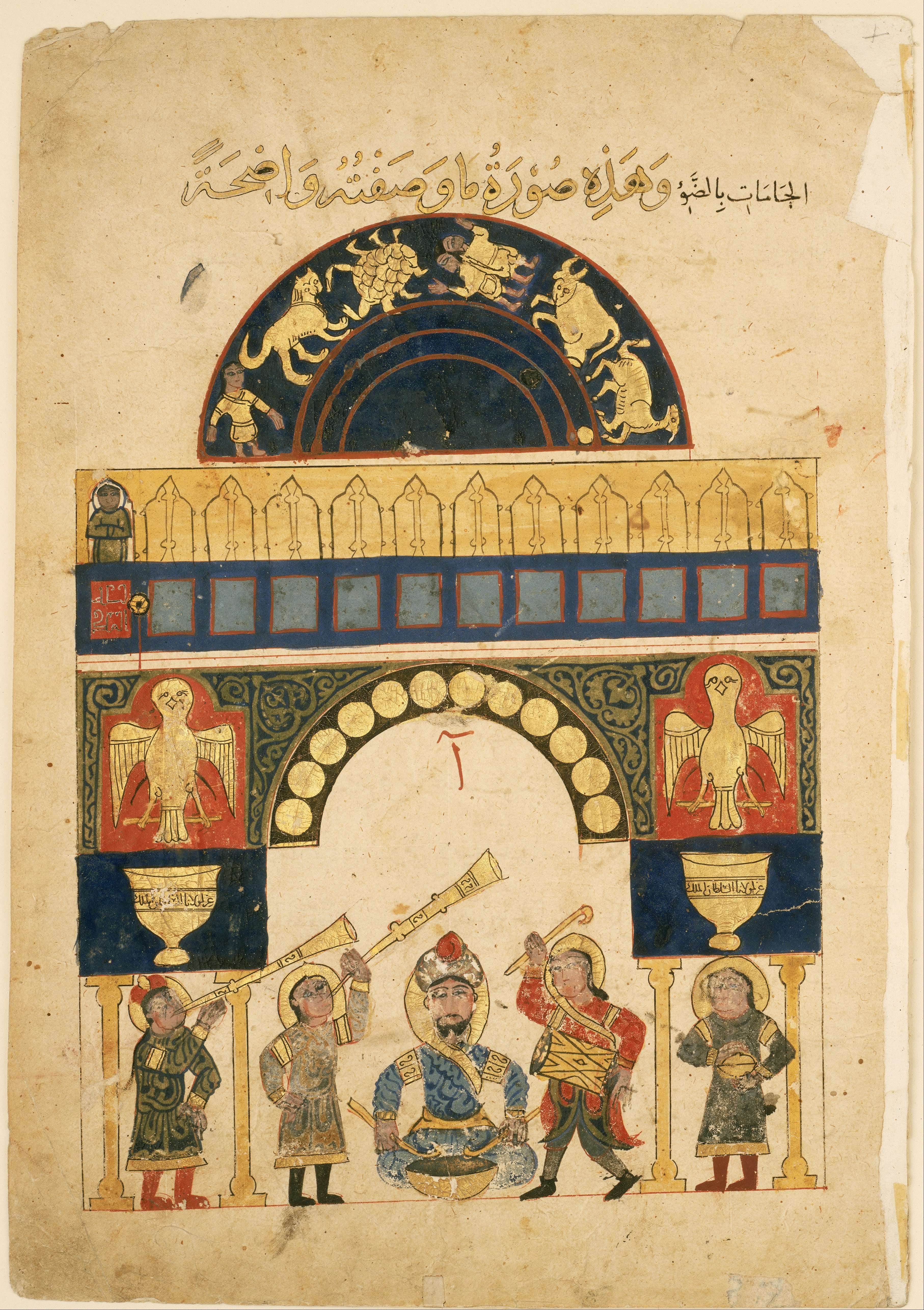
For pleasure, here are two monumental examples.
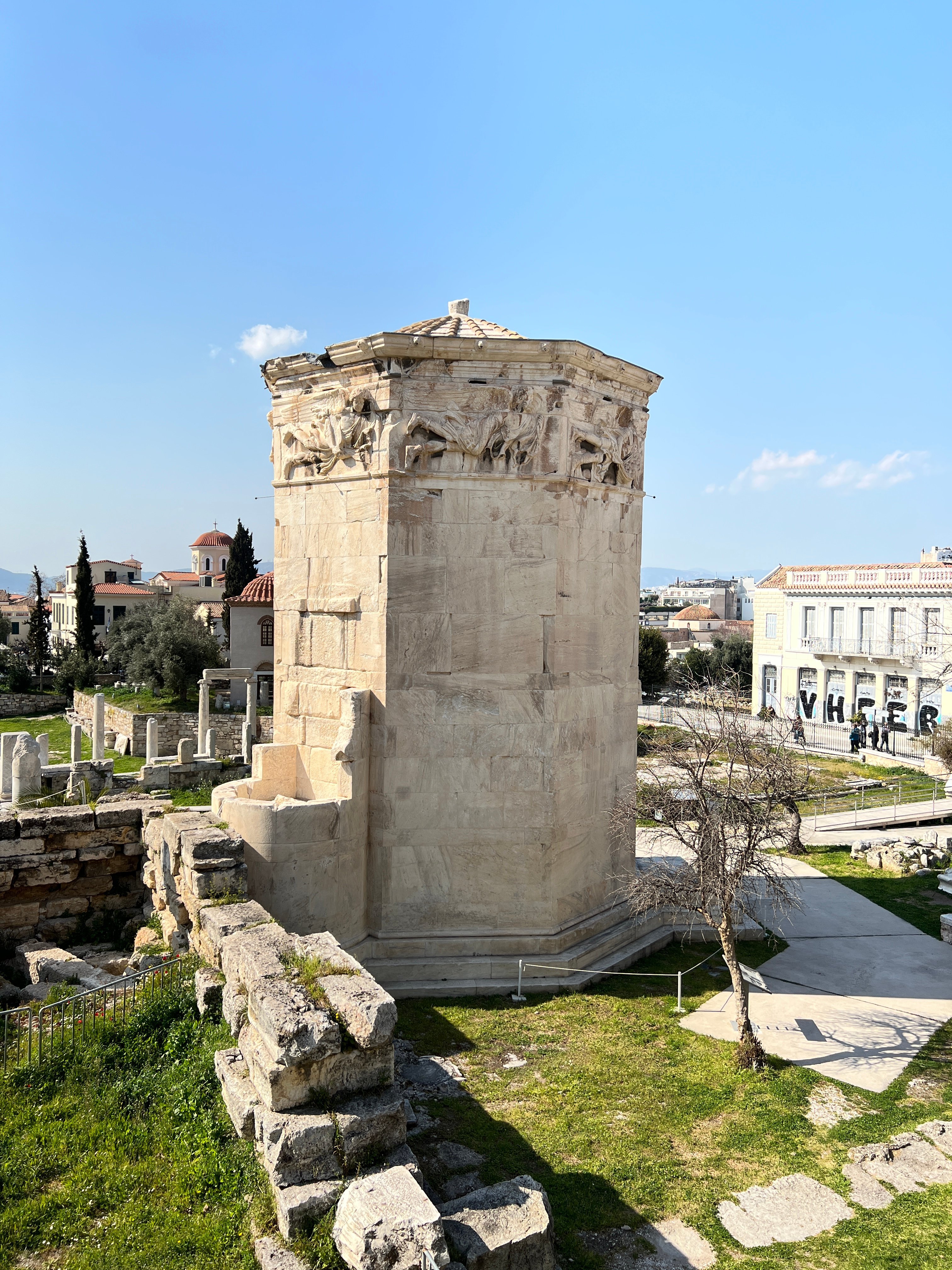
Left: the Tower of the Winds, built in the 2nd century BCE on the Roman Agora in Athens. This marble building was designed by astronomer Andronikos of Kyrrhos and named for the eight upper wind friezes. Here we see the water-clock side, with a reservoir at the base.
Right: a miniature from al-Jazari's Treatise on Automata (Museum of Fine Arts, Boston). Visible are the zodiac circle, Sun, Moon, 12 openings lit at night, and two birds dropping a ball. At 6, 9 and 12 o'clock, musician automata play.
Now, back to flow-rate problems.
Not much can be done about viscosity. For outlet size, noble materials or drilled gems were used to limit wear and aperture change.
The major issue remains the water level in the “source” vessel, which greatly alters flow.
A first solution was found by Egyptians and Greeks: instead of cylindrical vessels, they used flared shapes. This allowed equal-distance marks to be engraved inside one vessel. Of course, several mark columns were needed to account for differing day/night lengths (from dividing day/night into unequal hours). Even so, vessel shape was still not ideal.
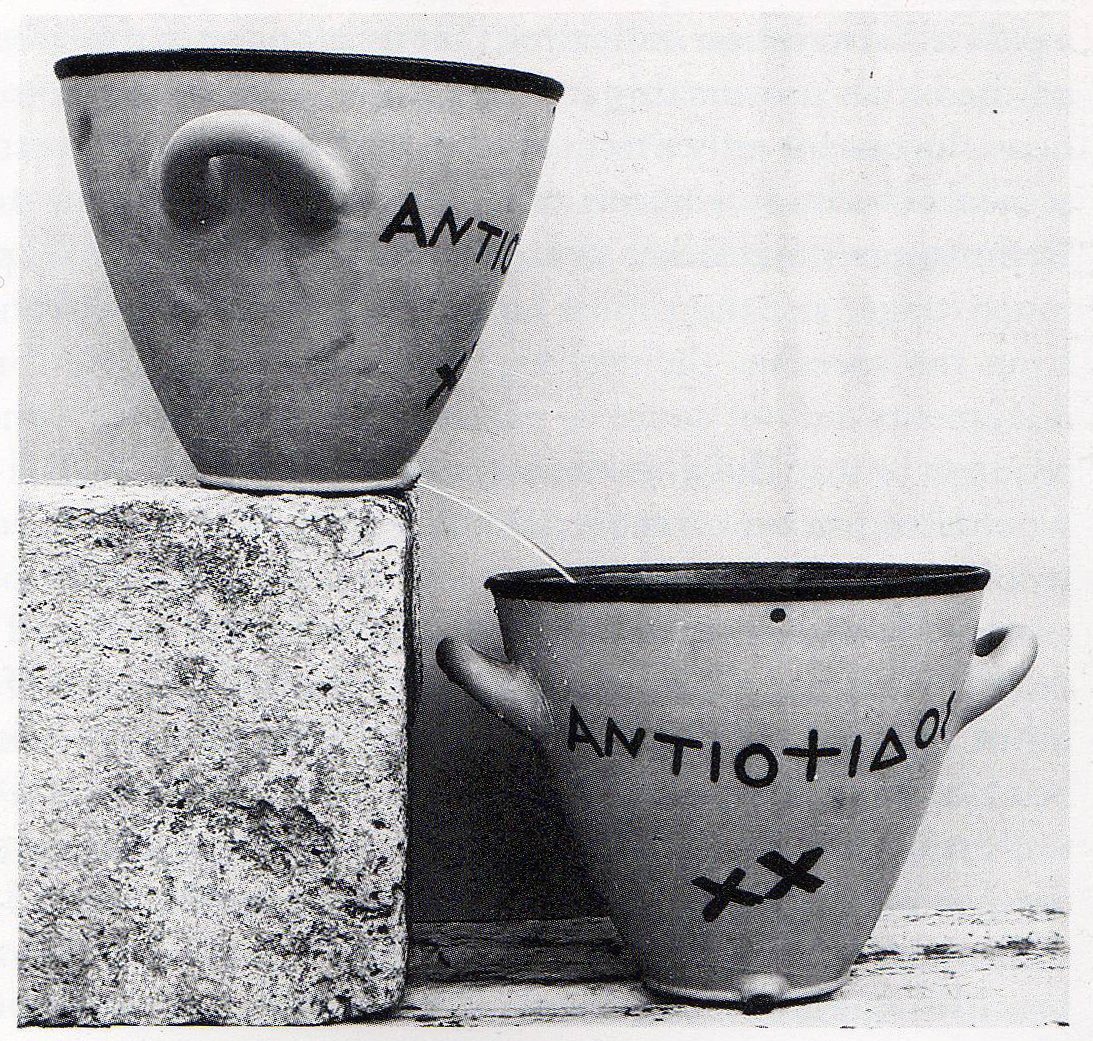

Even optimized, Egyptian and Greek clepsydras (first image) were not ideal compared with the theoretical profile (second image) derived from Daniel Bernoulli's theorems (Switzerland, 1700-1782), from a generation of eminent mathematicians.
It took highly inventive minds to solve both variable flow and unequal-hour issues. One was Ctesibius, a contemporary of Archimedes, active in Alexandria in the 3rd century BCE. At this stage, we can speak of water clocks rather than clepsydras. We may also cite Philo of Byzantium (230 BCE) and Heron of Alexandria (125 BCE). Their clocks were true artworks combining hydraulic research with automata craft.
For my part, lacking hard proof, I will say they invented these systems, not necessarily that they built every device themselves.
We will focus on Ctesibius's water clock through Vitruvius (1st-century BCE Roman architect, author of the ten-volume De Architectura) and Rees, who in 1819 published Clocks, Watches and Chronometers, source of many sketches shown here.
Ctesibius's clock
Let's see what this clock looks like in Vitruvius's drawing:
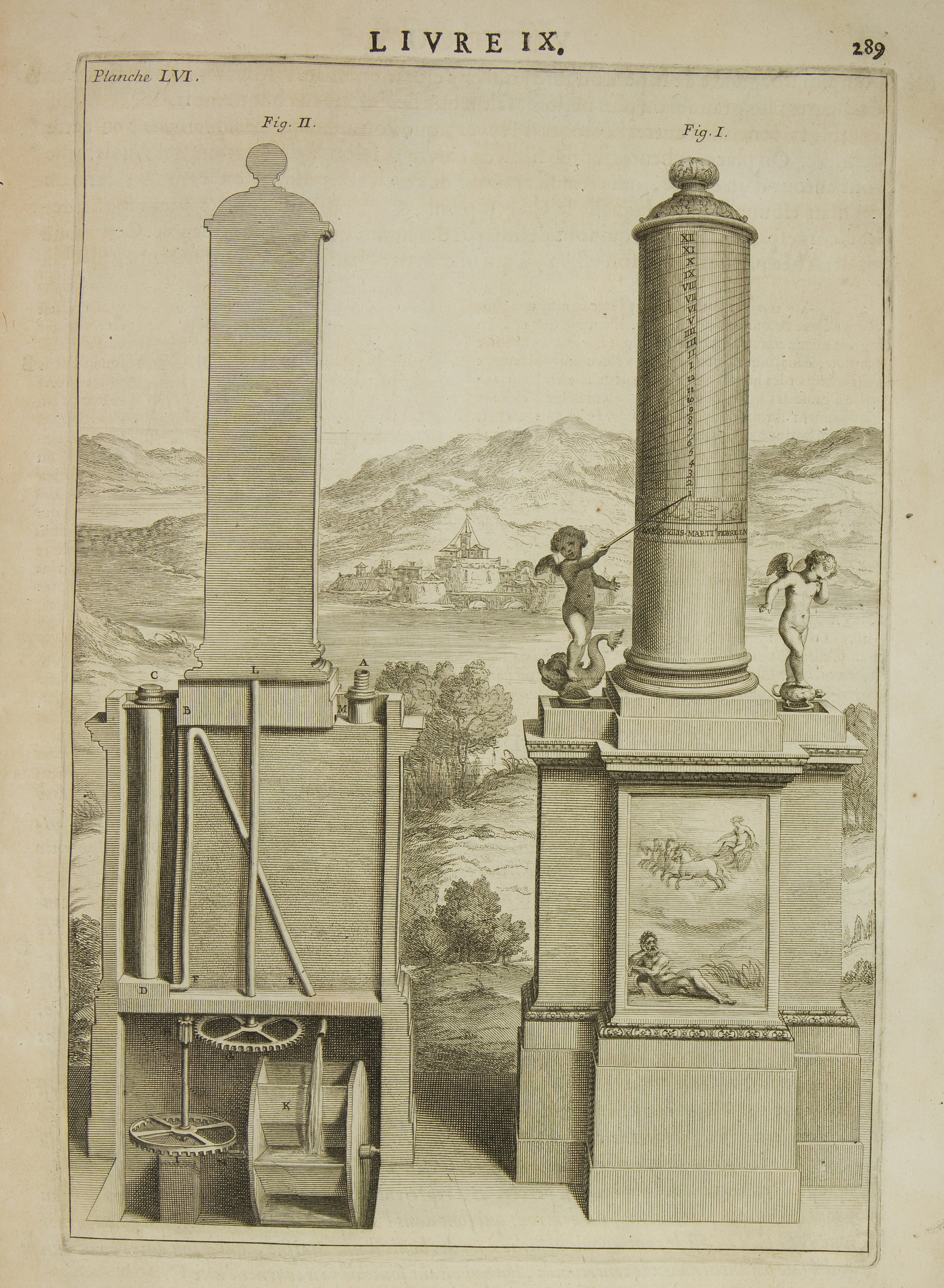
Through an ingenious dual system of column rotation (upper area, figure I on the right) and vertical movement of a figurine (holding a rod on the left of the same figure), he solves unequal hours. I will let Vitruvius describe the mechanism:
“First, he made the outflow orifice in a piece of gold or in a drilled gem; for these materials are not worn by flowing water, and dirt capable of clogging the hole cannot settle there. Water flowing regularly through this orifice raises an inverted float, called by craftsmen a “cork” or “drum.” On this float is fixed a rod engaging a rotating disc; rod and disc are equally toothed. These teeth, transmitting motion from one to another, produce measured rotations and displacements. In addition, other rods and wheels, toothed similarly and driven by the same impulse, produce varied effects and motions [...]. Furthermore, in these clocks, hours are marked either on a column or on an adjacent pilaster, and a figurine emerging from the base indicates them with a rod throughout the day. By adding or removing wedges each day and month, one necessarily accounts for shorter or longer days. [...]. Thus, thanks to these systems and arrangement, one can build water clocks usable in winter. But to increase day length by adding/removing wedges, which are often defective, one should proceed as follows: trace hours transversely on the columnette according to the analemma and engrave month lines on it. This column must be able to pivot so that, relative to the figurine and rod, by regular rotation, it accounts for each month's shorter or longer hours...
But you may ask: what about flow-rate control? As often when multiple versions exist, I will present them and let you choose. If anyone has further evidence, please contact me.
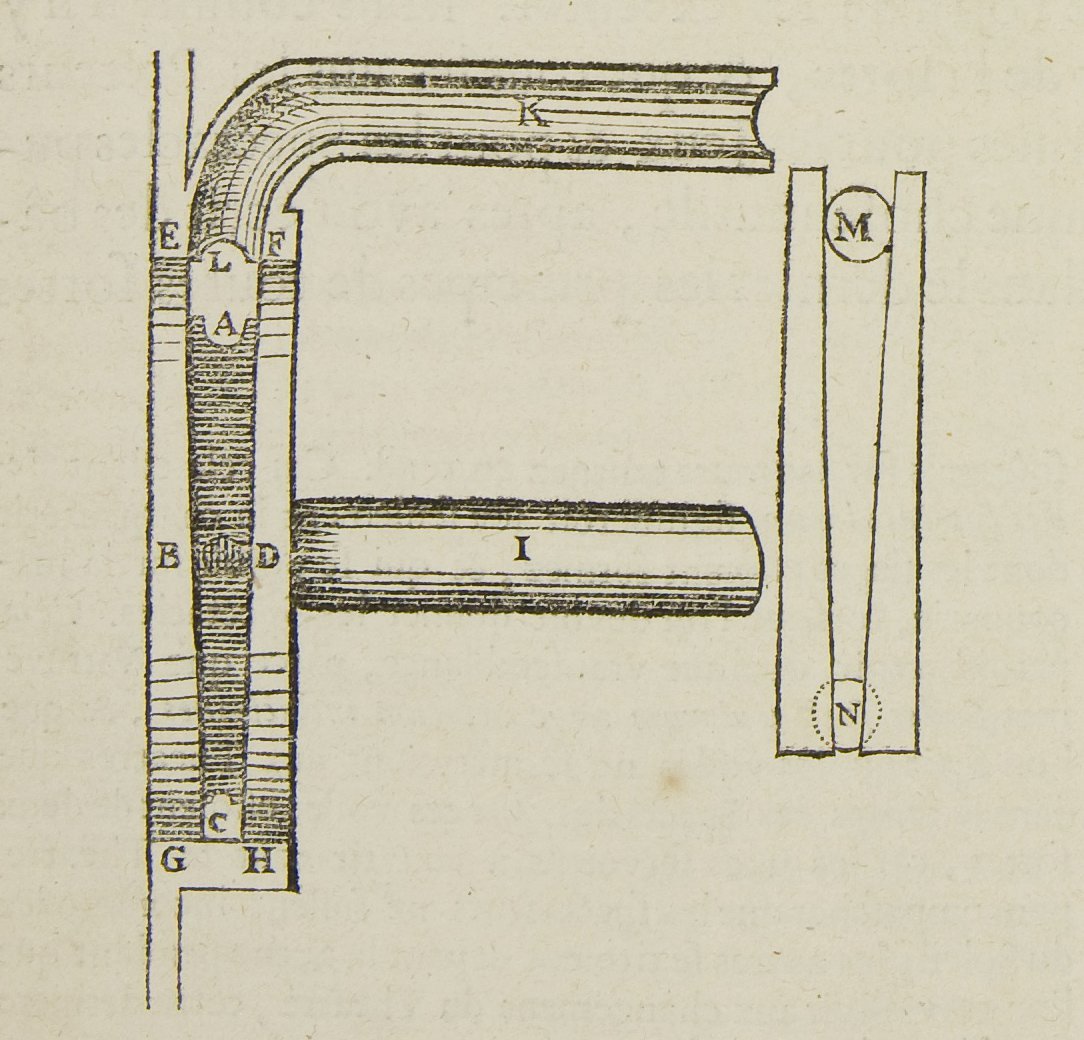
The first version says Ctesibius effectively invented a proto-carburettor: a cone float partially blocking inflow to another cone when water rises too high.
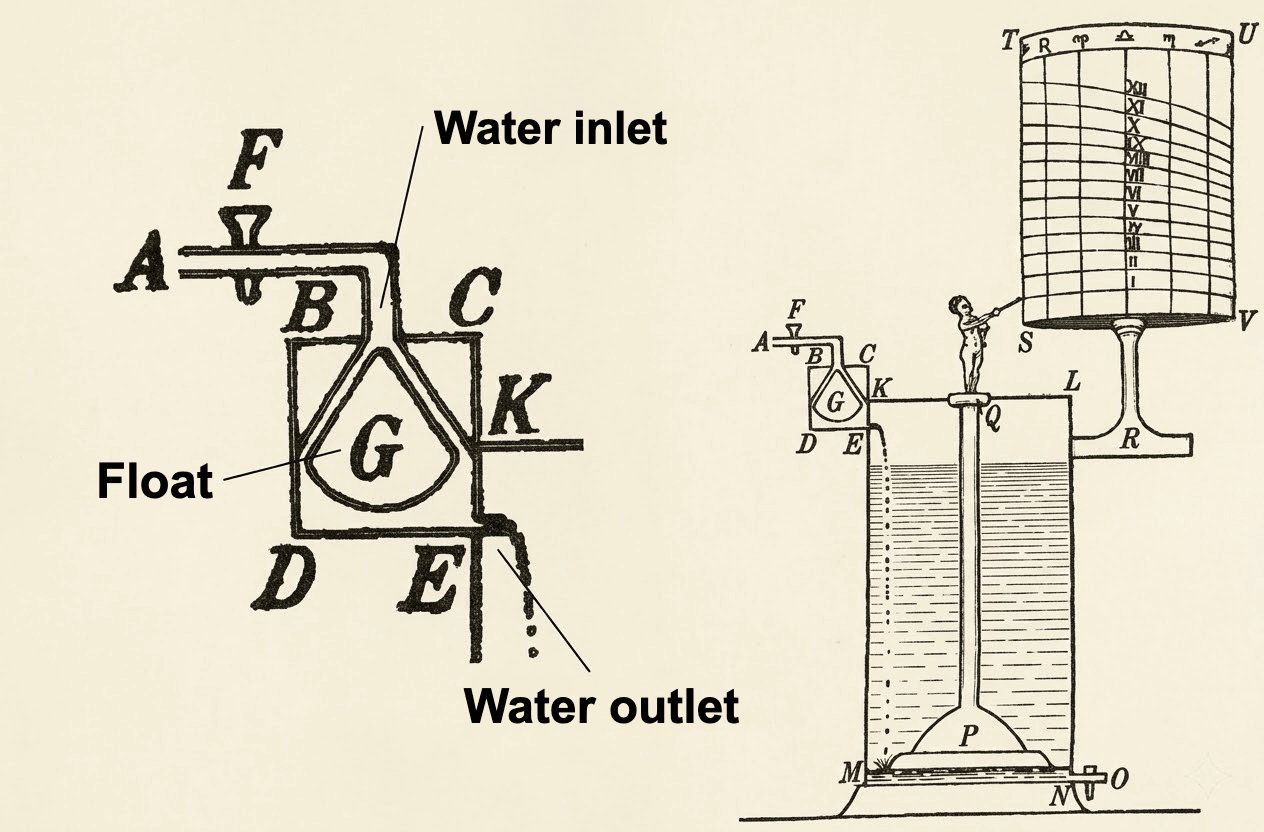
Under this first hypothesis, Ctesibius regulated flow via float G, which temporarily blocks inflow when water rises too high in compartment BCDE. When level drops, the float drops and inflow resumes.
The other version does not mention such a regulating float, but rather a system adjusting flow for unequal hours. Rees even states this system predates Ctesibius. In this view, flow is stabilized by keeping water level constant in the first vessel via overflow. Ctesibius's only innovation would then be the rotating vertical drum on which a figurine indicates exact time.
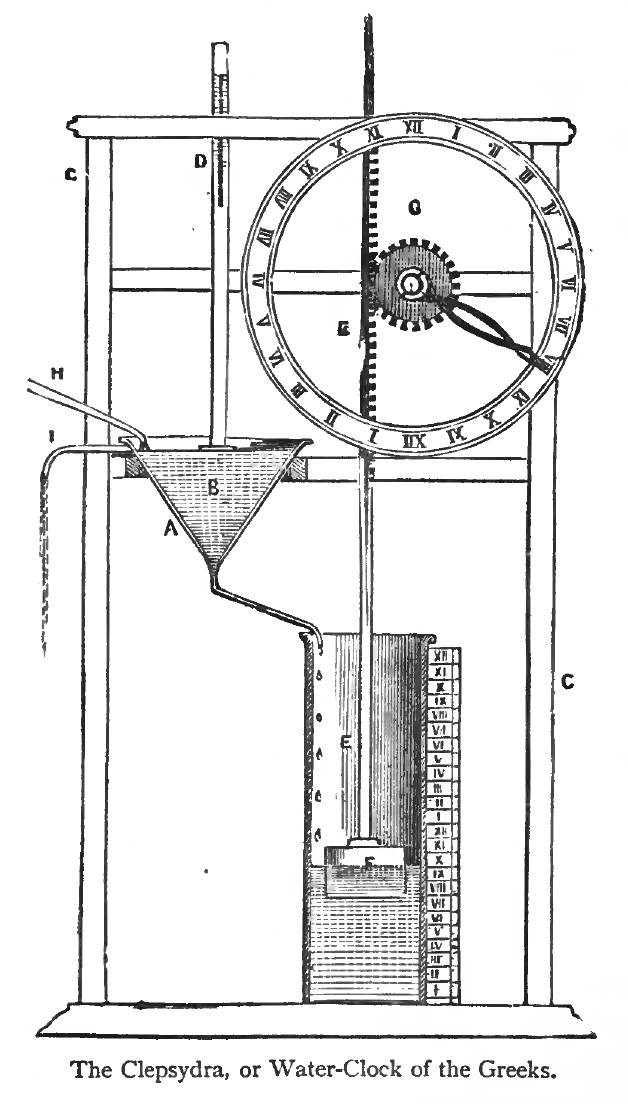
According to this second version, water enters through pipe H into a first conical funnel-shaped reservoir.
Excess water exits through pipe I, positioned to keep level constant in that reservoir.
Another solid metal cone is held inside the first and can be moved by indexed rule D. Bringing the cones closer reduces flow and thus limits liquid reaching the main reservoir on shortest days.
The index must be adjusted twice daily: once at sunrise and once at sunset, to respect unequal hours.
For full context, here is the omitted part of Vitruvius's text that I marked as [...] above: "The water taps, for regulating flow, are arranged thus: two cones are made, one solid, the other hollow, turned so that one may enter and fit within the other; and by means of the same rod they are separated or brought together to speed up or slow down water outflow into these vessels."
Other clock types described by Vitruvius
We will move quickly over other clock types described by Vitruvius because, however ingenious, they add little to instrument evolution. They are mainly further attempts to solve unequal hours.
Here is the plate from Vitruvius's book describing them:
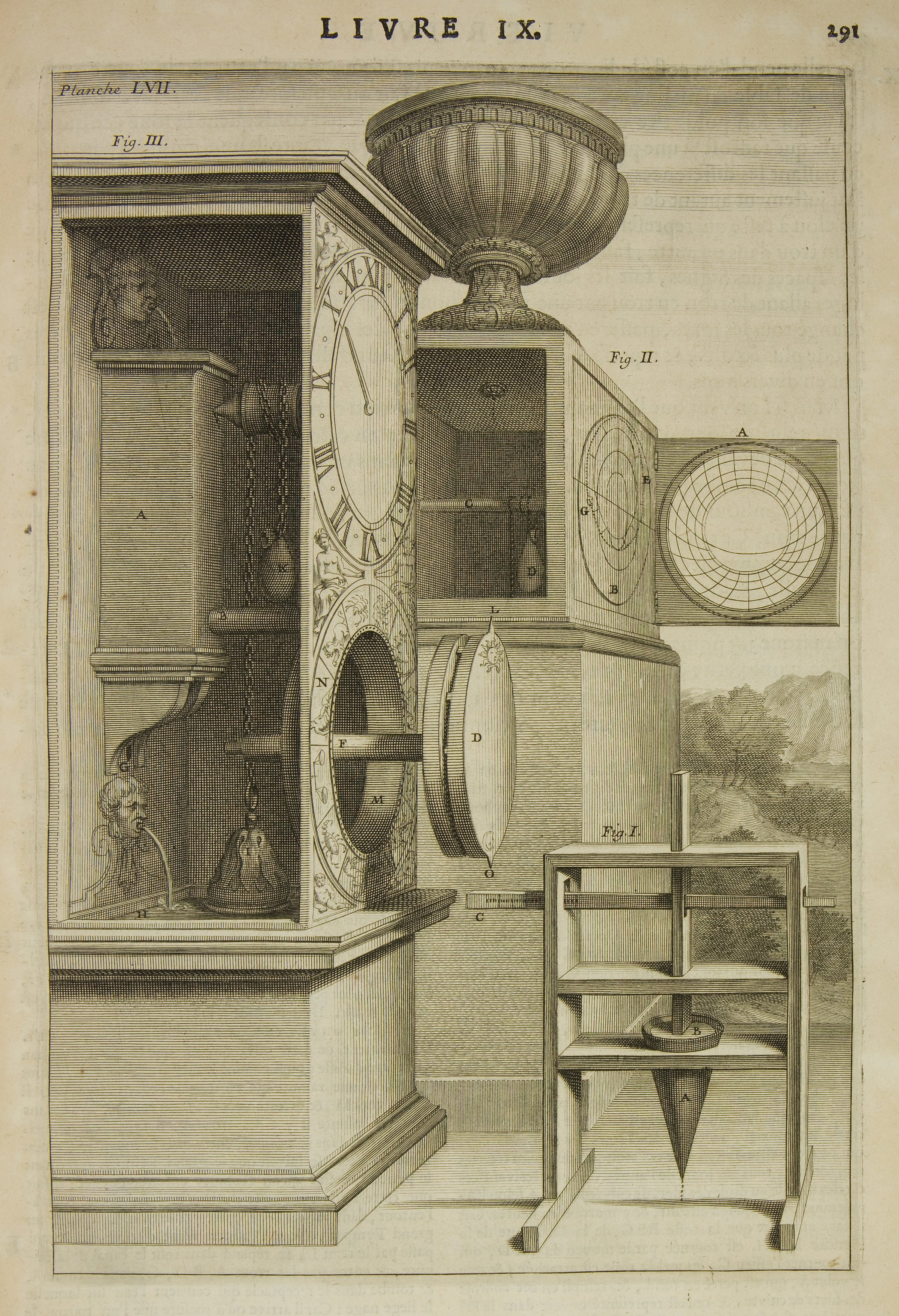
In the background, an anaphoric clock in which the hours are shown on an analemma (the circle to the right of the clock), which is nothing more than a projection of the celestial sphere as on astrolabes. The flow of water is not regulated.
On the left, a tympanum clock in which the passage of water is regulated by turning the disc at the bottom each day (normally in the "pushed" position), made up of two plates of variable thickness. See the following photo for details of the system. Vitruvius by Perrault, Public domain, via Wikimedia Commons / e-rara.ch
Su Song's clock
Let's jump to 1092.
That year, a Chinese scholar named Su Song built a huge clock in a three-storey wooden tower (each storey 3 meters) at the imperial palace in Kaifeng. The device was more an astronomical clock than a simple time-indicator. Its complex motion drove an armillary sphere and a celestial globe in full synchrony with star, Sun and Moon motions. Facing the tower, in a pagoda, animated figures rang bells and other sounding objects. In short, another automaton system.
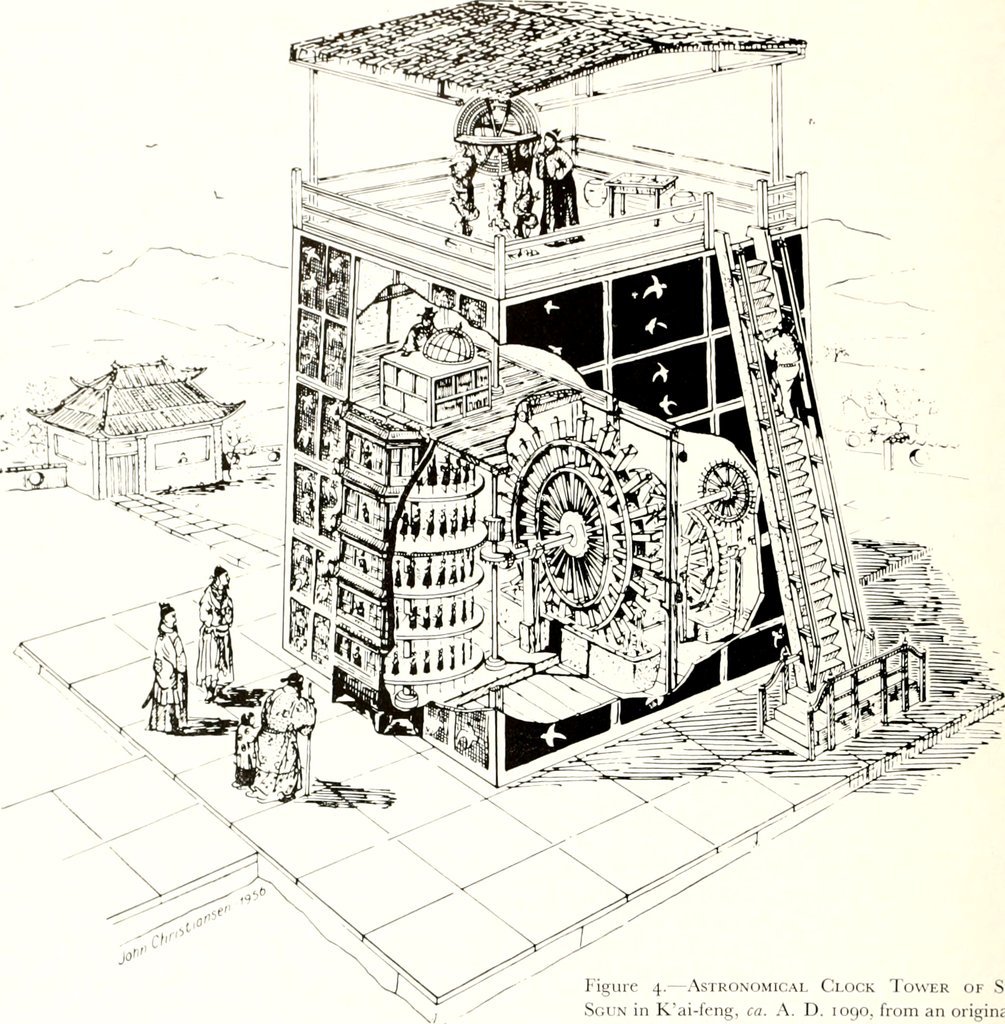
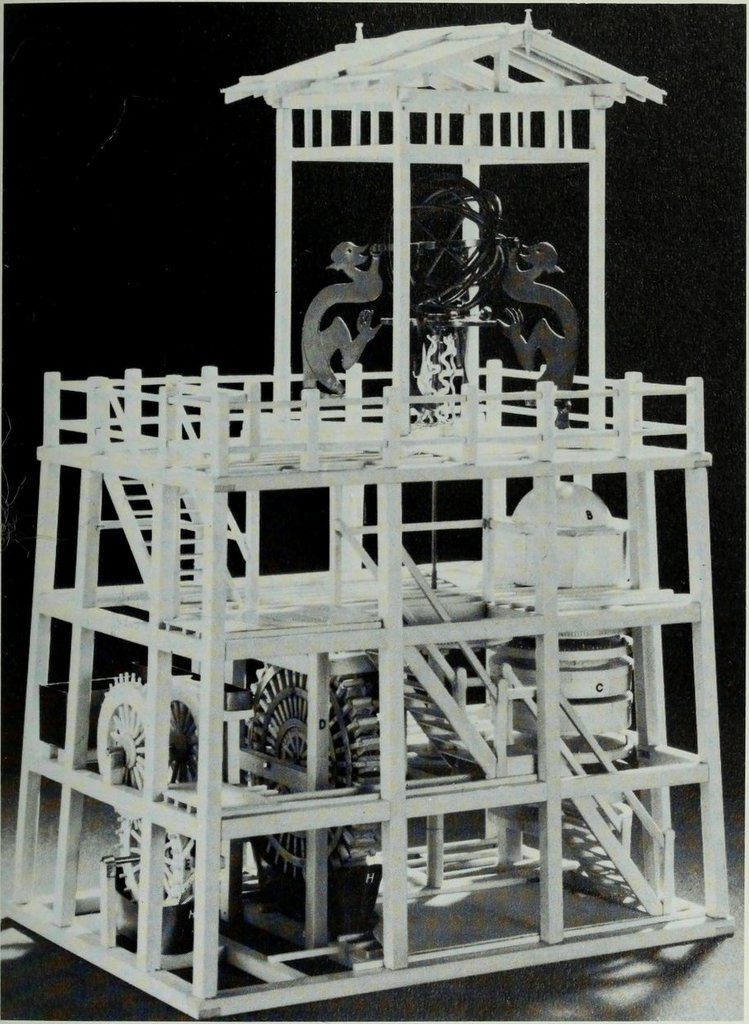
In 1126, the clock was dismantled by the Tartars and taken to Beijing. In the 14th century, it was destroyed when the Ming dynasty invaded Beijing.
But what does this clock add to time-measuring history?
Look closely at the large wheel in the center. You are looking at the first known escapement. None appears again before the 14th century.
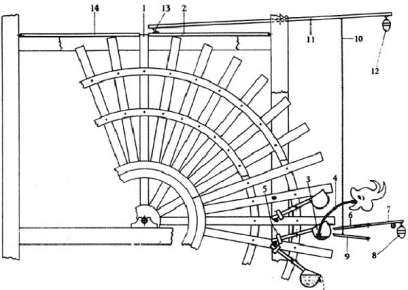
Escapement system of Su Song's machine. It is called an escapement because it lets one “tooth” escape at each impulse, here the filling of one bucket. Continuous water flow is thus converted into discontinuous wheel motion.
We should now give credit where due: invention of the escapement around 723 is attributed to two people, Buddhist monk Yi Xing and Chinese engineer Liang Lingzan. They too are said to have built an astronomical hydraulic clock.
“Modern” water clocks
To finish this clepsydra and water-clock survey, let's examine the mechanism of the 18th-century drum clepsydra shown at the beginning. For that, we open the drum and view it in section.
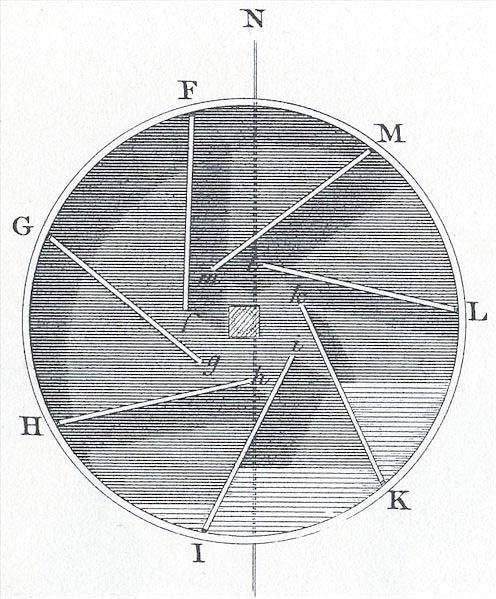
This drum is sealed and always contains the same water volume. It has six partitions, each with an opening, so water in one partition flows to the next in the lower compartment. When a compartment fills, the water weight rotates the drum, which winds opposite to the suspension cords supporting its axle.
The drum therefore descends in the clock, then stops until another compartment fills. Time is read on the wooden support where the axle stops. Here we are in an equal-hour system with the day divided into 24 hours of equal length.
The hourglass
We will not spend all day on an instrument everyone knows. Just a few points:
Origin
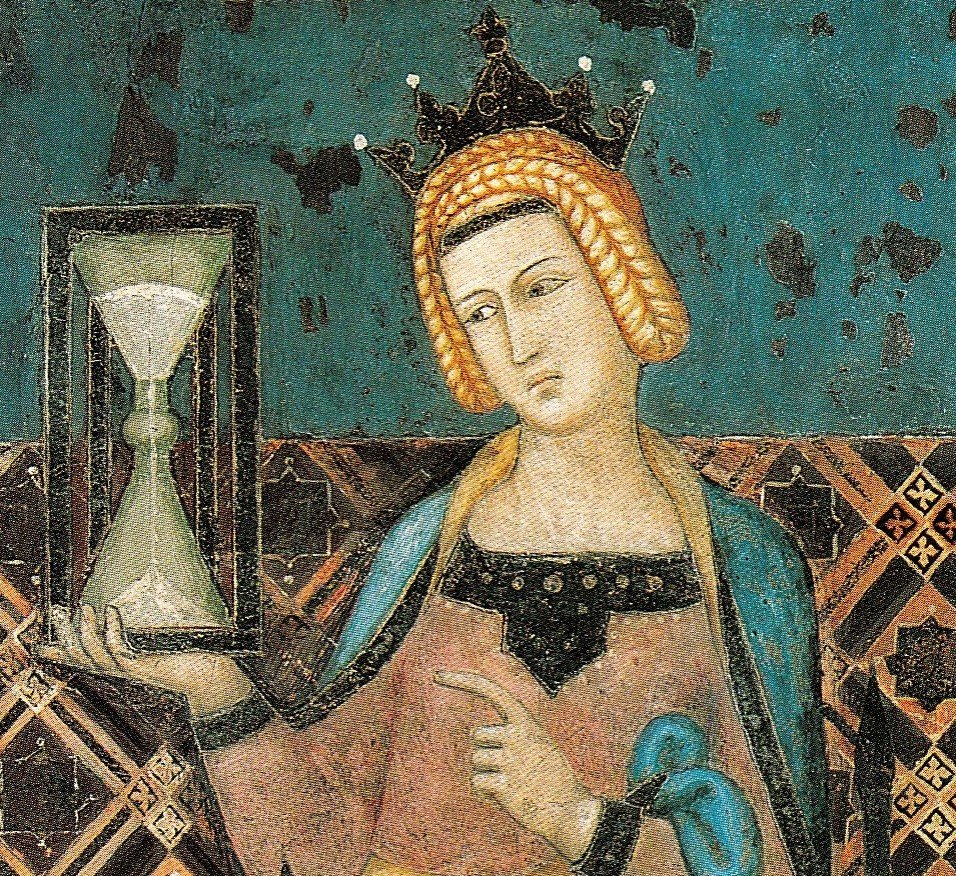
The hourglass, whose inventor is unknown, likely dates to the 13th century. It was first called orloge, then reloge, then horloge à sablon (sand clock), before becoming sablier (hourglass) in the 18th century.

Characteristics
Filled with sand, crushed eggshells, or even mercury, this timekeeper is mainly used for short durations (hours or fractions), though in volume one of Mémoires de mathématiques et de physique (1750), one Abbé Soumille, correspondent of the Royal Academy of Sciences, describes a "30-hour hourglass suitable for sea use, marking hours and minutes one by one, and not stopping even while being turned".
Unlike the clepsydra, sand outflow is independent of height in the bulb. Only the slope of the outlet must be very accurately determined. In 1725, Daniel Bernoulli won the Royal Academy of Sciences competition in Paris by calculating this slope.
The hourglass was widely used in navigation, where it was called an ampoulette (28-second duration). Used with the log line (knotted rope), it allowed ship speed measurement.
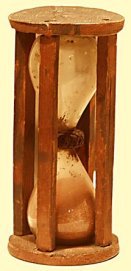
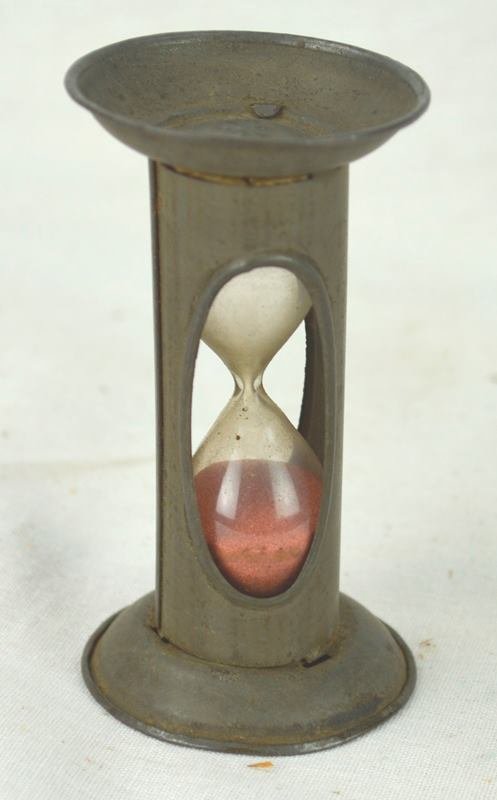
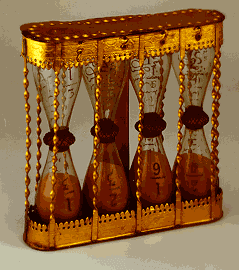
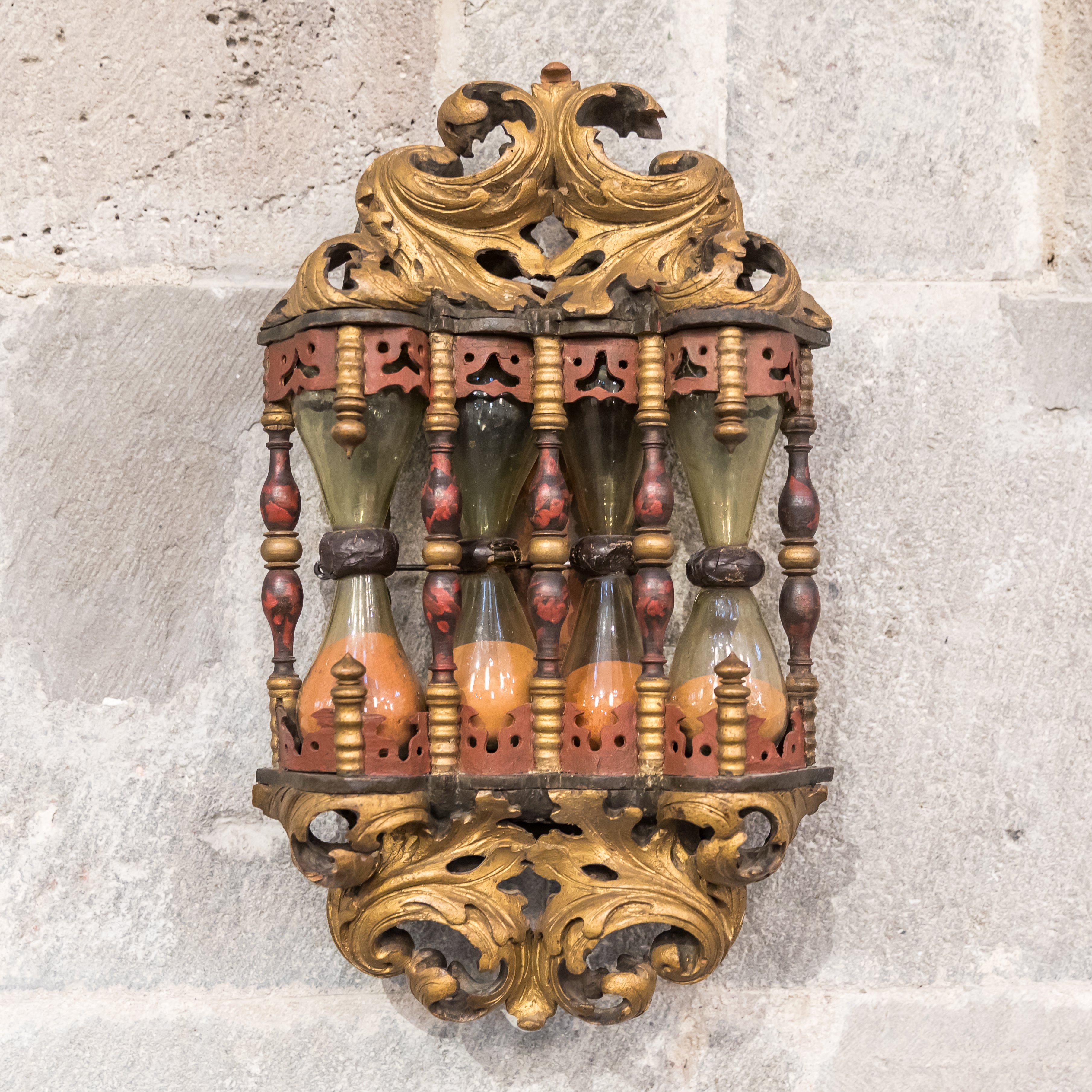
Left: a 1750 hourglass at the National Watch and Clock Museum (Columbia, Pennsylvania, US). Right: a multi-bulb hourglass for intermediate intervals.
I read somewhere, though I forget where, that priests used it to limit sermon length and called it the “sermon glass”. When a sermon ran long, the priest would turn it over and tell the congregation: “Brothers, let us have another glass.” Maybe untrue, but charming.
Combustion-based instruments
Here too, no need to make a drama of it.
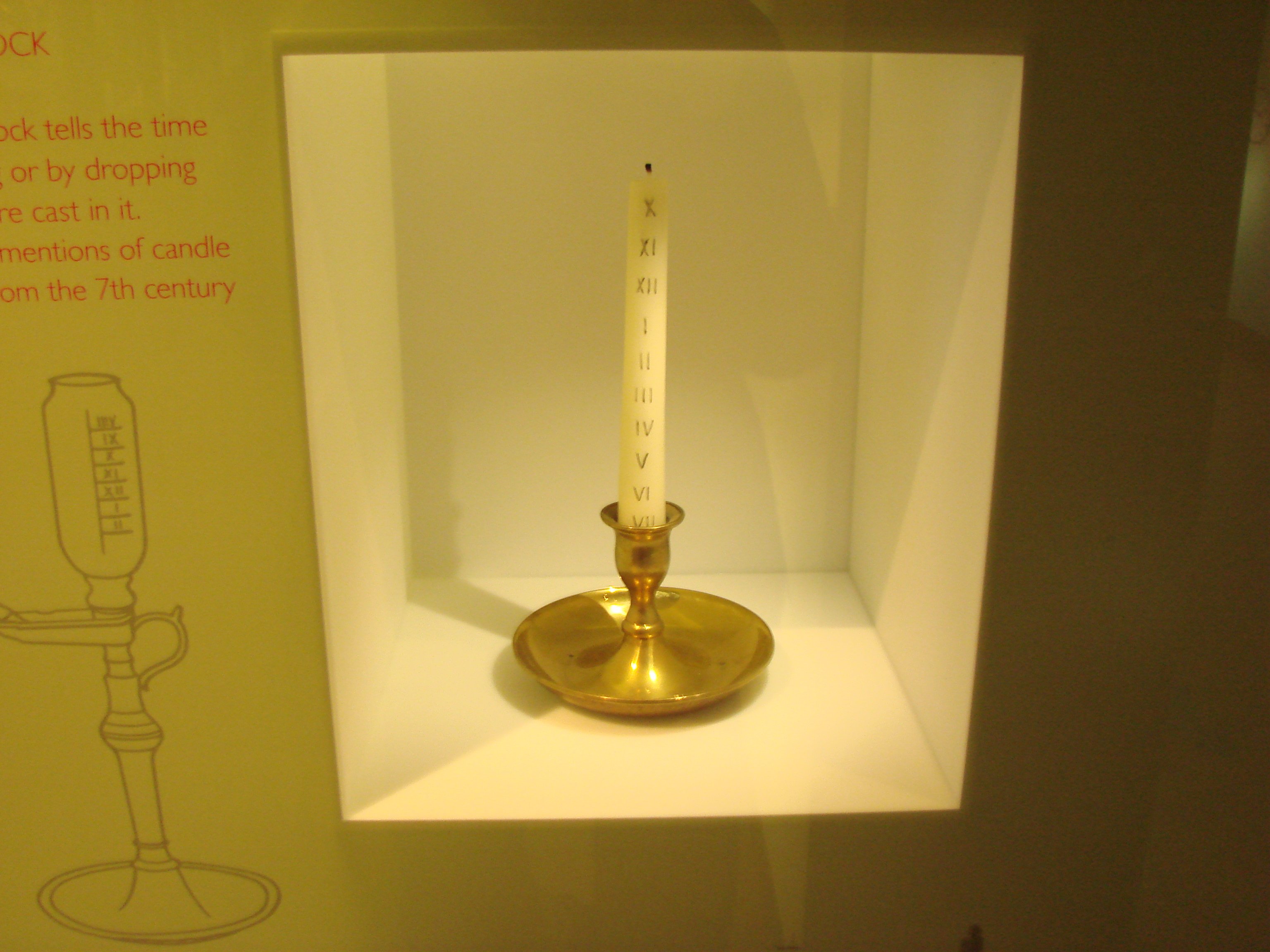
The principle is always the same: knowing burn time of a material and adding a few markers allows elapsed-time measurement.
Candle
Its “invention” as a duration-measuring tool is often credited to Alfred the Great (849-899), king of Wessex (England), who used it to divide time between work, prayer and sleep.
Oil lamp
Used in the 18th and 19th centuries in the West. You lit the wick, oil level dropped in a graduated reservoir, and elapsed time was read on the graduations.
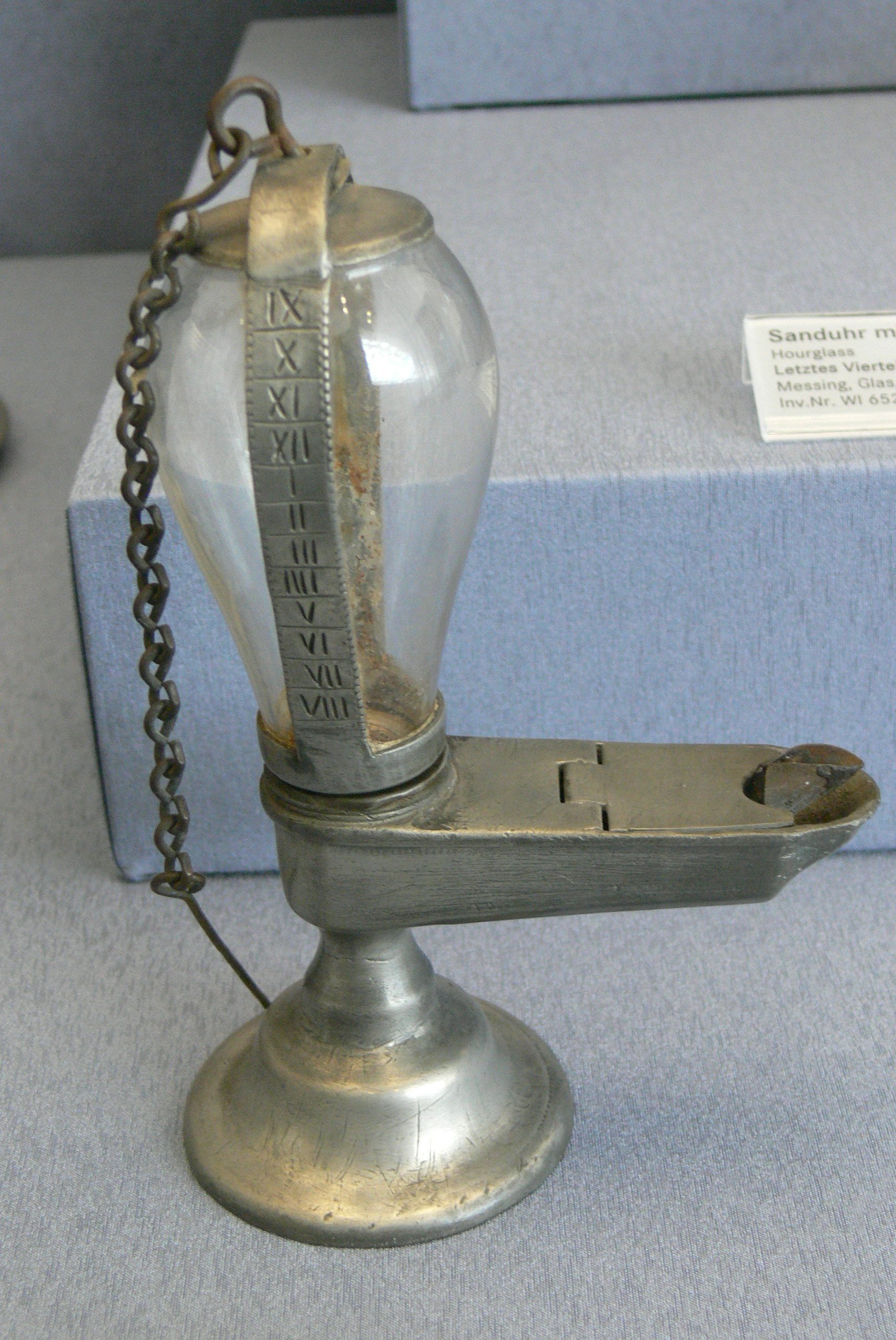
Fire clock
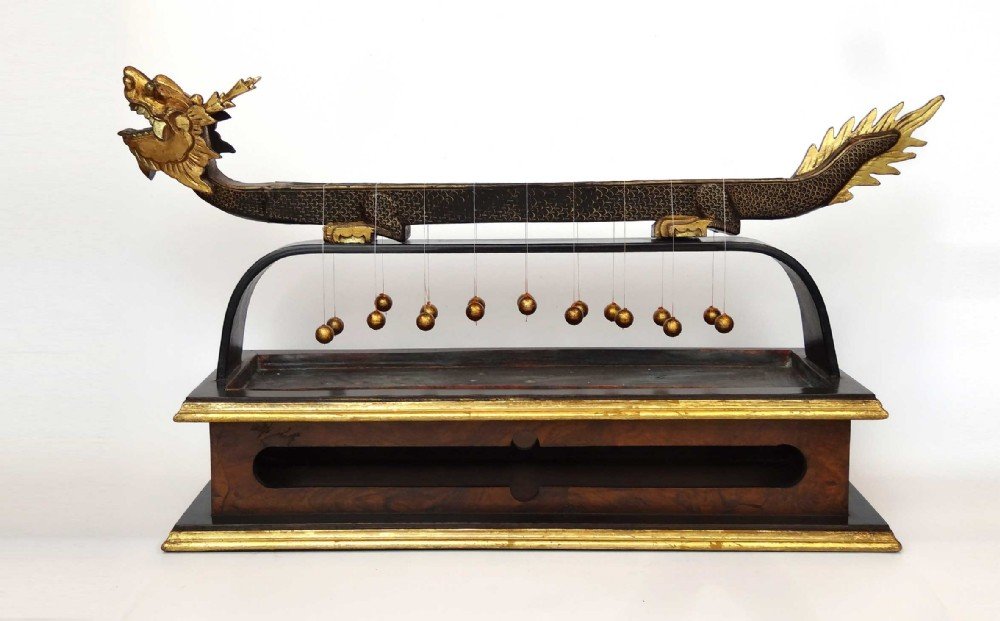
Used for a very long time in East Asia. The hollow part of a lacquer dragon-shaped object holds an incense stick on wire supports. Incense combustion gives the time.
It can even serve as an alarm clock by fixing a weighted thread across the dragon. When the burning stick reaches the desired wake-up time, it burns the thread, both weights fall into a metal receptacle, and ring like a bell.
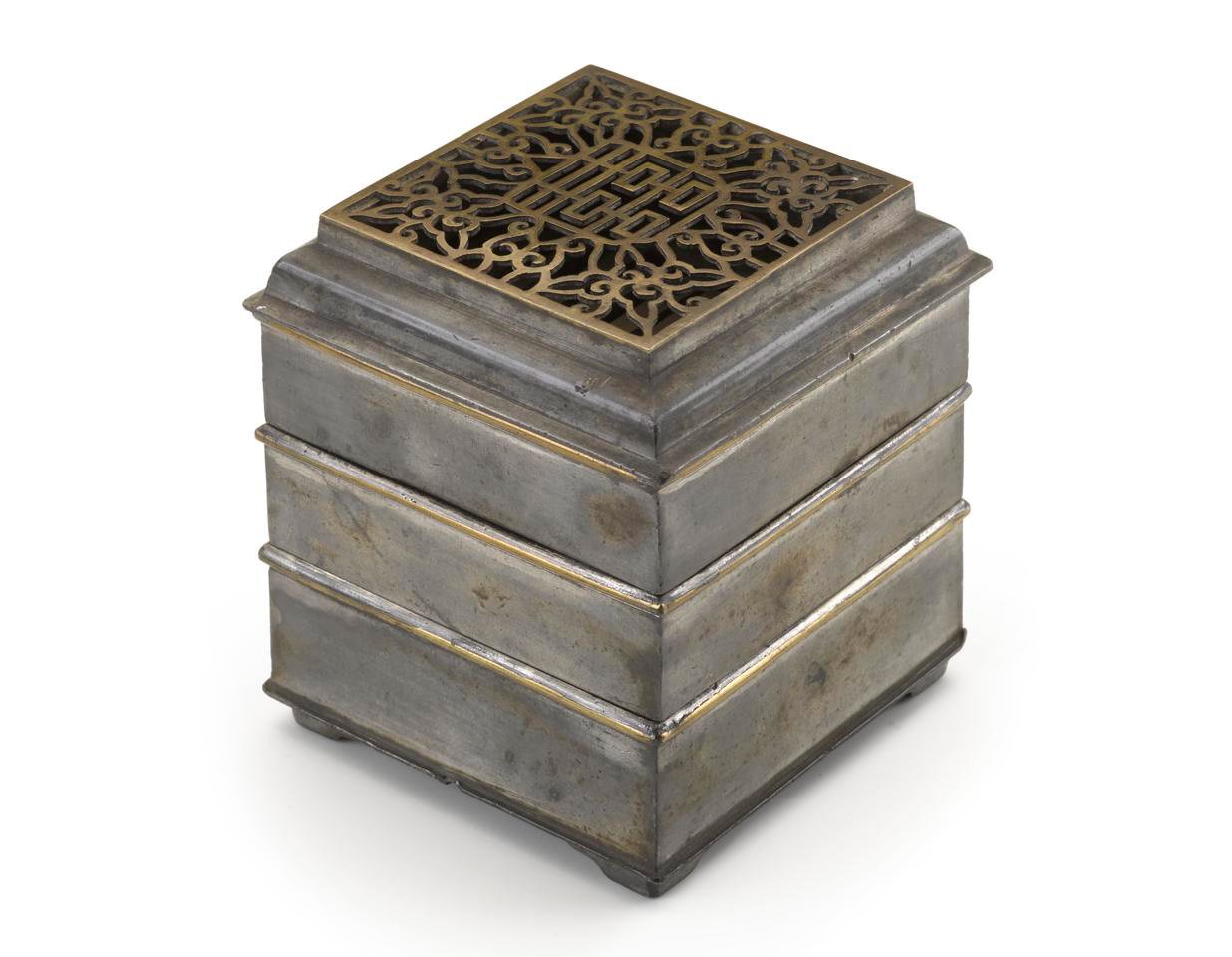
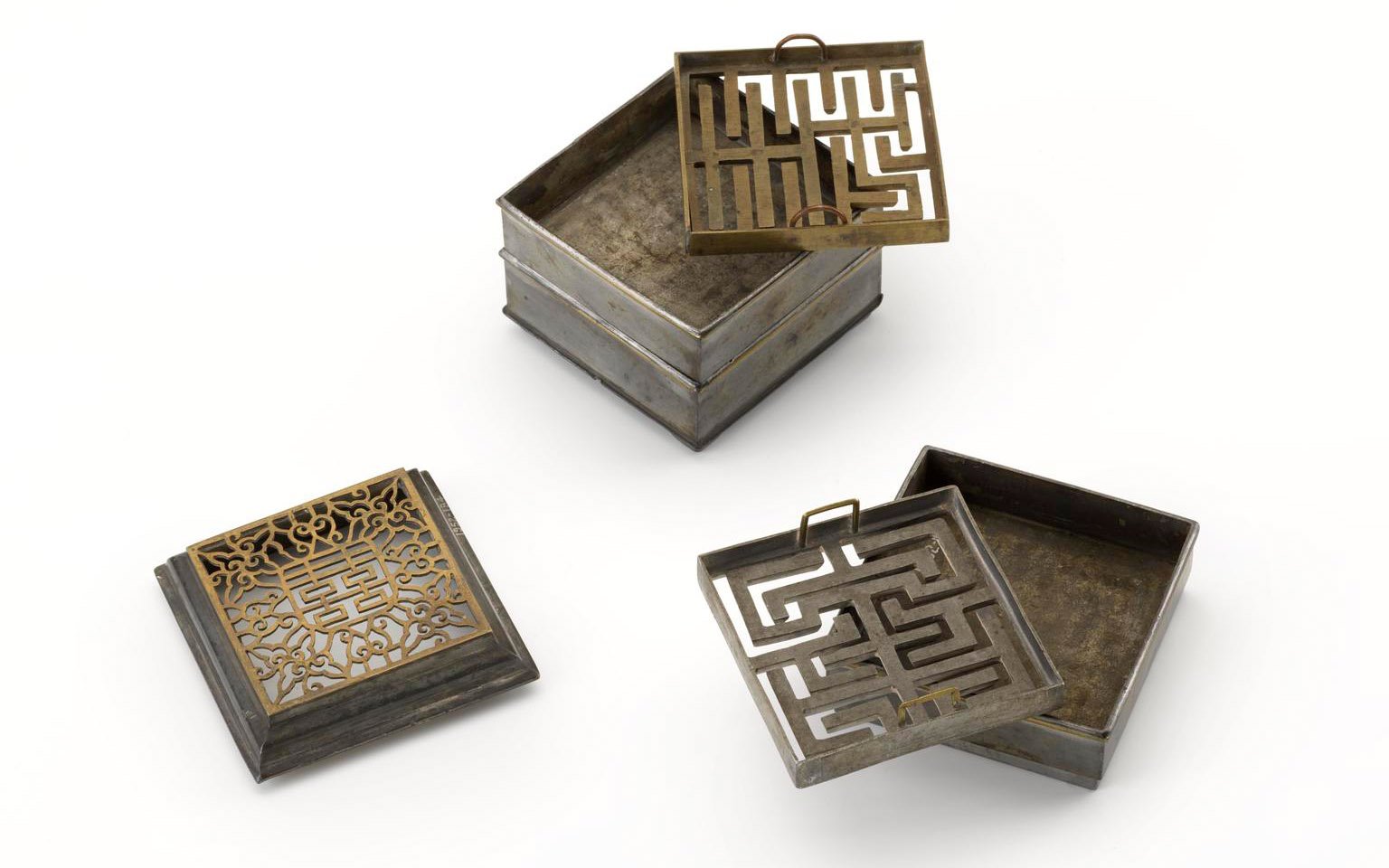
Another Chinese fire-clock type: the incense labyrinth. A grid is set on a support, the hollow channels are filled with incense powder, then the grid is removed (right image).
One end of the labyrinth is lit; when it has fully burned, the preset duration has elapsed. I assume different grids existed for different durations.