This study is intended for people building calendar-conversion software and for those who want a clearer view of the different abbreviations and their meanings (UT, UTC, GMT, ET, etc.). Since this page is not a duplicate of the Astronomy page, it is strongly recommended to reread that one before continuing. Time-measurement instruments are covered in a separate study.
1) In Search of a Time Unit - the Story of the Second
Let us imagine we are asked to define the second. How should we proceed?
Naturally, among astronomical phenomena, we will look for one that appears stable and say that a second is the X-th part of that phenomenon, which will become our time scale.
Clearly, stability is an essential condition for defining a reliable time scale. You would not define an elastic length as your meter reference.
A) First step in our search
The first idea that comes to mind is to use the day’s length as a time scale. We can define the day as the interval between two consecutive passages of the Sun at its highest point, i.e. at the local “meridian”. Since that is an instantaneous measure on a specific date, we have just defined the true solar day. In plain terms, this is sundial time.
Unfortunately, we cannot use the true solar day, because its duration varies across the year. For example, in Paris, the interval between two meridian passages is 23 h 59 min 47 s between 21 March and 22 March, but 24 h 00 min 00 s between 1 January and 2 January.
This difference results from two phenomena:
- Earth’s orbit is elliptical and follows Kepler’s laws (see the Astronomy page).
- Geometric projection on the celestial equator moves faster at solstices than at equinoxes.
So we cannot use the true solar day to define the second. Let us try something else.
We imagine a “fictitious Sun” that moves along the equator, not the ecliptic, with constant circular motion. This defines mean solar time, and the mean solar day is then defined in the same way as above.
If we compare sunrise/sunset tables from several postal calendars based on the mean solar day principle, we find matching day-to-day figures. So we have a reliable time scale: Universal Time, abbreviated U.T. (or UT in English). “Universal” means time is given by Earth’s rotation. Time in the UT scale is simply what our watches show.
First definition of the second
This gives us a first definition of the second as the X-th part of the mean solar day:
The second is 1/86,400 of the mean solar day.
The corresponding scale was defined as follows: UT is mean solar time at the prime meridian plus 12 hours. We will return later to the notion of the prime meridian.
A few remarks before we continue this story of the second:
First remark
Let us briefly go back to our postal calendar and note sunrise and sunset at a given date: 1 January 2002, for example, gives 07:46 and 16:02. Taking the half-sum gives the meridian passage time of our fictitious Sun: 11 h 54 min 30 s, i.e. a 5 min 30 s offset from mean solar time. So the Sun does not pass the meridian at 12 h UT, but either before or after.
If we plot all these daily offsets, we obtain a curve called the equation of time.
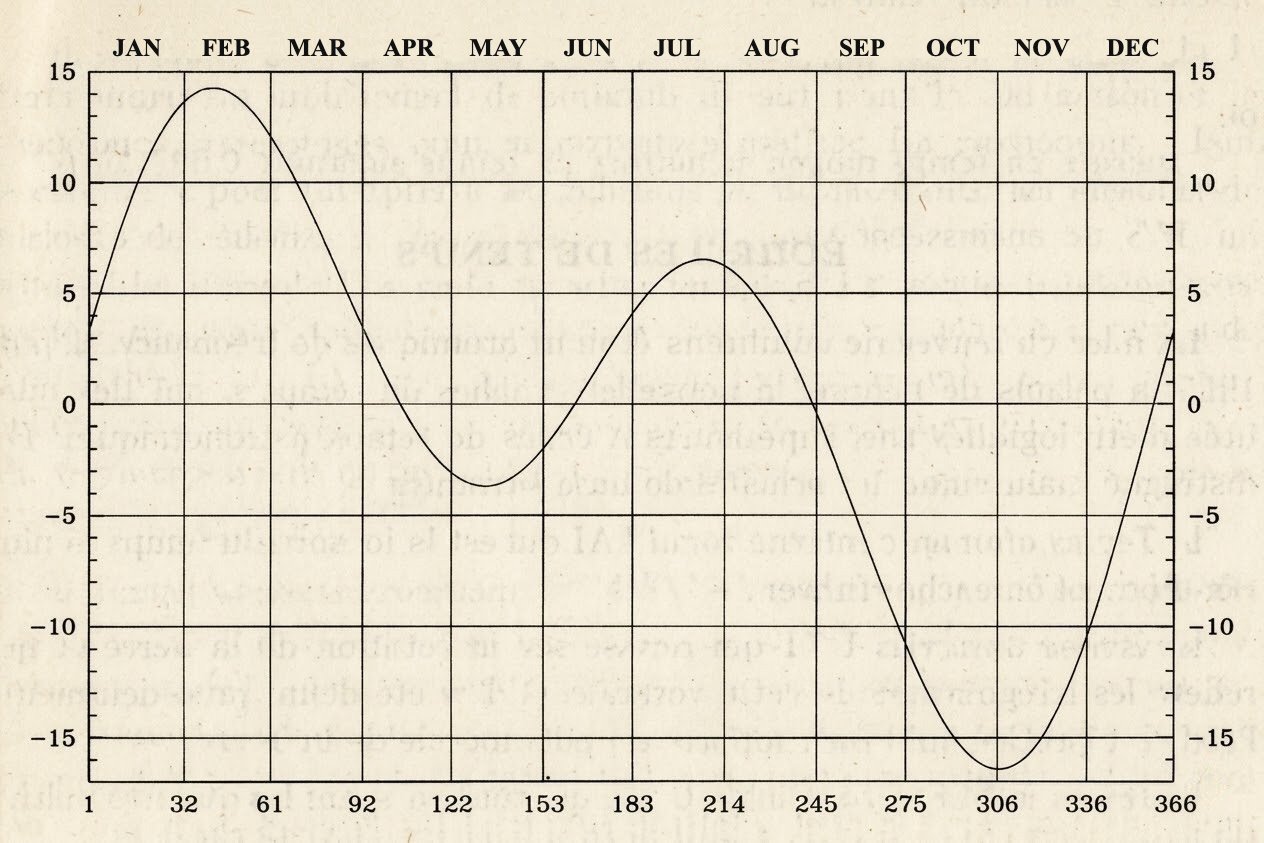
This curve crosses zero four times a year (16 April, 14 June, 1 September, 25 December). If we repeat the sunrise/sunset half-sum on those dates using the postal calendar, we indeed find meridian passage... 9 minutes before 12 h UT. Why 9 minutes? Simply because the postal calendar gives times for the Paris meridian, not the “prime meridian” (Greenwich) used in the definition above. It is an old story we will revisit later on this page.
Using this curve, we can convert between mean time and true time:
Mean time = True time + Equation of time
The equation-of-time curve is often shown in another form (analemma) on or near sundials to allow mean/true time correction.
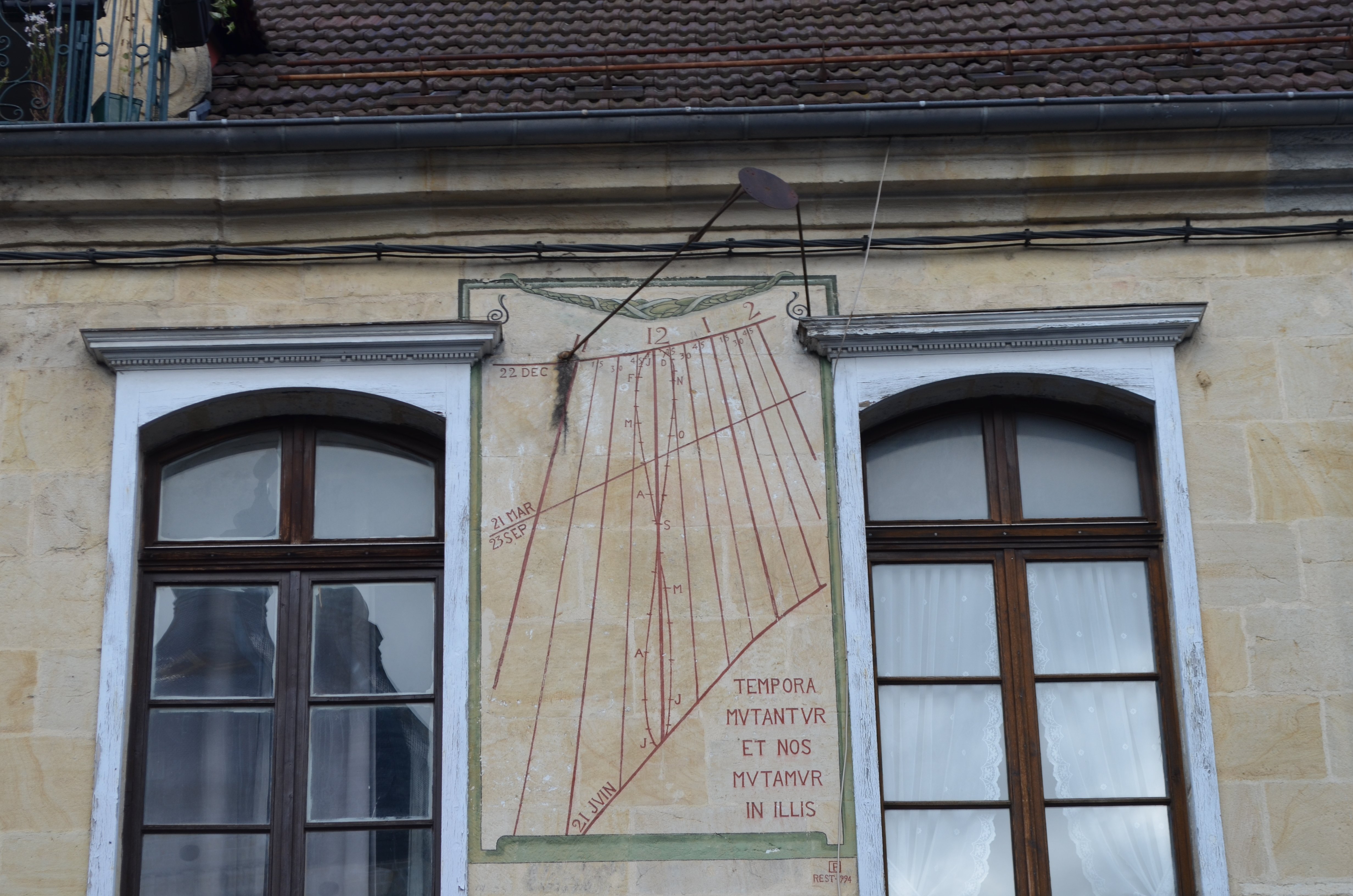
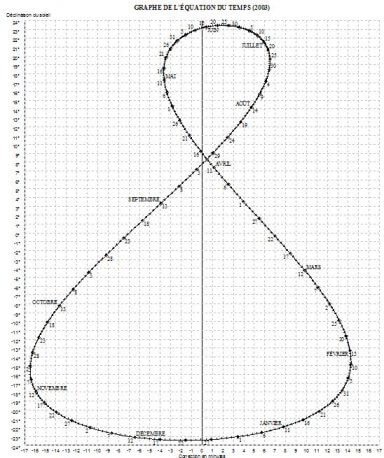
The equation of time as displayed in analemma form.
Second remark
As early as 1955, several UT variants were defined:
- UT0 is raw universal time without all corrections. Precision around 0.1 second.
- UT1 accounts for polar motion (position of Earth’s instantaneous rotation axis). This is former “UT”. Precision around 1 ms (0.001 s).
- UT2 accounts for annual Earth-rotation variations due to major climatic events.
- UT3 accounts for lunar effects (attraction, tides).
For calendar work and many other uses, there is no need to overcomplicate these TUx/UTx variants since their differences are tiny (under 30 ms between UT1 and UT0; under 60 ms between UT2 and UT1; under 4 ms between UT3 and UT2).
We will discuss UTC later; it came afterward.
Third remark: you may ask why we are not talking about GMT. Let us do so.
GMT stands for Greenwich Mean Time, i.e. mean time at longitude zero, the Greenwich meridian. We will return in part two to this choice of the prime meridian.
This time unit has no formal reason to exist since 1925, when it was replaced by UT, more precisely UT1. Still, in some professional circles it remains very persistent. That said, we are not in a great position to lecture others when French postal calendars still list sunrise/sunset by... the Paris meridian, which is not the globally recognized prime meridian.
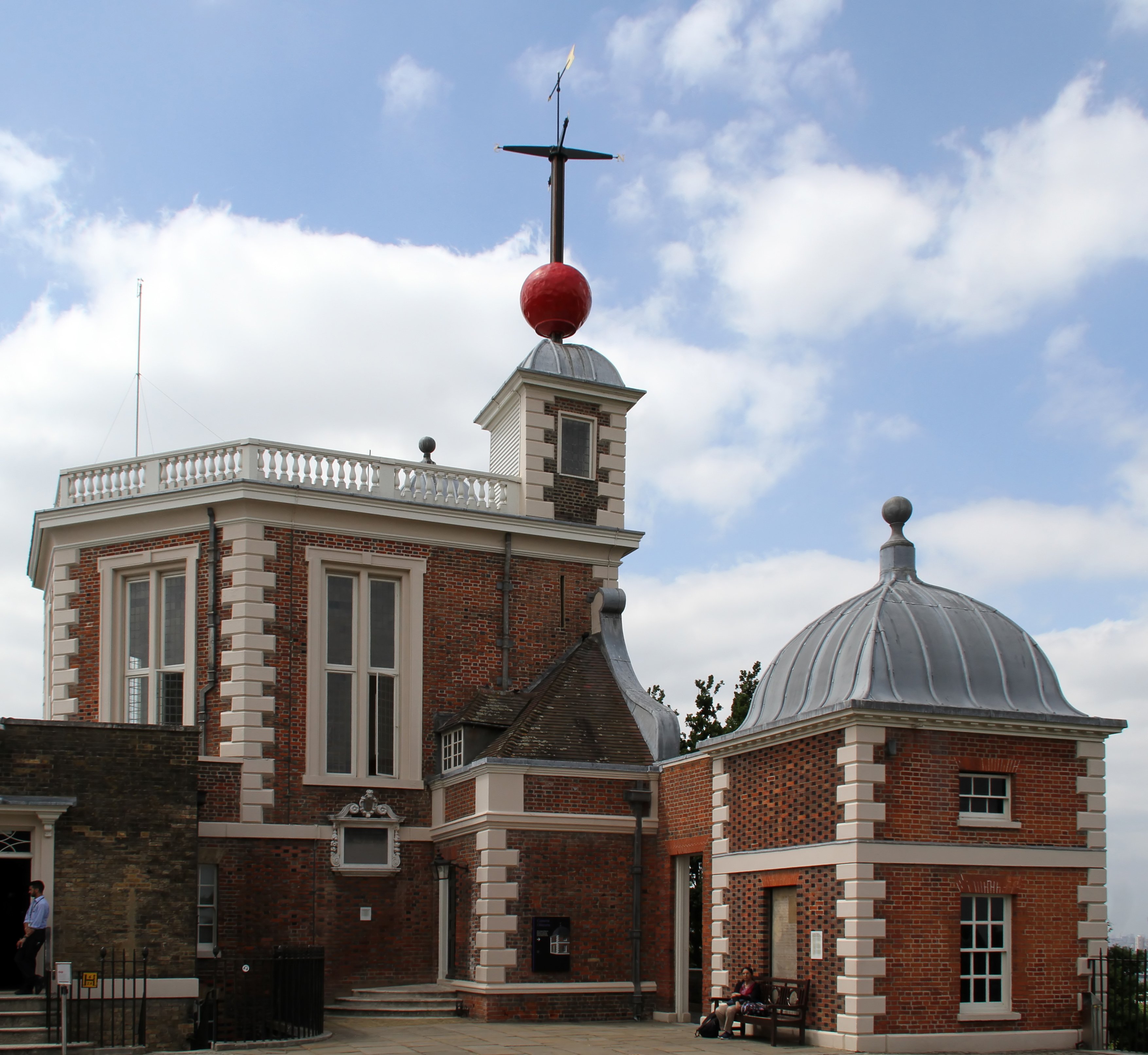
The Greenwich site became known as the Old Greenwich Observatory, and its buildings were integrated into the National Maritime Museum.
In the end, the Greenwich observatory only took on its current name after leaving Greenwich.
If you browse web discussion groups, you find endless debates about GMT. Some confidently claim UT = GMT. Others, just as confidently, claim UT = GMT + 12 h.
Who is right? The answer is simple: UT1 = GMT + 12 h. When the mean Sun passes over the Greenwich meridian, it is 00:00 GMT and, by the UT definition, 00:00 + 12:00 = 12:00.
The controversy comes from the fact that some professions (astronomers, navigators...) once agreed that at GMT “noon” it would be 00:00, to avoid changing date mid-nightshift. But that was a misuse of GMT’s definition. In any case, the dispute is largely moot because GMT is obsolete.
B) Second step in our search
Comparing mean solar time from one year to the next, we initially have every reason to be proud of UT as a scale based on Earth’s rotation.
Unfortunately, we then hit a wall: Earth’s rotation slows over the centuries. Astronomers have observed this repeatedly, and Halley (1656-1742), who discovered the comet bearing his name, already suspected it when observations failed to match calculations.
Let us try to understand this slowing phenomenon, where the Moon is the main culprit.
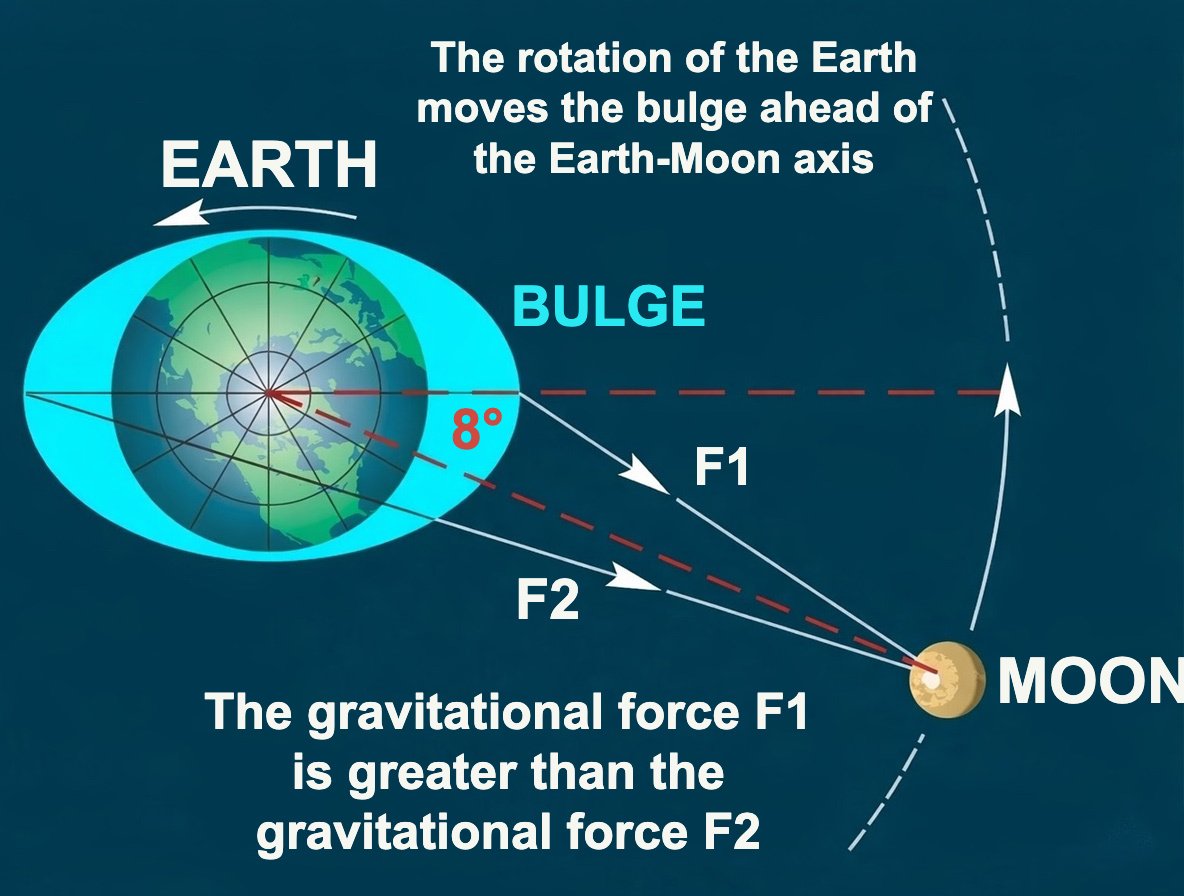
Tidal effect due to lunar attraction deforms Earth into an ellipse. This includes familiar ocean tides, but also a “solid Earth tide” that deforms Earth by a few centimeters. The major axis of this ellipse should pass through the Moon’s center. But that ignores Earth’s own rotation. Since Earth rotates faster around itself than the Moon orbits Earth, the tidal bulges do not point directly at the Moon; they run “ahead” of it. The angle is about 8 degrees.
These two bulges apply two forces of unequal intensity to the Moon (see image below). The resulting force has a double effect:
- Earth’s rotation slows down. Day length increases by about 1.8 milliseconds per century.
- Conversely, the Moon is accelerated. In space, acceleration implies orbital change: the Moon moves away from Earth. Measured recession is about two to three centimeters per year.
Will these effects last forever? No. They stabilize once Earth’s and Moon’s rotations become synchronous. At that point, in a few billion years, Earth and Moon will each show the same face to the other, and Earth’s day length will equal the lunar month. That would be roughly 50 current days. Note that the Moon has already completed this synchronization: its rotation period equals its revolution period.
Also note: although Earth’s day is lengthening now, it used to be much shorter. Dinosaurs, for example, lived with about 20-hour days.
Most surprising: there are witnesses to these phenomena - nautiluses.
A nautilus is a mollusc with a chambered shell coiled in a spiral. The chambers are linked by a tiny tube, and each night the nautilus injects nitrogen into them, which lets it rise from the roughly 400-meter depth where it lives to the surface.
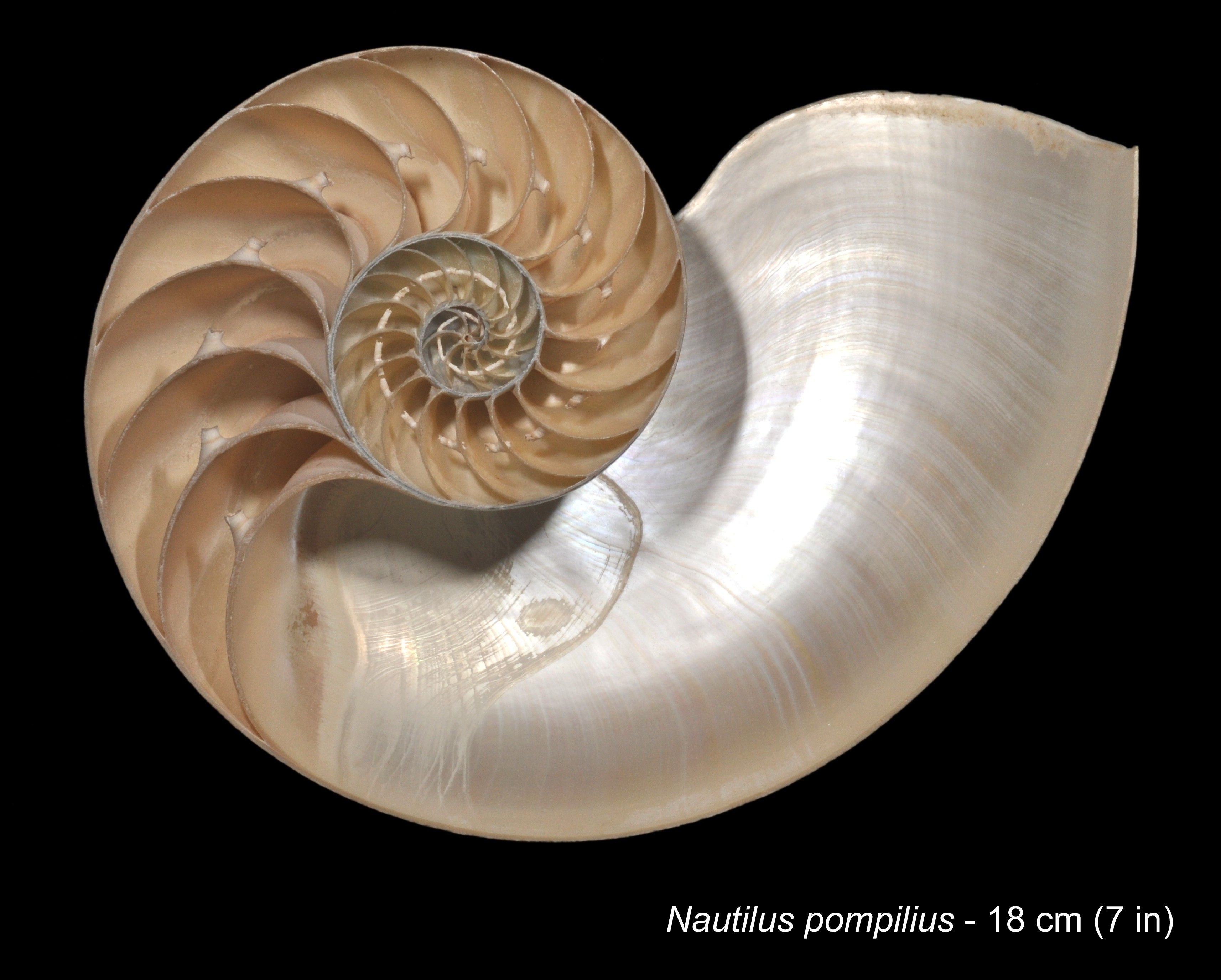
At each ascent, the nautilus secretes a calcium-carbonate growth line in its shell. These lines remain visible. After 29 or 30 days, a new chamber wall forms.
Two researchers, G. Kahn (Princeton University) and S. Pompea (Colorado State University), concluded that the nautilus seals one new chamber per lunar month, just as trees form one new ring per year (Nature, vol. 275, pp. 606-611, 1978).
By going back in time and examining fossils of different specimens with the same life pattern, Kahn and Pompea studied nautilus fossils around 420 million years old and found that the number of growth lines per chamber decreases with age: 25 lines in 30-million-year-old specimens, 17 in 150-million-year-old specimens, and 9 in 420-million-year-old specimens.
One can infer that 420 million years ago the Moon likely orbited Earth in 9 days. According to Kepler’s third law, Earth-Moon distance was then only around 150,000 kilometers.
After diving to the ocean floor for evidence, we are now convinced our initial time scale (UT) is not stable enough. We need another.
Since the day failed us, why not try another well-known astronomical phenomenon: the year.
In 1960, the 11th General Conference on Weights and Measures defined a new time scale based on year length: Ephemeris Time.
Brace yourself and admire the simplicity of its definition:
“Ephemeris Time ET is obtained as the solution of the equation giving the geometric mean longitude of the Sun:
L = 279°41'48.04" + 129,602,768.13“T + 1.089” T2
where T is counted in Julian centuries of 36,525 ephemeris days. The origin of T is 0 January 1900 at 12h ET, at the instant when the Sun’s geometric mean longitude had value 279°41'48.04".
And this gives the second definition of the second:
The second is the fraction 1/31,556,925.9747 of the tropical year for 1900 January 0 at 12 hours ephemeris time.
- First remark: purely personal - I understand none of it.
- Second remark: this was used only in astronomy.
- Third remark: this definition lasted only until 1967.
- Fourth remark: considering the two previous points, let us not overthink it and move on.
C) Third and final step in our search
The answer to our question - defining the second - is found neither in Earth’s rotation nor in its revolution around the Sun, but in the infinitely small: the atom.
Following work done in 1955 by physicists L. Essen and J. Parry at the National Physical Laboratory in London, the 13th General Conference on Weights and Measures (1967) adopted a third definition of the second:
The second is the duration of 9,192,631,770 periods of radiation corresponding to the transition between two hyperfine levels of the ground state of the caesium-133 atom.
And with it came a new scale: International Atomic Time (TAI).
We can skip the technical details here, since TAI is used mainly for scientific work rather than everyday life and has little direct use in calendar design. It is enough to know that it is produced by around 200 clocks across 30 countries, regularly cross-compared using the Global Positioning System (GPS) “in reverse”. Its precision is extraordinary: about 1 second in 1,500,000 years.
Now to the key point. Even if UT1 has irregularities, Earth’s rotation is still what structures our days and nights. It would be awkward, in exchange for a perfectly stable second, to see the Sun at zenith at... 15:00, for example.
Several decisions were made when TAI was adopted:
- A universal standard time was introduced on 1 January 1972 as the basis for legal time worldwide: coordinated universal time, UTC. Since 1978, it has been legal time in France.
- Its origin was set so that UT1 - TAI = 0 on 1 January 1958.
UTC should be viewed as a UT1 variant to which it is tightly linked. It is a compromise between TAI and UT1: its unit is the TAI second, but it may not differ from UT1 by more than +/- 0.9 second.
How is that bound maintained? The International Earth Rotation Service (IERS, formerly the Bureau International de l’Heure) in Paris monitors the offset and inserts or removes one second in UTC. This correction is applied either on 30 June or 31 December at midnight. That minute then has 61 seconds, and our clocks... jump by one second. Then we set them again.
On 1 January 1972, TAI-UTC difference was 10 seconds. Since then, 23 seconds were added, and TAI-UTC became 33 seconds, then 34 seconds in 2009.
Leap-second announcements are published in Bulletin C. Here is the 2008 one:
“INTERNATIONAL EARTH ROTATION AND REFERENCE SYSTEMS SERVICE (IERS)
SERVICE INTERNATIONAL DE LA ROTATION TERRESTRE ET DES SYSTEMES DE REFERENCE
SERVICE DE LA ROTATION TERRESTRE
OBSERVATOIRE DE PARIS
61, Av. de l'Observatoire 75014 PARIS (France)
Tel.: 33 (0) 1 40 51 22 26
FAX: 33 (0) 1 40 51 22 91
e-mail: services.iers@obspm.fr
http://hpiers.obspm.fr/eop-pcParis, 4 July 2008
Bulletin C 36
To authorities responsible
for the measurement and
distribution of timeUTC TIME STEP
on the 1st of January 2009A positive leap second will be introduced at the end of December 2008.
The sequence of dates of the UTC second markers will be:2008 December 31, 23h 59m 59s
2008 December 31, 23h 59m 60s
2009 January 1, 0h 0m 0sThe difference between UTC and the International Atomic Time TAI is:
from 2006 January 1, 0h UTC, to 2009 January 1 0h UTC: UTC-TAI = - 33s
from 2009 January 1, 0h UTC, until further notice: UTC-TAI = - 34sLeap seconds can be introduced in UTC at the end of the months of December
or June, depending on the evolution of UT1-TAI. Bulletin C is mailed every
six months, either to announce a time step in UTC or to confirm that there
will be no time step at the next possible date.Daniel GAMBIS
Observatoire de Paris, France
Head
Earth Orientation Center of IERS
Since 1972, one second has been added in each of the following years: 1972, 1973, 1974, 1975, 1976, 1977, 1978, 1979, 1980, 1981, 1982, 1984, 1987, 1989, 1990, 1991, 1992, 1993, 1995, 1996, 1998, 2005, 2008.
Also note: no second was added in 2009, in June 2010, or in December 2010.
2) History and operation of time zones
A notion heavily used in calendars (for conversions) is legal time (or local time), which comes from the creation of time zones.
In 1875, at an international congress in Paris, participants agreed to choose one single meridian from which longitudes would be counted. Greenwich was chosen at the Rome Conference in 1883.
In 1884, the International Meridian Conference in Washington created time zones: 24 vertical bands, each 15° of longitude wide. Some countries, including France, opposed adopting Greenwich as zero.
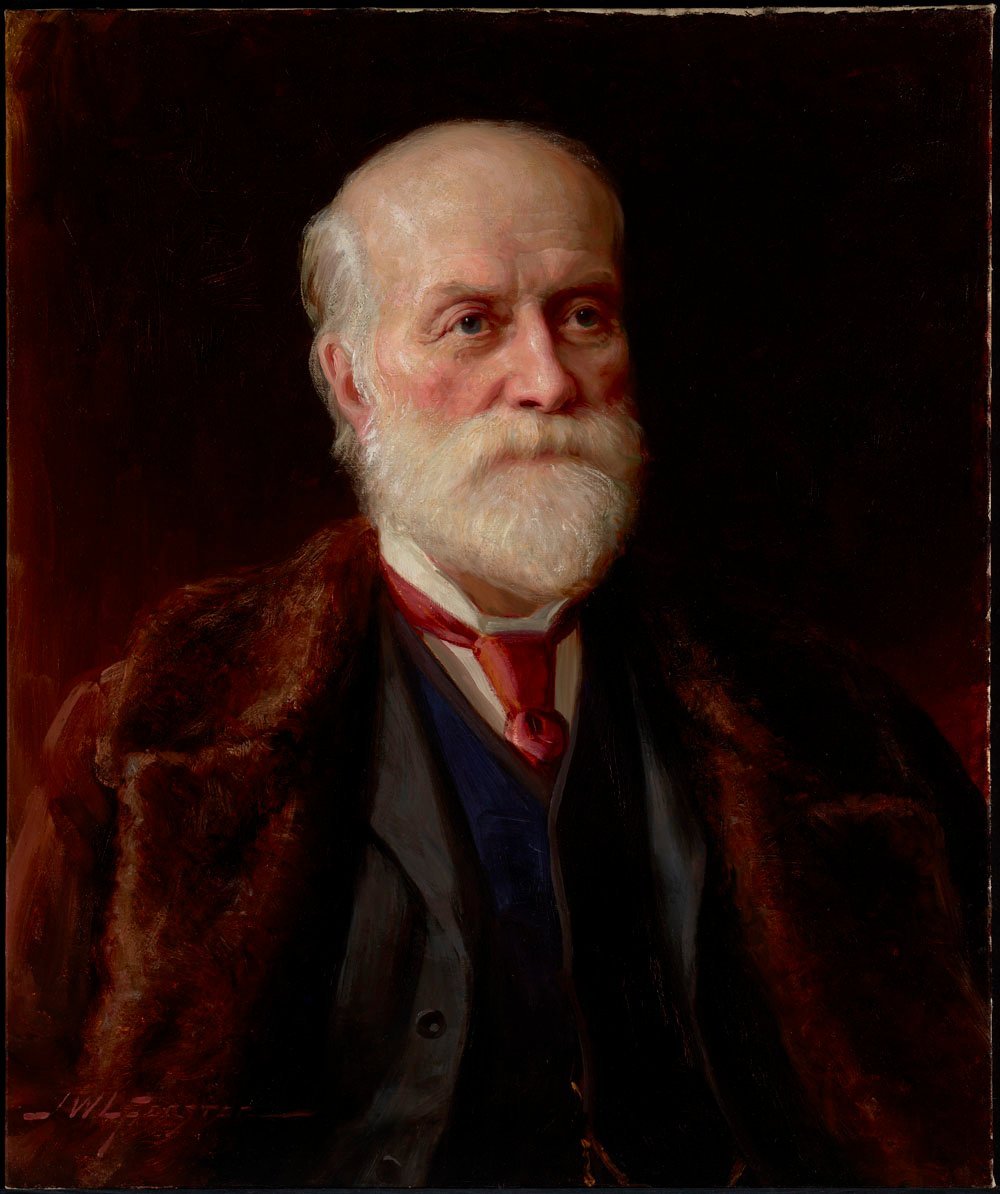
In 1878, Scottish engineer Sir Sandford Fleming (1827-1915), chief engineer of Canadian railways, proposed the time-zone system we still use today.
Until 1891, time in France varied because clocks followed the mean solar time of each prefecture. But the rise of communications (especially railways) made one national time urgent.
That uniform time was set by the law of 14 March 1891: Legal time in France and Algeria is Paris mean time.
A useful parenthesis: here is a passage from the period science weekly La Nature: “...For operational convenience and to avoid time disputes with travelers, most railway companies will set their timing instruments, by which they regulate service, three to five minutes behind Paris meridian time; so that in a station, all clocks outside the station or ticket offices show Paris time, while clocks inside the station on the platforms are five minutes behind; this is the case for Paris-Lyon-Méditerranée, Ouest, Etat and Midi railways. For Nord and Est railways, the delay is only three minutes...”
By law of 9 March 1911, France almost “fell into line”: legal time became Paris mean time delayed by 9 minutes 21 seconds (Paris longitude). In practice, this meant French time was universal time.
The 1911 law was replaced by the decree of 9 August 1978, stating that “legal time is obtained by adding or subtracting a whole number of hours from Coordinated Universal Time”.
Operation
Let us look at a map showing time zones:
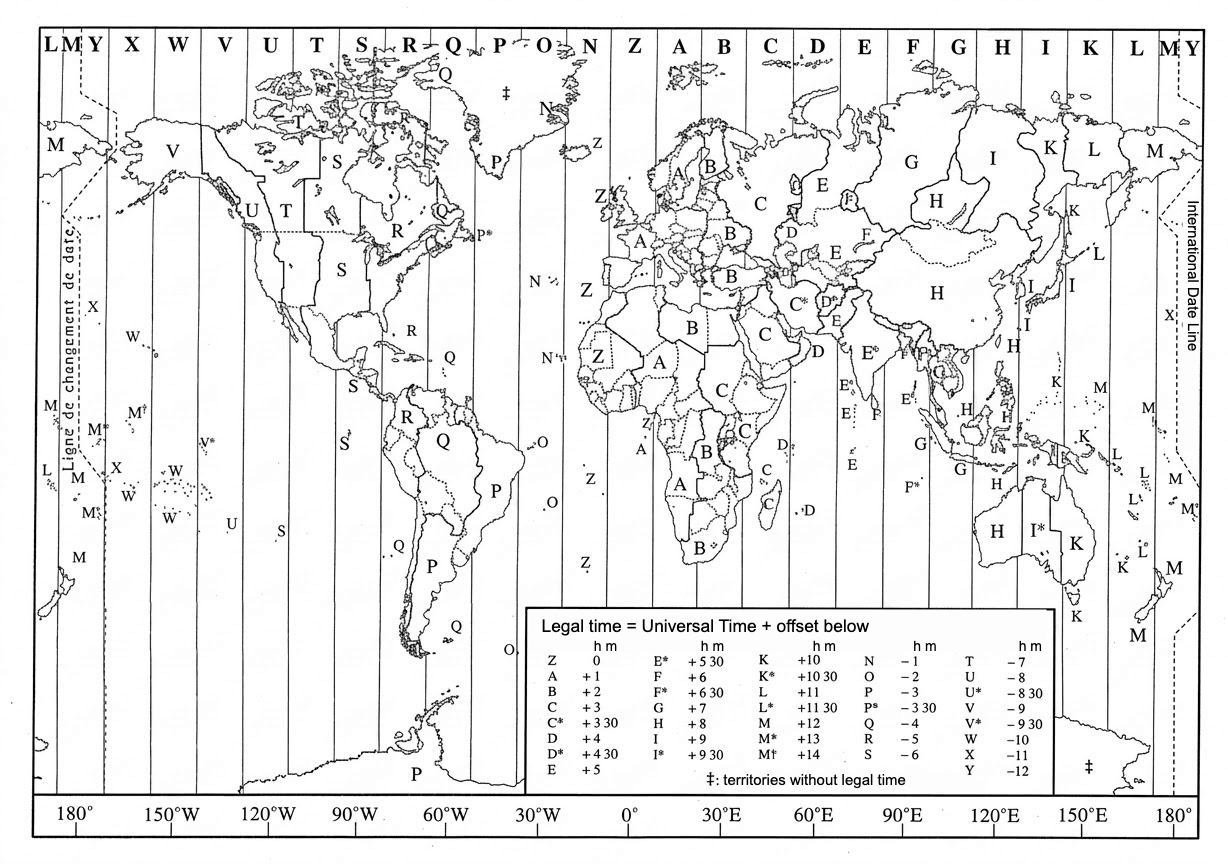
We first see the 24 “bands” representing the zones. At the top of each band is its letter code. Band Z is the one containing the Greenwich meridian, which, as noted, is the prime meridian. If we extend that meridian to its antipode (longitude 180°), we reach the date-change line. Looking closely, we better understand why Greenwich was chosen. Had Paris been chosen, for example, part of New Zealand would live under two different dates. Well... almost.
There is a one-hour offset from one zone to the next. Moving east from Greenwich, you add one hour at each zone change to get local time. Moving west from Greenwich, you subtract one hour. At the antipodal meridian, you keep the same clock time but switch date one way or the other depending on where you came from.
In short: local time is the same within one zone, but each zone is one hour earlier than its eastern neighbor. Plus the International Date Line exception. Thanks to that, Phileas Fogg gained a day in Around the World in Eighty Days.
That is the theory. In practice (for a large-format map click here):
- Some territories such as Greenland or Antarctica have no dedicated legal time: UTC is used there.
- Zone boundaries are not straight lines: some countries refuse to be split across two zones. Boundaries often follow borders. Sometimes zones are redrawn inside one country (Canada, for example). Even the date line is not exempt from adjustments.
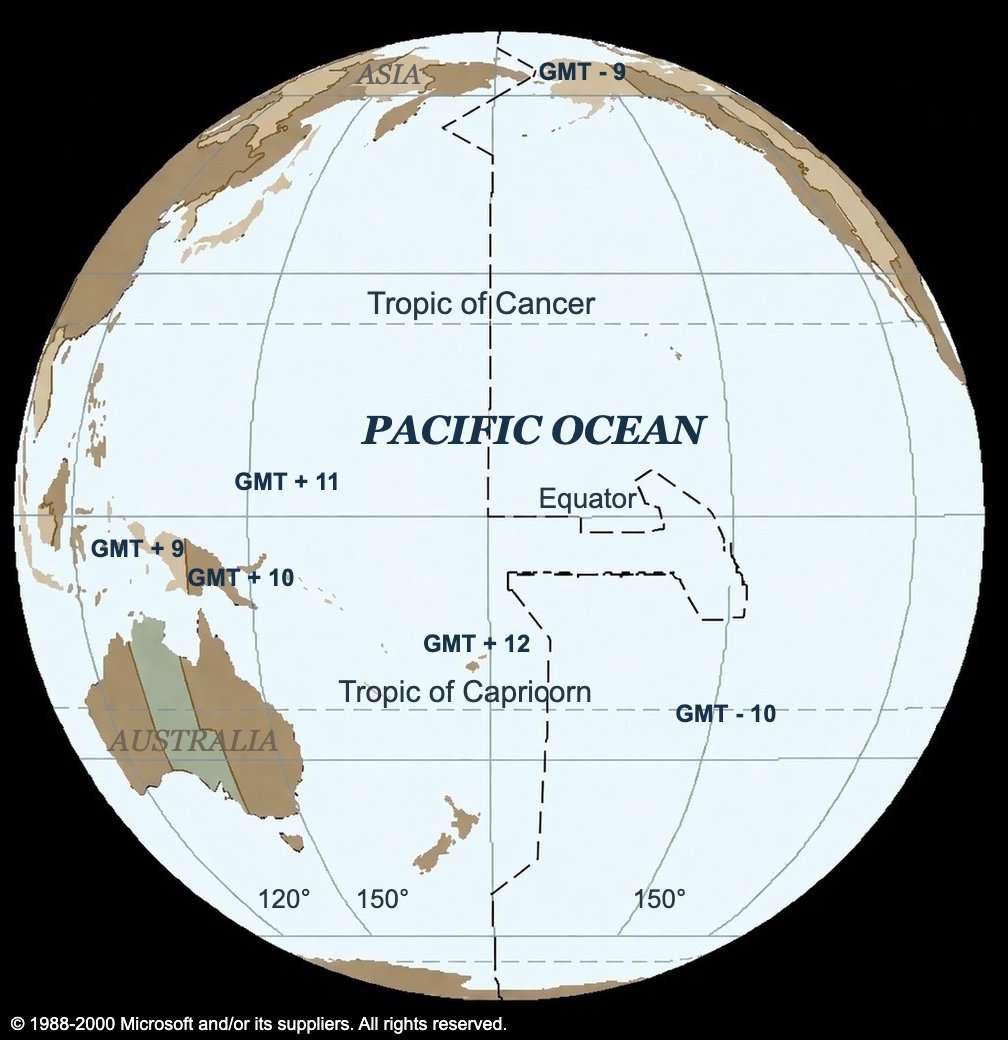
The date-separation line is not linear. Also note that some people still use the term GMT.
- Conversely, some countries that should logically have several legal times (because they span multiple zones) have chosen one nationwide legal time. China is the classic case: it uses Beijing time.
- Other countries use half-hour or quarter-hour offsets (Afghanistan = +3.5; India = +5.30; Nepal = +5.45...). France is not innocent either: although fully located in zone zero, it runs at +1.00. Clearly, we never fully made peace with Greenwich.
- On top of that, we must add daylight-saving systems almost everywhere (D.S.T, Daylight Saving Time). For France, here is the Order of 3 April 2001 on French legal time, signed by Laurent Fabius:
“The Minister of Economy, Finance and Industry, the Minister of Equipment, Transport and Housing, and the Secretary of State for Industry,
Having regard to Directive 2000/84/EC of the European Parliament and of the Council of 19 January 2001 on summer-time arrangements;
Having regard to Decree no. 78-855 of 9 August 1978 on French legal time;
Having regard to Decree no. 79-896 of 17 October 1979 setting French legal time,
Hereby decree:Art. 1. - In metropolitan departments of the French Republic, from year 2002 onward, summer time starts on the last Sunday of March at 2 a.m. At that instant, one hour is added to legal time.
Art. 2. - In metropolitan departments of the French Republic, from year 2002 onward, summer time ends on the last Sunday of October at 3 a.m. At that instant, one hour is subtracted from legal time.
Art. 3. - This order shall be published in the Official Journal of the French Republic.
A small, non-exhaustive table of legal times in different countries (without summer/winter adjustments). Note: this table is no longer up to date; countries occasionally change time zones.
| A | G | O | |||
| Afghanistan | + 4.5 H | Gabon | + 1.0 H | Oman | + 4.0 H |
| South Africa | + 2.0 H | Gambia | + 0.0 H | P | |
| Albania | + 1.0 H | Georgia | + 4.0 H | Pakistan | + 5.0 H |
| Algeria | + 1.0 H | Ghana | + 0.0 H | Panama | - 5.0 H |
| Germany | + 1.0 H | Greece | + 2.0 H | Papua New Guinea | + 10.0 H |
| Andorra | + 1.0 H | Grenada | - 4.0 H | Paraguay | - 4.0 H |
| Angola | + 1.0 H | Guatemala | - 6.0 H | Netherlands | + 1.0 H |
| Antigua and Barbuda | - 4.0 H | Guinea | + 0.0 H | Peru | - 5.0 H |
| Saudi Arabia | + 3.0 H | Equatorial Guinea | + 0.0 H | Philippines | + 8.0 H |
| Argentina | - 2.0 H | Guinea-Bissau | + 0.0 H | Poland | + 1.0 H |
| Armenia | + 4.0 H | Guyana | - 3.0 H | Portugal | + 1.0 H |
| Australia | + 10.0 H | H | Q | ||
| Austria | + 1.0 H | Haiti | - 5.0 H | Qatar | + 3.0 H |
| Azerbaijan | + 3.0 H | Honduras | - 6.0 H | R | |
| B | Hungary | + 1.0 H | Central African Republic | + 0.0 H | |
| Bahamas | - 5.0 H | I | Dominican Republic | - 4.0 H | |
| Bahrain | + 3.0 H | India | + 5.5 H | Czech Republic | + 2.0 H |
| Bangladesh | + 6.0 H | Indonesia | + 8.0 H | Reunion | + 4.0 H |
| Belgium | + 1.0 H | Iran | + 3.5 H | Romania | + 2.0 H |
| Belize | - 6.0 H | Iraq | + 3.0 H | United Kingdom | + 0.0 H |
| Benin | + 1.0 H | Ireland | + 0.0 H | Central Russia | + 4.0 H |
| Bhutan | + 6.0 H | Iceland | + 0.0 H | Eastern Russia | + 11.0 H |
| Myanmar | + 6.5 H | Israel | + 2.0 H | Western Russia | + 2.0 H |
| Bolivia | - 4.0 H | Italy | + 1.0 H | Rwanda | + 2.0 H |
| Bosnia and Herzegovina | + 1.0 H | J | S | ||
| Botswana | + 2.0 H | Jamaica | - 5.0 H | Saint Kitts and Nevis | - 4.0 H |
| Brazil | - 4.0 H | Japan | + 9.0 H | Saint Lucia | - 4.0 H |
| Brunei | + 8.0 H | Jordan | + 2.0 H | San Marino | - 4.0 H |
| Bulgaria | + 2.0 H | K | Saint Vincent and the Grenadines | - 4.0 H | |
| Burkina | + 0.0 H | Kazakhstan | + 6.0 H | Solomon Islands | + 11.0 H |
| Burundi | + 2.0 H | Kenya | + 3.0 H | Western Samoa | - 11.0 H |
| C | Kiribati | + 12.0 H | Sao Tome and Principe | + 0.0 H | |
| Cambodia | + 7.0 H | Kuwait | + 3.0 H | Senegal | + 0.0 H |
| Cameroon | + 1.0 H | L | Seychelles | + 4.0 H | |
| Canada Central | - 6.0 H | Laos | + 7.0 H | Sierra Leone | + 0.0 H |
| Canada East | - 5.0 H | Lesotho | + 2.0 H | Singapore | + 8.0 H |
| Canada Mountain Time | - 7.0 H | Latvia | + 2.0 H | Slovakia | + 1.0 H |
| Canada Pacific | - 8.0 H | Lebanon | + 2.0 H | Slovenia | + 1.0 H |
| Cape Verde | - 1.0 H | Liberia | + 0.0 H | Somalia | + 3.0 H |
| Chile | - 4.0 H | Libya | + 2.0 H | Sudan | + 2.0 H |
| China | + 8.0 H | Liechtenstein | + 1.0 H | Sri Lanka | + 5.5 H |
| Cyprus | + 2.0 H | Lithuania | + 2.0 H | Sweden | + 1.0 H |
| Colombia | - 5.0 H | Luxembourg | + 1.0 H | Switzerland | + 1.0 H |
| Congo | + 1.0 H | M | Suriname | - 3.0 H | |
| Cook | - 10.0 H | Macedonia | + 1.0 H | Swaziland | + 2.0 H |
| North Korea | + 9.0 H | Madagascar | + 3.0 H | Syria | + 2.0 H |
| South Korea | + 9.0 H | Malaysia | + 8.0 H | T | |
| Costa Rica | - 6.0 H | Malawi | + 2.0 H | Tajikistan | + 6.0 H |
| Côte d'Ivoire | + 1.0 H | Maldives | + 5.0 H | Taiwan | + 8.0 H |
| Croatia | + 1.0 H | Mali | + 0.0 H | Tanzania | + 3.0 H |
| Cuba | - 5.0 H | Malta | + 1.0 H | Chad | + 1.0 H |
| D | Morocco | + 0.0 H | Thailand | + 7.0 H | |
| Denmark | + 1.0 H | Marshall | + 12.0 H | Togo | + 0.0 H |
| Djibouti | + 3.0 H | Maurice | + 4.0 H | Tonga | + 13.0 H |
| Dominica | - 4.0 H | Mauritania | + 0.0 H | Trinidad and Tobago | - 4.0 H |
| E | Mexico Central | - 6.0 H | Tunisia | + 1.0 H | |
| Egypt | + 2.0 H | Mexico East | - 5.0 H | Turkmenistan | + 5.0 H |
| United Arab Emirates | + 4.0 H | Mexico West | - 7.0 H | Turkey | + 2.0 H |
| Ecuador | + 1.0 H | Moldova | + 2.0 H | Tuvalu | + 12.0 H |
| Eritrea | + 3.0 H | Monaco | + 1.0 H | U | |
| Spain | + 1.0 H | Mongolia | + 8.0 H | Uganda | + 3.0 H |
| Estonia | + 2.0 H | Mozambique | + 2.0 H | Ukraine | + 2.0 H |
| United States CT | - 7.0 H | N | Uruguay | - 3.0 H | |
| United States EST | - 6.0 H | Namibia | + 1.0 H | V | |
| United States MT | - 8.0 H | Nauru | + 12.0 H | Vanuatu | + 11.0 H |
| United States PCT | - 9.0 H | Nepal | + 5.75 H | Vatican | + 1.0 H |
| Ethiopia | + 3.0 H | Nicaragua | - 6.0 H | Venezuela | - 4.0 H |
| F | Niger | + 1.0 H | Vietnam | + 7.0 H | |
| Fiji | + 12.0 H | Nigeria | + 1.0 H | W | |
| Finland | + 2.0 H | Norway | + 1.0 H | Wallis and Futuna Islands | + 12.0 H |
| France | + 1.0 H | New Zealand | + 12.0 H | Y | |
| Reminder: this table does not account for daylight-saving and standard-time changes | Yemen | + 3.0 H | |||
| Yugoslavia | + 1.0 H | ||||
| Z | |||||
| Zambia | + 2.0 H | ||||
| Zimbabwe | + 2.0 H | ||||
And finally, a small extra: the list of words corresponding to time-zone letters:
| Letter | Word | Local time |
|---|---|---|
| Y | Yankee | UTC - 12 |
| X | X-Ray | UTC - 11 |
| W | Whiskey | UTC - 10 |
| V | Victor | UTC - 9 |
| U | Uniform | UTC - 8 |
| T | Tango | UTC - 7 |
| S | Sierra | UTC - 6 |
| R | Romeo | UTC - 5 |
| Q | Quebec | UTC - 4 |
| P | Papa | UTC - 3 |
| O | Oscar | UTC - 2 |
| N | November | UTC - 1 |
| Z | Zulu | UTC |
| A | Alpha | UTC + 1 |
| B | Bravo | UTC + 2 |
| C | Charlie | UTC + 3 |
| D | Delta | UTC + 4 |
| E | Echo | UTC + 5 |
| F | Foxtrot | UTC + 6 |
| G | Golf | UTC + 7 |
| H | Hotel | UTC + 8 |
| I | India | UTC + 9 |
| K | Kilo | UTC + 10 |
| L | Lima | UTC + 11 |
| M | Mike | UTC + 12 |