By way of introduction
By solving the drift in the date of Easter, the Gregorian reform also aligned the seasons to identical periods from one year to the next. The average length of the Gregorian year is almost identical to that of the tropical year.
Still, to better understand what we are talking about, we need to know exactly what a tropical year is, and what we mean by season(s).
Are we talking about the same thing when we say “this is not seasonal weather” or “strawberry season”? Worse: when we look at a postal almanac and read for 2007 “summer: 21 June at 18:06,” we are entitled to wonder what exactly happens on that day, at that hour, to justify saying we have moved from spring to summer.
As for me, however much I look around on 21 June, I see no difference from the day before. No more seems to happen between 20 and 21 June than between the day before and the use-by date printed on a can of peas.
Throughout this study, we will try to understand what these highly precise dates of the four seasons in calendars correspond to, verify whether these four seasons truly define the tropical year, determine what seasons mean in everyday life, and take a trip around the planet to see whether these four seasons exist everywhere.
Astronomical seasons
Credit where credit is due. Since this site is about time and calendars, let us take our 2007 postman almanac. It says: 21 March at 00:07 UT is spring, 21 June at 18:06 UT is summer, 23 September at 09:50 UT is autumn, and 22 December at 06:07 UT is winter.
And we ask ourselves:
- Why 21 March, 21 June, etc.? What could possibly be happening on those dates?
- And what happens between 21 March and 21 June, between 21 June and 23 September, etc.?
Astronomy will help us answer these questions.
No, no - don't run away! I am no more an astronomer than you are. So we will keep this simple, without drowning ourselves in astronomical jargon or complicated calculations. Our only aim is to understand these seasons mentioned by our calendar. Shall we?
Welcome, then, to those still reading this page. We will move forward step by step.
And let us note right away: all drawings on this page are not to scale.
Step one: revolution and eccentricity
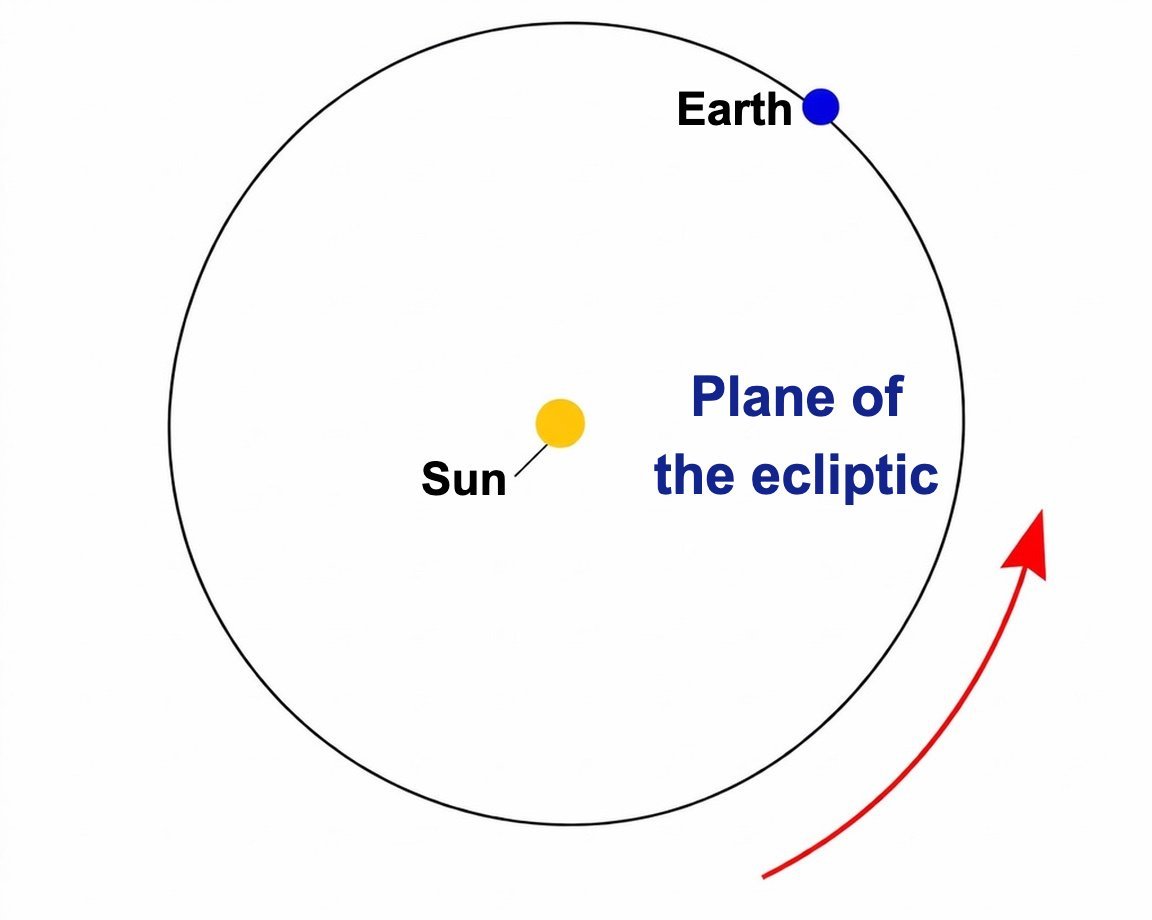
The Earth goes around the Sun in a plane, in direct motion (counterclockwise), in one year.
Several clarifications must be made.
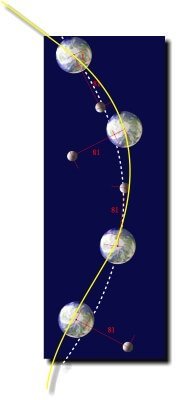
1) In fact, it is not Earth's geometric center that moves in the ecliptic plane (dotted white line), but the center of gravity of the Earth-Moon system.
This Earth-Moon center of gravity is called the barycentre and lies about 4,700 km from Earth's geometric center, on an imaginary line joining Earth's center and the Moon's center.
This creates a forward-backward wobble in Earth's motion during each lunar cycle (solid yellow line in the left diagram).
The mass ratio of the Earth-Moon system is 81:1, so the system's center of gravity is 81 times farther from the Moon's center than from Earth's center.
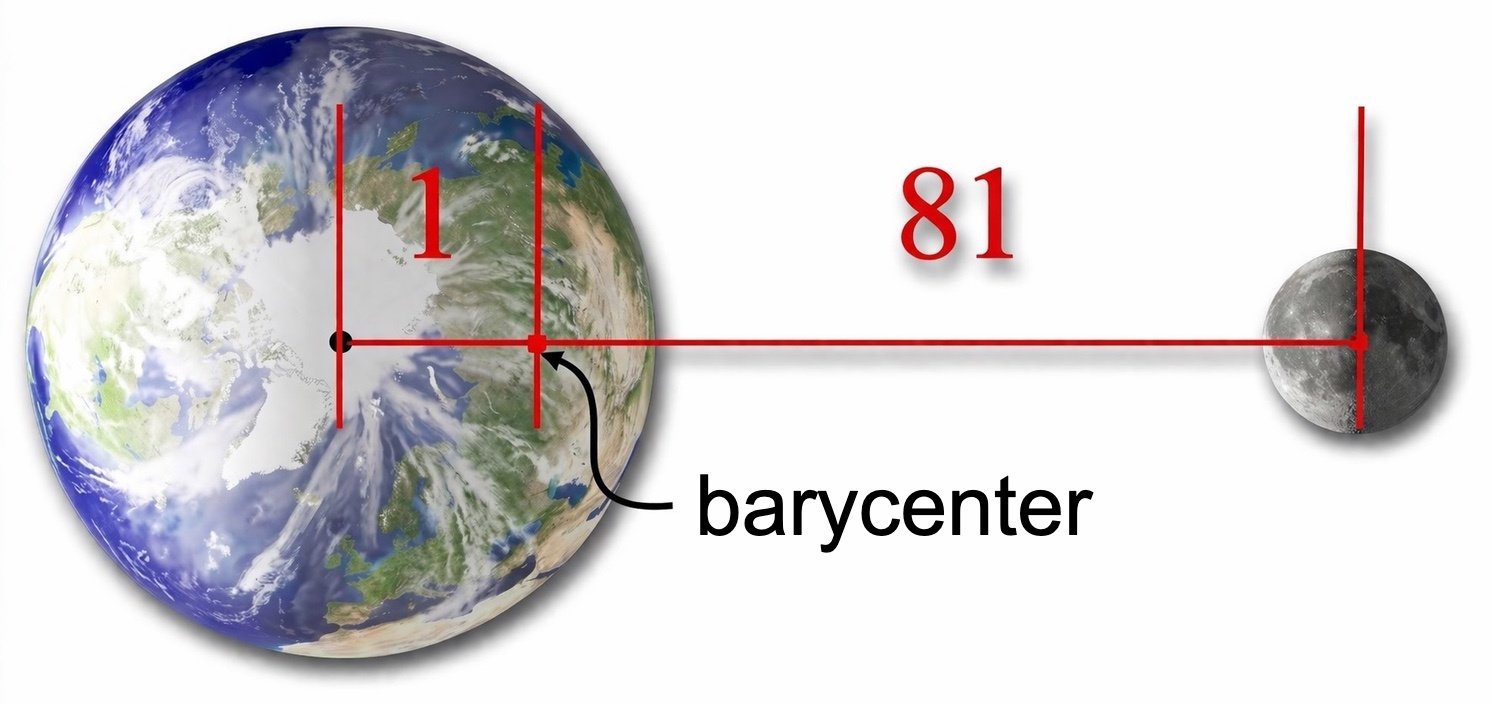
Note that Earth's center is often approximated as coinciding with the Earth-Moon barycentre. This approximation can sometimes have non-negligible consequences on the dates and times of certain astronomical events. We will come back to that below.
2) Earth's revolution around the Sun is not a circle but an ellipse.
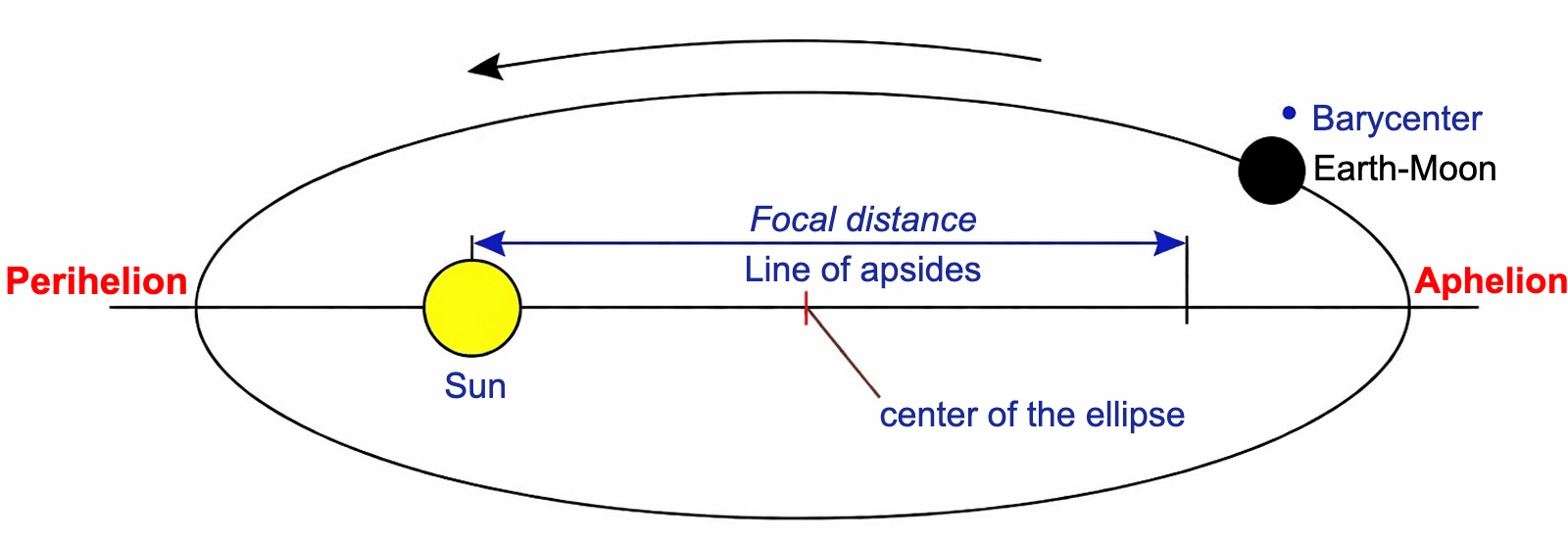
Every ellipse has two foci located on its major axis, called the line of apsides. The Sun occupies one of these foci.
The greater the distance between foci (focal distance), the flatter the ellipse. The ratio of this distance to the major-axis length is the eccentricity coefficient: e = focal distance / major-axis length. It varies between 0 and 1, and flattening increases as e approaches zero, as shown below.

For Earth, orbital eccentricity was 0.0167086342 on 1 January 2000 (it varies between 0 and 0.07 over a 95,000-year cycle). That shows how close the first image on this page was to reality.
In any case, because the Earth-Moon barycentre orbit is elliptical, Earth-Sun distance has a minimum value (perihelion) and a maximum value (aphelion). Those distances are currently about 147,100,000 km and 152,100,000 km respectively.
Earth passes perihelion currently in early January and aphelion in early July*. No, this is not a mistake: when days are hottest in our hemisphere, Earth-Sun distance is at its maximum.
- Earth reached aphelion on 6 July 2007 at 23:52 UTC, i.e. 7 July at 01:52 French legal time. Earth-Sun distance was then 152,097,044.24 km. Source: IMCCE.
3) At the beginning of this step, we said Earth's revolution around the Sun takes one year.
True - but there are several kinds of years. The principle is always simple: choose a remarkable reference position and measure the time until that position recurs.
From what we have seen so far, we can already define two.
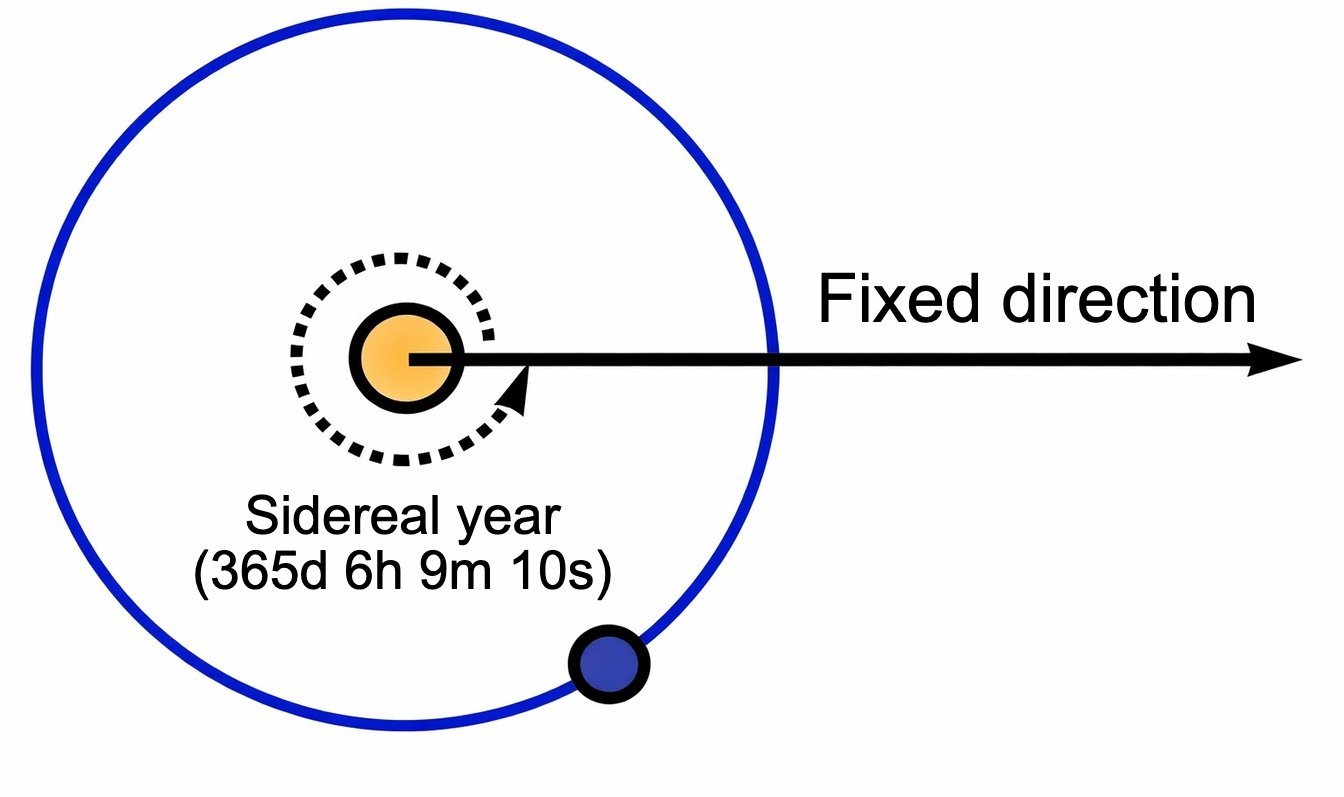
a) Sidereal year: the interval between two passages of Earth in the same fixed direction (relative to stars). Its duration is 365.2566 days (365 days 6h 9m 10s).
Still, note that:
- Earth's starting position relative to stars is not strictly identical at the end of one sidereal year.
- For seasons, we frankly do not care about the sidereal year. But it had to be mentioned, and it will serve as a reference for other year types.
b) Anomalistic year: this time we use passage of the Earth-Moon barycentre through perihelion as reference. The anomalistic year is the time between two such passages. What is that duration?
The first thought is that it should equal the sidereal year.
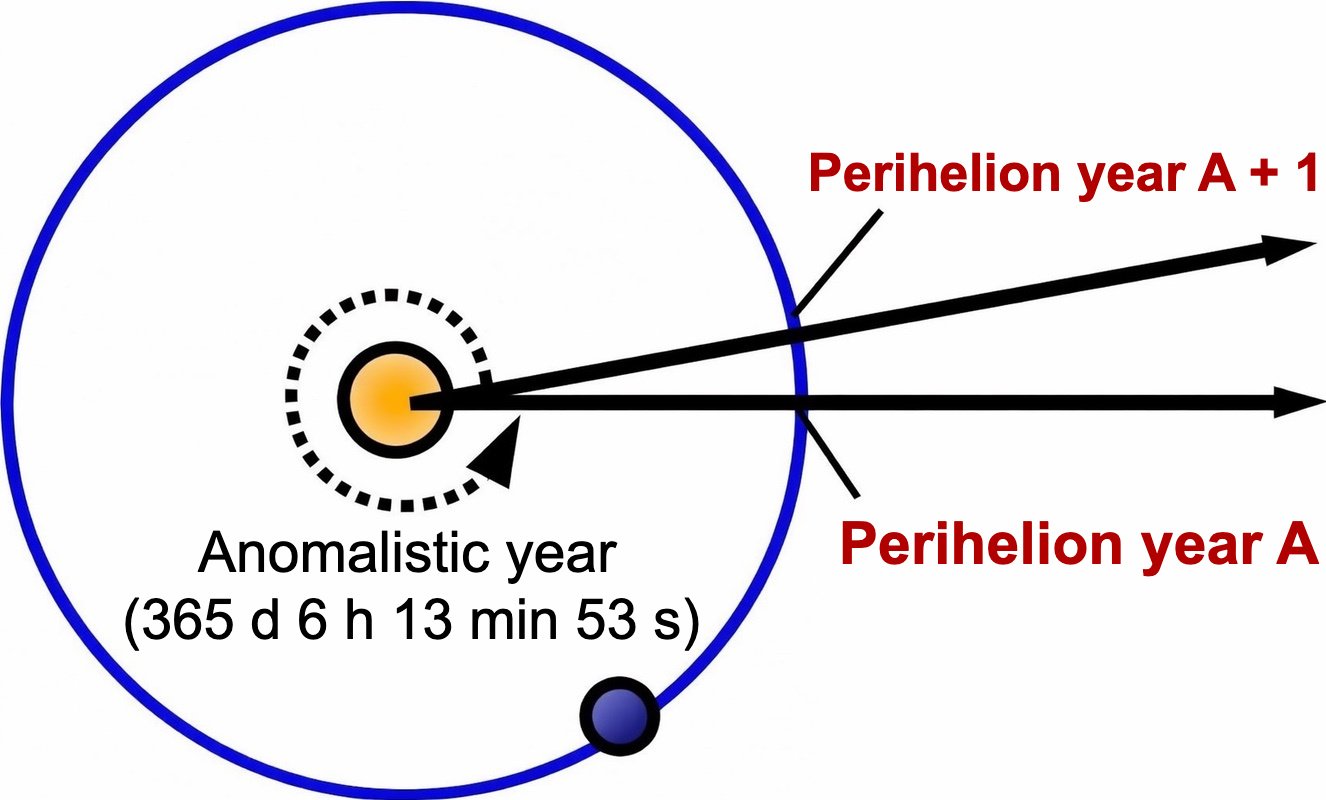
But Earth is not alone in the solar system; other planets and the Sun's mass make the line of apsides rotate slowly, in the same direction as Earth's orbital motion.
As a result, perihelion occurs slightly later each year than the previous year.
Therefore, the anomalistic year is longer than the sidereal year. It is currently 365.2596 days (365 days 6h 13m 53s).
Before ending this step in our discovery of the seasons shown in our 2007 postman almanac, let us add a small bonus we will need later and already discussed in our astronomy concepts page:
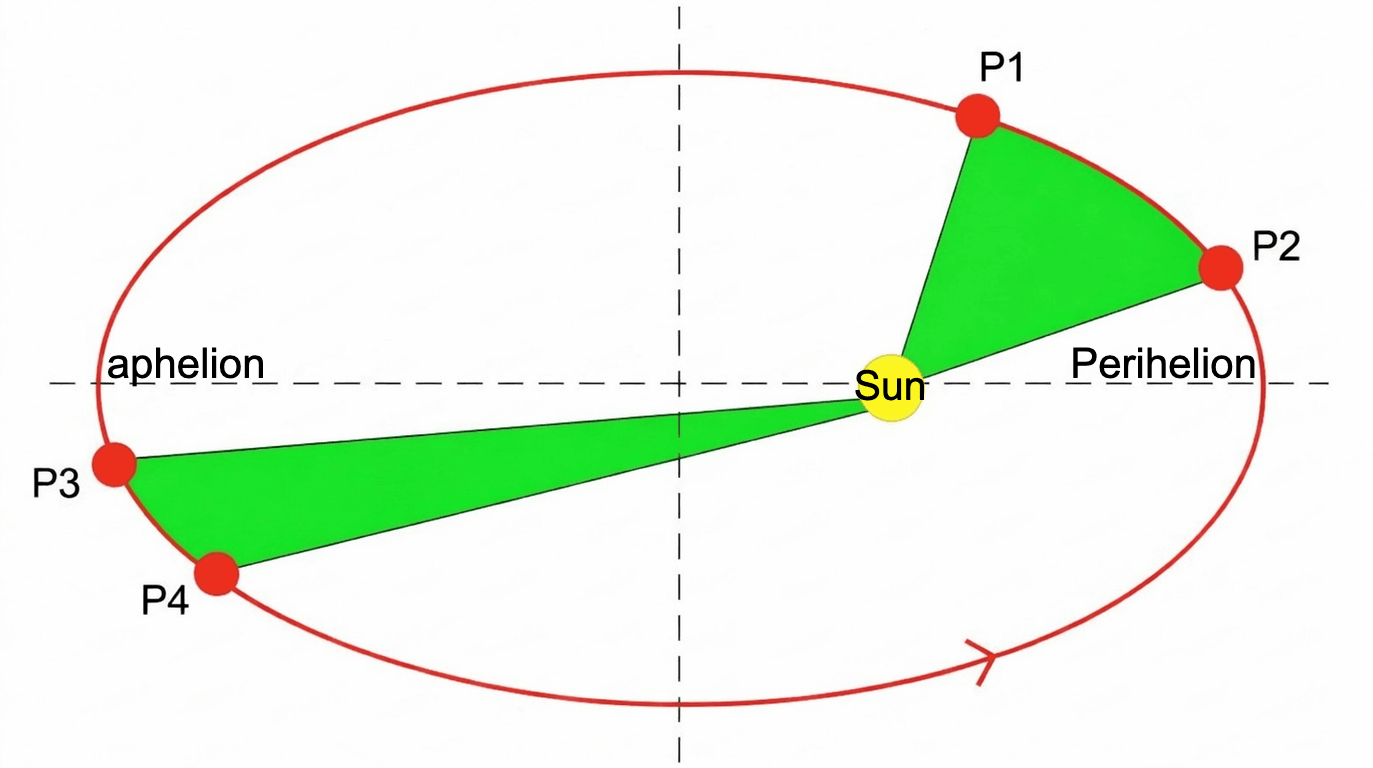
According to Kepler's second law, the duration between P1 and P2 equals that between P3 and P4. In other words, Earth moves more slowly when farther from the Sun.
At aphelion, speed is about 29.3 km/s versus 30.3 km/s at perihelion. This variation in orbital speed matters when defining the tropical year.
Step two: rotation and obliquity
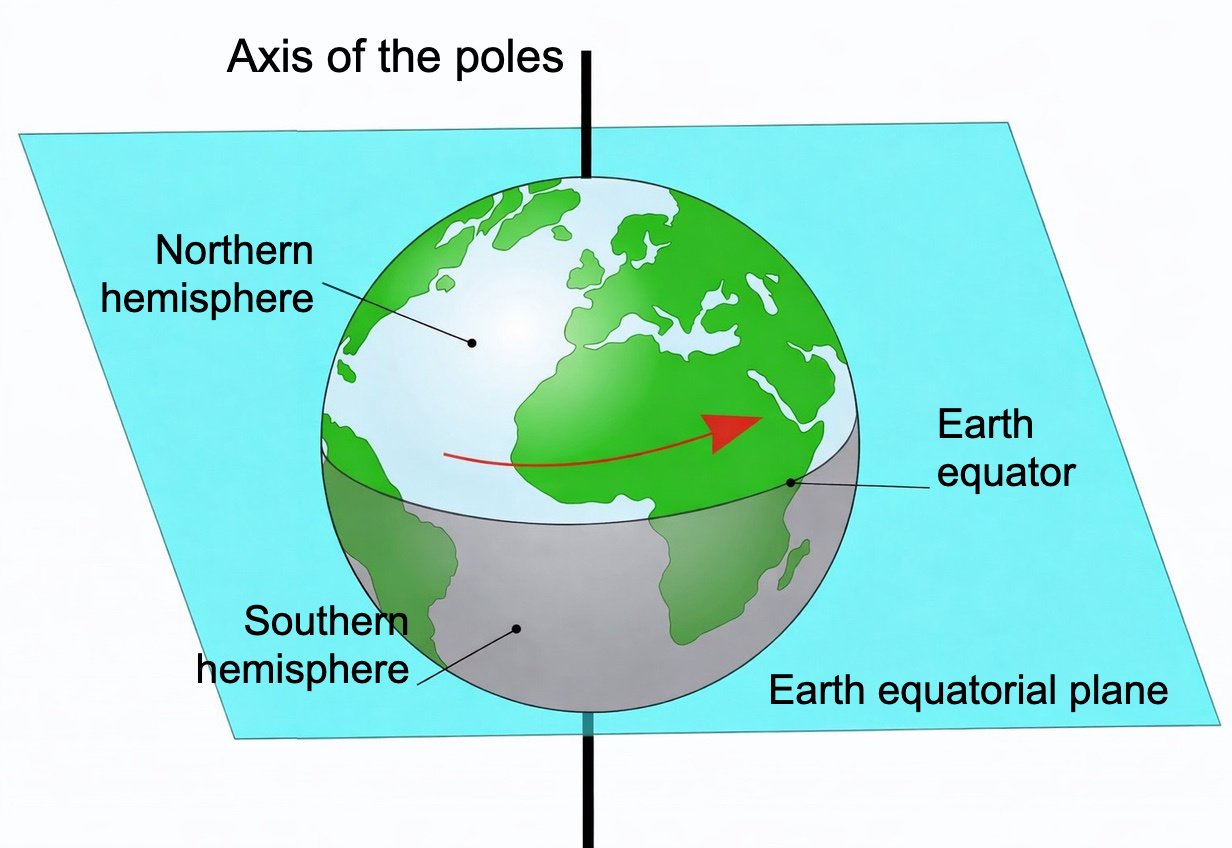
No secret here: Earth rotates around itself, around an axis (polar axis), counterclockwise from west to east. We can also define Earth's equatorial plane as the plane perpendicular to the polar axis and passing through Earth's center. Its intersection with Earth is the terrestrial equator.
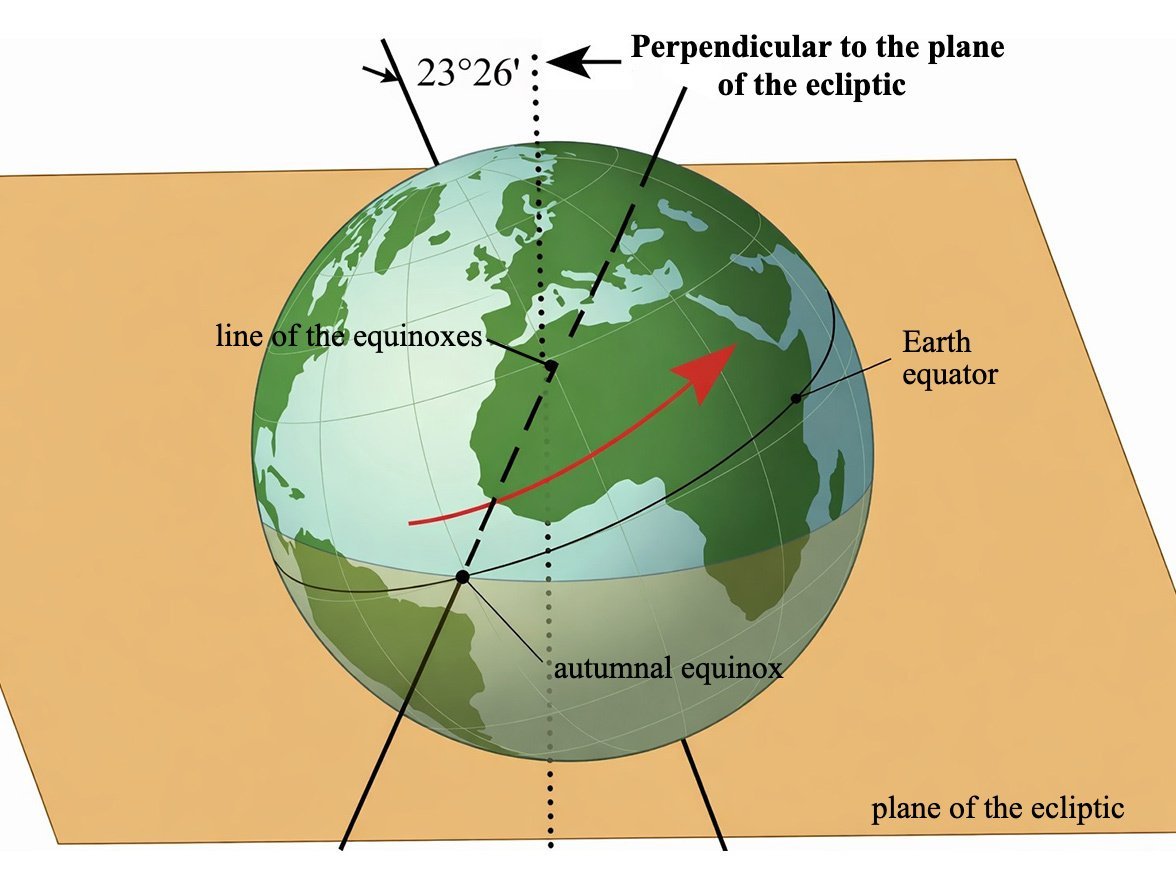
Is the polar axis perpendicular to the ecliptic plane? The answer is NO, which brings us closer to the notion of astronomical season we are trying to understand.
The polar axis (and therefore Earth's equatorial plane) is currently tilted by 23°26' (23.45°) relative to the ecliptic plane: this is ecliptic inclination or obliquity.
If we remember our 3D geometry lessons, two intersecting planes define a line. For the ecliptic plane and Earth's equatorial plane, that line is the equinox line.
A parenthesis: precession
Because we found four seasonal dates in the postman calendar we are analyzing, because that calendar follows a “tropical year,” and because this year length accounts for a precise phenomenon, we need to mention it briefly: precession. Let us ignore another phenomenon called nutation (see the astronomy page to meet it).
In the image above, we see the ecliptic tilt between the polar axis and the perpendicular to the ecliptic plane. What we do not see is that the first rotates around the second. We will not detail why this slow rotation occurs (26,000 years), involving the Sun and Moon... But let us note that this rotation is clockwise, that one distant day Polaris will no longer lie on the extension of the polar axis, and above all (for our purpose) that the equinox line slowly rotates on the ecliptic plane. Fittingly, this is called precession of the equinoxes.
Step three: “astronomical” seasons
Before we forget, let us state once and for all that what follows about “seasons” concerns the Northern Hemisphere; in the Southern Hemisphere, one must reverse things (day length, sunshine).
Let us momentarily ignore - without major consequence for our purpose - that the Earth/Moon barycentre is not exactly at Earth's center, and proceed as if it were. From earlier findings, we retain that due to obliquity, the ecliptic plane (relative to Earth's center) and equatorial plane intersect along the equinox line.
We can easily identify four points on Earth's elliptical orbit:
- the first two when the equinox line passes through the Sun's center. When the point of this line on Earth's surface lies between Sun center and Earth center, it is the March equinox. This point is also called the vernal point (symbol gamma), which gives orientation to the equinox line. It is often called the spring equinox - a very ambiguous term tied to the Northern (boreal) hemisphere, while in the Southern (austral) hemisphere it is the autumn equinox.
And while we are at it, the September equinox (or autumn equinox) occurs when the equinox line passes through Sun center in the direction Sun-Earth center-vernal point.
- the other two when the Earth-Sun segment is perpendicular to the equinox line. At that moment, one of Earth's poles is maximally oriented toward the Sun. If it is the North Pole, we have the June solstice (or summer solstice in the Northern Hemisphere). If it is the South Pole, it is the winter solstice.
Let us sketch what we just saw:
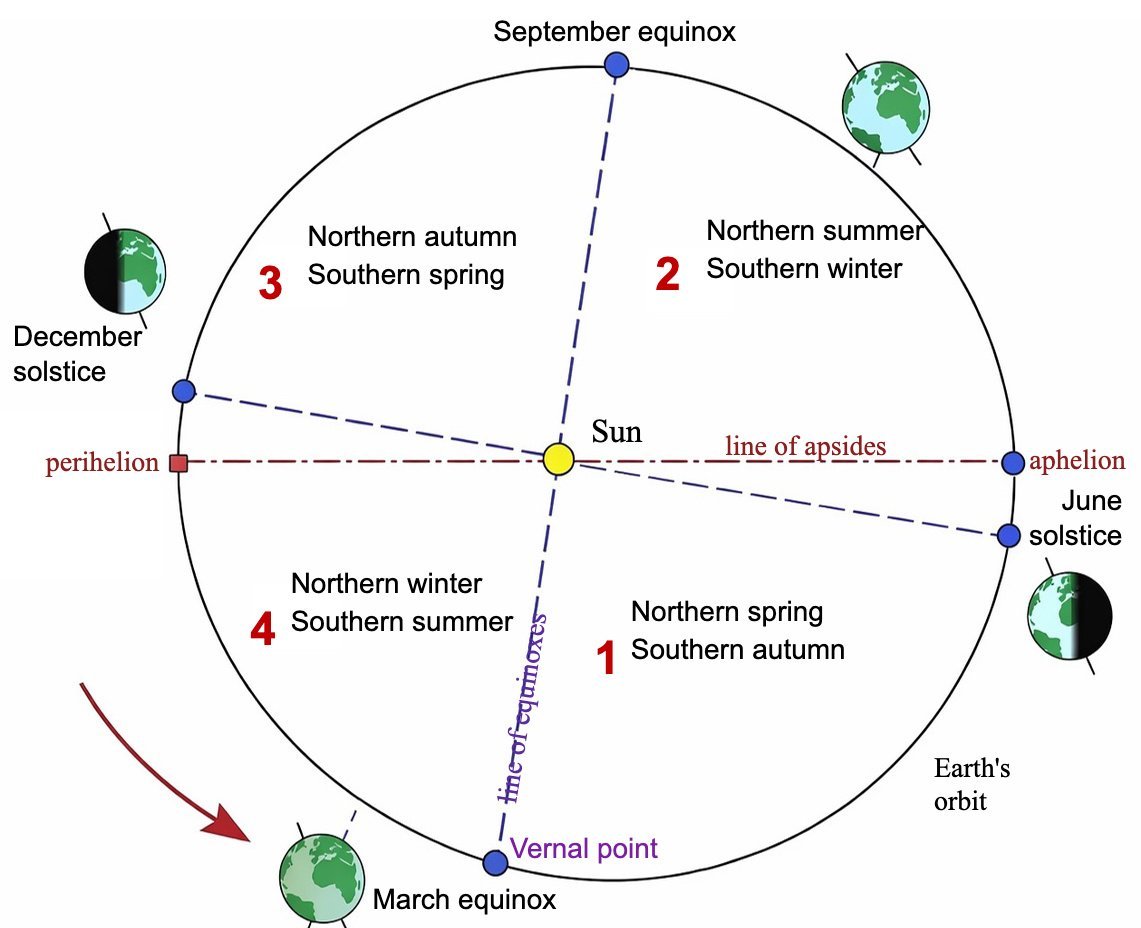
March, June, September, December - ring a bell? Yes. These are exactly the months we noticed in the postman almanac. So two dates correspond to the two equinoxes, and two to the two solstices.
Now we just need to ask what happens on those four dates, and in between them, to know what astronomical seasons are and what our calendar is actually marking.
Step four: characteristics of astronomical seasons
Characteristic 1
Look closely at the four Earth images above. I know, they are small, but since 3D geometry has no secrets for us, we will manage. Anyone wanting a closer look can check the astronomy page.
- At equinoxes, the polar axis is perpendicular to the equinox line. Obliquity effect is therefore canceled, and day length over Earth's surface equals night length. Appropriate, since equinox literally means “equal” “night.”
- At solstices, obliquity relative to sunlight reaches a maximum or minimum (depending on hemisphere and solstice). Consequently, days are shortest (or longest).
All this is explained in detail on the astronomy page. Let us conclude that the first characteristic of astronomical seasons is day length - a characteristic that is actually of limited importance for our core subject: seasons.
Characteristic 2
This characteristic is the Sun's maximum altitude above the horizon, with the direct consequence of varying insolation through the year. Everyone notices that the higher the Sun in the sky, the stronger it feels and the hotter it gets.
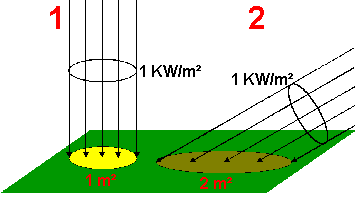
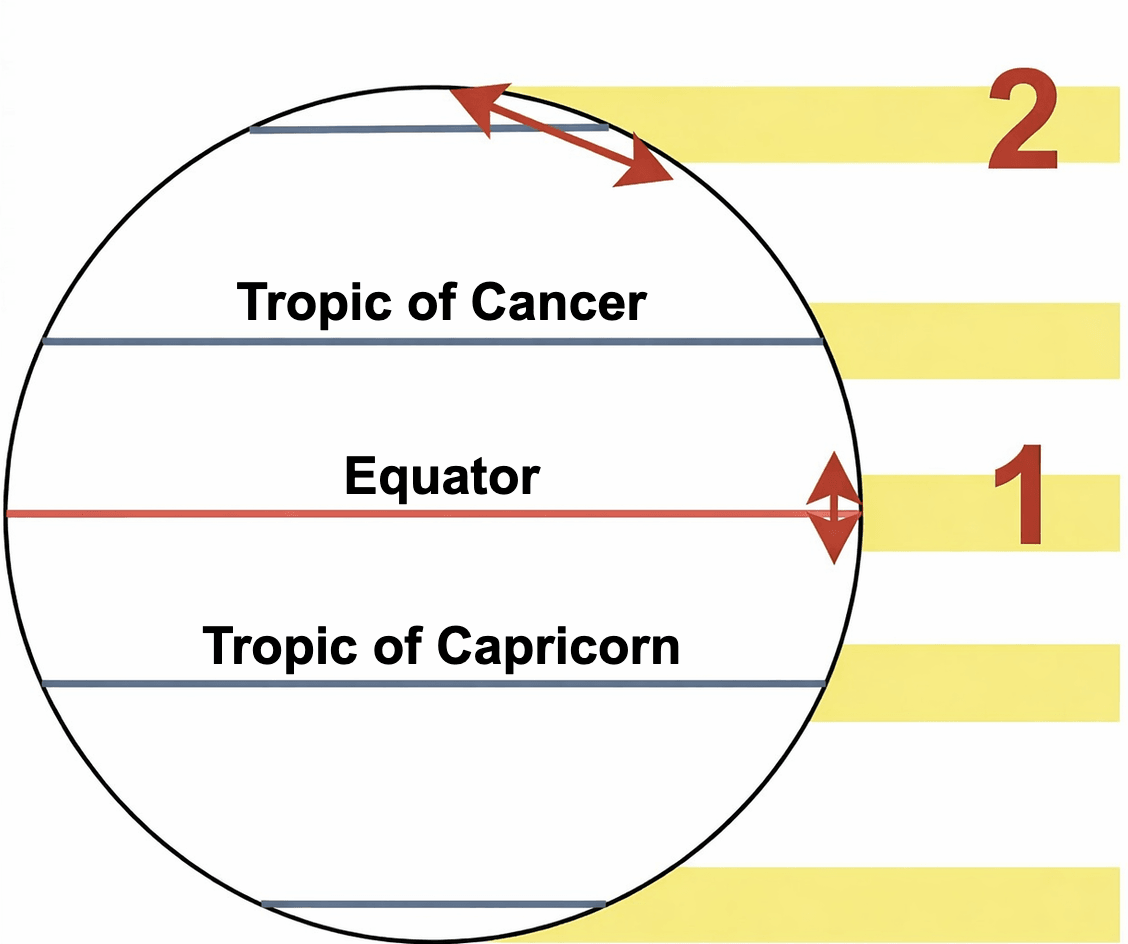
Irradiance is the intensity of solar energy delivered to a point on Earth or in Earth's atmosphere. It is measured in W/m2.
And the lower the Sun on the horizon, the larger the surface lit by the same light beam (same irradiance). The larger that surface... the less heating per unit area.
We must not lose sight of one thing: day length is not responsible for seasonal energy input. What matters directly is the incidence angle of solar rays, and therefore Sun altitude, which depends on polar-axis obliquity.
As we can see, distribution of what we may call “solar flux” varies with astronomical seasons and resembles the figure below (upper atmosphere, ignoring albedo and atmospheric absorption effects).
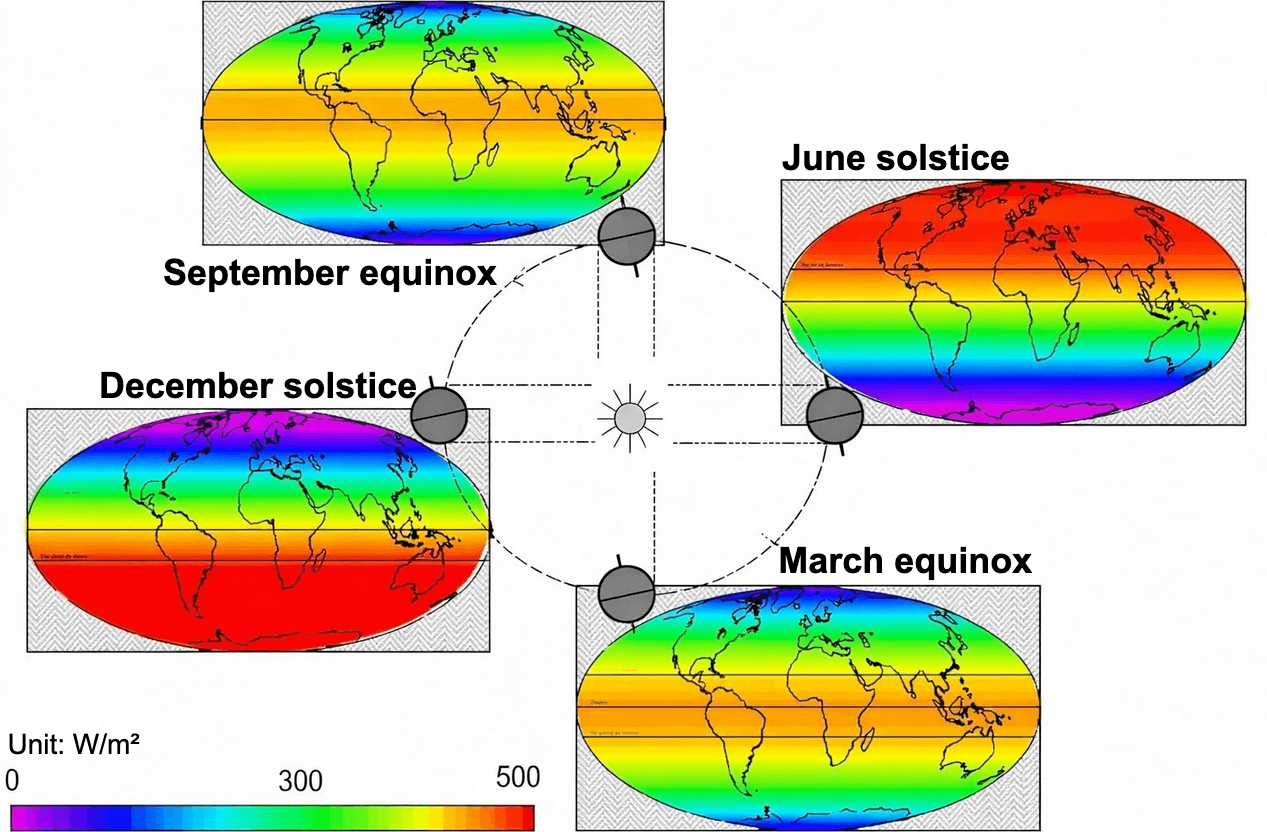
To finish, let us divide Earth (Northern Hemisphere only; Southern Hemisphere curves are reversed) into latitude bands accounting for obliquity, and draw some curves for each band, showing day length and Sun height at different times of year based on astronomical seasonal markers. Again, day length has limited direct impact on seasons.
A) the division
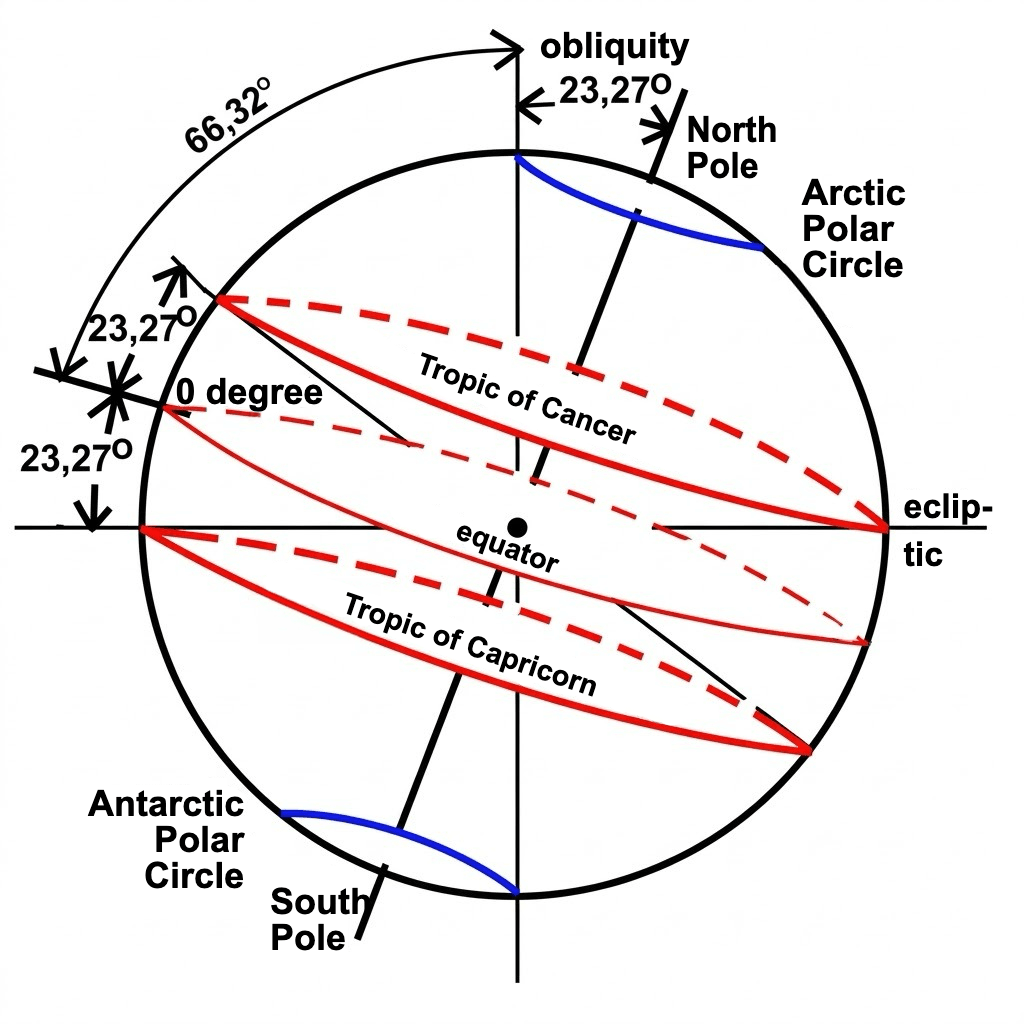
The equator is at latitude zero. At 23.27° latitude (matching obliquity), we find Tropic of Cancer for positive latitude and Tropic of Capricorn for negative latitude.
At 90° latitude are the poles. At 90° - 23.27° = 66.32° positive or negative latitude, we find Arctic and Antarctic circles respectively.
B) the bands
- EP = spring equinox
- SE = summer solstice
- EA = autumn equinox
- SH = winter solstice
| No. | Location | Sun height | Day length |
|---|---|---|---|
| 1 | At the North Pole | 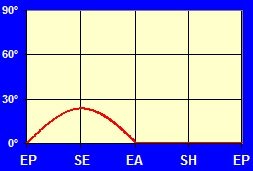 | 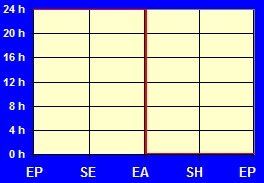 |
| 2 | Between the pole and the polar circle | 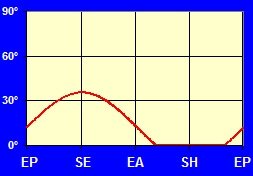 | 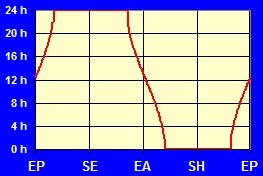 |
| 3 | At the Arctic Circle | 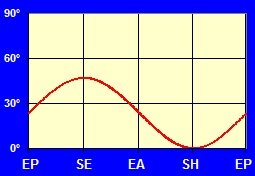 | 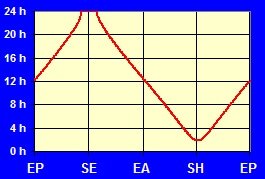 |
| 4 | Between the polar circle and Tropic of Cancer | 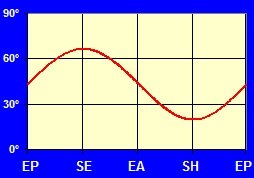 | 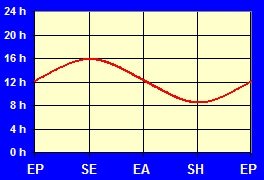 |
| 5 | At Tropic of Cancer | 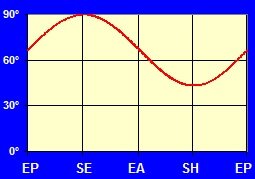 | 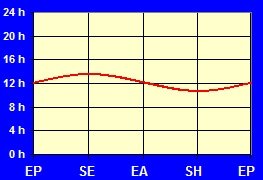 |
| 6 | Between Tropic of Cancer and the equator. We observe that the Sun is not at its maximum height on summer solstice. | 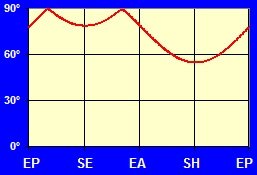 | 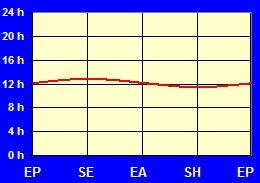 |
| 7 | At the equator. We observe that the Sun is not at its maximum height on summer solstice. | 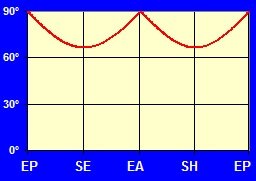 | 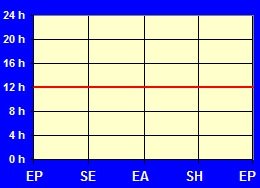 |
We will comment on these curves when discussing why seasons should be noted in the calendar (after all, this site is about calendars) that we all use daily.
But first, let us ask a basic question: year length.
Step five: four seasons make one year
The duration of a seasonal cycle made of two equinoxes and two solstices is called the tropical year and corresponds to one year in our calendar.
Incidentally - without insistence, since it has little effect on daily life - seasons are not all the same length within a given year, nor from one year to another.
What is the duration of a tropical year? We are speaking, of course, of average duration, not exact yearly duration.
One might be tempted to say it equals the sidereal year, i.e. 365.2566 days. But we must not forget precession of the equinoxes, which makes the tropical year shorter than the sidereal year: at epoch J2000, its duration is 365.2422 days.
Another issue: how do we define the tropical year? Saying it is “the duration of a cycle of four seasons” is too vague.
It has often been said (and still is, even on IMCCE pages) that the tropical year is the interval between two successive passages of the Sun at the spring (vernal) equinox.
But as we saw, Earth speed is not uniform along orbit, due to Kepler's second law. Therefore tropical-year duration varies depending on chosen origin. For example:
| Origin | year length |
|---|---|
| Vernal equinox | 365.2424 |
| Summer solstice | 365.2416 |
| Autumn equinox | 365.2421 |
| Winter solstice | 365.2427 |
| Average | 365.2422 |
The average does indeed match mean tropical-year duration. But one cannot use a definition based on vernal equinox and then assign it the average value.
According to IMCCE, the mean tropical year is "the time Earth takes to complete one revolution around the Sun in a rotating frame tied to the equinox line, i.e. the period linked to the difference between mean solar longitude and precession of the equinoxes." Euh... yes... very clear.
From “astronomical” seasons to climatic seasons: finishing with astronomical seasons
Whether in our postman almanac or in media (press, TV...), dates around 21 March, 21 June, 21 September and 21 December are presented as if they were official and universal season starts. With our postman calendar under our arm, let us explain to a Nuer in Africa or an Inuit in the Arctic that there are four seasons beginning on those calendar dates. They would likely laugh.
Except for astronomy enthusiasts (and most people are not), why keep telling us summer starts on 21 June, autumn on 21 September, etc.? The only things that occur on those dates are two solstices and two equinoxes.
We have seen that the only characteristic of astronomical “seasons” is Sun altitude. That is as reductive as trying to understand a car by studying only its engine. What interests us - not necessarily astronomy fans - is finding, year after year, in the same place, a certain homogeneity in weather tendencies (temperatures, rainfall, sunshine), and considering that we are then in spring, summer, etc.
In short, our daily life is immersed in climatic seasons, while we are fed astronomical ones.
Certainly, it is easier to consider only one parameter of the seasonal phenomenon (Sun altitude), while ignoring all other effects induced by solar activity: atmospheric circulation and thermal contrasts, planetary albedo, atmospheric absorption, and many others.
Certainly, it is easier to set seasonal boundaries to the minute - but what prevents fixing stable seasonal start dates for a given place (or country)?
Why are our calendars merely ephemerides giving astronomical information such as sunrise and sunset, moonrise and moonset, and dates/times of solstices and equinoxes?
It is high time to give climatic seasons the place they deserve and stop being saturated with purely theoretical notions.
Since our calendar is silent on this, let us say a few words about climatic seasons, which are closer to our everyday experience.
According to Meteo France, "A season is a part of the year during which the conjunction of astronomical and environmental factors ensures a clearly recognizable regularity in meteorological variables and phenomena for a given region, and generates biological, economic and social processes dependent on that regularity."
In general, climatic seasons are distributed as follows: spring (Northern Hemisphere) = March, April, May; summer = June, July, August; autumn = September, October, November; winter = December, January, February.
This breakdown, valid in temperate regions, is not necessarily best at other latitudes or in continental interiors. These variations led François Durand-Dastes, geography professor at Paris VII, to write that "in each place, there is a succession of seasons constituting its climate. These combinations can be classified according to two criteria: the main type of opposition between seasons (essentially thermal seasons or essentially rainfall seasons), and the intensity of this opposition." © Encyclopaedia Universalis 2006.
Although we seek periods of the year where weather tendencies are somewhat homogeneous, we should still briefly mention - without entering detail - climate classifications based precisely on rainfall and temperature.
Koppen classification
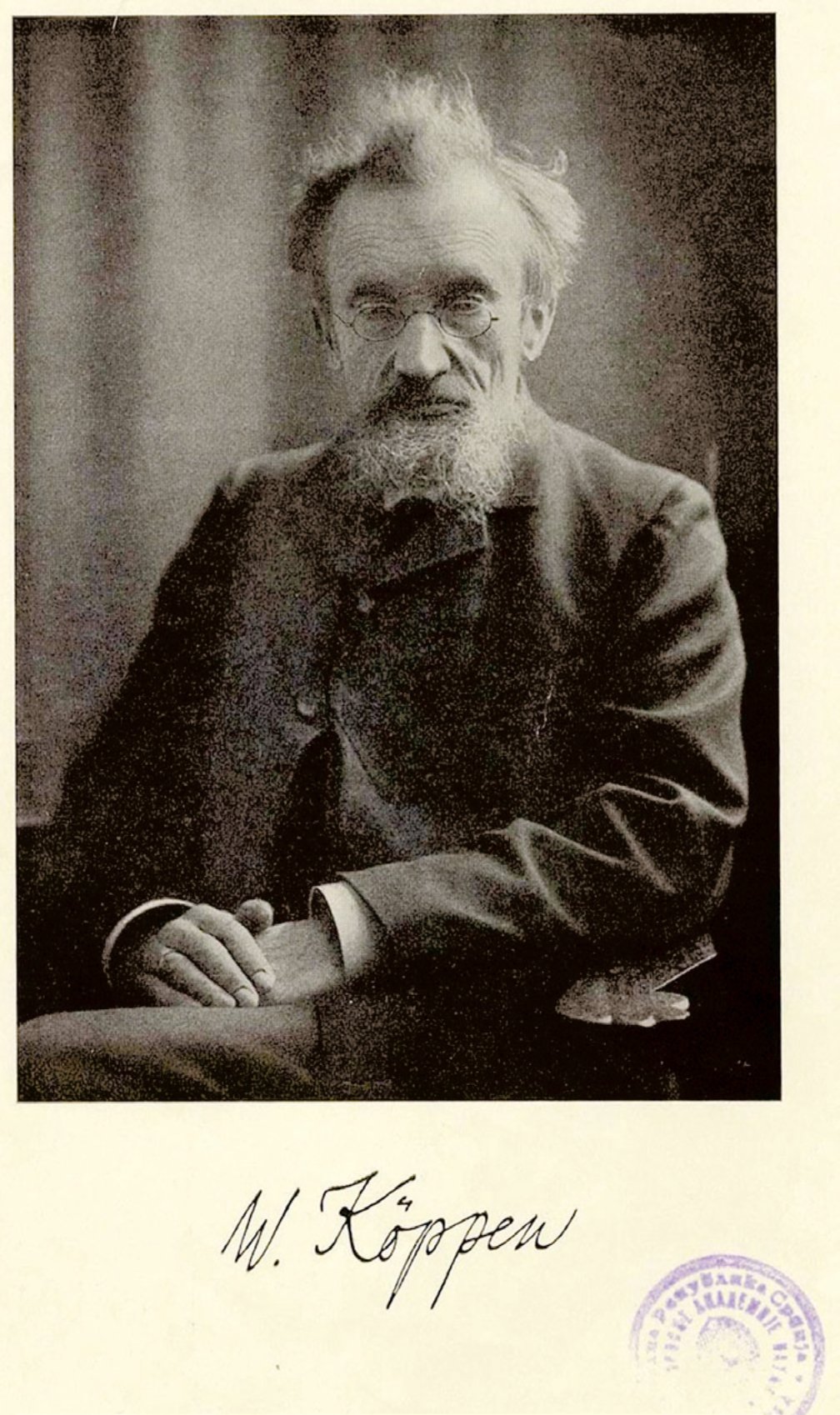
Between 1900 and 1936, Wladimir Peter Koppen (German meteorologist, climatologist and botanist born in Saint Petersburg on 25 September 1846, died in Graz, Austria, on 22 June 1940) developed and improved his classification system. After his death, the work was continued by Rudolph Geiger (1894-1981), with whom he had collaborated on a five-volume climatology handbook (Handbuch der Klimatologie).
For more on Wladimir Koppen, click here; for almost everything on the classification system and maps, click here.
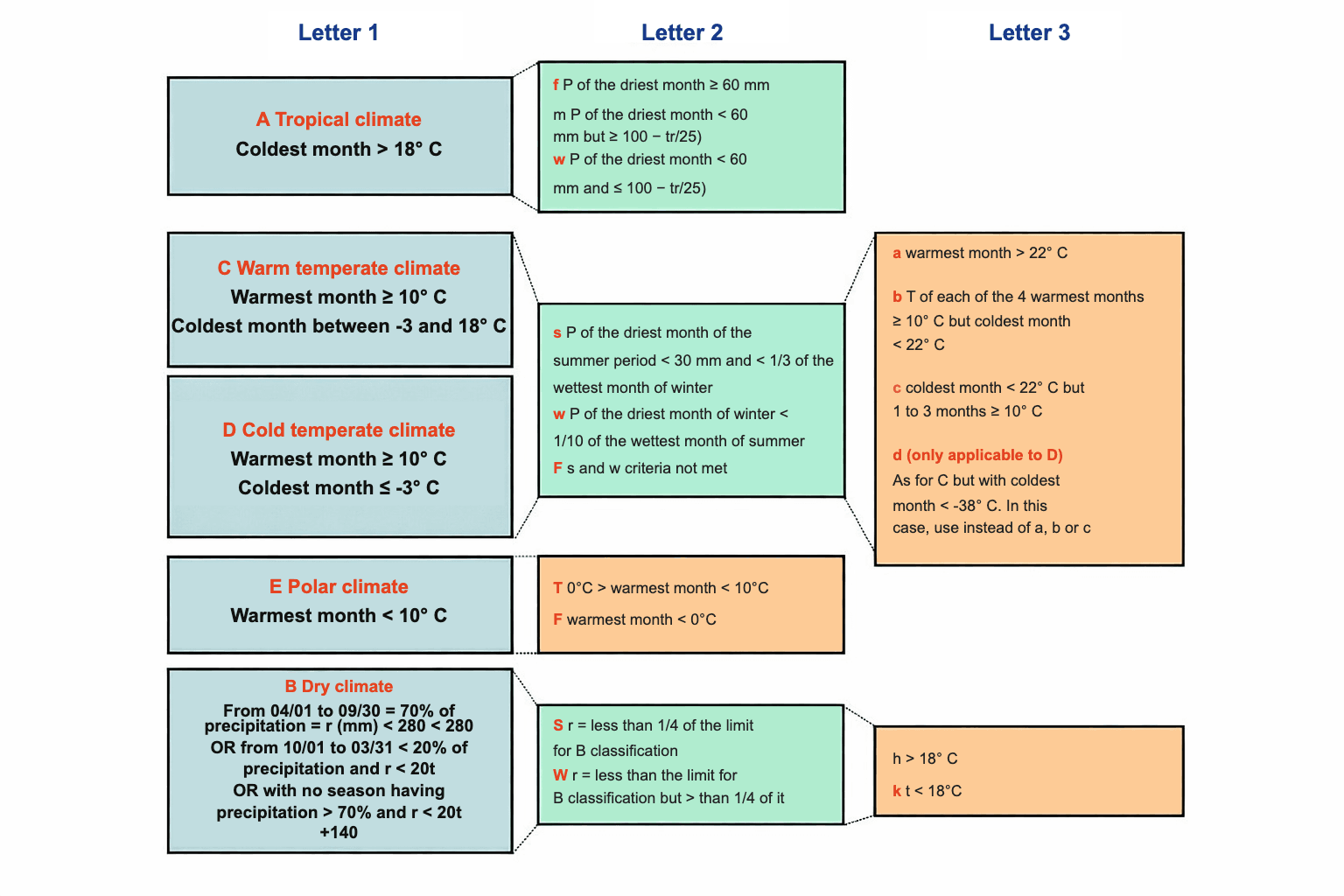
The system uses five letters (a sixth was added later) to divide the world into five (six) main climate regions based on mean annual precipitation, mean monthly precipitation, and mean annual temperature. This first letter gives the climate type.
Each of these five (six) types is then subdivided into categories based respectively on temperature and rainfall.
A world region can therefore be classified with two or three letters. Here is a concise table of possible combinations.
A few clarifications for reading the table:
- P = precipitation (green background; temperature data on brown background)
- E = period from 01/04 to 30/09 for Northern Hemisphere
- H = period from 01/10 to 31/03 for Northern Hemisphere
- For Southern Hemisphere, invert E and H
- t = annual mean temperature (°C)
- r = annual mean total precipitation
The combinations:
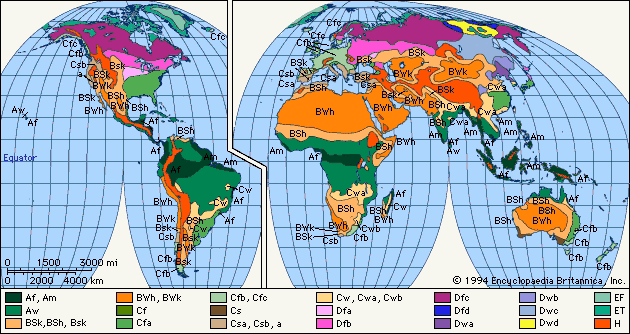
And a summary map of world climate classification:
From climate classification to “ecological seasons”
Even when considering only rainfall and temperature, Koppen classification yields many possible combinations. Add other factors such as cloud cover or wind, and things become even more complex.
Yet it is enough for one of these combinations to recur regularly over long periods for it to become a possible “season” for local populations.
What makes a season count as a season? Let us step back from modern habits that pay more attention to social events than to sequential natural events, and look at periods when today's calendar did not yet exist but people still had to orient themselves through the year.
We will take only a few examples, though it would be interesting to inventory seasons worldwide (names and number) and overlay them on climate classifications.
Pending such an inventory, let us at least try to understand why different numbers of seasonal cycles exist here and there.
Seasons around the world
Most examples below come from Martin P. Nilsson's Primitive Time-Reckoning which, although published in 1920, remains a mine of information.
We are now used to long, regular seasons (three months) imposed by a purely astronomical vision. But many “short seasons” existed and still exist. They are extremely important because, in the absence of calendars as discussed earlier, they enabled orientation in time for daily activities (farming, hunting, fishing...) as well as social relations (birth dates, festivals...).
The Hidatsa Indians (upper Missouri) use the same name for these short periods as for longer seasonal periods: kadu.
Those who read the page devoted to Hesiod's calendar should not be surprised by these shorter natural periods. Recall, for example, sowing time marked by hearing the crane's cry. Recall also that some farming tasks are keyed to astronomical events, such as grape harvest when Sirius and Orion are highest in the sky.
These time determinations based on natural phenomena are still alive in current rural practice. In Scania (southern tip of Sweden), for example, barley is sown when hawthorn blossoms. Inuit say someone was born when seals were hunted or when eggs of such-and-such bird hatched.
Of course, not every natural event yields a season. But events may strongly contribute if they recur regularly, last long enough, are linked to marked climate conditions, and are fundamental enough - for one reason or another - to attract the attention of concerned people. They can thus contribute to splitting “long seasons” into shorter periods.
As Nilsson writes, "the natural phenomena by which seasons are defined and named vary with latitude, country type, and way of life" (for example peoples living from agriculture, hunting, or herding).
If we had to count basic seasons, two would no doubt dominate: hot vs cold season; dry (or dry monsoon) vs wet (or wet monsoon) season; sometimes even stormy-wind season vs calm season, as in the Marshall Islands.
Naturally, these fundamental periods fluctuate and give rise to transitional periods. Also, identical periods (rainy ones, for example) may occur several times and need to be distinguished.
Combining all these features, we get many possible ecological seasons, ranging from two to... at least nine. Let us look at a few.
Two seasons
- Indonesia: dry monsoon from May to October, wet monsoon from November to April.
- Nuer people (southern Sudan): rainy season from March to September, dry season from October to February.
- Comanche, Hopi, Choctaw peoples.
- Walabunnba (Aboriginal people of Australia's Northern Territory): Wantangka (hot season from October to end of March) and Yurluurrp (cold season from April to end of September).
Three seasons
- Greeks of archaic and earlier periods: autumn was unknown and is attributed to Homer.
- Ancient Egypt: seasons of four months. See the page on the Egyptian calendar.
- Tasmania (island southeast of Australia): Wegtellanyta (December to end of April), Tunna (start of May to end of August), Pawenya peena (start of September to end of November).
Four seasons
Even when the number matches astronomical seasons, they differ in start date and duration.
- Official Australian calendar: three-month seasons, summer starts in December (Southern Hemisphere), autumn in March, winter in June, spring in September.
- Denmark: spring = 1 March; summer = 1 June; autumn = 1 September; winter = 1 December.
- British tradition: spring = 2 February (Candlemas); summer = 1 May (May Day); autumn = 1 August (Lammas); winter = 1 November (All Hallows).
Five seasons
- Yanyuwa (Aboriginal people, Northern Territory, Australia): Wunthurru (first rainy period, months 01 and 02), Lhabayi (proper rainy season, months 03-04-05), Rra-mardu (dry season, months 06-07), Ngardaru (very hot season, months 08-09), and Na-yinarramba (hot and humid season, months 10-11-12).
- Minang (Aboriginal people, Western Australia): Beruc (months 12-01); Meertilluc (months 02-03); Pourner (months 04-05); Mawkur (months 06-07); Meerningal (months 09-10-11).
Six seasons
- Jawoyn (Aboriginal people, Northern Territory, Australia): Jiorrk (months 01-02); Bungarung (months 03-04); Jungalk (month 05); Malaparr (months 06-07-08); Worrwopmi (months 09-10); Wakaringding (months 11-12).
- India: two-month seasons Sisira (winter); Vasanta (spring); Grisma (summer); Varsa (rains); Sarat (autumn); Hermana (cold).
- Yukaghir (people of Siberia): puge (summer); nade (autumn); cieje (winter); pore (first spring); cille (second spring); conjile (third spring).
Eight seasons
Inuit (Arctic regions of Siberia and North America - see page on their calendar for more): Ukiuq (winter); Upirngaksajaaq (toward first spring); Upirngaksaaq (first spring); Upirngaaq (spring); Aujaq (summer); Ukiatsajaaq (toward autumn); Ukiaksaaq (autumn).
Nine seasons
Shilluk tribe (Sudan): yey jeria (red dura harvest); anwoch (end of harvest); agwero (white dura harvest); wudo (harvest continuation); leu (hot season); dodin (no field work); dokot (start of rains); shwer (red dura planting); doria (start of harvest). Umm... what exactly is dura?
In conclusion
So, did you say “four seasons”? Cyrano would have answered: “Ah no! That's a bit short, young man!”