A little history
Do not expect me to recount more than 5,000 years of history on this page!
To help us locate ourselves in space, here is a map of ancient Egypt:
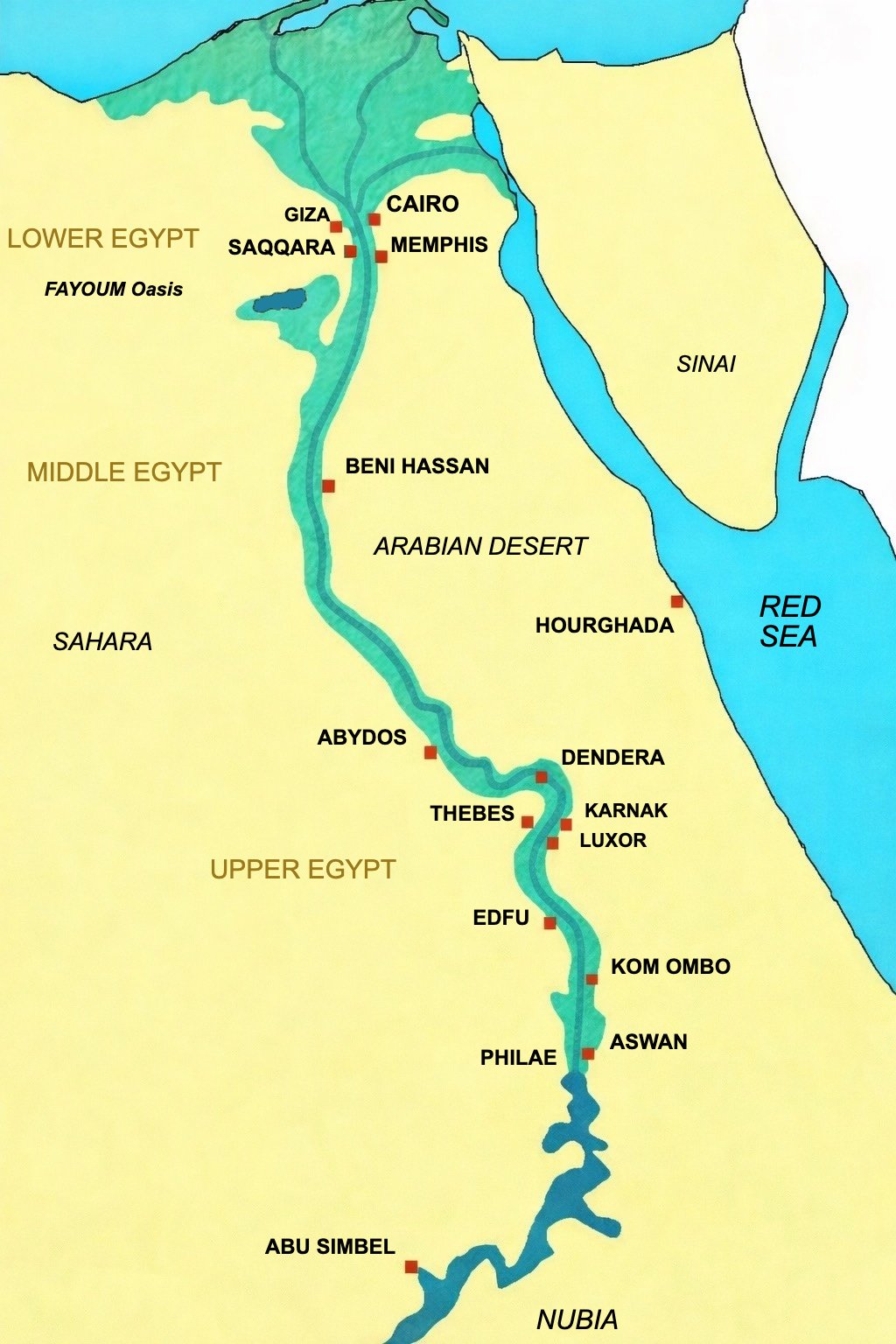
And to help us locate ourselves in time, you will find a separate chronology of Egypt. Since it is rather long, I preferred to separate it from calendar-specific material. Still, let us not forget that even if this chronology (of kings and pharaohs) goes back to around 5000 BC, Egyptian civilization itself extends back more than ten millennia.
A few observations: before starting the study of Egyptian calendars, let us project ourselves 5,000 years back in Egypt.
- We observe that haze is almost permanent near the horizon. As a result, astronomical observations are not very easy and remain far below the level reached by Mesopotamian peoples. Third- and second-magnitude stars are almost invisible at rising.
On the other hand, one star outshines all the others: Sirius (or Sothis if we use the Hellenized form of the Egyptian word Sopt). At that time it was considered a double star represented as a little dog (canicula in Latin) in the constellation of the Great Dog (canis in Latin). It set later and later in spring (our spring), then disappeared. About 70 days later, it reappeared one morning just before sunrise. This reappearance is called the heliacal rising. In predynastic times, it coincided with the hottest period of the year. Hence the word canicule (heatwave), derived from canicula.
- Egyptians were an agricultural people and could not fail to notice one event that returned regularly in their lives: the Nile flood. It is linked to the rainy season in the river's upper basin: Lake Victoria south of Sudan. This flood reaches the Cairo region around 20-25 June, almost at the summer solstice for the Northern Hemisphere. Flooding due to the inundation lasted around 4 months.
It turns out that at certain times (which we will identify), these three phenomena - heliacal rising of Sirius, Nile flood, summer solstice - coincided, and we will see how this triple coincidence influenced the Egyptian solar calendar.
Calendar(s)
There are two hypotheses regarding the calendars that may have existed in ancient Egypt:
- A “linear” hypothesis suggesting these calendars succeeded one another, one replacing the previous one.
- A “parallel” hypothesis suggesting these calendars coexisted.
To make our own assessment, we will examine both.
1) “Linear” hypothesis: calendars succeed one another
Like many early peoples, Egyptians first used a lunar calendar. The first form of “year” in the sense of a cycle would therefore have been the lunar month. Since the synodic period is 29.5 days, Egyptians used months of 29 and 30 days. Two consecutive lunations were associated to form the “year”.
This lunar calendar was quickly abandoned as a full reckoning system (it continued to be used for certain religious feasts), around the 5th millennium, in favor of a calendar based on returning seasons (and the Nile flood), better suited to an agricultural people.
Egyptians then adopted the “Mesopotamian” calendar of 12 months of 30 days, making a 360-day year.
These twelve months were grouped into 3 seasons of 4 months each (tetramenes), corresponding to three agricultural periods linked to life along the Nile: flood, sowing, harvest. These seasons were named.
By contrast, days and months were not named at first. Months bore their number within the season (1-2-3-4), and days their number within the month (1 to 30).
Months were named later, taking names derived from deities. We can track these names at least from the New Kingdom; before that, things are less certain. So beware of possible anachronisms. However, for readability, we will use them now.
Priests soon observed that the start of flood season matched the heliacal rising of Sothis (Sirius). They fixed New Year to the first day of the first month (Thot) of the Akhet season.
Given the above, we can build this first solar calendar, keeping in mind that months were not yet named at that time.
| Season | Month | Name | Representation |
|---|---|---|---|
Akhet (floods)  | 1 | Thot |  |
| 2 | Phaophi |  | |
| 3 | Athyr |  | |
| 4 | Khoiak |  | |
Peret (germination)  | 1 | Tybi |  |
| 2 | Mekhir |  | |
| 3 | Phamenoth |  | |
| 4 | Pharmouthi |  | |
Shemu* (harvest)  | 1 | Pakhon |  |
| 2 | Payni |  | |
| 3 | Epiph |  | |
| 4 | Mesore |  |
*: Shemu is also written Shomu. Some see in it the root of the English word summer.
Months were often simply labeled I Akhet, II Akhet, III Akhet... without specific names.
For year, month and day, we have the following representations:
| Year | Month | Day | |
|---|---|---|---|
| Name | Renep | Abed | Herou |
| Representation |  |  |  |
In addition, this year was divided into 36 decans  of 10 days. For each month we therefore have the first decan
  , the second decade
  , and the third decade
  . These decans, discussed further in the study on divisions of the day, would later delight astrologers.
But as we know, a tropical year is not 360 days, but about 365 1/4 days.
Therefore, the first day of the year coincided only exceptionally with the heliacal rising of Sothis. From this, priests deduced that the year should be 365 days.
They then added five days to the already constituted year. These additional days were called epagomenal by the Greeks, meaning those added on top (dona heriou roupet), indicating they were counted outside the months of the year. They were named Osiris, Horus, Seth, Isis and Nephthys, according to the following legend (reported by Plutarch):
“Nut, the sky goddess, and Geb, the earth god, had married without telling Ra, who would not have allowed it. He became furious when informed of their union. He cast a powerful spell on Nut to prevent her forever from bearing children, punishing her for marrying Geb without his permission. Nut was devastated. What is the point of marriage if one cannot have children?
The god Thoth took pity on her and on her grief. He played a game with the Moon and won. He played again and won again. After several victories, he asked the Moon to give him part of its light so he could create five whole days.
These five days belonged to no month; they stood outside the year and calendar, so Nut could, during these days, give birth to five children, thus escaping Ra's prohibition: Osiris, Horus, Seth, Isis and Nephthys.
In the Gregorian calendar, these five days correspond to 14, 15, 16, 17 and 18 July.
This 365-day calendar, born in 4236 (often cited) BC, lasted no less than 4,000 years and would become the origin of the Julian calendar and later strongly inspire the French Republican calendar.
Though poor astronomers, Egyptians thus bequeathed later civilizations the calendar framework that inspired them all.
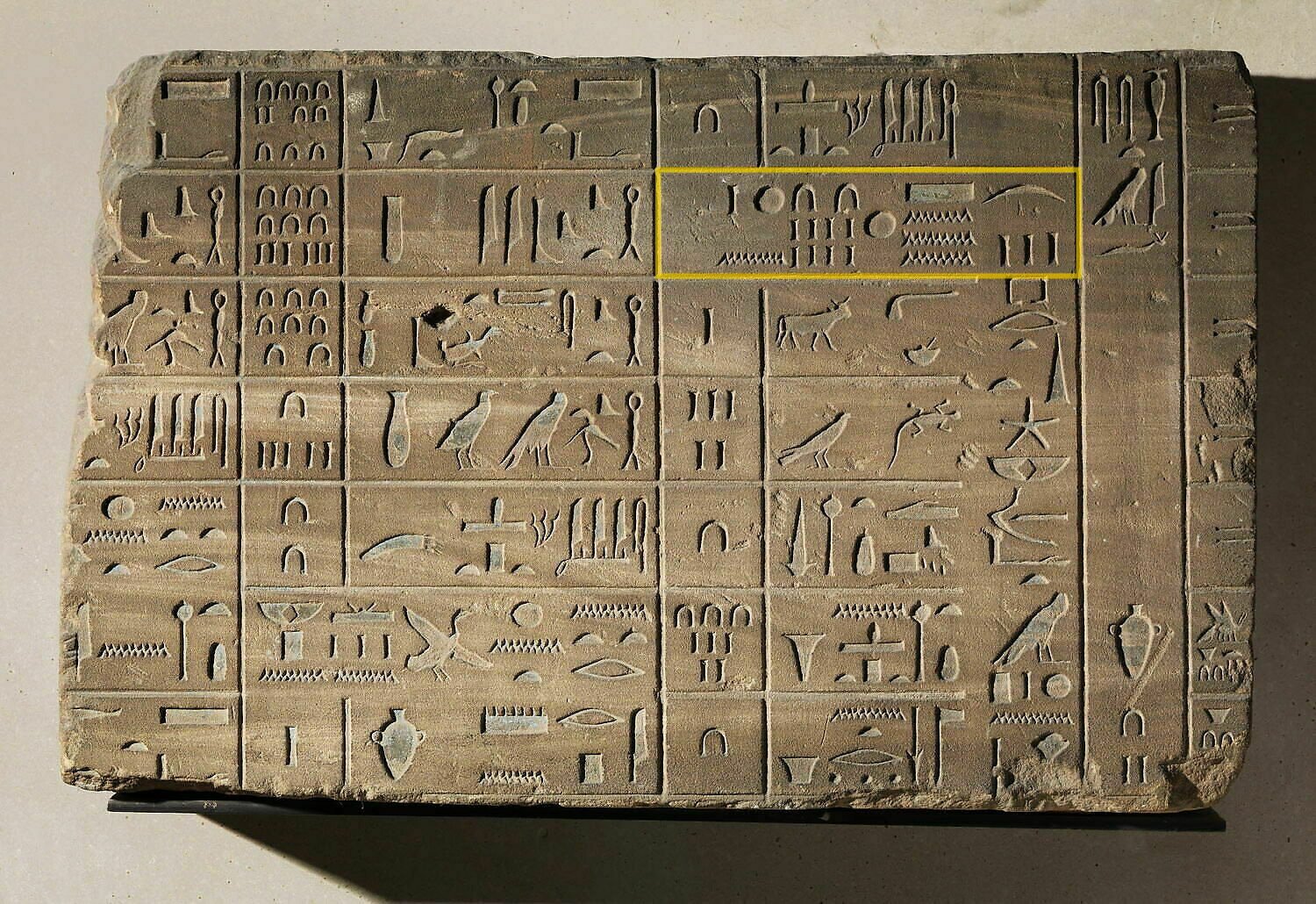
This 365-day Egyptian year is also known as the wandering year.
Why “wandering”?
Simply because 365 days are still not 365 1/4, and that annual deficit of 1/4 day creates a one-day shift every 4 years and a one-year shift every 365 X 4 = 1460 Julian years, or 1461 Egyptian years. The heliacal rising of Sirius, instead of remaining on 1 Thot, occurred on 2 Thot after four years, on 3 Thot after eight years, etc., and feasts tied to the calendar drifted. After 730 years, heatwave and harvest festivals were celebrated... in midwinter. Hence the nickname wandering calendar.
Instead of adding a sixth epagomenal day every four years (as Caesar would do with advice from Alexandrian astronomer Sosigenes), priests maintained the 365-day year and explained that it was good to sanctify each day of the year successively.
And since things returned to alignment every 1461 years, this return was marked by especially solemn celebrations.
This 1461-year cycle is known as the Sothic period. The Latin writer Censorinus reports celebrations in AD 139. The other coincidences of heliacal rising + first day of the year would have occurred in 1318, 2776 and 4236 BC (or -1317, -2775, -4235). Recent work, following astronomer Jacques Laskar, tends toward -4227 instead of -4235. Whether -4227 or -4235, first Thot at the beginning of the wandering calendar would fall in mid-July (Julian calendar).
We can note that only one Sothic cycle duration is exactly 1460 Julian years. Over time, the Sothic year increased slowly, and return to first day came faster: 1458 years for the second period and 1456 for the third (figures from astronomical computation).
It would be wrong to think no attempt was made to correct wandering-calendar drift. King Ptolemy III Euergetes (246-222 BC) tried to introduce a 6th epagomenal day every 4 years in 238 BC and proclaimed the Canopus Decree:
“"In order that the seasons may follow one another according to absolute rule and the order of the world, and so that feasts celebrated in winter do not fall in summer due to the annual shift of one day every four years in the rising of the star (Sothis), nor other feasts celebrated in summer later in winter, as has already happened and is now happening, from now on, the year remaining composed of 360 days plus the five additional days, one day dedicated to the festival of the gods Euergetes shall be intercalated every four years between the five epagomenal days and New Year."
But the Egyptian people refused to use this additional day, and the wandering calendar... remained wandering.
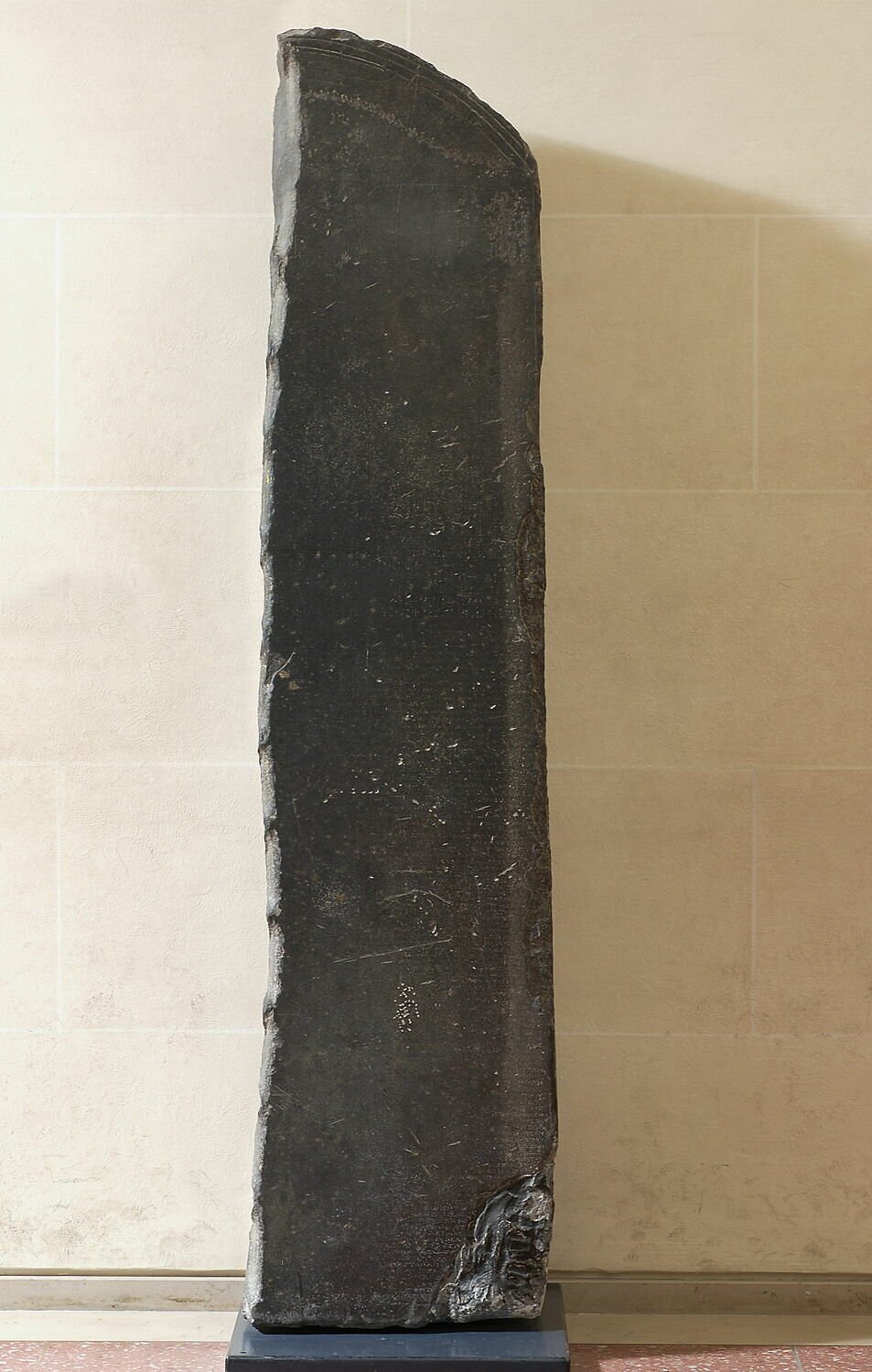
Less known than the Rosetta Stone, the Canopus Decree also has the distinction of being written in two languages and three scripts (hieroglyphic, demotic and Greek). This 1.94 m high and 45 cm wide stele is kept in the Louvre.
The decree was promulgated by a synod of Egyptian priests gathered at Canopus (near modern Aboukir) in the 9th year of Ptolemy III (22 October 239 BC - 21 October 238 BC).
The priests decreed that a feast in honor of Ptolemy III and his wife and sister Berenice must be celebrated on 1 Payni each year. Lines 44-46 of the Greek text (translation above) explain how to add a sixth epagomenal day every 4 years to the Egyptian year to prevent this date from drifting in the Egyptian wandering calendar.
We know the destiny this “one day every 4 years” would later have in the Julian calendar.
2) “Parallel” hypothesis: calendars coexist
According to Egyptologist Richard A. Parker, two calendars coexisted:
-
The 365-day wandering calendar as seen above, which he calls the civil calendar. It would have served only administrative needs and would have been introduced in the 3rd millennium (between 2937 and 2821) BC.
-
A lunar calendar, much older, whose existence would have continued during use of the civil calendar. Its role would have been religious. Could it also have had an agricultural function, or should we assume a third agricultural calendar? Mystery.
Also mysterious is a text found in a tomb at Abydos that greets Sothis (Sirius) as “herald of the new year and the inundation”. How should we interpret it? As evidence of a calendar running from one heliacal rising of Sirius to the next?
R.A. Parker sees an explanation in existence of the lunar calendar, whose New Year would be set on the new moon immediately following the heliacal rising of Sirius.
Existence of such a lunar calendar running at the same time as the civil solar one raises hard questions: how were both synchronized? How did this system evolve over time?
One may suppose synchronization was handled in classic fashion by adding an intercalary month. Intercalation rules would have been:
Whenever the heliacal rising of Sirius fell in the last 11 days of the twelfth month, an extra month was added to the following year. This thirteenth month was called Djehuty.
Whenever first day of the lunar calendar fell before first day of the civil calendar, the extra month was added.
Unlike civil-calendar months, named late, lunar-calendar months carried names of Egyptian gods and goddesses. The list appears in the table below. The last column recalls “Greek-ised” month names.
| Lunar: origin | Lunar: late period | Festival of | Egyptian civil | Egyptian Greek |
|---|---|---|---|---|
| Djehuty (intercalary) | - | - | - | |
| Tekhy | Djehuty | Thoth | I Akhet | Thot |
| Menhet | pA-n-IpAt | Opet | II Akhet | Phaophi |
| Hwt-hwr | Hwt-hwr | Hathor | III Akhet | Athyr |
| Ka-hr-ka | Ka-hr-ka | Ka | IV Akhet | Khoiak |
| Sf-Bdt | tA-aAbt | the Offering | I Peret | Tybi |
| Rekh wer | (pA-n) mhr | Mekhir | II Peret | Mekhir |
| Rekh neds | pA-n-Imn Htpw | Amenophis | III Peret | Phamenoth |
| Renwett | (pA-N) Rnnwtt | Renenutet | IV Peret | Pharmouthi |
| Hnsw | (pA-n) xnsw | Khonsu | I Shemu | Pakhon |
| Hnt-htj | pA-n-Int | the valley | II Shemu | Payni |
| Ipt Hmt | Ipip | Ipet | III Shemu | Epiph |
| Wep-renpet | mswt-Ra | birth of Ra | IV Shemu | Mesore |
3) Chronology
A major weakness of the Egyptian calendar was lack of a unique fixed epoch. There was therefore no Egyptian era. Year counting restarted with each new pharaoh's accession. Egyptians arranged for this “appearance” to coincide with first day of the year.
Dating was therefore done as follows:
Year (of reigning pharaoh) + month number within season + day number within month

Example: Year 9, 2nd month of Akhet, day 20, under the majesty of Horus Ankhmesout.
4) The Egyptian day
The day began at sunset. Unless it began at sunrise. Debate remains open.
Night (darkness), called gereh, and day (light), called heriou, were both divided into 12 equal periods within the same 24-hour cycle, though their absolute duration varied with days and seasons.
No calendar was used as long as the Egyptian wandering calendar, and it inspired many other calendars as we will see (Julian, Republican, Coptic, Ethiopian...).