On this page, we will try to get to know the Inuit calendar as it existed in two different places.
First, Thule, through what Jean Malaurie tells us in his book The Last Kings of Thule. Unfortunately, he says very little about the calendar itself.
We will therefore try to go further thanks to John MacDonald, who described Inuit astronomy in great detail in The Arctic Sky and gives key insights into the Inuit relationship with time.
A few reminders about the Inuit
These reminders come from Encyclopaedia Universalis:
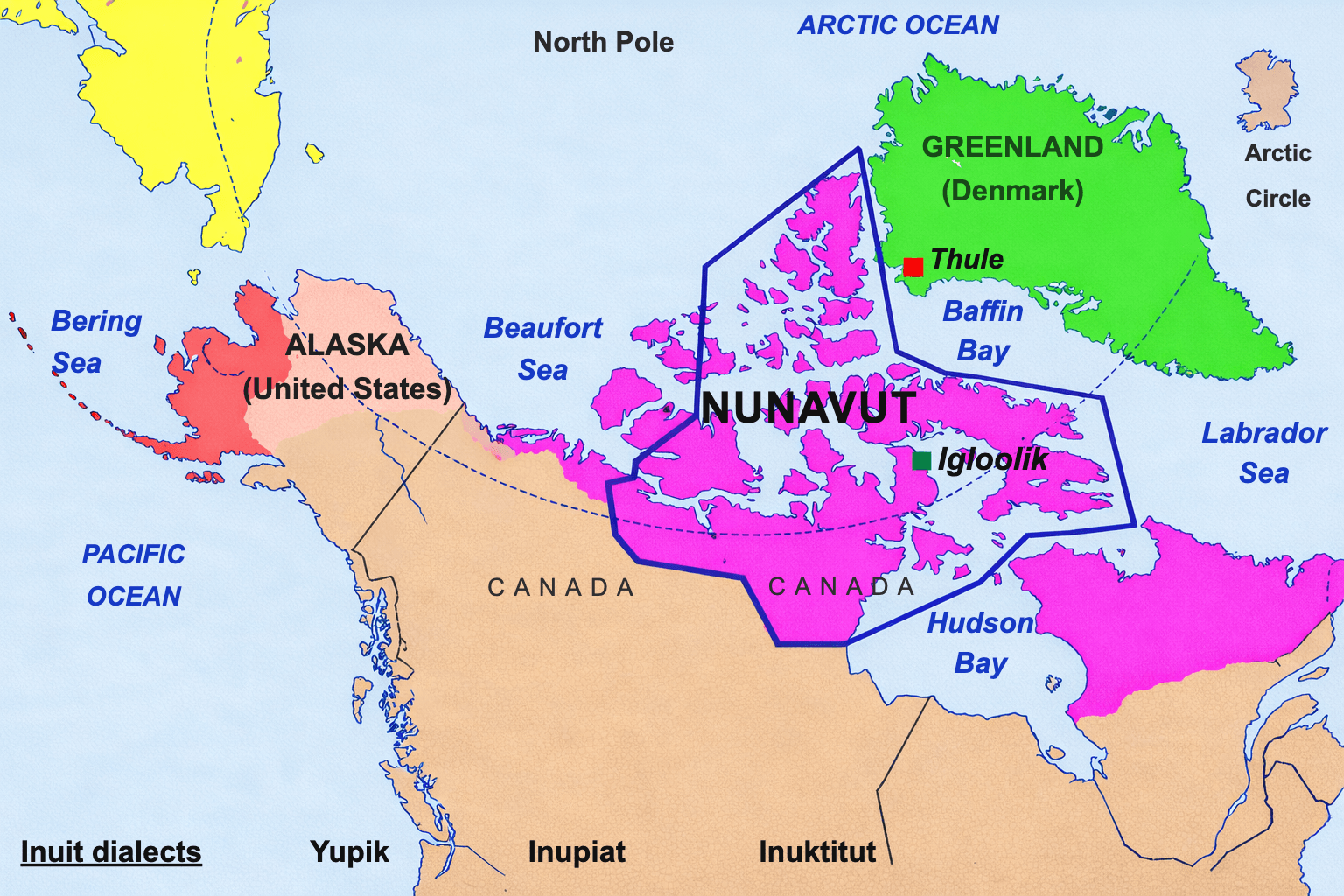
“"The term 'Eskimo' (or, in French spelling: Esquimau, Esquimaude, Esquimaux), referring to a specific culture and language family, designates a group of Arctic populations that gradually spread, through successive migrations, from eastern Siberia across the Bering Strait, along the southwest coasts of Alaska, and toward the far north of Alaska, Canada, and Greenland. Their habitat, located between 210° west longitude and 172° east longitude, and between 56° and 73° north latitude, covers an immense territory totalling around 15,000 kilometers of coastline. Today, Eskimo populations - numbering over one hundred thousand - are politically attached to four nations: Russia for Siberian Eskimos; the United States for those in Alaska; Canada for those in the central Arctic and Labrador; and Denmark for Greenlanders, who since 1979 have had internal self-government but remain under Danish authority for foreign affairs and defense.
Since the 1970s, some groups have rejected the term Eskimo, which they consider pejorative. In Canada, they prefer to call themselves Inuit (singular inuk), and in Greenland kalaallit (singular kalaaleq). In Alaska, the term 'eskimo' is still used, with the geographical and cultural distinction inupiat (northern communities) and yuit/yupiit (western and southwestern communities). Siberian Eskimos now also use yuit or yupiget to identify themselves."
Just two clarifications:
-
The languages spoken by Eskimo peoples are classified into two groups (both part of the Eskimo-Aleut family), reflecting two major settlement waves in the Arctic. First, Yupik (17,000 speakers), spoken by descendants of Paleo-Eskimos who came from Siberia via the Bering Strait. Inuit speak Inupiaq (or Inuktitut in Canada, about 60,000 speakers in total), the language of Thule culture, which spread from west to east. These two main branches are further divided into dialects.
-
Since 1 April 1999, Nunavut, the land of Canada's Inuit, has been a full territory of Canada. Since that date, Canada has had three territories: Yukon, the Northwest Territories, and Nunavut, created from a reorganization of the Northwest Territories.
The calendar
Strictly speaking, there is no Inuit calendar. And from the beginning of the 19th century, introducing notions entirely unknown to Inuit society, such as the week and Sunday rest, had consequences that were not always positive.
In the absence of a highly structured calendar, we will focus on the Inuit relationship to time and discover what Anthony Aveni (astronomy professor) very aptly calls eco-time.
But first, we need a little astronomy to understand what challenges arise, at latitudes between the Arctic Circle and the Pole, when trying to build calendars based on the fundamental notion of day (daylight + night).
A touch of astronomy
At the North Pole (90° N)
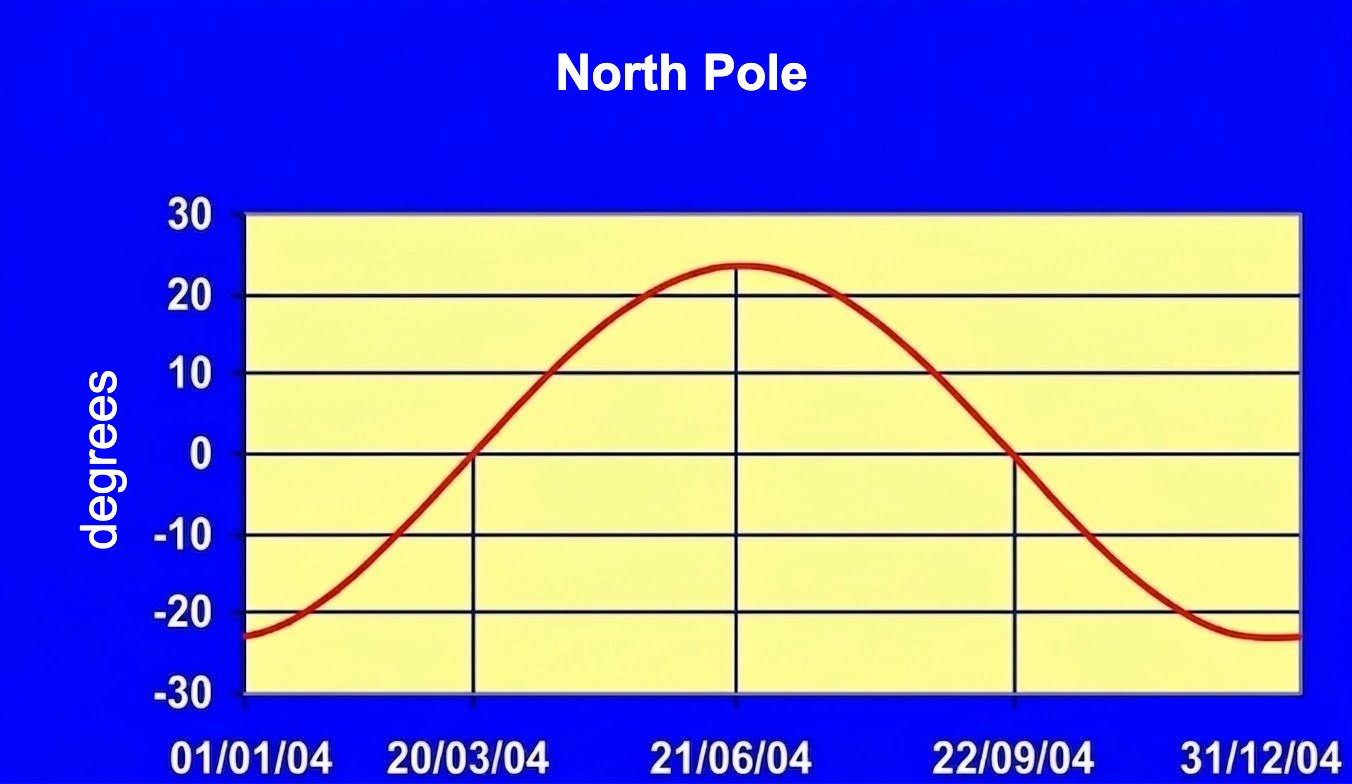
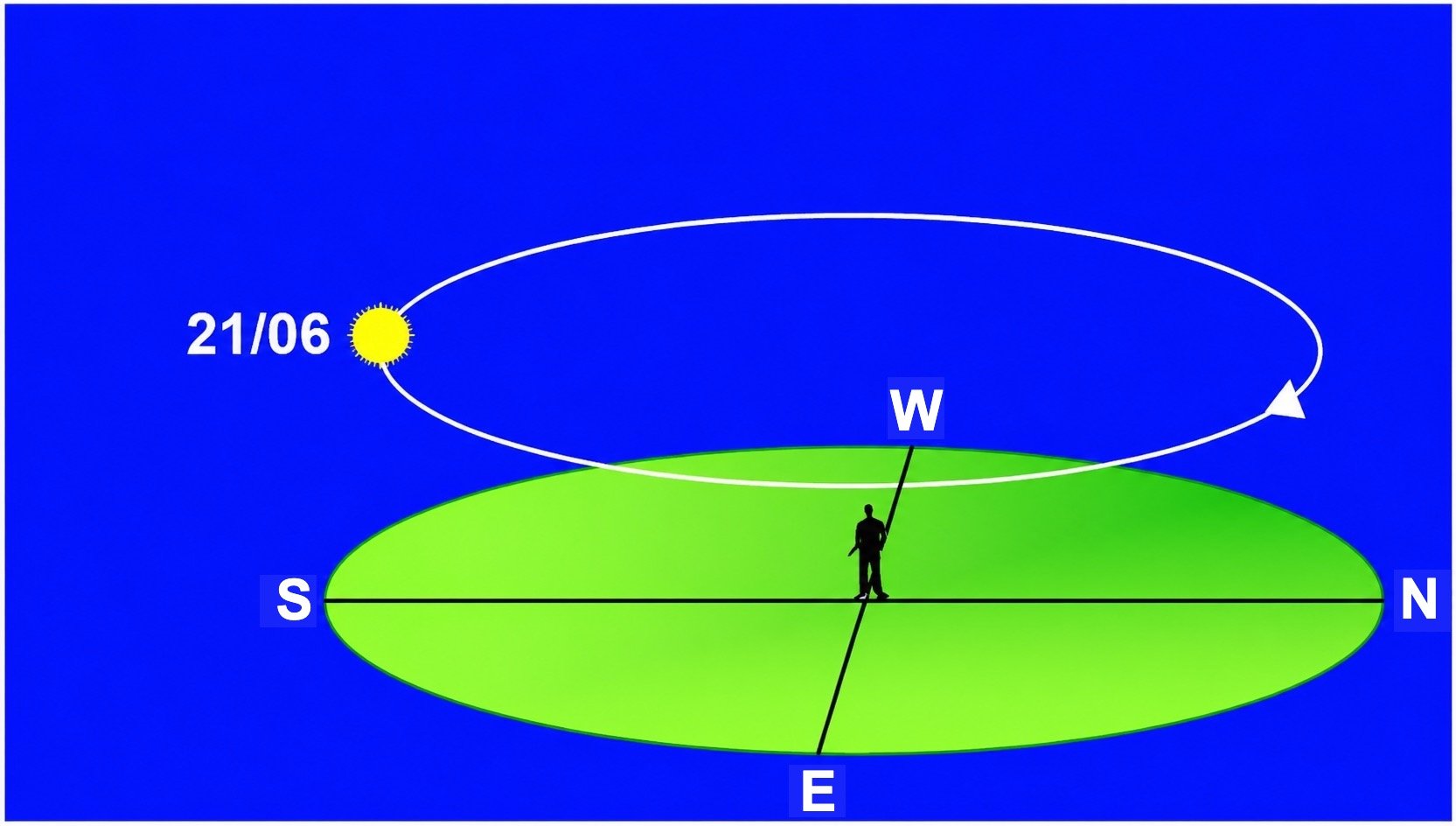
Elbert S. Maloney explains that "at the Pole, the Sun rises and sets once a year, the Moon once a month. Visible stars rotate endlessly in circles at the same altitude. Only half of the celestial sphere is visible... The 24-hour day at the Pole is not marked by the usual alternation of light and darkness, and 'morning' and 'evening' have no meaning. In fact, the day is marked by no observable phenomenon except that the Sun makes one complete circuit of the sky."
In the upper diagram, we can see that the Sun rises at the spring equinox and sets at the autumn equinox. Between those two dates, it makes one full circuit of the sky every 24 hours. It reaches its maximum height at the summer solstice, as shown in the second diagram.
In Thule (76° 32' N)
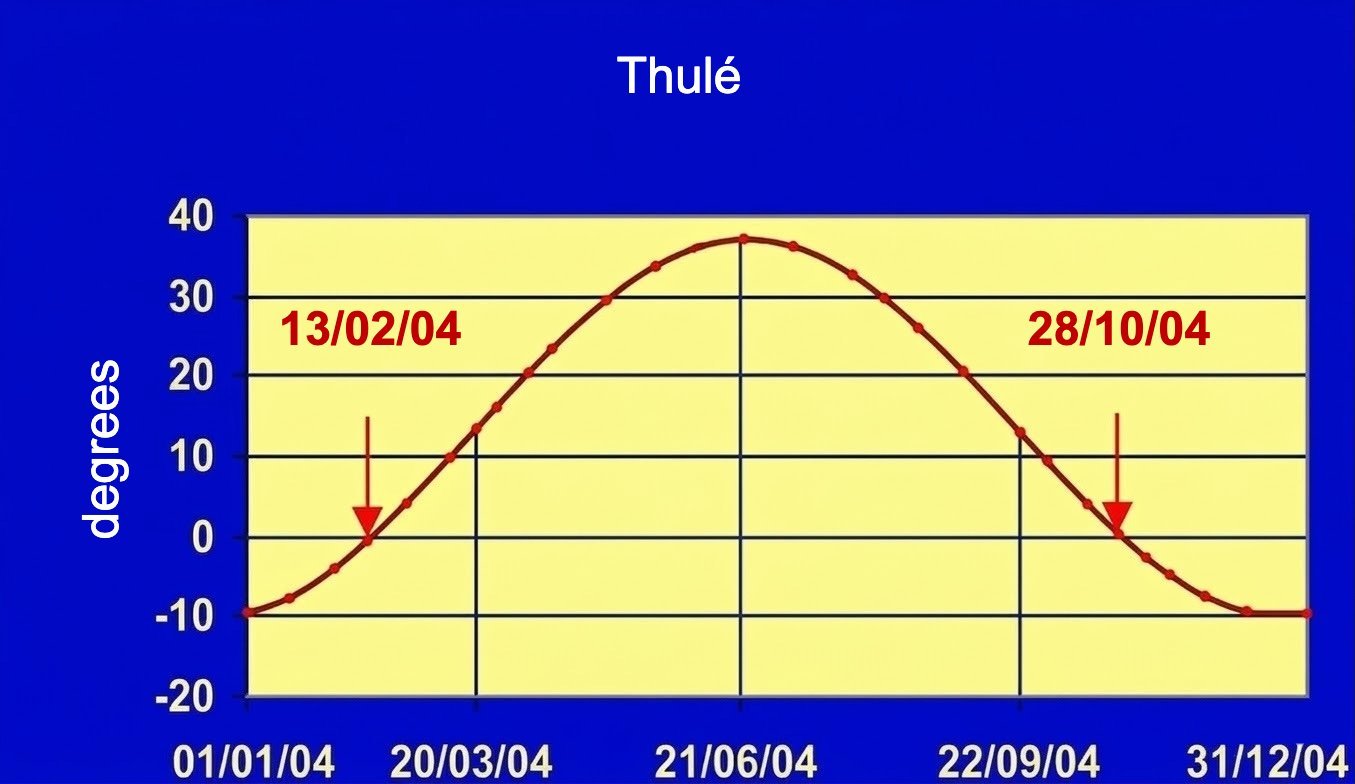
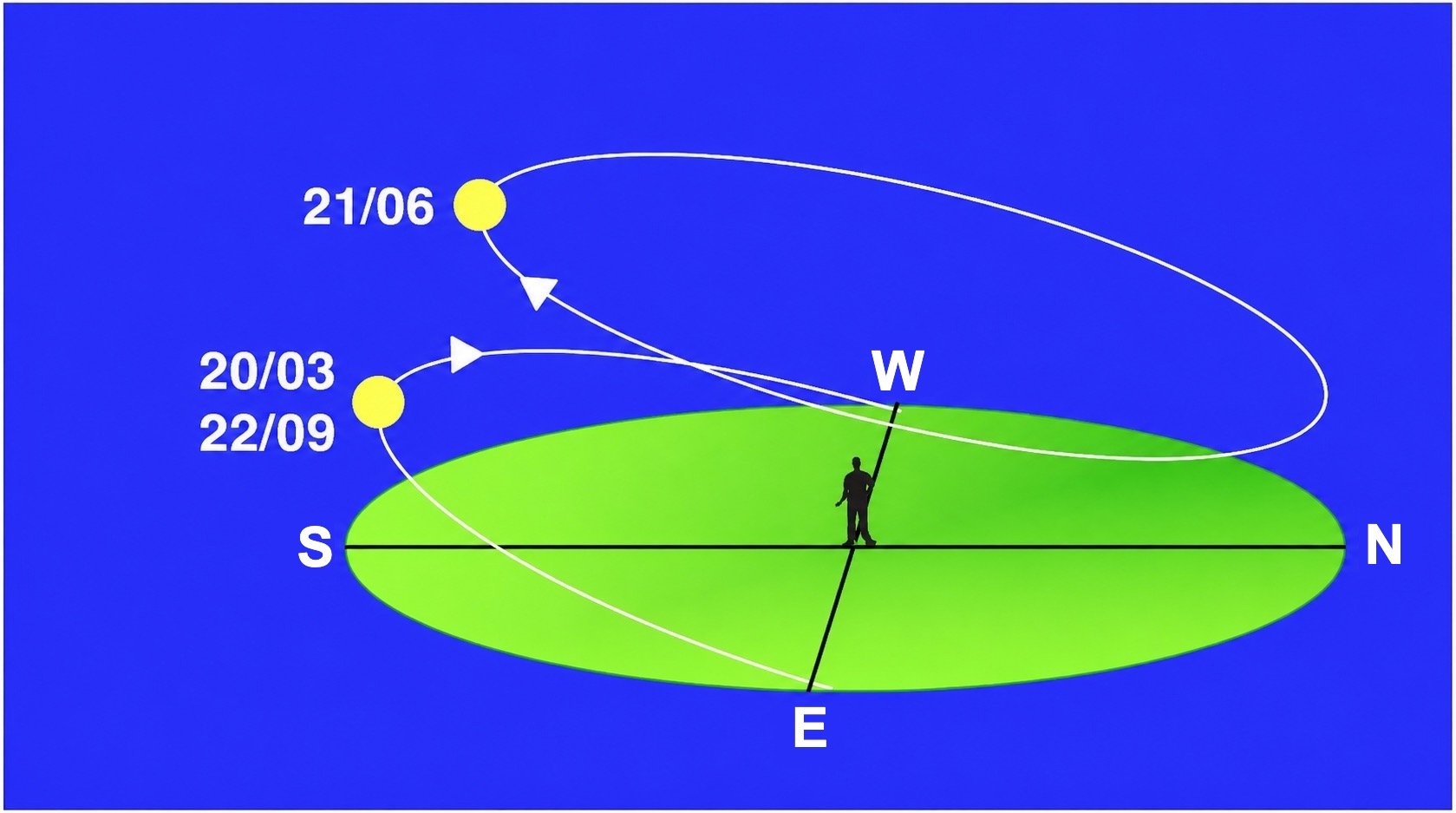
"At our latitudes, it is hard to imagine that Eskimo life takes place at the 77th parallel, not only in extremely severe temperatures and storms, but also with a very different alternation of light from what we know: four months of continuous polar night followed by eight months of continuous polar day."
Jean Malaurie
In the upper diagram, we can see that from late October to mid-February the Sun remains below the horizon. Then it climbs higher and higher in the sky until it no longer sets.
In Igloolik (69° 22' N)
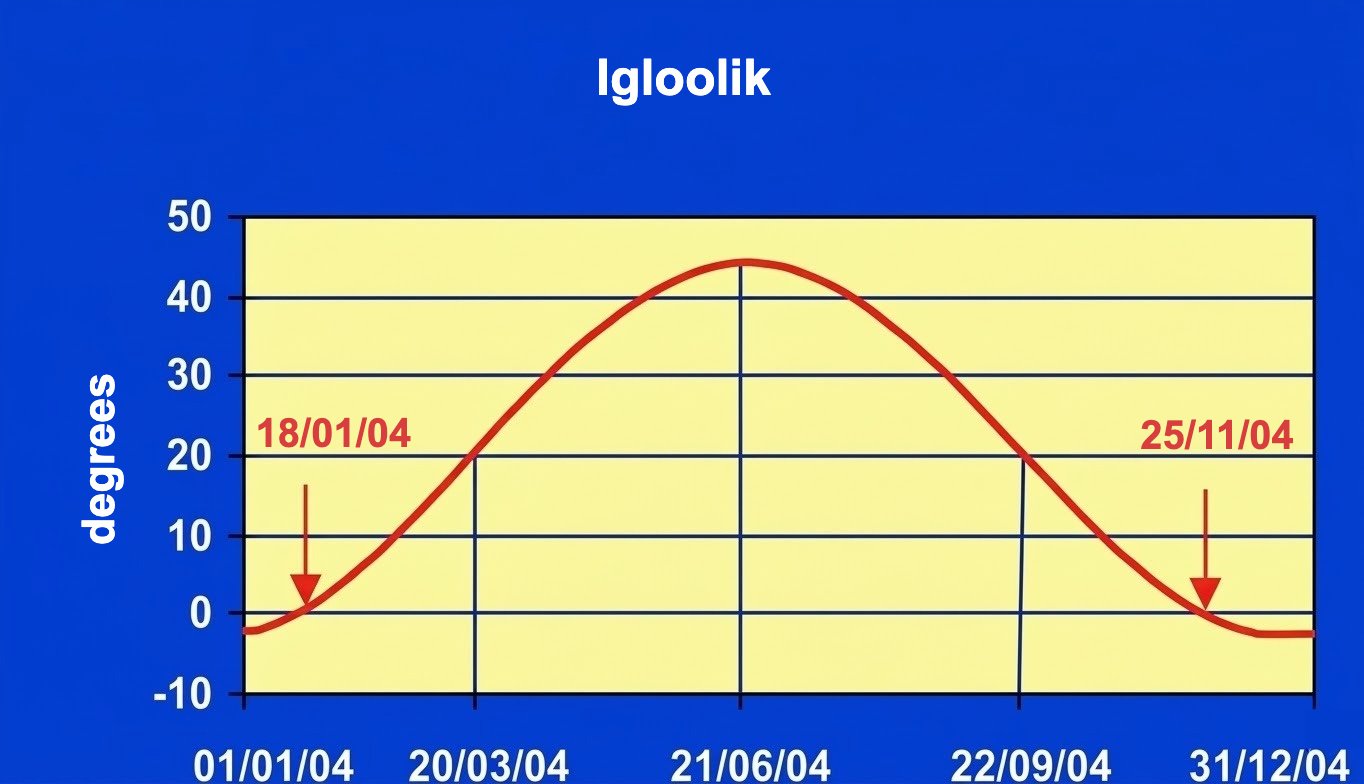
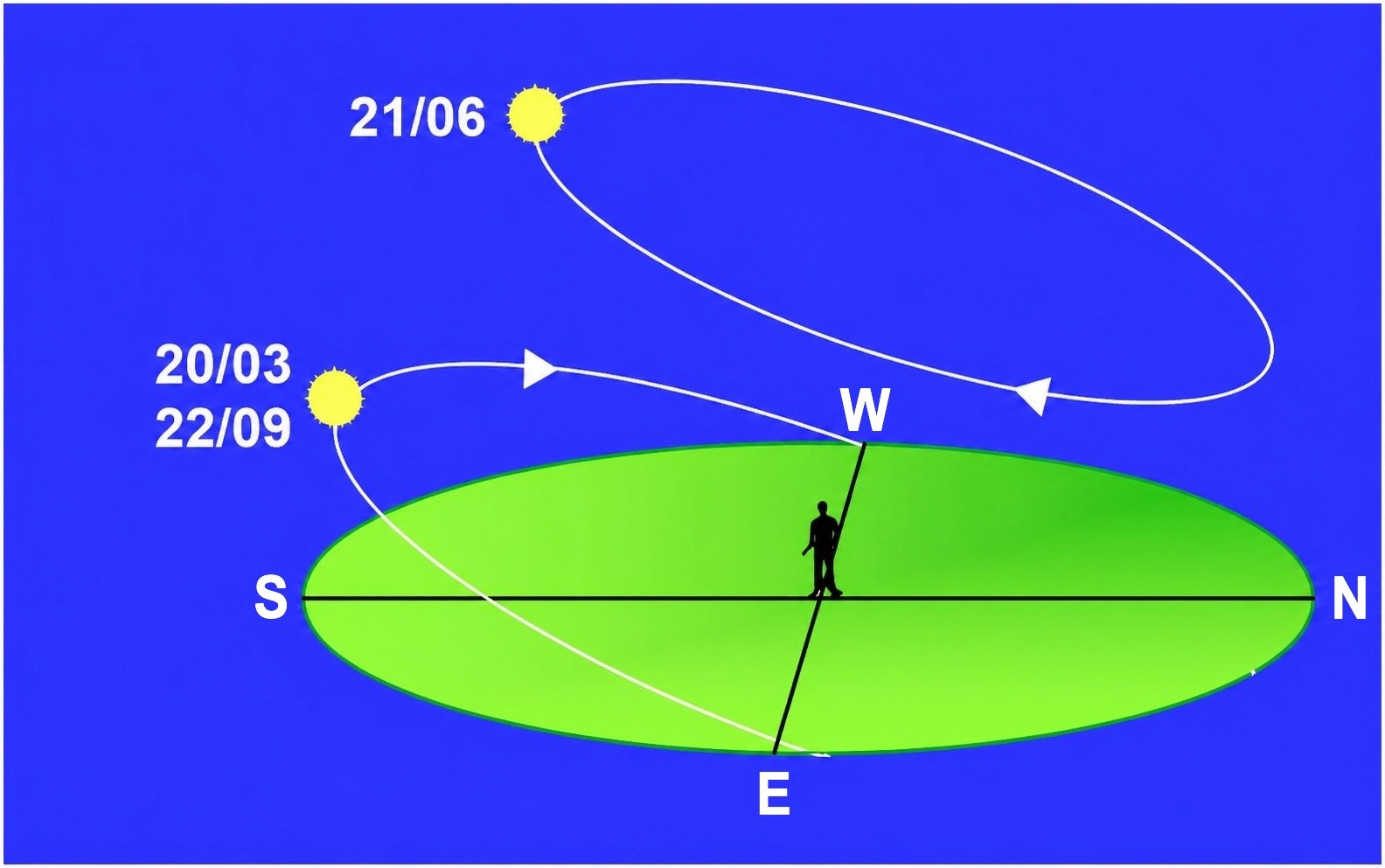
"In Igloolik, the Sun is below the horizon for 48 days between 29 November and 14 January, and above the horizon for 66 days between 19 May and 24 July (U.S. Naval Observatory, 1990). A month of twilight precedes and follows the midnight-sun period, masking the stars from around mid-April to late August... Robert Peary attributed Eskimo people's limited astronomical knowledge to the fact that star movements can be observed for only three months each year."
John MacDonald
In the upper diagram, we can indeed see the Sun rising around mid-January, climbing until it no longer sets, and disappearing again toward the end of November.
On the Arctic Circle (66° 34' N)
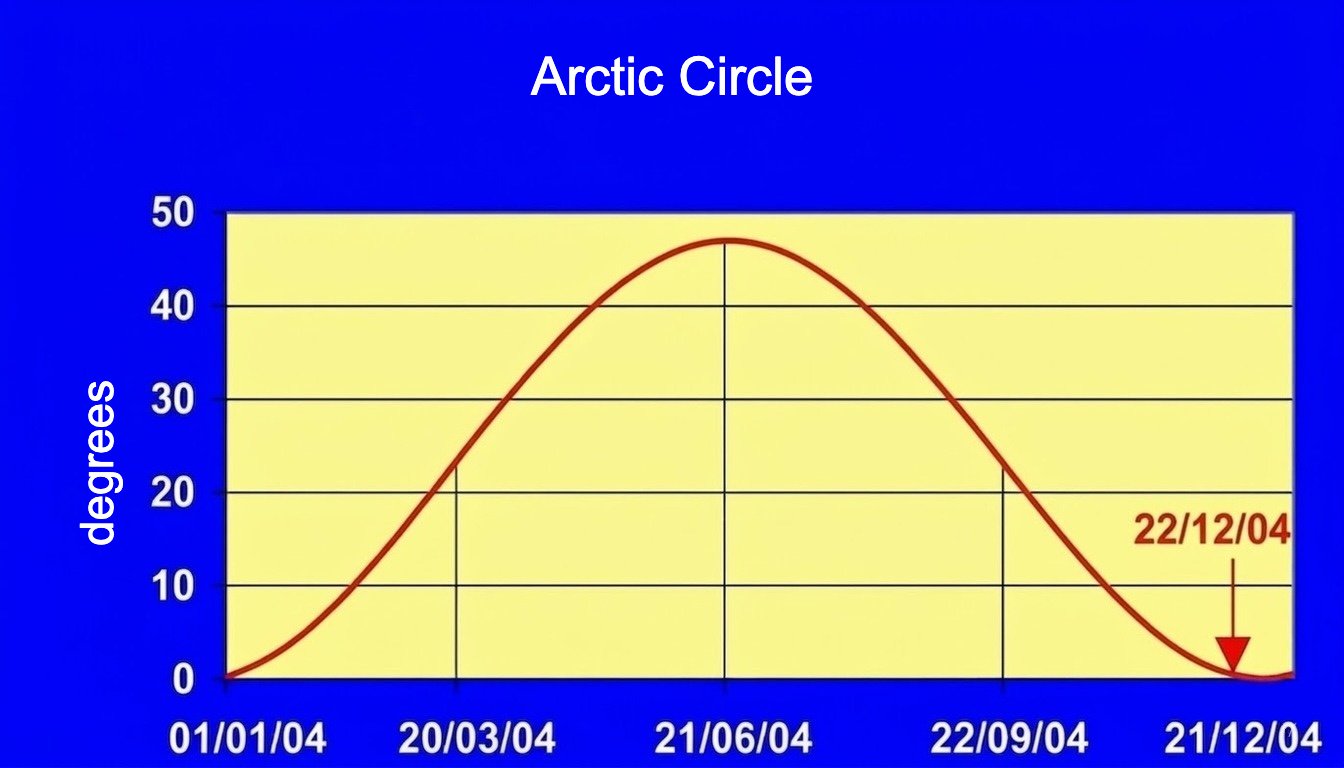
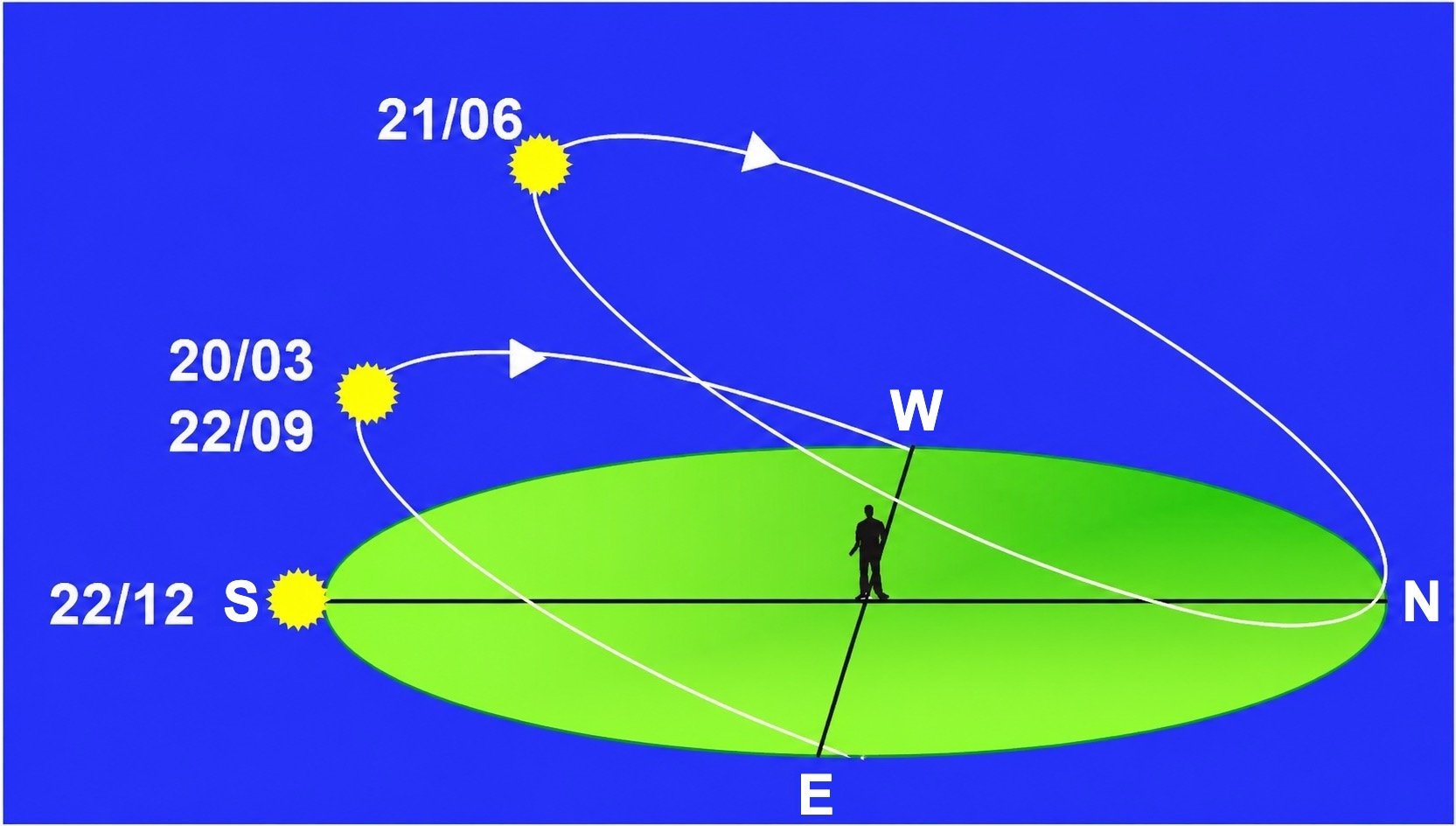
21 June is theoretically the only day when the Sun does not set. And 21 December is the day when the Sun barely rises above the horizon before almost immediately setting again.
Also note that between the extreme latitudes - the Pole on one side and the Arctic Circle on the other - the higher the latitude, the less bright the stars appear. This decrease in stellar brightness, due to reflected-light phenomena, was estimated by Stefansson as two to three times lower in the Arctic than at lower latitudes.
The Inuit eco-calendar
NOTE: The French word jour can be ambiguous (here even more than elsewhere), because we do not always know whether it refers to daylight or to a 24-hour span. We will therefore use nychthemeron for a full 24-hour period (day + night), and day for the daylight period.
When we live at our latitudes (France), what stands out most from this quick look at Arctic skies is certainly the alternation - longer or shorter depending on latitude - of nychthemerons without light and nychthemerons without darkness.
We should be careful, however, not to imagine this as simply the “deepest night” in winter and the “brightest day” in summer. In a study on Inuit night, Guy Bordin (Laboratory of Ethnology and Comparative Sociology) rightly writes: "The simplistic Western view - a long uninterrupted winter night and an uninterrupted summer day - has little to do with the Inuit representation of their environment. Everything is transformation and continuity."
In 1956, Edward Moffat Weyer wrote (my translation) in Daylight and Darkness in High Latitudes that "... defining day (light) as the level of light that allows one to read a newspaper outside under a clear sky, there are 32 weeks of continuous light at the Pole, plus 8 weeks during which there is at least that much light all the time. Where the northernmost Eskimos live, the Sun is continuously below the horizon for only slightly less than 16 weeks a year. During that period, only 11 weeks are without twilight light. And during those 11 weeks, the landscape is usually lit by the Moon, which behaves in ways that may seem unusual to people living at lower latitudes..."
We will see later that this prolonged night or day, even if it differs from what we imagine, is not at the heart of the Inuit concept of time.
Still, some fundamental units on which calendars are built are challenged by this specific Arctic sky.
What becomes of the day unit (day/night pair) when the Sun no longer rises or no longer sets? How do you build a lunar calendar when the Moon is not visible for long weeks? In short: how is time understood by the Inuit?
According to Danish historian Finn Gad, "... they were satisfied with the change of seasons and their knowledge of the habits of the animals they hunted. Wind and weather can disrupt anything, but overall there was a predictable series of changes in a relatively stable sequence, applicable to sunrise and sunset, the Sun's height above the horizon, periods of darkness, the midnight sun in the North, and finally lunar phases and tides. In addition, there existed a rough system for counting long periods of time, but it was more an individual measure related to important events in each person's life or in group life... the individual and close family had a private calendar based on children's growth markers, especially boys."
John MacDonald identifies in this text the three elements that, in his view, make up Inuit time:
- Animal migration;
- Solar and lunar cycles;
- Milestones in an individual's life.
He groups the first two under the term “eco-time”, coined by Anthony Aveni.
This eco-time “links people to the environment through natural changes to which they respond”. We will encounter this notion again in African calendars. Added to that is social and cultural time, which “links people to one another”. This is the last of the three elements already mentioned. John MacDonald adds a third category: mythical time, which “links people to their origins”, when everything was disorder and darkness.
We will mainly focus on eco-time in its two aspects.
Depending on the region (latitude), Inuit divide the year into six to eight major periods (which can be called seasons) and 12 or 13 sub-periods (luni-solar months). Based on an Inuit dictionary produced by a collective in Mittimatalik, Guy Bordin gives the following translation of season definitions:
- ukiuq (winter): the period between autumn and early spring.
- upirngaaq (spring): from the beginning of thaw until complete ice disappearance.
- aujaq (summer): open water and snow-free ground.
- ukiaksaaq (early autumn): the period between summer and autumn, with increasing cold.
- ukiaq (autumn): from late summer to winter, with the arrival of freezing conditions.
We can see that the reference points are mainly climatic and, to a lesser extent, linked to animal life. What struck us as an important element of the Arctic sky - darkness or light - is not central in Inuit classification.
Guy Bordin notes that this absence of reference to “night” or “day” is also found in the description of the 12 or 13 months. Thus, in Igloolik, there are eight periods marked by animal life, two by the Sun's position, one by social life, and only one referring to the total darkness of midwinter.
Let us now set out a table of months and seasons in Igloolik, keeping in mind that this is only one calendar among others, since they vary by latitude. That means lunar months do not always correspond exactly to the ecological events described.
| Season and meaning | Month and meaning | Approximate correspondence |
|---|---|---|
| UKIUQ Winter | SIQINNAARUT Time when the Sun may appear | January/February |
| QANGATTAASAN It (the Sun) rises higher | February/March | |
| UPIRNGAKSAJAAQ Toward early spring | AVUNNIIT Premature birth of seals | March/April |
| UPIRNGAKSAAQ Early spring | NATTIAN Seal season | April/May |
| UPIRNGAAQ Spring | TIRIGLUIT Bearded seal season | May/June |
| NURRAIT Caribou calving | Early June | |
| MANNIIT Egg season | Late June/July | |
| AUJAQ Summer | SAGGARUUT Caribou moulting season | July/August |
| AKULLIRUT Caribou fur thickens | August/September | |
| UKIAKSAJAAQ Toward early autumn | AMIRAIJAUT Season of velvet antlers on caribou | September/October |
| UKIAKSAAQ Autumn | UKIULIRUT Winter begins | October/November |
| UKIAQ Early winter | TUSARTUUT Period when news is exchanged | November/December |
| UKIUQ Winter | TAUVIKJUAQ Great darkness | December/January |
There is no need to ask whether this eco-calendar is purely lunar or luni-solar. It is necessarily luni-solar, since the events defining the months are seasonal and synchronized with nature.
But then, how does it avoid drifting? MacDonald explains that the midwinter months called Tauvikjuak (“great darkness”), a 45-day period without Sun, constitute two parts of a two-lunation span. One part is simply ignored: the calendar is “frozen” for that period and resumes counting at the first new moon after the Sun returns, in the month Siqinnaarut.
Stars and the notion of day
Of course, in the previous table we did not provide the number of days in each “month”. That is because this Western-style notion of “day” had no real meaning for the Inuit. On this point, Jean Malaurie writes that he “... counted his journeys in sinik, in number of sleeps”.
Should we conclude that there was no daily reference for eating, sleeping, waking? Not at all. Each Inuit person knew exactly where they were in time, and the positions of the Sun and Moon helped. And when there is no Sun? Then stars become the reference.
MacDonald tells a revealing anecdote involving explorer Elisha Kent Kane. A group of Inuit, looking for a place to sleep near his camp late at night, was told by one of Kane's companions - not very welcoming - that there was no point, as day would soon break. One Inuit replied while pointing to a star: “No, when that star reaches here” (pointing to one part of the sky), “and not higher than that star” (pointing to another), “then it will be time to harness the dogs.”
Inuit use two stellar motions to orient themselves in time:
- Rotation of the Big Dipper (Tuktujuit) around Polaris (Nuuttuittuq).
For example, for them the Big Dipper has the shape of a caribou. As midnight approaches, it rises on its hind legs and its head begins to lift. - Rising and setting of non-circumpolar stars, for example to mark the winter solstice and predict the return of the Sun after the dark period.
According to MacDonald, the Iglulingmiut divide the nychthemeron into 10 parts of unequal duration. 5 are built from ullaaq or ulluq (“day”): Ullaaksa, Ullaaraarjuk, Ullaaq, Ullaaqpasik, Ullulluaq. 5 others are built from unnuq (“night”): Unnuksaliqtuq, Unnuksa, Unnuliqtuq, Unnuk, Unnuaq.
We can note that although unnuaq (night) appears as a period, ulluq (day) does not appear as such. Ulluq should be understood as a generic term for the whole daylight span (from sunrise to sunset). Night without darkness has a specific name: unnuattak. By contrast, there is no specific name for day without light. Uhh... still with me?
Catastrophic introduction of the week
According to MacDonald, it was in 1822 that the Inuit of Igloolik began learning notions still unknown to them: the week, especially Sunday, and the rest attached to it. At that time, Captain Parry, during his expeditions, wanted to regulate Inuit visits to his ship, explaining that they could not come on Sunday during mass.
Vilhjalmur Stefansson recounts the consequences, a few years later, of introducing this “Sunday rest” among a people increasingly embracing Christianity. Translation mine:
"Animal migration is not regular, and often at the height of whale-hunting season, crews can camp for a week without seeing one. When Eskimos learned that God had forbidden work on the day of rest, they considered that it does not profit a man to gain the whole world if he loses his soul. And although whale capture was what they wanted most, on Saturday afternoon they pulled their boats away from the ice edge and prepared to observe Sunday. It took half of Monday to get everything ready again. Thus they lost two days out of seven in a warm season that lasts only six weeks per year."
And so, in the 1920s, the Inuit had to introduce a liturgical vision of time into their eco-time. Not without difficulty: women and elders, responsible for “keeping time”, marked days on a piece of wood and checked with others when Sunday had been “lost”.
The arrival of the calendar - our calendar - was inevitable. The first one was introduced by a Catholic mission in 1930.
Watches soon followed. Should we really be proud of that??