“In history, there is never a Beginning with a capital “B.”
Jean Bottéro - Specialist in ancient Mesopotamia.
There are only developments, intersections, separations,
forgettings, rediscoveries.
Introduction
We can understand why the year has 365 days: it is the approximate duration of one revolution of the Earth around the Sun.
We can understand why a month has 29 or 30 days: it is the approximate duration of one revolution of the Moon around the Earth. And through this site's various calendars, we can see that month length can be adjusted.
We know what a day is: the duration of the Sun's apparent revolution around the Earth, which is in fact the duration of the Earth's rotation on its axis.
But why does a day have 24 hours, an hour sixty minutes, and a minute sixty seconds? Asking these questions brings us back to the same issue we faced when asking why the week has seven days.
To try to answer, we will travel through time and follow how the number of hours in a day evolved from the earliest periods onward. From there, we should avoid concluding too quickly that we owe today's day-division to one civilization in particular, keeping in mind Jean Bottéro's point. The currents of influence are such that we simply cannot reconstruct them with certainty.
But before starting this inquiry, we must agree on the meaning of certain words we will use. Otherwise, we risk mixing everything up and not talking about the same things.
The meaning we will give to words
Beyond the advantage of using the same meaning for each word, defining them will already help us notice a number of facts that are not as obvious as they may seem at first glance.
The day
A) We will consider the day as the average interval between two sunrises, two sunsets, or two solar meridian passages at a given place. Roughly speaking, it corresponds to the civil day or astronomers' mean day. Note that for astronomers, the mean solar day begins at noon, while our current civil day begins at midnight. This “day” as just defined corresponds to what the Greeks called the nychthemeron (from nux-nuctos = night and hemera = day).
Let us still clarify one point, to avoid upsetting astronomers: the true solar day does not have the same duration depending on whether one measures it from sunrise, sunset, or meridian passage. For example, between 01/08/2003 and 02/08/2003, according to ephemeris data from the Bureau des longitudes, day length was:
| Day | Sunrise | Meridian passage | Sunset |
|---|---|---|---|
| 01/08/2003 | 4 h 24 m 52 s | 11 h 57 m 01 s | 19 h 28 m 17 s |
| 02/08/2003 | 4 h 26 m 12 s | 11 h 56 m 57 s | 19 h 26 m 49 s |
| Day length | 24 h 1 m 20 s | 23 h 59 m 56 s | 23 h 58 m 32 s |
But that is only a side observation, because our goal is less about minute-level differences and more about understanding why there are 24 hours in a day.
On that topic, let us ask another question: should we say a day has 24 hours, or two times twelve hours? After all, do our watches, alarm clocks and analogue clocks not have twelve-number dials? Who has never heard “it's 4:20” instead of “it's 16:20”?
If we still remember the Y2K bug, we less often remember that 1900 also had its own upheaval. Let us read what Henri de Parville, in the scientific journal La Nature (1898), wrote: "Newspapers announced that from 1900 onward the civil day would no longer be divided, as before, into two parts of twelve hours, called morning and evening hours. They based this on the fact that this year, according to the Bureau des longitudes yearbook, days still begin at midnight but are now counted from 0 to 24 hours.... People would go for a walk at 15:00, invite each other to dinner at 19:30, etc. What an upheaval in our habits! And what about watch dials and clock chimes? Will we have the patience to hear 23 chimes?"
And, as if to reassure readers, he adds later: "The Bureau des longitudes has no authority to change our hours. A law is needed. A bill for continuous numbering from 0 to 24 had indeed been submitted in Parliament. But, as often happens, it remained in a drawer... The reform is still pending elsewhere. So let us not move too fast in France, and reassure those somewhat troubled by this premature news of changing our age-old hours."
The news did remain premature... for 15 years, since the feared reform finally came through a law of 9 March 1914, by which France adopted time zones and a 24-hour day division.
And people still often say “it's 4:20” instead of “it's 16:20.” If switching to the euro takes that long, we may hear about francs for a while yet.
To close this topic, here are dictionary definitions of “hour” across editions of the Académie dictionary:
6th edition - 1835: "HOUR: interval of time making the twenty-fourth part of the natural day. The day is usually divided into two parts of twelve hours, the first beginning at midnight, the second at noon."
8th edition - 1932: "HOUR: interval of time making the twenty-fourth part of the natural day. The day was generally divided into two parts of twelve hours, the first beginning at midnight, the second at noon. Usage tends to introduce numbering from 0 to 24, beginning at midnight."
9th edition - in progress (vol. 1 released 1992; vol. 2 released 2000): “HOUR: interval corresponding to the twenty-fourth part of the day.”
B) We will call daytime the interval from sunrise to sunset.
C) Naturally, we will call night the interval from sunset to sunrise.
Naturally? As if we moved abruptly from night to daytime as soon as the Sun becomes visible. As if we moved abruptly from daytime to night as soon as the Sun disappears. What about all that time when it starts getting light before you see the Sun? Or when the Sun is gone but it is not yet full darkness? All those moments are covered by many terms:
- Dawn: the very first light before sunrise. Also called daybreak.
- Aurora: bright light following dawn and preceding sunrise.
- Sunrise.
- Morning: start of day; moments just before and after sunrise.
- Twilight: light preceding sunrise.
- Nightfall/dayfall: moment when night/day falls.
- Dusk.
- Evening: decline and end of day; moments before and after sunset.
- and surely others.
Note that in the 16th century, crépuscule referred to sunset rather than sunrise.
In the end, thinking it through, there is only one moment in a day that can be clearly defined: when the gnomon's shadow (see page on measuring instruments) is shortest - that is, when the Sun crosses the meridian and reaches its highest point of the day: true noon. Which leads us to divide our daytime as defined above into morning and afternoon.
Hmm... did I give the origin of the word day? No? That does not surprise me, since it is not obvious that French jour comes from Latin dies. And there we are - now you want more. And since I would hate not to satisfy your curiosity, here it is.
At the root of dies (and also of French dieu, “God”) is the Indo-European root dei, expressing brightness or shining. We still find traces in words like lundi, mardi, even midi. A synonym of dies in late Latin (3rd to 5th century) is diurnum. Losing its d, diurnum became jorn (10th century), then jur (11th century), and finally jour in the 13th century. And to finish upsetting you about etymology: Jupiter (the planet name) comes from die pater or jur-pater, which can be translated as “god of daylight.” Enlightening, is it not? So day and God are... cousins.
The hour
With the word “hour,” we touch a term that will complicate reading throughout this page.
A) First because we must distinguish between hour as “duration” and hour as “moment.” That part is manageable.
B) But above all because we must make a fundamental distinction between temporal hours (or unequal hours) and equinoxial hours (or equal hours). We will define those more precisely as we go. For now, simply note that equinoxial hours have the same duration all day and all year; temporal hours do not.
Hour comes from Greek “hôrai,” which became Latin “horae.” The Hôrai were minor but benevolent Greek goddesses personifying natural phenomena before becoming symbols of the seasons around the 4th century BCE. In Roman tradition, twelve in number, they accompany the goddess Aurora, who places them in the sky at regular intervals to guide the chariot of the Sun god.
Division of the day into 24 hours
Divisions in the Babylonian day
It is in Mesopotamia that we must look for a 12- or 24-hour division of the day (or of daytime?). Most likely among Babylonians, and even Sumerians. Recall: Sumerians arrived in Mesopotamia around 4200 BCE, began to know writing around 3000 BCE, widespread use came around 2700 BCE, and they knew second-degree equations by 2000 BCE. The Babylonian Empire emerged around 1900 BCE.
Why 12 or 24 in a civilization known for sexagesimal numeration (base 60, to which we will return)?
Because base 12 - and its multiples/divisors - played a major role in Sumerian and Babylonian measurements, as examples show:
- 1 ninnda = 12 cubits (length)
- 1 ninni (rope) = 120 cubits (length)
- 1 gin (shekel) = 3 * 12 su (weight)
- 1 sar = 12 * 12 square cubits (area)
- etc.
Also, when Babylonians invented the zodiac in the 6th century BCE, they divided it into 12 parts. Note this was done on the ecliptic plane, not the equatorial plane - evidence of advanced astronomical understanding.
So it is no surprise that Mesopotamian civilization used duodecimal division for the day.
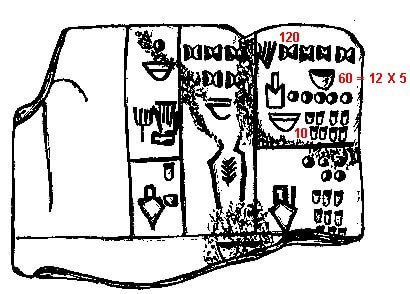
Tablet dated to 3000 BCE, found at Uruk, showing bases other than vigesimal. Ref: ATU 2, tabl. W 22 114. Baghdad, Iraqi Museum. Image from G. Ifrah's universal history of numbers.
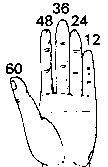
But why such attraction to 12? Perhaps because there are twelve months in the year. Another explanation invokes one of humanity's oldest counting methods: finger counting. Here, duodecimal counting would come from using one hand only. The right thumb opposes the other fingers and counts all their phalanges. After all, who has never counted on their fingers?
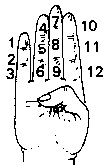
By opposing the other fingers, the thumb can count 12 phalanges.
That may explain the existence of the duodecimal system.
We have indeed kept traces of duodecimal counting: 12 eggs, a dozen oysters, a crate of twelve bottles of wine... I am not mentioning our clock numbering, since that is precisely this study's topic.
So what was the Babylonian day division? 12 or 24 hours? Day or daytime?
One often reads that the Babylonian day was divided into 12 equal kaspus. One kaspu would then equal two of our hours, implying equinoxial hours. Not very satisfying, since time measurement instruments then were essentially gnomons, unable to divide the night.
So we will replace that definition with Gerhard Dohrn-van Rossum's: "The full day was divided into twelve double hours, with separate division for day and night. In this system, daylight (sunrise to sunset) and night are each divided into twelve parts - always equal within each category. The duration and temporal position of these hours vary with daytime length, but the "sixth hour“always denotes noon.”
In short, using our terms: the day would be divided into daytime and night. The day would include 12 hours equal among themselves, but variable through the year depending on daytime length. Each daytime hour has a night counterpart; night also has 12 equal hours among themselves. The longer daytime hours are, the shorter night hours are. Daytime and night hours have the same length only twice a year, at equinoxes. These are temporal or unequal hours.
It is enough to imagine these double hours as equal to recover our old system (seen above) of two times twelve hours.
Dohrn-van Rossum's interpretation is confirmed by Herodotus (484-425 BCE), in time measurement among Greeks (II, 109): "The use of the polos, the gnomon, and the division of the day into twelve parts - the Greeks learned these from the Babylonians." If we reread the section on measuring instruments, we see that gnomon and polos are daytime-only instruments. So Herodotus is indeed speaking of daytime.
Another confirming text for the two-times-twelve hypothesis: before Babylonian exile, Hebrews divided the period from sunrise to sunset (our “daytime”) into three broad periods: morning, noon, afternoon. In Babylon they learned day division. Around 90 BCE, John the Evangelist writes: "Jesus said to them: Are there not twelve hours in the day? If anyone walks in the day, he does not stumble because he sees the light of this world. But if anyone walks at night, he stumbles because there is no light in him." So the 12-hour period is indeed a division of daytime only, not of the full day.
But how did Babylonians count night hours? Unless they had an instrument unknown to us, this division was theoretical. We will see they were accustomed to such abstract knowledge, not only because of their huge mathematical competence, when we get to divisions of hour and minute.
Were Babylonians therefore the “inventors” of the 24-hour day? Let us remember Jean Bottéro's line and answer: “It does not matter.” After studying Egyptian day division, we will see that 24-hour division took time to spread, and it is difficult to know exactly who inherited from whom. One thing is certain: Alexander the Great - said to have inherited the hour from the Babylonians - greatly encouraged diffusion of this day division through his conquests (India, Persia, Mediterranean lands). Besides, use of the word hora for temporal hour is attested only from his period onward.
Before leaving Mesopotamia for Egypt, note that some researchers consider it possible that day division there evolved through 6 hours, then 12, then 24. Moritz Cantor even mentions a primitive division into 60 parts.
Divisions in the Egyptian day
Egyptians took an original approach: they tackled what had long been a real plague (for lack of measuring instruments): the night. Instead of avoiding it, they focused on dividing it. Night division would not become Egypt's eighth plague. I am joking.
To do this, they used a phenomenon they knew well: the heliacal rising of stars.
Quick reminder: when a star rises at dawn only to disappear in first daylight, this is called its heliacal rising. It can be considered the signal for the night's final hour. The heliacal rising of Sothis (Sirius) marked the beginning of the Egyptian agrarian year.
We know the Egyptian year was divided into decades (10-day blocks - see Egyptian calendar) and had 36 of them. One star was chosen to mark end of night for those ten days. Then another for the next ten, and so on through all 36 decades. The “on-duty” star was the decan. Thus 36 decades or decans elapsed before a star was “on duty” again. We can represent this with a 36-column table where stars are named E1, E2, E3, etc. Let us keep only a few rows/columns for understanding.
| Decan | 1 | 2 | 3 | 4 |
|---|---|---|---|---|
| Hour | ||||
| 1 | E1 | E2 | E3 | E4 |
| 2 | E2 | E3 | E4 | E5 |
| 3 | E3 | E4 | E5 | |
| 4 | E4 | E5 | ||
| 5 | E5 | |||
How to read this table? If, for example, we are in the second decade and can see E4 but not yet E5, then we are in the third hour of the night. One sees that from one column to the next, a star name rises one row. Hence the term diagonal calendar often given to such tables.
Our table has 36 or 37 columns (Egyptians accounted for epagomenal days by adding one extra decade). But how many rows?
Quite simply: the number of heliacal star risings observable in one night. In Egypt, on the shortest summer night, one can observe 12 star risings. So there are 12 rows and night is divided into 12 temporal hours.
Use of decans may date back to the Third Dynasty, around 2750 BCE.
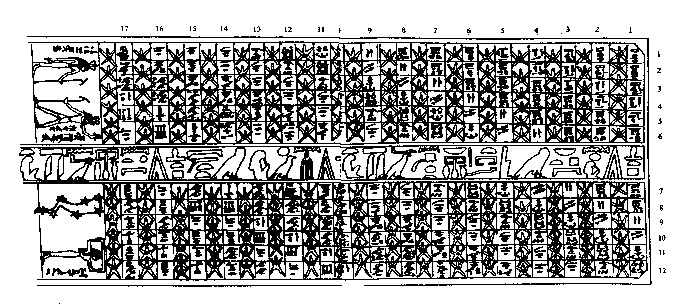
Decanal tables are improperly called diagonal calendars, whereas they are more accurately stellar clocks. Part of Achayt's coffin, Cairo Museum - Neugebauer-Parker, Egyptian Astronomical Texts I, 1960.
Naturally, during the ten days of its decan, a star will not always “rise” in the same way. It rises on first day of the decade, then appears progressively higher each subsequent day (or night). So the end-of-night marker shifts cyclically from dawn into deep night. Still, that is enough to determine times for night religious offices.
These decans were used only in Egypt for several reasons: Egypt's sky is visible only in... Egypt, precession effects, and arrival of instruments like the nocturnal dial. Later astrologers loved them. Earlier, they are found in Egyptian cult texts such as the Book of the Dead and the Book of Gates.
The Books of the Dead include twelve parts corresponding to the twelve hours of night. Each hour is dedicated to the Sun god in his boat, surrounded by beings inhabiting that region. Through the whole night he had to fight his sworn enemy, the serpent Apopis.
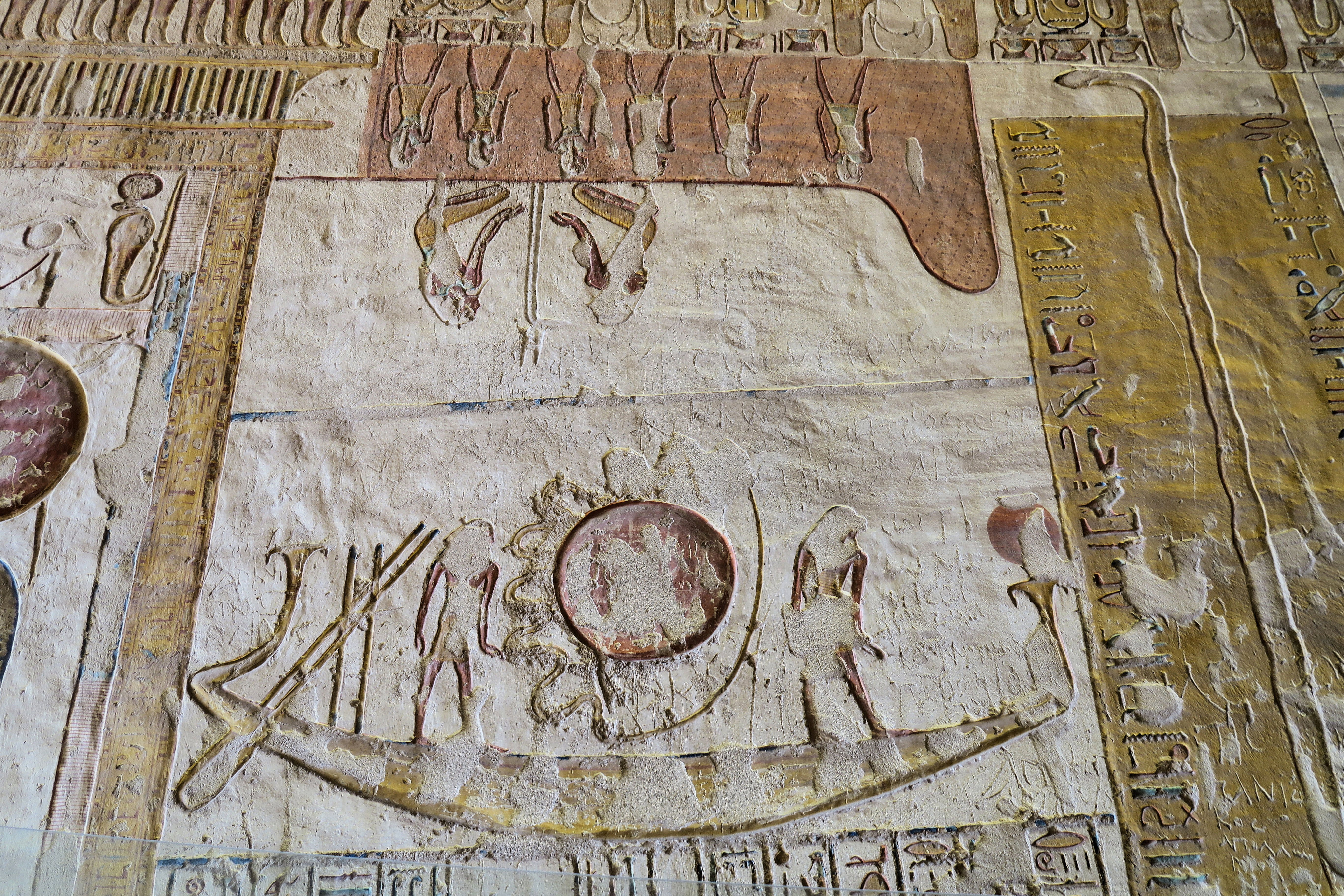
For more images, see here. Copyright “Une promenade égyptienne”.
And the division of daytime?
A painting in the tomb of Seti I, pharaoh who reigned from 1318 to 1304 BCE, shows a sundial divided into ten hours between sunrise and sunset. Egyptians added one hour for dawn and one for dusk. These are of course temporal hours.
If we add those daytime temporal hours to night hours, we get a 24-hour Egyptian day.
The fate of Babylonian and Egyptian systems
After what we have read, one might think the 24-hour day (or two-times-twelve) quickly spread through later centuries. It did not. We can see this through two examples: ancient Rome and the Middle Ages.
Ancient Rome and the 24 hours
In the Laws of the Twelve Tables (450 BCE), one reads: "...When litigants settle by compromise, let the magistrate announce it... In the afternoon, if one of the parties fails to appear, let the magistrate rule in favor of the one present. If both are present, proceedings may continue until sunset, but no later."
Better to litigate in winter. Well... I digress. What I mean is: at that period, noon and sunset were known reference points. Probably sunrise too. Three daily markers.
According to Varro, in 263 BCE consul Valerius Messalla brought back a sundial from Catania, conquered by Roman legions. It was likely used extensively, since only 89 years later did people realize its markers were wrong: Rome's latitude is not Catania's.
One had to wait until 164 BCE for a correct sundial to be installed, and 159 BCE for a public water clock. Hence Pliny the Elder saying that before this, daytime had not really been divided.
Well, almost. Because in Rome - even after instruments arrived - there were practical divisions sufficient to structure daily life. Daytime was divided into four sections, night into four watches (prime, terce, sext, none). These sections were publicly signalled by official authorities.
Some learned people, for their own needs, used additional notions to mark more precise moments:
- diluculum: daybreak
- mane: morning
- ad meridiem: toward noon
- meridies: noon
- suprema: sunset
- vespera: evening
- crepusculum: twilight
- prima fax: first torch
- concubium: late night
- intempesta nox: deep night
- media nox: midnight
- gallicinium: cockcrow
The Middle Ages and the 24 hours
This Roman approach to dividing the day - practical rather than strictly mathematical - is found again in the Middle Ages.
The English monk Ælfric (c. 955-1014), for example, writes in De temporibus anni (the seasons of the year), regarding night:
“Night has seven divisions from sunset to sunrise. The first is called crepusculum, twilight. The second is vesperum, when the evening star appears. The third is conticinium, when all things are silent in their beds. The fourth is intempestum, the middle of the night. The fifth is gallicinium, cockcrow. The sixth is matutinum or aurora, dawn. The seventh is diluculum, the early morning between dawn and sunrise.
As for the Catholic Church, we saw on the page about time-measuring instruments that it divided daytime into eight sections: Matins, Lauds, Prime, Terce, Sext, None, Vespers and Compline.
Should we conclude from Rome or Middle Ages examples that Babylonian or Egyptian day-division systems were lost over time? Certainly not. We simply confirmed Jean Bottéro's phrase: “There are only developments, intersections, separations, forgettings, rediscoveries.”
Use of the 24-hour system truly entered common practice only when real needs arose and time-measuring instruments became available to everyone. Until then, aside from a few initiated experimenters, most people kept using what worked for them.
So saying Romans adopted hour-based division in 263 BCE may be rushing things. Just as one swallow does not make a spring, one sundial does not make a 24-hour day.
Equinoxial hours
If one needed to justify the previous two sections, adoption of equinoxial hours is a good example.
As early as the 2nd century BCE, Greek astronomer Hipparchus of Nicaea divided the day into 24 equal hours (equinoxial hours) for astronomical purposes.
He was followed by Ptolemy, who went further in the Babylonian direction. We will return to this.
And yet, usage of equinoxial hours only really began entering social practice at the end of the 13th century, with arrival of instruments able to measure and display them. I did say began.
Divisions and subdivisions of the hour
Let us go straight to the source: it seems Sumerians and Babylonians were first to divide the hour into sixty minutes and the minute into sixty seconds. This division likely dates roughly from 300 BCE to 100 BCE. Earlier, around 2400 BCE, they may have divided the circle into 360 degrees. All date estimates remain tentative.
Those divisions were largely theoretical (especially the second), given instrument precision at the time.
Needless to say, such fine hour subdivision was mostly for astronomers. And even then: Claudius Ptolemy, in the 2nd century CE, never gave observation times with precision better than a quarter hour.
That same Claudius Ptolemy strongly contributed to adoption of 60-minute and 3600-second day divisions by using them in his own astronomical calculations. And given how actively astronomers later shaped measurement tools like clocks, it is unsurprising we still use those divisions today.
But knowing the origin does not explain the reason. Why 60?
Simply because Sumerians used sexagesimal numeration in cuneiform writing. It was a positional numeration (...thousands, hundreds, tens, units), like ours, except ours is base 10 and theirs base 60, and we use zero. Symbols representing numbers 1 to 60 in base 60 are:
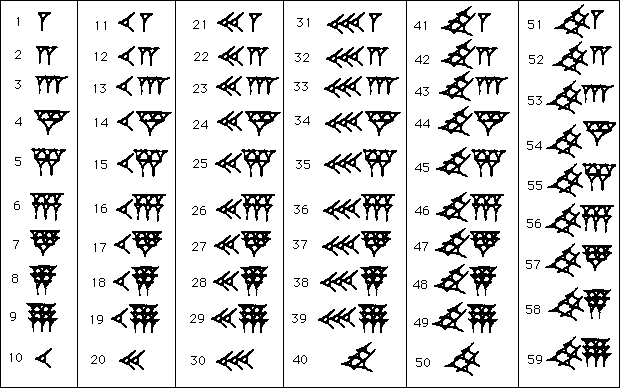
One clearly sees positional logic: for example 29 = symbol for 20 + symbol for 9.
We are used to non-decimal bases since our study of the Mayan vigesimal base, so one short example is enough: 985 in our system is 9 * (10 * 10) + 8 * 10 + 5, i.e. 9.8.5. In Sumerian system, it is 16 * 60 + 25, i.e. 16.25.
And for hours, minutes, seconds? Nothing simpler: our 06 h 25 min 30 sec (6:25:30 in Excel) corresponds to 6 25/60 30/3600, i.e. 6;25,30.
Fine, we understand sexagesimal counting. But why base 60 rather than 18, 37 or 72?
Yes... fair question. Truth is, we do not have a definitive answer. Hypotheses abound. Let us quickly review those listed by Georges Ifrah, before reaching his own, quite attractive, hypothesis.
- Theon of Alexandria (4th century), commentator on Ptolemy; John Wallis (1616-1703); Löfler: 60 has as factors the first six integers.
- Formaleoni (1789) and Moritz Cantor (1880): Babylonian year had 360 days; 1/6 of circle = 60.
- Lehmann-Haupt (1889): relation between Sumerian hour and Sun's apparent diameter. Somewhat obscure.
- Neugebauer (1927): metrological origin via fusion of decimal measurement series. Even more obscure.
- Kewitxch (1904): conjunction of two peoples, one bringing decimal, the other base 6. Hypothesis rejected by Thureau-Dangin because base-6 system is a postulate without historical grounding.
Let us skip mystical explanations and turn to Ifrah's own “plausible” one.
Historically, there may have been several indigenous populations before Sumerian dominance in Mesopotamia. One may suppose these populations and Sumerians used different counting systems, and that base 60 emerged from cultural symbiosis. In this view, original bases were 12 (already discussed) and 5. Looking at the first ten numbers and their names:
| Number | 1 | 2 | 3 | 4 | 5 | 6 | 7 | 8 | 9 | 10 |
|---|---|---|---|---|---|---|---|---|---|---|
| Name | ges | min | es | limmu | ia | as | imin | ussu | ilimmu | u |
Ifrah sees traces of a quinary system. Except for 8, numbers above 5 are contractions of two numbers between 1 and 5:
- 6 as = ia.ges = 5 + 1
- 7 imin = ia.min = 5 + 2
- 9 ilimmu = ia.limmu = 5 + 4
Applied to finger counting, 60 is the primary base, while 12 and 5 are auxiliary bases. On the right hand, one counts 1 to 12. At twelve, one folds the left ring finger, and so on with the other fingers.
This concludes our study of divisions and subdivisions of the day. As far as possible, we now understand why we have 24 hours and 60 minutes/seconds, and where it comes from. But let us not forget Jean Bottéro's line: In history, there is never a Beginning with a capital “B.”