Throughout our study of calendars, we occasionally encounter an additional unit of time layered on top of years and months: the week.
I assume that, like me, you have a few questions about it:
- What is its origin?
- Where do day names and their order come from?
- Which is the first day of the week?
Let's note right away that we use week here in its strict sense from septimana, a group of seven days, more precisely from septem and mane, seven mornings.
1) What is the origin of the week?
Let's rephrase: what is the origin of a perpetual cycle of seven days (named or unnamed)?
The question is less simple than it looks, but the answer is simple: we do not really know. So I will list a few hypotheses without treating them, as some do, as certainties.
A 7-day duration is sometimes linked to average lunar phases. Other schools seek the 7-day cycle in internal biological rhythms, a harder idea to swallow.
Early Egyptians may have used month divisions based on lunar phases.
In Babylonia, seven was considered inauspicious, and aristocratic custom discouraged undertakings on the 7th, 14th, 21st and 28th of the month. One can see here both traces of a seven-day week (interrupted by 30-day months) and early forms of weekly rest.
If we add that Babylonians (and before them Sumerians) knew seven “planets,” each linked to a god, we may have a clue to the origin of the seven-day week. But it remains a hypothesis.
In any case, Hebrews knew the week, as seen in Genesis:
“Genesis 29 27 Complete this woman's week, and we will give you the other one too, in return for another seven years of service. 28 Jacob did so and completed her week. Then [Laban] gave him his daughter Rachel as wife.
Did Hebrews adopt weekly practice after their forced stay in Babylon?
As for Moses, sometimes credited with creating the week, he simply set rules for Sabbath observance. But that is another story, and we will return to it.
Later, the week spread through much of the world by different routes and in more or less developed forms. We return to that evolution in the next section.
Around Christ's birth, it was already popular in the Roman Empire. In the first century CE, it had reached India, then Tibet, Burma, Nepal, Thailand and Ceylon. By the end of the first century, through the Song dynasty, it reached China. More recently, it spread across Christian empires in Europe (around the 3rd century in France). It was also adopted by Islam, which helped spread it.
It is now used in all countries of the world (really everywhere?), if only for economic reasons.
Before moving on, a note about Genesis saying God created the world in six days and rested on the seventh. These are obviously not “our” days. How could they be, since day length comes from Earth's rotation in orbit around the Sun, and at that point there was no such world yet. So literal Old Testament reading is not a serious explanation for the week's origin. As for “rest,” see John Paul II's apostolic letter on the subject.
2) Where do day names and their order come from?
To answer this, we need a little ancient astronomy and astrology.
Babylonians observed moving celestial bodies against fixed stars. They counted seven and, from the 20th century BCE onward, gave each the name of a divinity, without fully identifying body and god. One said “star of Mars,” not simply “Mars.” Later, the longer expression disappeared.
In the 5th century BCE, Greeks replaced Semitic deity names with their own, trying to preserve equivalent attributes.
In the 1st century BCE, Romans did likewise.
That gives us the following table, where these seven bodies and successive names appear:
| French | Babylonian | Greek | Roman |
|---|---|---|---|
| Moon | Sin | Selene | Luna |
| Mercury | Nabou | Hermes | Mercurius |
| Venus | Ishtar | Aphrodite | Venus |
| Sun | Shamash | Helios | Sol |
| Mars | Nergal | Ares | Mars |
| Jupiter | Mardouk | Zeus | Jupiter |
| Saturn | Nin Urta | Kronos | Saturnus |
But why discuss planets when we are supposed to discuss the week?
Because via astrology emerged the astrological week. It had mixed influences: Eastern, Babylonian, Egyptian and Hebrew. It began spreading in Rome from Augustus and became established in the 2nd century.
The principle: each of the 24 hours of a day was placed under a planetary deity. Each day took the name of the planet ruling its first hour.
This required ordering known planets. The chosen order was by estimated distance from Earth, with Earth seen as center of the universe. So everything revolved around Earth, including the Sun's treatment as a “planet.”
Two schools opposed one another: an “Egyptian” order (supported by Plato, Aristotle, Eratosthenes...) and a “Chaldean” order (linked to Pythagoras, Archimedes, Hipparchus, Ptolemy).
The Chaldean order prevailed, descending as:
Saturn, Jupiter, Mars, Sun, Venus, Mercury, Moon
From there, we can build the hourly sequence for seven days and derive day names:
| Hour | Day 1 | Day 2 | Day 3 | Day 4 | Day 5 | Day 6 | Day 7 |
|---|---|---|---|---|---|---|---|
| 1 | Saturn | Sun | Moon | Mars | Mercury | Jupiter | Venus |
| 8 | Saturn | Sun | Moon | Mars | Mercury | Jupiter | Venus |
| 15 | Saturn | Sun | Moon | Mars | Mercury | Jupiter | Venus |
| 22 | Saturn | Sun | Moon | Mars | Mercury | Jupiter | Venus |
| 23 | Jupiter | Venus | Saturn | Sun | Moon | Mars | Mercury |
| 24 | Mars | Mercury | Jupiter | Venus | Saturn | Sun | Moon |
Astrologers explain day order differently, though based on the same planetary sequence. The seven bodies form a heptagon whose sides produce the day sequence.
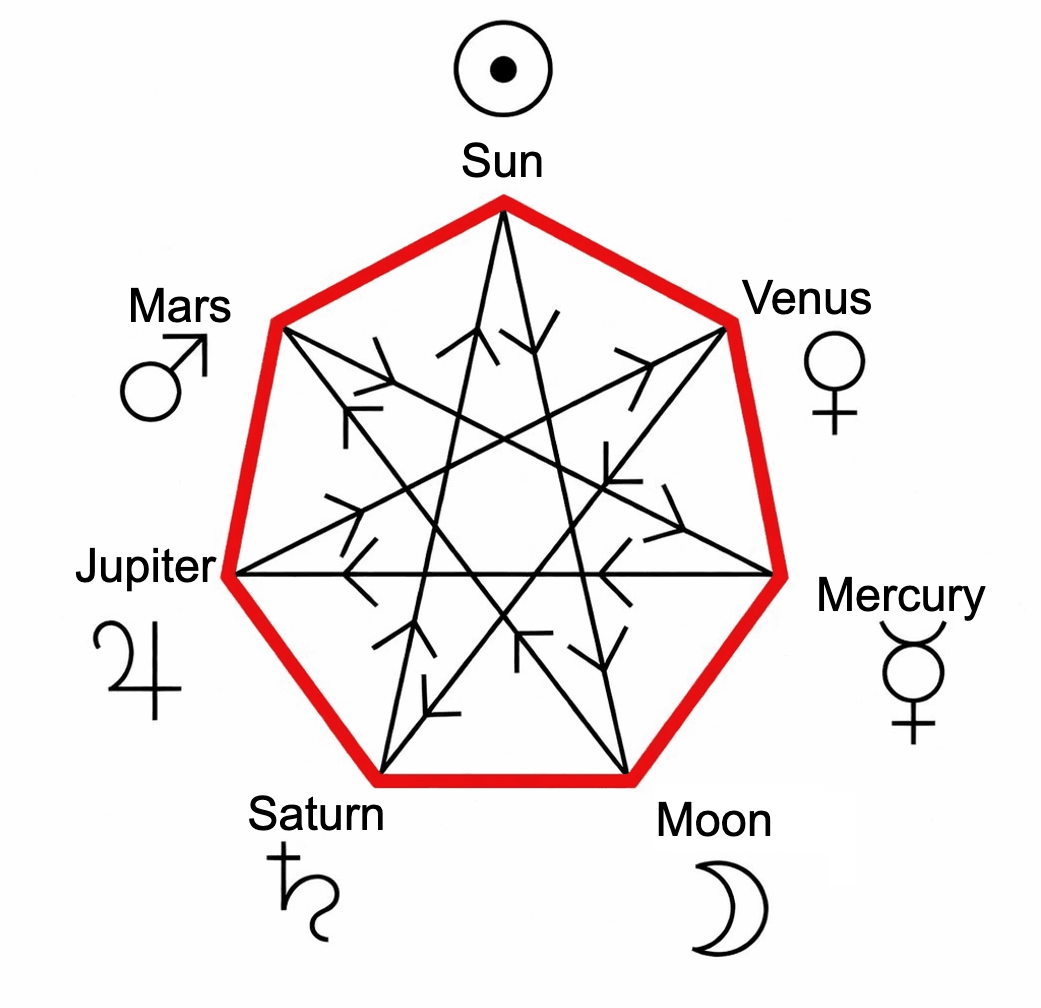
Day ordering according to astrologers: start from any planet/day and follow arrows to get the next day.
We can now draw the weekday names known in pre-Christian Rome. For orientation only, first column uses modern French names, even where they no longer derive directly from the Roman form (those cases are shown in blue in the original).
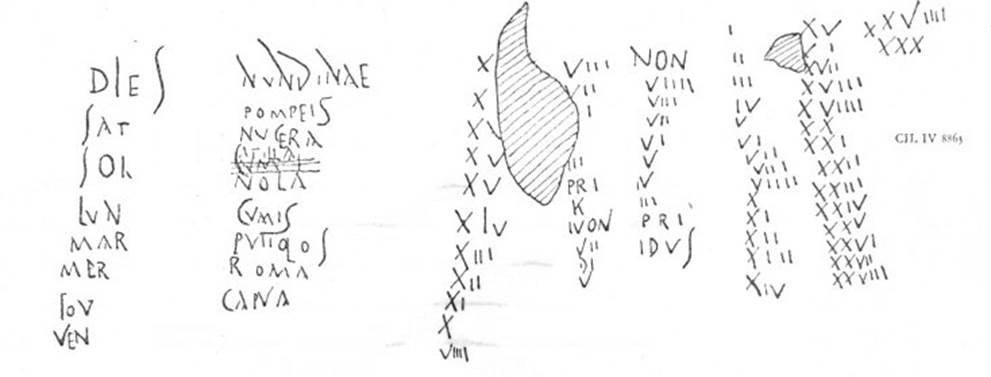
| French day name | Roman name |
|---|---|
| Saturday | saturnus dies |
| Sunday | solis dies |
| Monday | lunae dies |
| Tuesday | martis dies |
| Wednesday | mercurii dies |
| Thursday | jovis dies |
| Friday | veneris dies |
As we will now see, countries and local languages inherited pre-Christian or Christian Roman weekday systems and planetary-day names, keeping them, adapting them to local deities, or switching to simple numbering with a specific name for one or two days. In short, endless combinations whose traits we will try to unpack across some languages.
It would be difficult, but interesting, to map influence routes from one weekly system to another. We might find the imprint of economic influence patterns.
On that point, I have summarized in a page grandly titled the week around the world many weekday names by language. It is far from exhaustive and not highly meaningful by itself, but useful for examples supporting this study.
Back to our week: the system above was adopted as such in India. In Sanskrit, for example: Ravivara (Sun day), Somavara (Moon day), Mangalvasara (Mars day), Budhavasara (Mercury day), Guruvasara (Jupiter day), Shukravasara (Venus day), Shanivasara (Saturn day).
In England, some Roman names remained while other days received local gods:
- Monday: day of the Moon
- Tuesday: day of Tyr, Norse war god (instead of Mars)
- Wednesday: day of Odin, Norse sky father (instead of Mercury)
- Thursday: day of Thor, Norse thunder god (instead of Jupiter)
- Friday: day of Freya, Norse goddess of beauty and love (instead of Venus)
- Saturday: day of Saturn
- Sunday: day of the Sun.
There is still a clear desire to keep substitution gods functionally close to original Roman ones.
When did saturnus dies become sabbatum dies? Why did the change affect Saturn's day specifically? And why was that day shifted to week-end, with the other days rotating to preserve sequence? I have no clear answer.
Still, in the Bible days are simply numbered, except the last day, Sabbath, to which Moses gave the rest-day rule: "See that the Lord has given you the Sabbath; therefore on the sixth day He gives you bread for two days. Let each remain in his place; let no one go out on the seventh day." (Exodus 16:29).
The Jewish people still use this naming today. In Hebrew, days are: Yom rishon (first day), Yom sheni (second), Yom shlishi (third), Yom Revi'i (fourth), Yom chamishi (fifth), Yom shishi (sixth), Shabat (Sabbath), corresponding to our Sunday through Saturday.
Replacement of saturnus dies by sabbatum dies spread widely: Sabbath reference appears across Romance languages and most Christian-world languages.
French samedi itself comes from sabbatum dies via Old French sambedi.
If Sabbath is the day of worship and official rest, Christian Rome introduces another Lord's day and rest day: Sunday.
As we saw in the liturgical calendar page, the new Church could not simply replicate Judaism. Since faith in Christ was central to the emerging Church, another weekday had to be set for worship. A particularly strong Christian time marker already existed: Resurrection. This weekly Easter was chosen.
“Saint Ignatius of Antioch, died around 107: Those who lived according to the old order came to new hope. They no longer observe the Sabbath but the Sunday, the day on which our life rose through Christ and his death.
The day of the Sun (solis dies) was therefore renamed day of the Lord (dominicus dies) in memory of Resurrection. This Christian reference appears in all modern Romance languages.
French dimanche itself comes from dominicus dies.
At first Sunday was only a celebration day. Its legal rest-day status came under Constantine.
Law promulgated on 7 March 321: "Let all judges, city people and craftsmen rest on the venerable day of the Sun. But let those in the countryside freely attend to farming, as no day is often more suitable for sowing or planting vines; thus favorable time should not be lost and Heaven's benevolent intentions frustrated." (Justinian Code, Book III, title 12, law 3; cited in Louis Thomas, Le Jour du Seigneur, vol. II, Appendix III, p. 21, Geneva and Paris, 1893.)
Incidentally, Constantine hardly set the best example by calling Sunday “day of the Sun” when he might have said “day of the Lord”.
We can now summarize origins of weekday names in our calendar:
| Day | Origin | Planet |
|---|---|---|
| Sunday | Dominicus dies | |
| Monday | Lunae dies | Moon |
| Tuesday | Martis dies | Mars |
| Wednesday | Mercurii dies | Mercury |
| Thursday | Jovis dies | Jupiter |
| Friday | Veneris dies | Venus |
| Saturday | Sabbatum dies |
The Church attempted to remove pagan character by numbering days (feria secunda = Monday, feria tertia = Tuesday, feria quarta = Wednesday, feria quinta = Thursday, feria sexta = Friday). It had little success, but Portuguese did adopt this system: Domingo, Segunda-feira, Terca-feira, Quarta-feira, Quinta-feira, Sexta-feira, Sabado.
One last note before next section:
I have read that in Latin, word order does not determine syntax strongly, so one may say Martis dies or dies Martis.
Hence variants where di appears first, others where it appears last, and others dropping it altogether, keeping only deity name.
Examples:
- di first Catalan: diumenge, dilluns, dimarts, dimecres, dijous, divendres, dissabte.
- di final Italian: Domenica, Lunedi, Martedi, Mercoledi, Giovedi, Venerdi, Sabato.
- Without di Romanian: Duminica, Luni, Marti, Miercuri, Joi, Vineri, Sambata.
Some countries translate dies (day) in their own language, e.g. German where day = Tag: Sonntag, Montag, Dienstag, Mittwoch, Donnerstag, Freitag, Samstag (sometimes Sonnabend).
So if we seek common traits in most weekday systems worldwide, we find:
- day names tied to Roman planetary/god names (or local equivalents)
- a Lord's day (Sunday)
- a Sabbath-related day
3) Which is the first day of the week?
We saw day order is an endless sequence ...Tuesday, Wednesday, Thursday, Friday, Saturday, Sunday, Monday, Tuesday... stretching both backward and forward without origin.
The first day is whichever one a system chooses as first.
Historically, first day was once Saturday, then Sunday.
Anglo-Saxon countries still often treat Sunday as first.
In German, Wednesday is Mittwoch (mid-week), implying Sunday as first. In Greek, Monday is Deutera (second day), again implying Sunday first.
In France, things are less simple. Inherited from Christian Roman calendar, the week initially began on Sunday. In its 7th edition (1878), the French Academy Dictionary defined Sunday as first day.
Common logic says one rests after working. Add “weekend” practice and modern usage leads many French speakers to treat Monday as first day. In its 8th edition (1932), the French Academy Dictionary changed and treated Sunday as last day. One only needs to look at calendars or diaries to see this.
For harmonization, ISO standard 8601 states: “a week begins on Monday.”
Naturally, this decision mainly coordinates business calendars and does not override cultural habits and traditions worldwide.