This page is divided into two major parts:
- The first, titled Several Julian calendars?, is less a full study than an inventory of the different “Julian calendars” we may run into.
- The second, titled Around the year of confusion, examines what happened after Caesar’s reform, especially regarding leap years. It is not intended to explain how the Julian calendar was created or how it is structured. For that, see The Julian calendar.
Several Julian calendars?
I look at my postal wall calendar and tell myself that the beginning of our era was 01/01/01 on that very same calendar. What was Easter’s date in the year Caesar died? Did he really die on Wednesday 15 March -43? Or was it -44? And finally, a question raised by Jean Lefort: “Cervantes and Shakespeare both died on the same date, 23 April 1616. Which one died first?” Ignoring the time of day, of course.
Enough to make your head spin, right? Although the confusion goes well beyond Roman and Julian calendars, we will focus on that long period running from Romulus to the post-Caesar era.
Major periods
Those who “invent” an era, whether when creating a new calendar or simply defining a new “epoch” (the starting point of a new chronology), often place its start at a date far earlier than the date of its “discovery”. And to position the start of that new era, they define it relative to an even older era. When the era change does not coincide with the creation of a new calendar, its epoch is given in the calendar in force at the time of the era change.
That is how the Julian calendar, as framed by Dionysius Exiguus (Denys the Little), dates from year 532 of the Christian era (or Anno Domini, AD) of that same Julian calendar. Dionysius started that era (year 1, since zero was unknown) in year 753 from the Foundation of Rome. Some argue for 754... and no one can now say with certainty who is right. Dionysius is no longer here to clarify it. So the Julian calendar as we still sometimes use it (under specific conditions we will mention) dates from AD 532. And if we take 1922, when it was abandoned by the Greek Orthodox Church, as its definitive end, then its broadest practical span is 532-1922. Naturally, the end date depends on when each country adopted the Gregorian calendar.
But there is another Julian calendar. You might call it the real Julian calendar: the one born from Julius Caesar’s reform, which counts years in A.U.C. (Ab Urbe Condita), with its epoch at the founding of Rome. According to Varro, a historian who died in 27 BC (in Christian-era Julian reckoning), that founding dates to 21 April 753 BC in Christian-era Julian notation, commonly aligned with year 754.
In that A.U.C. framework, Caesar’s reformed calendar began in year 709 if we ignore year 708, the transition year, also called the year of confusion, which we will revisit in the second part of this page.
To be precise, as we will also see in that second part, there was indeed another layer of confusion in the first decades of Caesar’s reformed calendar because of leap-year distribution. The Julian calendar as Caesar intended it did not fully settle until 753 or 757 A.U.C., depending on the hypothesis.
Our current label Julian calendar therefore covers two calendars: one in the Roman era, one in the Christian era. Add the fact that throughout the Middle Ages people still used Ides, Kalends and Nones, and the “Julian calendar” concept really covers at least three systems.
Another confusion: was the A.U.C. era known to Romans in Caesar’s time (and earlier)?
Nothing is less certain.
As we have seen, it was a construction by Varro meant to establish a Roman historical chronology.
On this point, let us read what Theodor Mommsen writes in Roman History, Book II, Chapter IX:
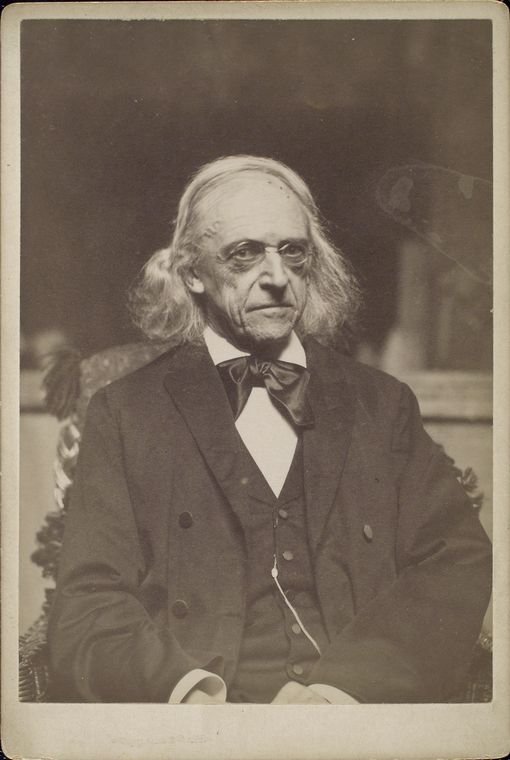
THEODOR MOMMSEN (1817-1903)
A German historian of Antiquity, Theodor Mommsen came from Schleswig-Holstein, where his father was a pastor.
Mommsen left behind a truly monumental body of work, much of which has stood the test of time. His Roman History (Römische Geschichte), carried through to Caesar’s death, is a major achievement; published in three volumes in Breslau from 1854 to 1856, then completed by a final volume published in Berlin in 1886, it was reissued and translated many times. Roman Constitutional Law (Das römische Staatsrecht, 1871-1888) and Criminal Law (Das Strafrecht, 1899) are two remarkable syntheses. Excerpt from Encyclopædia Universalis.
“Among the Romans there was no generally adopted computational era in common use. Yet in sacred matters one counted from the consecration of the Temple of Jupiter Capitolinus, which also served as the starting point for magistrate lists. [...] One thing is certain: the pontifical tables recorded the year of Rome’s foundation. And everything suggests that when, around the first half of the 5th century, the colleges of pontiffs set out to write a true and more useful annal, they first placed at its head the previously unknown history of Rome’s kings and their fall. Then, by placing the foundation of the Republic on 13 September 245, day of the consecration of the Temple of Jupiter Capitolinus, they thus made the chronology of the annals and the undated facts preceding history appear to coincide (though only in appearance).”
In short, Romans knew only the Capitoline era (or the sequence of consular reigns). To build a more coherent chronology, they later invented an A.U.C. era by “filling in” the gaps between A.U.C. and the Capitoline era (epoch: 13 September 509 BC Julian, or 245 A.U.C.) with events or kings such as Numa Pompilius, Ancus Marcius, Tullus Hostilius... whose status as history or legend remains uncertain.
Hence the difficulties we discussed in detail on the pre-Julian Roman calendars page when trying to reconstruct calendar history between Rome’s presumed founding and Julius Caesar’s reform.
The extended Julian calendar
A key feature of the Julian calendar is stability: three years of 365 days, then one year of 366 days. Unlike the Gregorian calendar, it never suppresses leap years.
That is why astronomers value it outside its official historical lifetime. Easier to read than Julian Day numbers, it helps establish relative antiquity between events.
So the Julian calendar is often extended backward before year 532 of itself (a “proleptic calendar”, from Greek prolepsis, anticipation) and forward beyond a country’s adoption date of the Gregorian calendar.
But this must be stated explicitly. Otherwise, dates become ambiguous.
Zero and negative years
We already discussed this negative-year issue here at length.
In short, the native Julian calendar with Christian-era year numbering has no year zero. It goes directly from year -1 to year 1.
But then, for negative years, you lose the clean leap-year divisibility-by-4 logic. To keep that convenience, astronomers (following the convention introduced by Jacques Cassini) inserted a year zero corresponding to 1 BC.
One rule says dates written with BC/AD-style labels should have no year zero, whereas dates written with a minus sign should include one. Unfortunately, this rule is not always followed. Again, this must be made explicit. Year -4 in astronomical notation implies a year zero; year -4 in historian notation implies no year zero. Another option, as mentioned on the dedicated page, is to write the first as ~4 and the second as -4. Jean Lefort uses that notation and states it clearly. It also seems to appear in Petit Robert 2. The drawback is that ~ can also mean “approximately”.
Whatever the chosen convention, users working with negative dates should always state their framework clearly: negative years with or without year zero, and which calendar is being used when a date is outside the calendar actually in force at that time.
Summary table
At the risk of reduced readability, this table does not include every historical variant (Roman calendar adjustments, Julian confusion years, etc.) affecting these calendars over time.
Also note that, for any given country, the end of Julian calendar use usually coincides with adoption of the Gregorian calendar.
| A.U.C. era | Christian era | A.U.C. year | Julian year (historians) | Julian year (astronomers) | Notes | |
|---|---|---|---|---|---|---|
| Archaic Roman | Proleptic Julian BC | Proleptic Gregorian | 1 | 754 BC | - 753 | Ab Urbe Condita |
| Julian | 709 | 45 BC | - 44 | Caesar’s reform | ||
| 753 | 1 BC | 0 | Depending on notation, this year is 0 or 1 | |||
| Proleptic Julian AD | 1 AD | 1 | Notation no longer matters | |||
| Julian | 532 AD | 532 | Dionysius Exiguus “invents” the Christian era | |||
| Gregorian | 1582 | 1582 | Varies by adoption date of the Gregorian calendar in each country | |||
| 1922 | 1922 | End of Julian calendar use in the Greek Orthodox Church | ||||
| Extended Julian | 2005 | 2005 | To be continued... | |||
Around the year of confusion
For the rest of this section, let us agree to call Julian the calendar used by historians (proleptic Julian without year zero), and Roman the calendar as known before and during the time of Caesar and Augustus.
Also, since this study is a zoom on one part of Roman calendar history, we assume readers are familiar with that history before Caesar and after Caesar.
Finally, I want to acknowledge Chris Bennett’s vast and outstanding work on Roman chronology. His highly technical site is here. We will try to present his findings and interpretations in a more accessible way.
The questions we will ask are:
- The year of confusion: how was it structured, and how many days did it contain?
- Leap years from Caesar’s reform to Augustus’ reform: how many, and when?
The year of confusion
| Primary source authors | ||
|---|---|---|
| Caius Suetonius Tranquillus (Suetonius) | c. 70 - c. 140 | Latin historian |
| Dio Cassius | 115 - c. 235 | Greek historian Consul in 220 and 229 |
| Censorinus | c. 240 | Roman grammarian |
| Ambrosius Theodosius Macrobius (Macrobius) | 4th - 5th century | Latin writer |
What were the length and structure of the so-called “year of confusion”, 708 A.U.C., which preceded the start of Caesar’s Roman calendar in 709 A.U.C.?
“Macrobius, Saturnalia 1.14.3: Caesar, wishing to establish a new regulation of the year, first allowed all days still capable of producing confusion to pass; this made that year, the last of the period of disorder, extend to 443 days. After this, following the Egyptians, the only people versed in celestial mechanics, he sought to model the year on the Sun’s revolution, which completes its course in 365 days and a quarter.
“This year”, as Macrobius writes, is year 708 A.U.C. It is from him that we get the label “year of confusion” or “year of disorder”.
Macrobius also tells us this year contained 443 days.
Suetonius (Life of Julius Caesar 40) gives further details on that year’s composition:
“So that this new arrangement could begin with the Kalends of January of the following year, he added two additional months, between November and December, to the year in which this reform was made; and thus it became a year of fifteen months, including the old intercalary month, which, according to custom, occurred that year.
From this we learn:
- The following year (709 A.U.C.) begins in January. So the traditional year start moves from March to January.
- Two months are added to year 708 A.U.C. between November and December (Int. prior and Int. posterior).
- One intercalary month under the “old method” (22 days between 23 and 24 February, or 23 days between 24 and 25 February) was also added that year, giving a total of 15 months.
What was the length of that February intercalary month? And what were the lengths of the two added months between November and December?
Censorinus, in De die natali (20.8), answers both questions while introducing a doubt:
“And such was the result of this confusion that C. Caesar, Pontifex Maximus, wishing in his third consulship and that of M. Aemilius Lepidus to correct and repair the error, had to place between November and December two intercalary months totalling sixty-seven days, although he had already intercalated twenty-three days in February; thus that year became one of four hundred and forty-five days. At the same time he provided that such an error should not recur, for, having abolished the intercalary month, he fixed the civil year according to the course of the Sun.
So we learn:
- The two months between November and December total 67 days. How those 67 days were split between them remains unknown.
- The February intercalary month has 23 days.
- The civil year is aligned with the course of the Sun. Sosigenes had, according to his calculations, set the spring equinox at “25 March”.
Note that 67 days = 22 + 22 + 23. Some suggest this corresponds to three intercalary months Caesar had “forgotten” to insert in prior years while he was Pontifex.
The doubt is this: Censorinus says the year had 445 days, while Macrobius says 443. Who is right? Where is the error, if there is one?
Dio Cassius (43.26) confirms the 67 days between November and December: “As the days of the years were not in proper agreement, Caesar introduced the present method of counting, intercalating the 67 days needed to restore concordance.”
Since the old normal Roman year had 355 days, adding one intercalary month and the 67 days between November and December gives either 355 + 22 + 67 = 444 days or 355 + 23 + 67 = 445 days. In any case, not 443.
So Macrobius would be off by two days. Also note: if the “traditional” year still existed (the consular year had already started in January since 601 A.U.C.), then year 707 A.U.C., from March to December, totalled 31 + 29 + 31 + 29 + 31 + 29 + 29 + 31 + 29 + 67 + 29 = 365 days, i.e. the future Julian year length.
Leap years from Caesar’s reform to Augustus’ reform
| Additional sources for this section | ||
|---|---|---|
| Caius Julius Solinus | Mid-3rd century | Latin writer |
| C. Plinius Secundus (Pliny the Elder) | 23 - 79 | Latin historian |
As before Caesar’s reform, it was entrusted to men trained in the sciences of measurement and writing - in short, the pontiffs - to insert leap years. They were remarkably poor at this task before Caesar and just as poor after him.
Instead of intercalating every four years, they did it every three. And since Caesar died on 15 March 44 BC from a few dagger thrusts, he was no longer around to point this out. And Sosigenes... well? where had Sosigenes gone?
And because Augustus took years to react, the issue lasted for decades. Let us look more closely.
Macrobius gives us the most detail:
“Saturnalia 1.14: Caesar, having thus organized the civil division of the year and brought it into agreement with lunar revolutions, promulgated it publicly by edict. The error might have ended there, had the priests not made a new one from the correction itself. Whereas the day produced by four quarter-days should have been intercalated after four complete years and before the beginning of the fifth, they intercalated not after but at the beginning of the fourth year. This error lasted thirty-six years, during which twelve days were intercalated whereas only nine should have been. It was finally noticed, and Augustus corrected it by ordering twelve years to pass without intercalation, so that those three supernumerary days, produced by the priests’ haste over thirty-six years, would be absorbed by the following twelve non-intercalated years. At the end of that period, he ordered that one day be intercalated at the beginning of every fifth year, as Caesar had arranged; and he had the whole arrangement engraved on a bronze tablet for perpetual preservation.
Other sources are less informative:
“Pliny the Elder, Natural History XVIII LVII: [...] And this computation too, where an error was found, was corrected: for twelve consecutive years no intercalation was made, because the year, which had previously been in advance, now lagged behind the stars.
“Solinus, De mirabilibus mundi I: [...] but another error occurred due to the priests. They had been instructed to intercalate one day in the fourth year. This intercalation had to occur at the end of that fourth year, before the inauguration of the fifth; instead, it took place at the beginning of the fourth, not the end. Thus, instead of intercalating nine days over thirty-six years, they intercalated twelve. Augustus corrected this error by ordering twelve years without intercalation, to offset those three wrongly added days beyond the nine required. On this basis the computation of the year was then established. This reform and many others belong to Augustus’ time.
Pliny is very vague, and there is little difference between Solinus and Macrobius.
At first reading, Macrobius seems clear and precise, but on closer inspection his text raises several questions. Ready for a brief textual analysis?
1) Intercalation errors
1-a) What is certain
- Instead of intercalating at the end of the fourth year following a previous intercalation, the priests intercalated before the fourth year.
- The error lasted 36 years.
- 12 days were intercalated instead of 9.
1-b) Open questions
- In which year was the first intercalary day inserted? Put differently: which year “initializes” the 4-year leap cycle?
- Should this first intercalation count as an error? The initialization year cannot really be considered erroneous. But did Macrobius count it as such? In short: 12 or 13 intercalations between the two reforms?
- What is the starting point of the 36 years? If we follow Macrobius, the intercalation does not anticipate the annual 4 x 1/4 excess day but corrects it. So the 36 years should run from the first “error” (inclusive) to the end of the 9th cycle, i.e. three years (inclusive) after the 9th faulty intercalation. Did Macrobius mean it that way?
2) Corrections
2-a) What is certain
- 12 years must elapse after the 36-year period before intercalating again.
- Three years that would otherwise be leap years must be 365-day years during those twelve years.
2-b) Open questions
- At the end of those twelve years, is intercalation resumed immediately?
- Also: were the three omitted cycles triennial or quadrennial?
Depending on how Macrobius is interpreted and how these questions are answered, one gets different schemes of intercalated and omitted leap days over the roughly 50 years following Caesar’s reform.
Chris Bennett lists six such schemes, due to Scaliger (1583), Kepler (1614), Ideler and Mommsen (1859), Matzat (1883), Soltau (1889) and Radke (1960).
We will summarize each scheme in a table, adding Chris Bennett’s own model as well. I thank Chris Bennett for helping reconstruct this entire table and for his valuable guidance and explanations.
In the table below, B marks a “normal” leap year, Mx (x = number) the leap years included in Macrobius’ 36-year span, and S an omitted leap year. Yellow areas mark a 12-year period, blue areas a 36-year period, the red area an 11-year period, and the green area a 12-year span measured date to date.
| A.U.C. | Julian | 1583 | 1614 | 1859 | 1883 | 1889 | 1960 | 2004 | Bennett model notes |
|---|---|---|---|---|---|---|---|---|---|
| Scaliger | Kepler | Mommsen | Matzat | Soltau | Radke | Bennett | |||
| 708 | 46 | 445-day year | |||||||
| 709 | 45 | B | M1 | M1 | |||||
| 710 | 44 | M1 | B | Leap year | |||||
| 711 | 43 | M1 | |||||||
| 712 | 42 | M1 | **B** scheduled | M1 | M2 | ||||
| 713 | 41 | M2 | M2 | M1 | First year of error | ||||
| 714 | 40 | M2 | |||||||
| 715 | 39 | M2 | M2 | M3 | |||||
| 716 | 38 | M3 | M3 | M2 | |||||
| 717 | 37 | M3 | |||||||
| 718 | 36 | M3 | M3 | M4 | |||||
| 719 | 35 | M4 | M4 | M3 | |||||
| 720 | 34 | M4 | |||||||
| 721 | 33 | M4 | M4 | M5 | |||||
| 722 | 32 | M5 | M5 | M4 | |||||
| 723 | 31 | M5 | |||||||
| 724 | 30 | M5 | M5 | M6 | |||||
| 725 | 29 | M6 | M6 | M5 | |||||
| 726 | 28 | M6 | |||||||
| 727 | 27 | M6 | M6 | M7 | |||||
| 728 | 26 | M7 | M7 | M6 | |||||
| 729 | 25 | M7 | |||||||
| 730 | 24 | M7 | M7 | M8 | |||||
| 731 | 23 | M8 | M8 | M7 | |||||
| 732 | 22 | M8 | |||||||
| 733 | 21 | M8 | M8 | M9 | |||||
| 734 | 20 | M9 | M9 | M8 | |||||
| 735 | 19 | M9 | |||||||
| 736 | 18 | M9 | M9 | M10 | |||||
| 737 | 17 | M10 | M10 | M9 | |||||
| 738 | 16 | M10 | |||||||
| 739 | 15 | M10 | M10 | M11 | |||||
| 740 | 14 | M11 | M11 | M10 | |||||
| 741 | 13 | M11 | |||||||
| 742 | 12 | M11 | M11 | M12 | |||||
| 743 | 11 | M12 | M12 | M11 | |||||
| 744 | 10 | M12 | |||||||
| 745 | 9 | M12 | M12 | S | |||||
| 746 | 8 | S1/2 | M12 | last leap year in 3-year cycle First year of Augustus' reform | |||||
| 747 | 7 | ||||||||
| 748 | 6 | ||||||||
| 749 | 5 | S | S | S | S1 | S | S | S | |
| 750 | 4 | S2 | |||||||
| 751 | 3 | ||||||||
| 752 | 2 | S | |||||||
| 753 | 1 | S | S | S | S1 | S | S | ||
| 754 | 1 | S2 | |||||||
| 755 | 2 | S | |||||||
| 756 | 3 | ||||||||
| 757 | 4 | S | S | S | B | S | B | B | first leap year in the 4-year cycle |
| 758 | 5 | ||||||||
| 759 | 6 | ||||||||
| 760 | 7 | ||||||||
| 761 | 8 | B | B | B | B | B | B | B |
A few comments
- Scaliger initializes Caesar’s calendar in 709 A.U.C. without placing a leap year there. The rest follows Macrobius: 36 years of error, then Augustus’ reform in 746 A.U.C. with three leap days removed across three 4-year cycles.
- Kepler argues that the first leap year should have been 42 BC and therefore the pontiffs’ first error began the year before. For the rest, he accepts the Augustan reform cycle presented by Scaliger. Later on, and for reasons that are not entirely clear, he ultimately accepted Scaliger’s full model.
- Mommsen uses the same overall model as Scaliger, but places a leap year in 709 A.U.C., treating it not as an error but as the initialization year for leap years.
- Matzat infers from Dio Cassius 48.33.4 (“In the preceding year [...] an intercalary day was added, contrary to the rule”) that a leap year was added in 713 A.U.C. That sentence appears in a paragraph referring to 713 and 714 A.U.C. Since it says “the preceding year” and is placed at the end of the paragraph, one can infer it refers to the year before 714 A.U.C., i.e. 713 A.U.C.
Note that Mommsen interpreted that passage differently, taking Dio Cassius to refer to the year before 713 A.U.C., i.e. 712 A.U.C.
For the 12-year suppression, Matzat counts date-to-date (from the Kalends of January 8 BC to the Kalends of 4 AD), while not treating Augustus’ reform year (746 A.U.C.) as leap.
Since Matzat does not specify where the omitted leap years are placed within Augustus’ reform, the hypotheses are marked S1 and S2 in the table.
- Soltau agrees with Matzat on misplaced intercalary days and with Scaliger on omitted days. However, he rejects 710 A.U.C. and prefers 709 A.U.C.
- Radke, although rejecting Mommsen’s argumentation, ends up with nearly the same scheme, except that he includes 709 A.U.C. among the faulty intercalations, which shifts everything else.
- Bennett, logically, considers his own model to be correct. It is very close to Matzat’s but (1) adds a “faulty” leap year in 746 A.U.C., and (2) treats 710 A.U.C. as the initialization year of the triennial leap sequence, which cannot itself be called “faulty”. He also concludes that Macrobius’ “twelve years” should be read as “until the twelfth year” counting from Augustus’ reform.
Without going into every detail, here are the main lines of Bennett’s model:
- From a papyrus (pOxy 61.4175), analyzed in 1999, and a decree by Paullus Fabius Maximus (iPriene 105 = OGIS 458), one can infer that the last leap year of the final triennial cycle is 746 A.U.C., and that the first “true” Julian leap year is 757 A.U.C.
- Leap days omitted by Augustus are omitted within a triennial cycle, and the first true leap year (in a quadrennial cycle) is the 12th year of Augustus’ reform.
- From Dio Cassius 48.33.4, the first “faulty year” appears to be 713 A.U.C.
- Was 710 A.U.C. a leap year?
Dio Cassius (48.33.4) says that prid. Kal. Jan. 713 A.U.C. was a market day, and that Kal. Jan. 702 A.U.C. was also a market day.
702 A.U.C. was a leap year with 23 days added, so it had 378 days. From 703 to 707 inclusive there were no leap years, giving 5 x 355 = 1775 days. The year of confusion lasted 445 days. If we then count 365 days in year 713 to reach prid. Kal. Jan., plus 4 x 365 for years 708 to 711 inclusive, we get:
378 + (5 X 355) + 445 + (4 X 365) + 365 = 4423 days. 4423 is not divisible by 8 (market day occurred every 8 days).
By contrast, if 710 A.U.C. was a leap year, the total becomes 4424 days, a multiple of 8.
Is this model the right one?
It assumes the year of confusion indeed had 445 days and that Censorinus was mistaken.
It also assumes that Macrobius, Pliny and Solinus confused “twelve years” with “until the twelfth year”.
I will let you form your own view.