This page is the first in a three-part series that takes us from the earliest Roman calendars to today's Gregorian calendar, by way of the Julian calendar.
A little history
NOTE: There are many books - and no shortage of websites - explaining Roman history from its beginnings to its fall.
So our short “history section” will look more like a chronology than a detailed narrative. Its main purpose is to place us in time so we can follow the evolution of our calendars.
The chronology in each page corresponds to the calendars explained on that page. It therefore continues across the three parts mentioned above.
The Trojan War has just taken place, and the city has fallen to the Greeks.
All perish except Aeneas, his father Anchises, his son Ascanius, and a few loyal followers who obey Venus and leave to build a new Troy.
Their sea journey brings them to the banks of the Tiber, where Aeneas founds the city of Lavinium.
Aeneas dies in battle against the Etruscans, and his son Ascanius, who succeeds him, founds Alba Longa.
Several generations pass. Numitor gains power, but his brother Amilius overthrows him and forces his niece Rhea Silvia (Numitor's daughter) to become a Vestal so she cannot produce a new heir to the throne.
Rhea Silvia, miraculously impregnated by the god Mars, gives birth to twins, Romulus and Remus. Amilius orders them killed. A she-wolf upsets his plans, “adopts” the babies, and nurses them until they are taken in by a couple.
As teenagers, the two brothers decide to found their own city. They cannot agree on the location. A fight breaks out, and Romulus kills his brother Remus - accidentally or not.
Romulus thus becomes the first king of the new city, Rome, on 21 April 753 BCE.
One summer day in 715 BCE, he disappears in a storm.
This story is compelling, but it is not history. It is legend, and even Rome's foundation date is wrong.
The truth is that, having lost all memory of their historical origins, the Romans had to invent one.
It is only from the reign of Tarquinius Priscus that archaeology confirms certain elements of the traditional narrative.
Yet even if Rome's foundation date is false, it still played a major role in Roman chronology, which was built upon it. We owe that date to Varro, at the end of the Roman Republic.
Five kings succeeded Romulus:
- Numa Pompilius (-715 to -673), Sabine king: credited with creating a second calendar.
- Tullus Hostilius (-673 to -642), warlike Sabine king.
- Ancus Marcius (-640 to -616), Sabine king, expands Rome's walls and includes Janiculum Hill.
- Tarquinius Priscus (-616 to -579), Etruscan king, introduces Etruscan civilization to Rome and builds sewers.
- Servius Tullius (-578 to -534), Etruscan king: credited with Rome's first political structuring, division into districts, and addition of three hills: Quirinal, Viminal and Esquiline.
- Tarquinius Superbus (-534 to -509), Etruscan king: a revolt drives him out in 509, and the Republic is proclaimed for 500 years.
That republic lasts until Caesar's dictatorship, after which Rome enters the imperial period.
It would be too long to explain here all major events of the Republic, including the three Punic Wars against Carthage and the calmer intervals between them.
As for Caesar, he will be the subject of the second part of this triptych.
Here I only want to mention two dates that played a role in the calendar early in the Republic:
The beginning of the Republic was marked by struggles between Rome's two social classes, plebeians and patricians, the latter alone having access to the Senate and to the formulae that made legal knowledge available. Plebeians demanded publication of those rights, and in 451 and 449 two commissions of decemvirs drafted the Law of the Twelve Tables to resolve the issue. It was not a success, and the decemvirs were expelled in 445. We will see them again in another area more directly relevant to our topic.
The calendars
| Source author | Period | Author profile |
|---|---|---|
| Publius Ovidius Naso (Ovid) | 73 BCE - 17 CE | Latin historian |
| Plutarch | c. 46 - c.120 | Greek philosopher |
| Ambrosius Theodosius Macrobius (Macrobius) | 4th - 5th century | Latin writer |
| Theodor Mommsen | 1817 - 1903 | German historian |
A few words about Theodor Mommsen:
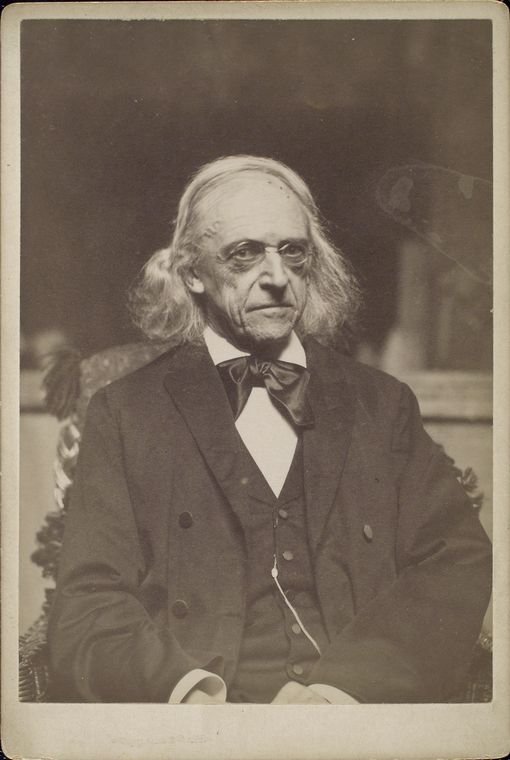
Theodor Mommsen, a German historian of antiquity, came from Schleswig-Holstein, where his father was a pastor.
Mommsen left behind a truly monumental body of work, much of which has stood the test of time. His Roman History (Römische Geschichte), carried through to Caesar's death, is a major work: published in three volumes in Breslau from 1854 to 1856, then completed by a final volume published in Berlin in 1886, it went through multiple reprints and translations. Roman Constitutional Law (Das römische Staatsrecht, 1871-1888) and Roman Criminal Law (Das Strafrecht, 1899) are two remarkable syntheses. Excerpts from Encyclopædia Universalis.
As we have just seen, the period of Roman history before Tarquinius Priscus is not well known. That uncertainty naturally affects what we know about calendars from that period.
The so-called “Romulus calendar”
Ancient authors describe Romulus' calendar as an alternation of 30-day months (incomplete) and 31-day months (full), yielding a 304-day year.
Should we really call that a year in the modern sense (Earth's revolution around the Sun)? Why only ten months? Why 304 days?
On this point, Theodor Mommsen writes: "For some time, the Italians knew no fraction of time smaller than the day and larger than the month [...]. The annual calendar did not yet exist, at least when Greeks and Italians separated, to judge by the very different names they used for the year and the seasons." (Roman History, Book I, chapter XIV).
That disorder is also mentioned by Macrobius: "The Arcadians divided their year into three months; the Acarnanians into six; other Greeks counted 354 days in their year." (Saturnalia, chapter XII).
Continuing Mommsen's Roman History: "The Romans, simplifying their lunar-month computations with the decimal system, adopted the term annus (ring) to designate a cycle of ten months; this term thus bears the mark of high antiquity."
In short, the so-called Romulus year is more a ten-month cycle than a true year.
Why ten months? "When Rome's founder wished to regulate time division, he established two times five months in his year. You can see it, Romulus knew war better than astronomy: his great concern was defeating neighboring peoples. Yet Caesar, he had reasons that persuaded him, and even his error is not without excuse. Ten months are enough for a child to leave its mother's womb; Romulus thought that same period should measure the year. It is also ten months that a wife, after her husband's death, wears mourning clothes in her solitary home; that likely struck Quirinus' mind, clothed in his trabea, when he fixed the divisions of the year for his rough people." Ovid, Fasti I, 27-44.
Since this “ring” had little to do with the tropical year, why not? As Mommsen says, the system was purely decimal.
How was this “ring” kept roughly in phase with the seasons, absent any real calendar?
A possible answer is given by Macrobius in his Saturnalia (1.12): "Such was the year's division established by Romulus, which, as we already said, consisted of ten months and 304 days; six months of thirty days, and four of thirty-one. But as this division agreed neither with the Sun's course nor the Moon's phases, it often happened that cold came in summer months and heat in winter months. When this occurred, they stopped counting months and let days pass until they reached the point in the year where the month in use should once again coincide with the state of the sky."
So apparently, they occasionally inserted “blank” days not counted in the calendar, to re-synchronize with the “state of the sky.” Which state - seasons or lunar phases?
But why exactly 304 days? We do not know. Some have still observed that 304 equals 38 x 8 days. And eight days correspond to what may be called the “Roman week.”
At first, months were likely designated simply by ordinal number. Romulus is credited with having personalized the earliest months - meaning they were personalized, but we no longer know when.
The first became Martius (god of war) in honor of Mars, divine father of Romulus. The year indeed began in March.
The second became Aprilis, possibly from Aperta (epithet of Apollo), or aperire (to open), referring to opening buds, or from Aptirilis derived from Aphrodite, Greek name of Venus. Until the 16th century, the year began in April.
The third became Maius, in honor of the goddess Maia, sister of Atlas, or in honor of Jupiter.
The fourth became Iunius, dedicated to Juno.
And if we stop seeing Romulus everywhere, we may stick to Mommsen's view: "The year begins with spring: its first month, the only one bearing a divine name, is named after Mars (Martius); the next three are those of budding (aprilis, April), growth (majus, May), and flowering (junius, June)."
We can now list the months of this archaic calendar:
| Month | Length |
|---|---|
| Martius | 31 |
| Aprilis | 30 |
| Maius | 31 |
| Iunius | 30 |
| Quintilis | 31 |
| Sextilis | 30 |
| September | 30 |
| October | 31 |
| November | 30 |
| December | 30 |
| Total | 304 |
The so-called “Numa calendar”
Let us note in passing that Numa too belongs to Rome's legendary kings. The 304-day calendar was clearly too short relative to the solar year.
A first reform took place under Numa Pompilius. According to Macrobius, Numa added 50 days to the original calendar and redistributed day counts.
“Saturnalia, chapter XIII: [1]Numa, who immediately followed Romulus, added fifty days to the year [...] so that the year reached 354 days, which he believed should encompass the twelve revolutions of the moon. To those fifty added days, [2] Numa added six more, taken from the six 30-day months, one day each; [3] and having thus formed fifty-six days, he distributed them into two equal months. He called the first Ianuarius (January), wishing it to be first month of the year, because being dedicated to the two-faced god, it sees both end and beginning of the year. Numa dedicated the second month to Februus, regarded as god of purification. The city was to be purified during that month, in which Numa also instituted offerings to the Manes.
[...] [4] Soon after, in honor of the odd number, whose mystery nature had revealed before Pythagoras, Numa added one day to the year, giving it to January, to preserve oddness in both year and months, February excepted. Twelve months all even or all odd would necessarily yield an even total; one even month alone keeps the total odd. [...]
Having thus computed the year according to the moon's course, as Greeks did, Romans necessarily introduced an intercalary month. [...] Romans wished to adopt that Greek arrangement; but without success, since they did not account for the day added in favor of oddness, as said above, which exceeded Greek reckoning. As a result, octaeterid intercalation could not restore regularity in sequence or day count. As this error was not first noticed, they reckoned like Greeks, [5] adding ninety extra days every eight years: four intercalations, two of 22 days and two of 23 days, inserted every two years. But since Roman year had one day more than Greek year, each year left one excess day; over eight years this produced eight excess intercalary days. Once recognized, correction was as follows: [6] every twenty-four years, instead of ninety days, only seventy were intercalated. Subtracting twenty-four days every twenty-four years exactly offset the twenty-four-day excess produced by the extra day over Greek year.
[...] All intercalations were assigned to February, since it was the year's last month, as among Greeks. [...] Romans differed in one point: Greeks intercalated at end of last month, while Romans [7] did so on the twenty-third of February, after the Terminalia festival, then placed after intercalation the five remaining days of February. I believe it belonged to ancient Roman religious custom that March should immediately follow February.
Who said this was unclear?
Let us calmly summarize, following my numbered markers:
- [1] Numa (or his successors) added 50 days to the year.
- [2] He removed six days from the existing year (one from each of the six 30-day months).
- [3] He created two extra months, Januarius (dedicated to Janus) and Februarius (dedicated to Februs), each 28 days (using the 50 added + 6 recovered days).
- [4] But horror: the year's total was... 354 days. Even! So one day was added to January, making it 29 days and bringing year total to 355.
Redistribution was done so months had odd day counts (except February), since even numbers were considered ill-omened.
A possible distribution was therefore:
Martius-31; Aprilis-29; Maius-31; Junius-29; Quintilis-31; Sextilis-29; September-29; October-31; November-29; December-29; Januarius-29; Februarius-28.
Why possible? Because we do not really know where the new months January and February were placed. Sources vary:
Macrobius says “...February, because it was the last month of the year” and “I think... that March followed immediately after February”. If March immediately follows February and February is last, then January and February come after December, in that order.
Ovid (Fasti 1.40) says: "Numa, for his part, neglected neither Janus nor ancestral shades, and placed two new months at the head of the old ones."
Plutarch (Lives, Life of Numa) writes: "March had been first month; he made it third, placing January first - under Romulus it had been eleventh. February had been twelfth and last; it became second." That appears to agree with Ovid. Except for one major point: Plutarch says January and February already existed in Romulus' time. He then adds: “However, some authors said January and February were added by Numa.”
Quite a mess, confirming Mommsen's remark: "Everything suggests that when, around first half of the 5th century, the college of pontiffs wished to write a true and useful annal, it first placed at the head a previously unknown history of Rome's kings and their fall. Then, by dating the Republic's foundation to 13 September 245, day of dedication of Jupiter Capitolinus' temple, it made chronology and undated facts appear to coincide - though only in appearance." Today we are still trying to impose chronology on partly invented history where ancient authors themselves got tangled. The calendar likely evolved as we reconstruct it, but we may be compressing changes that unfolded over a much longer time.
Today many argue January was moved to year's head because of its name: Janus, two-faced god of beginnings and transitions, would look both backward and forward.
But even this can be challenged. Mommsen writes of Janus: "the two opposite faces also signify a gate opening inward and outward. It is all the less appropriate to make him an annual or solar god, since the month bearing his name (Januarius, January) is the eleventh month of Roman year, not the first. I would add that this month-name likely comes from the fact that, after forced midwinter rest, fieldwork resumes."
Lacking better evidence, we will place January and February after December in the “Numa calendar.”
Why still possible? Because Mommsen also says Februarius did not always have 28 days. We will return to that.
Intercalary months (Intercalaris or Mercedonius)
Let us continue reading Macrobius and compare with Mommsen. Although Mommsen rarely cites sources, his reputation means his claims cannot be dismissed, and his sources likely went beyond Macrobius alone.
| Macrobius | Mommsen |
|---|---|
| Numa reorganizes months | Before the Decemvirs (c. 450 BCE) Trieteric period Over 4 years: February has 28 days in first 3 years, 29 days in the 4th. One 29-day intercalary month in year 4. |
| [5] During or after Numa: 90 additional days every 8 years: 2 months of 22 days every 2 years 2 months of 23 days every 2 years. [7] intercalary month placed after 23 February | |
| [6] Later (when?): Every 24 years, 70 intercalated days instead of 90. | Correction by the Decemvirs Attic 8-year period. February in intercalary years goes from 29 and 28 to 24 and 23 days respectively. Intercalary months keep same length. |
| No mention of a 24-year cycle |
What do both columns really share? Two points:
1) By adopting the octaeteris (8-year cycle), likely from Greeks, Romans completely forgot that their 355-day year had one day too many for a lunar calendar.
2) Macrobius' and Mommsen's octaeterides contain the same total number of days over 8 years. Let us check:
| Source | Period | Years | |||||||
|---|---|---|---|---|---|---|---|---|---|
| 1 | 2 | 3 | 4 | 5 | 6 | 7 | 8 | ||
| MACROBIUS average year of 366.25 days | start of February | 28 | 23 | 28 | 23 | 28 | 23 | 28 | 23 |
| Intercalary month | 0 | 22 | 0 | 23 | 0 | 22 | 0 | 23 | |
| "End of February" | 0 | 5 | 0 | 5 | 0 | 5 | 0 | 5 | |
| Rest of year | 327 | 327 | 327 | 327 | 327 | 327 | 327 | 327 | |
| MOMMSEN average year of 366.25 days | February | 28 | 23 | 28 | 24 | 28 | 23 | 28 | 24 |
| Intercalary month | 0 | 27 | 0 | 27 | 0 | 27 | 0 | 27 | |
| Rest of year | 327 | 327 | 327 | 327 | 327 | 327 | 327 | 327 | |
In fact, Mommsen seems to include in the intercalary month, during embolismic years, the 5 remaining days of February after the 23rd.
Ultimately, the College of Pontiffs was allowed to give Mercedonius whatever length was needed - or even omit/add an intercalary month for convenience. "Cicero once asked this quite naturally, in order to shorten his stay in Cilicia, which weighed on him." Mommsen, Roman History, Book V, chapter XI, note 1.
As a result, by 46 BCE the calendar lagged three months behind the seasons. Caesar put things back in order.
Before Julius Caesar's Julian reform, the calendar was:
| Month | Length |
|---|---|
| IANUARIUS | 29 |
| FEBRUARIUS | 28 |
| MARTIUS | 31 |
| APRILIS | 29 |
| MAIUS | 31 |
| IUNIUS | 29 |
| QUINTILIS | 31 |
| SEXTILIS | 29 |
| SEPTEMBER | 29 |
| OCTOBER | 31 |
| NOVEMBER | 29 |
| DECEMBER | 29 |
| MERCEDONIUS (every 2 years) | Alternation of 22 and 23 days |
One important point noted by Mommsen deserves emphasis, though unfortunately he gives few details: “Moreover, Italian peasants used, very early on, the rural calendar of Eudoxus.” In plain terms, this suggests Caesar's future calendar was in practice before his official reform.
Divisions of the month
Three marked days structured the month and divided it into unequal periods:
- Kalends: the first day of the month. The name likely comes from calare (to proclaim), because important dates were announced then.
- Ides: from Etruscan iduare, meaning to divide. They marked mid-month: the 15th in Martius, Maius, Julius and October; the 17th in the other months. Let us remember Roman aversion to even numbers.
- Nones: the ninth day before the Ides. Since counting included the target day, they therefore fell either on the 5th or on the 7th, depending on whether the Ides were on the 13th or the 17th.
Romans named each day relative to the next marker: for example, “three days before the Kalends of March” or “six days before the Ides of August.”
The day before a marker was called Pridie (e.g. Pridie Nonas, eve of Nones). Naturally, the day before Pridie was not “second day before” the marker, because the marker itself was counted. As with our own expression “in eight days” for what is in fact a seven-day week.
The day after Kalends, Nones and Ides was called postridie kalendas, postridie nonas and postridie idus.
A full table of days and months is on the page dedicated to the Julian calendar.