A little history
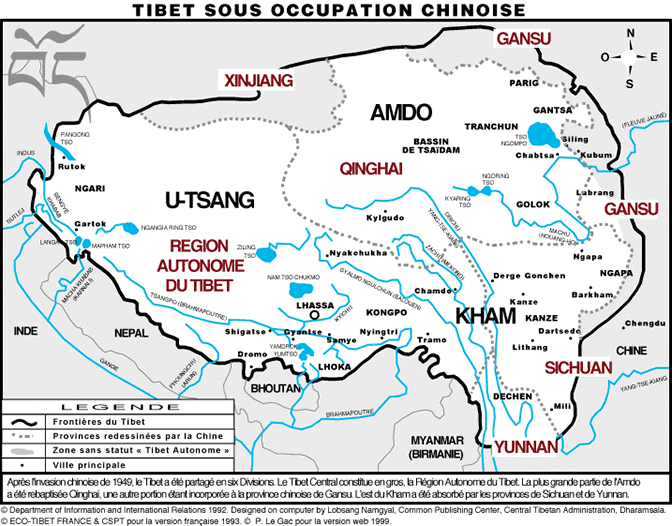
Let us begin with a brief chronology of Tibetan civilization and Tibet.
| Period | Events |
|---|---|
| Prehistory | Poorly documented period. According to legend, the first Tibetans came from the union of a monkey and a rock ogress. Their social organization is said to have come from a semi-divine being, gNya'-khri-btsan-po, who descended from the sky by a celestial rope. |
| 6th century | King Namri Songten (570-619) and his son Songtsen Gampo (610-649) unified Tibet. Songtsen Gampo introduced Buddhism, established relations with China, and built the capital Lhasa. |
| 8th century | Under Trisong Detsen (755-797), Tibet reached peak military expansion and its armies invaded China, briefly taking the Chinese capital of Changian (present-day Xian). Trisong Detsen is credited with officially proclaiming (Indian) Buddhism as state religion. |
| 822 | Peace treaty signed with China |
| 13th century | Genghis Khan's Mongols turned their attention to Tibet. The great lama Sakyapa acknowledged Mongol suzerainty and was appointed viceroy by Mongol emperor Godan. |
| 1368 | Tibet regained independence after the fall of the Yuan dynasty. |
| 15th century | Tsong-kha-pa (1357-1419) founded the Gelugpa religious order (Yellow Hat school). In 1578, the third Gelugpa abbot received from the Mongol prince Altan Khan the Mongol title of Dalai Lama. In 1642, the alliance of the Mongols and the Gelugpa sect established the temporal power of the Dalai Lamas. |
| 1720 | Chinese troops expelled the Mongols and entered Lhasa. The Qing emperors asserted sovereignty over the country. In 1750, governing authority was once again entrusted to the Dalai Lamas. |
| 1788 | For economic and financial reasons, Nepal came into conflict with Lhasa. In 1791, Chinese emperor Qianlong pushed back the Nepalese and tightened control over Tibetan government. |
| 1795 | After Qianlong's death in 1795, Tibet gradually regained freedom. |
| 1904 | The British, fearing Russian expansion in Central Asia, invaded Tibet. They left in 1906 after signing a Sino-British agreement recognizing China's sovereignty over Tibet. |
| 1911 | The Qing dynasty was overthrown, and Tibet became *de facto* independent. |
| 1950 | One year after proclamation of the People's Republic of China, the People's Liberation Army invaded Tibet amid broad global indifference. |
| 1951 | China forced Tibetans to sign a 17-point agreement in May 1951, recognizing Chinese sovereignty over Tibet in exchange for a promise of broad autonomy. |
| 1956-1976 | Following numerous Tibetan guerrilla actions against Chinese rule since 1956, a major uprising broke out in Lhasa on 10 March 1959. It was bloodily crushed by Chinese forces (about 87,000 Tibetan deaths), and religious persecution intensified. By 1978, only 13 monasteries remained intact out of 6,000. |
| 1976- | After Mao Zedong's death in 1976, China somewhat relaxed its policy toward Tibet, including in religious matters. Anti-Chinese riots in 1987 nonetheless marked a revival of Tibetan nationalism. Further riots in 1988-89 were again bloodily repressed, causing hundreds of victims and many arrests. In December 1989, the Dalai Lama received the Nobel Peace Prize. Since then, he has traveled the world, meeting world leaders and pleading for the survival of his people. |
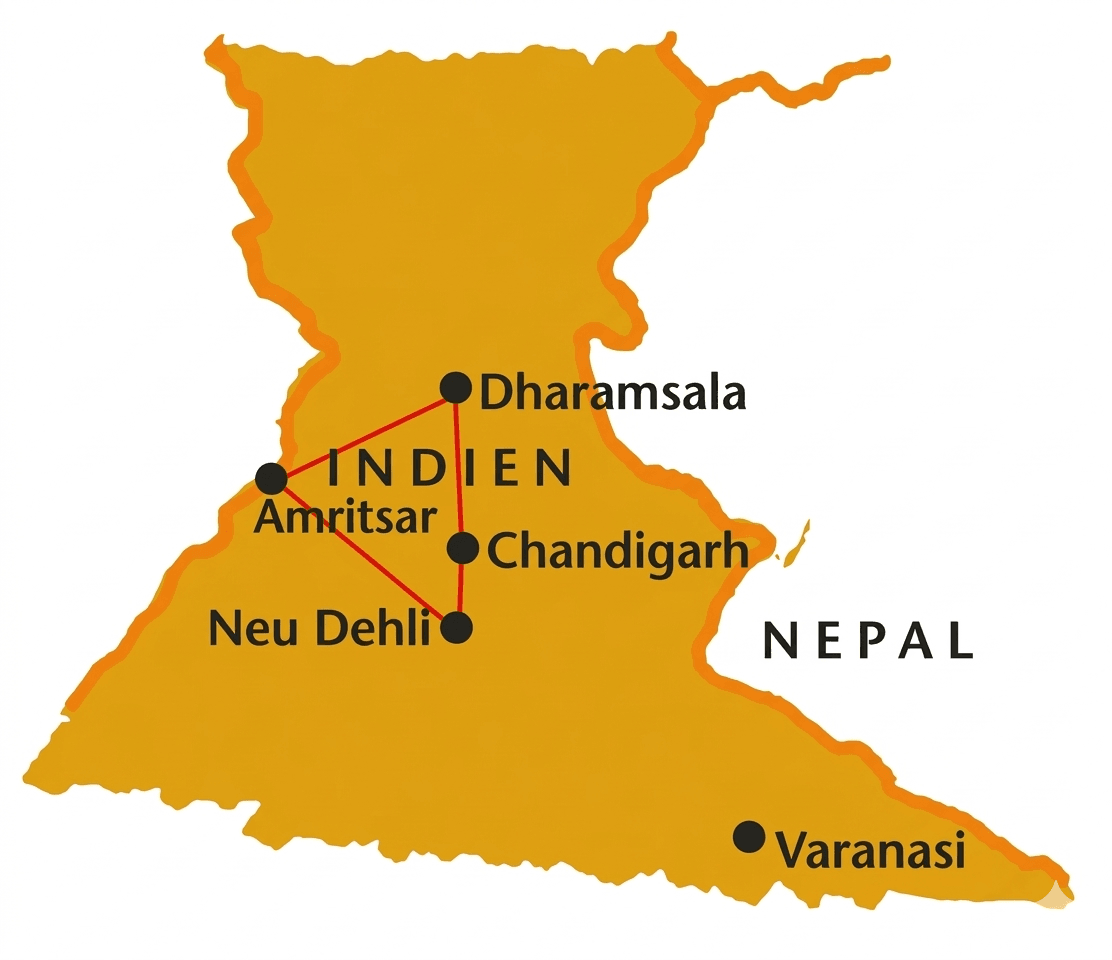
Dharamsala (India), a symbolic city, has hosted the Dalai Lama since his departure from Tibet, along with the Tibetan government in exile. Many monasteries, schools, and cultural centers are located there, supporting preservation of Tibetan culture.
A quick word on Tibetan Buddhism, borrowed from Encarta:
“Tibetan Buddhism inherited tantric Mahayana Buddhism once practiced in India, as well as certain beliefs and practices specific to the Himalayan region. Buddhism was introduced into Tibet in the 8th century AD by the Indian master Padmasambhava (c. 717-c. 762), who founded the first Buddhist temple at Samye and ordained the first monks. Buddhism then spread rapidly. Its development was briefly hindered by persecutions under King Langdarma, who reigned from 838 to 842, but resumed afterwards.
Tibetan Buddhism is a complete tradition with many aspects: philosophy, way of life, inner training, search for liberation, ritual practice, meditation, yoga, offerings, lay, monastic or hermitic life, and development of very rich architecture and art. Its approaches can differ greatly, depending on whether one seeks deep inner practice or a more popular path focused mainly on well-being in this life and future lives.
Tibetan Buddhism is divided into four major schools, independent from one another, each with its own head, organization and monasteries: Nygmapas, Sakyapas, Kagyupas and Gelugpas. The Dalai Lama, who belongs to the Gelugpa school without being its head, plays the role of temporal leader of the country but does not exercise direct spiritual authority outside his own school.
Monasteries (about 6,000 before the Chinese invasion) are usually headed by a tulkou, a person recognized as the reincarnation of a revered master known for great qualities. Before Chinese occupation of Tibetan territory and the resulting religious persecutions, some monasteries were true cities with several thousand monks.
“Tibetan Buddhism”, Microsoft(R) Encarta(R) Encyclopaedia 2000. (C)1993-1999 Microsoft Corporation. All rights reserved.
Calendars
In Tibet, calendar, astrology and religion are intimately intertwined. In this study, we will try to focus on the calendar side and leave aside the astrological dimension, which I would be quite unable to explain properly.
There are, in fact, two calendars in Tibet:
- The Phukluk calendar, created in 1447 by astrologer Phukpa Lhundrub Gyatso and developed in an astrological work: “oral teachings of Pundarika” (pad dkar zhal lung). This calendar is considered the official Tibetan calendar and is used by most Tibetans.
- The Tsurluk calendar, created by the third Karmapa Rangjung Dorje (1284-1339) in his work “Compendium of Astrology” (rtsis kun bsdus pa).
Note: karmapa is a branch of the Kargyupa (or Kagyupa) school, whose main monastery is Tsurphu near Lhasa. This school is also known as the Black Hat school.
This calendar is used by Karma Kagyu, a “sub-group” within the Kagyupa religious community.
It seems these two calendars differ (strictly from a calendar perspective, leaving astrology aside) only in the start date of the year. I admit I do not know exactly by what mechanism, though I assume it is tied to the intercalation system for additional months. If you have an explanation, please contact me.
Let us look closely at the Phukluk calendar and see how it is built.
For this, let us proceed chronologically. We will then see that the “recipe” of the Tibetan calendar can be summarized as: “a Kalacakra base with a touch of Chinese symbolism”.
A) A Kalacakra base
Let us open a parenthesis to define Kalacakra, or more precisely Kalacakra Tantra.
As its name suggests, Kalacakra Tantra is one of the religious texts of Tantrism. Its precise name would be Kalacakra Laghutantra, an abridged form of a longer text, Kalacakra Mulatantra.
Kalacakra Mulatantra is said to have been taught by Buddha himself at the great stupa of Dhanyakataka in India. This 12,000-line text was reportedly commented on and transcribed by King Sucandra of Shambhala.
Later, another king of Shambhala, Yashas, is said to have written an abbreviated form, Kalacakra Laghutantra, about three quarters shorter.
Another king, Pundarika, wrote a commentary on Kalacakra Laghutantra known as Vimalaprabha.
In 1027, these texts were translated from original Sanskrit into Tibetan and introduced into Tibet.
Kalacakra is divided into five chapters. The first chapter deals with “Outer Kalacakra”: the physical world, in particular calendar computation and its astrological aspect.
Which elements of what we will call the “Kalacakra calendar” are used in the Tibetan calendar?
- First, its lunisolar principle: twelve 30-lunar-day months, with a thirteenth lunar month (Da shol) in some years (about every 32 months) to offset drift against the solar year.
- Months begin on new-Moon day and continue to the next new Moon. More precisely, the first day of each month is the day during which the Moon sets for the first time after new-Moon time. Of course, Moonset varies depending on observer location on Earth. The official Tibetan calendar reference location is DHARAMSALA (see above). For calendar builders and converters, coordinates are: longitude 76d19'0E (76.3167); latitude 32d13'0N (32.2167); altitude 1456 m.
- Intercalary months: as in the Chinese calendar, the Sun is supposed to pass from one zodiac sign to the next during one lunar month. If it does not, that lunar month is considered intercalary (Da shol) and has the same characteristics as the month it “duplicates”.
- The solar day (civil day) starts at sunrise and continues until next sunrise. As in many calendars (see study on the week), these days are named after the seven “planets”: Sun, Moon, etc.
- Lunar day: contrary to what one might think, it is not one-thirtieth of the time elapsed between two new Moons. It is the time needed for the Moon-Sun angle to increase by 12 degrees.
The Tibetan calendar indicates, for each month, the rank of the lunar day. Since an average lunar day is approximately 0.984 solar day, what can happen does happen: the endpoint (used as reference) of two lunar days may fall within the same solar day. In that case, the second lunar-day rank is “skipped”. This skipped day is called tsi chad-pa.
Conversely, there may be no lunar-day endpoint within a solar day. Then the previous lunar-day rank is “duplicated”. The second day is called tsi lhag-pa.
So in the Tibetan calendar, day numbers within a month do not necessarily run continuously.
Take, for example, month one of year 2130 in the Tibetan calendar (March-April 2003):
| Tibetan lunar day | 1 | 2 | 2 | 3 | 4 | 5 | 6 | 7 | 8 | 9 |
|---|---|---|---|---|---|---|---|---|---|---|
| Gregorian day | 03/03 | 04/03 | 05/03 | 06/03 | 07/03 | 08/03 | 09/03 | 10/03 | 11/03 | 12/03 |
| Tibetan lunar day | 10 | 11 | 12 | 13 | 14 | 15 | 16 | 17 | 18 | 19 |
| Gregorian day | 13/03 | 14/03 | 15/03 | 16/03 | 17/03 | 18/03 | 19/03 | 20/03 | 21/03 | 22/03 |
| Tibetan lunar day | 21 | 22 | 23 | 24 | 25 | 26 | 27 | 28 | 29 | 30 |
| Gregorian day | 23/03 | 24/03 | 25/03 | 26/03 | 27/03 | 28/03 | 29/03 | 30/03 | 31/03 | 01/04 |
Let us note in passing that year 1 of the Tibetan calendar corresponds to 127 BC in our calendar. That year corresponds to accession of the first Tibetan king, Nyatri Tsenpo.
- Losar (or Lhosar), Tibetan New Year.
Here we hit one of the least clear points in both Tibetan and Kalacakra calendars: determining the start of the year. Several hypotheses are put forward:
- first, Losar (New Year day in the official Tibetan calendar) would fall on the new-Moon day of February (or March if the previous year has an intercalary month). Even if this often looks true, it does not satisfy me because it refers back to the Gregorian calendar.
- second, Losar would fall on the new-Moon day preceding the spring equinox. If anyone wants to run the calculations and test this, let me know.
- third, Kalacakra New Year would fall in month three of the Tibetan calendar. One would then only need to position Kalacakra New Year and go back two lunar months to locate Losar.
The issue is that, contrary to Kalacakra “recommendations” and Vimalaprabha commentaries, Tibetans adopted the sidereal zodiac instead of the tropical zodiac (see astronomy) and their calendar now uses, without corrective updates, a solar position relative to the zodiac (tropical or sidereal) that no longer means much.
B) A touch of Chinese symbolism
The animal-element system already seen in the Chinese calendar also exists in the Tibetan calendar.
The animal system has existed since the mid-7th century, under influence of spiritual masters attached to the Chinese princess who married King Songtsen Gampo. It naturally forms a 12-animal cycle found in years, months, days and hours alike.
The twelve animals, in order, are: Hare (Yo), Dragon (Drouk), Serpent (Trul), Horse (Ta), Sheep (Loug), Monkey (Tre), Bird (Tcha), Dog (Khyi), Pig (P'ak), Mouse (Tchi), Ox (Lang), Tiger (Tak).
In the 10th century, under influence of Kalacakra practitioners, the five elements (djoungwa) appeared in the calendar: Wood (shing), Fire (me), Earth (sa), Metal (tchak) or Iron, and Water (tchou).
Combining animal and element leads, as in the Chinese calendar, to a sexagenary cycle called Rab-byung, beginning with the fire-hare pair (unlike the wood-rat start in the Chinese cycle).
Year 2003 of our calendar corresponds to year 17 of Rab-byung 17, which started in 1987. It is the “water sheep” year.
Year one of Rab-byung one corresponds to our year 1027, which is also the date when Kalacakra was translated into Tibetan.
Let us lay out the latest Rab-byung:
| Animal | Hare | Dragon | Serpent | Horse | Sheep | Monkey | Bird | Dog | Pig | Mouse | Ox | Tiger |
|---|---|---|---|---|---|---|---|---|---|---|---|---|
| Element |  |  | |  | |  | |  | | | | |
| Year index | 1 | 2 | 3 | 4 | 5 | 6 | 7 | 8 | 9 | 10 | 11 | 12 |
| Gregorian year | 1987 | 1988 | 1989 | 1990 | 1991 | 1992 | 1993 | 1994 | 1995 | 1996 | 1997 | 1998 |
| Element | | | | | | | | | | | | |
| Year index | 13 | 14 | 15 | 16 | 17 | 18 | 19 | 20 | 21 | 22 | 23 | 24 |
| Gregorian year | 1999 | 2000 | 2001 | 2002 | 2003 | 2004 | 2005 | 2006 | 2007 | 2008 | 2009 | 2010 |
| Element | | | | | | | | | | | | |
| Year index | 25 | 26 | 27 | 28 | 29 | 30 | 31 | 32 | 33 | 34 | 35 | 36 |
| Gregorian year | 2011 | 2012 | 2013 | 2014 | 2015 | 2016 | 2017 | 2018 | 2019 | 2020 | 2021 | 2022 |
| Element | | | | | | | | | | | | |
| Year index | 37 | 38 | 39 | 40 | 41 | 42 | 43 | 44 | 45 | 46 | 47 | 48 |
| Gregorian year | 2023 | 2024 | 2025 | 2026 | 2027 | 2028 | 2029 | 2030 | 2031 | 2032 | 2033 | 2034 |
| Element | | | | | | | | | | | | |
| Year index | 49 | 50 | 51 | 52 | 53 | 54 | 55 | 56 | 57 | 58 | 59 | 60 |
| Gregorian year | 2035 | 2036 | 2037 | 2038 | 2039 | 2040 | 2041 | 2042 | 2043 | 2044 | 2045 | 2046 |
Months follow the same rotational logic as follows:
| Animal | Dragon | Serpent | Horse | Sheep | Monkey | Bird | Dog | Pig | Mouse | Ox | Tiger | Hare |
|---|---|---|---|---|---|---|---|---|---|---|---|---|
| Element | | | | | | | | | | | | |
| Month | 1 | 2 | 3 | 4 | 5 | 6 | 7 | 8 | 8 | 10 | 11 | 12 |
To conclude this Tibetan calendar study, for those who may want to build such a calendar or perform Gregorian-Tibetan conversions, I quote a line (translated by me) from Tsipon Shuguba, author of “In the Presence of my Enemies”:
“Near the end of each year, a new calendar is prepared by the country's astrologers. Therefore, no one can know what the new year will be before it begins.
This sentence mainly concerns festival days, but because astrology and calendar are tightly linked, astrologers sometimes remove “unfavorable” days to duplicate some “favorable” ones.
So be careful: nothing is entirely automatic in a Tibetan calendar.