A little history
Let us begin with a brief chronology of China to highlight the events related to the calendar:
| Dates | Chinese dynasties | Calendar events | |
|---|---|---|---|
| 12000 - 2000 | Neolithic | The calendar is said to have been invented by the Yellow Emperor (Huang Di) in 2637, during the 61st year of his reign. See text below. | |
| 2200 - 1500 |  | Xia | 2205 The Tiger month is the first month of year 0. |
| 1700 - 1027 |  | Shang | 1401: The Ox month is the first month of the year. 1122: The Rat month is the first month of the year. |
| 1027 - 771 |   | Western Zhou | The Metonic cycle is used to set intercalary months. |
| 770 - 221 |  | Eastern Zhou | |
  | 770 - 476 BCE - Spring and Autumn period | ||
  | 475 - 221 BCE - Warring States period | ||
| 221 - 207 |  | Qin | 221: The Rat month is the first month of the year. |
| 206 - + 9 |  | Western Han | 104: The Qi rule is adopted to determine the position of intercalary months. The Tiger month is the first month of the year. |
| 9 - 24 | Xin (Wang Mang's usurpation) | ||
| 25 - 220 | | Eastern Han | |
| 220 - 280 |  | Three Kingdoms (San Guo) | |
| 220 - 265 - Wei | |||
| 221 - 263 - Shu | |||
| 229 - 280 - Wu | |||
| 265 - 316 |  | Western Jin | |
| 317 - 420 | | Eastern Jin | |
| 420 - 588 | Period of the Southern and Northern dynasties | ||
  | 420 - 588 Southern dynasties | ||
 | 386 - 588 Northern dynasties | ||
| 581 - 617 |  | Sui | |
| 618 - 907 |  | Tang | The "true moon" and the "mean sun" are used to determine the position of intercalary months. |
| 907 - 960 |   | Five Dynasties | |
| 907 - 979 |  | Ten Kingdoms | |
| 960 - 1279 | Song | ||
 | 960 - 1127 - Northern Song | ||
| | 1127 - 1279 - Southern Song | ||
| 916 - 1125 |  | Liao | |
| 1038 - 1227 | | Western Xia | |
| 1115 - 1234 | | Jin | |
| 1279 - 1368 |  | Mongol Yuan dynasty | |
| 1368 - 1644 |  | Ming | |
| 1644 - 1911 |  | Manchu Qing dynasty | 1645: The "true moon" and "true sun" are used to determine the position of intercalary months. |
| 1911 - 1949 | Republic of China | In 1912, the Gregorian calendar became the official calendar in China. But the traditional Chinese calendar is still used to determine festival dates. | |
| 1949 - today | People's Republic of China | ||
Before beginning the study of the Chinese calendar, I should point out that I neither speak nor read Chinese. To write the Chinese names and terms on this page, I have therefore used the pinyin method.
The calendar(s)
There are in fact two Chinese calendars: a solar calendar and a lunisolar calendar. But this does not mean you can use one or the other independently. They are fully interdependent. The first draws the names of its months from the second, and the second can only be constructed from the first. Without really being wrong, one could say there is one Chinese calendar with two parts.
Among all calendars described on this site, the Chinese calendar is the only one using a true dual approach, both lunar and solar, without either side really losing its identity.
It is also worth noting that China has adopted the Gregorian calendar as its official calendar since 1912. But, and in my opinion this is a good thing, the Chinese have not abandoned their traditions and still use the traditional calendar to set festival dates and various holidays. They therefore integrate their traditional calendar into the Gregorian one. So then: one, two or three calendars? You can make up your own mind after this study.
The solar part of the Chinese calendar
By using gnomons and water clocks very early on, the Chinese were able to make empirical observations on the year, the seasons, the day and eclipses.
The gnomon enabled them to locate the two solstices and the two equinoxes and therefore to set the length of the year at 365 1/4 days.
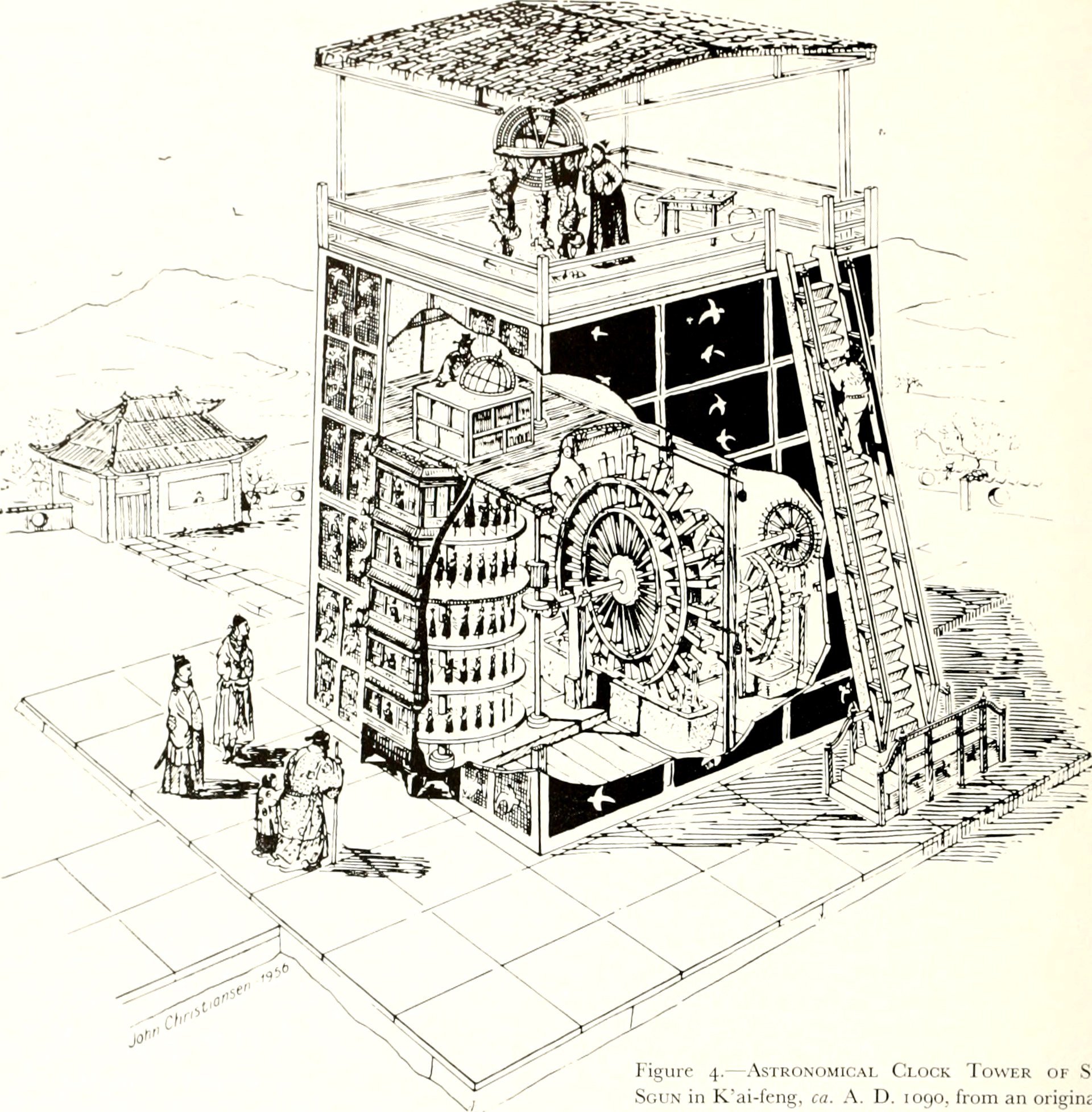
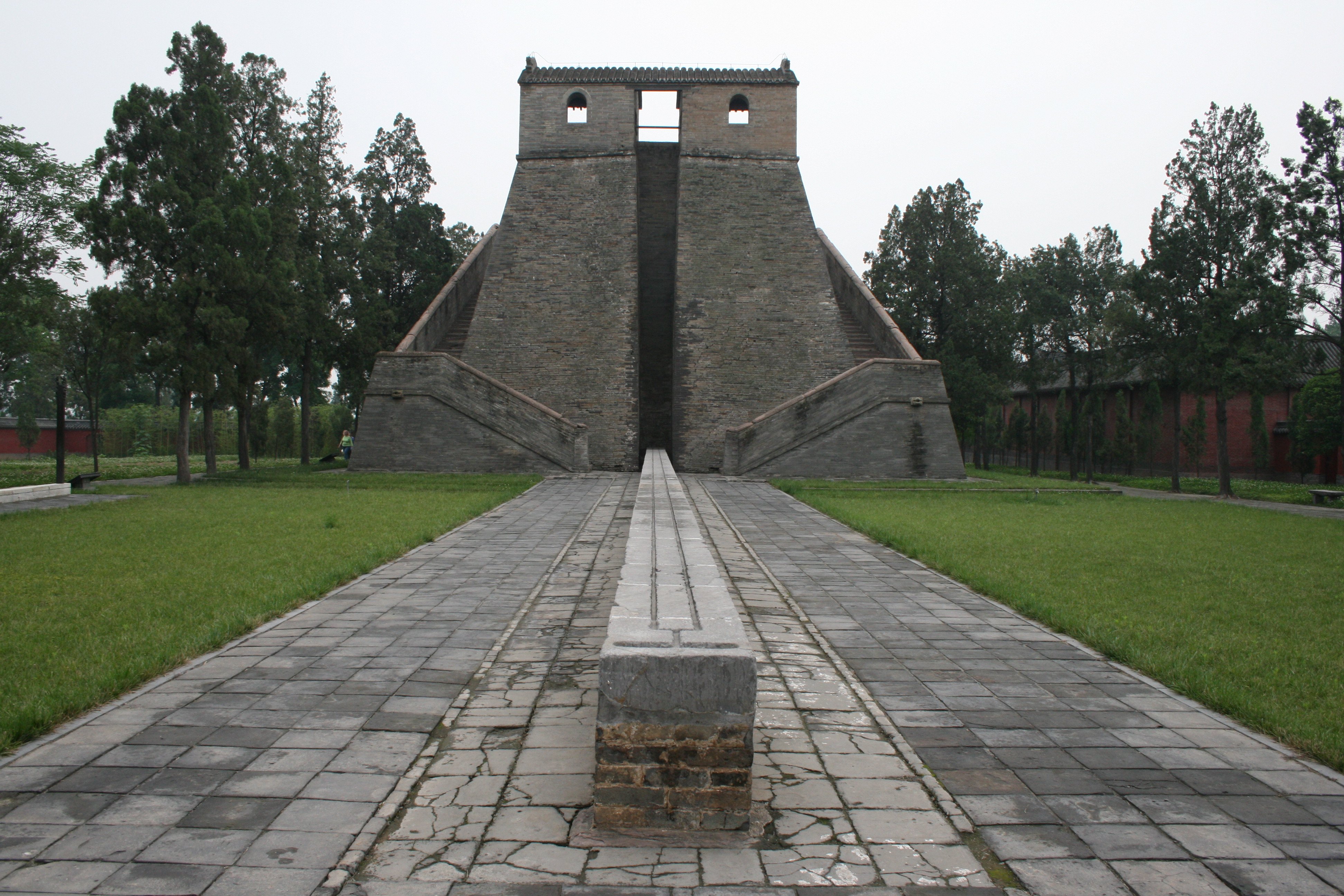
Chinese farmers needed reference points to know the best periods for sowing and harvesting. The solar calendar answered this need perfectly.
A brief side note: if you are not (or no longer) very comfortable with basic astronomy concepts, I suggest refreshing your memory on the astronomy page before continuing.
The Chinese solar year is divided into 24  jieqi (also translated as markers, nodes or sections), each corresponding to a precise position of the sun on the ecliptic (solar ecliptic longitude). If we divide the ecliptic into 360 degrees, each marker is 15 degrees from the next one. In days, it takes on average 15 days to move from one marker to the next. I say on average because the Earth's speed is not constant throughout the year.
The 24 jieqi are divided into two groups:
- 12 jie which we will abbreviate as S1, S2, ...
- 12 qi or principal markers (which we will abbreviate as P1, P2, ...) that play a special role in determining intercalary months in the lunar calendar.
Once we add that the solar New Year begins at the exact moment when the sun reaches the 15th degree of Aquarius, Beijing time (which corresponds to 4 or 5 February in our calendar), we can draw up the table of the 24 jieqi:
| Name | Date | Longitude | |||
|---|---|---|---|---|---|
| S1 |  | Lichun | Beginning of spring | 4 or 5 February | 315 |
| P1 |  | Yushui | Rains | 18, 19 or 20 February | 330 |
| S2 |  | Jingzhe | Awakening of insects | 5 or 6 March | 345 |
| P2 |  | Chunfen | Spring equinox | 20 or 21 March | 0 |
| S3 |  | Qingming | Clear and bright | 4 or 5 April | 15 |
| P3 |  | Guyu | Beneficial rains | 19, 20 or 21 April | 30 |
| S4 |  | Lixia | Beginning of summer | 6 or 7 May | 45 |
| P4 |  | Xiaman | Ears almost full | 20, 21 or 22 May | 60 |
| S5 |  | Mangzhong | Rising ears | 5, 6 or 7 June | 75 |
| P5 |  | Xiazhi | Summer solstice | 21 or 22 June | 90 |
| S6 |  | Xiaoshu | Minor heat | 6, 7 or 8 July | 105 |
| P6 |  | Dashu | Major heat | 22, 23 or 24 July | 120 |
| S7 |  | Liqiu | Beginning of autumn | 8 or 9 August | 135 |
| P7 |  | Chushu | End of heat | 22, 23 or 24 August | 150 |
| S8 |  | Bailu | White dew | 7, 8 or 9 September | 165 |
| P8 |  | Qiufen | Autumn equinox | 22 or 23 September | 180 |
| S9 |  | Hanlu | Cold dew | 8 or 9 October | 195 |
| P9 |  | Shungjiang | White frost | 23 or 24 October | 210 |
| S10 |  | Lidong | Beginning of winter | 7 or 8 November | 225 |
| P10 |  | Wiaoxue | Minor snow | 22 or 23 November | 240 |
| S11 |  | Daxue | Major snow | 6, 7 or 8 December | 255 |
| P11 |  | Dongzhi | Winter solstice | 21, 22 or 23 December | 270 |
| S12 |  | Xiaohan | Minor cold | 5, 6 or 7 January | 285 |
| P12 |  | Dahan | Major cold | 20 or 21 January | 300 |
What can we observe in this table?
- Before the 1645 calendar reform, the interval between two qi was 30.44 days because the Chinese used a “mean sun”. From 1645 onward, these intervals varied between 29.44 and 31.44 days to account for the astronomically determined “true sun”.
- The principal markers P2, P5, P8 and P11 are simply the Western seasonal reference points.
- The markers S2, S5, S8 and S11 correspond to the start of seasons in China. In the West, spring starts at the March equinox, whereas in China spring begins between the December solstice and the March equinox.
- Although there is some symmetry in the table (for example minor and major heat follow the summer solstice just as minor and major cold follow the winter solstice), it is sometimes difficult to see (minor and major snow before the winter solstice do not really mirror full and rising ears before the summer solstice).
The lunar part of the Chinese calendar
Within this solar year, we now have to fit in purely lunar months.
But what is a lunar month for the Chinese?
First, let us not forget that, as with the solar year, the lunar month is determined not by average calculations based on long-term observations but by true calculations. This is important when placing intercalary months in a year.
Rule 1: Calculations are made from 120° East. Before 1929, they were made from the Beijing meridian (116°25).
Rule 2: The day on which a new moon occurs is the first day of a lunar month. Note that in the civil calendar we are studying, the exact time of the new moon does not matter: the new moon applies to the whole day.
From this rule we deduce that lunar month length is the number of days between two new moons. Unlike our Gregorian calendar, where month lengths are fixed (except February), a Chinese lunar month can have either 29 or 30 days. It is possible to have three or even four consecutive 30-day months.
Note that Chinese months do not have specific names and are simply identified by rank. A method once existed to name months according to the sexagesimal cycle discussed below, but this has fallen out of use.
The obvious question is: “Yes, but where does the first month fall in the solar calendar?”
There are several rules to determine the date of Chinese New Year. They coexist because one of them occasionally fails when applied to older years. They all seem fairly reliable for modern years... except 2033, which appears to be a Chinese puzzle for the Chinese themselves.
Most of the time, these rules produce the same result. They should not be applied one after another; one should be chosen. I list them all so you can choose:
- Rule 3: New Year falls on the day of the second new moon after the December solstice (around 22 December).
- Rule 3: New Year falls on the day of the new moon that belongs to S1 (Lichun, beginning of spring).
- Rule 3: New Year falls on the day of the new moon after P12 (Dahan, major cold).
- Rule 3: New Year falls on the day of the first new moon in P1 (Yushui, rains).
In all cases, New Year should fall between 21 January and 21 February inclusive.
We have now determined the year start, each month's start and each month's length. We now face the classic problem of any lunisolar calendar: a tropical year does not contain an exact number of lunar months. Twelve lunar months contain 353, 354 or 355 days depending on month lengths, whereas a solar year is about 365.25 days.
As usual, we need to add one lunar month to a 12-month year, creating a 13-month embolismic year to catch up the pure lunar year with the solar year.
A simple method known in China was to add seven embolismic years within a 19-year cycle (positions 1, 4, 7, 10, 12, 15, 18), known as the Metonic cycle. Long before it was attributed to Meton, this cycle was already known in Mesopotamia, and the Chinese seem to have inherited it from there. They applied this rule until 104 BCE.
They then applied their own method, based on an effective principle closely tied to the solar calendar:
Rule 4: The lunar month that contains no qi (principal marker) is an intercalary month. This month takes the same rank as the previous month.
Even if it has the same rank as the previous month, the intercalary month does not necessarily have the same number of days.
For reference, here is the list of embolismic years from 1900 to 2050 (the intercalary month number is in parentheses):
| 1900 (8) | 1903 (5) | 1906 (4) | 1909 (2) | 1911 (6) | 1914 (5) | 1917 (2) | 1919 (7) |
| 1922 (5) | 1925 (4) | 1928 (2) | 1930 (6) | 1933 (5) | 1936 (3) | 1938 (7) | 1941 (6) |
| 1944 (4) | 1947 (2) | 1949 (7) | 1952 (5) | 1955 (3) | 1957 (8) | 1960 (6) | 1963 (4) |
| 1966 (3) | 1968 (7) | 1971 (5) | 1974 (4) | 1976 (8) | 1979 (6) | 1982 (4) | 1984 (10) |
| 1987 (6) | 1990(5) | 1993 (3) | 1995 (8) | 1998 (5) | 2001 (4) | 2004 (2) | 2006 (7) |
| 2009 (5) | 2012 (4) | 2014 (9) | 2017 (6) | 2020 (4) | 2023 (2) | 2025 (6) | 2028 (5) |
| 2031 (3) | 2033 (11) | 2036 (6) | 2039 (5) | 2042 (2) | 2044 (7) | 2047 (5) | 2050 (3) |
Like the leap-year rule in the Gregorian calendar, the Chinese calendar includes exceptions to Rule 4 for inserting an intercalary month.
One of the following two rules may be used to handle these exceptions.
- Rule 5: If the absence of a principal marker occurs less than 20 months after a previous intercalary month, it must be ignored and this markerless month remains a “normal” month.
- Rule 5 (which seems easier because it does not require going back 20 months): the first intercalary month after a month containing two principal markers is a “false” intercalary month and must not be considered as such.
Let us take an example to illustrate Rules 4 and 5.
| Month | New Moon | QI | QI | Notes |
|---|---|---|---|---|
| 8 | 27/08/1984 | 23/09/1984 | P10 | |
| 9 | 25/09/1984 | 23/10/1984 | P11 | |
| 10 | 24/10/1984 | 22/11/1984 | P12 | |
| 10 | 23/11/1984 | * | Rule 4: no principal marker. Intercalary month. | |
| 11 | 22/12/1984 | 22/12/1984 | P1 | This month contains two principal markers. Applying Rule 5(2), the next intercalary month will be a "false" one. |
| 20/01/1985 | P2 | |||
| 12 | 21/01/1985 | 19/02/1985 | P3 | |
| 1 | 20/02/1985 | * | Rule 5: false intercalary month. | |
| 2 | 21/03/1985 | 21/03/1985 | P4 |
By applying these five rules, we are fully able to construct a Chinese calendar. We still need ephemeris tables or good software to determine new moon dates and qi dates.
That does not conclude our study yet, as several other aspects remain to be discovered.
Year names and the sexagesimal cycle
Unlike us, who name months and number years, the Chinese name lunar years and number months.
To name years, the Chinese use one of their many cycles: the sexagesimal cycle.
This cycle comes from combining a cycle of 10 with a cycle of 12 (6 cycles of 10 equal 5 cycles of 12). You may say 12 x 10 equals 120, not 60. True. But progression advances one step in each cycle at the same time, so it does result in 60 (6x10 or 5x12).
The 10-cycle is represented by the ten heavenly stems (tian gan).
The 12-cycle is represented by the twelve earthly branches (dizhi).
Since the 6th century CE, an animal has been associated with each earthly branch.
The names of the five elements are also often associated with heavenly stems. So stems come in pairs with the same element name. But each can be Yin (if even) or Yang (if odd).
Let us summarize this in table form:
| Heavenly Stems | Earthly Branches | ||||||
|---|---|---|---|---|---|---|---|
| Chinese | Pinyin | Element | Yin/Yang | Chinese | Pinyin | Animal | |
 | Jia | Wood | Yang | Each component of each cycle is used sequentially: - first year of the cycle: Jia-Zi - second year: Yi-Chou - tenth year: Gui-You - eleventh year: Jia-Xu - last year: Gui-Hai |  | Zi | Rat |
 | Yi | Yin |  | Chou | Ox | ||
 | Bing | Fire | Yang |  | Yin | Tiger | |
 | Ding | Yin |  | Mao | Hare | ||
 | Wu | Earth | Yang |  | Chen | Dragon | |
 | Ji | Yin |  | Si | Snake | ||
 | Geng | Metal | Yang |  | Wu | Horse | |
 | Xin | Yin |  | Wei | Goat | ||
 | Ren | Water | Yang |  | Shen | Monkey | |
 | Gui | Yin |  | You | Rooster | ||
| Yin: even rank Yang: odd rank |  | Xu | Dog | ||||
 | Hai | Pig | |||||
A Chinese year name is therefore composed of Stem-Branch combinations. This combination was first used to name months, days and hours in Chinese astrology. It was during the Han dynasty that it began to be used for years. Today, the sexagesimal cycle of years is the only one still in use.
Two simple calculations allow us to retrieve the Stem-Branch combination name from a known (Gregorian) year:
- Rank in the 10-stem cycle = remainder of the division by 10 of year-3. For 2002, for example, the remainder of 1999 (2002-3) divided by 10 is 9, corresponding to Ren (element Water).
- Rank in the 12-branch cycle = remainder of the division by 12 of year-3. For 2002, for example, the remainder of 1999 (2002-3) divided by 12 is 7, corresponding to Wu (animal horse).
Year 2002 is therefore ren-wu, or the Year of the Horse.
Table of years from 2000 to 2020
| Chinese year | Gregorian date | Stem-branch combination | Earthly branch animal | Heavenly stem element |
|---|---|---|---|---|
| 4698 | 05 February 2000 | Geng-Chen | Dragon | Metal |
| 4699 | 24 January 2001 | Xin-Si | Snake | Metal |
| 4700 | 12 February 2002 | Ren-Wu | Horse | Water |
| 4701 | 01 February 2003 | Gui-Wei | Goat | Water |
| 4702 | 22 January 2004 | Jia-Shen | Monkey | Wood |
| 4703 | 09 February 2005 | Yi-You | Rooster | Wood |
| 4704 | 29 January 2006 | Bing-Xu | Dog | Fire |
| 4705 | 18 February 2007 | Ding-Hai | Pig | Fire |
| 4706 | 07 February 2008 | Wu-Zi | Rat | Earth |
| 4707 | 26 January 2009 | Ji-Chou | Ox | Earth |
| 4708 | 14 February 2010 | Geng-Yin | Tiger | Metal |
| 4709 | 03 February 2011 | Xin-Mao | Hare | Metal |
| 4710 | 23 January 2012 | Ren-Chen | Dragon | Water |
| 4711 | 10 February 2013 | Gui-Si | Snake | Water |
| 4712 | 31 January 2014 | Jia-Wu | Horse | Wood |
| 4713 | 19 February 2015 | Yi-Wei | Goat | Wood |
| 4714 | 08 February 2016 | Bing-Shen | Monkey | Fire |
| 4715 | 28 January 2017 | Ding-You | Rooster | Fire |
| 4716 | 16 February 2018 | Wu-Xu | Dog | Earth |
| 4717 | 05 February 2019 | Ji-Hai | Pig | Earth |
| 4718 | 25 January 2020 | Geng-Zi | Rat | Metal |
Chinese chronology
The Chinese do not have a continuous year numbering system. A new count begins with each new emperor.
Nevertheless, during the Han dynasty, some scholars attempted to reconstruct ancient chronology and set as its starting point the supposed date when the calendar was invented. It was allegedly invented by the Yellow Emperor Huang Di in 2637 BCE, during the 61st year of his reign. Many people prefer to begin counting at 2697 BCE, corresponding to the first year of his reign.
If we consider 2697 BCE as the starting point of Chinese chronology, Gregorian year 2002 corresponds to Chinese year 4639.
It is also common to count years from the start of a sexagesimal cycle, whose first cycle would begin in 2697 BCE. A quick calculation shows that the current 60-year cycle is the 78th and began on 2 February 1984. Gregorian year 2002 is the 19th year of this 78th cycle.
This concludes our study of the Chinese calendar. I have deliberately left aside the whole astrology section, which is closely linked to the calendar but is not the focus of this site. You will find the “variants” of this Chinese calendar on other pages.
This concludes our study of the Chinese calendar.