Before reading this page, it is recommended that you first read those devoted to the Julian calendar, the Gregorian calendar, and the Jewish calendar.
Here we will deal only with the Roman liturgical calendar. The others will be covered on separate pages of this site.
Also, this page is not meant to be a page about Christian religion itself. We therefore will not ask whether this or that event is exact (unless it is historically established). What interests us is only the impact on the calendar.
Before we move on to this site's usual “historical interlude”, it is worth asking whether the liturgical (or ecclesiastical) calendar we are about to study can truly be considered a calendar.
Its purpose is to place fixed and movable religious feasts onto already existing calendars. It is not intended to count time.
Under these conditions, I personally prefer the term ecclesiastical computus. It has the advantage of not implying the existence of a specific calendar and of putting greater emphasis on calculation (computus = compature = to calculate). But I will let you form your own opinion as we go along.
Below is the link to the calendar canons we will discuss later:
A bit of history
Among the many feasts whose date had to be fixed, Easter was certainly the most important.
So our historical interlude will focus on Easter, and we will see that it was anything but straightforward.
But first, a few reminders:
1) Jesus and his twelve apostles gathered (the Last Supper) on a Thursday evening to celebrate the Jewish Passover (Pesach), commemorating the Exodus from Egypt and liberation from bondage. This feast began with the sacrifice of a lamb, eaten on the fourteenth day of the month of Nisan.
During this meal, Jesus instituted the Eucharist, announced that one of them (Judas) would betray him, and that Peter would deny him three times before the cock crowed. They then went to the Mount of Olives, where Jesus was arrested and handed over to the priests, who delivered him the next morning (7 April, year 30), a Friday, to Pontius Pilate.
Condemned to be crucified, he died that same day at around 3 p.m. In the evening, Joseph of Arimathea obtained Pilate's permission to recover the body. Night had already fallen, and since the next day was the Sabbath, a day of rest, he placed the body in a sealed tomb before the final burial, which Mary Magdalene, Mary, and Salome were to take care of the day after, on Sunday. But the tomb was empty, and an angel told them that Jesus Christ had risen.
2) In the Jewish calendar, which is a lunar calendar with solar corrections, the month of Nisan is the first month of the year and begins on the new moon that falls on the day of the spring equinox, or immediately after.
“Exodus 12:1-7: "This month shall be for you the beginning of months: it shall be for you the first month of the year. Speak to the whole congregation and say to them: on the tenth day of this month, each of you shall take a lamb by family, a lamb by household... You shall keep it until the fourteenth day of this month, and the whole assembly of Israel shall slaughter it between the two evenings... Its flesh shall be eaten that night..."
So much for the reminders. But we already encounter a first discrepancy, one that will in fact have very little importance. According to the three Synoptic evangelists (Matthew, Mark, and Luke), the Friday of Jesus' death would correspond to 14 Nisan. According to the fourth evangelist (John), Jesus died on the afternoon preceding the feast, i.e. also 14 Nisan.
Two positions would quickly clash over when to celebrate, which also raised the question of what to celebrate: should one celebrate the Last Supper, or Christ's Resurrection?
Christians in Asia (including the apostles John and Philip), from a Jewish tradition, chose to celebrate the Last Supper, therefore on 14 Nisan, the day of Pesach. They were nicknamed, not without irony, the Quartodecimans.
As for non-Jewish Christians (including Peter and Paul) of the Roman Empire and Rome (the Quintodecimans), they opted to celebrate the Resurrection by setting Easter on the Sunday following 14 Nisan.
It even seems that some churches chose to keep the three-day chronology between the Last Supper and the Resurrection and celebrated Easter on 17 Nisan. Others, less comfortable with lunar observation, chose fixed dates (25 March or 7 April). In some churches, both the Passion on 25 March and the Resurrection on the 27th were celebrated.
In short, it was complete chaos, and everyone did as they pleased.
Around 155, Polycarp, bishop of Smyrna and a disciple of John, went to Rome as representative of the Quartodecimans to discuss the issue with Pope Anicetus. The latter failed to persuade Polycarp to renounce his Jewish customs.
Let us say it plainly: this was less a purely liturgical quarrel than a struggle for influence and power among different churches. Early Christianity could hardly rely on the authorities of another religion to determine the date of its principal feast. Moreover, and we will come back to this, the method used by the Jews did not allow Easter to be calculated in advance, since the beginning of the month depended on observing the first crescent moon at sunset. The Quartodeciman position was therefore doomed to fail.
But let us continue our study anyway.
In 197, Pope Victor, a supporter of celebrating the Resurrection on Sunday, asked the bishops to gather and deliberate on the matter.
The councils of Rome, Lyon, Corinth, Amastris, Caesarea, Antioch, and Alexandria agreed with Pope Victor's position.
By contrast, at the Council of Ephesus, presided over by Polycrates, it was decided to keep celebrating the feast on 14 Nisan and, as a result, all Christians in Asia were excommunicated by Victor I.
With some excommunicated and the others in agreement, the issue seemed partly settled.
Not quite!! Because, for example, in Antioch the Jews determined the date of the first month of the year (and therefore the 14th, and therefore Easter), while in Alexandria scholars well trained in astronomy calculated Easter themselves. And the two dates rarely matched.
Later, in 314, the Council of Arles confirmed that Easter had to be celebrated on the same day throughout the world, without explaining how to achieve that.
This is where Emperor Constantine entered the scene. To maintain a degree of cohesion in the Roman Empire, his predecessors had used the method of declaring themselves gods. Since, on one hand, Christians wanted nothing to do with such a god and, on the other hand, the Empire was beginning to crack, Constantine realized he could not fight Christians. He decided to join them.
He therefore had every interest in ending the divisions caused by determining Easter's date.
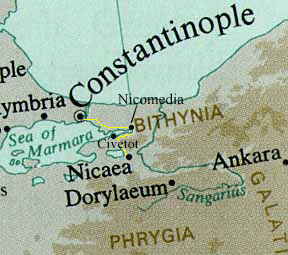
To this end, he organized the Council of Nicaea, held from 20 May to 25 June 325. There were 318 bishops present, not counting the countless priests, deacons, and others.
The council eventually established a rule still in force today, decreeing that "the feast of Easter would be celebrated on the first Sunday after the fourteenth day of the moon of the first month, provided nonetheless that if this fourteenth day fell on a Sunday, one would wait until the following Sunday, that is to say seven days later. Declaring that this first month was the one whose fourteenth moon fell on the day of the spring equinox, or immediately after."
This rule is better known in simplified form: "Easter is the Sunday that follows the fourteenth day of the moon that reaches that age on 21 March, or immediately after."
In reality, it is a little more complicated, and one may wonder whether the council truly laid down a precise rule. We will return to this one day in a study on the subject.
Still, a letter from Constantine himself confirmed that the quarrel was over, that everyone had agreed to celebrate Easter on the same day, and that the Church of Alexandria was tasked with explaining the method.
The controversy did not truly end until 525, when Rome adopted the Alexandrian computus in the form given to it by Dionysius Exiguus. We will return to this in the study of the calendar itself.
The calendar
Before diving into the study of the calendar itself, let us take a short pause:
Was Easter the only feast in the liturgical calendar? Certainly not!! The number of these holy days of obligation increased regularly and progressively until it reached around one hundred.
Even La Fontaine mentioned this multitude of feast days in his fable The Cobbler and the Financier:
“...At his house, the financier summons
through the year are scattered days
the singer (the cobbler), and says: "Well then, good Sir Grégoire,
what do you earn in a year?" “In a year? Upon my word, sir,”
says the merry fellow with a laugh,
"that is not how I count; I do not pile
one day on top of another; it is enough, by year's end,
if I somehow make it through.
Each day brings its bread."
“Then tell me what you earn per day?”
"Sometimes more, sometimes less; the trouble is that always
(and without this, our earnings would be fair enough)
on which we must not work; feast days ruin us.
One harms another, and Monsieur le Curé (the parish priest)
is always loading his sermon with some new saint...."
It would take until the Concordat concluded between Pius VII and Napoleon I in 1802 (year of promulgation) for the number of holy days of obligation (those sanctified under the Church's first commandment) to be reduced to four: Christmas, Ascension, Assumption, and All Saints' Day.
But let us return to our calendar.
What is the difference between the dates of Easter and Christmas? As we have just seen in our historical interlude, Easter depends on the moon's age. By contrast, Christmas has a fixed date in the calendar.
One conclusion follows: the Church uses a calendar that is both lunar and solar. All movable feasts are linked to the lunar calendar, while fixed feasts depend on the solar calendar. For completeness, note that there are also other feasts linked to the position of a Sunday in relation to a fixed feast (Advent, for example).
Two major cycles are found in the calendar:
- the sanctoral cycle, which concerns fixed feasts in the solar calendar.
- the temporal cycle around Easter: movable with respect to the solar calendar, but fixed with respect to the lunar calendar.
To make this easier to follow, we will break this calendar section down as follows:
- A) The Easter computus in the Julian calendar.
- B) The Easter computus in the Gregorian calendar.
- C) Feasts in the Gregorian liturgical calendar.
A) The Easter computus in the Julian calendar
We have seen that the Council of Nicaea (perhaps) set a rule for determining Easter's date: "Easter is the Sunday that follows the fourteenth day of the moon that reaches that age on 21 March, or immediately after."
It still remained to find a computus that would actually place that date on the calendar. The monk Dionysius Exiguus, founder of the Christian era, took on that task and designed a computus (the Alexandrian rule) used from the 6th century onward and kept in force until 1585 (date of transition to the Gregorian calendar). Since waiting every year for the new crescent moon is not practical, Dionysius Exiguus, relying on Meton's cycle, built a perpetual lunar calendar within the Julian calendar. As a reminder, Meton's cycle is a 19-year cycle after which (after 235 lunations) lunar phases return on the same dates.
Dionysius Exiguus distributed the 235 lunations in the Julian perpetual calendar by alternating lunations of 29 and 30 days. A normal year includes 115 lunations of 29 days and 120 lunations of 30 days.
Let us build this perpetual table of Julian moons over the 19-year cycle, and note that a year's position in that cycle is called the Golden Number (year I of our era was assigned Golden Number 2).
The dates shown in the table correspond to the start of each theoretical lunation. Dates in red indicate 30-day lunations. Numbers in brackets indicate the day for leap years. Remember that we are in the Julian calendar, where the leap day comes after 24 February. Figures separated by commas mean there are two lunation starts in the same month.
| Golden Number | Jan. | Feb. | March | April | May | June | July | Aug. | Sep. | Oct. | Nov. | Dec. |
|---|---|---|---|---|---|---|---|---|---|---|---|---|
| 1 | 23 | 21 | 23 | 21 | 21 | 19 | 19 | 17 | 16 | 15 | 14 | 13 |
| 2 | 12 | 10 | 12 | 10 | 10 | 8 | 8 | 6 | 5 | 4 | 3 | 2 |
| 3 | 1,31 | 1,31 | 29 | 29 | 27 | 27 | 25 | 24 | 23 | 22 | 21 | |
| 4 | 20 | 18 | 20 | 18 | 18 | 16 | 16 | 14 | 13 | 12 | 11 | 10 |
| 5 | 9 | 7 | 9 | 7 | 7 | 5 | 5 | 3 | 2 | 2,31 | 30 | 29 |
| 6 | 28 | 26,(27) | 28 | 26 | 26 | 24 | 24 | 22 | 21 | 20 | 19 | 18 |
| 7 | 17 | 15 | 17 | 15 | 15 | 13 | 13 | 11 | 10 | 9 | 8 | 7 |
| 8 | 6 | 4 | 6 | 5 | 4 | 3 | 2 | 1,30 | 29 | 28 | 27 | 26 |
| 9 | 25 | 23 | 25 | 23 | 23 | 21 | 21 | 19 | 18 | 17 | 16 | 15 |
| 10 | 14 | 12 | 14 | 12 | 12 | 10 | 10 | 8 | 7 | 6 | 5 | 4 |
| 11 | 3 | 2 | 3 | 2 | 1,31 | 29 | 29 | 27 | 26 | 25 | 24 | 23 |
| 12 | 22 | 20 | 22 | 20 | 20 | 18 | 18 | 16 | 15 | 14 | 13 | 12 |
| 13 | 11 | 9 | 11 | 9 | 9 | 7 | 7 | 5 | 4 | 3 | 2 | 1,31 |
| 14 | 30 | 28,(29) | 30 | 28 | 28 | 26 | 26 | 24 | 23 | 22 | 21 | 20 |
| 15 | 19 | 17 | 19 | 17 | 17 | 15 | 15 | 13 | 12 | 11 | 10 | 9 |
| 16 | 8 | 6 | 8 | 6 | 6 | 4 | 4 | 2 | 1 | 1,30 | 29 | 28 |
| 17 | 27 | 25,(26) | 27 | 25 | 25 | 23 | 23 | 21 | 20 | 19 | 18 | 17 |
| 18 | 16 | 14 | 16 | 14 | 14 | 12 | 12 | 10 | 9 | 8 | 7 | 6 |
| 19 | 5 | 3 | 5 | 4 | 4 | 2 | 1,30 | 28 | 27 | 26 | 25 | 24 |
We now need to find the fourteenth day of the moon that reaches that age on 21 March, or immediately after. Nothing could be simpler: add 13 days to the previous dates and keep those that fall on or immediately after 21 March. That gives us the following table:
| Golden Number | 1 | 2 | 3 | 4 | 5 | 6 | 7 | 8 | 9 | 10 | 11 | 12 | 13 | 14 | 15 | 16 | 17 | 18 | 19 |
|---|---|---|---|---|---|---|---|---|---|---|---|---|---|---|---|---|---|---|---|
| March | 25 | 22 | 30 | 27 | 24 | 21 | 29 | ||||||||||||
| April | 05 | 13 | 02 | 10 | 18 | 07 | 15 | 04 | 12 | 01 | 09 | 17 |
Note: We can start directly from the previous table if we know the year's Golden Number. It can be found on the La Poste calendar or with the following formula: Golden Number = 1 + mod(year,19). Reminder: pages devoted to calendars contain no (or very few) formulas so as not to harm readability. Formulas are gathered on the Conversion page, accessible from the miscellaneous menu.
To complete the application of the rule defined by the Council of Nicaea, all that remains is to find... the following Sunday...
To do this, we will introduce the concept of the Dominical letter: we assign one letter from the series A,B,C,D,E,F,G to every day of the year, starting on 1 January (which therefore has letter A). The Dominical letter is the letter assigned to Sunday. This Dominical letter is Sunday's letter for the whole year, except...
Because there is one complication in this simple principle: leap years. In that case, 24 and 25 February have the same letter and, as a result, Sunday has two different Dominical letters: one before 24 February and another after 25 February. Naturally, since Easter never falls in February, we only use the second letter to determine the date.
Example: in 2000 (a leap year), 1 January would have been a Friday in the Julian calendar and carried letter A. Letter C would therefore have been Sunday's letter. In February, the 21st is a Sunday. Here is what happens in February:
| Date | 21 | 22 | 23 | 24 | 25 | 26 | 27 | 28 |
|---|---|---|---|---|---|---|---|---|
| Day | Sunday | Monday | Tuesday | Wednesday | Thursday | Friday | Saturday | Sunday |
| Letter | C | D | E | F | F | G | A | B |
“The” Dominical letter for 2000 was therefore CB.
Because of leap years, the Dominical-letter cycle only completes after 28 years. This 28-year period is called the solar cycle (because Sunday is the day of the sun).
Now that we know a given year's Golden Number and Dominical letter, all that remains is to consult a table to read Easter's date.
| Golden Number | Dominical Letter | ||||||
|---|---|---|---|---|---|---|---|
| A | B | C | D | E | F | G | |
| 1 | 09/04 | 10/04 | 11/04 | 12/04 | 06/04 | 07/04 | 08/04 |
| 2 | 26/03 | 27/03 | 28/03 | 29/03 | 30/03 | 31/03 | 01/04 |
| 3 | 16/04 | 17/04 | 18/04 | 19/04 | 20/04 | 14/04 | 15/04 |
| 4 | 09/04 | 03/04 | 04/04 | 05/04 | 06/04 | 07/04 | 08/04 |
| 5 | 26/03 | 27/03 | 28/03 | 29/03 | 23/03 | 24/03 | 25/03 |
| 6 | 16/03 | 17/04 | 11/04 | 12/04 | 13/04 | 14/04 | 15/04 |
| 7 | 02/04 | 03/04 | 04/04 | 05/04 | 06/04 | 31/03 | 01/04 |
| 8 | 23/04 | 24/04 | 25/04 | 19/04 | 20/04 | 21/04 | 22/04 |
| 9 | 09/04 | 10/04 | 11/04 | 05/04 | 06/04 | 07/04 | 08/04 |
| 10 | 02/04 | 03/04 | 28/03 | 29/03 | 30/03 | 31/03 | 01/04 |
| 11 | 16/04 | 17/04 | 18/04 | 19/04 | 20/04 | 21/04 | 22/04 |
| 12 | 09/04 | 10/04 | 11/04 | 05/04 | 06/04 | 07/04 | 08/04 |
| 13 | 26/03 | 27/03 | 28/03 | 29/03 | 30/03 | 31/03 | 25/03 |
| 14 | 16/04 | 17/04 | 18/04 | 19/04 | 13/04 | 14/04 | 15/04 |
| 15 | 02/04 | 03/04 | 04/04 | 05/04 | 06/04 | 07/04 | 08/04 |
| 16 | 26/03 | 27/03 | 28/03 | 22/03 | 23/03 | 24/03 | 25/03 |
| 17 | 16/04 | 10/04 | 11/04 | 12/04 | 13/04 | 14/04 | 15/04 |
| 18 | 02/04 | 03/04 | 04/04 | 05/04 | 30/03 | 31/03 | 01/04 |
| 19 | 23/04 | 24/04 | 18/04 | 19/04 | 20/04 | 21/04 | 22/04 |
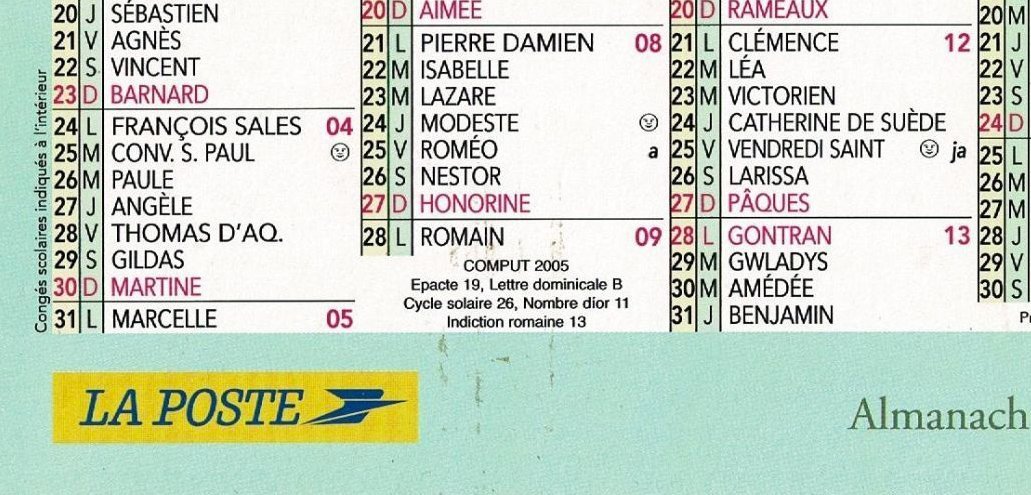
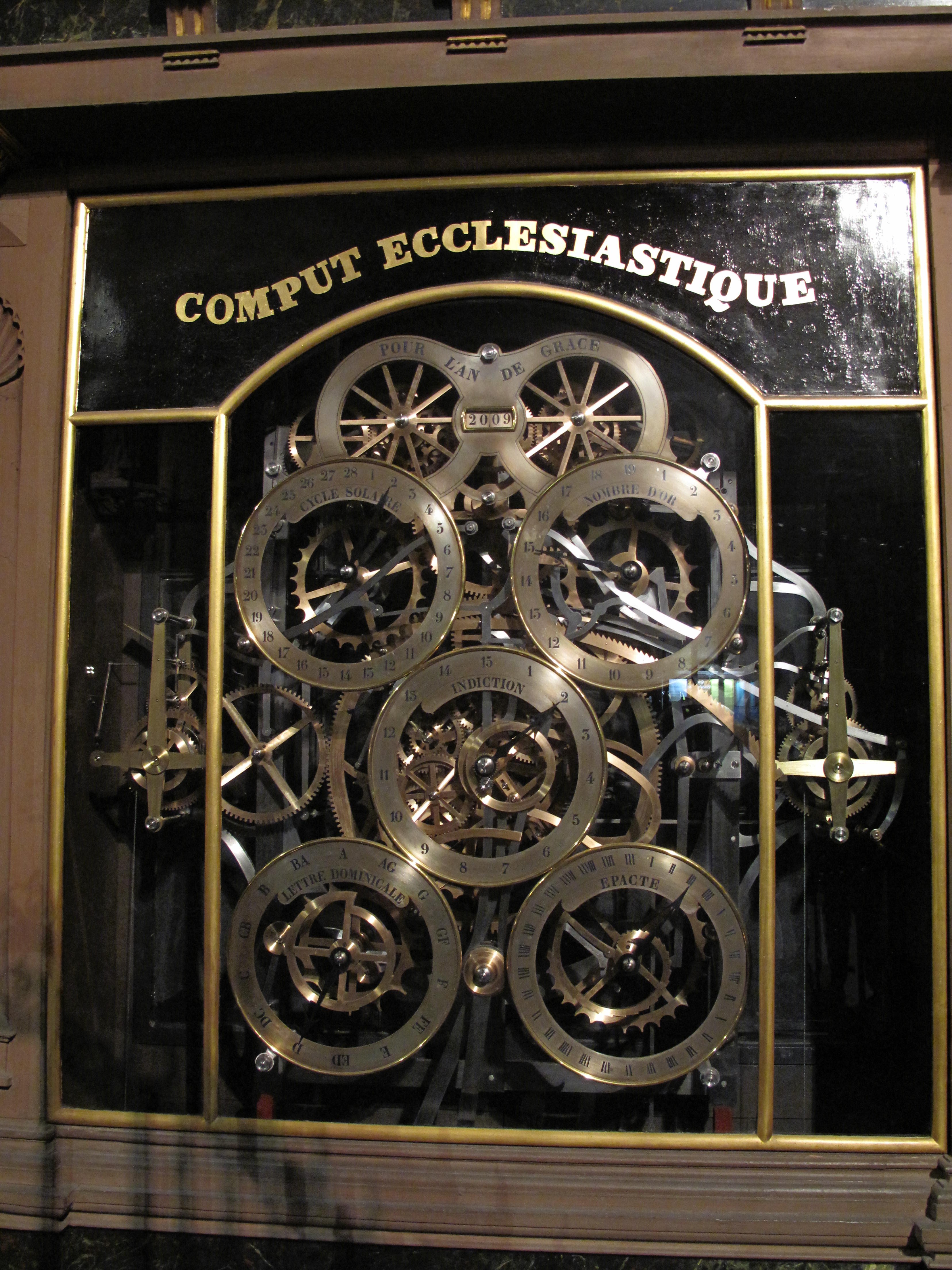
The Roman indiction has no relevance for ecclesiastical computus. It is a 15-year period that, in the time of the Roman emperors, corresponded to the collection of an extraordinary tax. Since Gregory VIII, the popes have made it begin on 01/01/313. Papal bulls are still dated by Indiction.
B) The Easter computus in the Gregorian calendar
As we saw in the pages devoted to the Julian and Gregorian calendars, there was an error in the Julian calendar's estimate of the tropical year: by the 16th century, the equinox was delayed by 10 days. In addition, an error in Meton's cycle meant that the computus moon no longer matched the real moon (by 1h30 every 19 years). This error is small, but it accumulates over centuries.
This time, we owe the computus in the Gregorian calendar, in force from 1582 onward, to Lilio and Clavius.
Here we must introduce another element of computus: the epact. It is what replaces the Golden Number in the “Julian computus”.
What is the epact (from Greek epi-aktos: added number)? It is the moon's age on a specific date. By moon's age, we mean the number of days elapsed since the last new moon. And we are not speaking of the “real” moon, but of the one determined in ecclesiastical computus and shown in the tables we saw.
The epact already existed in “Julian” computus and represented the moon's age on 22 March (equivalent to the moon's age on 31 December of the previous year).
After the Gregorian reform, a year's epact became the age of the computus moon on 1 January minus one unit (which is not necessarily the moon's age on 31 December of the previous year). This is the definition we will keep, including for the Julian calendar.
The epact is therefore a number between 0 and 29.
Note in passing that the Julian epact can take only 19 values, since the same values recur at the end of Meton's cycle. Depending on the Golden Number, these values are (for Golden Numbers from 1 to 19): 8, 19, 0, 11, 22, 3, 14, 25, 6, 17, 28, 9, 20, 1, 12, 23, 4, 15 and 26. To reconstruct the series, simply add 11 to the previous value and subtract 30 whenever possible. To move from the last epact of one series to the next, add 12 (and subtract 30). Of course, since there is a correspondence between epact and Golden Number, it would have been possible to calculate Easter's date in the Julian calendar from Julian epacts.
Among other effects, the Gregorian calendar corrected the perpetual lunar calendar in order to reduce the differences between real new-moon dates and those of the Julian calendar.
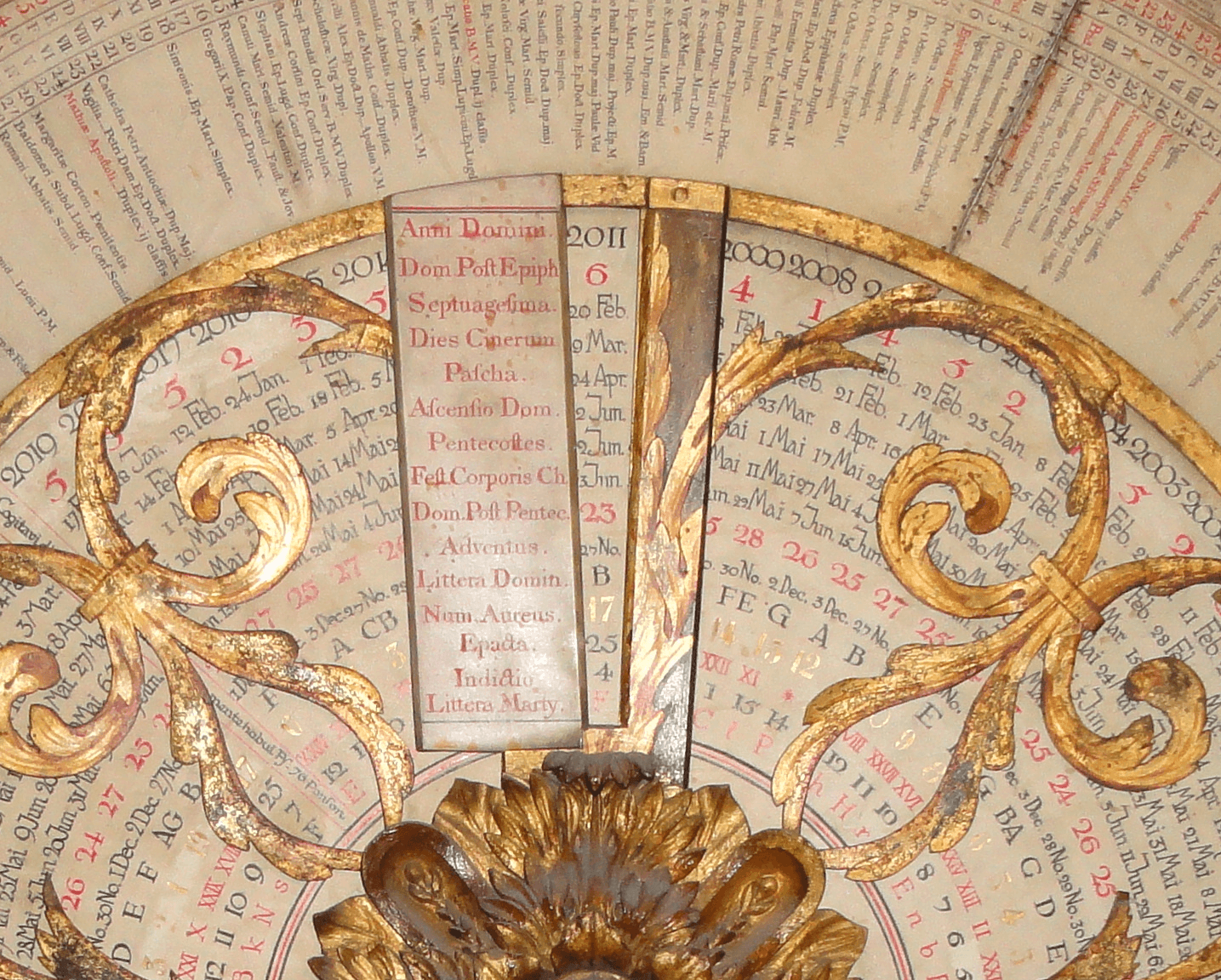
To calculate Easter dates, Golden Numbers were dropped (at least in theory) in favor of epacts. The Dominical letter, however, was kept unchanged. Easter's date could therefore be determined from the Dominical letter and the epact.
How does the epact system work? It is fairly complex and full of subtleties. So follow carefully as we do a little theory. If you do not understand everything, that is fine, because ready-made tables will help us.
The perpetual cycle of Julian epacts (8, 19, 0, ..., 26) is no longer truly perpetual, because from time to time we perform “epact jumps”. In addition, the epact for the year 1582 is modified to correct all errors due to the solar calendar and Meton's cycle.
1) Changes made in 1582
- The Julian epact in 1582 was 3 in the Julian epact cycle (8, 19, 0, 11, 22, 3, 14, 25, 6, 17, 28, 9, 20, 1, 12, 23, 4,15,26)
- 10 days are removed when moving from the civil Julian calendar to the civil Gregorian calendar: 3 - 10 = -7
- three days are added to correct the delay of the “ecclesiastical moon” phases compared with those of the astronomical moon: -7 + 3 = -4
- epact 3 of the epact cycle therefore becomes -4 + 30 = 26
Since the calculation from one epact to the next is unchanged, the cycle therefore becomes: 1, 12, 23, 4, 15, 26, 7, 18, 29, 10, 21,2, 13, 24, 5,16, 27,8,19
Note in passing that, although it is no longer truly justified, 19-year cycles are retained. However, regular corrections are added for the reasons explained above.
Also note that, due to the inaccuracy of Meton's cycle, the delay accumulated by the moon relative to itself since Nicaea was 4 days, not 3 (the value used for correcting the “ecclesiastical moon”).
2) Scheduled epact jumps
a) correction due to the solar cycle: each non-leap century year, one day is subtracted from the epact. This is metemptosis (or the solar equation).
b) correction due to the lunar cycle: every 300 years, upon reaching a century year, one day is added to the epact. This is proemptosis (or the lunar equation). This addition is performed eight times (the first in 1800), but afterwards one counts 400 years instead of 300 before starting a new 25-century cycle. Over 25 centuries (7 x 300 + 400), 8 days are therefore added. That corresponds to an average addition of one day every 312.5 years (2500/8), whereas the ideal lunar cycle would require one day every 310 years for a perfect correction of Meton's cycle.
c) correction to improve the regularity of the succession of theoretical new moons: an epact 25bis is created, written 25 (in bold), while epact 25 is written in normal type. The dates of this 25 epact are used instead of those of epact 25 when the Golden Number is greater than 11 (as I said, dropping the Golden Number was only theoretical!!).
c bis) every month of December, when the Golden Number is 19 (again!!), has only 29 days instead of 30. Of course, we are speaking of lunar months. This occurs when there is an epact jump on the following 1 January.
Rules a and b can combine, and therefore cancel each other out. In that case, the cycle remains continuous.
Let us summarize all this in a direct-read table:
Table of metemptoses and proemptoses for years 1600 to 5100
M = metemptosis; P = proemptosis
| Year | P | M | Year | P | M | Year | P | M |
|---|---|---|---|---|---|---|---|---|
| 1600 | 2800 | 4000 | ||||||
| 1700 | - 1 | 2900 | - 1 | 4100 | - 1 | |||
| 1800 | + 1 | - 1 | 3000 | + 1 | - 1 | 4200 | - 1 | |
| 1900 | - 1 | 3100 | - 1 | 4300 | + 1 | - 1 | ||
| 2000 | 3200 | 4400 | ||||||
| 2100 | + 1 | - 1 | 3300 | + 1 | - 1 | 4500 | -1 | |
| 2200 | - 1 | 3400 | - 1 | 4600 | + 1 | - 1 | ||
| 2300 | - 1 | 3500 | - 1 | 4700 | - 1 | |||
| 2400 | + 1 | 3600 | + 1 | 4800 | ||||
| 2500 | - 1 | 3700 | - 1 | 4900 | + 1 | - 1 | ||
| 2600 | - 1 | 3800 | - 1 | 5000 | - 1 | |||
| 2700 | + 1 | - 1 | 3900 | + 1 | - 1 | 5100 | - 1 |
Table of Gregorian epacts by year and Golden Number (G.N.)
| G.N | Year range | ||||||||||||
| 15 16 | 17 18 | 19 20 21 | 22 24 | 23 25 | 26 27 28 | 29 30 | 31 32 33 | 34 36 | 35 37 | 38 39 40 | 41 | 42 43 44 | |
| Gregorian epacts | |||||||||||||
| 1 2 3 4 5 6 7 8 9 10 11 12 13 14 15 16 17 18 19 | 1 12 23 4 15 26 7 18 29 10 21 2 13 24 5 16 27 8 19 | 0 11 22 3 14 25 6 17 28 9 20 1 12 23 4 15 26 7 18 | 29 10 21 2 13 24 5 16 27 8 19 0 11 22 3 14 25 6 17 | 28 9 20 1 12 23 4 15 26 7 18 29 10 21 2 13 24 5 16 | 27 8 19 0 11 22 3 14 25 6 17 28 9 20 1 12 23 4 15 | 26 7 18 29 10 21 2 13 24 5 16 27 8 19 0 11 22 3 14 | 25 6 17 28 9 20 1 12 23 4 15 26 7 18 29 10 21 2 13 | 24 5 16 27 8 19 0 11 22 3 14 25 6 17 28 9 20 1 12 | 23 4 15 26 7 18 29 10 21 2 13 24 5 16 27 8 19 0 11 | 22 3 14 25 6 17 28 9 20 1 12 23 4 15 26 7 18 29 10 | 21 2 13 24 5 16 27 8 19 0 11 22 3 14 25 6 17 28 9 | 20 1 12 23 4 15 26 7 18 29 10 21 2 13 24 5 16 27 8 | 19 0 11 22 3 14 25 6 17 28 9 20 1 12 23 4 15 26 7 |
As we did for the Julian calendar, let us now build the Gregorian perpetual lunar calendar, which gives the dates of (theoretical) new moons for each month according to the epact. Dates in red indicate 30-day lunations. Numbers in brackets indicate the day for leap years. Bracketed dates for December are used when there is an epact jump on the following 1 January. When the year's Golden Number is greater than 11, read row 25 (in bold), shown as 25 (G); otherwise read row 25 (normal).
| Epact | Jan. | Feb. | March | April | May | June | July | Aug. | Sep. | Oct. | Nov. | Dec. |
|---|---|---|---|---|---|---|---|---|---|---|---|---|
| 8 | 23 | 21 | 23 | 21 | 21 | 19 | 19 | 17 | 16 | 15 | 14 | 13 [13] |
| 19 | 12 | 10 | 12 | 10 | 10 | 8 | 8 | 6 | 5 | 4 | 3 | 2 [2, 31 ] |
| 0 | 1 ,31 | 1 ,31 | 29 | 29 | 27 | 27 | 25 | 24 | 23 | 22 | 21 [21] | |
| 11 | 20 | 18 | 20 | 18 | 18 | 16 | 16 | 14 | 13 | 12 | 11 | 10 [10] |
| 22 | 9 | 7 | 9 | 7 | 7 | 5 | 5 | 3 | 2 | 1 ,31 | 29 | 29 [29] |
| 3 | 28 | 26, (27) | 28 | 26 | 26 | 24 | 24 | 22 | 21 | 20 | 19 | 18 [18] |
| 14 | 17 | 15 | 17 | 15 | 15 | 13 | 13 | 11 | 10 | 9 | 8 | 7 [7] |
| 25 | 6 | 5 | 6 | 5 | 4 | 3 | 2 | 1, 30 | 29 | 28 | 27 | 26 [26] |
| 25 (G) | 6 | 4 | 6 | 4 | 4 | 2 | 2, 31 | 30 | 28 | 28 | 26 | 26 [26] |
| 6 | 25 | 23 | 25 | 23 | 23 | 21 | 21 | 19 | 18 | 17 | 16 | 15 [15] |
| 17 | 14 | 12 | 14 | 12 | 12 | 10 | 10 | 8 | 7 | 6 | 5 | 4 [4] |
| 28 | 3 | 2 | 3 | 2 | 1 ,31 | 29 | 29 | 27 | 26 | 25 | 24 | 23 [23] |
| 9 | 22 | 20 | 22 | 20 | 20 | 18 | 18 | 16 | 15 | 14 | 13 | 12 [12] |
| 20 | 11 | 9 | 11 | 9 | 9 | 7 | 7 | 5 | 4 | 3 | 2 | 1 , 31 [31] |
| 1 | 30 | 28, (29) | 30 | 28 | 28 | 26 | 26 | 24 | 23 | 22 | 21 | 20 [20] |
| 12 | 19 | 17 | 19 | 17 | 17 | 15 | 15 | 13 | 12 | 11 | 10 | 9 [9] |
| 23 | 8 | 6 | 8 | 6 | 6 | 4 | 4 | 2 | 1, 30 | 30 | 28 | 28 [28] |
| 4 | 27 | 25, (26) | 27 | 25 | 25 | 23 | 23 | 21 | 20 | 19 | 18 | 17 [17] |
| 15 | 16 | 14 | 16 | 14 | 14 | 12 | 12 | 10 | 9 | 8 | 7 | 6 [6] |
| 26 | 5 | 4 | 5 | 4 | 3 | 2 | 1, 31 | 29 | 28 | 27 | 26 | 25 [25] |
| 7 | 24 | 22 | 24 | 22 | 22 | 20 | 20 | 18 | 17 | 16 | 15 | 14 [14] |
| 18 | 13 | 11 | 13 | 11 | 11 | 9 | 9 | 7 | 6 | 5 | 4 | 3 [3] |
| 29 | 2 | 1 | 2 | 1, 30 | 30 | 28 | 28 | 26 | 25 | 24 | 23 | 22 [22] |
| 10 | 21 | 19 | 21 | 19 | 19 | 17 | 17 | 15 | 14 | 13 | 12 | 11 [11] |
| 21 | 10 | 8 | 10 | 8 | 8 | 6 | 6 | 4 | 3 | 2 | 1, 30 | 30 [30] |
| 2 | 29 | 27, (28) | 29 | 27 | 27 | 25 | 25 | 23 | 22 | 21 | 20 | 19 [19] |
| 13 | 18 | 16 | 18 | 16 | 16 | 14 | 14 | 12 | 11 | 10 | 9 | 8 [8] |
| 24 | 7 | 5 | 7 | 5 | 5 | 3 | 3 | 1, 31 | 29 | 29 | 27 | 27 [27] |
| 5 | 26 | 24, (25) | 26 | 24 | 24 | 22 | 22 | 20 | 19 | 18 | 17 | 16 [16] |
| 16 | 15 | 13 | 15 | 13 | 13 | 11 | 11 | 9 | 8 | 7 | 6 | 5 [5] |
| 27 | 4 | 3 | 4 | 3 | 2 | 1, 30 | 30 | 28 | 27 | 26 | 25 | 24 [24] |
To finish, all that remains is to set out the table that gives Easter's date according to the epact and the Dominical letter:
| Epact | Dominical Letter | ||||||
|---|---|---|---|---|---|---|---|
| A | B | C | D | E | F | G | |
| 0 | 16/04 | 17/04 | 18/04 | 19/04 | 20/04 | 14/04 | 15/04 |
| 1 | 16/04 | 17/04 | 18/04 | 19/04 | 13/04 | 14/04 | 15/04 |
| 2 | 16/04 | 17/04 | 18/04 | 12/04 | 13/04 | 14/04 | 15/04 |
| 3 | 16/04 | 17/04 | 11/04 | 12/04 | 13/04 | 14/04 | 15/04 |
| 4 | 16/04 | 10/04 | 11/04 | 12/04 | 13/04 | 14/04 | 15/04 |
| 5 | 09/04 | 10/04 | 11/04 | 12/04 | 13/04 | 14/04 | 15/04 |
| 6 | 09/04 | 10/04 | 11/04 | 12/04 | 13/04 | 14/04 | 08/04 |
| 7 | 09/04 | 10/04 | 11/04 | 12/04 | 13/04 | 07/04 | 08/04 |
| 8 | 09/04 | 10/04 | 11/04 | 12/04 | 06/04 | 07/04 | 08/04 |
| 9 | 09/04 | 10/04 | 11/04 | 05/04 | 06/04 | 07/04 | 08/04 |
| 10 | 09/04 | 10/04 | 04/04 | 05/04 | 06/04 | 07/04 | 08/04 |
| 11 | 09/04 | 03/04 | 04/04 | 05/04 | 06/04 | 07/04 | 08/04 |
| 12 | 02/04 | 03/04 | 04/04 | 05/04 | 06/04 | 07/04 | 08/04 |
| 13 | 02/04 | 03/04 | 04/04 | 05/04 | 06/04 | 07/04 | 01/04 |
| 14 | 02/04 | 03/04 | 04/04 | 05/04 | 06/04 | 31/03 | 01/04 |
| 15 | 02/04 | 03/04 | 04/04 | 05/04 | 30/03 | 31/03 | 01/04 |
| 16 | 02/04 | 03/04 | 04/04 | 29/03 | 30/03 | 31/03 | 01/04 |
| 17 | 02/04 | 03/04 | 28/03 | 29/03 | 30/03 | 31/03 | 01/04 |
| 18 | 02/04 | 27/03 | 28/03 | 29/03 | 30/03 | 31/03 | 01/04 |
| 19 | 26/03 | 27/03 | 28/03 | 29/03 | 30/03 | 31/03 | 01/04 |
| 20 | 26/03 | 27/03 | 28/03 | 29/03 | 30/03 | 31/03 | 25/03 |
| 21 | 26/03 | 27/03 | 28/03 | 29/03 | 30/03 | 24/03 | 25/03 |
| 22 | 26/03 | 27/03 | 28/03 | 29/03 | 23/03 | 24/03 | 25/03 |
| 23 | 26/03 | 27/03 | 28/03 | 22/03 | 23/03 | 24/03 | 25/03 |
| 24 | 23/04 | 24/04 | 25/04 | 19/04 | 20/04 | 21/04 | 22/04 |
| 25 | 23/04 | 24/04 | 25/04 | 19/04 | 20/04 | 21/04 | 22/04 |
| 25(G) | 23/04 | 24/04 | 18/04 | 19/04 | 20/04 | 21/04 | 22/04 |
| 26 | 23/04 | 24/04 | 18/04 | 19/04 | 20/04 | 21/04 | 22/04 |
| 27 | 23/04 | 17/04 | 18/04 | 19/04 | 20/04 | 21/04 | 22/04 |
| 28 | 16/04 | 17/04 | 18/04 | 19/04 | 20/04 | 21/04 | 22/04 |
| 29 | 16/04 | 17/04 | 18/04 | 19/04 | 20/04 | 21/04 | 15/04 |
NOTE: for readers interested in translated texts of the Gregorian reform canons, they are here.
C) Feasts in the Gregorian liturgical calendar
We could have studied these feasts by type: sanctoral (fixed in the solar calendar) or temporal (fixed in the lunar calendar). But I preferred to present them in chronological order, according to when they entered our calendar. I find it much easier to read that way. You will have no trouble placing them in one cycle or the other.
| Feast | Notes |
|---|---|
| Epiphany First Sunday of the year | Manifestation of God among humankind. Presentation of the child Jesus to the Magi, whose origin is unknown: Melchior (Japhethic lineage), who brings gold; Gaspar (Asian lineage), who brings myrrh (fragrant resin); and Balthazar (African lineage), who brings incense. The origin of the king cake tradition is unknown. |
| Candlemas 2 February | In Leviticus 12:2-8, the Old Testament prescribes a special sacrifice of two turtledoves for the purification of a new mother: on the 40th day after the birth of a boy, on the 80th day after the birth of a girl, hence this feast of the "Purification of the Virgin," celebrated on 2 February, 40 days after the Nativity, 33 days after the Circumcision. The two turtledoves became two silver coins, then two candles (hence Candlemas), then two crepes... |
| Mardi Gras one day before Ash Wednesday Ash Wednesday 40 days before Holy Week (Easter Week) 46 days before Easter Lent 42 days before Easter | The first Sunday of Lent is called Quadragesima and, through successive contractions (Quadragesima, Quaresime, Quaresme), gives the French term *carême* ("Lent"). It is a 40-day period during which Christians prepare for Holy Week through penance and fasting. This period is split in two: Thursday of the third week is *mid-Lent*, when people celebrate. Ash Wednesday marks the first day of Lent. This feast recalls Adam, condemned after his sin to return to dust. On the previous day, Mardi Gras, people prepare for deprivation by slaughtering the fattened ox. Shrovetide: the three "fat" days preceding Lent, and especially Mardi Gras. Quadragesima, Reminiscere, Oculi, Laetare: Sundays of Lent, 6th, 5th, 4th, 3rd. Passion: second Sunday before Easter. |
| Annunciation 25 March unless .... | Announcement by the angel Gabriel to Mary of the honor granted to her of becoming the mother of the Savior of the world. This day, marked in the papal calendar as the Annunciation of the Virgin, existed long before the conception and birth of Christ. It was in fact a feast day in pagan Rome in honor of Cybele, the Roman goddess who is none other than the mother of the Babylonian messiah. Two prayers are associated with it: the Ave Maria and the Angelus. Louis XI ordered church bells to ring morning, noon, and evening so that the faithful could recite the Angelus. The Annunciation is normally celebrated on 25 March, but: - If the 25th falls on a Sunday, the feast is postponed to the 26th. - If the 25th (or the 26th when the 25th is a Sunday) falls during Holy Week or within the Easter Octave (the eight days after Easter Sunday), the feast of the Annunciation is postponed to the Monday following the second Sunday of Easter. |
| Palm Sunday Sunday before Easter | Last Sunday of Lent. It marks the beginning of "Holy Week." It commemorates Jesus' solemn entry into Jerusalem. "The next day the great crowd that had come for the feast heard that Jesus was coming to Jerusalem; they took palm branches and went out to meet him, crying: Hosanna! Blessed is he who comes in the name of the Lord, the king of Israel!" John 12:12-15 |
| Easter the Sunday that follows... (see text above) | Feast of Christ's Resurrection. During the forty days of penance, the Church forbade the use of eggs. With large quantities of eggs piling up in household stores, the quickest way to dispose of them was to give them to children. Later they were decorated and, in the 18th century, people decided to empty a fresh egg and fill it with chocolate. Holy Thursday: celebration of Jesus sharing his last meal with the apostles (3 days before Easter). Good Friday: celebration of Christ's Passion (2 days before Easter). Quasimodo: Sunday that closes Easter Week. |
| Ascension 40 days after Easter always on a Thursday | Commemorates Jesus Christ's ascent into heaven. The three preceding days are the Rogation Days. Established in 474 by Saint Mamert, they have appeared in the liturgical cycle since 816 under Pope Leo III. They are marked by processions intended to draw God's blessing upon crops. |
| Pentecost 50 days after Easter | Descent of the Holy Spirit upon the Apostles, who were then able to speak all languages. It goes back to Jewish Pentecost (Feast of Weeks, or Feast of the Fiftieth), which corresponds to the promulgation of Mosaic law 50 days after crossing the Red Sea. |
| Assumption 15 Aug. | The Virgin's ascent into heaven. It dates from the pontificate of Gregory I the Great. |
| All Saints' Day 1 November All Souls' Day 2 November | It stems from the celebration of martyrs, whose number grew so much that it became impossible to celebrate them individually. There was a tendency to turn All Saints' Day into a feast of the dead. The Concordat kept only 1 November as a public holiday. NOTE: In medieval England, All Hallows' Eve was a Celtic pagan feast where the devil came to haunt the world of the living. Celts disguised themselves as witches and ghosts to deceive the demon and carried sweets to avoid being cursed. This feast, symbolized by a carved pumpkin (Jack O'Lantern), called All Hallows Eve, became Halloween. NOTE 2: until Vatican II, All Souls' Day was moved to 3 November if the 2nd fell on a Sunday. It is now fixed. |
| Advent the 4 Sundays before Christmas Christmas 25 December | Commemoration of the birth of Jesus Christ. Advent comes from *adventus* (arrival, coming). Since Pope Gregory I the Great, Advent has represented the period of preparation for Christ's coming. It begins on the fourth Sunday before Christmas and marks the beginning of the ecclesiastical year. "By celebrating the liturgy of Advent each year, the Church makes this expectation of the Messiah present: by sharing in the preparation for the Savior's first coming, the faithful renew their ardent desire for his second coming" (Catechism of the Catholic Church). During Advent, people in earlier times prepared for Midnight Mass. On Christmas Eve, a large wooden Yule log was brought to the hearth and was meant to burn all night. In the 12th century, the tradition of the Christmas tree appeared in Europe, in Alsace. But it was in 1521 that the tree, also called the tree of Christ, was first mentioned in Alsace. Originally it represented the Tree of Eden in mystery plays performed on Christmas Eve along the Rhine. Apples were tied to its branches for decoration. In 1223, the Nativity scene took shape under the impulse of Francis of Assisi. |