This page is the last in a three-part series that takes us from the primitive Roman calendars to today’s Gregorian calendar, via the Julian calendar.
A little history
Note: There are many books, and no shortage of websites, explaining Roman history from its beginnings to its decline.
So our “brief historical detour” will look more like a chronology than a set of detailed explanations. Its main purpose is to place us in time so we can follow the evolution of our calendars.
The chronology on each page matches the calendars explained on that page. It therefore runs across the three parts mentioned in the introduction.
I ended the previous part, devoted to the Julian calendar, with this sentence:
“There was therefore only one issue left to solve for the Julian calendar to become the calendar used today: over time, adjusting the length of the year to the tropical year.”
Indeed, the Julian year had 365.25 days, whereas the tropical year is 365.24221935 days, a difference of 11 minutes and 12 seconds per year. By the time of the Council of Nicaea, this difference had already reached nearly three days.
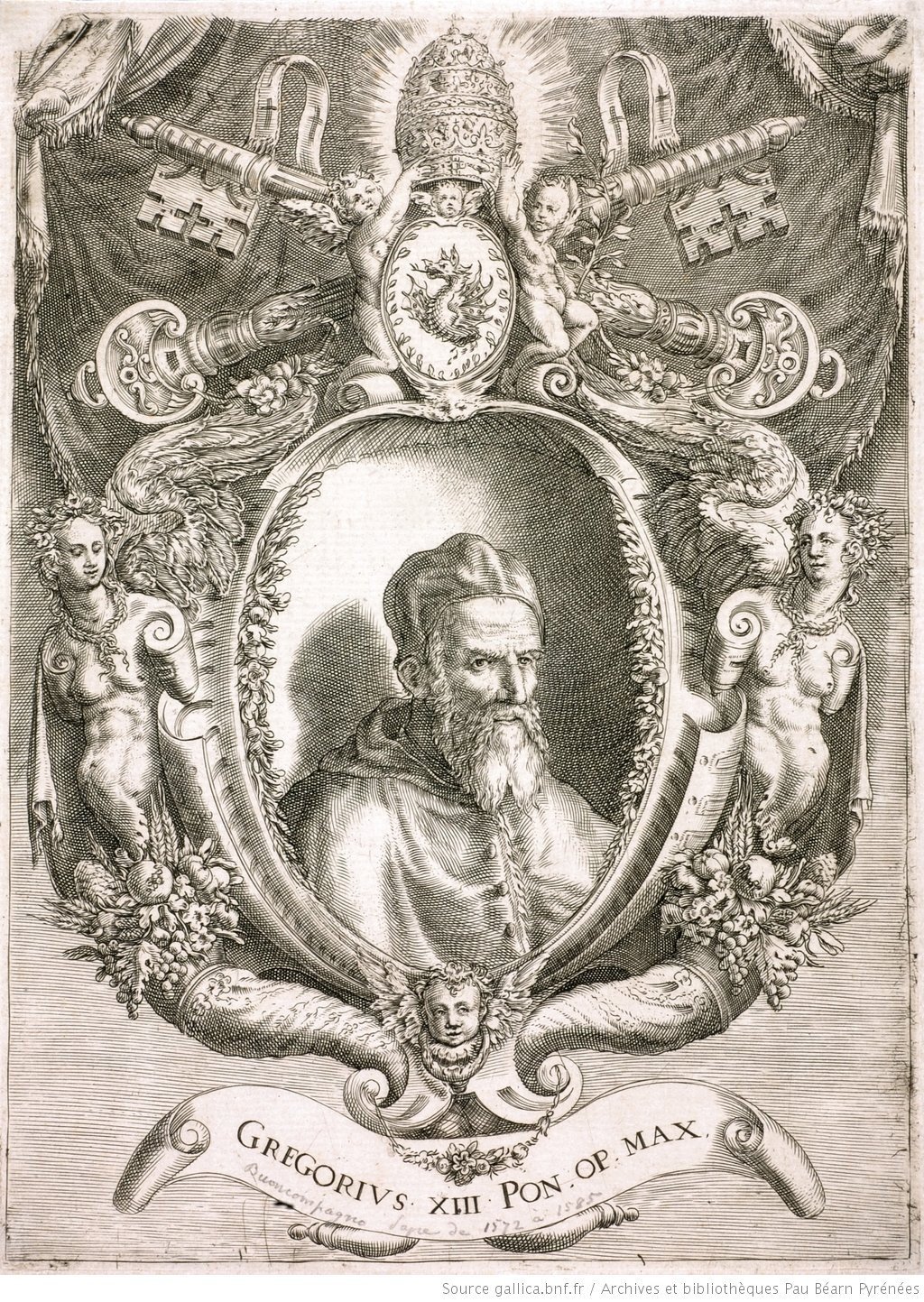
It was Pope Gregory XIII who reduced this growing gap in 1582.
In truth, Gregory XIII was less concerned with the length of the calendar year compared with the tropical year than with the drift in Easter’s date, which would eventually have moved into summer.
I still wonder who would have taken up the issue if Constantine had fixed Easter on a fixed date, or if he had not made the unfortunate decision to mix Church and State.
But before looking at the substance of the Gregorian reform, let us take a brief historical look at what led to the famous 24 February 1582, the date when the bull Inter gravissimas was promulgated.
A quick aside to mention a remarkable website whose author, Rodolphe Audette, did an enormous amount of compiling and translating of texts about the reform. Hats off for that work and for the humor in his writing style.
With that well-deserved tribute paid, let us return to our brave Gregory.
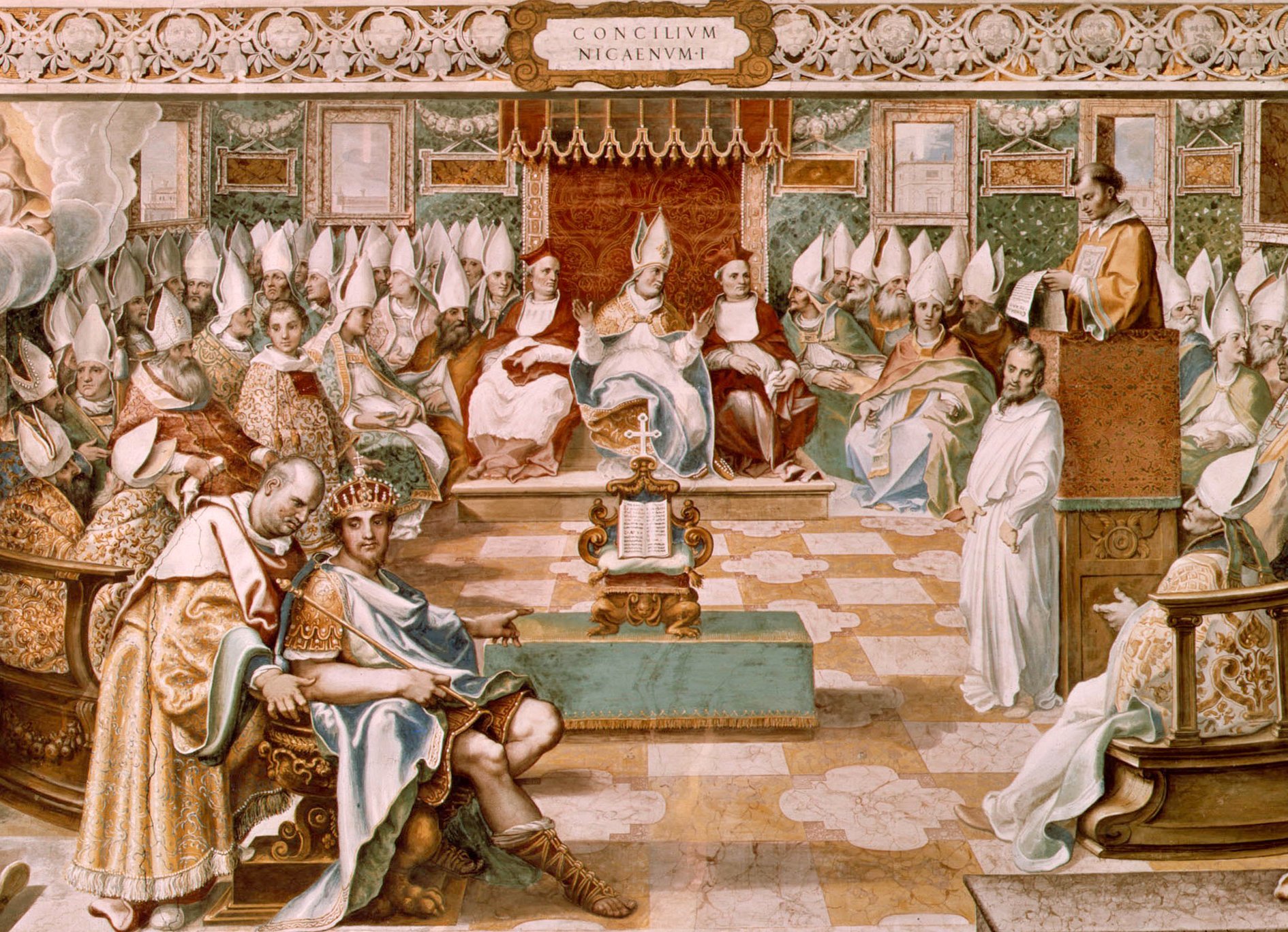
After the Council of Nicaea, which apparently did not set a rule for calculating Easter (let us remember: first Sunday after the first moon following the spring equinox), the Church set up complex equations for computing it. Two astronomers, both bishops in Alexandria, Theophilus and his nephew Cyril, drew up tables covering 380 to 480 and 437 to 581 respectively.
Another problem was added to the calculation of Easter’s date: contrary to the injunctions of the Council of Nicaea, each city did things in its own way, leading to a confrontation between Alexandria (East) and Rome (West), foreshadowing the later definitive split between the Eastern and Western Churches.
In 525, Pope John I asked the abbot Dionysius Exiguus (Dionysius the Little) to calculate Easter for the following year. Dionysius took up the task, adopted the Alexandrian formulas, and used the 19-year lunar cycle. He recalculated Cyril’s tables over 95 years (from 532 to 627).
Dionysius is known for another “invention”: Anno Domini (A.D.). At the time, the era in use began with Emperor Diocletian’s accession to the throne. As Dionysius had little affection for Diocletian (who had persecuted Christians), he suggested counting years from the Incarnation of Christ, with AD 1 as the starting point (zero did not yet exist in Rome). This is why his tables mention anni domini nostri Jesus Christi.
This innovation was not immediately successful and was only adopted centuries later (at different times depending on the country). As for the tables, they fell into oblivion, and Easter’s date continued to drift.
In the 13th century, things started moving again. In 1200, Conrad of Strasbourg stated that the winter solstice had lost 10 days since Julius Caesar’s reign.
A little later, the Englishman Robert Grosseteste, a canon in Paris, calculated a shift of one day every 304 years (in reality, one day every 308.5 years). He suggested calculating Easter with the spring equinox on 14 March instead of 21 March, thus offsetting the accumulated delay.
Another Englishman, Johannes de Sacrobosco, also known as John of Holywood or John of Halifax, proposed in a treatise, De Anni Ratione, abolishing one day every 288 years. The proposal went nowhere.
In the middle of the 13th century, Roger Bacon followed in Grosseteste’s footsteps and forcefully demanded reform directly from Pope Clement IV. Clement died without taking a decision.
In 1345, Pope Clement VI, elected in Avignon, decided to reform the calendar.
He summoned several specialists for this purpose. One of them was Jean de Meurs who, together with another expert, Firmin de Belleval, proposed a solution in an Epistola super reformatione antiqui kalendarii (letter on the reform of the old calendar). Their solution was to remove a certain number of days in a given year and then remove one day every 310 years thereafter. For reasons unknown (a plague outbreak may be a fair guess), the reform was not carried out.
As Easter kept drifting, Cardinal Pierre d’Ailly presented, at the sixteenth ecumenical Council of Constance in 1417, a treatise Exhortatio super correctione calendarii (Exhortation on the correction of the calendar), reusing the arguments of Grosseteste, Sacrobosco and Bacon. But Pierre d’Ailly acknowledged that “the true length of the year is not known with certainty”, and once again the reform did not take place.
In 1436, the astronomer Nicholas of Cusa, proposing an almost identical reform, had no better luck.
At the beginning of the 16th century, when the calendar still showed the 21st, the real equinox had already passed by 10 days, and calls for calendar reform grew increasingly urgent and numerous.
In 1514, Pope Leo X asked the Dutch bishop and astronomer Paul of Middelburg to chair a commission in charge of correcting the calendar. Whatever solution was proposed, the reform never happened. Leo X had the bad idea of asking the sovereigns of the time for their opinion; very few replied.
One of those letters ended up in the hands of a German-Polish astronomer, Nicolaus Copernicus (1473-1543), one of the greatest geniuses of his age. If I had to summarize his immense work, I would say he reversed the positions of Earth and Sun on celestial charts. As a result, Earth became only another planet orbiting (at last!) the Sun. Copernicus gave the duration of this revolution as 365.2425 days (versus 365.2422 in reality). He hesitated to publish his work and only did so at the end of his life. That work would play a major role in Gregory XIII’s reform.
The issue of Easter’s drift was discussed again at the Council of Trent (1545-1553), without a solution, except for a decree entrusting the reform to Pope Pius IV.
In 1582, three men succeeded where all the others had failed: Ugo Boncompagni, elected pope on 25 May 1572 under the name Gregory XIII; a Calabrian physician named Luigi Lilio; and a Bavarian Jesuit astronomer, Christophorus Clavius.
In fact, the commission overseeing the reform under Cardinal Guglielumo Sirleto included other members, but I am naming only the most important ones.
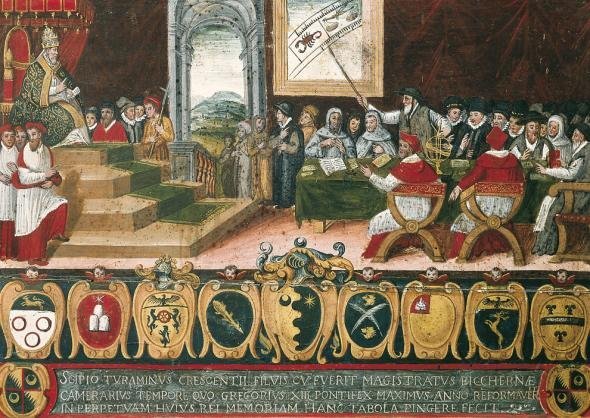
The main architect of the reform was Luigi Lilio, who found solutions to the problems it raised. Unfortunately, he could not present them to the pontifical commission because he died in 1576. His spokesman was his brother Antonio, himself a physician and astronomer.
Several texts appeared during and after the reform. Here is the timeline:
- 1575: Antonio Lilio presented his brother Luigi’s reform project to the commission. The original text no longer exists.
- A Compendium (summary) was written and submitted to the political, religious and scientific figures of the time. As the responses were only partly satisfactory, Gregory XIII decided.
- On 24 February 1582, Gregory XIII signed the bull Inter Gravissimas, which established the calendar bearing his name.
- Explanatory texts (the equivalent of implementing decrees) were published after the bull, written by Clavius, who was the second key architect of this calendar. Six canons were then published.
- In 1603, Clavius published a huge document of more than 600 pages: Romani calendarii a Gregorio XIII pontifice maximo restituti explicatio (Explanation of the Roman calendar restored by the supreme pontiff Gregory XIII).
But let us now look at what this new calendar contained: a calendar that took so long to be born, would have great difficulty being accepted by everyone, and is now used almost universally.
The calendar
As with the Julian calendar and Caesar’s reform, the problem was twofold:
- Catch up the calendar’s drift in relation to the Sun (the calendar year was longer than the tropical year).
- Prevent further drift by applying a few modifications to the Julian calendar.
Added to that was fixing the date of Easter and its computus.
I say “added”, but this was in fact Gregory XIII’s main concern; he cared little about the length of the tropical year.
As one page of this site is devoted to the liturgical calendar, we will avoid mixing time reckoning and the fixing of religious feasts here.
So let us focus on the Gregorian reform from a strictly civil point of view.
The best way to identify what was new is perhaps to read a few excerpts from the pontifical bull of 24 February 1582 (thanks to Rodolphe Audette for the translation):
“7. Therefore, so that the vernal equinox, fixed by the fathers of the Council of Nicaea on the twelfth day before the calends of April, may be restored to that date, we prescribe and order that ten days be removed from October 1582, from the third day before the nones up to and including the eve of the ides, and that the day following the fourth day before the nones, when Saint Francis is traditionally celebrated, be called the ides of October...
“9. Then, so that the equinox may no longer move away in future from the twelfth day before the calends of April, we decree that a leap day be inserted every four years according to custom, except in centurial years; and although these have always been leap years until now, and although we wish the year 1600 to remain so, not all of them shall be leap years afterwards; rather, in every period of four hundred years, each of the first three centurial years shall pass without a leap day, and the fourth shall be leap, so that 1700, 1800 and 1900 shall not be leap years, while in 2000 a leap day shall be inserted according to custom, February thus having 29 days; and the same order of omissions and insertions of leap days in every four-hundred-year period shall be observed forever.
So we clearly find our two stages:
- Catch up the calendar’s drift relative to the tropical year: subtract 10 days from the year 1582. To do this, the day after Thursday 4 October would be Friday... 15 October. As a result, in 1583 the spring equinox is back on 21 March.
- Prevent further drift by applying a few changes to the Julian calendar: remove 3 days over 400 years. The principle of a leap year every four years is kept, BUT centurial years remain common years EXCEPT those divisible by 400, which remain leap years. That is why the year 2000 remained leap even though it is a centurial year, unlike 1900 which was common (centurial, but not divisible by 400).
Applying this rule gives a year of 365.2425 days instead of 365.2424, meaning that over 10,000 years the calendar would gain three extra days. A later (non-Gregorian) rule proposed treating years 4000, 8000, 12000... as common years. Will the tropical year still be the same in 4000? There is a strong chance we will not be around to answer.
Implementation of the reform
The changes introduced by the reform were far from being applied immediately by all countries in the Catholic world. Naturally, the later the reform was adopted, the greater the number of days that had to be removed.
Here is a non-exhaustive list of reform adoption dates in various countries:
| Country | End of Julian | Start of Gregorian | No. of days removed |
|---|---|---|---|
| Albania | 12/1912 | 12/1912 | |
| Austria | |||
| Brixen, Salzburg and Tyrol | 05/10/1583 | 16/10/1583 | 10 |
| Carinthia, Styria | 14/12/1583 | 25/12/1583 | 10 |
| Belgium | |||
| Spanish provinces | 21/12/1582 | 01/01/1583 | 10 |
| Liège (diocese) | 10/02/1583 | 21/02/1583 | 10 |
| Bulgaria | 01/11/1915 | 14/11/1915 | 12 |
| Czechoslovakia (Bohemia and Moravia) | 06/01/1584 | 17/01/1584 | 10 |
| Denmark | 18/02/1700 | 01/03/1700 | 10 |
| Egypt | 1875 | 1875 | |
| Estonia | 01/02/1918 | 15/02/1918 | 13 |
| Finland | 17/02/1753 | 01/03/1753 | 11 |
| France | 09/12/1582 | 20/12/1582 | 10 |
| Alsace | 1648 | 1648 | |
| Lorraine | 16/02/1760 | 28/02/1760 | 11 |
| Strasbourg | 05/02/1682 | 16/02/1682 | 10 |
| Catholic regions of Germany | |||
| Augsburg | 13/02/1583 | 24/02/1583 | 10 |
| Baden | 16/11/1583 | 27/11/1583 | 10 |
| Bavaria (diocese) | 05/10/1583 | 16/10/1583 | 10 |
| Cologne (archdiocese) | 03/11/1583 | 14/11/1583 | 10 |
| Jülich | 02/11/1583 | 13/11/1583 | 10 |
| Mainz | 11/11/1583 | 22/11/1583 | 10 |
| Münster (city and archdiocese) | 16/11/1583 | 27/11/1583 | 10 |
| Strasbourg (diocese only) | 16/11/1583 | 27/11/1583 | 10 |
| Trier | 04/10/1583 | 15/10/1583 | 10 |
| Würzburg (diocese) | 04/11/1583 | 15/11/1583 | 10 |
| Protestant regions of Germany | |||
| Hildesheim (diocese) | 15/03/1631 | 26/03/1631 | 10 |
| Courland | 1617 | 1617 | |
| Minden | 01/02/1668 | 12/02/1668 | 10 |
| Neuburg (Palatinate) | 13/12/1615 | 24/12/1615 | 10 |
| Osnabrück (diocese) | 1624 | 1624 | |
| Paderborn (diocese) | 16/06/1585 | 27/06/1585 | 10 |
| Prussia | 22/08/1610 | 02/09/1610 | 10 |
| Westphalia | 01/07/1584 | 12/07/1584 | 10 |
| Other regions | 18/02/1700 | 01/03/1700 | 10 |
| England and colonies | 02/09/1752 | 14/09/1752 | 11 |
| Greece | 14/07/1916 | 28/07/1916 | 13 |
| Hungary | 21/10/1587 | 01/11/1587 | 10 |
| Transylvania | 14/12/1590 | 25/12/1590 | 10 |
| Ireland | 16/11/1700 | 28/11/1700 | 11 |
| Italy | 04/10/1582 | 15/10/1582 | 10 |
| Latvia | 01/02/1918 | 15/02/1918 | 13 |
| Lithuania | 01/02/1918 | 15/02/1918 | 13 |
| Netherlands | |||
| Holland, Zeeland, Brabant and present-day Belgium | 21/12/1582 | 01/01/1583 | 10 |
| Guelders | 30/06/1700 | 12/07/1700 | 11 |
| Utrecht, Overijssel | 30/11/1700 | 12/12/1700 | 11 |
| Friesland, Groningen | 31/12/1700 | 12/01/1701 | 11 |
| Drenthe | 30/04/1701 | 12/05/1701 | 11 |
| Norway | 18/02/1700 | 01/03/1700 | 10 |
| Poland | 04/10/1582 | 15/10/1582 | 10 |
| Silesia | 12/01/1584 | 23/01/1584 | 10 |
| Portugal | 04/10/1582 | 15/10/1582 | 10 |
| Romania | 31/03/1919 | 14/04/1919 | 13 |
| Russia | 31/01/1918 | 14/02/1918 | 13 |
| Spain | 04/10/1582 | 15/10/1582 | 10 |
| American colonies | 1584 | 1584 | |
| Sweden | 17/02/1753 | 01/03/1753 | 11 |
| Switzerland | |||
| Lucerne, Uri, Schwyz, Zug, Fribourg, Solothurn | 11/01/1584 | 22/01/1584 | 10 |
| Valais | 28/02/1655 | 11/03/1655 | 10 |
| Zurich, Bern, Basel, Schaffhausen, Geneva, Thurgau | 31/12/1700 | 12/01/1701 | 11 |
| Appenzell, Glarus, St. Gallen | 1724 | 1724 | |
| United States | |||
| British colonies | 02/09/1752 | 14/09/1752 | 11 |
| Alaska | 05/10/1867 | 18/10/1867 | 12 |
| Yugoslavia | 04/03/1919 | 18/03/1919 | 13 |