A little history
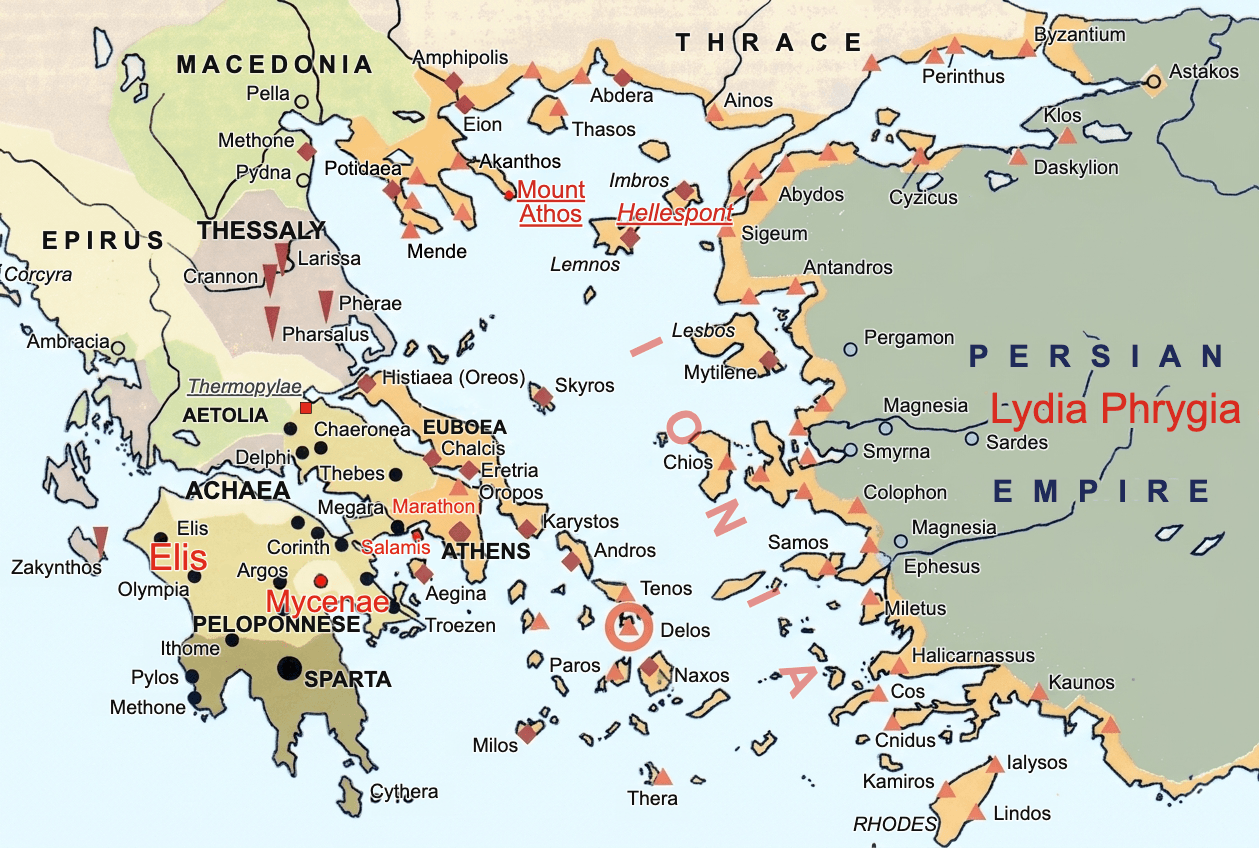
To identify the key events related to calendars in Greece, we will first look briefly at the major periods of ancient Greek history, then at a more detailed chronology up to the death of Alexander the Great. Events directly linked to the calendar are marked in red.
Major periods of ancient Greece
| Neolithic period | ~6500 to ~3200 | Click the thumbnails to view larger maps | |
| Bronze Age period This period is divided into 3 parts: - Early Bronze: 3200-1950 - Middle Bronze: 1950-1550 - Late Bronze: 1550-1100 which roughly correspond to three civilizations | Cycladic civilization | ~3200 to ~1950 | |
| Minoan civilization (Crete) | ~1400 to ~1200 | 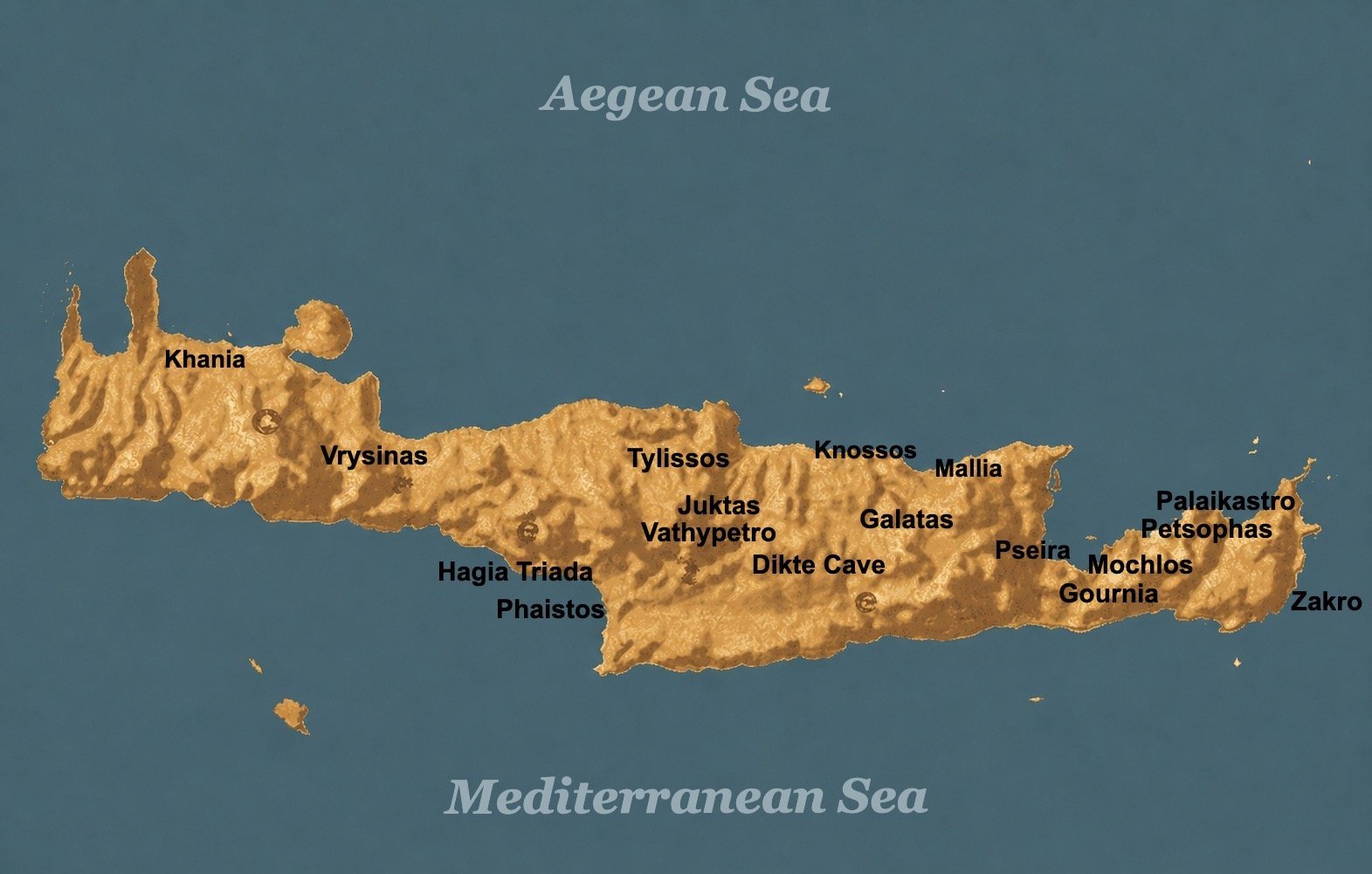 | |
| Mycenaean or Helladic civilization | ~1400 to ~1200 | 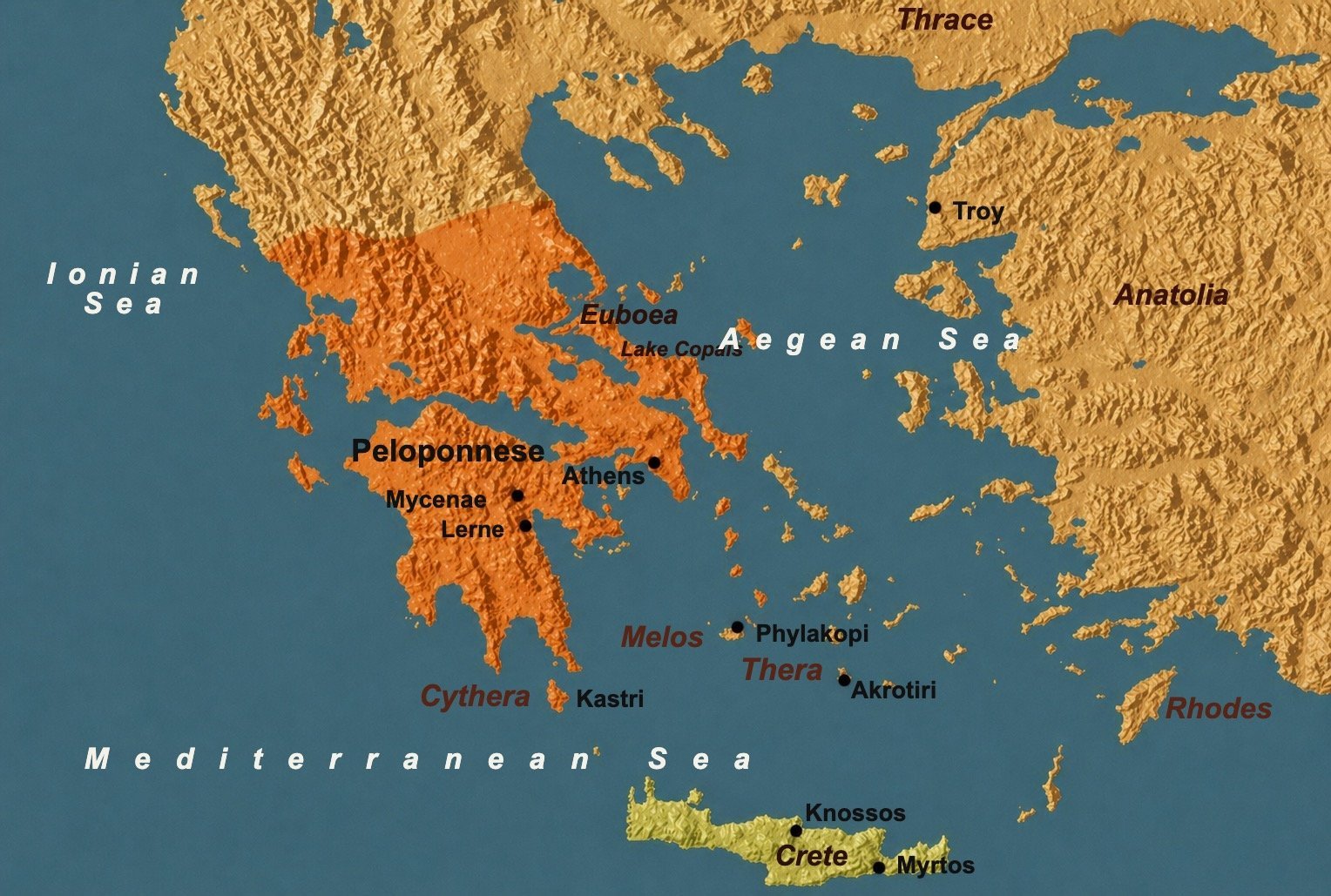 | |
| Dark Ages | Proto-Geometric period | late 11th century to 9th century | Click the thumbnails to view larger maps |
| Geometric period | 9th and 8th centuries | ||
| Orientalising period | ~720 to ~620 | ||
| Archaic period | ~620 to ~490 | 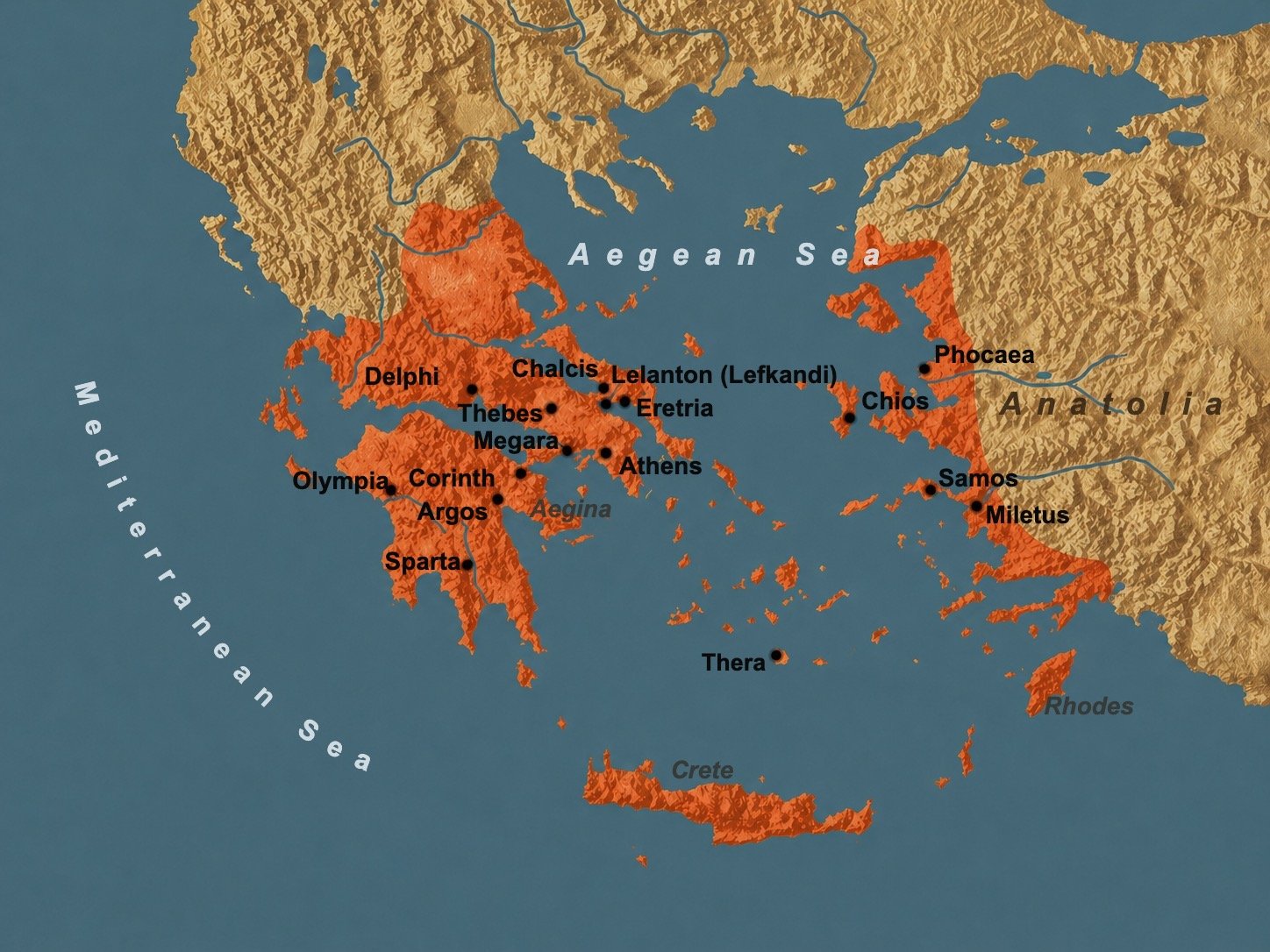 | |
| Pre-classical period | ~490 to ~460 | ||
| Classical period | ~480 to ~323 | 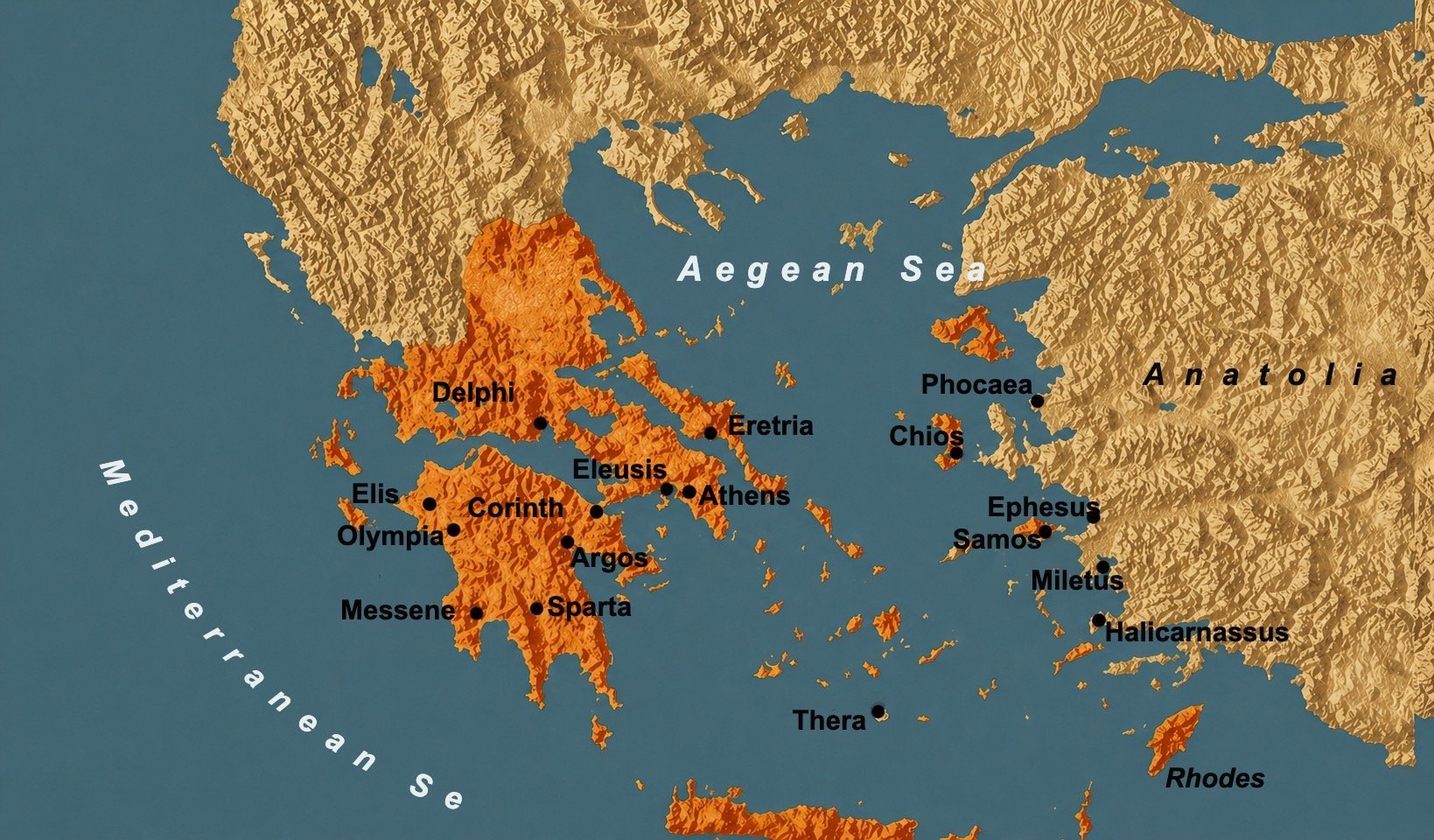 | |
| Hellenistic period | ~323 to ~31 | 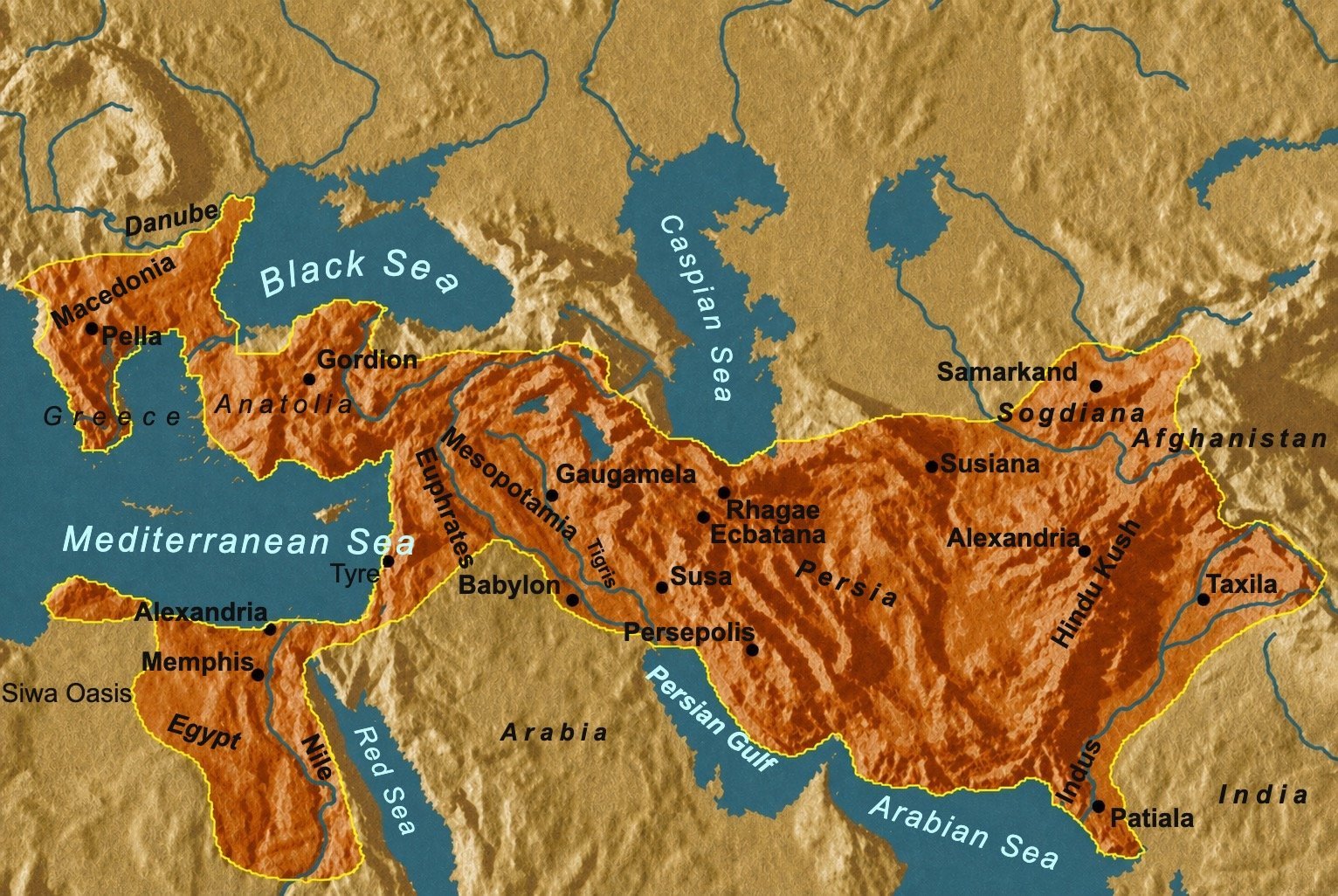 |
More detailed chronology
Events directly linked to the calendar are in bold. Naturally, all dates are BCE.
| Years (BCE) | Description |
|---|---|
| 6218 +/-150 | Neolithic site at Nicomedes in Macedonia |
| 5520 +/-70 | Site at Drakhmani in central Greece |
| 4480 | Neolithic site near Sesklo in southern Thessaly |
| 3000 to 1400 | Minoan Crete |
| 2500 to 1100 | Helladic civilization in the Peloponnese |
| 2000 to 1600 | The Ionians occupy Attica and the Cyclades The Aeolians settle in Thessaly The Achaeans settle in the Peloponnese |
| 1480 to 1450 | Cultural differences appear between Knossos and the rest of Crete |
| 1480 to 1450 | Knossos occupied by the Mycenaeans |
| 1400 | Destruction of Knossos |
| 1260 | Destruction of Troy |
| 1200 | Last traces of Linear B |
| 1200 to 750 | Disappearance of Achaean Mycenaean civilization with the arrival of the Dorians Major migration movements: Boeotia, Thessaly, Asia Minor, and Lesbos occupied by the Aeolians Corinth, the Peloponnese, Crete, and Rhodes occupied by the Dorians Attica, Euboea, and the Cyclades occupied by the Ionians |
| 1100 | Destruction of Mycenae |
| 800 to 700 | Appearance of the Greek alphabet (of Phoenician origin), and writing of the Iliad and Odyssey by Homer. |
| 776 | Date retained for the first Olympic Games |
| 750 | First traces of writing in the Greek alphabet |
| 750 to 550 | First phase of Greek colonization (Marseille, Asia Minor, Black Sea) |
| 734 | Naxos, first colony in Sicily |
| 733 | The Corinthians found Syracuse in Sicily |
| ~700 | Hesiod writes Theogony and Works and Days |
| 668 | Sparta defeated by the Argives at Hysiae (Pheidon is king of Argos) |
| 650 to 500 | Rule of tyrants in Athens |
| 657 | Byzantium (future Constantinople), a Greek colony, is founded |
| 632 | Hereditary monarchy is abolished by the nobles (Eupatrids) and replaced by a Council of the Areopagus. This council appoints magistrates called archons. The people are given an assembly (ecclesia) that can only ratify the archons' decisions. |
| 632 | Attempt at popular tyranny by Cylon |
| 621 | Draco codifies the laws of Athens, famous for their extreme severity ("draconian") |
| 595 to 590 | First Sacred War concerning the sanctuary of Delphi |
| 594 | Solon becomes archon and introduces a constitution replacing birth privilege with property qualification. Society is divided into four census classes by income. Voting rights and equality of all classes in the ecclesia are recognized. |
| ~594 | Solon introduces hollow and full months |
| 585 | Thales of Miletus predicts a solar eclipse. |
| 582 | The Pythian Games are founded at Delphi and the Isthmian Games at Corinth |
| 581 to 497 | Pythagore |
| 570 | Minting of the first coinage in Athens |
| 561 | First tyranny of Pisistratus in Athens |
| 549 to 546 | Conquest of Media and Lydia by Cyrus. |
| 546 to 527 | Final phase of Pisistratus' tyranny in Athens |
| 546 | Sparta predominates across almost all the Peloponnese. Formation of the Peloponnesian League. |
| 528 to 510 | Hipparchus and Hippias, sons of Pisistratus, rule a prospering Athens |
| 525 | Persian conquest of Egypt |
| 521 | Darius seizes power in Persia |
| 514 | Hipparchus, brother of the tyrant Hippias, is assassinated by Harmodius and Aristogeiton |
| 513 | Darius invades Thrace |
| 510 | Hippias is overthrown by the Spartans. Athens becomes part of the Peloponnesian League |
| 508 to 506 | Archonship of Isagoras. Reforms by Cleisthenes creating democratic institutions |
| 499 | Ionian Revolt against Persia |
| 498 | Athens joins the Ionian Revolt. Burning of Sardis. |
| 494 | Battle of Lade |
| 490 | First Persian expedition in Europe. Battle of Marathon, where the Athenians defeat the expedition |
| 488 | Ostracism in Athens |
| 480 | Persian invasion of Greece. Numerous battles |
| 478 | Foundation of the Delian League under Athenian hegemony to drive the Persians out of the Aegean |
| 460 | Cimon wins a series of victories, consolidating the League's position in the Aegean |
| 462 | Democratic reforms of Ephialtes in Athens |
| 446 | Peace of Callias: end of war with Persia. The Delian League becomes the Athenian Empire. |
| 443 to 429 | Athens under Pericles, leading the Delian Confederacy and dominating Greek seas |
| 433 (ou 432) | Discovery (?) of the 19-year cycle by Meton |
| 431 to 404 | Peloponnesian War. Sparta defeats Athens |
| 429 | Death of Pericles |
| 404 to 371 | Athens surrenders, makes peace with Sparta, but keeps its intellectual and artistic supremacy |
| 371 | Thebes defeats Sparta and extends its hegemony in western Greece. |
| 359 to 336 | Philip II of Macedon extends his dominance over the Greek city-states. |
| 356 to 323 | Alexander III the Great, son of Philip II |
| 347 | Death of Plato |
| 337 | Alexander the Great sent into exile with his companions |
| 336 | Alexander returns after the assassination of Philip II and is proclaimed king. |
| 335 | Aristotle leaves for Athens where he founds a school |
| 334 to 330 | Alexander the Great conquers the Persian Empire |
| 331 | Callippus of Cyzicus, a student of Eudoxus, develops the *callippic cycles* by creating a 76-year period |
| 331 | Alexander founds Alexandria |
| 327 | Alexander's army reaches India. |
| June 11, 323 | Death of Alexander the Great |
| .... | .... |
| ~160 ~120 | Hipparchus of Nicaea modifies the Callippic period |
Calendar(s)
| Source authors | Period | Role |
|---|---|---|
| Hesiod | 8th-7th century BCE | Greek poet |
| Aristoxenus of Tarentum | 4th century BCE | Greek philosopher and musician |
| Geminus (or Geminos) | mid-1st century BCE | Greek author |
| Plutarch | c. 46 - c. 120 | Greek biographer and moralist |
| Censorinus | c. 240 | Roman grammarian |
| Louis Ideler | 1766-1846 | German chronologist |
| Jean Chretien Ferdinand Hoefer | 1811-1878 | Historian of science |
| M. De Koutorga | c. 1860 | Professor at the University of St Petersburg |
Warning: Even though we occasionally mention other Greek calendars, this page is specifically dedicated to the Attic calendar and its evolution. Another page will cover the Macedonian calendar because of its spread across Alexander's empire. We will also review Greek months other than those of Athens in an annex.
Why not treat the whole calendar system of ancient Greece at once?
Simply because we will first address the calendar of religious festivals, and almost every Greek city had its own festivals and, therefore, its own month names and year start.
As early as the 4th century BCE, Aristoxenus of Tarentum, philosopher and musician, wrote that "when the Corinthians are on the tenth day, the Athenians are only on the fifth, while others are on the eighth" (Elem. harmon.). Plutarch later wrote:
“Aristides, §58: They fought this battle on the fourth day of Boedromion according to the Athenians, but on the twenty-seventh of Panemus according to the Boeotians; [...] We should not be surprised by this irregularity in Greek months, since even in our own time, when astronomy is more developed and more exact, some begin their months when others end theirs.
With that clarified, let us get to the heart of the subject.
In search of the Great Year
Let me remind you of two figures we will keep chasing throughout this study of Greek calendars:
Tropical year: 365.2421904 days; Lunation: 29.5305882 days.
I say we, but that does not mean this pursuit was the favorite pastime of Greeks in antiquity. It was mainly the business of astronomers, and their discoveries had little - if any - impact on daily life.
I titled this section “In search of the Great Year”. This expression, borrowed from Censorinus (De die natali, XVIII), refers to the period that would reconcile lunar months with solar years. In a Great Year made of x solar years, there would be an integer number of lunar months. In short: a search for squaring the circle.
Let Geminus (Introduction to Celestial Phenomena) explain why one needed to build a... lunisolar calendar (there, it is said!):
“The ancients sought to regulate laws by the Moon and years by the Sun. For the three kinds of sacrifices prescribed by laws and oracles, according to ancestral custom, were those to be performed month by month, those fixed on specific days, and those returning only once a year. So all Greeks tried to align years with the Sun, and days and months with the Moon. They tried to align years with the Sun so that sacrifices to the gods were always made in the same seasons of the year, so that the sacrifice meant for spring was truly made in spring, and that of summer in summer [...]
Greeks therefore had to keep the solar year and lunar months in phase for religious reasons.
Agricultural calendars
What about daily life? What about seasonal agricultural tasks?
For centuries, practical-life calendars (called parapegmata) linking daily work to simple astronomical events were highly successful and multiplied. It is striking that renowned scholars (Meton, Eudoxus, Callippus, Hipparchus...) contributed to them, since these were mostly solar calendars while, at the same time, they were struggling to reconcile the two figures mentioned above into a strict lunisolar calendar.
These parapegma calendars varied from one city to another and developed independently, without coordination. Here is what such a practical calendar looked like in Hesiod's Works and Days (7th century BCE):
“Morning rising of the Pleiades. Snails appear; sickles are sharpened and harvesting begins.
Morning rising of Arcturus. The vintage is prepared.
Morning rising of Orion's Belt. The harvested grain is threshed.
Sirius appears in the morning. Thistles grow, cicadas sing.
Fifty days after the summer solstice, second summer begins. Sirius is visible during part of the night. Weather is good for sailing. The heat is damp and oppressive.
If you cannot spot the Pleiades in the sky but are an expert on the first yearly appearance of snails or the song of cicadas, you can still date each event. A clue: the first line corresponds to 17 May in our calendar.
See the full study dedicated to Hesiod's calendar here.
Let us now follow how the precision of the Great Year evolved, and with it the different lunisolar calendars known to the Greeks, whose earliest forms are lost in the mists of time.
Lunisolar calendars
1) A 354-day lunar calendar
Hoefer (Histoire de l'astronomie) and Ideler (Historische Untersuchungen uber die astronomischen Beobachtungen der Alten) agree that the earliest Greek calendars were mainly lunar. The month began at noumenia, the moment when the Moon, as a crescent, became visible again after Sun-Moon conjunction (new moon). It ended at the next noumenia. For that reason, the full moon fell in the middle of the month and was called dichomenia.
This 354-day lunar year therefore almost certainly included months of 29 and 30 days, called (at the time or later) hollow and full respectively.
2) A lunisolar calendar with 30-day months
Later, we do not know exactly when, but certainly by Hesiod's time, Greeks assigned 30 days to each of the 12 months.
Then they started intercalating. At that point, the lunisolar calendar was being born.
Here is what Censorinus writes:
“"Several ancient cities of Greece, having observed that during the year required for the sun to complete its revolution there were sometimes thirteen moonrises, and that this happened once every two years, concluded that the solar year corresponded to twelve and a half lunar months; therefore, by intercalation, they set their civil years so that some had twelve months and others thirteen, calling each one separately a solar year, and the combination of two solar years a great year. This period was called trieteris, because intercalation of one month took place every third year, although the cycle embraced only two years and was in fact a dieteris."
Some notes on this passage:
- Several ancient cities of Greece: in other words, and from what we know elsewhere, each city-state had its own month names based on local festivals or associated deities, started the year in one month or another, and placed embolismic months where it wished.
- The triennial period was actually biennial, but intercalation came after two full years as if it happened in the third year.
With this biennial period, the theoretical difference from the Sun was (360 x 24 + 30) - (365.25 x 2), i.e. 19 1/2 days, and from the Moon (360 x 24 + 30) - (29.53 x 25), i.e. 11 3/4 days.
On this point, Ideler makes an interesting remark. He cites a passage of Cicero stating that "Sicilians and other Greeks customarily wanted their days and months to agree with the Sun and the Moon; so that sometimes, if there was a difference, they subtracted one day from the month, the last one, or two; they called them subtractive days, and at other times they also lengthened the month by one or two days."
Ideler therefore concludes that, besides intercalary months, Greeks made punctual corrections so that months remained aligned with the Moon. It is very likely they did this in later “improved” calendars as well.
Geminus confirms this assumption: "A proof that month days are rightly counted by the Moon is that solar eclipses occur on the last day of the month, when conjunction takes place; and lunar eclipses on the night before mid-month, because then the Moon is opposite the Sun and enters the Earth's shadow."
3) A lunisolar calendar with variable-length months
We now reach Solon's period, around 600 BCE. He observed that the month did not have 30 days, and it is reasonable to think he introduced alternation between full 30-day months and hollow 29-day months. He also introduced the designations old and new, as Plutarch reports: "Solon had observed the inequality of months; he saw that the Moon's motion agreed with neither sunrise nor sunset, and that often on the same day it caught up with and overtook the Sun. He ruled that this day would be called old and new: he assigned to the ending month the part of the day before conjunction, and to the starting month the part after it. [...] Solon called the following day neomenia."
Keeping the 30-day embolismic month, this alternation of 30- and 29-day months shortened the 2-year period by 12 days. The difference from the Moon dropped to about 6 hours, and to 7 1/2 days (too long) relative to the Sun. So from time to time, an intercalary month had to be skipped.
4) A four-year period?
If Censorinus is to be believed, the two-year period (called triennial) was followed by a four-year period (called quinquennial). Geminus says nothing about it, but Censorinus writes: "Later, having recognized their error, the ancients doubled that span and established the tetraeteris, which, because it returned every fifth year, was called pentaeteris. This way of forming the great year from four solar years seemed more convenient; for since the solar year was about three hundred and sixty-five and a quarter days, this fraction allowed one full day to be added every four years to the fourth year."
How exactly this four-year period was built, if it existed at all, remains unknown.
5) Birth of the octaeteris
Around 450 BCE, an astronomer called Cleostratus of Tenedos proposed an 8-year intercalation system, hence the name octaeteris cycle. Greeks actually adopted and widely used it. Geminus describes it as follows:
“The ancients, soon convinced by appearances of the Sun and the Moon that in the trieteris days and months did not agree with the Moon, nor years with the Sun, sought a period with this property, containing whole days, months, and years. First, they formed the 8-year period (octaeteris), made up of 99 months, three of them intercalary, containing 2922 days. Here is how they arranged it: the solar year being 365.25 days and the lunar year 354, they took the excess of the first over the second, namely 11.25 days, eight times, obtaining 90 days, or three months of 30 days each. By intercalating them over 8 years, festivals returned to their proper season. These intercalary months were inserted after years 3, 5, and 8, and the other months were counted alternately as 29 and 30 days.
Censorinus, on the same subject, writes:
“[...] the octaeteris was established, called enneaeteris because it reappeared every ninth year; and this span was regarded by almost all Greece as the true great year, because it consists of a number of natural years without fractions, as any great year should. It consisted of ninety-nine full months and eight natural years, also without fractions. This octaeteris is usually attributed to Eudoxus of Cnidus; but Cleostratus of Tenedos is said to deserve the honor of having invented it. So say Harpalus, Nauteles, Mnesistratus, and others, including Dositheus, whose work is titled The Octaeteris of Eudoxus.
Geminus gives us more detail than Censorinus on the structure of this period. Censorinus, however, confirms the weight Greeks gave it and names its inventor.
On intercalations, Macrobius (Saturnalia XIII) says: "The Greeks therefore intercalated, every eighth year, ninety days, which they divided into three months of thirty days each."
Of course, “every eighth year” should be understood as “at the end of the 8th year”. Who is right, Geminus or Macrobius? Given how important Greeks considered month beginnings, it is hard to believe they waited until the very end of an 8-year period to intercalate. So Geminus is probably right.
We should also note the word “first” in Geminus. He then mentions a 16-year period (198 months or 5847 days) and a 160-year period (58,440 days in 1,979 months). We know nothing about these periods (date, author), and even less whether they were used in civil life.
Still, the 8-year period remained in use for a long time, if we consider that the Metonic cycle discussed below may only have started to be used around 342 BCE. The most visible trace of octaeteris is the 4-year spacing of the Olympic Games, i.e. half an octaeteris cycle.
6) Birth of the enneadecaeteris (Metonic cycle)
433 BCE sees the emergence of a famous new cycle: Meton's cycle, or the 19-year cycle, or enneadecaeteris.
Meton of Athens, a geometer in Pericles' century, is generally credited with this cycle. I say generally because if we look at the Babylonian calendar, we find evidence that such a cycle was already known from the 8th century BCE. For more on both the topic and the man, see here.
Meton's cycle distributes 6,940 days over 19 years, divided into 235 months, 125 full and 110 hollow.
At this point, Ideler remains very relevant:
“To construct the period completely, one needed to know in which years the intercalary months were to be placed, or which years of the period had 13 months. [...] But since we lack any clear testimony from an ancient author that could decide the question, we are not in a position to restore with certainty the canon of Meton's 19 years. We cannot even fix precisely the epoch of his period, however confidently chronologists have ruled on this point.
So we must keep to hypotheses. The principle is:
- 19 solar years equal 235 lunations.
- Distribute these 235 lunations across 12 years of 12 lunar months and 7 years of 13 lunar months.
- 12 lunations make 354.367 days, so years of 354 and 355 days.
- 13 lunations make 383.897 days, so years of 383 and 384 days.
This leads to the following table:
| Number of years | Number of days | Days |
|---|---|---|
| 5 | 355 | 1,775 |
| 7 | 354 | 2,478 |
| 6 | 384 | 2,304 |
| 1 | 383 | 383 |
| Total | 6,940 |
Embolismic years are placed in positions 3 (or 2), 5, 8, 11 (or 10), 13, 16, and 19 (or 18)... perhaps.
The average year value is 6940/19 = 365.263158 and the average month value is 6940/235 = 29.531915.
According to Diodorus, the cycle began on 13 Scirophorion (28 June), in the fourth year of the 86th Olympiad (433 BCE). Ideler remarks that "Diodorus's words certainly mean only that Meton began his 19-year astronomical calendar, not his period, on 13 Scirophorion, day of the summer solstice.*"
* This “astronomical calendar” was an early ephemeris (or a later parapegma), listing solstices, risings and settings of fixed stars, and usual temperatures. It covered the 19-year period, perhaps with a little extension at both ends.
7) Later refinements
In 330 BCE, the astronomer Callippus proposed his own cycle (apparently not used in everyday life) to correct Meton's cycle error: group 4 Metonic cycles into a 76-year Callippic cycle and remove one day over that period.
The Callippic cycle therefore has 27,759 days. The average year is 365.25 days and the average month 29.530851 days.
This period seems to have been well received by Greek astronomers. Its epoch was set at 28 June 330 BCE.
In 130 BCE, astronomer and mathematician Hipparchus became the first to note that the tropical year is not 365.25 days. He set its length at 365.246528 days (about six minutes too long) and lunation at 29.530579 days (about one second short). To correct the calendar, he proposed removing 1 day every 4 Callippic cycles (every 304 years).
With Hipparchus, we reach the most accurate ancient coordination of solar and lunar cycles. Still, it is easy to imagine the drift that can occur over 19 years (within Meton's cycle) before things line up again.
To sum up, here is a table of the cycles discussed:
| Year (BCE) | Name | Days | Years | Error | Lunations | Error |
|---|---|---|---|---|---|---|
| ? | - | 354 | 1 | 11.2 d | 12 | - 44 m |
| ~600 | - | 738 | 2 | 3.8 d | 25 | - 15 m |
| ~500 | - | 1,092 | 3 | 1.25 d | 37 | 24.6 m |
| ~450 | Cleostratus | 2,922 | 8 | 11 m | 99 | - 22 m |
| 433 | Meton | 6,940 | 19 | 30 m | 235 | 2 m |
| 330 | Callippus | 27,759 | 76 | 11 m | 940 | 22 s |
| 143 | Hipparchus | 111,035 | 304 | 6 m | 3760 | - 0.4 s |
Later, after Caesar's reform, Greeks gradually adopted the Julian calendar, keeping at first their own start-of-year date and, generally, their month names. Start of the year? Months? Let's look at that.
Months in the year
Here is a table of month names in different states or cities, since each city-state had its own month names, usually based on festivals or deities associated with those festivals.
Further below, we will try to clarify year beginnings in Athens. For now, we will simply treat this list as a sequence, without assuming Hecatombaeon is the first month.
| Athens | Macedonia | Delphi |
|---|---|---|
| Hecatombaeon | Dios | Apellaeus |
| Metageitnion | Apellaios | Bucatius |
| Boedromion | Audynaios | Boathous |
| Pyanepsion | Peritios | Heraeus |
| Maimakterion | Dystros | Daedaphorius |
| Poseideon | Xanthikos | Proetropius |
| Gamelion | Artemisios | Amlius |
| Anthesterion | Daisios | Bysius |
| Elaphebolion | Panemos | Theuxenius |
| Munychion | Loios | Endyspaetropius |
| Thargelion | Gorpiaios | Hericlius |
| Scirophorion | Hyperberetaios | Ilaeus |
We have seen that the calendar quickly came to alternate full months of 30 days and hollow months of 29 days. Also, matching Attic months to our Gregorian months is risky, since intercalary months were inserted.
Let us still take the risk and consider the following table with great caution.
| Season | Month | No. of days | Gregorian |
|---|---|---|---|
| Summer | Hecatombaeon | 30 | July-August |
| Metageitnion | 29 | August-September | |
| Boedromion | 30 | September-October | |
| Autumn | Pyanepsion | 30 | October-November |
| Maimakterion | 29 | November-December | |
| Poseideon * | 29 | December-January | |
| Winter | Gamelion | 30 | January-February |
| Anthesterion | 29 | February-March | |
| Elaphebolion | 30 | March-April | |
| Spring | Munychion | 29 | April-May |
| Thargelion | 30 | May-June | |
| Scirophorion | 29 | June-July |
* In Athens, the intercalary month was inserted after Poseideon and was called Poseideon II.
Month names reflected customs or events. For example, in the Athenian months:
| Name | Greek name | Meaning |
|---|---|---|
| Hecatombaeon |  | Sacrifice of a hecatomb (100 oxen) |
| Metageitnion |  | Month of moving house |
| Boedromion |  | Celebration of the Boedromia, commemorating Theseus' victory over the Amazons |
| Pyanepsion |  | Festivals in honor of Apollo, so named because cooked beans were eaten on those days. |
| Maimakterion |  | In honor of Zeus Maimaktes (god of storms) |
| Poseideon |  | Festival of Poseidon. |
| Gamelion |  | Month of marriages. |
| Anthesterion |  | Festival in honor of underworld deities (season of nature's awakening) |
| Elaphebolion |  | Festival of deer hunting, in honor of the goddess Artemis. |
| Munychion |  | Festival of Artemis Mounychia |
| Thargelion |  | Festivals in honor of Apollo and Artemis |
| Scirophorion |  | Month of the Skirophoria, festivals in honor of Athena |
The Pyanepsion and Maimakterion month-order problem
Were these two months swapped at some point? That is the question some specialists have raised. To frame the issue, here is a brief digest of remarks by Ideler and by Buttmann (a 19th-century professor and librarian in Berlin).
Ideler notes that Ptolemy reports observations by the astronomer Timorachis in the year 283 BCE: an occultation of the Pleiades (M45 in Taurus) on the evening of 8 Anthesterion, and an occultation of Spica (in Virgo) on 6 Pyanepsion. The two observations are 283 days apart. If Pyanepsion had come before Maimakterion, the interval would have been 29 or 30 days too long.
Buttmann gives other arguments in favor of a Maimakterion-Pyanepsion order. Here is one that is not too technical:
Aristotle (Hist. nat. L. VI), speaking about the rutting season of deer (I did say “not too technical”... astronomically), writes that “their mating takes place after Arcturus, around Boedromion and Maimakterion”. This wording usually means X and Y, not from X to Y.
But neither Buttmann nor Ideler ignored two lapidary inscriptions reported by another specialist, Corsini, one of which states: In Boedromion, Nymphodote.
In Pyanepsion, Demetrius.
In Maimakterion, Sympheron.
These inscriptions mention the names of prefects in Athens at the time of the emperors.
And Buttmann does not believe for a moment that "any government or private person would leave on stone an inscription where one month had been written for another".
He ends by acknowledging the month-order problem without taking sides.
Ideler, for his part, thinks the two months did not always occupy the same position across periods.
The fact remains that no ancient author gives the month order explicitly. So the issue remains open. Make up your own mind, or dig deeper. If you uncover anything useful, feel free to send it my way.
The day
In archaic Greece, the day began at sunset and was split into two unequal parts: day and night. Each of these was itself divided into three loosely defined phases (beginning, middle, end).
The full day was called a nychthemeron. After Alexander the Great, the civil day started at sunrise. Sundials appear around 600 BCE, but only much later (under Alexander) was the day divided into two groups of 12 hours, which moreover varied in length.
Counting days within the month
As noted above, the month was supposed to begin at noumenia. But because intercalations were not always correctly applied, drift occurred and periodic adjustments were needed.
The month was divided into three 10-day decades. In hollow months, the final decade had only 9 days. The first day of the month (first day of the first decade) was called neomenia, and the last one triakas. In the first two decades, days were named by their rank within the decade. In the third decade, counting ran backwards. Hence the table below.
| First decade | Middle decade | Decade before the end (full month) | Decade before the end (hollow month) |
|---|---|---|---|
| neomenia | first | tenth | ninth |
| second | second | ninth | eighth |
| third | third | eighth | seventh |
| fourth | fourth | seventh | sixth |
| fifth | fifth | sixth | fifth |
| sixth | sixth | fifth | fourth |
| seventh | seventh | fourth | third |
| eighth | eighth | third | second |
| ninth | ninth | second | triakas |
| tenth | tenth | triakas |
As you can see, counting in the final decade resembles what the Romans later did with the Kalends system. In my view, this reverse count supports the idea that, outside embolismic months, they regularly corrected lag between month start and noumenia by adding or removing days, as Cicero described.
Start of the year
At the beginning of a text by De Koutorga (Critical research on Greek history during the Persian Wars period), we find a precise summary of knowledge about the start of the year. De Koutorga also offers his own analysis.
Chapter 1 of part one opens as follows:
“"In the second half of the fifth century before Jesus Christ, and specifically since the Peloponnesian War, the Athenian year began in Hecatombaeon. Thucydides is explicit on this point. At the start of his second book, in recounting the war, he dates the first hostilities very precisely. He says the Thebans opened the war in spring, in the fifteenth year after the thirty-year treaty, in the sixth month after the battle of Potidaea, when Chrysis was priestess of Hera at Argos, Aenesias ephor at Sparta, and Pythodorus archon at Athens; he adds that the latter had only two months left in office. This testimony shows that the Athenian year ended two months later and began again in summer."
De Koutorga assumes (without proving it) that the Attic civil year started when magistrates took office. Hence spring + 2 months = Hecatombaeon. Hmm...
For the record, all other translations of Thucydides that I have seen say “four months”, not two. Since I do not read Greek, if anyone can verify this point, I would be grateful.
De Koutorga then reviews different chronologists' positions on the start of the Athenian year:
- Scaliger first, followed by Petau, Dodwell, Corsini, Larcher, and Ideler, argue that Athenians originally began the year in winter, in Gamelion.
This would explain why Poseideon, as the last month of the year, was followed by the intercalary month called Poseideon II. - Petau adds that the shift from Gamelion to Hecatombaeon was actually a return to an earlier situation where Hecatombaeon had already been the first month. So Athenians would have started with a summer new year (Hecatombaeon), then winter (Gamelion), then summer again (Hecatombaeon).
- Others, by contrast, such as Freret and Clinton, think the Athenian year always began in summer.
De Koutorga then investigates who is right.
For my part, what stands out is this: not one ancient author says outright, “the year began in month XXXX”. So we are left interpreting phrases and trying to make them speak. Here is an example discussed by De Koutorga:
“"[...] Herodotus indicates the beginning of the Athenian year just as precisely. In Book VI, he recounts the movements of the Phoenician fleet through the whole fair season, that is, from spring to autumn. He describes the capture of the islands of the Hellespont, of Byzantium, mentions Miltiades' flight to Attica, and after carrying his account into autumn, adds [VI, XLII]: 'During the rest of that year, the Ionians suffered nothing from the Persians.' So when did the year end? We believe that by 'the rest of the year', Herodotus could only mean winter. But a little later he gives the answer himself: 'With the following spring', he says [VI, XLIII], 'Mardonius, son of Gobryas, reached the sea at the head of large forces.' These two passages show that one year had ended after autumn, and another had begun before spring, that is, in winter."
Yes, but one can also read: "The Persian fleet, which had wintered near Miletus, set sail again in the second year and easily took the nearby islands off the mainland [...]".
After many interpretations of this kind, De Koutorga reaches the following conclusion: "In short, the evidence presented above overturns the view of Freret and Clinton, and gives Scaliger's hypothesis the value of historical truth."
So the Attic year would have started in winter, then in summer.
He then asks when the change happened: "To complete our work, let us now turn to another question, closely linked to this one, and seek at what time the Athenians shifted the beginning of the year from winter to summer."
Here too, he is categorical:
“Dodwell, Corsini, Larcher, and most chronologists who accept Gamelion as the first month of the year thought this usage lasted until the start of the 87th Olympiad, and was changed only by Meton, who introduced the 19-year cycle. We share this view, because it rests on positive testimony, that of Festus Avienus, whose verses contain the most exact description of the change carried out by the astronomer Meton. It is true that Ideler rejects Festus's testimony, calling it a poet's fancy. But he is wrong: these verses are poetic only in form; they contain a very precise description that we would look for in vain in other writers.
Nam qui solem hiberna novem putat æthere volvi,
Ut lunæ spatium redeat, vetus Harpalus, ipsam
Ocius in sedes momentaque prisca reducit.
Illius ad numeros prolixa decennia rursum
Adjecisse Meton Cecropia dicitur arte;
Inseditque animis, tenuit rem Græcia solers,
Protinus, et longos inventum misit in annos.
Sed primæva Meton exordia sumpsit ab anno,
Torreret rutilo quum Phœbus sidere Cancrum, etc.Seeing this testimony gives one more proof that at the time of the Persian Wars the Athenians began their civil year in winter, and one can hardly doubt that the change was carried out by the republican government, on Meton's proposal.
The translation (here, on the website of Philippe Remacle, Francois-Dominique Fournier, J. P. Murcia and Thierry Vebr) of Festus's verses is:
“For example, ancient Harpalus, who thinks the Sun
out at sea, and when Sirius casts the flames of its dark stars.
must roll through nine winters for the Moon to return to its starting point,
brings it back too quickly to its cradle: to that number, they say,
the learned Athenian Meton added ten long years; this system prevailed:
learned Greece adopted it and passed it on for a long time to posterity.
Yet Meton placed the beginning of the year at the time when Phoebus
burns Cancer with his star's fire, when Orion's belt floats far
No need to overcomplicate things: Cancer scorched by Phoebus means summer. What matters here is the “Yet” (or “But”). Ideler, contrary to what De Koutorga says, does not reject this text. He writes: "The word but shows that the season of the year's beginning was indeed changed. Be that as it may, it is proved by more than one passage in Thucydides, Plato, and Demosthenes that in their time the year began around the summer solstice."
For my part, I ask: “Yet (or But), compared with what?” What if this was simply a “scientific” cycle-start issue, with no major link to the Athenians' civil year?
A year beginning in Hecatombaeon is certain. A year beginning in Gamelion in earlier periods would explain the position of the intercalary month. The debate is far from closed. We might even add a question De Koutorga did not ask: why make the change? To align the start of the year with the Olympiads?
Greek chronology
Until the 3rd century BCE, there was no real common chronology, as each city did things its own way. Athenians linked years to the office of the eponymous archon in place. Spartans referred instead to the president of the ephors' college.
After Alexander, Greeks counted years by Olympiads. The epoch started at the first Olympic Games, fixed at 776 BCE. Notation used two numbers: first the Olympiad number, then the year within it. For example, the second year of the 100th Olympiad was written Ol. 100,2.
Athens also had another reference, a “political chronology”. After Cleisthenes' reform (late 6th century BCE), Greece was divided into 10 tribes. Fifty members (bouleutai) from each tribe formed a council of 500 (the Boule). For current affairs, only the 50 bouleutai of one tribe served on duty according to an order fixed by lot (executive bureau of the Boule). This duty lasted one tenth of the year. The Athenian year was therefore split into 10 prytanies lasting 36 or 39 days (later 30). Administrative documents were dated by the name of the duty tribe and the day of the prytany.
Finally, in the 2nd century CE, the Greek astronomer Ptolemy created an artificial era to exploit Babylonian observations: the Era of Nabonassar, starting on 26 February 747 BCE. It was used only by astronomers and historians.
Note
Greece switched to the Gregorian calendar in 1920.
The rule based on division by 400 was modified as follows: any year divisible by 900 with a remainder of 200 or 600 is a leap year. This gives 218 leap years every 900 years, i.e. an average year of 365.24222 days, closer to the tropical year than the Gregorian average year (365.2425 days).