Before asking whether Meton truly discovered the “Metonic cycle”, let us first try to understand who Meton actually was and what he precisely discovered.
Who was Meton?
We know almost nothing about Meton except that he was born in Leuconoe, a district of Attica near Athens. Aelian, writing in the first half of the 3rd century AD, says in his Varia Historia: "Meton of Leuconoe, another astronomer, erected columns on which he marked the revolutions of the sun, and boasted that he had found the great year, which he claimed to be nineteen years long."
The comic playwright Phrynichus, a contemporary of Aristophanes, also places Meton's birth in Leuconoe in his play Monotropos.
We also know that he lived in the second half of the 5th century BC.
Aelian, in the 3rd century, presents him as an astronomer. And today he is generally regarded as one.
Yet it does seem that this reputation as an astronomer was largely posthumous, and that during his lifetime he was better known as a geometer.
Since we have mentioned Aristophanes, let us read a passage from his play The Birds, performed in 414 BC. Aristophanes even introduces Meton himself as a character.
“METON: I have come to see you.
PISTHETAERUS: Another nuisance! What are you doing here? What is your plan? Why this journey? Why this tragic stride in your cothurni?
METON: I want to measure out the air and divide it for you into streets.
PISTHETAERUS: In the name of the gods, what sort of man are you?
METON: Who am I? Meton, known to Hellas and Colonus.
PISTHETAERUS: Tell me, what do you have with you?
METON: Instruments to measure the air. First, you must understand that the air as a whole is exactly like an oven. With this curved ruler, dropping from above, and by fitting in the compass... Do you follow?
PISTHETAERUS: Not at all.
METON: I apply a straight rule so that you get a square circle; in the center is the Agora, and the streets leading to it are straight and converge on the center, just as rays shine outward in all directions from a star, round by nature.[....]
PISTHETAERUS: Have I not said so for ages? Go and take your measurements somewhere else.
In this passage, Meton appears as a geometer, not an astronomer. A geometer claiming to solve the problem of squaring the circle.
And why was he especially associated with Kolonos (Colonus, not far from Athens)? Some said because he was born there, others because he had built a fountain or aqueduct there. In Monotropos, which we already mentioned, Phrynichus writes: “Meton of Leuconoe, the one who brings the springs.”
Yet Philochorus, a 3rd-century BC author, states that Meton never built anything in Colonus, but that in 432 he erected a heliotropion (a gnomon with solstice markers) “in the place where the Assembly now meets, near the wall of the Pnyx”.
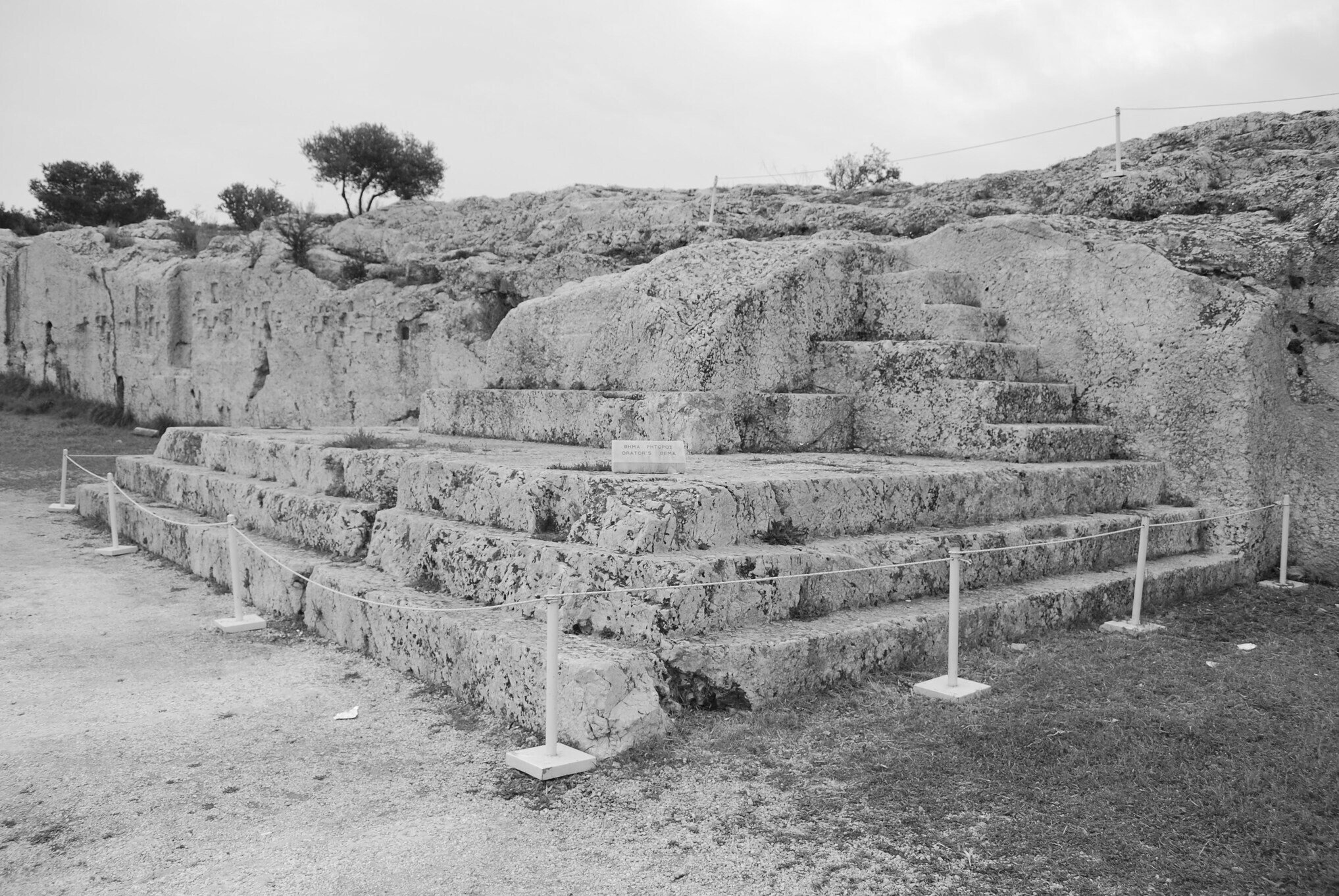
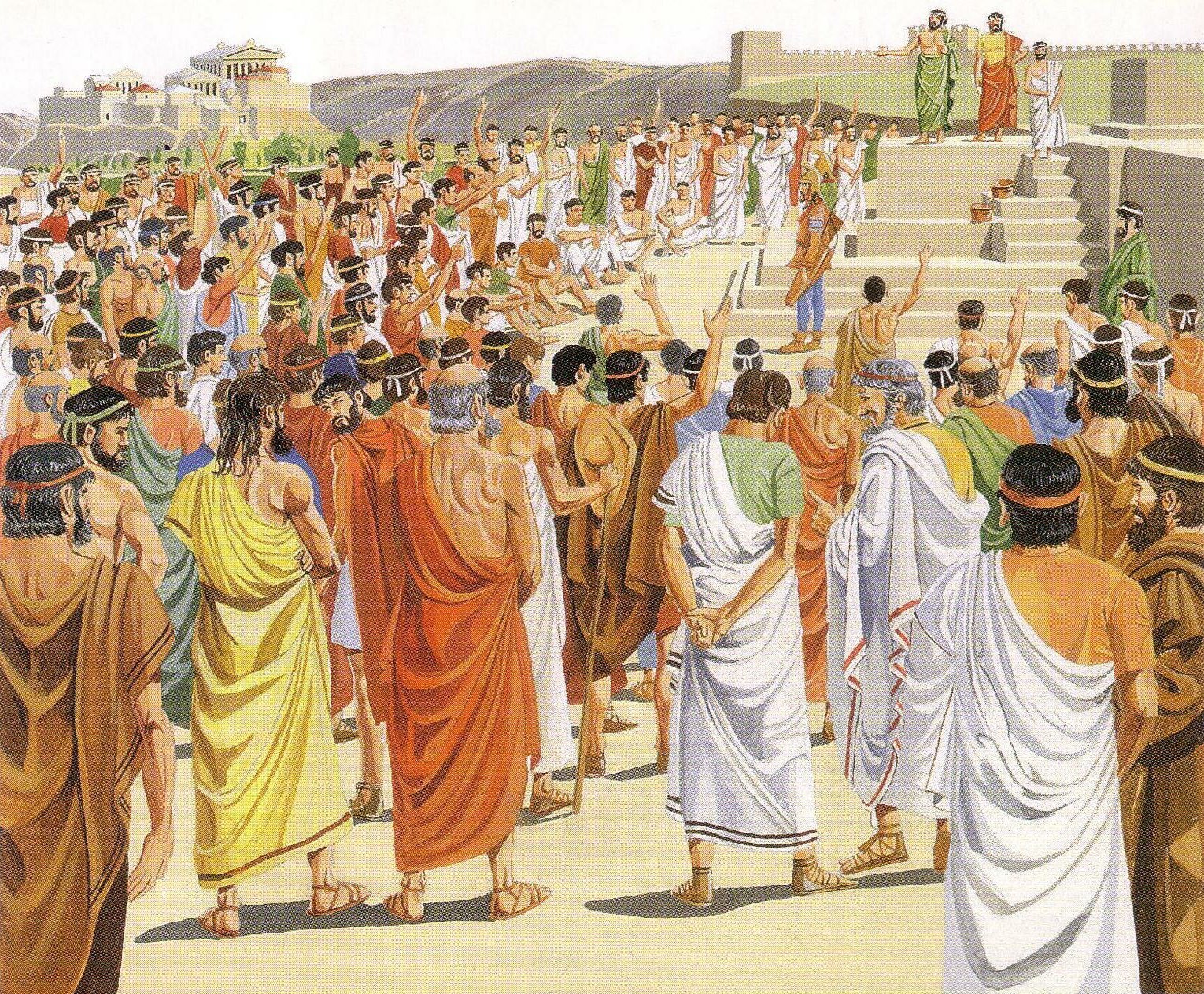
The Pnyx, on a hill facing the Acropolis, was the Athenians' meeting place for assemblies. That is where Meton is said to have erected his heliotropion... or something else... or nothing at all.
One final anecdote about Meton is also reported by Aelian in Varia Historia - BOOK XIII.
“12. On the astronomer Meton.
WHEN the Athenian fleet was ready to sail for Sicily*, the astronomer Meton, whose name had been included among those due to embark, foresaw what might happen and feared the dangers of the voyage, so he tried to be excused. Failing that, he decided to feign madness: among various antics intended to convince others he had truly lost his mind, he set fire to his house near the Poecile; whereupon the archons dismissed him. In my view, Meton played the madman better than Ulysses, king of Ithaca. Palamedes uncovered Ulysses' trick, and no Athenian noticed Meton's. Justin, IV, 4.
* The Athenians were waging war against Syracuse: this expedition ruined Athens' strength and was followed by the city's capture by the Lacedaemonians.
Let us not draw hasty conclusions from this. Other texts claim Meton acted this way to save his son. Unless it was a political act.
This section would be incomplete without mentioning Euctemon, Meton's “colleague” and very likely co-author of the cycle that interests us. It will be brief, since we know nothing about him except that he was an astronomer.
What was each man's role in devising the “Metonic cycle” or “great year”? Given what we currently know, we cannot say.
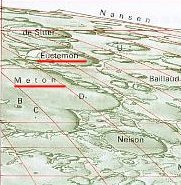
Certainly close in life, Meton and Euctemon are also close on the Moon, where two nearby craters bear their names.
By chance or design, the Meton crater stays in darkness until the 19th day after the new moon. At that point, it becomes visible.
What exactly did he discover?
Whether we call it the 19-year cycle, Metonic cycle, Meton's year, great year or enneadecaeteris, it makes little difference: Meton and Euctemon developed a cycle stating that
19 solar years = 235 lunations
As it stands, this equality means little unless we know the length of a solar year and of a lunation.
What were those values in Meton's time? We know very little. But fortunately, we do know that the cycle lasted 6940 days.
If the cycle were exact, it would give a solar year of 365.26316 days and a lunation of 29.5319 days.
We know that is not the case, since the tropical year is about 365.242219 days and the lunation about 29.53059 days. Both values were too long and later led to longer, more accurate cycles. But that is another story (see the page on eras and cycles).
That said, nothing allows us to claim that the figures above were those actually used or discovered by Meton and Euctemon. We can assume that any cycle giving a total close to 6940 may be valid.
According to Bigourdan (1851/1932), an astronomer by profession, for Meton “the year equals 365 days 5/19 and the lunation 29 days 25/47”. Why not? That gives us a cycle of 6939.999 days. In the end, it matters little.
What does this cycle mean, and how can it be used?
Strictly speaking, from an astronomical point of view, it means that every 19 years the Moon returns to exactly the same place in the sky (let us forget for a moment that it is not exact). Shall we check?
It is easy to verify with modern astronomy software. For the images below, I used Alphacentaure. I could just as well have used Cartes du ciel. Both are exceptional free software tools. That tribute paid, let us get back to... Meton and Euctemon.
Let us pick an observation location at random, Athens for example. Let us pick a date, 28 June 433 BC in the Julian calendar. Say at 23:00.
Where is the Moon in the sky at that place and on that date?
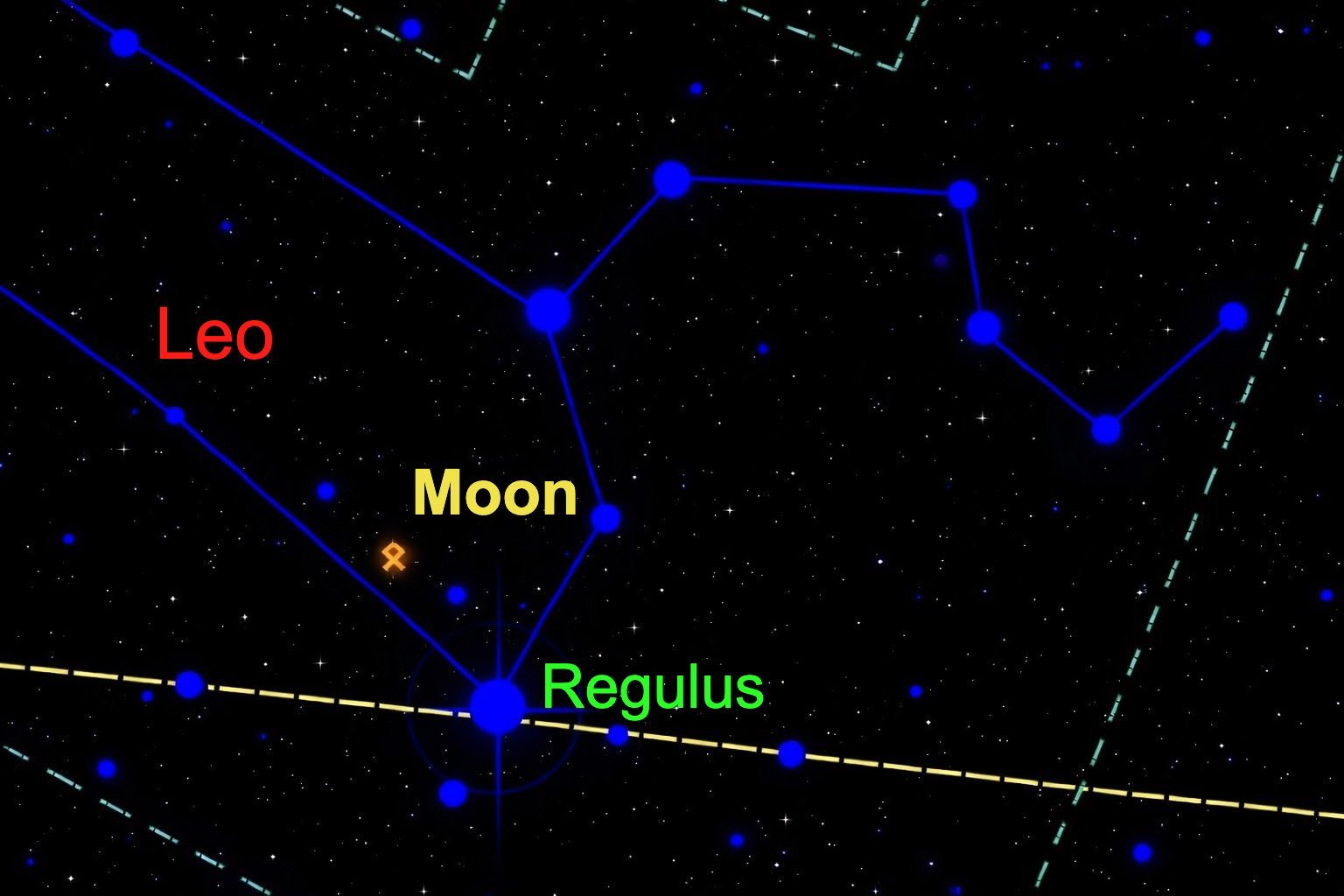
Where is the Moon for the same place 6940 days later, that is, one Metonic cycle later?
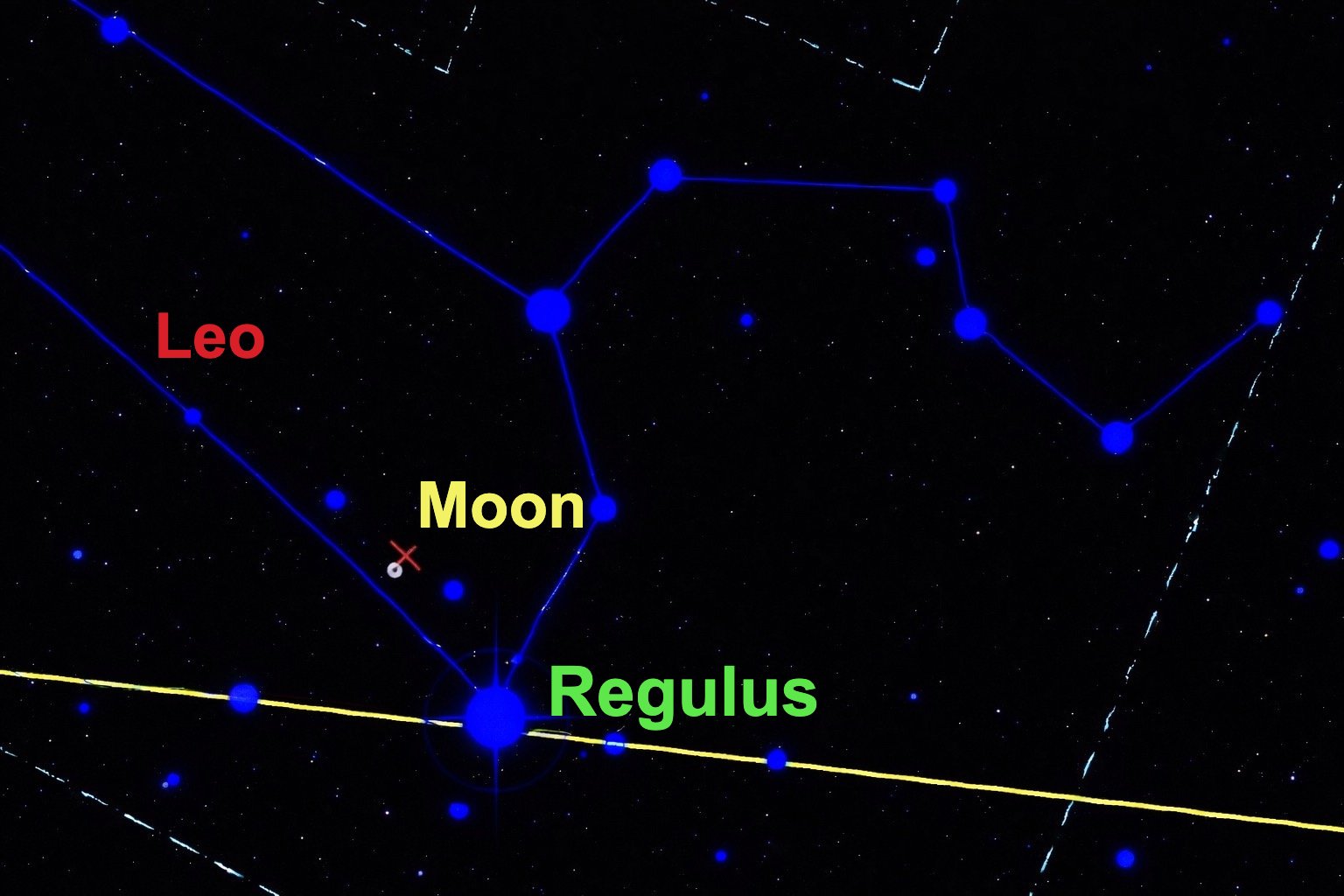
It is almost in the same place. To say exactly, it would need to be at the center of the red cross visible slightly above its actual position. That positional difference shows the cycle's error.
I do not know what you would have done, with the naked eye and almost no modern pointing tools, but for my part I find this remarkably good.
This cycle can be used for two purposes:
- To know lunar phases in advance. You only need to record them for 19 years. Then they recur on the same day in subsequent cycles. That is exactly what Dionysius Exiguus did (around 532) when he produced a table of “fictitious” moons (or ecclesiastical / calendar moons) in the Julian calendar. The Metonic cycle would serve the ecclesiastical calendar for centuries. For more, see the page on the ecclesiastical calendar.
- In lunisolar calendars, to determine which years must be embolismic (with a 13th month) so that the lunar year remains aligned with the solar year.
Did Meton and Euctemon create such a table ranking embolismic years? Very likely, since the cycle's purpose was precisely to stop the Greek calendar from drifting.
Were the intercalations in years 3, 5, 8, 11, 13, 16, 19, along with each month's day count (which we will not revisit here; all details are here), fixed this way by Meton and Euctemon? No one knows, but the principle is what matters: insert 7 additional months in a 19-year cycle so that the cycle totals 6940 days.
When was the cycle invented, and what was its starting date?
According to Diodorus, Meton began his cycle on the 13th day of Scirophorion in the fourth year of the 86th Olympiad. That would correspond to 28 June 433 BC (Julian).
For his part, Jean-Etienne Montucla (1725-1799), in his history of mathematics (1799), gives another date: "...This cycle was established in the Julian year 433 BC, on 16 July, the 19th day after the summer solstice; and the new moon that occurred that day at 7:43 in the evening marked its beginning, the first day of the period being counted from sunset on the previous day. Meton deliberately chose this new moon, although it was farther from the solstice than the previous one, so as not to have to insert an intercalation in the very first year. For the Greek year was such that the full moon of its first month had to come after the solstice, because the Olympic Games were celebrated in the middle of that first month after the summer solstice..."
So then? Diodorus or Montucla?
Now to the legendary side of Meton's cycle, where Montucla helps us enter the matter directly. He writes that "...Meton displayed in Athens, and probably before Greece gathered for those famous games, a table explaining the order of his period, and the applause with which most Greek nations received it gave it the name of cycle, or golden number..."
Why “golden number”? Because, it is said, the table was inscribed in gold letters on tablets attached to public monuments (Hoeffer, 1873). Unless it was directly on the wall of the Pnyx, or on the Temple of Minerva, wherever that may have been.
In short, one reads everything and its opposite on this topic. And the reality is much sadder, especially for Meton...
His discovery went almost unnoticed. Geminus, in his Introduction to the Phenomena, does not even mention Meton and attributes the cycle to Callippus.
The cycle was not used in Greece before 342 or 330 BC.
Which is why, in 423 BC, Aristophanes in Peace still complains about calendar disorder:
"On our way here, we met Diana (the Moon), [...] who told us she was very angry at the insults she receives every day. [...] She complained that you do not observe her feast days at all, and let them pass in confusion. [...] And while we gods are keeping fasts, those are precisely the days when you hold your libations and banquets".
How could Aristophanes, who as we have seen knew Meton, have forgotten a celebrity supposedly crowned at the Olympic Games and still complain about the calendar?
As for the famous Golden Number engraved everywhere, it seems to date only from 1170, when Alexander of Villedieu wrote his Massa compoti. And only in the 13th century do we find, under the pen of a “scholar”, that “this number surpasses all other lunar calculations as gold surpasses other metals”.
Besides, Dionysius Exiguus, who used the golden number in his tables, did not call it golden number but cyclus decemnovennalis.
Did he discover “his” cycle?
Let us set aside Chinese astronomy which, depending on the source, is said to have known the 19-year cycle at various and inconsistent dates, without the sources being truly clear. One can read that the 19-year cycle was known as early as the 27th century BC from observations at the observatory built by Hoang-Ti. Others point instead to the Shang dynasty (1554-1145 BC).
Let us simply retain what Helmer Aslasken writes, whose expertise on the Chinese calendar is beyond doubt. According to him, the Metonic cycle has been known in China as the cycle zhang since around 600 BC. The first calendars using this cycle would date from before 104 BC.
By contrast, we will focus on the 19-year cycle among the Babylonians.
Acknowledgements
Before we begin, I would like to thank three people:
Emmanuel Bertin for his huge work identifying intercalary months in Babylonian texts.
G.R.F. Assar for his insightful advice, patience and availability. Thanks to him, Emmanuel and I were able to correct some dating errors. The findings below agree with his own conclusions in “Parthian Calendars at Babylon and Seleucia on the Tigris”, IRAN 41 (2003), 171-185.
And I would be remiss not to thank Francis Joannes as well. First, for the site http://www.achemenet.com, a real gold mine for anyone working on Babylonian texts. Second, for his valuable guidance on how to “decode” Babylonian dates and navigate the chronology.
The 19-year cycle and the Babylonians
Why this meticulous study of dated texts? Simply because reading a few books leaves an impression of vagueness and room for doubt regarding when the Babylonians adopted the 19-year cycle.
In his book Mesopotamia (1985), Georges Roux writes that "When astronomers realized that 235 lunar months exactly equalled 19 solar years, in 747 King Nabu-nasir in Babylon decided to introduce seven additional months spread over a 19-year period; however, this 'Nabonassar calendar' was not standardized until between 388 and 367". For dates, his text refers to Babylonian Chronology 626 BC - AD 75 (1956) by Parker, Richard A. and Waldo H. Dubberstein.
Parker and Dubberstein write in that book: "In the fourth century - in 367 B.C according to our scheme - the intercalations became standardized, and the nineteen-year cycle came into being."
O. Neugebauer, in The Exact Sciences in Antiquity, notes that according to A. Sachs, intercalation rules had been fixed before 380 BC.
Before, yes, but by how many years? Before 433 or after? What exactly does “standardization” mean? What did the calendar look like before that standardization? That is what we tried to determine.
Reminders about the Babylonian calendar
For the period that concerns us, from Nabonassar to Alexander the Great, that is from 747 BC to 330 BC, the calendar is lunisolar.
The months are named Nisanu, Ayaru, Simanu, Duzu, Abu, Ululu, Tashritu, Arahsamnu, Kislimu, Tebetu, Shabatu, Addaru.
Intercalary months, when present, are inserted after Ululu or Addaru and are simply called second Ululu or second Addaru. When fixed, the 19-year cycle would place intercalations in years 1, 3, 6, 9, 11, 14 and 17. A second Ululu would be inserted in year 1 of the cycle, and a second Addaru in the other embolismic years.
Until the Seleucid era, years were counted from a new king's accession to the throne. When, within the same year, a deceased king was replaced by another, convention counted the deceased king's final regnal year as a full year, and called the few-month period used to complete it the “inaugural year” (or “year 0”). In the Seleucid era, counting became continuous, and year 1 of the Seleucid era corresponds to 312/311 BC.
Results from compiling dated texts
To avoid studying an overlong table, we have shortened it and kept only its interesting, significant part.
We denote A for a year containing a second Addaru, and U for a year containing a second Ullulu.
| King | Reign dates | Regnal year | Intercalary months | Cycle |
|---|---|---|---|---|
| Nabonidus | 555/554 | 1 | A | None. Intercalary months are distributed irregularly. |
| 554/553 | 2 | |||
| 553/552 | 3 | A | ||
| 552/551 | 4 | |||
| 551/550 | 5 | |||
| 550/549 | 6 | A | ||
| 549/548 | 7 | |||
| 548/547 | 8 | |||
| 547/546 | 9 | |||
| 546/545 | 10 | U | ||
| 545/544 | 11 | |||
| 544/543 | 12 | A | ||
| 543/542 | 13 | |||
| 542/541 | 14 | |||
| 541/540 | 15 | A | ||
| 540/539 | 16 | |||
| 539/538 | 17 | |||
| Cyrus | 538/537 | 1 | ||
| 537/536 | 2 | U | ||
| 536/535 | 3 | A | ||
| 535/534 | 4 | |||
| 534/533 | 5 | |||
| 533/532 | 6 | A | ||
| 532/531 | 7 | |||
| 531/530 | 8 | |||
| 530/529 | 9 | U | ||
| Cambyses | 529/528 | 1 | ||
| 528/527 | 2 | |||
| 527/526 | 3 | U | Three 8-year cycles (octaeterides), each with three intercalary months. | |
| 526/525 | 4 | |||
| 525/524 | 5 | A | ||
| 524/523 | 6 | |||
| 523/522 | 7 | |||
| 522/521 | 8 | A | ||
| Darius | 521/520 | 1 | ||
| 520/519 | 2 | |||
| 519/518 | 3 | U | ||
| 518/517 | 4 | |||
| 517/516 | 5 | A | ||
| 516/515 | 6 | |||
| 515/514 | 7 | |||
| 514/513 | 8 | A | ||
| 513/512 | 9 | |||
| 512/511 | 10 | |||
| 511/510 | 11 | U | ||
| 510/509 | 12 | |||
| 509/508 | 13 | A | ||
| 508/507 | 14 | |||
| 507/506 | 15 | |||
| 506/505 | 16 | A | ||
| 505/504 | 17 | |||
| 504/503 | 18 | |||
| 503/502 | 19 | U | A 19-year cycle. Two irregularities: 1) A second Addaru in regnal year 23 instead of regnal year 21. 2) A second Ullulu in regnal year 30 instead of a second Addaru in regnal year 29 | |
| 502/501 | 20 | |||
| 501/500 | 21 | |||
| 500/499 | 22 | A | ||
| 499/498 | 23 | |||
| 498/497 | 24 | A | ||
| 497/496 | 25 | |||
| 496/495 | 26 | |||
| 495/494 | 27 | A | ||
| 494/493 | 28 | |||
| 493/492 | 29 | |||
| 492/491 | 30 | U | ||
| 491/490 | 31 | |||
| 490/489 | 32 | A | ||
| 489/488 | 33 | |||
| 488/487 | 34 | |||
| 487/486 | 35 | A | ||
| 486/485 | 36 | |||
| Xerxes | 485/484 | 1 | ||
| 484/483 | 2 | U | A 19-year cycle. One irregularity: A second Ullulu in regnal year 7 instead of a second Addaru. | |
| 483/482 | 3 | |||
| 482/481 | 4 | A | ||
| 481/480 | 5 | |||
| 480/479 | 6 | |||
| 479/478 | 7 | U | ||
| 478/477 | 8 | |||
| 477/476 | 9 | |||
| 476/475 | 10 | A | ||
| 475/474 | 11 | |||
| 474/473 | 12 | A | ||
| 473/472 | 13 | |||
| 472/471 | 14 | |||
| 471/470 | 15 | A | ||
| 470/469 | 16 | |||
| 469/468 | 17 | |||
| 468/467 | 18 | A | ||
| 467/466 | 19 | |||
| 466/465 | 20 | |||
| 465/464 | 21 | U | A 19-year cycle. No text mentions an intercalary month in regnal year 8. | |
| Artaxerxes | 464/463 | 1 | ||
| 463/462 | 2 | A | ||
| 462/461 | 3 | |||
| 461/460 | 4 | |||
| 460/459 | 5 | A | ||
| 459/458 | 6 | |||
| 458/457 | 7 | |||
| 457/456 | 8 | ? | ||
| 456/455 | 9 | |||
| 455/454 | 10 | A | ||
| 454/453 | 11 | |||
| 453/452 | 12 | |||
| 452/451 | 13 | A | ||
| 451/450 | 14 | |||
| 450/449 | 15 | |||
| 449/448 | 16 | A | ||
| 448/447 | 17 | |||
| 447/446 | 18 | |||
| 446/445 | 19 | A | A 19-year cycle. One irregularity: A second Addaru in regnal year 19 instead of a second Ullulu. | |
| 445/444 | 20 | |||
| 444/443 | 21 | A | ||
| 443/442 | 22 | |||
| 442/441 | 23 | |||
| 441/440 | 24 | A | ||
| 440/439 | 25 | |||
| 439/438 | 26 | |||
| 438/437 | 27 | A | ||
| 437/436 | 28 | |||
| 436/435 | 29 | A | ||
| 435/434 | 30 | |||
| 434/433 | 31 | |||
| 433/432 | 32 | A | ||
| 432/431 | 33 | |||
| 431/430 | 34 | |||
| 430/429 | 35 | A | ||
| 429/428 | 36 | |||
| 428/427 | 37 | |||
| 427/426 | 38 | A | A 19-year cycle. One irregularity: A second Addaru in regnal year 19 instead of a second Ullulu. Same error as in the previous cycle under the same king. | |
| 426/425 | 39 | |||
| 425/424 | 40 | A | ||
| 424/423 | 41 | |||
| Darius II | 423/422 | 1 | ||
| 422/421 | 2 | A | ||
| 421/420 | 3 | |||
| 420/419 | 4 | |||
| 419/418 | 5 | A | ||
| 418/417 | 6 | |||
| 417/416 | 7 | A | ||
| 416/415 | 8 | |||
| 415/414 | 9 | |||
| 414/413 | 10 | A | ||
| 413/412 | 11 | |||
| 412/411 | 12 | |||
| 411/410 | 13 | A | ||
| 410/409 | 14 | |||
| 409/408 | 15 | |||
| 408/407 | 16 | U | A 19-year cycle. No irregularity. | |
| 407/406 | 17 | |||
| 406/405 | 18 | A | ||
| 405/404 | 19 | |||
| Artaxerxes II | 404/403 | 1 | ||
| 403/402 | 2 | A | ||
| 402/401 | 3 | |||
| 401/400 | 4 | |||
| 400/399 | 5 | A | ||
| 399/398 | 6 | |||
| 398/397 | 7 | A | ||
| 397/396 | 8 | |||
| 396/395 | 9 | |||
| 395/394 | 10 | A | ||
| 394/393 | 11 | |||
| 393/392 | 12 | |||
| 392/391 | 13 | A | ||
| 391/390 | 14 | |||
| 390/389 | 15 | |||
| 389/388 | 16 | U | A 19-year cycle. One irregularity: A second Addaru in regnal year 20 should have been intercalated in the following year. | |
| 388/387 | 17 | |||
| 387/386 | 18 | A | ||
| 386/385 | 19 | |||
| 385/384 | 20 | A | ||
| 384/383 | 21 | |||
| 383/382 | 22 | |||
| 382/381 | 23 | |||
| 381/380 | 24 | A | ||
| 380/379 | 25 | |||
| 379/378 | 26 | A | ||
| 378/377 | 27 | |||
| 377/376 | 28 | |||
| 376/375 | 29 | A | ||
| 375/374 | 30 | |||
| 374/373 | 31 | |||
| 373/372 | 32 | A | ||
| 372/371 | 33 | |||
| 371/370 | 34 | |||
| 370/369 | 35 | U | A 19-year cycle. No irregularity. Le cycle est standardisé. | |
| 369/368 | 36 | |||
| 368/367 | 37 | A | ||
| 367/366 | 38 | |||
| 366/365 | 39 | |||
| 365/364 | 40 | A | ||
| 364/363 | 41 | |||
| 363/362 | 42 | |||
| 362/361 | 43 | A | ||
| 361/360 | 44 | |||
| 360/359 | 45 | A | ||
| 359/358 | 46 | |||
| Artaxerxes III | 358/357 | 1 | ||
| 357/356 | 2 | A | ||
| 356/355 | 3 | |||
| 355/354 | 4 | |||
| 354/353 | 5 | A | ||
| 353/352 | 6 | |||
| 352/351 | 7 |
From this analysis, we can distinguish four separate periods:
- Before 527/526 BC, the calendar is indeed lunisolar, but intercalary months seem to be inserted randomly. It is hard to believe the 19-year cycle was already known in Nabonassar's time.
- From 527/526 to 503/502 BC, several 8-year cycles are applied, with 4 intercalations per cycle in years 1, 3 and 6. This is the octaeteris that, among the Greeks, was discovered in 500 BC by Cleostratus of Tenedos, who placed embolismic years in positions 2, 5 and 8 of the cycle. It is also clear that the start of each cycle is always an embolismic year in which the doubled month is Ullulu, whereas in other embolismic years the doubled month is Addaru.
- From 503/502 to 370/369 BC, the 19-year cycle is used with a few irregularities in position and in the name of the doubled month, but without departing from the principle of 7 intercalations in 19 years. The only missing doubled month is that of 457/456. But should we conclude there was no intercalary month that year just because no text was found?
- From 359/358 BC onward, the cycle is stabilized. Contrary to what can be read here and there, the cycle does appear to begin with an embolismic year with two Ullulu months, in continuity with what had been done in the 8-year cycles. Assuming this principle that the cycle starts with a year containing a double Ullulu, intercalations would have occurred in years 1, 3, 6, 9, 11, 14 and 17.
By way of conclusion
Did Meton invent the cycle that bears his name?
It would seem not, since the Babylonians and the Chinese had preceded him.
But after all, he never asked for this 19-year cycle to bear his name. And nothing proves that he even knew of the others.