A little history
Who are the Berbers?
When speaking of Berbers, it often seems easier to say what they are not than what they are.
They are not a race, not one single people, not one single religion. And yet they do exist. There is a distinct Berber authenticity. And it is not recent: Berbers have been among the earliest inhabitants of the broader Maghreb (today's Algeria, Morocco, Tunisia, Libya and Mauritania) for over 5,000 years.
Did they ever form a civilization? Let us be careful not to attempt, here, to answer a question many still debate.
So I will simply quote Universalis to characterize them:
“The word Berber, borrowed by French from Arabic and by Arabic from Latin, very early lost its original meaning of “foreign to Greco-Roman civilization.” Today, strictly speaking, it designates a North African linguistic group: Berber-speakers, a set of tribes that spoke or still speak dialects related to a common base, the Berber “language” [...]
In North Africa and beyond the Sahara, the Berber language is the only bond of a community of more than twelve million people. But this is a community unaware of itself, because the very diverse groups that compose it are dispersed across immense territories. Everywhere a minority, Berber is the official language of no state. Despite a few limited attempts, it has never gained full written-language status.
Important clarification: the word Berber has a pejorative connotation close to barbarian. Berbers identify themselves by group name (Tuareg, Kabyle, Chleuh) and use the word Imazighen, meaning “free men,” to designate Berbers as a whole. Here we use the word Berber only for ease of understanding and with no disrespect.
On this page, we will therefore try to understand the Amazigh calendar (Amazighe being the language of the Imazighen).
Where Berbers live
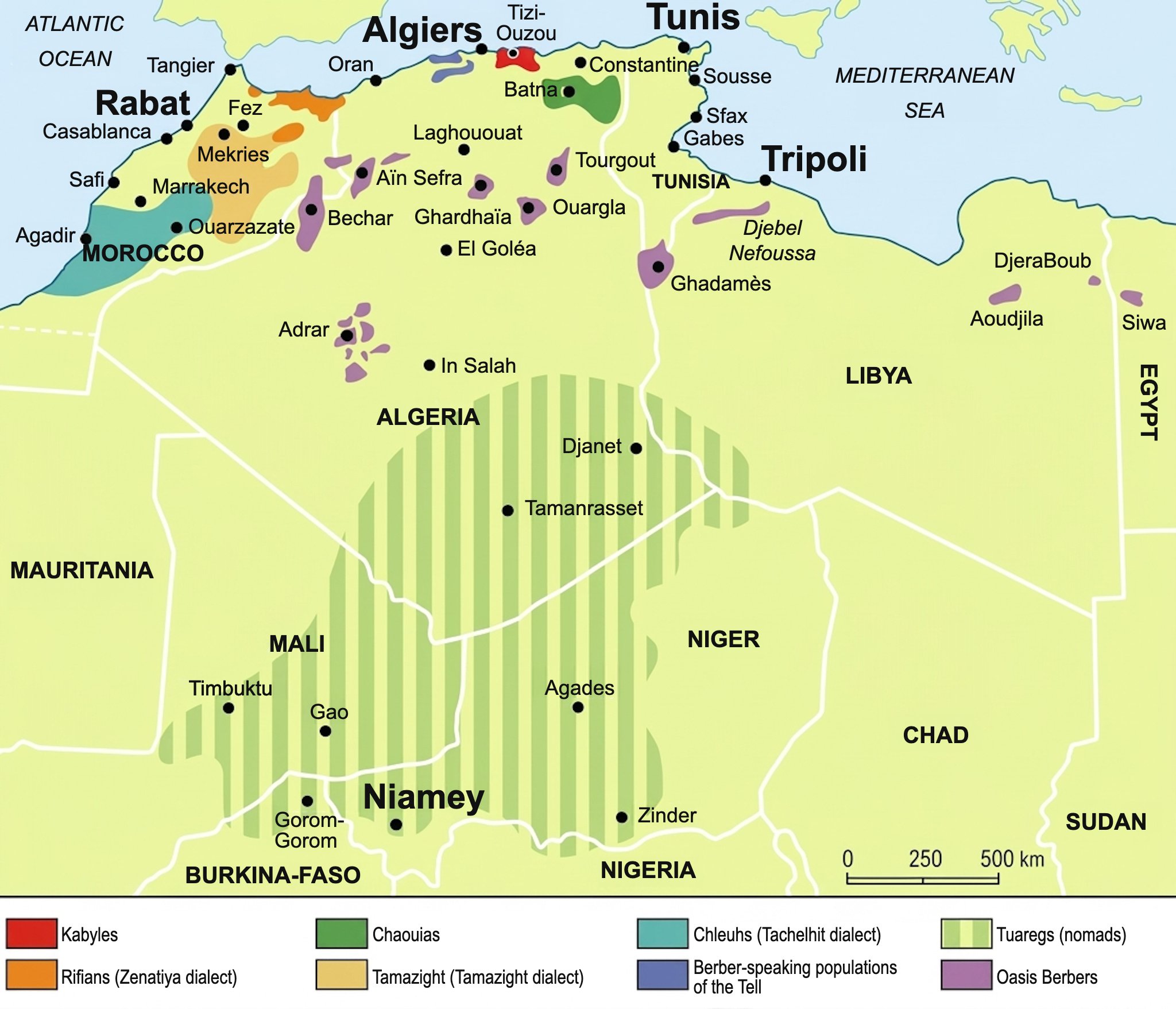
The current distribution of Berbers can be outlined by mapping areas where Amazighe is spoken. Amazighe is spoken, in a scattered way, inside an African space bounded by the Atlantic Ocean, the Mediterranean Sea, and the Tropic of Cancer. From east to west, Berber-speaking populations still exist:
- in Egypt, in the northwestern oasis of Siwa;
- in Libya, in the Nafusa Mountains and the oases of Ghadames, Sokna, Awjila, and also on the coast at Zouara;
- in Tunisia, as shrinking enclaves, especially in villages on the island of Djerba, in Tamezret north of Matmata, in Chenini and Douiret east of Tataouine;
- in Algeria. Kabylia is by far the largest Berber-speaking region in Algeria, and two-thirds of Berbers in this country are Kabyle; the Aures hosts a large Chaoui community and the Mzab another Berber-speaking group; some pockets also remain in the Ksour mountains of southern Orania, in Gourara and Ouargla, and in the north, in Djebel Bissa and Chenoua;
- in Morocco. Three large Berber dialect zones cover the country's mountain regions: in the north of the Rif, Tarifit; in the center, in the Middle Atlas and part of the High Atlas, Tamazight; in the south-southwest, in the High Atlas, Anti-Atlas and Sous (the Chleuh area), Tachelhit;
- in Mauritania, in a region north of the Senegal River, where Zenaga speech is attested among populations of Trarza.
To all these Amazighe-speaking areas, we must add a vast territory crossed by Tuareg camel nomads, whose number is estimated at 400,000. They form a major Berber-speaking group, unevenly spread across Niger, Mali (for two-thirds), Algeria (Ahaggar, Ajjer), Libya (Ajjer), Burkina Faso (Udalen), and Nigeria.
We must also account for a significant Imazighen diaspora spread through major North African cities and across Europe. France has around 600,000 Moroccan and Algerian Imazighen immigrants, the latter being mostly Kabyle.
Source: Hachette Encyclopaedia
A map of Imazighen populations was published in 1994 by Le Monde Diplomatique.
The calendar
After reading the pages on the Julian calendar and the Gregorian calendar, we know the difference between the two is that century years (1600, 1700, 1800, 1900, 2000) are leap years in the Julian calendar (since divisible by 4), whereas in the Gregorian calendar they are common years, except those divisible by 400 (1600 and 2000). Because of this rule, the offset between the two calendars increases by one day every 128 years and by three days every 400 years.
We also know that, to correct accumulated delays we need not revisit here, the Gregorian reform removed 10 days from the Julian calendar in 1582, jumping from 4 October 1582 (end of Julian dating) to 15 October 1582 (start of Gregorian dating).
But why mention these two calendars on a page about the Berber calendar?
Quite simply because the structure of the Berber calendar draws from both.
Historically, this structure likely comes from the Julian calendar, which spread through the Maghreb during the Roman period.
And let us state it right away: the first day of the Berber year currently corresponds to 12 January in the Gregorian calendar. So the Berber calendar seems to be a strict Julian calendar. Except that the first januarius of the Julian calendar currently corresponds (in year 2004) to... 14 January 2004 in the Gregorian calendar. Why this 2-day gap?
Two possible answers, and I admit I cannot decide between them:
- The first: the Berber calendar is a native Julian calendar. This means the year's start (relative to Gregorian) shifts every 128 years. In that case, there is an error in how Berber and Gregorian correspond. The current correspondence would actually be that of Gregorian years 1701-1800. Two shifts would therefore have been missed.
- The second: today's Berber calendar is a Gregorian-style calendar (accepting the 400-year rule) that, at some point, did not apply the initial 10-day shift. In that case, New Year will always be 12 January Gregorian.
To know the exact answer, one would only need to know whether the Berber calendar year 1900 had 29 days in February.
Ideally, of course, we would know who implemented this calendar and what rules define it.
On that point, and although I rarely use web sources, I came across a text while seeking answers to my questions, and it left me puzzled. I share it below (bold added by me):
“
S H E S H N A Q and the AMAZIGH calendar
By: Amar NEGADI
About the calendar
“[...] Thus practices and rites considered “pagan” are, by force of circumstances and by prior existence, integrated/assimilated by new beliefs, their only way to survive/impose themselves. So for the Imazighen, choosing a date/marker to fix their calendar from an incontestable historical fact does not break this rule! Not considering themselves Greek, Roman, Hebrew or Arab, they felt entitled - and duty-bound - to establish different markers... This is what happened in 2930 (1980).
And here is the message I posted at that time: "The first time an Amazigh calendar was published and circulated was in 2930, that is in 1980, by the association Tediut n'Aghrif Amazigh (Union of the Amazigh People - UPA -), which I had the honor of founding and leading, and so I am the initiator of this famous calendar whose mysterious origin and distant paternity so many have tried, for years now, to invent.
It is precisely those who know that a Chaoui was behind this initiative who tried, and still try, to muddy the waters.
The calendar, very simple and very modest, in line with our means at that time, looked like this: handwritten and typewritten, size 30x42 cm; in its center, in the upper three quarters, it showed a Tuareg ready to draw his sword, and on the scabbard was written in tifinagh (we leave it to those who claim to know this history to provide details). Writing and drawing were in indigo blue.
Well before that, discussions were harsh and controversial, and especially afterwards (as was also the case for the first list of Amazigh first names we circulated at the same time): people were divided over whether such a calendar was appropriate; while some were unconditionally enthusiastic, many opposed it.
For, as always, they feared we would be labeled regionalist, deviationist, separatist, etc.
Even in Morocco, our friend Mohamed Chafik was reluctant about the appropriateness of such an action and disapproved of the introductory text on Amazigh first names... according to him, terms were too harsh and the attack too frontal, and, again according to him, there was no urgency...
Needless to say, I welcome any information that can provide an answer, or the start of one, to the questions I am asking, which can be summarized as: “What rules govern the Berber calendar?”
Epoch of the Berber calendar
Epoch is used here in the sense of starting point.
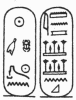
This epoch corresponds to year 950 BC. It is said to be the year a Berber ruler became Pharaoh of Egypt and founded the 22nd dynasty under the name Sheshonq I. This consecration was legitimized by marriage of his son, Osorkon, to the daughter of Psusennes II, Princess Makare. Note that currently accepted reign dates for Sheshonq I are 945-924.
Year 2004 of the Gregorian calendar therefore corresponds to year 2954 of the Berber calendar.
Months of the Berber calendar
Their names are as follows in different dialects:
| Month | Latin | Kabyle | Central Morocco | Chleuh | Tuareg | Dialectal Arabic* |
|---|---|---|---|---|---|---|
| January | Januarius | Yannayer, Nnayer | Ennayer | Innayer | Innar | Yeneyar, Yannayar |
| February | Februarius | Furar | Febrayer | Khubrayer | Forar | Frayer |
| March | Martius | Meghres | Mars | Mars | Mars | Mars |
| April | Aprilis | Yebrir, Brir | lbril | Ibrir | Ibri | Abril |
| May | Maius | Mayyu, Maggu | Mayyu | Mayyu | Mayo | Mayyuh |
| June | Junius | Yunyu, Yulyu | Yunyu | Yulyu | Yunioh | Yunyoh |
| July | Julius | Yulyuz | Yulyuz | Yulyuz | Yulyez | Yulyuh |
| August | Augustus | Ghucht | Ghucht | Ghucht | Ghuchet | Ghucht |
| September | September | Chtember | Chutanbir | Chutanbir | Chetember | Chtember |
| October | October | Tuber, Ktober | Ktuber | Ktuber | Tuber | Ktuber, Aktuber |
| November | November | Nwamber, Wamber | Ennwamber | Ennwamber | Wanber | Nunember |
| December | December | Djember, Dudjember | Dujambir | Dujambir | Dejamber | Djanber |
*: Dialectal Arabic is the one spoken in everyday life. It cannot truly be written, except through free coding conventions. It is opposed to classical Arabic, the language of the Quran.
Content of the Berber calendar
With the “mold” already built (in this case the Julian calendar), all that remains is to define content. Reference to the Julian calendar stops at structural framework and month naming. No need to look for calends, ides, or nones. The content is purely Berber tradition, oriented toward agricultural activity. The Berber calendar is traditionally an agrarian calendar.
Each Berber group has its own distribution of agricultural activities, even though common elements can be found. This is how Marceau Gast speaks of a “hunger calendar” concerning that of the Tuareg of the Ahaggar.
The first common element to all calendars of Imazighen groups is division of the year into seasons:
| Season | Name | Start (Berber) | Start (Gregorian) |
|---|---|---|---|
| Spring | Tafsut | 14 furar | 28 February |
| Summer | Awil or Anebdu | 17 maggu | 29 May |
| Autumn | Amiwan | 18 Ghucht | 30 August |
| Winter | Tagrest | 17 November | 29 November |
Each season is itself divided into parts that vary according to group activities and climate features. But inside these sub-parts of the year (or season segments), common elements can still be found. This is, for example, the case in winter, where two major periods appear: black nights (midwinter core) and white nights (announcing the fair season). We also find the opposition auspicious days / inauspicious days. Even if the timing differs from one group to another, associated beliefs are similar: do not touch ploughing tools, do not make animals work... in short, let the land rest. We can easily understand that if the aim of this period is identical everywhere, its starting date may vary from place to place. That is precisely the point of an agrarian calendar.
Another feature is the existence of Tawurt n usegwass, the doors of the year. Like doors in a house letting you pass from one room to another, they let the Earth move from hot days to wet days, from wet days to cold days, and so on. These doors naturally mark transition from one season to another.
A few words on start of the year:
New Year (ixf u segwas or anezwar u segwas) gives rise, in the evening, to Imensi u menzu n yennayer, the dinner of the first day of January. It is abundant, based on couscous and poultry. Around the shared dish, spoons for absent family members are placed. On that day, it is considered good that whatever is undertaken be completed.
By way of conclusion
Quite endearing, these Berber calendar(s). You take an existing calendar, Julian or Gregorian, that does not drift too much against the solar year, and attach everyday activities to it, mostly agricultural. We are far from religious calendars of all types. In the end, it is the Hopi calendar with improved practical operation. Fans of “garden calendars” will recognize the spirit.