A little history
The Hopi Indians are the westernmost group among the Pueblo peoples.
Their ancestors are believed to have been the Anasazi, who around AD 100-200 built villages made of adjoining stone or adobe houses, flat-roofed and often multi-storey (the pueblos).
The Hopi Reservation was established in 1882. It lies on the plateaus of northeastern Arizona, in the middle of the Navajo Reservation. The plateaus, called mesas, are separated by wide valleys. The reservation, covering nearly 6,500 km², includes three mesas averaging 1,500 meters in altitude, where the various Hopi villages are located.
Average temperatures are 30°C in summer and -7°C in winter. Rainfall ranges between 15 cm and 25 cm per year in dry periods, and between 25 cm and 35 cm in wetter periods (annual average for Paris: 58 cm). It comes half from summer rain and half from winter snow.
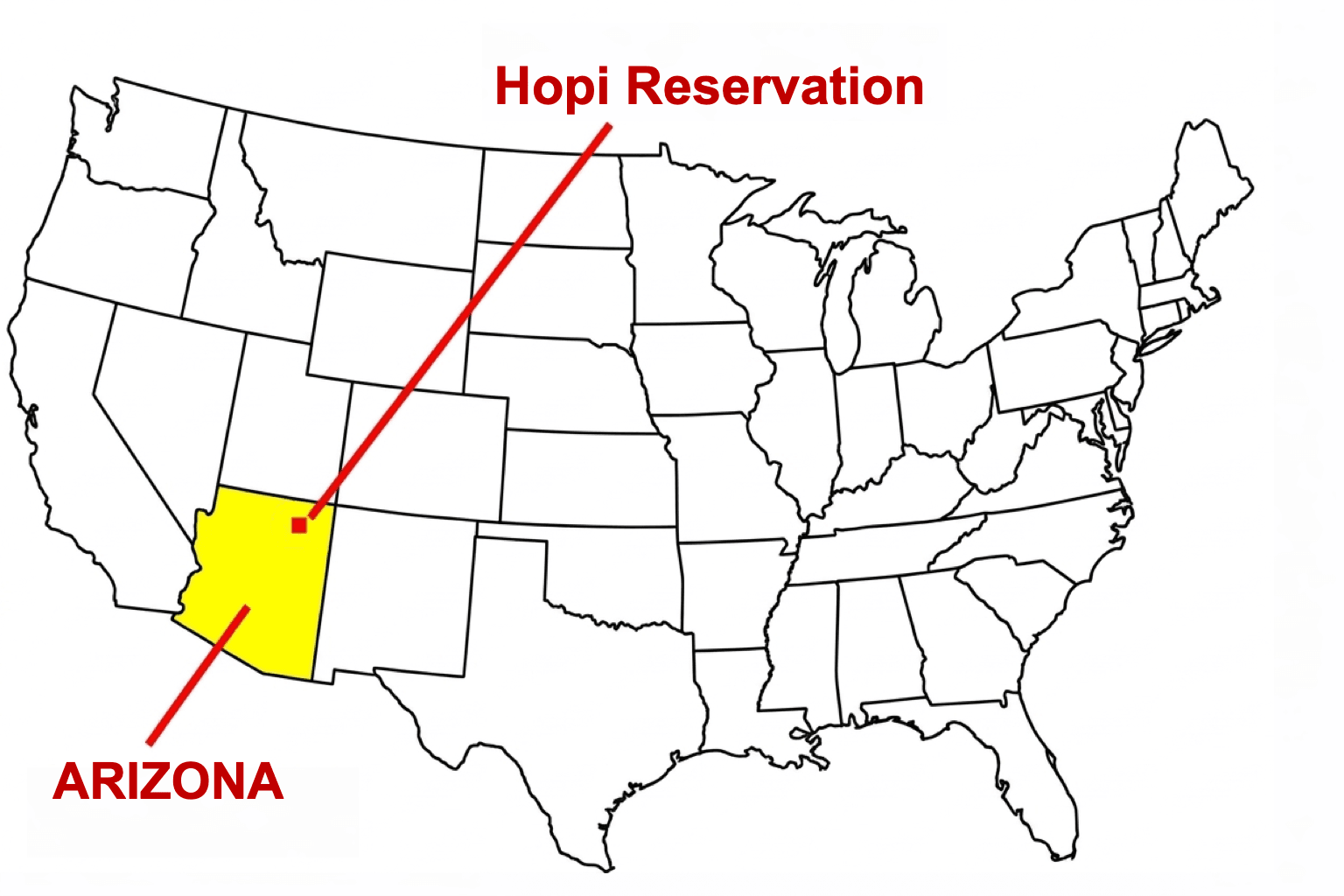
The Hopi Reservation is in northeastern Arizona and covers 6,500 km².
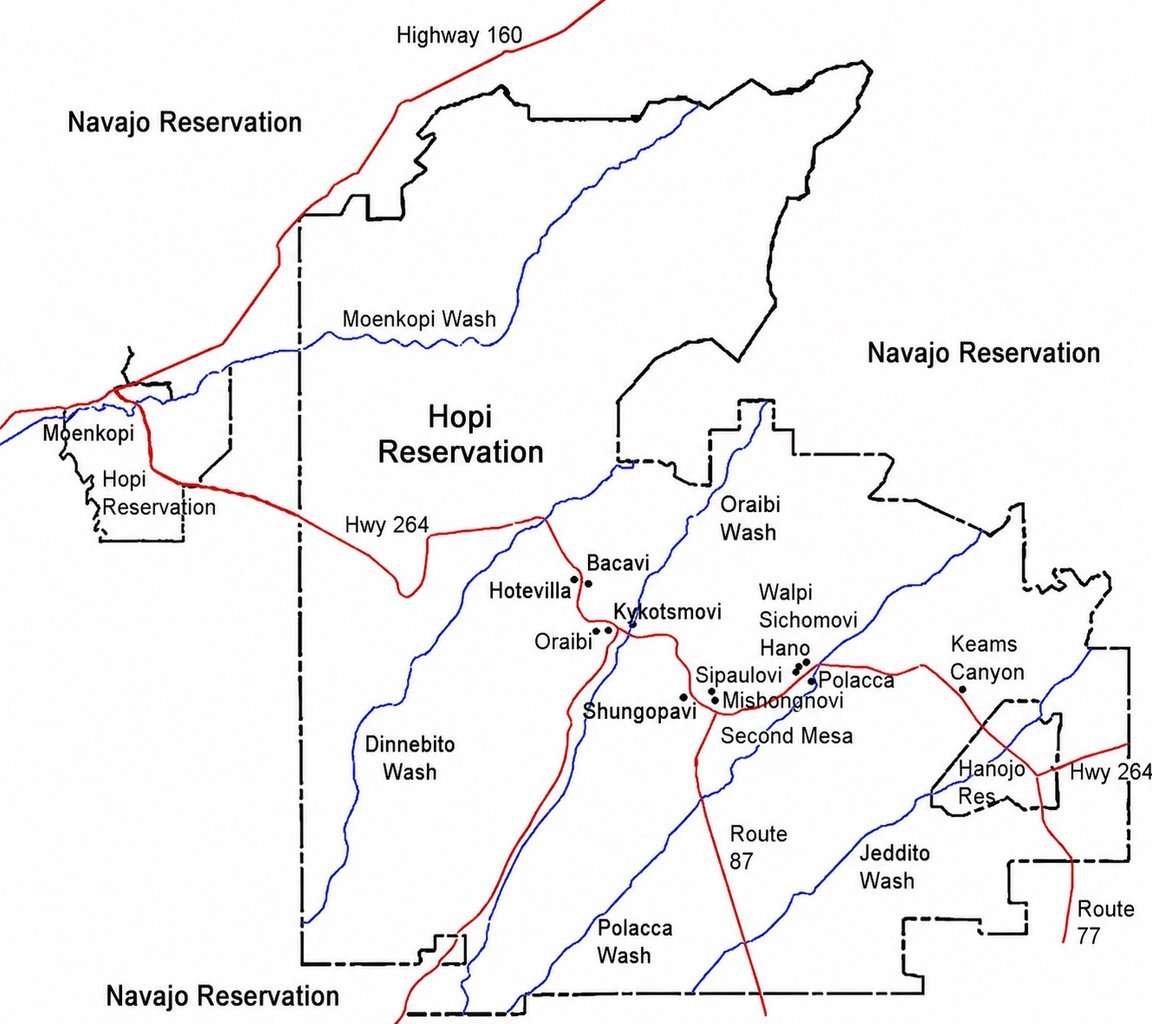
The different Hopi villages are spread across the three mesas of the reservation, separated by valleys where “a river flows” (in blue on the map on the right). Roads are shown in red.
The total Hopi population on the reservation is close to 10,000 people, mainly grouped into 12 villages. By comparison, the Navajo population, whose reservation surrounds (I did not say “encircles”!) the Hopi one, is 94,000, while Arizona's total population is 4,950,000.
“Encyclopaedia Universalis: their economy is based on agriculture (especially maize, beans and squash) and sheep herding. Descent is matrilineal and residence matrilocal, so men's position is rather uncomfortable. The kiva serve as meeting places; there they weave, paint, smoke and pray.
Like all other Pueblo peoples, the Hopi are peaceful and deeply religious. Boys begin their ceremonial path at the age of six, during initiation into the kachina (katcina) cult. Hopi kachina are masked representations of a wide variety of gods, spirits, and dead ancestors. The kachina administer ritual whipping to young boys, then reveal that they are not supernatural beings but villagers in disguise. The Hopi year is structured by different festivals. The most important is the snake dance, which brings rain.
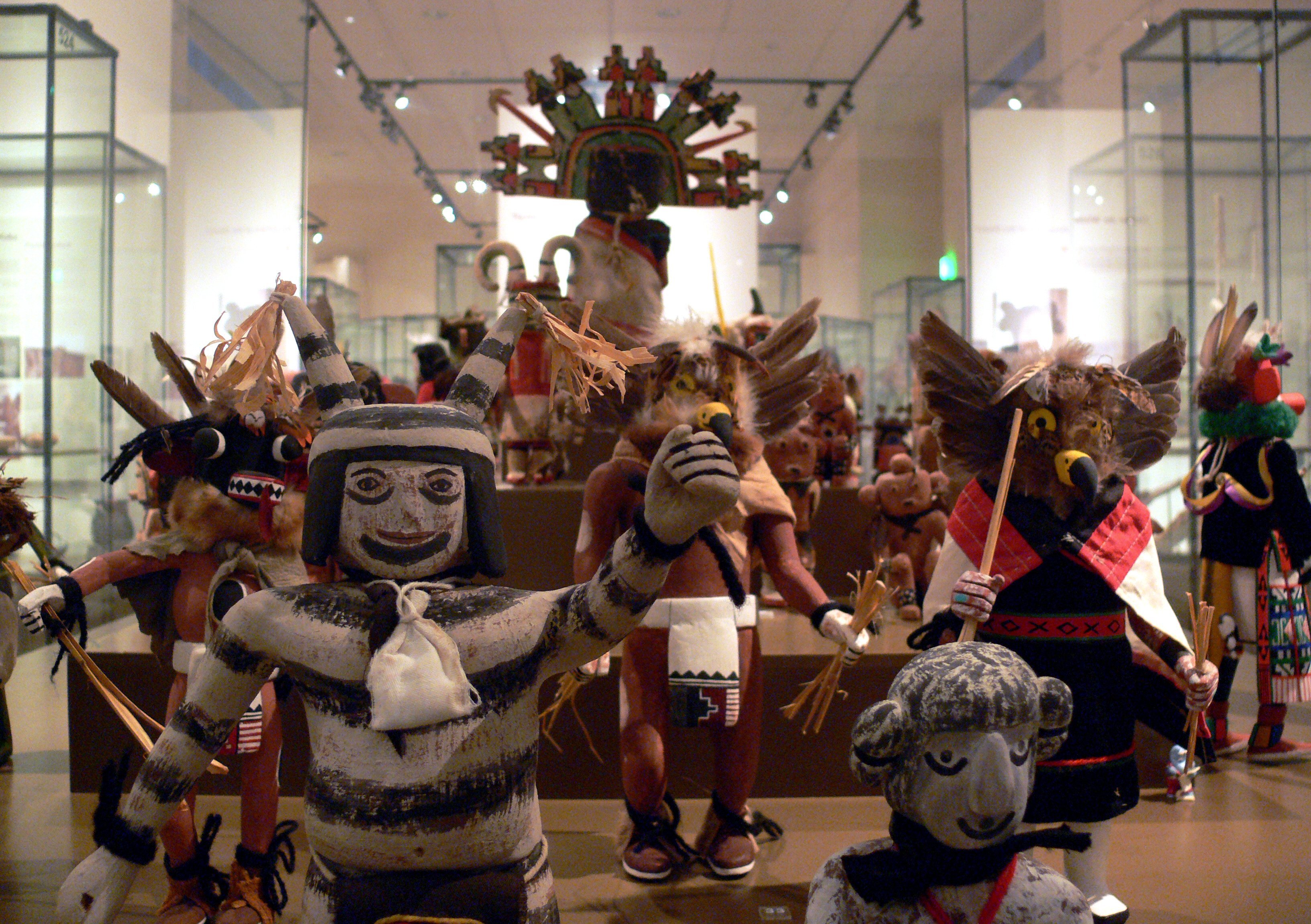
Nearly 300 kachina dolls are direct representations of ancestral spirits and play an essential role in ceremonies.
Today, the Hopi try, as best they can, to preserve their original culture and traditions, including an oral tradition (in the absence of a written language) of transmitting narratives through the Shoshone language of the Uto-Aztecan family. Each village has its own chief, and each contributes to the annual cycle of ceremonies.
The calendar
How do you determine the right day for farming tasks or ceremonies when you have no written language?
One way is to rely on recurring climatic events (rain, snow, floods...) or ecological ones (migratory birds passing, leaves falling). We remember Hesiod and his poem Works and Days, mentioned on the page about the Greek calendar.
Another way is to use astronomical markers, for example the apparent movement of the sun over the year. Here we recall what we saw in the first part of the study on timekeeping instruments, especially Stonehenge. You stand at a precise observation point and check the sun's position at a precise moment in relation to reference points which, at Stonehenge, are standing stones.
The Hopi follow the same principle: they observe the sun's position over the year relative to fixed reference points and from a fixed observation point. The difference is that the Hopi use the horizon's natural relief as their reference points.
Before seeing exactly how these horizon calendars work, let us recall a few astronomical principles.
Reminder of a few astronomy notions
We will return to our local celestial sphere as introduced in part two of the study on timekeeping instruments.
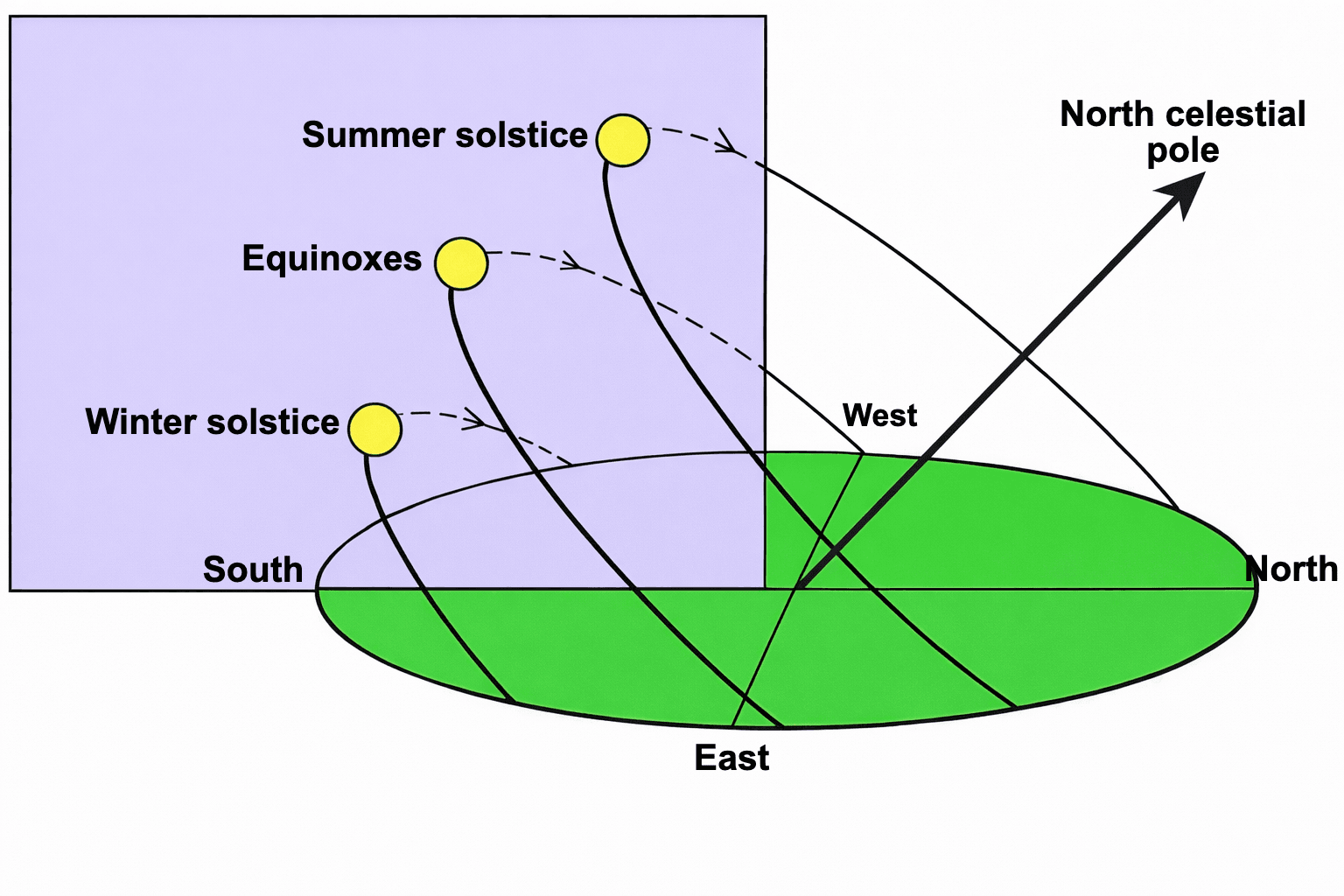
An observer placed at the center of the circle notices two things over the year:
- the sun climbs higher and higher in the sky, then follows the same path in reverse;
- the sun's position on the horizon, at both sunrise and sunset, varies between two extreme points.
These two extreme points correspond to the winter and summer solstices.
Imagine we are in Paris, with an imaginary natural landscape on the horizon. The various sunrises over the year would appear as in the following sketch:
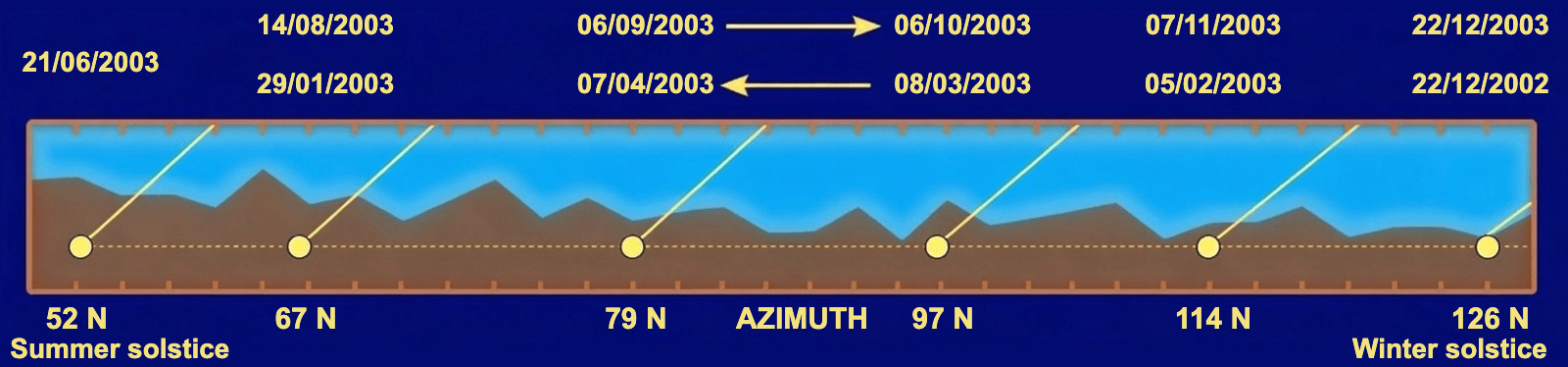
One issue is that the sun's day-to-day shifts along the horizon decrease rapidly near the solstices, to the point where it is impossible to identify the “true day” of the solstice with the naked eye. Measurements have shown that a detectable change in the sun's position is 4' (1' = 1/60 of a degree), corresponding to about 8 days before the solstice. To know the true solstice day, we therefore need to start from a sun position around ten days before the solstice and then count days.
Another point: equinoxes are not at equal distance from solstices, because the sun's apparent movement on the horizon is not at a constant “speed” due to the eccentricity of Earth's orbit around the sun. So if we need to know the horizon point where the sun rises at the equinoxes, we must observe it, not calculate it.
Clearly, these “horizon calendars” can only work under two conditions: the observer must always stand at the same location, and the horizon relief must be sufficiently uneven so that reference points are clearly identifiable.
Two examples of horizon calendars in two Hopi villages
Several archaeoastronomers, as they are now called, gave us information on Hopi use of horizon calendars: McCloskey, Alexander Stephen and Michael Zeilik.
As noted above, each village has its own chief and each contributes to the annual cycle of ceremonies. Fortunately (unless this is in fact a consequence of the landmark system), because the landscape is not the same from one village to another.
Some Hopi calendars are mainly used to set dates for many ceremonies and festivals. Others are more agricultural. In any case, not just anyone can decide when a ceremony or agricultural task begins. That role often belongs to the “sun priest” or “sun chief” (tawa-mongwi) or else the village “ceremonial chief”.
Horizon calendar of the Shungopavi village
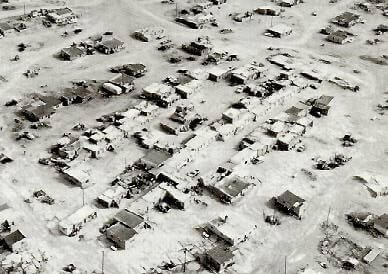
Shungopavi (Songoopavi) is the main village on the Second Mesa. It was settled there after the destruction of the first village (Old Shungopavi) during the Pueblo Revolt in 1680.
This village's horizon calendar is both ritual and agricultural.
If we leave aside the indigenous names of the visual landmarks, it looks like this sketch:
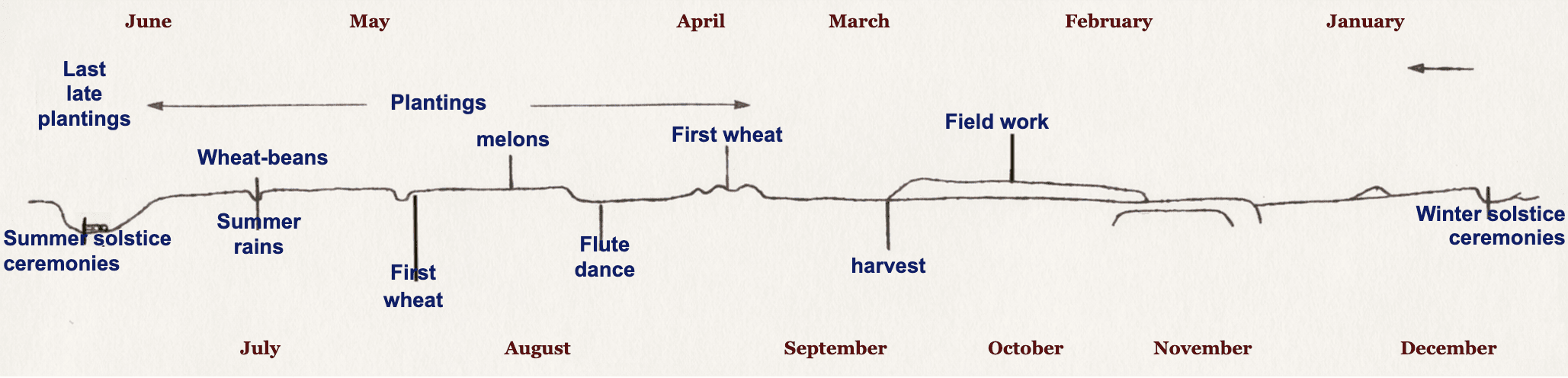
In this “calendar”, sunrises are observed against different points.
At each end we see reference points for the two solstices, which are marked by festivals. Throughout the year, other points indicate which agricultural tasks should be carried out. Naturally, you have to go back and forth between the two extremes to cover the full year.
Horizon calendar of the Walpi village
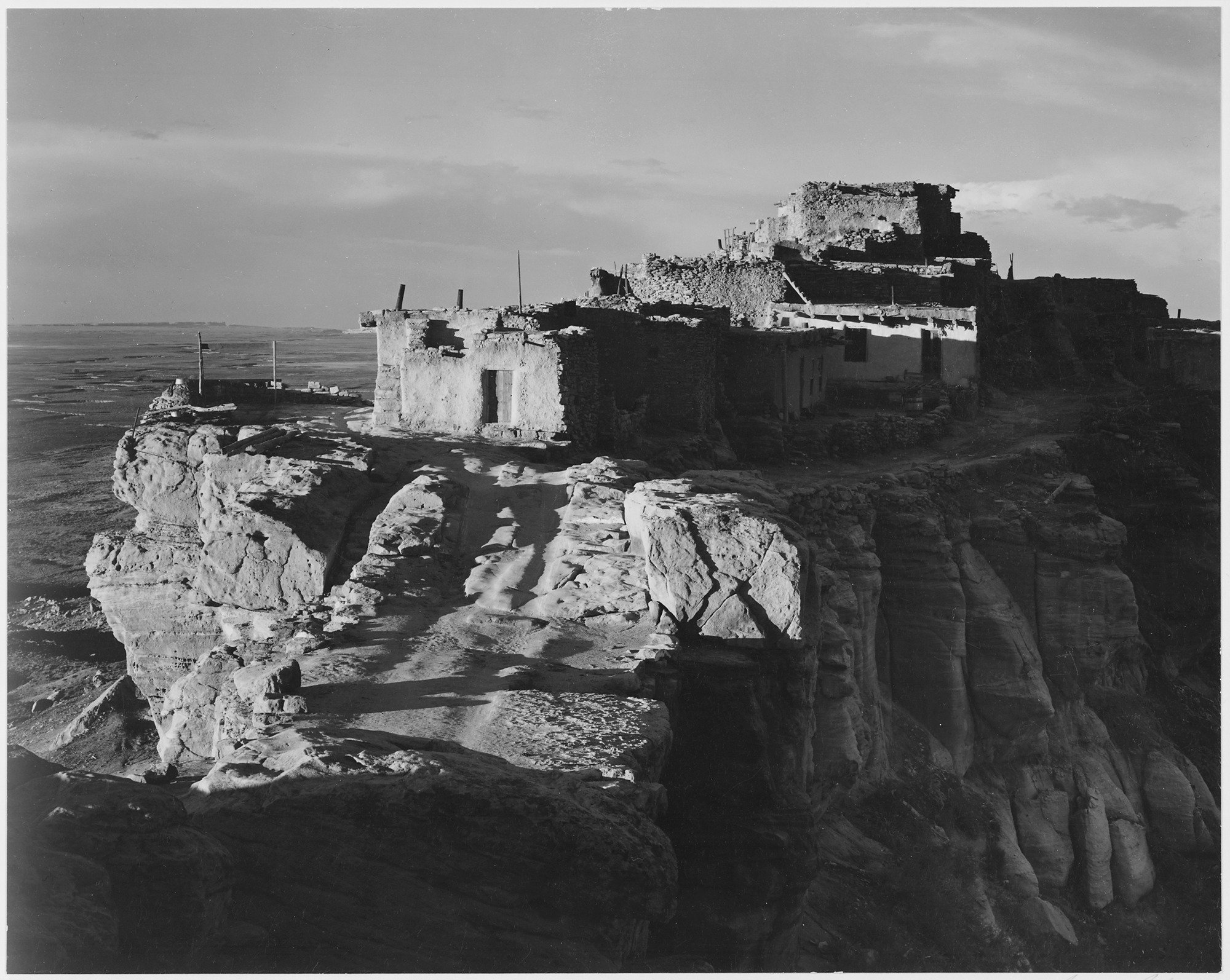
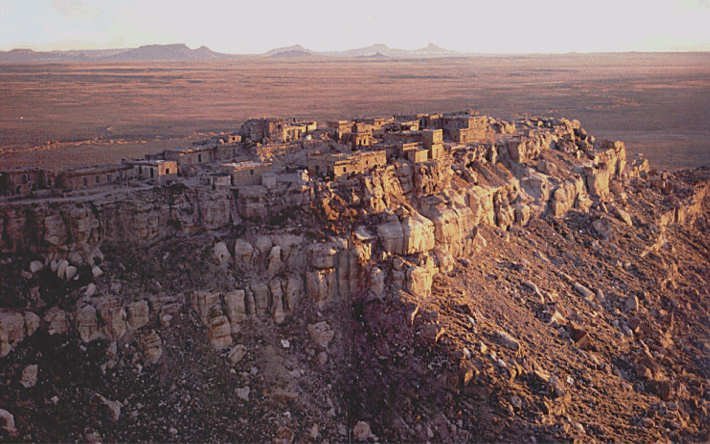
The village of Walpi (Waalpi) is perched on top of the First Mesa.
This time, we will see how the “Sun Chief” determines the winter solstice using his “horizon calendar”.
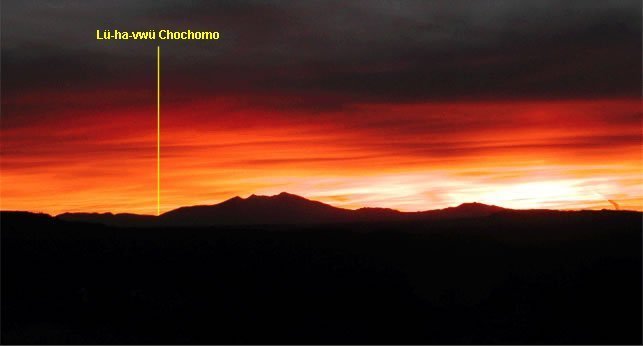
From Alexander Stephen, we know he positions himself on the roof of the “Bear clan house” (probably a common building where villagers gather; if someone can clarify this, please send me a message) at sunset as soon as the sun roughly reaches the horizon point indicated on the sketch. Each evening, he checks whether the sun has set at the point known as Lu-Ha-vwu Chochomo. From that point, he knows the solstice will occur 11 days later and that ceremonies linked to the winter solstice can begin.

It is worth noting that the inhabitants of Walpi use both sunrise and sunset to determine other dates.
Below is a photo of sunset seen from the village, where we can recognize part of the horizon shown in the sketch.
The “modern” Hopi calendar
It may be a stretch to think the Hopi still often use the horizon calendar.
Today they have a calendar much closer to ours.
It begins in November and has twelve months. Let us look at what it looks like, what the month names are, and which festivals are celebrated in each month.
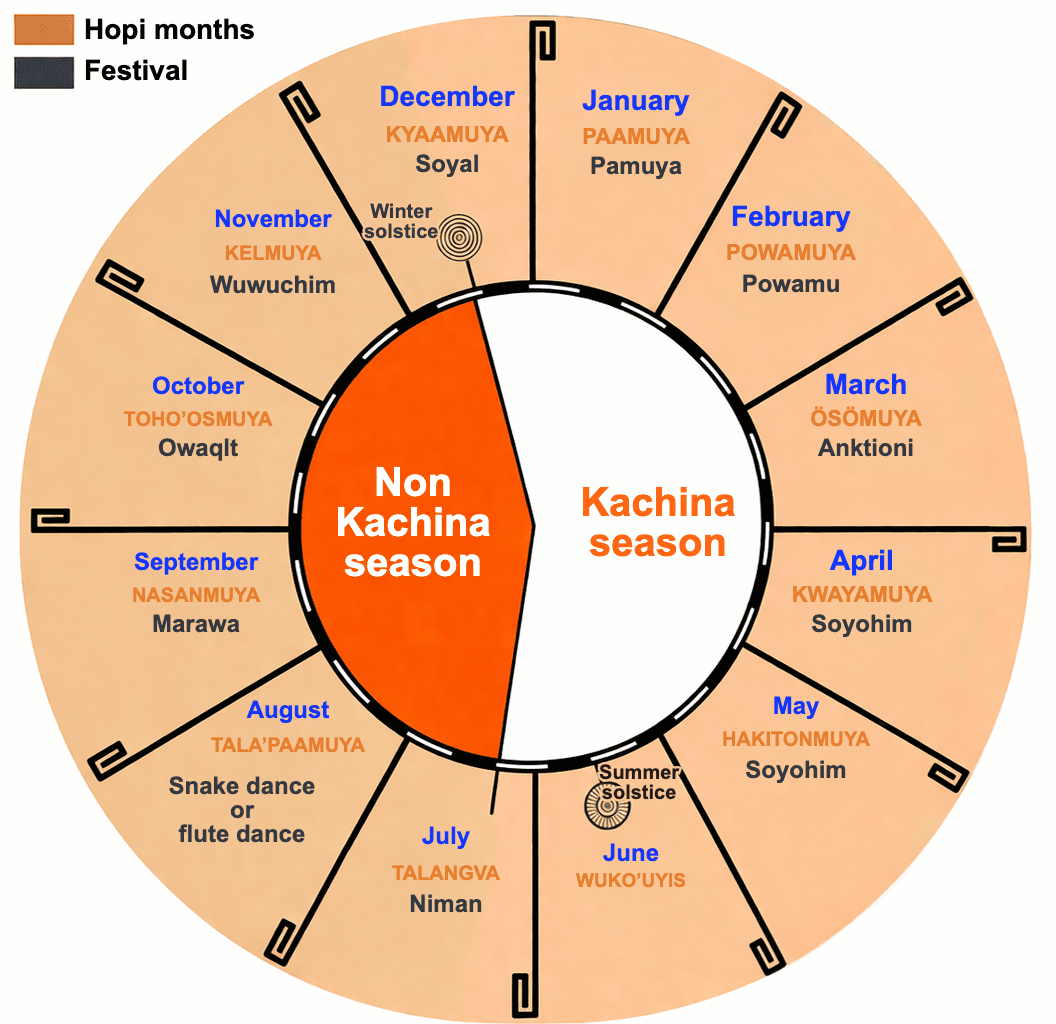
A few observations: we saw above that kachinas are physical representations (or doll representations) of gods, spirits, and dead ancestors. According to Hopi beliefs, they begin arriving in villages at the winter solstice, and their presence marks the start of kachina ceremonies lasting six months. After the Niman ceremonies, they return home to the San Francisco Peaks until the next winter solstice. Hence the two seasons shown in the middle of the diagram.