In this page, we will try to explore what the English call the “Heathen Calendar” (the pagan calendar) that existed during the Anglo-Saxon period.
I say try because very little evidence of this calendar survives, and our only real source is De Temporum Ratione, written by Bede in the 8th century.
Let us now look at it more closely.
A little history
For once, I will not impose my own prose to tell this historical background, which helps us place the calendar in its period. Instead, I will let you enjoy the account by Messrs De Roujoux and Alfred Mainguet, who published in 1844 a second edition (I do not know the date of the first) of a History of England in a style that is anything but dull.
That book, and the following volumes, can be read and downloaded from Gallica, the digital library of the Bibliothèque nationale de France (French National Library), which contains a wealth of texts.
For our purposes, we will focus on one historical stretch, from the beginnings of England to Bede's own time, since it is through his writings that we get most of the information available on pre-Christian calendars.
Also for once, I will spare you the italics that usually mark quotations: the text (shortened by me where it becomes too wordy) runs from the next line to the end of this section.
Britain before the Romans
Some parts of what are now called the British Isles were known to the ancients long before the beginning of our era. Phoenicians from Gadir (Cadiz) came to the Cornish coast to obtain tin from rich mines. In the 4th century BC, Himilco the Carthaginian, after wandering for four months on the great Ocean, also discovered the Oestrymnides; that is the name he gives these islands in his travel journal. The Greeks discovered them in turn and called them the Cassiterides, the Tin Islands. The Romans already knew them before Caesar's wars in Gaul.
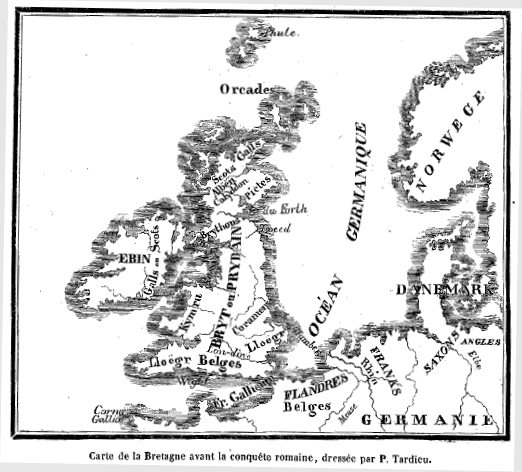
At the time of the Roman conquest, Great Britain, the largest of the Cassiterides, was divided into two unequal parts, with the River Forth as boundary. The northern part was called Alben, land of mountains, or Calydon, land of forests. The other part took from the Brythons, a people living near the Tweed, the name Bryt or Prydain, which became the name of the whole island and which the Romans turned into Britannia. In that part lived, in the west, the Kymrys (Cambrians) in Kymru (Cambria), and in the south and east, the Lloegrys (Logrians) in Lloegr (Logria). Most likely, the Kymrys, of the same stock as the Brythons and Lloegrys and like them coming from eastern Europe, had pushed the aboriginal population (of Gallic stock) westward and northward when they arrived on the island. Some fugitives found refuge in the inaccessible northern mountains, where they remained under the name Gaels or Galls, a name they still carry today. Others crossed the sea and took refuge in the great island called Erin by its inhabitants, probably of the same stock as the Breton aborigines. Later, when the Lloegrys and Brythons landed in Britain, the Kymrys were in turn pushed back along the western shores, into the wild mountainous region that then took the name Kymru (Cambria, now Wales). Further invasions brought Belgae from Gaul into the south and Coranians (Corraniaid), of Teutonic stock, into the east. The union of these different peoples formed the nation the Romans called Britanni (Bretons).
Thanks to trade relations and easy contact with the continent, the civilization of the southern tribes differed little from that of Gaul. In the center and west, barbarism still prevailed. [...]
Druidism, imported from Gaul, was the religion of these peoples. [...]
From Julius Caesar's first invasion to the withdrawal of the imperial legions (55 BC - AD 420)
During Caesar's wars in Gaul, inhabitants of southern Britain had provided aid to Rome's enemies. Caesar decided to take revenge and add that other world to his conquests. At the head of five legions, he landed in Britain in 55 BC.
The Britons, alarmed, realized they had to end internal quarrels and unite against the common enemy. Their fierce courage, and the wild, unfamiliar sight of these naked, tattooed, long-haired men, intimidated the Romans. Winter was approaching and placing them in danger; three weeks after landing, they crossed back over the Channel.
More successful in a second invasion (54 BC), helped once more by divisions among the Britons, Caesar overcame the courage and efforts of Cassivellaunus, a famous warrior commanding the Logrians and elected as chief among chiefs. But there was a long way from the submission of a few tribes, ready to rise again at the first chance, to the submission of the whole island. Caesar knew this well. He therefore stayed only a few months in Britain before returning to the continent, content with imposing a light yearly tribute on the Britons, which Augustus later replaced with trade taxes between Britain and Gaul.
From then until the reign of Claudius - ninety-seven years - the Britons kept their original independence. Only in AD 43 was Aulus Plautius sent to Britain to complete its final submission. [...]
It was the famous Agricola who conquered all known territory of Great Britain, established lasting settlements, and pacified the region. [...]
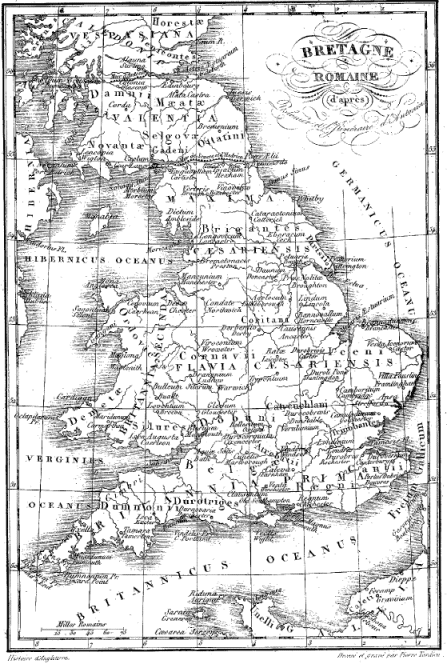
Yet in Great Britain the Romans faced enemies even harder to subdue than the Britons. Every spring, men from Caledonia - usually called Picts by Latin historians, probably because of their custom of painting their bodies - crossed the Clyde in wicker boats covered with leather and descended on the towns, giving the whole country over to killing and plunder. These incursions forced the Romans to build, at the edges of their conquest, two immense walls with towers, stretching from one sea to the other. These fortifications took the names of the emperors who successively built or repaired them: Hadrian's Wall, Antonine Wall, and Severus's Wall. Parts of them still survive.
From that point, Britain's history merges with that of the Empire. Little happened there beyond mutinies among Roman legions and usurpations of imperial dignity by Roman governors. The only one worth noting is Carausius, whom Diocletian and Maximian were forced to recognize as colleague, and who died after five years of a glorious reign (288-293), assassinated by his minister Allectus.
The Britons, softened and effeminate, did not think to exploit the Empire's internal divisions to regain freedom. Only with the barbarian invasions, when Honorius, pressed on all sides, recalled the Roman legions from the island (416-420), did they recover - and almost despite themselves - an independence soon to be taken from them again, and forever.
From the withdrawal of Roman legions to the founding of the last Saxon kingdom (AD 420 to AD 584)
When Roman legions withdrew from Britain, the government they had established left only faint traces. The form and even the names of its various administrations disappeared. Ancient native customs regained the upper hand. [...]
Around 449, weak supreme authority was in the hands of a Logrian named Wyrtigern, or Wortigern. Unable to resist raids from northern tribes, he resolved to imitate the Romans by setting barbarians against barbarians, and called on Germanic sea raiders - who often attacked Britain - for help against Picts and Scots.
At that time, chance brought three ships of those pirates to the coast, commanded by two brothers named Hengist and Horsa. They were famous chiefs, as notable for birth as for bravery, and were said to be grandsons of Odin. Wortigern sent envoys to them and, in exchange for the small island of Thanet on the Kent coast (formed by the sea and a small river splitting into two arms), proposed that they fight the Scots for a fixed period. The Saxons accepted. With sixteen hundred men, they marched with the Britons against Picts who had advanced beyond their limits; they defeated them, and the Britons believed they had found defenders as formidable as the Romans, but more generous.
Generosity, however, was no Saxon virtue. They informed other adventurers of British wealth and fertile lands. They presented the conquest as easy and asked for reinforcements. Five thousand men on seventeen ships soon landed at Thanet. The Britons were alarmed and tried in vain to satisfy their defenders' greed. A dispute arose over payment of subsidy; the Saxons immediately allied with Scots and Picts, and a war of extermination was declared. After several battles, one in which Horsa was killed, Hengist conquered Cantian territory on the right bank of the Thames and founded a settlement called the Kingdom of the Men of Kent, or Kant-wara-rice (457). The door to conquest was now open.
The Saxons, originally from northern Germania and the Cimbrian Chersonese, were made up of several tribes known as Jutes, Angles and Frisians; together they formed a broad confederation associated for war, plunder and piracy. [...]
In that sense, war was almost part of Saxon religion. [...]
The tale of enormous gains achieved by these adventurers, repeated and amplified among peoples who had poured them into Britain, spread from the marshes of the Elbe to Baltic shores. Then the Anghels, or Angles, living in that region, left in crowds to claim their share of Britain's spoils. [...]
None of these settlements was made without major battles and strong resistance from native populations. Ida, whom the Britons nicknamed “the man of fire”, met at the foot of the mountains from which the Clyde descends a Breton chief who fought him in bloody engagements. [...]
So too with the famous Arthur, founder of the Round Table, hero of the earliest chivalric romances. Yet his exploits, and the thirteen great victories he is said by the bards to have won over the invaders, could save neither his country nor himself. Mortally wounded in a battle against his own nephew, he died of his wounds. [...]
Those whom the Saxons' murder-wearied arm spared were reduced, by immense favor, to eternal servitude. In Cornwall (Cornweallas), and in the poor mountainous land of the Cambrians (Weallas or Cambria), all those withdrew who preferred a miserable but free life to serving under enemy yoke. [...]
At last the work of extermination stopped. With conquest complete, victors divided conquered lands and dwellings, and forced unfortunate Britons to cultivate as slaves the lands they had once owned. But among Anglo-Saxons, war was a need, a condition of life; once native resistance ceased, they turned their combat fury against one another. Seven settlements had been founded by the conquerors. For two centuries, these seven independent kingdoms fought each other relentlessly. [...]
Conversion of the Saxons to Christianity
From the first centuries of our era, Christianity had been introduced into Britain by imperial legions and had spread quickly. “Places inaccessible to Roman arms are subject to Christ's faith,” said Tertullian at the end of the 2nd century. At the beginning of... [...] Soon Saxons reappeared on the island, this time never to leave. Christianity, retreating before fierce worshippers of Odin, was pushed back and confined with native populations within the narrow limits of Cornwall and Wales, while Saxon paganism ruled the rest of the island. It was left to Gregory the Great to destroy it. [...]
On his orders, Roman monks left for Britain under the leadership of Augustine, one of their own. [...]
Through interpreters, Augustine set out to the king the principal dogmas of the Catholic faith and ended by promising him a heavenly kingdom and eternal bliss: “Your words are very fine,” replied Ethelbert, "but they are new to me, and I cannot abandon my fathers' faith for principles that still seem doubtful. You are welcome, however. I am grateful for your long journey. I shall lodge you, feed you, and leave you free to teach your doctrines everywhere."
Encouraged by this favorable reception, the religious men entered Kent-Wara-Byrig, Canterbury. An old Breton church was handed to them; they consecrated it to Christ and celebrated the holy rites there with splendor. Soon after, the king agreed to receive baptism (597), and almost all his people followed his example. “The harvest is great,” Augustine wrote to Gregory, “and there are not enough workers.”
On hearing of these successes, the pope wrote to Ethelbert, sent gifts, new missionaries and holy relics; and as Anglo-Saxons, in zeal, destroyed temples of their former gods, he ordered those temples to be preserved, purified and converted into churches. Augustine then received from the pontiff the title of archbishop, along with the pallium (official sign of primacy), plus authority to create and consecrate twelve bishops. He also received power to institute an archbishop in York, who would remain under Augustine's authority during Augustine's lifetime, and become independent and metropolitan after his death.
But for the new archbishop, the task was not only to convert Anglo-Saxons: he also needed to bring back into the Church's fold Breton clergy who had withdrawn and remained in Cambria. In doctrine, Breton priests differed little from the Catholic Church. Yet they did not admit original sin's action when a creature died before committing any fault; and they differed on several disciplinary points that appeared important to Augustine. Little used to Roman computus, they did not celebrate Easter at the date fixed by papal decisions. They were neither tonsured according to Roman rules nor dressed like continental clergy. Bishops had no fixed residences, and the archbishop had never asked Rome for the pallium. Augustine informed that archbishop and his bishops that the pope did not recognize them in that capacity. [...]
The struggle was uneven between poor Cambria's priests and the Church of Rome, which soon added to the balance the swords of converted Saxon kings. After brave resistance, Cornish Britons became tributary to West Saxons, and Offa, king of Mercia, enclosed Cambria's Britons behind a long earthwork and trench (Offa's Dyke), extending south to north from the Wye to the valleys of the Dee (775). There, once and for all, the frontier was set between the two races that had once lived together across the whole south of old Prydain, from the Tweed to Cape Cornwall.
The terror inspired by Anglo-Saxon kings' arms gradually weakened the spirit of freedom in Cambrian churches, and the religious submission of the country was completed step by step. [...]
In the 8th century, Britain's intellectual level stood above that of most other European countries; letters and schools prospered there more than anywhere else. Christian centers of learning and science founded in Britain outmatched those on the continent. [...]
It was a broader education than one would have found then in any school of Gaul or Spain, and it bore remarkable fruit. Bede, author of the Ecclesiastical History of the English People, was born in Britain, and so was Alcuin - Charlemagne's teacher, confidant, adviser, and perhaps the fullest representative of his era's intellectual progress....
The Venerable Bede (672?-735)
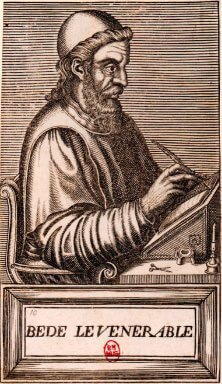
“"Today he is regarded as the first historian of England; yet for the centuries immediately following him, the Venerable Bede was first and foremost the author of several technical works that laid foundations for the literary, historical and even scientific culture of the early Middle Ages, as well as a major Bible commentator, gathering, summarizing and transmitting the body of interpretations developed by the Church Fathers."
“Encyclopaedia Universalis
Bede was born around 673 into a peasant family in the English kingdom of Northumbria (in north-east England, near the Scottish border).
At age seven, he was entrusted to Wearmouth monastery, founded a few years earlier by Benedict Biscop, and was later sent to the twin abbey of Jarrow, not far from the mouth of the Tyne.
He completed his education there, was ordained deacon, then priest at age thirty.
He almost never left Jarrow except for short journeys, hardly ever beyond York. Although he became one of the greatest scholars of his age, his reputation during his lifetime did not extend beyond little Northumbria.
He knew Latin and Greek and was interested in astronomy, medicine and history.
As we saw in our short historical overview, the Easter date was a problem, and its computus opposed, in Anglo-Saxon kingdoms, monks from Ireland and missionaries sent by Rome. To help young monks, whose education he had been tasked with, learn calendars and chronology, Bede first wrote a school summary, De temporibus liber, then a much fuller and more detailed work, De ratione temporum. It is in the latter that we find what little information survives about the old English calendar.
Even though this is what matters most for us on this page, it is not the heart of his work. His extraordinary gifts for analysis and synthesis, and his ability to compile documentation, made him England's first historian.
In what might be called his foundational training, and within the stricter frame of his “profession”, he commented on many books of the Old and New Testaments, including Genesis (I-XX), the Books of Kings, the Song of Songs, the Gospels of Mark and Luke, the Acts of the Apostles, and Revelation.
It is in his Historia ecclesiastica gentis Anglorum (Ecclesiastical History of the English People), a less constrained frame than biblical commentary, that he fully displays his gifts as historian. This is the work by which he became known.
A few years after his death in 735, he became famous. Alcuin hailed him as Beda Magister. He was honored with the title “venerable”. For nearly four hundred years he remained one of the masters of the medieval West, before declining in the 12th century as documentary source treatment evolved.
The calendar
So it is through Bede and his De ratione temporum that we know, in part, the calendar used in England before the Roman conquest. It was naturally replaced by the Julian calendar, most likely as Roman conquests progressed.
As expected for the period, it was a lunar calendar with “solar correction” - in short, a lunisolar calendar.
The year consisted of twelve lunations, from new moon to new moon. From time to time, a thirteenth month was added to stay aligned with the tropical year.
What we do not know
- How exactly the start of the month was fixed: observation or calculation?
- The exact length of the months.
- The intercalation rule for supplementary months.
- The year in which computus began and the event marking its origin.
What we do know
Logic would suggest that, to discover this calendar, we should follow an order like year, month, day. We will not follow that order. We will use another, allowing each point to explain the next.
A) Month names
Let us first become familiar with these names, which will make the rest easier to understand. We will return later to their detailed meaning.
| Month | Approximate modern correspondence |
|---|---|
| (Æfterra) Geola | January |
| Solmonath | February |
| Hrethmonath | March |
| Eostremonath | April |
| Thrimilci | May |
| (Ærra) Litha | June |
| (Æfterra) Litha | July |
| Weodmonath | August |
| Haligmonath | September |
| Winterfylleth | October |
| Blotmonath | November |
| (Ærra) Geola | December |
We can see that four months, in two pairs, share the same name: Geola and Litha.
B) Seasons
According to Bede, "they divided the year into two seasons, summer and winter, assigning to summer the six months in which days are longer than nights, and to winter the other six months. Accordingly, they called the month that begins winter Winterfilleth, a name made of Winter and full moon, because winter begins at the first full moon of that month."
This split of the year into two seasons was not unusual and was common in northern countries at the time. In those regions, two intermediate seasons had less practical basis.
In the month table above, summer months are highlighted in yellow and winter months in blue. For both summer and winter, the first three and last three months frame the summer or winter solstice.
C) Days
Days were named, and those names reveal different influences. For a fuller analysis of weekdays, see the dedicated page.
Let us look at day names:
| French day | Modern English day | Old English day | Meaning |
|---|---|---|---|
| Monday | Monday | Monnandaeg | Day of the Moon |
| Tuesday | Tuesday | Tiwesdaeg | Day of Tyr |
| Wednesday | Wednesday | Wodnesdaeg | Day of Odin |
| Thursday | Thursday | Thunresdaeg | Day of Thor |
| Friday | Friday | Frigedaeg | Day of Frigg |
| Saturday | Saturday | Sæterdaeg | Day of Saturn |
| Sunday | Sunday | Sunnandaeg | Day of the Sun |
We can see there are seven named days, so this is a week. Saturday, Sunday and Monday are rooted in names of celestial bodies - a strong Roman influence. That suggests weekday names are not as old as other parts of the calendar (month names, for example).
We can also see that some Roman deities, such as Mars for Tuesday in Romance languages, were replaced by Germanic gods or goddesses (Tyr, Odin, Thor, Frigg).
So weekday names in Old English (and modern English too) are Roman in origin, after Germanic adaptation.
Also important: here “day” must be understood first as daylight. In other words, the day was the span from sunrise to sunset. Only then did it carry the names shown above. From sunset to next sunrise, the “day” - which was actually night - had another name.
| After sunrise | After sunset |
|---|---|
| Monnandaeg | Tiwesniht |
| Tiwesdaeg | Wodnesniht |
| Wodnesdaeg | Thunresniht |
| Thunresdaeg | Frigeniht |
| Frigedaeg | Sæterniht |
| Sæterdaeg | Sunnaniht |
| Sunnandaeg | Monnanniht |
To use modern terms: Monday would be Monday only from sunrise to sunset. Before moving to Tuesday at the next sunrise, the period from Monday sunset to Tuesday sunrise would be called Tuesday eve.
It even seems that the day (in the sense of daytime) actually started with the previous night. The “day” ran from one sunset to the next.
D) The intercalary month
We do not know how its insertion was calculated or decided, but we know where it was placed: after the two summer months called Litha, and it carried the same name - more precisely, Third Litha.
E) Start of the year
According to Bede, it fell on the night before our Christmas, a night called Modranect, which in Old English can be analyzed as Mod[d]ra Niht, translated as Mothers' Night.
But why refer to Christmas in a pre-Christian calendar?
- Also because the Christmas we know is in fact the “appropriation” of an older pagan feast celebrating the Sun: "Our Christmas festival is nothing but the continuation, under a Christian name, of that ancient sun festival. For ecclesiastical authorities judged it proper, toward the end of the 3rd century or start of the 4th, to move Christ's birth date arbitrarily from 6 January to 25 December, with the aim of diverting to their God the worship that pagans had until then offered to the sun." James G. Frazer, The Golden Bough.
F) Months in detail
The months corresponding to December and January both bore the same name, Geola, the old form of the English word Yule. Bede seems to say that Geola, Yule, was the name of winter solstice day. But it is also possible that Geola covered a whole period starting on winter solstice day and ending twelve days later. Since this period would straddle two months, those months may have been named (Ærra) Geola (before Yule) and (Æfterra) Geola (after Yule).
The month corresponding to February was called Solmonath, which Bede presents as “the Month of Cakes”, referring to cakes offered to the gods during a festival held in that month.
March and April, named Hrethmonath and Eostremonath respectively, honored two deities (otherwise unknown) said to have been named Hrethe and Eostre.
May, named Thrimilci (month of three milkings), because “at that time cows were milked three times a day”, according to Bede.
June and July, like December and January, share the same name: Litha. One is “before” and the other “after” Litha.
Bede writes that "Litha meant 'gentle' or 'navigable' because during these two months the breezes were mild and they could sail on a calm sea."
Modern interpreters, however, think Litha was the name of the summer solstice just as Yule was the name of the winter solstice. There would therefore be a “before solstice” and an “after solstice”, hence the names of June and July. This would mirror the two pairs of identically named months. Why not?
Weodmonath, roughly August, would be the “weed month”, likely alluding to full vegetation growth.
Very little information survives for Haligmonath (our September), which would be “Holy Month” according to Bede, who gives no further detail.
October, called Winterfylleth, is named after the appearance of the first full moon of winter. We already met this month and Bede's description of it in the section on seasons.
Finally, November, called Blotmonath, would be the “Month of Sacrifice”. Without means to preserve meat, excess animals were slaughtered and fish was smoked or salted.
In closing: from Bede to Tolkien
In 1954-1955, J.R.R. Tolkien (1892-1973) wrote his major work, The Lord of the Rings, after a gestation of twelve years.
He pushed precision to the point of inventing several calendars to place his characters in time, described in Appendix D of the book.
We will look more specifically at the Hobbit calendar, used by inhabitants of Middle-earth. We will see that this Shire calendar strongly resembles the one described by Bede.
The year in the Shire calendar has the same length as ours.
All months have 30 days, which is close to a lunation.
However, the synchronization system with the tropical year differs from the old English calendar. As in fixed or perpetual calendars, we find the notion of blank days outside months. There are five of them: three in mid-year (1 Lithe, Mid-year's Day and 2 Lithe), one at the end (1 Yule) and one at the beginning of the year (2 Yule). Every fourth year (leap year), except the last year of a century, an additional day outside any month, Overlithe, is added.
Calendar computus started in year 1600 of the Third Age. Lord of the Rings readers will understand. I take this opportunity to ask them to point out any reading or interpretation error from me, a Tolkien-calendar novice.
A new year in the Shire calendar starts on 23 December in the Gregorian calendar. Now, 23 December can be a possible date for winter solstice. I admit I have not done the conversion, but it would be interesting to know whether the equivalent Gregorian date for the start of Hobbit computus happened to fall exactly on winter solstice.
Month names are as follows:
| Hobbit month | English month | Approximate modern correspondence |
|---|---|---|
| Afteryule | (Æfterra) Geola | January |
| Solmath | Solmonath | February |
| Rethe | Hrethmonath | March |
| Astron | Eostremonath | April |
| Thrimidge | Thrimilci | May |
| Forelithe | (Ærra) Litha | June |
| Afterlithe | (Æfterra) Litha | July |
| Wedmath | Weodmonath | August |
| Halimath | Haligmonath | September |
| Winterfilth | Winterfylleth | October |
| Blotmath | Blotmonath | November |
| Foreyule | (Ærra) Geola | December |
We have to admit: the resemblance is striking.
To finish, note that each year begins on the first day of the week, Saturday, and ends on the last day, Sunday. Special days, naturally, are not part of the weekdays. Here again, we find features of perpetual or fixed calendars.