Tip: Before reading the rest of this page, anyone who is not comfortable with basic astronomy should first read the page dedicated to that topic, here. It is very basic and should not cause any unbearable headache. A quick read of the “astronomical seasons” section on the page about seasons would also be useful.
Also, if you want to learn more about Mars and its satellites, feel free to visit P. Labrot's site here.
A few moments to relax
After reading all or part of this site dedicated to calendars and time studies, we have earned a short break.
Why not use it for some practical calendar work? For example, we could build the calendar that might be used on another planet if we ever felt like going there for a holiday.
And why not choose as our test ground the planet closest to us: Mars?
If you are up for this session of slicing Martian time, we will first review the characteristics of Mars that are useful for building our calendar and compare them with Earth's. Then we will build the skeleton of a Martian calendar and compare it with those designed over recent decades.
Because, honestly, there is no shortage of “Martian calendars.” We will visit the reference site on the subject: Martian Time (Note: the original site disappeared, but Mars24 Sunclock still exists). It was the ultimate resource on the topic. Its author, Thomas Gangale, truly deserves a huge salute. He is also the author of one of the best-known Martian calendars: the Darian calendar (named after his son, Darius).
Meanwhile, I will allow myself one small criticism of Martian Time: it was an absolute mess, and even a cat would have lost her kittens there. So I will try to indicate as precisely as possible what was where.
Comparing Earth and Mars characteristics
Let us view them in table form, noting that only figures related directly or indirectly to calendar construction (plus a few general data points) are listed.
| Warning: image proportions are not preserved | Mars | Earth | |
|---|---|---|---|
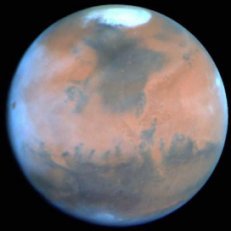 | 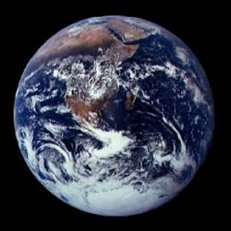 | ||
| Characteristic | Index | Value for Mars | Value for Earth |
| Equatorial diameter | 6,794 km (0.5326 of Earth's) | 12,756.28 km | |
| Distance at aphelion | 1 | 249.23 million km | 152.10 million km |
| Distance at perihelion | 2 | 206.65 million km | 147.10 million km |
| Average distance from the Sun | 227.94 million km | 149.60 million km | |
| Orbital eccentricity | 3 | 0.09340 | 0.01671 |
| Tilt of equator relative to the ecliptic | 4 | 25.19 deg (25 deg 12') | 23.45 deg (23 deg 27') |
| Surface temperature | -123 deg / +37 deg C | 15 deg C average | |
| Sidereal rotation period | 5 | 24.622962 h 24 h 37 min 22 s | 23.9345 h 23 h 56 min 4 s |
| Mean solar day | 6 | 24.65973 h 24 h 39 min 35 s | 24.0000 h 24 h 00 min 00 s |
| Sidereal orbital period | 7 | 686.996 d 668.6146 sols | 365.2564 d 365 d 6 h 9 min 12.96 s |
| Anomalistic orbital period | 8 | 686.980 d 668.5991 sols | 365.2596 d 365 d 6 h 13 min 49.44 s |
| Orbital period at the vernal equinox | 9 | 686.972 d 668.5907 sols | 365.2424 d 365 d 5 h 49 min 3.34 s |
| Orbital period at the summer solstice | 10 | 686.968 d 668.5880 sols | 365.2416 d 365 d 5 h 47 min 54.24 s |
| Orbital period at the autumn equinox | 11 | 686.974 d 668.5940 sols | 365.2420 d 365 d 5 h 48 min 28.80 s |
| Orbital period at the winter solstice | 12 | 686.976 d 668.5958 sols | 365.2427 d 365 d 5 h 49 min 29.28 s |
| Tropical orbital period | 13 | 686.973 d 668.5921 sols | 365.2422 d 365 d 5 h 48 min 46.08 s |
Quite a list of numbers, right? Let us comment on a few of them by index.
1 - 2: aphelion is the farthest point of the orbit from the Sun. Perihelion is the closest point. See paragraph 2 in the “Astronomical seasons” section on the page about seasons.
3: It varies between 0 and 1. The closer eccentricity is to zero, the flatter the ellipse. So Mars's orbit is slightly less flattened than Earth's. See paragraph 2 in the “Astronomical seasons” section on the page about seasons.
4: This tilt, explained in “Step 2: rotation and obliquity” of the Astronomical seasons section on the seasons page, means that Mars, like Earth, has astronomical seasons.
Data 5 and 6 concern planetary rotation around the axis, while data 7 to 13 concern orbital travel time (with different reference points). For now, we will ignore the notion of a “sol” and come back to it later.
5: sidereal rotation is the time after which the planet returns to the same orientation relative to surrounding stars.
6: mean solar day is the average over a very large number of days of the interval between two consecutive passages of the Sun over the same meridian. Of course, this assumes meridians have been defined on Mars... but well... let us act as if they have.
7: the anomalistic year is the time the planet takes to return to perihelion.
8 to 13: see “Step 5: four seasons make one year” in the Astronomical seasons section on the page about seasons.
Building Martian calendars
Let us forget “lunar” calendars
Since Earth has lunar calendars based on lunation length, why not imagine months based on the synodic periods (time between two passages of a moon at the same position relative to the Sun) of one of Mars's two satellites, Phobos and Deimos?
We must quickly abandon that idea.
Not because it would be too much honor to compare these two “potato-shaped rocks” with our majestic Moon.
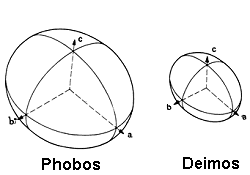
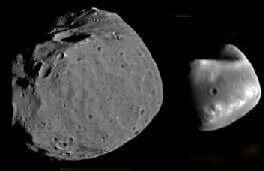
Phobos and Deimos are tiny, potato-like bodies, what mathematicians would call three-axis ellipsoids. One slight similarity with our Moon: both satellites always show the same face (part a in the diagrams) toward Mars.
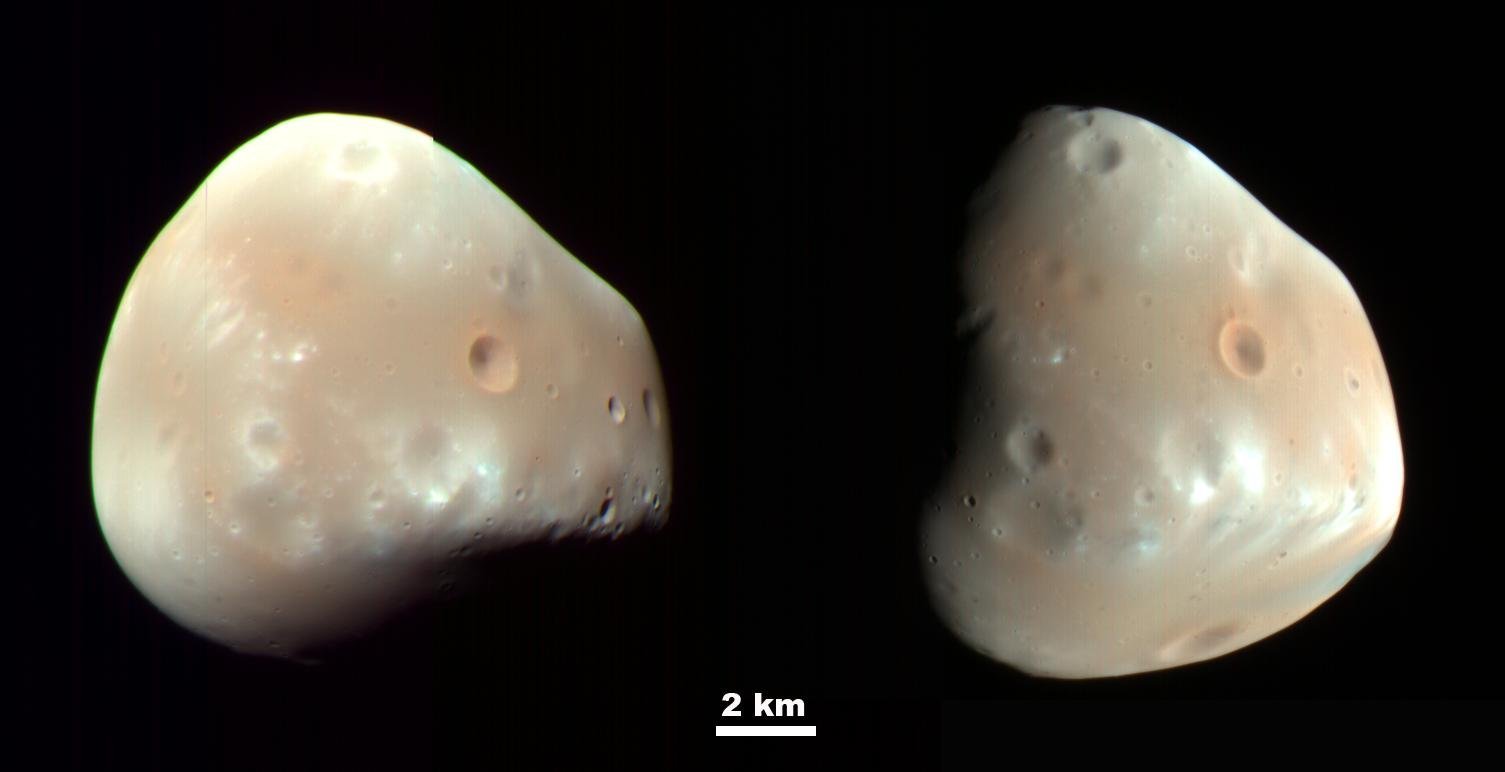
Deimos (no accent on the e, please) (15 km x 12 km x 11 km) is among the smallest natural satellites in the solar system (for comparison: Moon diameter = 3,476 km). It orbits 23,459 km above the Martian surface (384,000 km for the Moon from Earth).
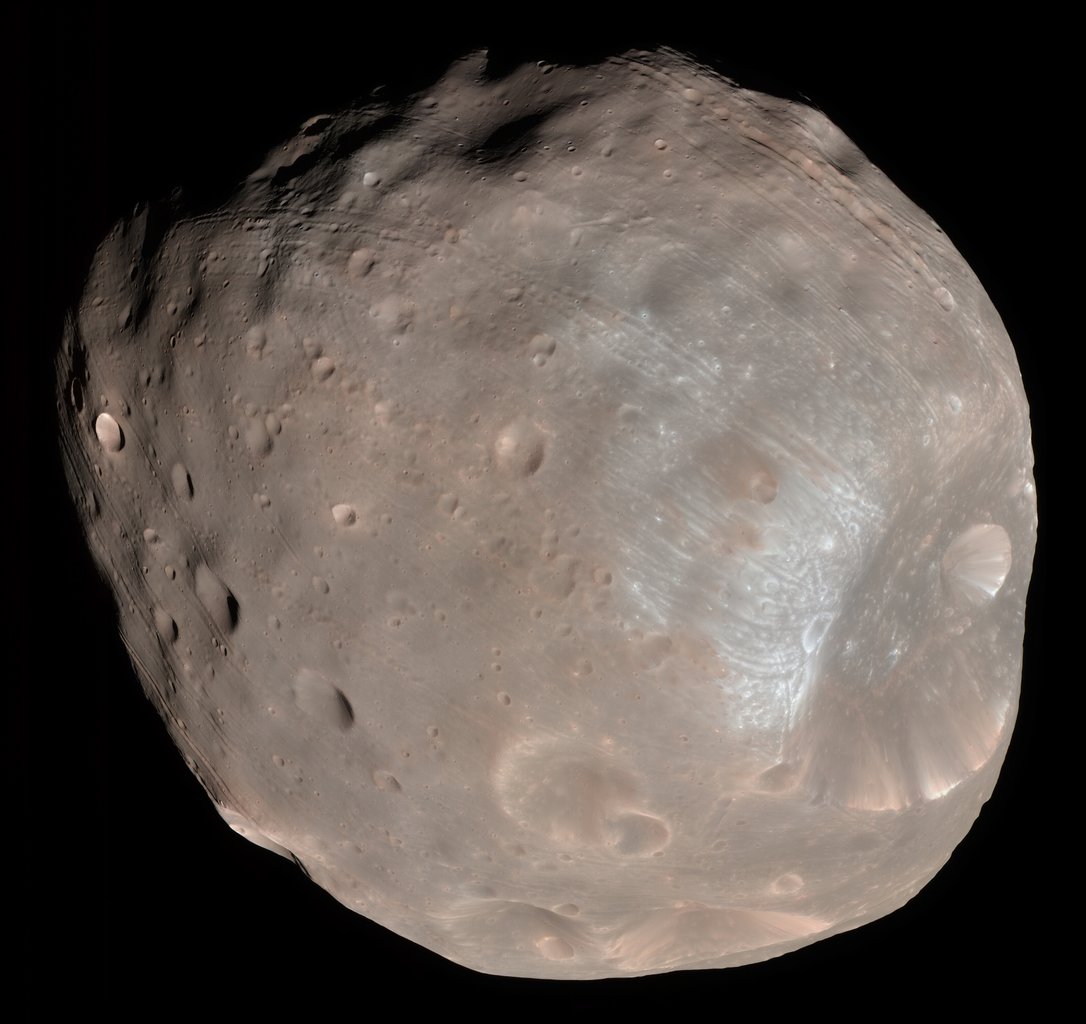
Phobos (27 km x 21 km x 18 km) is also among the smallest natural satellites in the solar system (Moon diameter = 3,476 km). It orbits 9,380 km above the Martian surface (384,000 km for the Moon from Earth).
The real reason to abandon the lunar-calendar idea is simple: the revolution periods of Phobos and Deimos are 7.65 h (7 h 39 min) and 30.30 h (30 h 18 min), respectively. That is far too short for a calendar month. A “Phobos month” would even be shorter than one Martian day.
Toward a solar calendar: two unavoidable units, day and year
Once a Martian lunar calendar is ruled out, we must go with a solar calendar and define its main units: the day (through the notion of hour) and the year.
The rest (months and weeks) is simply a matter of subdivision, open to anyone's preferred model.
The Martian day: how many hours?
From the characteristics table, we saw that Earth's mean solar day is, naturally, 24 h 00 min 00 s, while Mars's is 24 h 39 min 35.24409 s.
The difference is therefore small (about 2.75% longer on Mars), and one might keep the Earth model (24 hours / 60 minutes / 60 seconds), slightly adjusting second length to 1.02749125 “Earth” seconds.

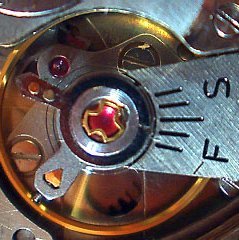

So we could keep old mechanical clocks and watches. Their future lies ahead... on Mars. It would be enough to shift calibration toward S (slow) so Earth seconds become Martian seconds. And since Martian gravity is only one-third of Earth's, the alarm clock would weigh hardly more than the watch.
Many Martian-calendar designers kept the Earth model. Others used the opportunity to unleash their imagination, with some even proposing decimal models that the authors of the 1792 French Republican calendar would probably have liked.
One important note: to distinguish the Earth day from the Martian day by duration, Mars-calendar inventors also coined names for the Martian mean solar day. Options vary widely, as shown on Martian Time: dar, Mday, antoi, even day. But sol seems to have prevailed since 1976 and the first Viking Lander missions.
The Martian year: how many days or sols?
With day length settled, we now need to determine how many sols are in a Martian year.
Let us look more closely at the list of calendars invented since the early 20th century, formerly listed on Martian Time.
As noted earlier (planet characteristics table), depending on the chosen starting point (equinox or solstice), year length varies between 668.5880 and 668.5958 sols, with a mean tropical year of 668.5921 sols.
Since a calendar year must use an integer number of days, one can imagine a 668-sol year plus intercalation (leap-style) to compensate for the gap between 668 calendar sols and the true orbital period of 668.xxxx sols.
This principle appears in many proposed models: mostly 668-sol years with occasional inserted days to quickly reduce drift. Very classic.
Every calendar has an epoch, i.e., a starting date corresponding to a specific date in a reference calendar. Proposals for Martian epochs were numerous: start of the Julian period (1 January 4713 BC), start of our era (1 January AD 1), Viking 1 landing (20 July 1976), and many others.
We should also ask whether a Martian era should begin at year 0 or year 1. Answers vary. It is still a pity that even simple sol counting at probe landings was never truly synchronized: sol 0 for Viking, sol 1 for others, sol 1 for Opportunity and Spirit even though their landings were separated by 22 sols.
In conclusion
In the end, if we take stock of building a Martian calendar, we find nothing fundamentally new if we already followed how solar calendars emerged, such as Julian and then Gregorian systems.
When visiting Martian Time, one cannot help asking: what is all this for?
Nearly 90 versions of Martian calendars appeared in the list we studied. Everyone proposes their own number of days per week, per month, per year, their own number of weeks per month, months per year, lists of weekday names, month names, and much more.
For my part, I have an answer to that question: unless it is simply for the pleasure of doing it, all this is for nothing.