A little history
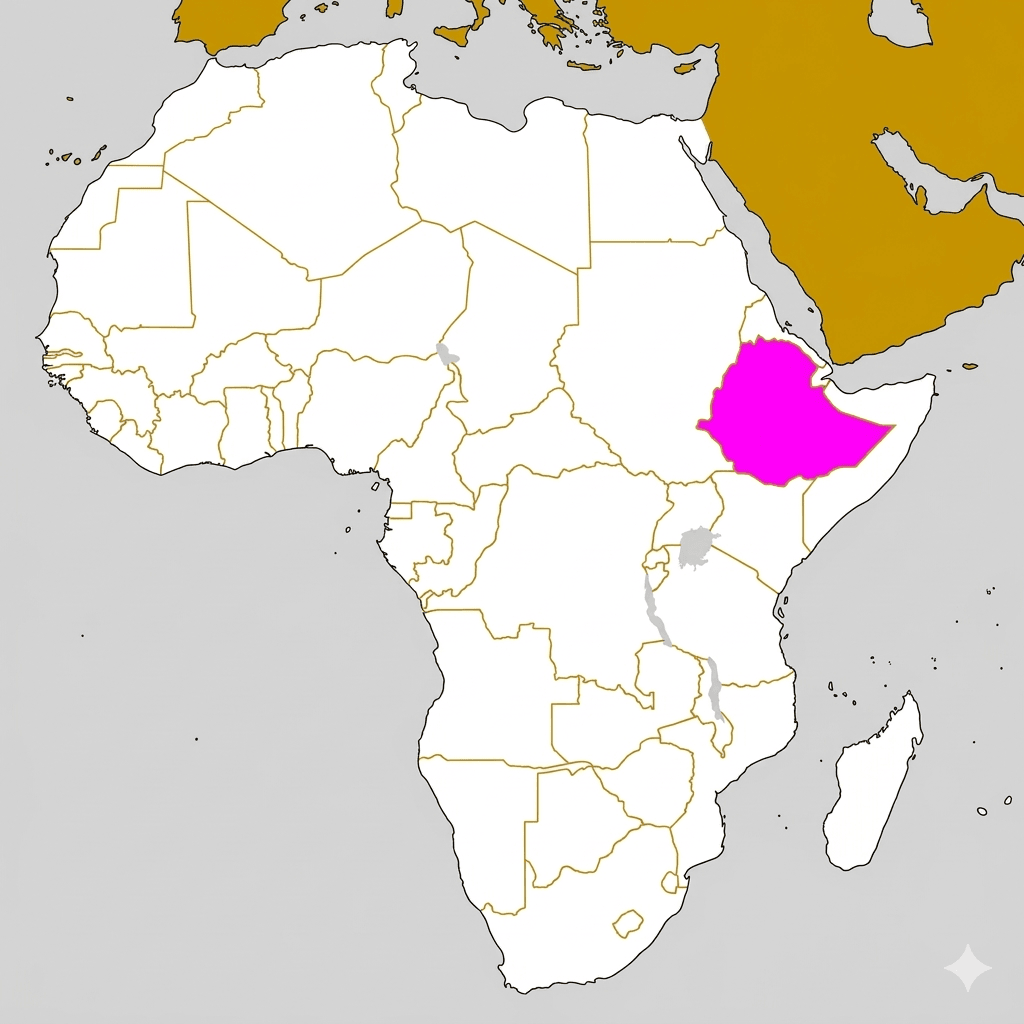
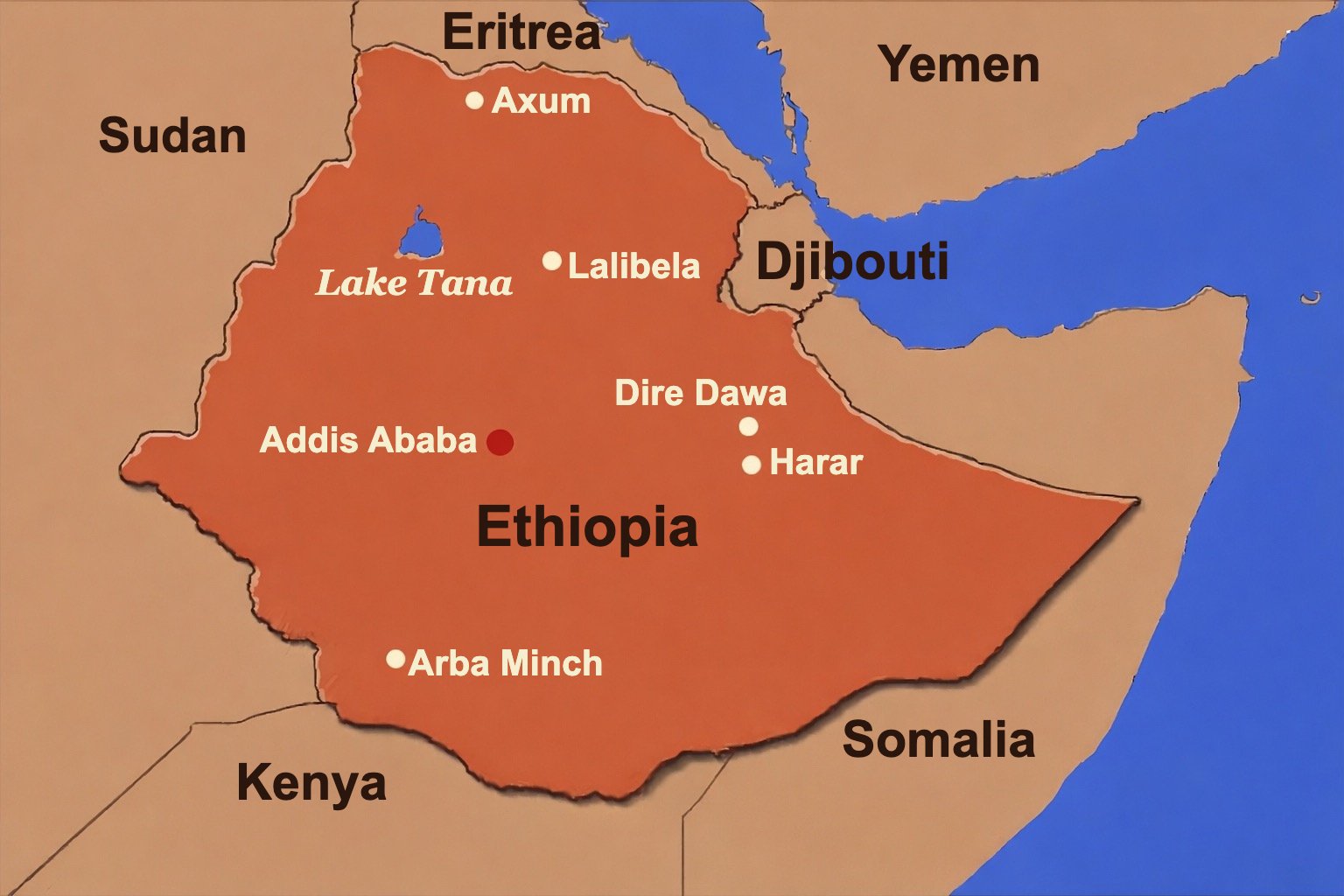
One of the oldest known hominids, Lucy (around 3 million years old), was discovered in Ethiopia, which is considered one of the cradles of humanity.
Ethiopia (“land of burnt faces” in Greek), from the Semitic Habesha (which gave Abyssinia), was known to the Pharaohs and mentioned in the Old Testament. There we read that Menelik I, son of King Solomon and the Queen of Sheba, founded the Ethiopian Empire.
The kingdom of Aksum emerged around 500 BC, and its power expanded across all of northern Ethiopia and most of the center.
Ezana, who ascended the throne around AD 320, converted to Christianity and adopted the same monophysite tradition as the Coptic Christians of Egypt. The kingdom then prospered for several centuries.
In the 7th century, Islam appeared, spread rapidly, and the kingdom collapsed in the 10th century.
In 1137, the Agaw Zagwe dynasty seized power and was overthrown in 1270 by Yekuno Amlak.
In the 15th century, a political system was born that lasted until the mid-20th century: an absolute monarchy led by an emperor (Negus).
In the 16th century, the kingdom fell under Muslim domination, and the Negus requested Portuguese support. Muslims were defeated in 1543, halting the advance of Islam in Ethiopia.
A long period of dynastic confusion and decline followed, until Menelik II came to power in 1889, reunified the kingdom, and established the capital in Addis Ababa.
Lij Iyasu, great-nephew of Menelik II, ascended the throne after his abdication and was deposed in 1916.
Power then passed to Tafari, who became negus nagast (King of Kings) on 2 August 1930 under the name Haile Selassie I. He gave Ethiopia its first constitution. In 1936, Mussolini's Italy invaded the country, and Victor Emmanuel III (King of Italy) became emperor. Haile Selassie fled and regained his throne only in 1941 with British support.
In 1952, the United Nations opted for a federation of Eritrea and Ethiopia. Eritrea became an annexed province in 1962. A national resistance movement immediately appeared: the Eritrean Liberation Front.
The headquarters of the Organization of African Unity (OAU) were established in Addis Ababa in 1963.
In February 1974, an army revolt broke out in response to Haile Selassie's refusal to address Ethiopia's internal problems (inequality, underdevelopment, famine), and he was deposed by the military junta on 12 September.
After a period of social and political unrest, Lieutenant-Colonel Mengistu Haile Mariam became President of the Council of Ministers and the Military Council in 1977. A period of purges and terror followed. He had to confront armed rebellion in Ogaden, Eritrea and Tigray, as well as war with Somalia.
In 1984-1985, severe drought caused a devastating famine in the northwest of the country. Supported mainly by Cuba and the USSR, Mengistu's regime could not survive the collapse of the Soviet Union and internal opposition movements (EPRDF, Ethiopian People's Revolutionary Democratic Front, and EPLF, Eritrean People's Liberation Front).
In May 1991, Mengistu went into exile in Zimbabwe, and the EPRDF entered Addis Ababa.
Eritrea's independence was recognized on 3 May 1993. The elections of 1992 and 1994 were won by the EPRDF. In August 1995, parliament elected Negasso Gidada President of the Republic. He appointed Meles Zenawi (leader of the EPRDF) as head of government.
Border disputes between Eritrea and Ethiopia are still unresolved...
The calendar
Like the Coptic calendar, the Ethiopian calendar comes from the Egyptian wandering calendar, with an adaptation for leap years.
It therefore strongly resembles the Julian calendar.
The year consists of twelve months of 30 days, followed by a “small month” made up of 5 or 6 epagomenal days (5 in common years and 6 in leap years).
| Month | Name | Julian months | Gregorian months |
|---|---|---|---|
| 1 | Meskerem | August/September | September/October |
| 2 | Tekemt | September/October | October/November |
| 3 | Hedar | October/November | November/December |
| 4 | Tahesas | November/December | December/January |
| 5 | Ter | December/January | January/February |
| 6 | Yekatit | January/February | February/March |
| 7 | Meggabit | February/March | March/April |
| 8 | Miyazia | March/April | April/May |
| 9 | Genbot | April/May | May/June |
| 10 | Sene | May/June | June/July |
| 11 | Hamle | June/July | July/August |
| 12 | Nahase | July/August | August/September |
| 13 | Pagume | from 24 August to 28 or 29 August | from 6 September to 10 or 11 September |
Unlike the Egyptian wandering calendar, this calendar has a fixed starting point (1 Meskerem, year 1), corresponding to 29 August, year 8 (Julian).
As in the Gregorian calendar, this starting point refers to the birth of Christ. The issue is that this date is disputed. Ethiopians therefore chose a date shifted by 7 or 8 years from the Gregorian choice. It may in fact be further from the historical date.
The Ethiopian New Year (Enqutatash) begins on the date that currently corresponds to 11 or 12 September in the Gregorian calendar (29 or 30 August in the Julian calendar).
Leap years
They follow the rhythm of Gregorian leap years as follows: Ethiopian leap years are those in which the end of the corresponding Gregorian year is immediately followed by a Gregorian leap year. Example: nahase 1995 (Ethiopian) corresponds to August/September 2003 (Gregorian). 2003 is followed by leap year 2004. Therefore 1996 E.E. is a leap year.
The Ethiopian week
The Ethiopian week has seven days, with Sunday as the first day. The day names are:
| English day | Ethiopian day |
|---|---|
| Sunday | Ehud |
| Monday | Segno |
| Tuesday | Maksegno |
| Wednesday | Rebu |
| Thursday | Hamus |
| Friday | Arb |
| Saturday | Kidamie |