TIP: Because the Aztec and Maya calendars are built on very similar principles, it is best to read the section on Maya calendars before this one. On this page, we focus only on the differences between the two systems.
A little history
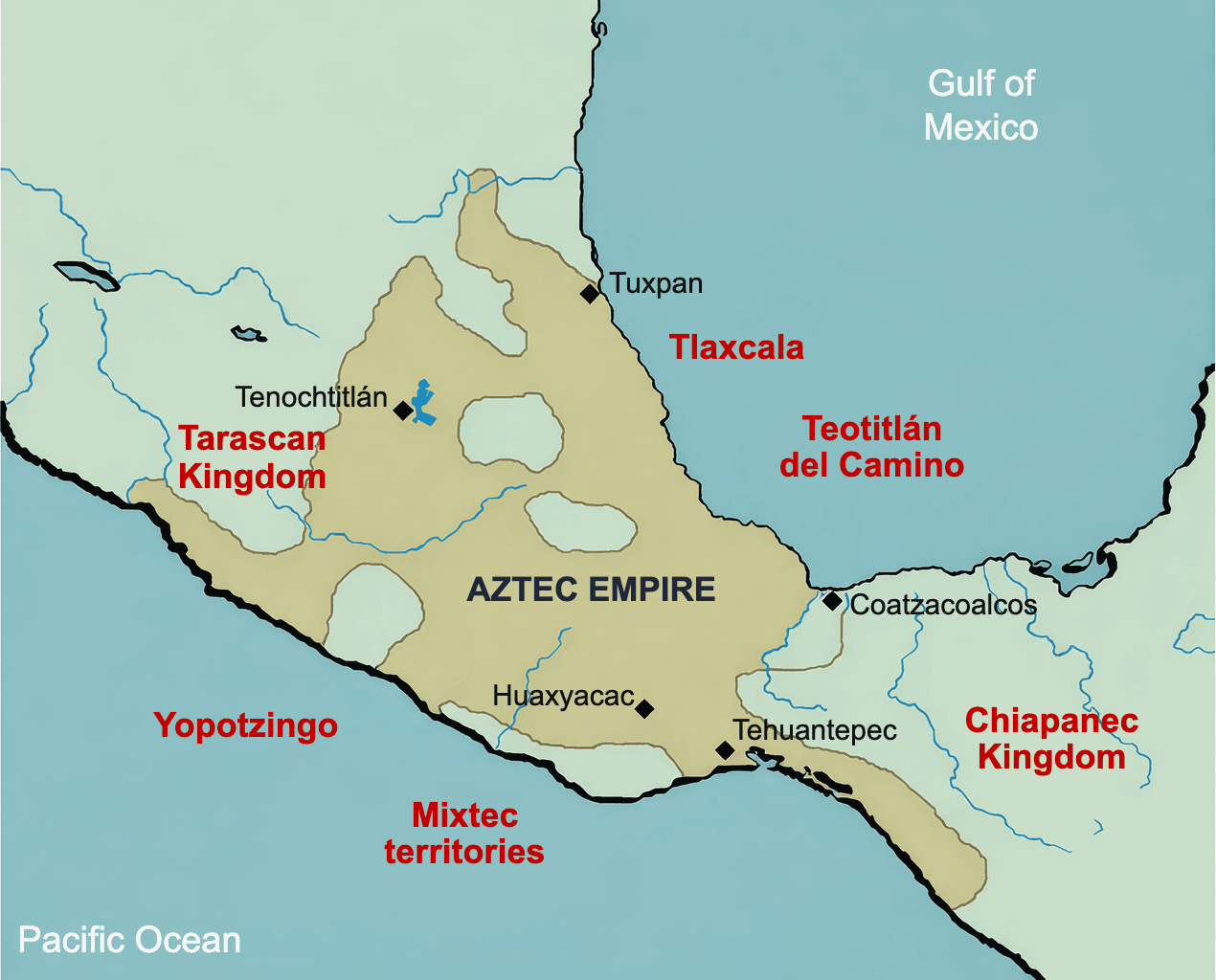
We are still in what is called Mesoamerica (see Maya calendar), but this time in its Mexican area.
Mexican history is usually divided into four major periods (source: Encyclopaedia Universalis):
- Preceramic period (15,000 to 1,500 BC): nomadic hunter-gatherer tribes.
- Preclassic or Formative period (1,500 BC to AD 300): emergence of agriculture (maize), sedentarization, and worship of gods and goddesses. Between 1200 BC and 900 BC: rise of Olmec civilization.
- Classic period (until AD 900): emergence of major religious centers and urban development.
- Postclassic period: first wave of invaders from the north, the Toltecs, perhaps linked to the building of Teotihuacan and founders of Tula in 980. Ten priest-kings are said to have ruled successively until 1168, developing what became known as the Toltec Empire. The most famous of these kings was Acatl-Topiltzin. Civil war drove him from Tula, and his followers scattered across the valley and allied with other Nahua tribes. Integrating nomadic tribes from the north, Tula developed until 1165, when the city was ravaged by fire during a final Chichimec invasion. The Toltecs then fled and influenced many cities such as Texcoco, Coyoacan, Azcapotzalco, Culhuacan, Chalca and Xochimilco.
That was the situation when, in the 13th century, a group of Chichimecs from the north appeared in the Valley of Mexico. They were called Mexicas or Aztecas. They said they came from a place called “Aztlan” and were led by four priests carrying their tribal god, Huitzilopochtli. Skilled and brave warriors, they gradually became masters of Mexico:
In 1323, they were expelled from Culhuacan by its king. He had agreed to give his daughter in marriage to their chief so she could become a war goddess, unaware that this deification required her sacrifice.
Once again the Mexicas had to flee, but in 1325 they found the place where Huitzilopochtli had ordered them to build their city: where they would see an eagle on a cactus devouring a serpent. On an islet in Lake Texcoco, they founded Mexico-Tenochtitlan. Shortly after, they built a twin city on a neighboring islet, called Tlatelolco.
Around 1367, however, poverty forced them to enlist as mercenaries in the Tepanec kingdom of Atzcapotzalco, ruled by Tezozomoc. City-states in the valley fell one after another.
Around 1376, Acamapichtli, prince of Culhacan, was elected as first Tlatoani (priest-king) of the Aztecs.
In 1426, King Tezozomoc died, and his son Maxtlazin (the “Tyrant Mextla”) did everything possible to oppress the Aztecs and the rising power they represented.
The Aztecs won that confrontation. From 1427 to 1440 ruled the man who established Aztec hegemony across the Valley of Mexico: Itzcoatl, assisted by his adviser Tlacaeelel. The latter remained adviser under three reigns.
Under his influence, the Triple Alliance was formed between Tenochtilan, Texococo and Tlacopan.
From 1440 to 1502, under Moctezuma and his successors (Axayacatl, Tizoc, Ahuiltzol), the Aztec realm kept expanding. Only a few regions resisted Aztec pressure.
Moctezuma Xocoyotzun (1502-1520), paralysed by memory of old Toltec traditions, believed he recognized in Hernan Cortes the Toltec king Quetzalcoatl (the Feathered Serpent), as prophecy had foretold. At his invitation, the conquistadors entered Mexico on 8 November 1519.
Despite an Aztec resistance surge in 1520, the siege of Mexico began in May 1521 and the city fell in August.
By 1525, the Aztec Empire - which, as we saw, was more a confederation of states than a true empire - had come to an end.

Calendar(s)
We saw that the Maya used two calendars: Tzolkin and Haab. What about the Aztecs?
They also used both systems. The sacred calendar is called Tonalpohualli (Tzolkin for the Maya). The civil calendar is called Xiuhpohualli (Haab for the Maya).
1) Tonalpohualli calendar
Same structure as its Maya counterpart: a 260-day cycle. Same mechanism too: interlocking rotation of thirteen numbers and twenty signs.
A day (tonali) is therefore made of a number-sign combination. The glyphs and protective deities, however, are different:
| Glyph | Name | Translation | Protective deity |
|---|---|---|---|
 | Cipactli | Crocodile | Tonacatecuhtli |
 | Ehecatl | Wind | Quetzalcoatl |
 | Calli | House | Tepeyollotl |
 | Cuetzpalin | Lizard | Huehuecoyolt |
 | Coatl | Serpent | Chalchihuitlicue |
 | Miquizti | Death | Tecciztecatl |
 | Mazatl | Deer | Tlaloc |
 | Tochtli | Rabbit | Mayahuel |
 | Atl | Water | Xiuhtecuhtli |
 | Itcuintli | Dog | Mictlantecuhtli |
 | Ozomahtli | Monkey | Xochipili |
 | Mamilalli | Grass | Patecatl |
 | Acatl | Reed | Tezcatlipoca |
 | Ocelot | Jaguar | Tlazolteotl |
 | Cuauhtli | Eagle | Xipe Totec |
 | Cozcacuauhtli | Vulture | Itzpapalotl |
 | Ollin | Movement | Xolotl |
 | Tecpatl | Flint | Chalchihuihtotolin |
 | Quiahuitl | Rain | Tonatiuh |
 | Xochitl | Flower | Xochiquetzal |
This sacred 260-day count was divided into 13-day periods (trecenas, analogous to our weeks), each marked by the glyph opening the sequence. Each trecena was itself placed under the protection of a deity. This gives the following distribution:
| No. | Name | God | No. | Name | God |
|---|---|---|---|---|---|
| 1 | Cipactli | Ometeotl | 11 | Ozomahtli | Patecatl |
| 2 | Ocelotl | Quetzalcoatl | 12 | Cuetzpalin | Itzlacoliuhqui |
| 3 | Mazatl | Tepeyollotl | 13 | Ollin | Tlazolteotl |
| 4 | Xochitl | Huehuecoyotl | 14 | Itzcuintli | Xipe Totec |
| 5 | Acatl | Chalchihuitlicue | 15 | Calli | Itzpapalotl |
| 6 | Miquiztli | Tonatiuh | 16 | Cozcacuauhtli | Xolotl |
| 7 | Quiahuitl | Tlaloc | 17 | Atl | Chalchihuihtotolin |
| 8 | Malinalli | Mayahuel | 18 | Ehecatl | Chantico |
| 9 | Coatl | Xiuhtecuhtli | 19 | Cuauhtli | Xochiquetzal |
| 10 | Tecpatl | Mictlantecuhtli | 20 | Tochtli | Xiuhtecuhtli |
2) Xiuhpohualli calendar
Same structure as its Maya counterpart: “year” (xihuitl) = 18 “months” (meztli) of 20 days + 5 ominous days (nemontemi). Same operation too: interlocking rotation of thirteen numbers and twenty signs. A day (tonali) is therefore made of a number-sign combination.
However, meztli glyphs and protective deities differ:
| Month | Glyph | Name | Translation |
|---|---|---|---|
| I |  | Atlacacauallo | Cessation of water |
| II |  | Tlacaxipehualiztli | Flaying of men |
| III |  | Tozoztontli | Little Vigil |
| IV |  | Hueytozoztli | Great Vigil |
| V |  | Toxcatl | Drought |
| VI |  | Etzalcualiztli | Consumption |
| VII | 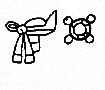 | Tecuilhuitontli | Little feast of dignitaries |
| VIII | 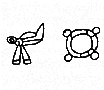 | Hueytecuihutli | Great feast of dignitaries |
| IX | 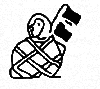 | Tlaxochimaco | Offering of flowers |
| X | 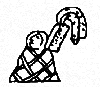 | Xocotlhuetzin | Falling of fruits |
| XI |  | Ochpaniztli | Sweeping |
| XII |  | Teoleco | Return of the gods |
| XIII |  | Tepeihuitl | Mountain feast |
| XIV |  | Quecholli | Name of a bird |
| XV |  | Panquetzaliztli | Raising of banners |
| XVI | 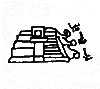 | Atemoztli | Descent of water |
| XVII |  | Tititl | Birth feather |
| XVIII |  | Izcalli | Growth |
 | Nemontemi | The 5 ominous days |
The last day of the last month of the year (xihuitl) gave its name to the year. This name was associated with a number from 1 to 13. This “gear-wheel” association is now familiar to us. Only four names could recur: Acalt (Reed), Tecpatl (Flint), Calli (House), Tocltli (Rabbit). Year 1-Reed was thus followed by 2-Flint, then 3-House...
After 52 years, all combinations are exhausted and the cycle starts again at 1-Reed.
3) Calendar count
This 52-year cycle, which also existed among the Aztecs, was called xiuhmolpilli. It was subdivided into four 13-year periods, each named after the symbol associated with number 1. For example, the 13-year group starting with 1-House is called “House years” or House sign. At the end of this 52-year cycle, the Aztecs celebrated the New Fire Ceremony.
4) Supplementary days
With a 365-day year, the calendar was not aligned with the mean tropical year of roughly 365.25 days. How did the Aztecs correct that gap? By adding one day every four years like the Julian calendar, by adding several days at regular intervals (as in the Chinese calendar), or by doing nothing (as in the Egyptian calendar)?
Every hypothesis has been proposed on this point (including on this page in an earlier version), but without proof, a hypothesis remains just talk.
Given the current state of evidence and research, we must acknowledge that Michael D. Coe of Yale University is right when he writes (Mexico, p. 181) that "... neither the Aztecs nor any other Mesoamerican people used leap years or any intercalation system to correct the fact that the true year is a quarter day longer than 365 days" (my free translation).
Until proven otherwise, we will therefore treat the Aztec calendar as a “wandering” calendar, in the same sense as the Egyptian calendar.
I would add that, according to Eduard Seler (see here), between the year of conquest (1519) and the date of Sahagun's writings, over some forty years, no intercalation was carried out.
And besides, since each day (including ominous days) corresponds to a distinct glyph, why is there no trace of glyphs for supplementary days if they existed?
5) Correspondence with our calendar
It is not established with exact precision. We know that some date the fall of Tenochtitlan to 13 August 1521 (Julian calendar), corresponding to 1-coatl in year 3-Calli.
We cannot finish studying Aztec calendars without mentioning the famous Piedra del Sol (Stone of the Suns), often incorrectly called the “Aztec calendar”. Its Aztec name was Cuauhxicalli (Eagle vessel).
If you want to discover this stone, click here.