In a page devoted to almanacs, we saw that royal almanacs, published as prints, were true witnesses to the period in which they were produced, when they were not outright propaganda tools.
Here, we will try to see whether the same was true (and perhaps still is) for what we will generically call the “postal calendar”: that printed front-and-back card, sometimes with extra sheets, containing all kinds of information and handed to us each year by the postman (when he rings, and when he is willing!).
Before starting the analysis itself, this short historical overview will help us follow the steps that led to the postman's almanac as we know it today.
That long evolution cannot be separated from the history of the postman, and I would have liked to point you to a website that traces that story through the ages. Unfortunately, I have not found one that does it in precise detail.
A short history
Let's summarize the main milestones in the birth of the postman's almanac in table form.
| Date | Events and notes | |
|---|---|---|
| 13th century | University messengers handled the transport and delivery of letters for students and their families. They were later authorized to serve private individuals as well. | |
| 1576 | King Henry III established royal messenger services that competed with the university services. | |
| 1595 | Creation of the office of general superintendent of posts, marking the birth of the letter post service. Mail transport, previously a royal privilege, was soon opened to the public. At this stage, mail was carried only from town to town. | |
| 1638 | A document from the *Cour des Aides* (a sovereign court where litigation related to taxes and levies was judged in final instance) mentions the notion of a "delivery postman". | |
| 5 March 1758 | Piarron de Chamousset created a Petite Poste service to collect and distribute letters within Paris, with three deliveries per day. | |
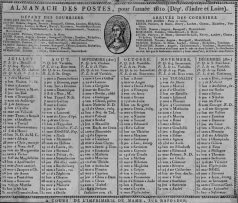
| 1759 - 1850 | In the following years, other Petite Poste offices appeared in the provinces: Bordeaux (1733); Nantes (1777); Lyon (1777); Rouen (1778); Lille and Marseille (1781). Up to 1855, postmen handed out calendars in exchange for New Year's tips, either as booklets (such as the Lille Petite Poste almanac or the Paris Post almanac) or as small wall calendars. These calendars had many names: Postman's New Year Gift, XXX Postal Almanac, Desk Almanac, calendar, office calendar, and even, for the first time in 1810, Postal Almanac (bottom image). | 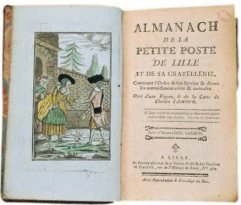 |
 | ||
| 1830 | This is when rural service was introduced (laws of 3 and 10 June 1829). The countryside was now served by postmen every two days. The round became daily in 1832. | |
| 15/12/1849 | In a circular, the Director General of Posts, Edouard J. Thayer, prohibited postmen from distributing printed matter other than that entrusted to the postal service, except for "the distribution of calendars for their own benefit and account, in accordance with long-established custom". | |
| Early 1850 | Postmen in Rennes had 21 x 27 sheets printed (the current format) and mounted them on cardboard. These calendars showed six months on each side, with zodiac signs and postal service information. | |
| 1854 | Francois-Charles Oberthur, a printer in Rennes, offered his services to Rennes postmen and improved their 1850 calendar. He added drawings on the front alongside the 12 months of the year. The back was reserved for postal information. The sheets were mounted on card with a colored paper border. | |
| 01/09/1855 | By circular, the Director General of Posts, Stourm, instructed postmen to distribute almanacs supplied either by the postal administration or by departmental service heads. The postal administration therefore took control in Paris and, in the provinces, imposed content control through departmental inspectors or directors. Officially named "postal almanac", the calendar had to include saints' names and general and local information on postal service operations. | |
| 28/08/1857 | The postal administration took full control of almanac supply and entrusted manufacturing, for 12 years starting in 1859, to the Mary-Dupuis printing house in Noyon. | |
| 1859 | As Mary-Dupuis could not manufacture all calendars alone, Oberthur obtained the concession for 32 departments. | |
| 1860 | Mary-Dupuis failed to meet its commitments, and calendar manufacturing rights were transferred to Oberthur, who bought out the monopoly. | |
| 28/10/1867 14/12/1867 | Two ministerial decisions ended the monopoly on almanac supply, effective in 1870. | |
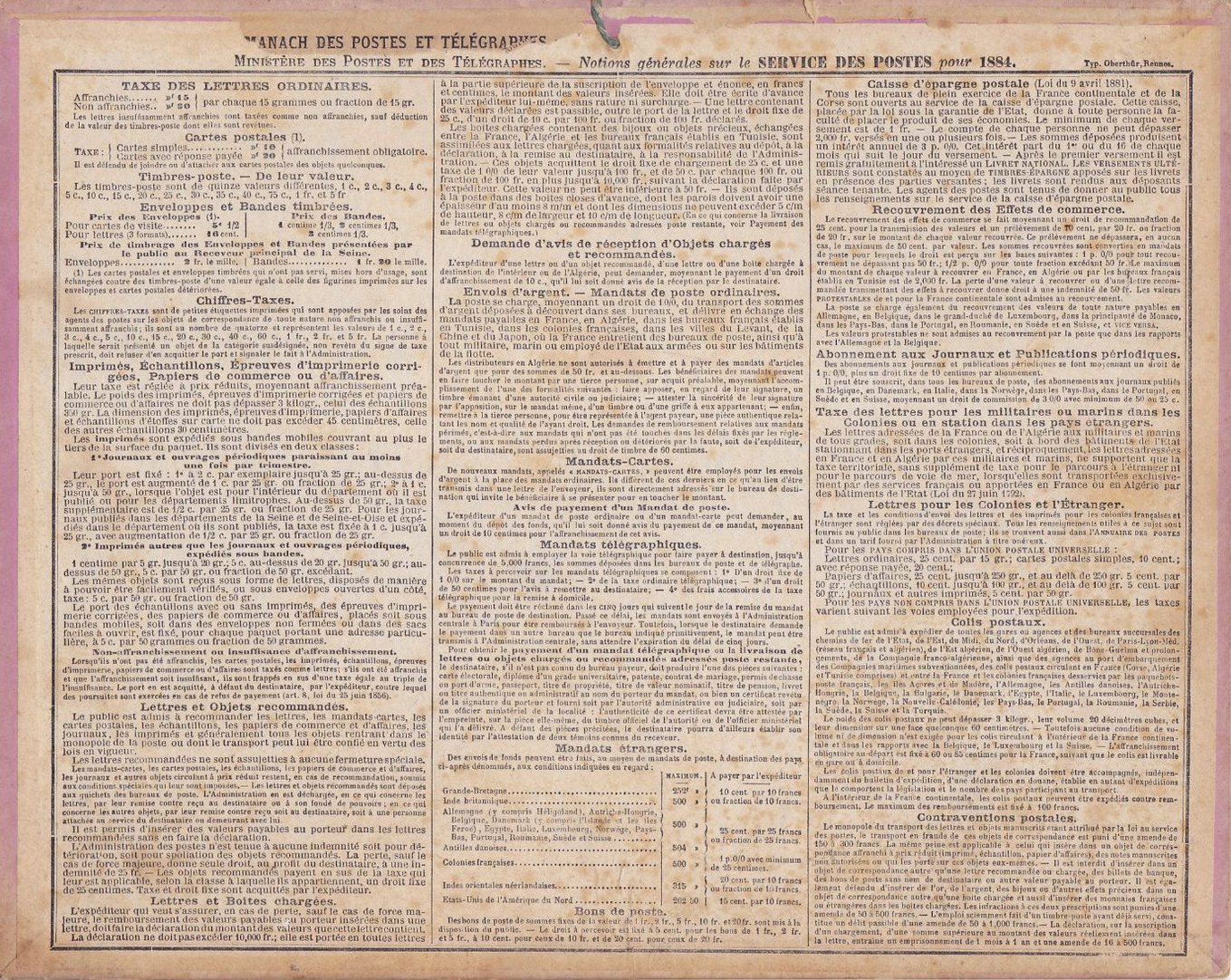
| 01/1870 | The Director General of Posts, E. Vandal, specified that "any publisher in the Empire could undertake publication, at their own risk, for one or several departments, provided they complied with regulatory requirements." Those requirements remained the same in terms of content: calendars, astronomical notes, fairs and markets, and general information on postal services. Almanac proofs were submitted by publishers to the departmental director, who granted authorization, then printed on the almanac itself, as shown opposite. | 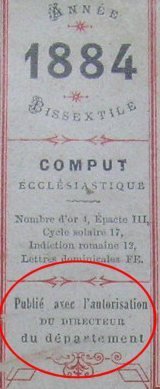 |
| 1880 | The Postal Almanac became the Post and Telegraph Almanac. | |
| From 1880 to today | Publishers coexisted or replaced one another with mixed success. - Between 1884 and 1913: Pithiviers, Villain, Typlite, Vanito. - 1915: the PTT orphanage took 37% of the market from Oberthur. - 1928: creation of Oller (still a publisher today). - 1950: Nisse. - 1952: Petillot. | |
| 1989 | The Post and Telegraph Almanac became the Postman's Almanac. It was still called that in 2004. | |
The “postal calendar”, a witness to its time?
Here we will focus on images, since the textual content itself is not very informative from a documentary point of view.
As we will see through a few almanacs, the answer to the question is YES, at least until roughly the 1950s.
The postal calendar held a privileged place in homes. Often hung on a wall, it provided daily information people regularly needed: saint's day, today's position in the year, moon phases, and so on. That central place in daily life made it perfect for conveying, gently or more bluntly (then we call it propaganda), either snapshots of everyday life, records of major events from the previous year, or political messages. As Frederic Maguet rightly notes in Les Temps de la vie, "[It has] a hold over duration, over the succession of events, those salient moments in the history of mankind."
Let's look at this subtle dissemination and this blunt propaganda through a few examples.
We should also note that less subtle propaganda can be consciously accepted or rejected. The variety of image themes means people can make an informed choice each year.
Postal Almanac 1810 - quiet propaganda
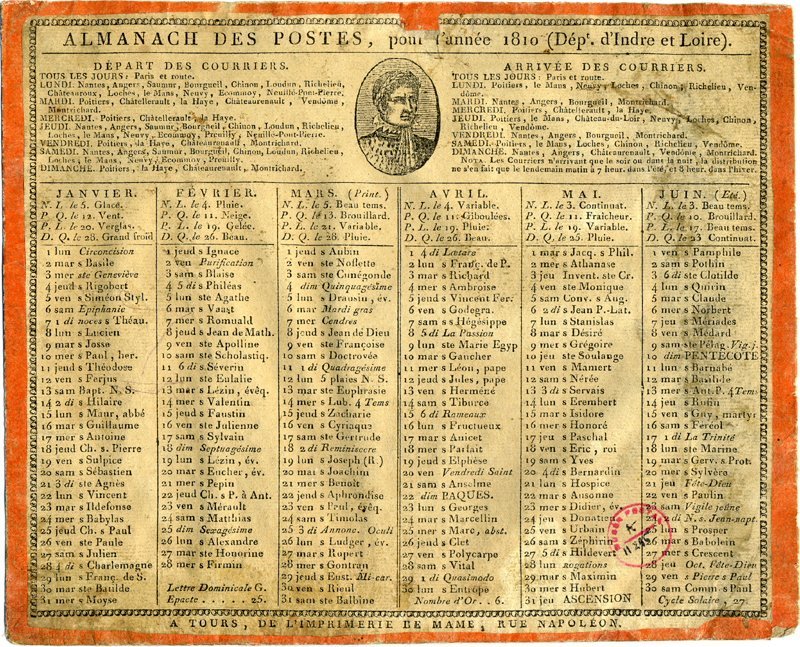
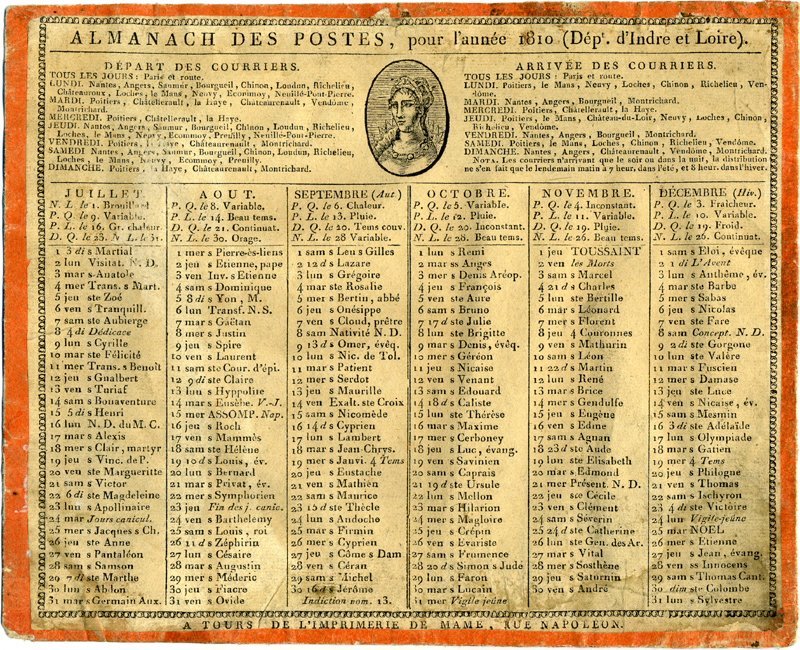
This is far from the lavish imagery of royal almanacs. Just a medallion at the top: Napoleon I on the front and the Empress on the back.
Post and Telegraph Almanac 1884 - social change: getting away
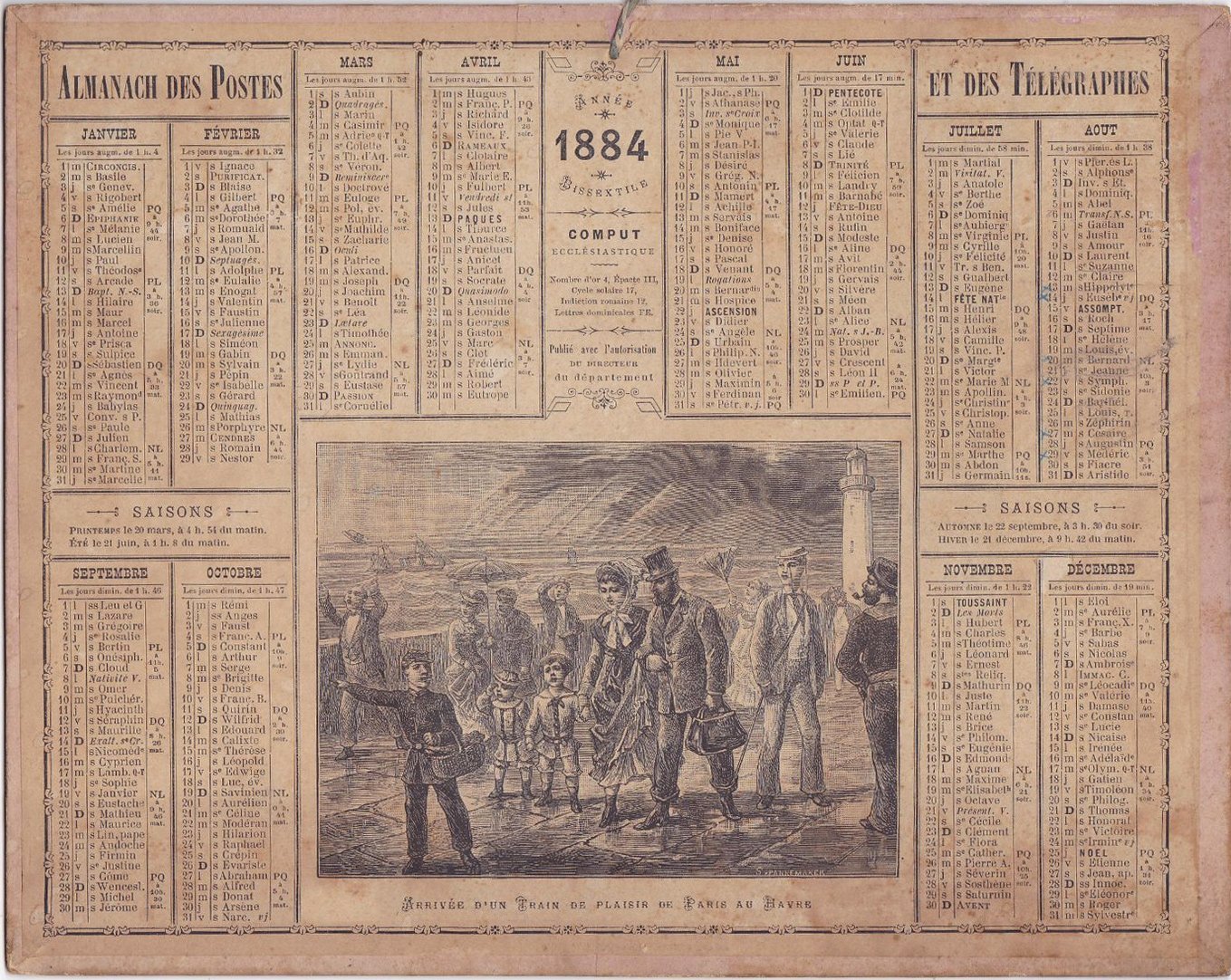
The image is titled Arrival of a pleasure train from Paris to Le Havre.
"In his whole life, he had taken only three holidays, each lasting eight days, to move house. But sometimes, on major holidays, he left on a pleasure train bound for Dieppe or Le Havre, to uplift his soul through the imposing spectacle of the sea." Guy de Maupassant, Les dimanches d'un bourgeois de Paris.
The first Paris railway was inaugurated on 25 August 1837, and only a few decades later one could read: "Paris walls are covered with temptations on blue, yellow, green and violet paper. Pleasure train to Strasbourg! Pleasure train to Nancy! Pleasure train to Le Havre and Trouville! Travel to Belgium, Holland and the Rhine! Excursions to Switzerland! You cannot take a step without a railway company urging you to leave Paris; and now Spanish lines are joining in. A newspaper announced the other day that, on the 8th of this month, the first pleasure train between France and Spain crossed the Pyrenees." (L'Illustration, 21 May 1864, Courrier de Paris, p. 323.)
Neither the train nor the station is shown in the image. A sailor, a lighthouse and a boat at sea are enough to suggest the destination.
As for “pleasure”, not quite. All travelers look sour, soaked, and seem to be fighting the wind. Should we see a cause-and-effect link between this grim arrival and the fact that, at the time, pleasure trains were already shifting from Channel resorts toward the milder skies of the Mediterranean?
Sport and fashion
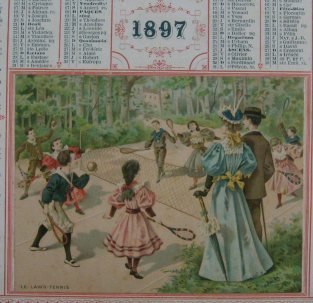
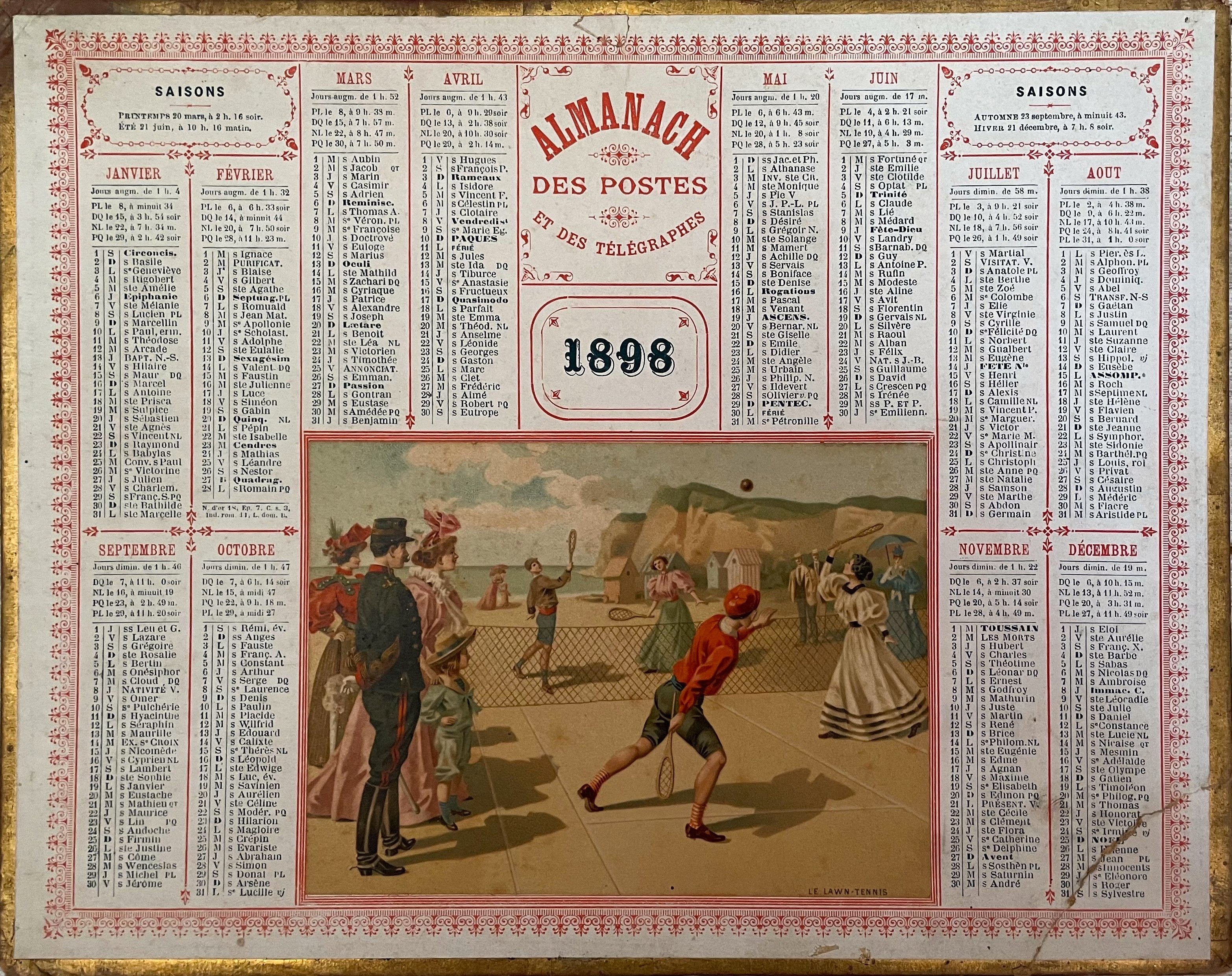
These two Post and Telegraph Almanacs are titled Lawn Tennis.
From 1890-1900 onward, lawn tennis (Jeu de Paume on grass, in English), born in England, spread worldwide. The term “lawn tennis” gradually gave way to “tennis” as the game moved to different surfaces.
The two images also show that location matters very little.
We can also note how similarly both images are composed, just one year apart. It seems the small 1897 family suddenly grew in 1898. A useful chance to observe period clothing and yearly shifts in fashionable colors.
Clean wars with no violence
1914-1918
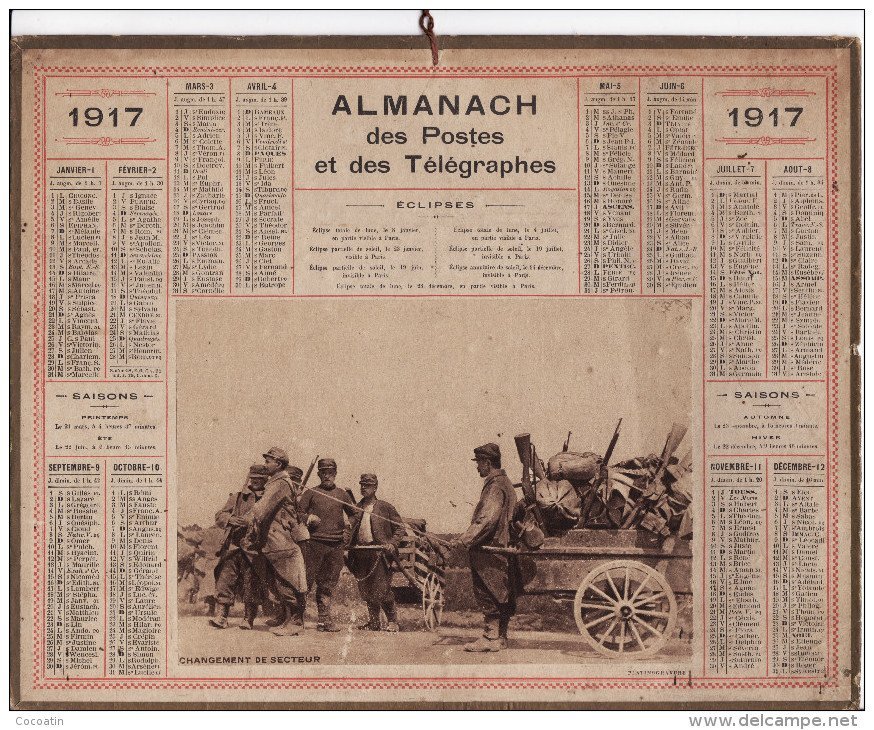
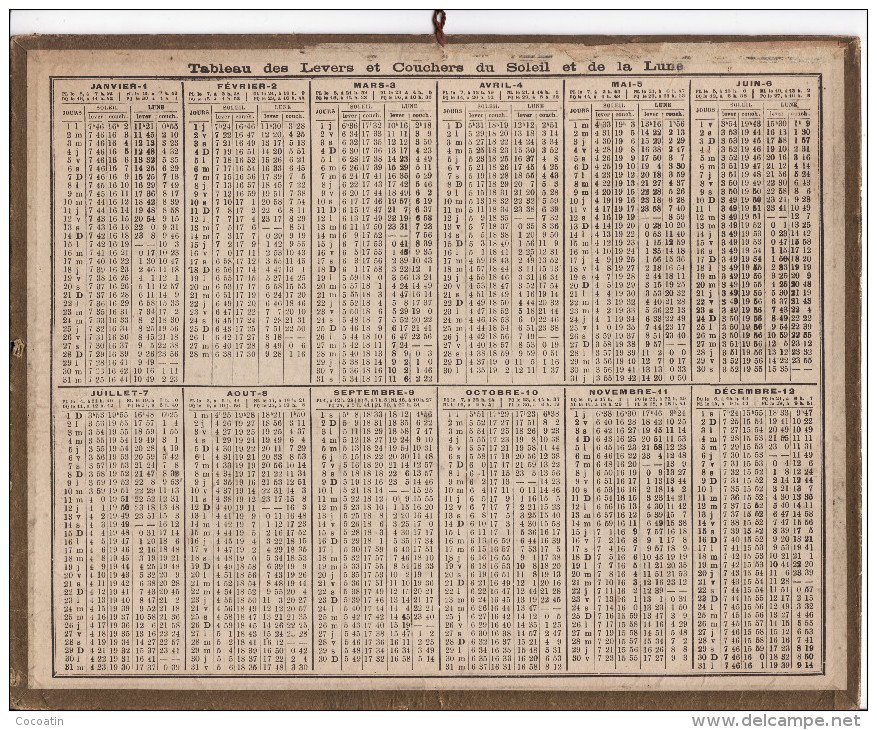
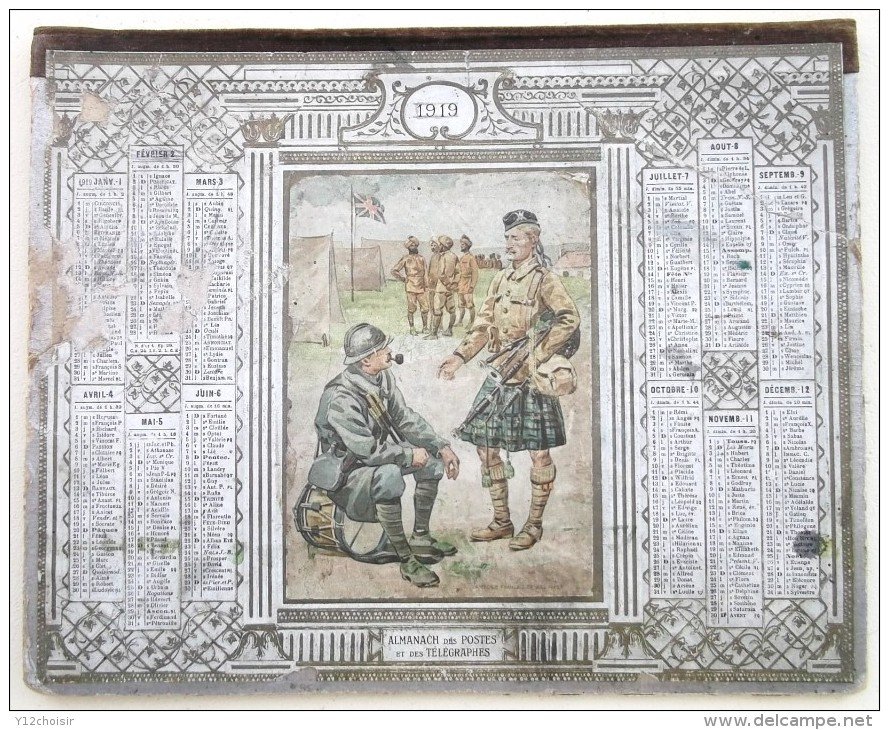
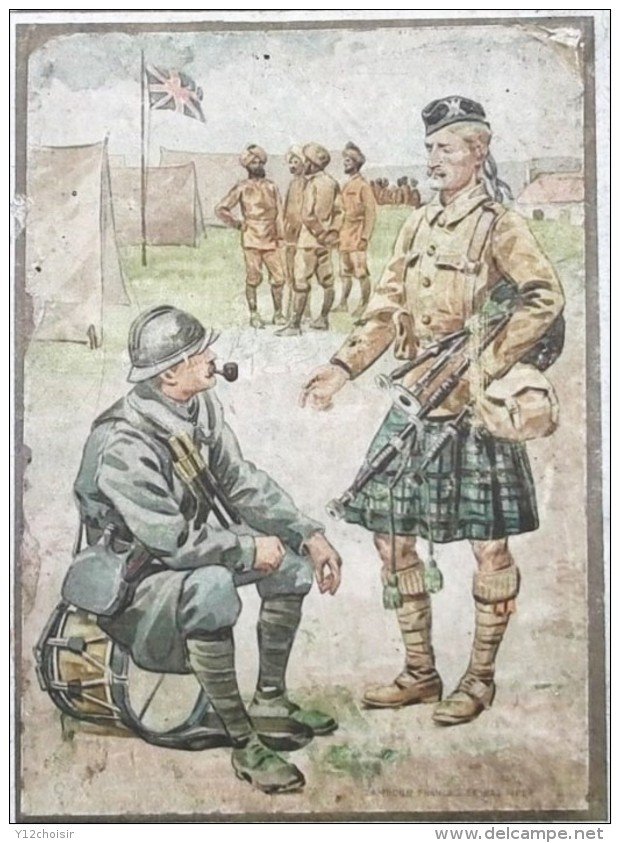
No combat scenes in the 1914-1919 calendar images. Just troops moving in neat order, uniforms spotless.
Or, as in the 1919 Almanac, tributes to the 74 000 Scots who died on French battlefields. In the background, one can distinguish Indian soldiers under British command.
And when people did not want daily war images before their eyes, even sanitized ones, they could always ask the postman for an Almanac showing ordinary scenes, like this 1914 issue titled A road crossing.
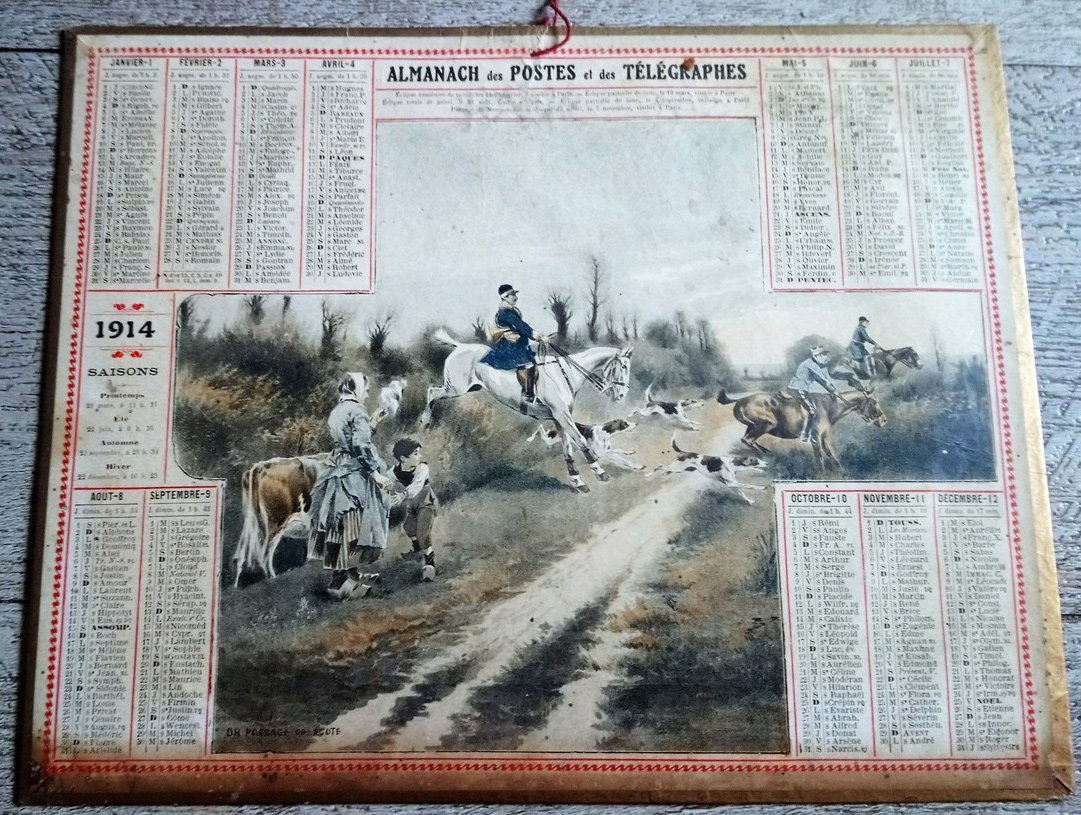
Though one might still wonder whether this road crossing has a double meaning. Does this frightened child and galloping pack, with a military figure in second position, depict a simple road crossing... or a border crossing?
1939-1945
In the calendars of the Second World War, drawings of combat largely disappear, replaced by full-length portraits or close-up figures, often photographs. Propaganda reaches its peak.
During the war these figures are, of course, Petain; in the final year and after, de Gaulle.
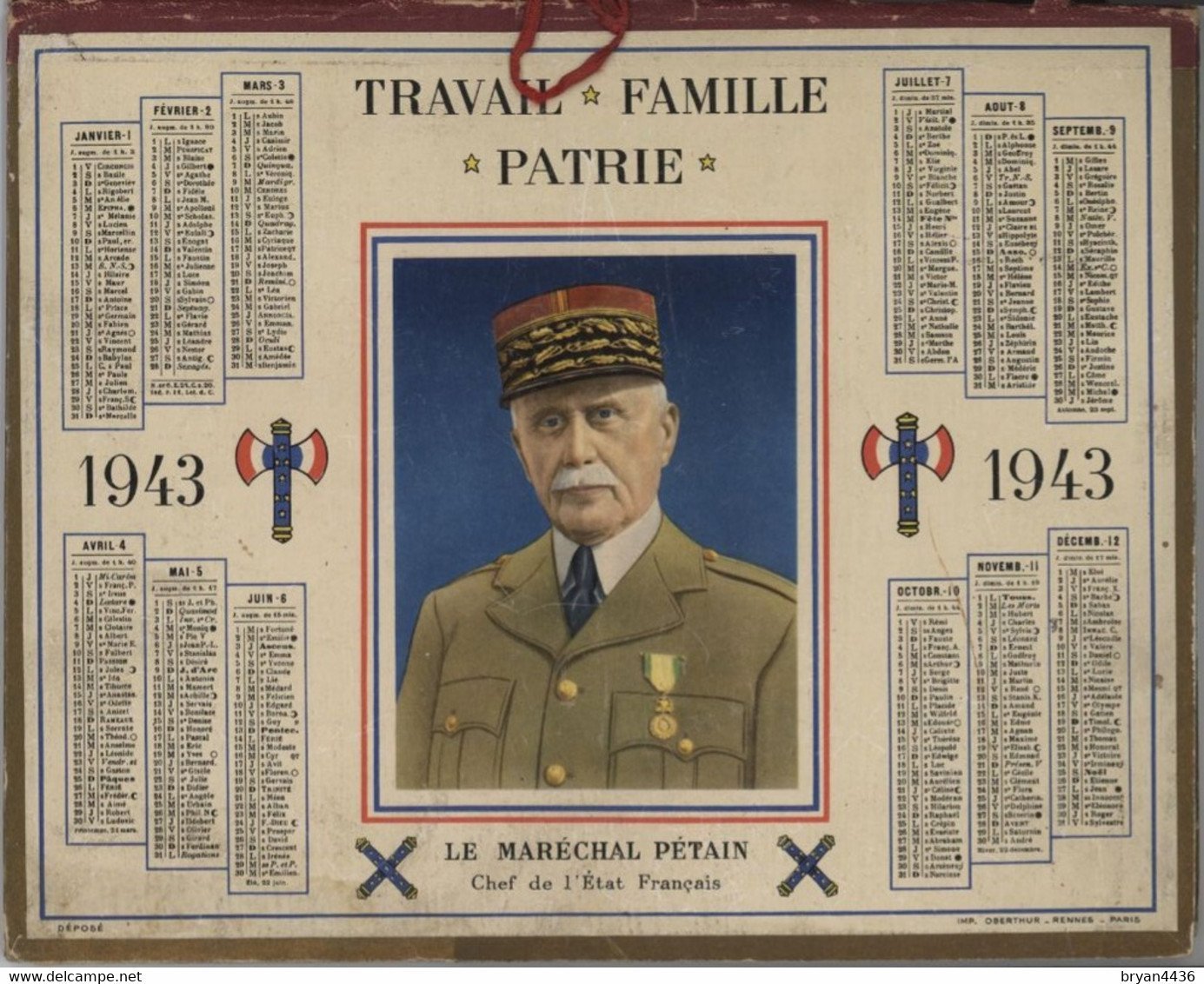
1943 calendar. At first glance, it may not seem to be a Postal Almanac, but it is impossible to ignore: all propaganda markers are there, the Francisque in French colors and a martial Petain in uniform.
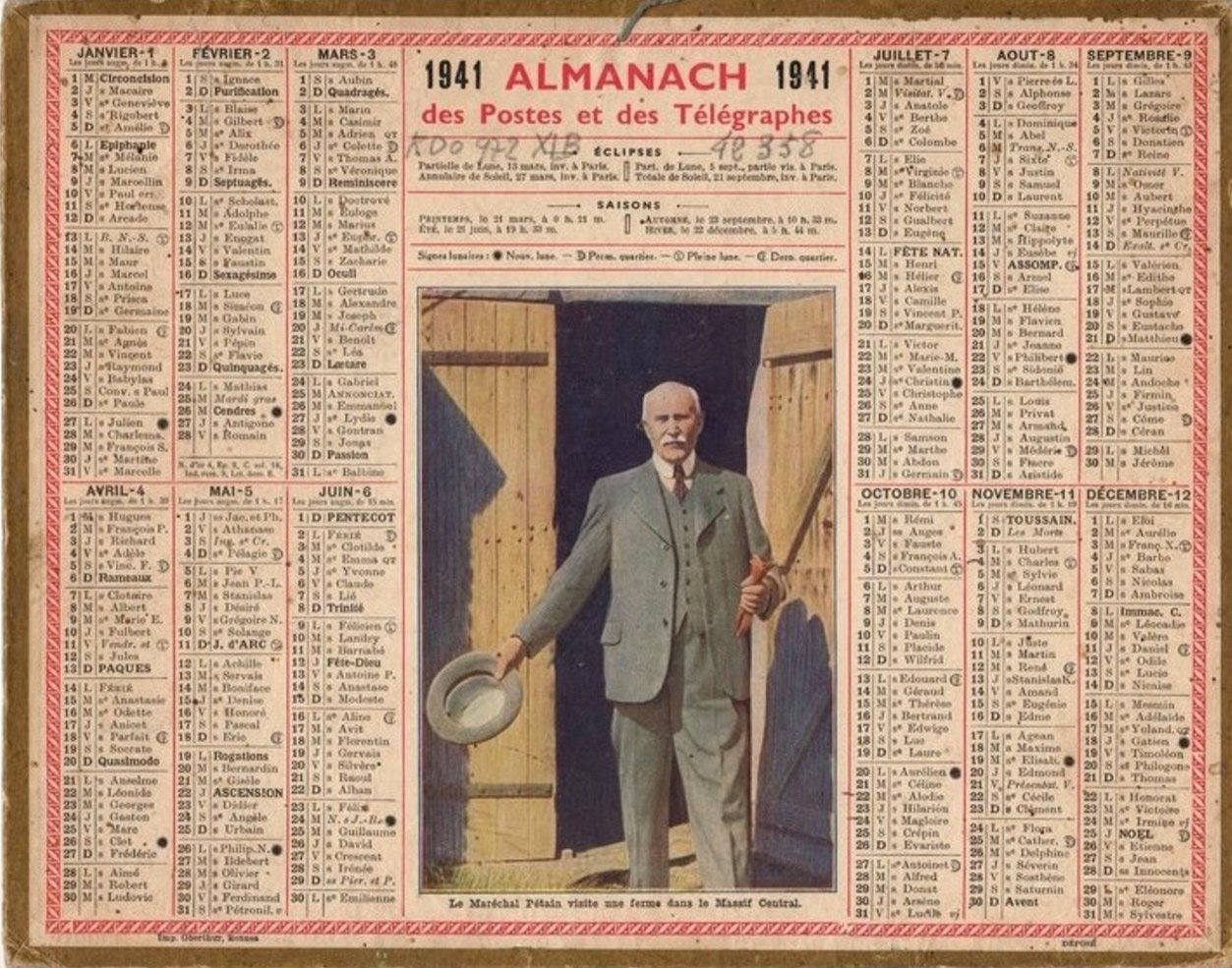
1941 Post and Telegraph Almanac, captioned Marshal Petain visits a farm in the Massif Central. Here Petain appears in civilian clothes, as vigilant father of the nation, attentive to every social group.
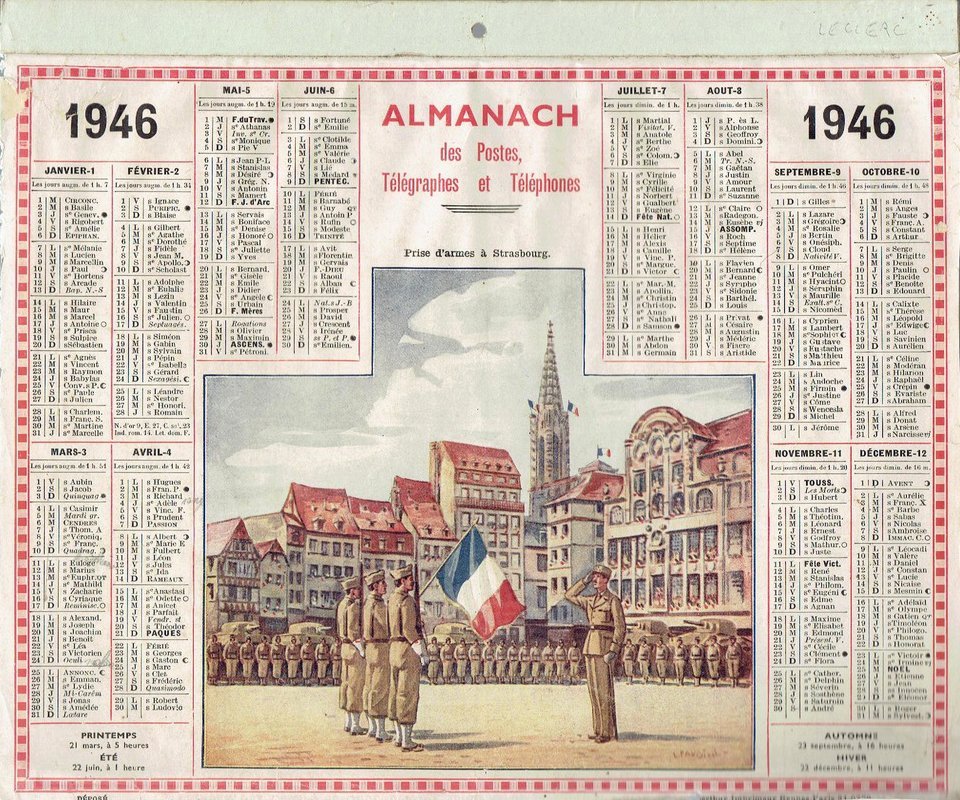
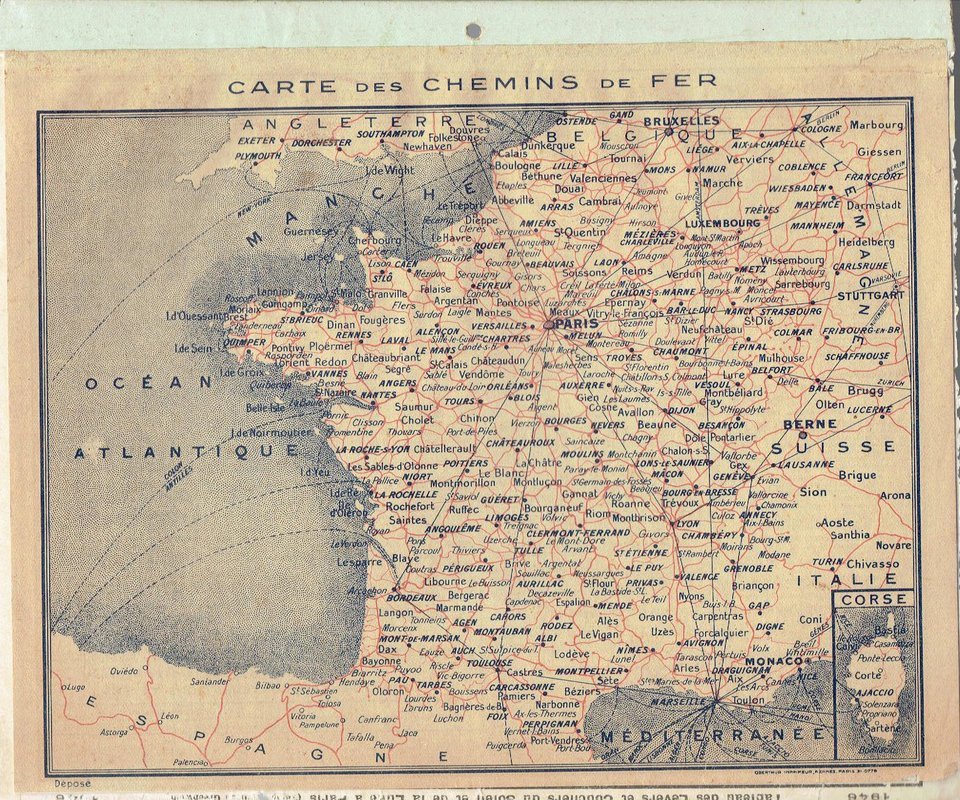
Naturally, in 1945 the central figure changes. In this 1946 Postal Almanac titled Arms ceremony in Strasbourg, a military officer, likely General Leclerc, conducts the ceremony. Flags flying on monuments symbolize, if needed, the liberation of the city.
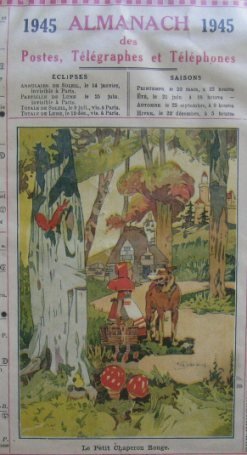
And as in the First World War, if you want not to think of war every time you check your calendar, there are more neutral images.
Here too, as in 1914-1918, one can wonder whether a double reading is possible: does the wolf from Little Red Riding Hood, in this 1945 Almanac, symbolize a certain occupying army? Let us remember that a given year's calendar images can only depict events from the previous year.
The Postal Almanac after the last world war
Little by little after 1945, we see a complete impoverishment of image content. Curiously, this coincides with photography replacing drawing.
Today it is nearly impossible to find postman's almanacs showing anything other than cute kittens, puppies, or bland animals and landscapes with little significance. Calendar topicality has been overtaken by the media. Would there still be demand for representations lagging one year behind? Perhaps, but the postman does not ask our opinion, and the publisher certainly does not ask his.
It would be interesting to browse the image catalogues that Oberthur or Oller make available to postmen, but if you visit their websites you quickly find that access is restricted. A pity.
For year 2005, I got a dog in a basket on the front and two Labrador puppies on the back. As a witness of its time, we have seen better.