It is often said that the rule for fixing the date of Easter was established at the Council of Nicaea (today Iznik, Turkey), held for at least three months starting on 20 May 325 (Julian). Is that true?
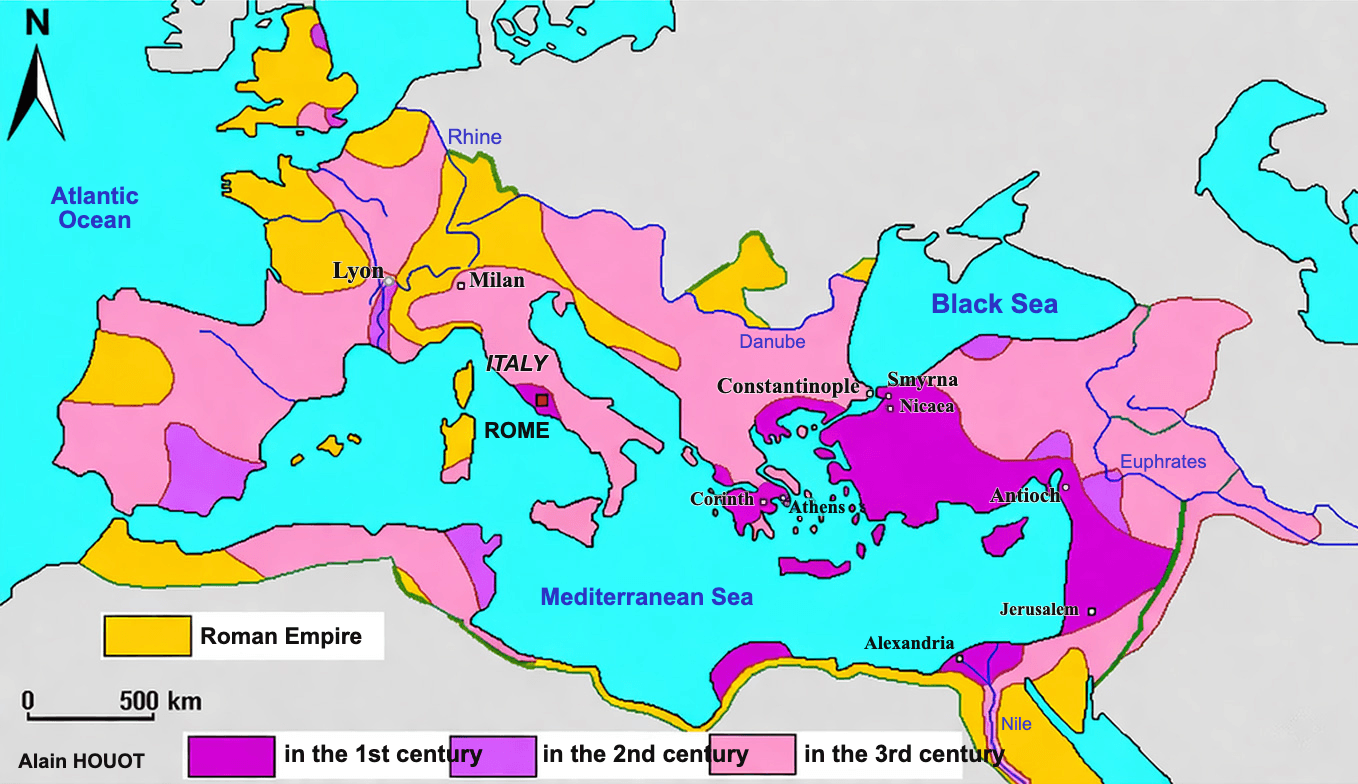
Map of the spread of Christianity before the Council of Nicaea
Certainly convened at the initiative of Gaius Flavius Valerius Aurelius Constantinus, better known as Constantine I the Great (306-337), bishops from across the Christian world were present at Nicaea. Well... almost all, since Pope Sylvester, too old to travel, sent two legates in his place. Thus nearly 300 Fathers of the Church (250 according to Eusebius, 359 according to Hilary of Poitiers), in the presence of Constantine himself, are said to have laid down the famous rule, still in force, which can be summarized as follows: Easter is celebrated on the Sunday following the fourteenth day of the Moon that reaches that age on 21 March or immediately after.
From this sentence we can extract the three ingredients needed for a “good” Easter:
- A Sunday;
- A full moon (fourteenth day);
- An equinox (21 March).
The Fathers had two issues on the agenda: Arianism and the thorny problem of the date of Easter.
Let us set Arianism aside, since it is not the subject of this page, and focus on Easter by trying to understand why its date was a “thorny issue” and by noting that the Council of Nicaea was not the origin of the famous rule.
Why a “thorny issue”?
This issue had two roots, closely linked: on one hand, the relationship between Christian Easter and Jewish Passover; on the other, disagreements within the Christian community itself.
Jewish Passover and Christian Easter
The Passion and resurrection of Christ took place at the time when Jews celebrated Passover.
Let us briefly recall what Jewish Passover is.
“Passover (Hebrew Pesah) ... begins on the 15th day of Nisan and lasts seven days (eight in the Diaspora). It celebrates Israel's deliverance from bondage in Egypt. In the biblical text it has two names: first (Exodus 34:25), Feast of Passover (hag ha Pesah), because God “passes over” the houses of the children of Israel when striking Egypt's firstborn (Ex. 12:23); second (Ex. 23:15), Feast of Unleavened Bread (hag ha massot), justified by consumption of that food during the hurried departure of the Hebrews (Ex. 12:39). In the period of the Jerusalem Temple, the essential rite was sacrifice of the paschal lamb (korban Pesah) on the eve of 14 Nisan.
Critical scholarship identifies two components in the feast rites: first, sacrifice of the lamb, a shepherd rite historicized by being tied to the Exodus; second, Feast of Unleavened Bread, a spring celebration linked to the agricultural calendar (Ex. 13:4), which was easily tied to salvation history because of the traditional date of the Exodus. The Book of Joshua (5:10-12) indicates that Israelites under Joshua celebrated Unleavened Bread at Gilgal. The Book of Kings (2 Kings 23:21-23) stresses the splendor of Passover under Josiah (late 7th c.). Fusion of both elements likely occurred at the beginning of the Babylonian Exile. Source: Encyclopaedia Universalis.
To have all elements in hand, let us read two Bible texts:
“Exodus 12
12.1 The Lord said to Moses and Aaron in Egypt: 12.2 "This month is to be for you the first month, the first month of your year. 12.3 Tell the whole community of Israel that on the tenth day of this month each man is to take a lamb for his family, one for each household. 12.4 If any household is too small for a whole lamb, they must share one with their nearest neighbor, having taken into account the number of people there are. 12.5 The animals you choose must be year-old males without defect, and you may take them from the sheep or the goats. 12.6 Take care of them until the fourteenth day of the month, when all the members of the community of Israel must slaughter them at twilight. 12.7 Then they are to take some of the blood and put it on the sides and tops of the doorframes of the houses where they eat the lambs. 12.8 That same night they are to eat the meat roasted over the fire, along with bitter herbs, and bread made without yeast. 12.9 Do not eat the meat raw or boiled in water, but roast it over a fire-with the head, legs and internal organs. 12.10 Do not leave any of it till morning; if some is left till morning, you must burn it. 12.11 This is how you are to eat it: with your cloak tucked into your belt, your sandals on your feet and your staff in your hand. Eat it in haste; it is the Lord's Passover."
“Leviticus 23
23.9 The Lord said to Moses, 23.10 "Speak to the Israelites and say to them: 'When you enter the land I am going to give you and you reap its harvest, bring to the priest a sheaf of the first grain you harvest. 23.11 He is to wave the sheaf before the Lord so it will be accepted on your behalf; the priest is to wave it on the day after the Sabbath. 23.12 On the day you wave the sheaf, you must sacrifice as a burnt offering to the Lord a lamb a year old without defect, 23.13 together with its grain offering of two-tenths of an ephah of the finest flour mixed with olive oil-a food offering presented to the Lord, a pleasing aroma-and its drink offering of a quarter of a hin of wine. 23.14 You must not eat any bread, or roasted or new grain, until the very day you bring this offering to your God. This is to be a lasting ordinance for the generations to come, wherever you live.'"
Note that these texts give no explicit indication that Passover must be celebrated after the spring equinox. One may only infer it from the offering of first harvest fruits.
Let us close this parenthesis on Jewish Passover and ask: depending on what is being celebrated (Passion or resurrection), is it not enough to use the start date of Jewish Passover as a reference to determine Christian Easter?
Disagreements within the Christian community
Even if this method is workable, one still has to decide what to celebrate: Christ's death or his resurrection?
From the start of the second century, the Church of Rome chose the resurrection. Irenaeus (bishop of Lyon), as cited by Eusebius (Hist. eccl. V 24), reminds Pope Victor: "Among these men, the presbyters before Soter who led the Church you now govern-that is, Anicetus, Pius, Hyginus, Telesphorus, Xystus-did not themselves keep (the fourteenth day)..."
And Rome not only celebrated the resurrection, but naturally kept this celebration on Sunday.
The Churches of Asia, by contrast, judged that the Passion should be celebrated. They therefore celebrated on the first day of Jewish Passover, 14 Nisan, day of Christ's death.
In this date choice we find the influence of Saint John who, in his Gospel, indeed places Christ's death on 14 Nisan, while the Synoptics (the three other Gospels) say Jesus ate the Paschal lamb on the 14th and was crucified on the 15th. Another point of disagreement we will not develop here.
Asian communities therefore celebrated Easter on 14 Nisan, whatever day of the week it fell on. From this came their name: Quartodecimans (supporters of the 14th day).
We must remember that early Christians in Asia were, at first, almost all Jews. They were still attached to Mosaic usages, and celebrating Christian Easter-at the same date as Jewish Passover, even with new meaning-certainly allowed preservation of older rites, especially the lamb meal.
All the more since words were attributed to the Apostles: "As for you, do not make calculations. But when your brethren of the Circumcision celebrate their Passover, celebrate yours too... and even if they err in the calculation, do not worry."
Eusebius describes the situation as follows: "At that time, a question by no means unimportant arose, because the churches of all Asia, following a very ancient tradition, thought that the fourteenth day of the moon must be kept for the feast of the Savior's Passover. This was the day on which Jews were ordered to slaughter the lamb; and according to them it was absolutely necessary, whatever day of the week that date might fall on, to end fasting then. But the Churches of the rest of the world were not accustomed to this, and according to apostolic tradition kept the usage in force to this day, judging it unsuitable to end fasting on any day other than the day of our Savior's resurrection [Sunday]." (Hist. Eccl. V 23)
We will pass quickly over Pope Anicetus's failure, at the end of the 2nd century, to persuade Polycarp, bishop of Smyrna, to abandon Jewish customs.
Let us also pass over Pope Victor's hardline method: declaring that the resurrection must be celebrated on Sunday and, in the same movement, seeking to excommunicate all those who struggled to accept it. Quartodecimans owed their survival only to Irenaeus and his peacemaking spirit (Eusebius's phrase, adding that Irenaeus “exhorted and negotiated for the peace of the Churches”.)
To answer the question posed at end of the previous section, it would have been enough to let Jews set their own Passover date and align Christian Easter accordingly.
Not so. Things were not that simple, and this was true well before Nicaea.
Because Christians could no longer accept dependence on Jewish reckoning to determine Easter, mainly for two reasons:
- A rising community such as the Christian Church could not let another community-from which it sought to distinguish itself-set the date of its principal feast.
- All the more because Jews, who after all had no reason to care about Christian Easter, changed the calculation of their own Passover, apparently at the end of the 2nd century, no longer taking spring equinox into account. So why would Christians continue using a reckoning no longer matching that of Jesus' time and that sometimes led to two Passovers in one year (between two equinoxes)?
Nor should we forget that the Jewish calendar was lunar and required intercalary months; computing dates in such a system is no trivial matter (see page on the Jewish calendar).
As Chauve-Bertrand rightly notes in La question du calendrier: "Since the destruction of Jerusalem, the college of Temple priests had perished, and remaining synagogues, left to themselves, computed as best they could-some with Jewish cycles, others with Greek cycles-the date of their Passover."
If we add the will to stop depending on an approximate Jewish computus, this was enough for Rome and Alexandria to launch their own calculations. Only Antioch remained more hesitant.
And whoever says lunar-calendar computation necessarily says cycle systems with intercalary months. Thus appeared works using various cycles: Hippolytus and his 16-year cycle doubling a known 8-year cycle; Anatolius of Laodicea (born in Alexandria) and the famous 19-year cycle called “Meton's”. Anatolius's computus excluded an Easter date before the equinox.
Computi in the second half of the 3rd century were therefore:
- Alexandria: use of 19-year cycle. Easter after spring equinox fixed on 21 March (actual equinox date at that time). Easter on moon day 15 accepted.
- Rome: use of a hybrid 84-year cycle composed of 8- and 19-year cycles (19 X 4 + 8). No account taken of the equinox fixed at 25 March in the Julian calendar. Easter cannot occur before moon day 16.
Nicaea and the rule for determining Easter date
When we look at Alexandrian computus before Nicaea, we see that all elements stated at the beginning of this page were already present.
So we can say the Council of Nicaea did not invent the Easter dating rule as we know it.
What, then, was its role? Quite simply: to decide between positions.
Between which positions?
To answer, we must inventory known direct and indirect documents concerning the Paschal question after the council. We will skip the 20 canons.
- First, what is not there: there is no decree on Easter-date calculation. Nothing containing the famous rule supposedly born at Nicaea. Could such a decree have been lost? Hard to imagine when the 20 conciliar canons were preserved. Moreover, D.M. Ogitsky rightly notes: "a detailed and exhaustive ordinance covering all technical aspects of Pascha calculation (including issues from Julian calendar inaccuracy) was not within the council's competence." We will soon see how right he was.
- A synodal letter addressed to the Church of Alexandria. On Easter it states: "... We also bring you the good news of the agreement reached concerning our most holy Easter: thanks to your prayers, this point has been settled like the others. All our brethren of the East who did not agree in this with the Romans, with you, and with those who from the beginning follow your usage, will from now on celebrate Easter at the same time as you."
- A letter of Constantine “to all those [bishops] who were not present at the council” states notably: "...Christian Easter must be celebrated by all on the same day; and for date calculation, no reference must be made to the Jews. That would be humiliating, and moreover it is possible for them to have two Passovers in one year. Consequently, the Churches must conform to practices followed by Rome, Africa, Italy, Egypt, Spain, Gaul, Britain, Libya, Greece, the diocese of Asia, Pontus and Cilicia."
- Athanasius, present at Nicaea, wrote in 369 in an epistle to the bishops of Africa that "the council was convened on account of the Arian heresy and Passover, because Christians of Syria, Cilicia and Mesopotamia disagreed with us [Alexandria] and celebrated at the time when Jews celebrate."
So? Between what and what did the Fathers of Nicaea decide?
- Between Quartodecimans and Sunday supporters? Certainly not. Otherwise the diocese of Asia would not be among territories agreeing with Rome and Alexandria. For the council, that issue seemed already historical.
- Between supporters of an autonomous computus independent from Jews, and those relying on Jewish computus? Certainly yes. Dependence on Jewish reckoning was viewed as humiliating and error-prone. It had to end. Note in passing that Athanasius says “at the time when Jews” and not “on the same day”. So the point was not to avoid at all costs both Easters falling the same day. During four centuries after Nicaea, Jewish and Christian Passovers were celebrated simultaneously several times. Only Julian drift later made this no longer happen.
- Between “equinoxalists” and “non-equinoxalists”? A categorical answer is harder.
One sometimes reads that Nicaea entrusted Alexandrian patriarchs to calculate Easter date and communicate it to Rome, which would then communicate it to other Churches. I would like to see the sources for that claim.
Cyril of Alexandria is said to have written a Paschal epistle saying that "the ecumenical council unanimously voted that the Church of Alexandria, owing to its illustrious astronomers, should communicate Easter date each year to the Church of Rome, and Rome would communicate it to the other Churches."
I admit I have not found the full text of this epistle. But since Cyril became bishop in 412, nothing proves he refers to Nicaea. And since the Council of Constantinople (381) says nothing of the kind... mystery.
Which does not mean such a practice was never used later, given the competence of Alexandrian astronomers and mathematicians.
L. Duchesne (Revue des questions historiques, 1880) also defends the equinoxalist thesis as follows:
- The Churches named and pointed out as poor pupils are Eastern non-equinoxalists.
- Rome, though it did not treat spring equinox as an absolute upper bound, could not be counted among these poor pupils because it was, in his words, “the first of all churches to adopt an exclusively Christian calculation method.” He adds that "Roman usage, if not Roman computus, at the time of Nicaea agreed with the rule not to anticipate the equinox." I admit I could not verify the evidence he gives: "Dates on which Easter was actually celebrated in Rome, from 312 to 343, are preserved in one table of the Philocalian chronography of 354; no Easter before 25 March appears there. It even seems a 22 March Easter was avoided in 330."
If so, Alexandrian computus emerged as clear winner of Nicaea's practical “test.”
Conclusion: a decision of principle
In any case, we can only observe how impossible it was for this council to formulate a practical rule like the one we now know, because placing Rome and Alexandria on the same model level meant completely ignoring their practical divergences (cycle used, equinox date and observance, etc.).
Dionysius Exiguus, asserting in his Liber de Paschate, in good faith or not, that the 19-year cycle had been established by the Fathers of Nicaea, was certainly not unrelated to the fact that everyone came to believe the famous rule had been decreed by the first ecumenical council.
Yes, D.M. Ogitsky was quite right: "a detailed and exhaustive ordinance on all technical aspects of Pascha calculation was not within the council's competence."
And it is this lack of technical competence that allowed divergences between Rome and Alexandria to continue well after Nicaea. But that is another story...