By way of introduction
The sentence you are reading was written in France on 20 May 2006 at 8:00 a.m. At that same instant, in the Samoan Islands in the Pacific Ocean, it is Friday 19 May around 7:30 p.m. And anywhere in the world, however hard you look, there are no other Gregorian dates for that same instant than 19 or 20 May 2006.
So if it is the start of a month in some countries (1 October, for example), it can be the end of the previous month in others (30 September in that example).
By contrast, in the Muslim religious calendar, we can see that 1 Shawwal 1426 (2005 in the Gregorian calendar), the day of Id al-Fitr (or Eid al-Fitr), occurred on Wednesday 2 November 2005 in Libya and Nigeria, on Thursday 3 November in 30 countries (Algeria, Egypt, Saudi Arabia, part of the USA...), on Friday 4 November in 13 countries (South Africa, Canada, part of the USA, Iran...), and on Saturday 5 November in part of India.
Why this multitude of dates for a single event, when it cannot be explained by a simple time-zone difference?
Throughout this page, we will try to understand the issue (because it is indeed one) by briefly recalling the principle of month beginnings in the Muslim religious calendar and the interpretations that follow from it.
Our aim is not to take sides with one school or another, but simply to make things clearer as far as possible. After that, everyone can form their own view.
Reminder of the rules for month beginnings
These rules are simple, at least to state: the year has twelve lunar months. Each month begins with the first visible crescent of the Moon after the new Moon (let us not forget that the day starts at sunset) and lasts until the next reappearance of this crescent. This interval cannot exceed 30 days or be shorter than 29.
In the rest of this page, we will call this “first visible crescent” Hilaal. First, because it is quicker to write than “first visible lunar crescent”!! Second, because this is the Arabic name for this privileged moment.
To understand the problems caused by these rules, we need a little astronomy about the Moon and its crescents. Since we are not necessarily astronomy enthusiasts, we will try to do it with the minimum of technical terms. Of course, people well versed in astronomy can skip the next section.
A little astronomy: the phases of the Moon
Note: this section and the next were written with the valuable guidance of Patrick Rocher - IMCCE. I thank him warmly.
“Minimum” does not mean “none”. So we will allow ourselves one astronomers’ term: the ecliptic.
Let us recall a few notions learned at school:
- All planets, including Earth, orbit the Sun.
- The Moon, a natural satellite, orbits Earth.
- Of all bodies in the Solar System, only the Sun is a light source. So the Moon, which is not luminous in itself, merely reflects sunlight.
The plane formed by Earth’s orbit around the Sun is the ecliptic. If we place ourselves above the Sun, perpendicular to that plane, the Sun-Earth-Moon trio appears as in figure 1.
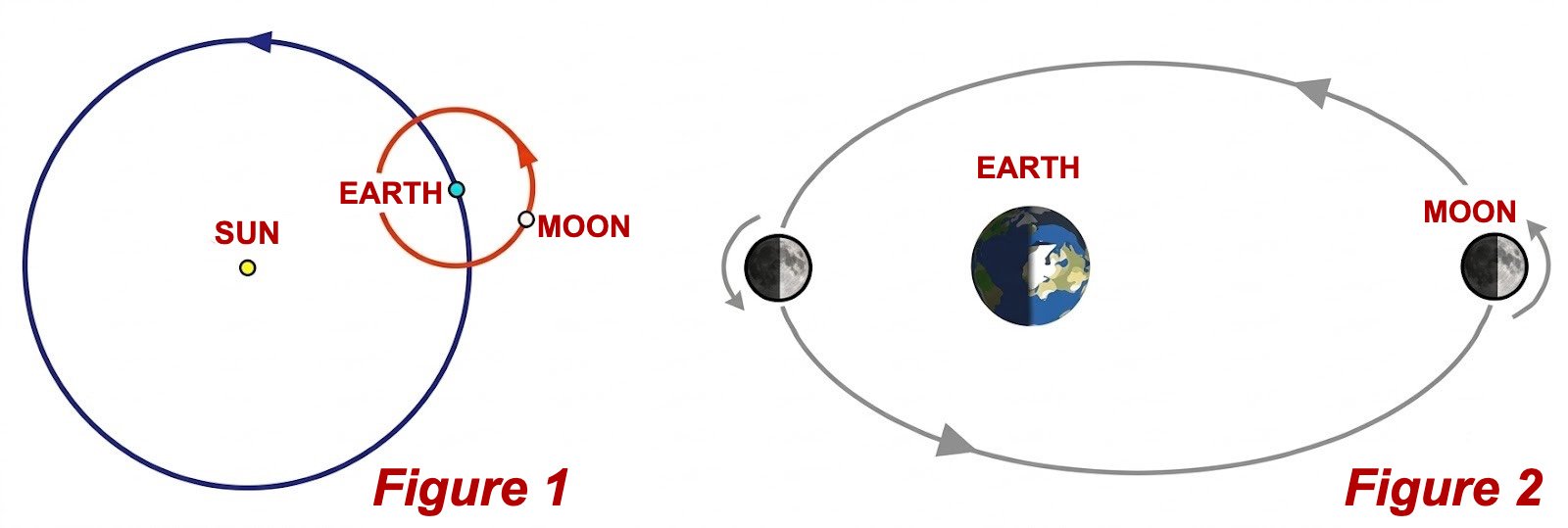
The proportions are nowhere near realistic, and they never are, whether in books or on websites. To quote Patrick Rocher (IMCCE): “if one wanted to draw the three bodies to scale, it would be impossible. If Earth were a circle of 2 cm radius, the Moon would be a circle of 0.55 cm located about 1.20 m from Earth, and if one wanted to represent the Sun, it would have a radius of 2.18 m and would be 469 m from Earth.”
In our study, we meet a first difficulty (we will see later why this matters): neither Earth nor Moon follows a circle. The path is an ellipse, as shown in figure 2. Here again, proportions are not respected because these ellipses are very close to circles. For the Moon in particular, the Earth-Moon distance varies between 356,400 km and 406,700 km.
Even though the gap between minimum and maximum distance is not huge, it is enough to make the Moon’s speed around Earth non-uniform. According to Kepler’s law (1571-1630), it moves faster when near Earth and slower when farther away (about 30% faster in angular speed at minimum distance than at maximum distance). Let us note this and continue.
Let us revisit figure 1 at another moment (figure 3):
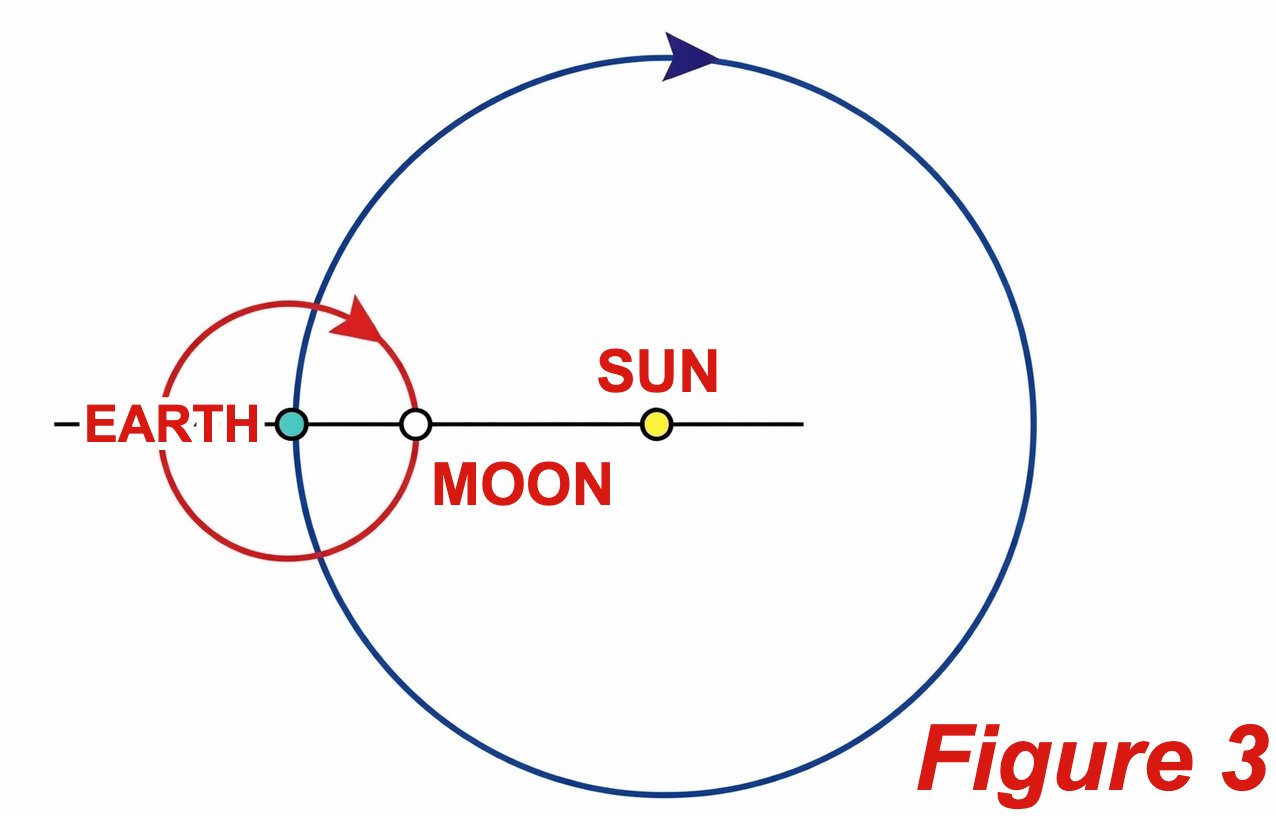
At that instant, the Moon’s projection onto the ecliptic plane lies exactly on an imaginary line passing through Earth and the Sun. Seen from Earth, the illuminated face of the lunar surface is directed away from Earth. So the Moon is completely invisible to an observer. This is the new Moon.
Try a simple experiment: hold a tennis ball (Moon) at arm’s length toward the Sun. The side you see is entirely in shadow.
It is essential to understand that the definition of new Moon (and lunar phases) is geocentric, based on the angle between the center of Sun-center of Earth direction and the direction from Earth’s center to the projection of the Moon’s center onto the ecliptic plane. This geocentric definition gives one specific instant, unique for the new Moon. Astronomers generally publish this instant in UTC. Naturally, when converted to a country’s legal time, this unique instant may shift the phenomenon by one day forward or backward depending on time-zone difference with UTC. The same applies to all geocentric phenomena. For example, a geocentric event at 23h10 UTC occurs at 0h10 the next day in French winter legal time, and at 1h10 in summer legal time.
How much time, on average, passes between two new Moons? This “mean synodic revolution” (or mean lunation) lasts 29.530588 days, i.e. 29 d 12 h 44 min 2.8 s. Although this is not our focus, note that this lunation does not match the average time the Moon takes to orbit Earth and return to the same point relative to a star. That “mean sidereal” revolution is 27.321661 days. It is worth stressing that these are average durations, and true durations (the ones relevant to first-crescent observation) can vary by +/- 7 h.
Those still following (!!!) are thinking that since every ~29.5 days the Moon is between Sun and Earth, there should be a solar eclipse somewhere on Earth each time. Good reasoning, yet still false.
Indeed, if instead of imagining ourselves above Earth’s orbital plane as in figure 1, we imagine standing on the ecliptic plane, we get this (figure 4a):
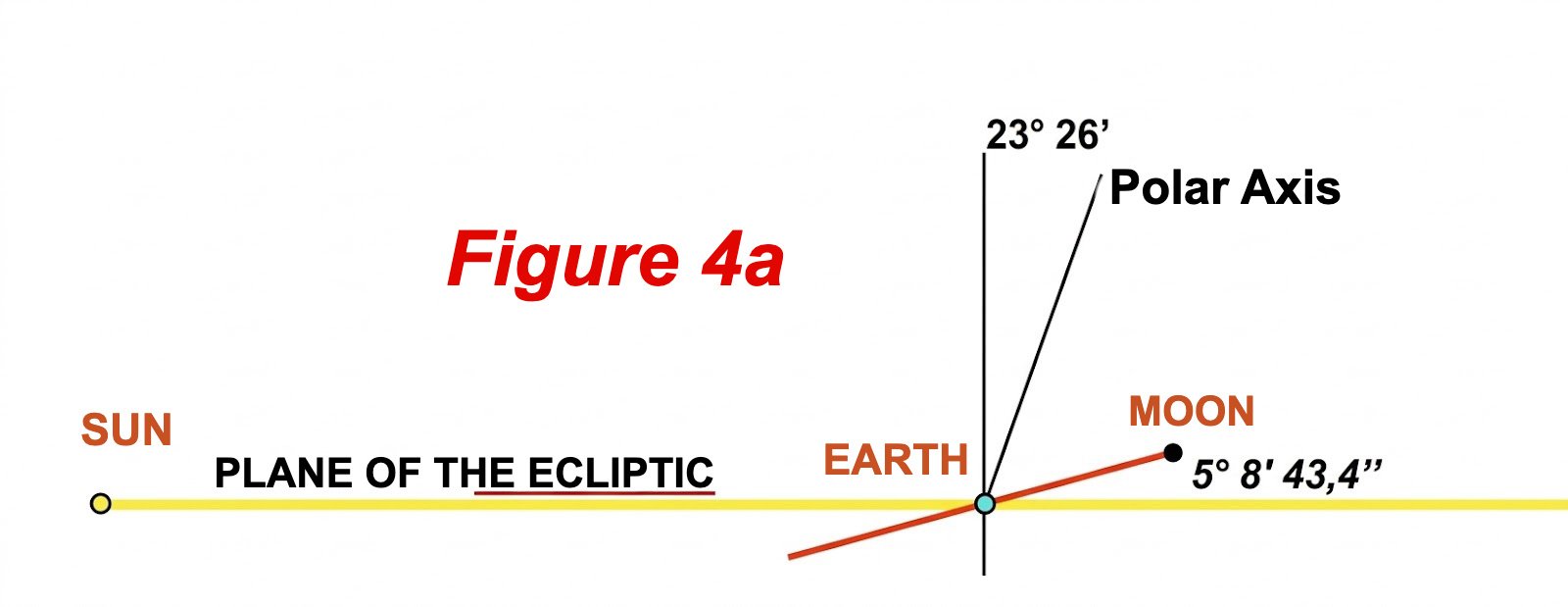
Even without correct proportions and angles, we can see that the Moon’s orbital plane is not the ecliptic plane: it is tilted by about 5°.
That is why we spoke above of the “Moon’s projection onto the ecliptic plane”. It is very rare for the Moon to lie exactly on the Sun-center / Earth-center line. This changes nothing in the Moon’s illuminated appearance from Earth. Raise or lower our tennis ball slightly relative to an Eyes/Sun line, and we still see only the shadowed part.
We also note that Earth’s equatorial plane is tilted by about 23° relative to the ecliptic plane.
As figure 4b shows, the two planes intersect along a line (called the line of nodes).
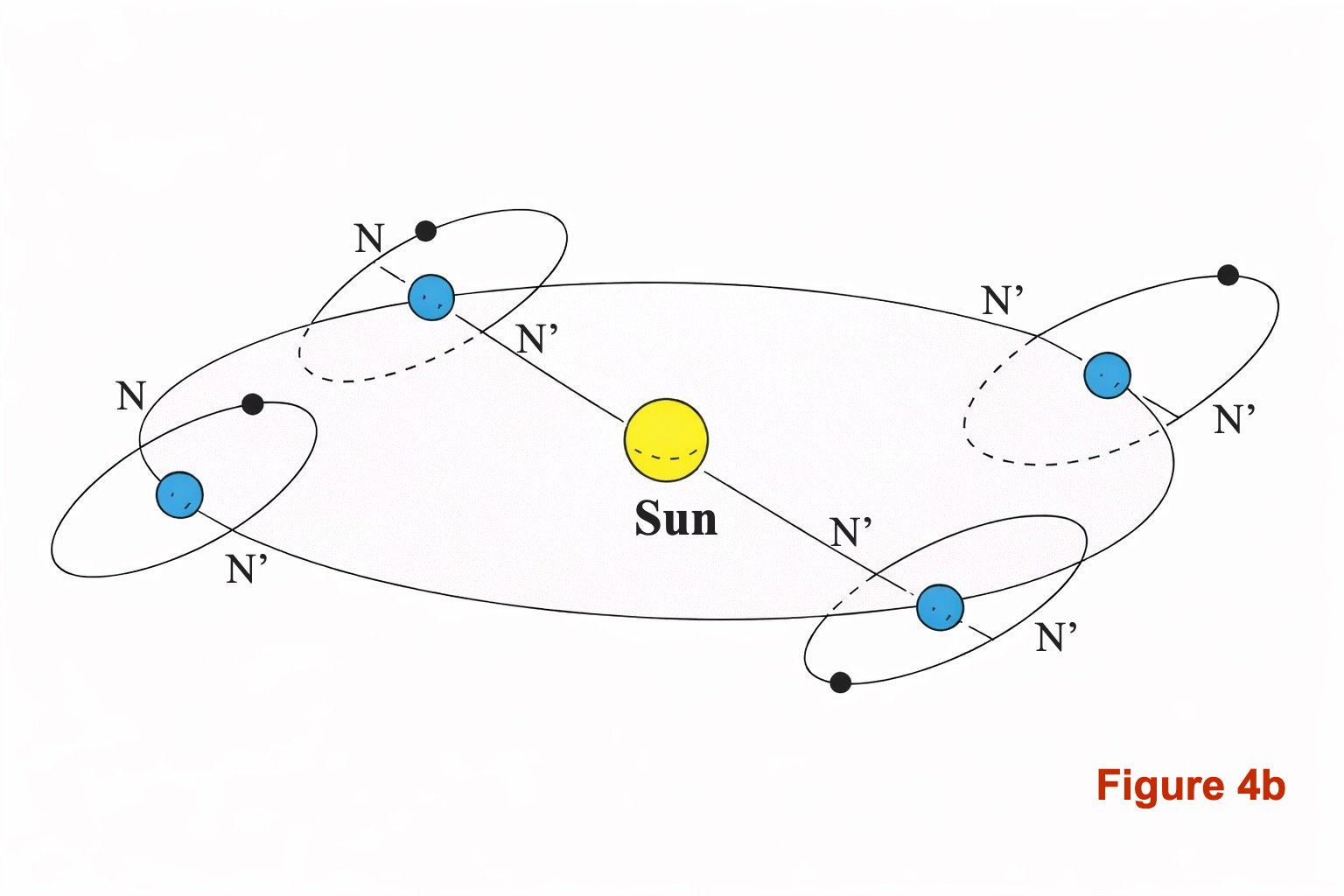
To simplify: only when the Moon is near this line at new Moon are those still following (!!!) right to expect a solar eclipse. Other potential eclipses are “lost in space” because Earth is not aligned with an imaginary Sun-Moon line.
To make the Sun-Earth-Moon mechanism even harder to picture, the Moon’s orbital plane, and therefore the line of nodes, rotates within the ecliptic plane (counter-clockwise) every 18.6 years.
Those in a hurry (!!!) may ask why we care about new Moon when our interest is the first crescent. Tempted as I am to answer “because I wrote this page and I do as I like”, I will say instead: “it’s coming, it’s coming...”
We now understand (figure 5) that there is a new Moon whenever the Moon’s projection on the ecliptic lies in the Earth-Sun direction. Then Moon and Sun are in conjunction, and the Moon sets and rises almost at the same time as the Sun.
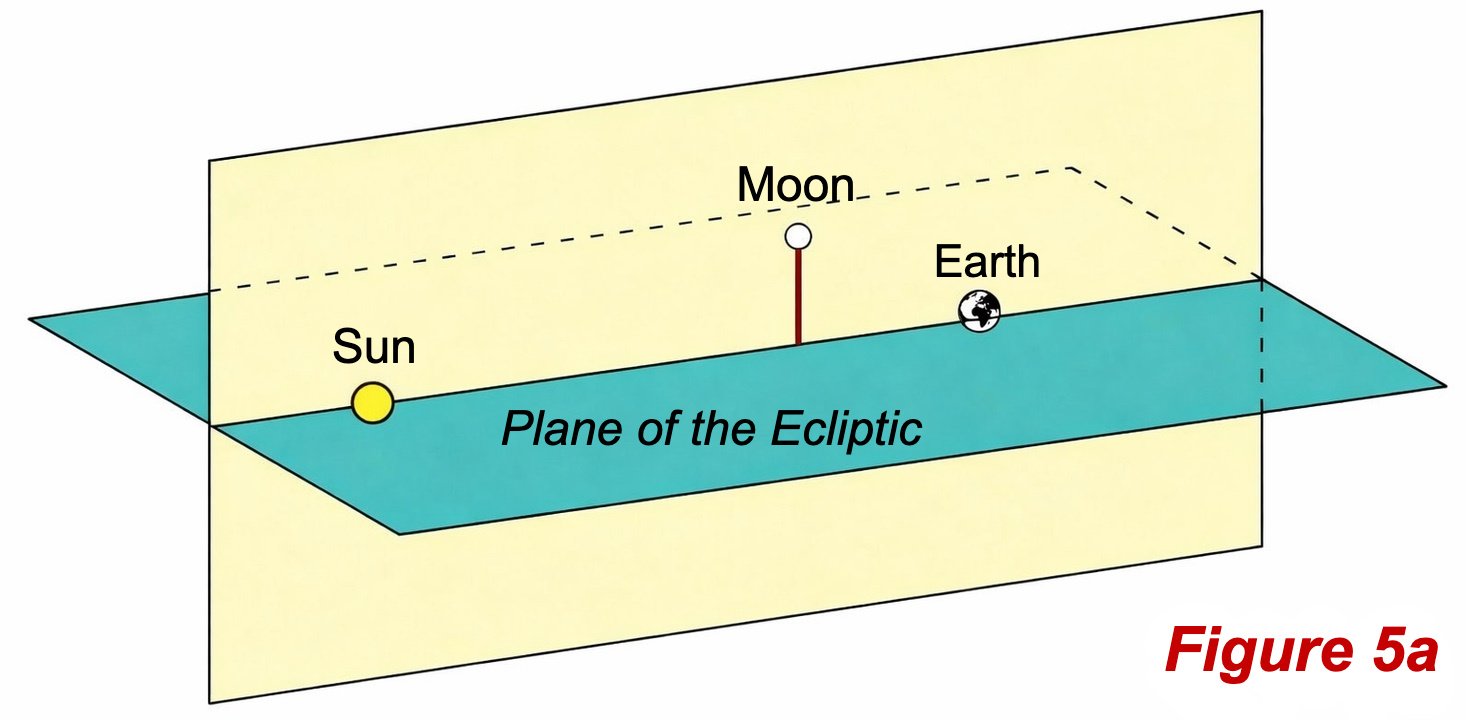
In figure 5a, there is a new Moon because the Moon’s projection onto the ecliptic plane intersects the Earth/Sun line.
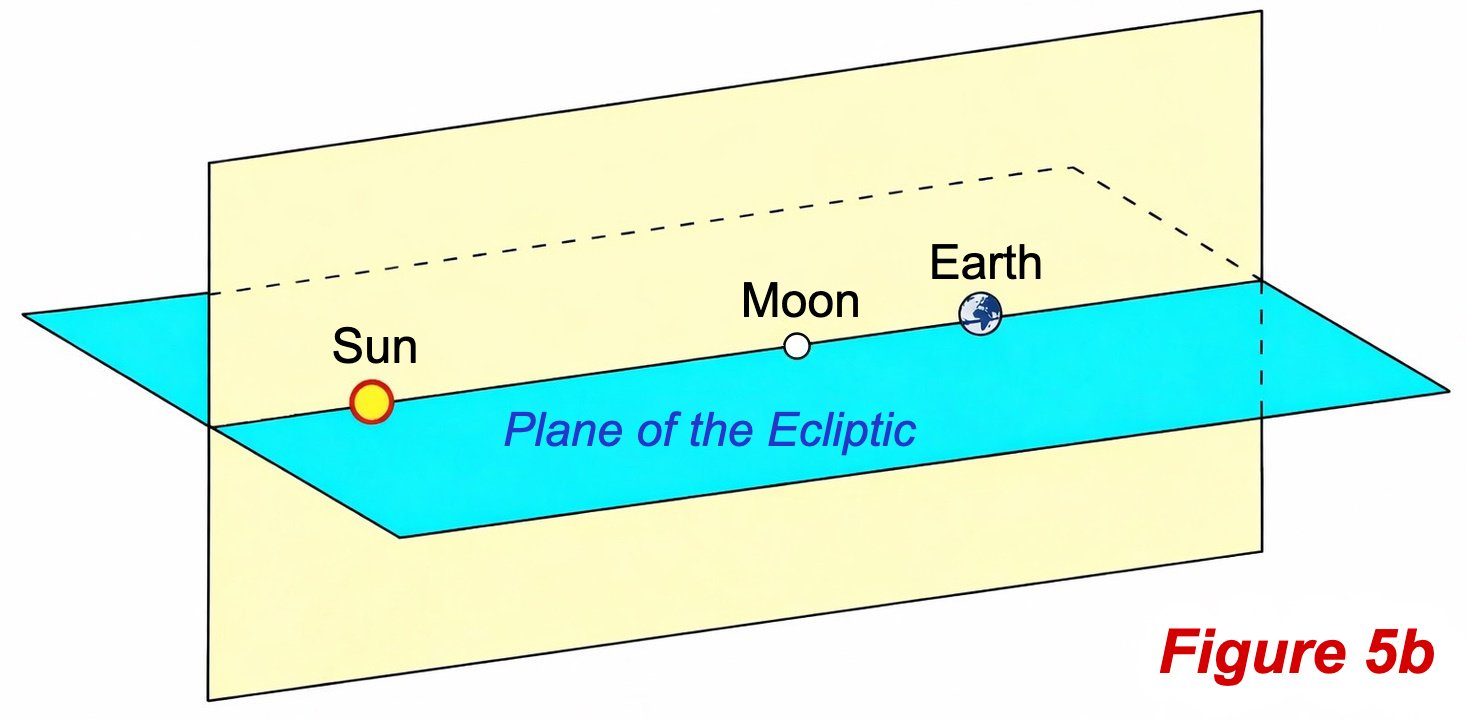
In figure 5b, there is not only a new Moon but also a solar eclipse.
By contrast, if Earth is between Sun and Moon, we have a full Moon. Then Moon and Sun are said to be in opposition. The Moon rises when the Sun sets and sets when the Sun rises. The Moon’s illuminated side is then on Earth’s side and is seen almost as a full disc.
What happens between these two extreme phases?
In fact, it is always the half of the Moon facing the Sun that is illuminated. But from our observer’s position, we progressively see more of that illuminated half and pass through all lunar phases (waxing phases), as shown in figure 6 (by Patrick Rocher, IMCCE). The waning phases are likewise seen between full Moon and the next new Moon.
In short, phases are caused by the observer’s relative position on Earth with respect to the Moon. Turn around holding our tennis ball, and we see more and more illuminated surface. The ball is fully lit when we turn our back to the Sun... provided we hold it higher or lower than the Sun. Otherwise, we head straight... to an eclipse.
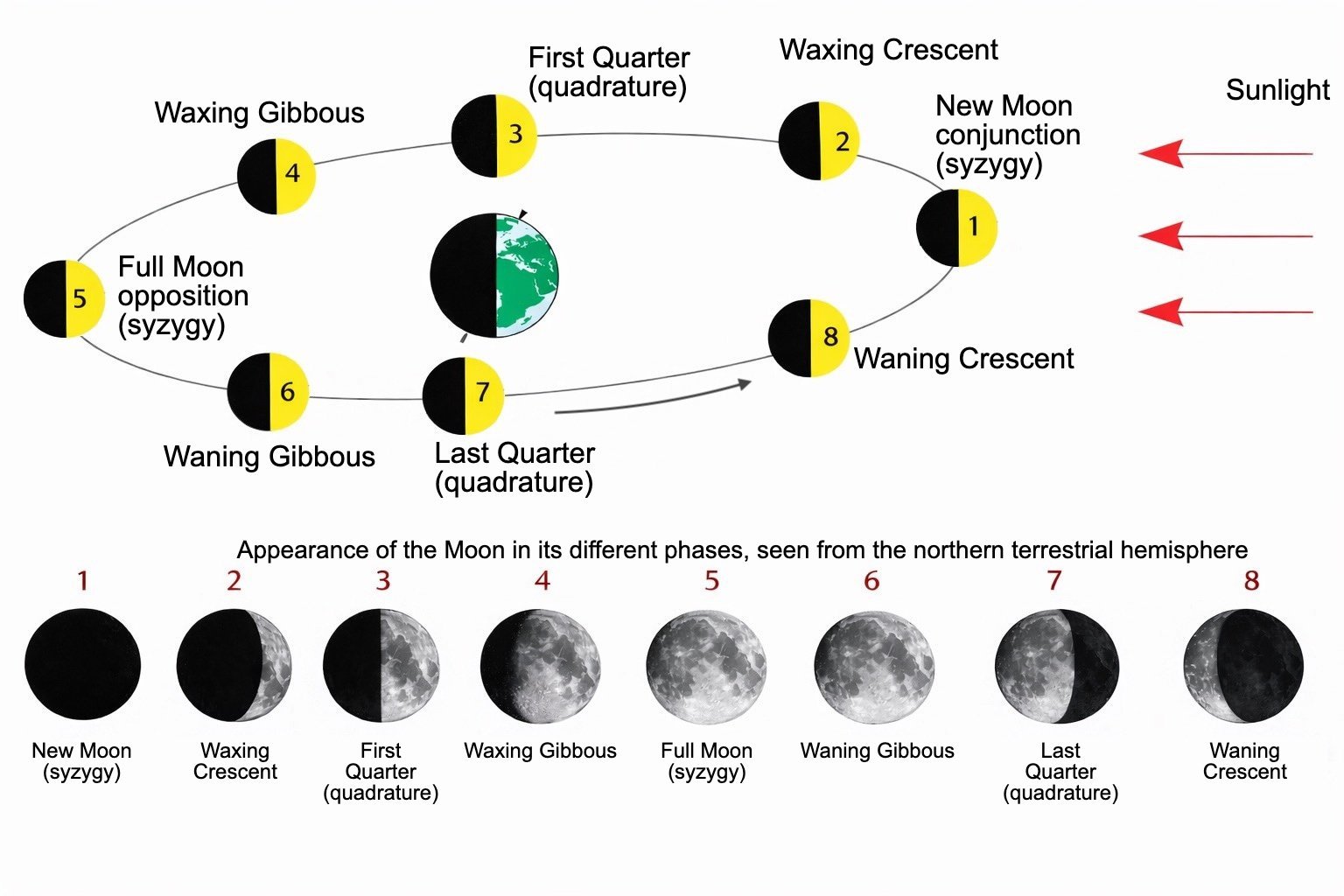
Also note that phase drawings are schematic, and the illuminated part does not always look the same depending on location, even though it is always the same physical side.
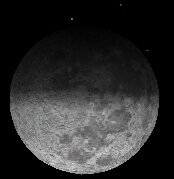
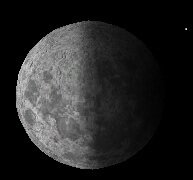
Imagine an observer on an axis perpendicular to the ecliptic plane. How would they see the first-quarter Moon, for instance, from around point H (not the North Pole because of Earth’s tilt relative to the ecliptic), point O, and point B?
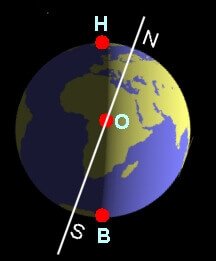
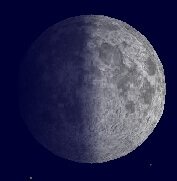
- For the observer at point H, the right half of the Moon is visible and the Moon is near the horizon. That is the left photo.
- For the observer at point O, the lower half of the Moon is visible and the Moon is at the zenith. That is the center photo.
- For the observer at point B, the left half of the Moon is visible and the Moon is near the horizon. That is the right photo.
Again, as with phases, all intermediate views are possible depending on where we are, and we see a more or less tilted lunar portion. But remember: wherever we are, the illuminated surface is always the same.
A little more astronomy: the first crescent
In this section, we zoom in on a few-hour period covering the new Moon and the first visible lunar crescent (Hilaal), and ask a few practical astronomy questions.
What is the Moon’s age?
It is the time interval, in days and hours, counted from the new Moon. For example, we say the Moon is 14 days old at full Moon.
What is meant by Mahaq?
It is the new Moon phase. Strictly speaking, new Moon is one precise instant. For example, the new Moon of May 2006 occurred on 27 May at 05h27 UTC.
Still, for an observer on Earth, the Moon is invisible for a period varying from about 30 hours (15 hours before and 15 hours after new Moon) to about 50 hours. This period of complete disappearance of the Moon, regardless of observation site, is called Mahaq.
“New Moon” or “new Moons”?
In the previous section (theoretical astronomy, figure 5), we saw there is only one new Moon for everyone: the precise instant when the Moon’s projection on the ecliptic lies exactly on an imaginary Earth-Sun line (conjunction).
But this astronomical definition is geocentric (observer at Earth’s center). In practice, we are on Earth’s surface. For a surface observer, the alignment observer-Sun / observer-projection of the Moon’s center does not occur at the geocentric new Moon instant. The difference can reach several hours. Also, at that instant, the Moon may not even have risen. This is due to the Moon’s proximity (astronomers call this parallax): the difference between Moon direction seen from Earth’s center and from Earth’s surface can reach 1°, i.e. twice the Moon’s apparent diameter.
That same direction difference can reach 1° (thus several hours). Astronomers call this parallax. It is comparable to photographers’ parallax (non-SLR cameras), where lens and viewfinder do not “see” exactly the same thing. Here, the lens center is Earth’s center, and the viewfinder is the observer.
To be convinced, just remember that a solar eclipse is not visible across the entire sunlit side of Earth.
Now recall that a total solar eclipse is nothing other than a “visible new Moon”. So the same issue applies to observing the first crescent (Hilaal).
Where should one look for Hilaal?
We saw above that when Moon and Sun are in conjunction, the Moon sets almost at the same time as the Sun. So to see the first lunar crescent, it is enough, after checking an ephemeris giving the new Moon date and time (the IMCCE site, for example), to look each evening about fifteen minutes after sunset, to the right and left of where the Sun set, to spot the crescent marking the start of the month.
Do not forget the Moon itself is setting too; after first visibility of the crescent, it quickly disappears below the horizon.
Can months have different lengths?
Of course. Between two first crescents there may be 29 or 30 days, and it can even happen that several successive months have 29 or 30 days.
Can the moment of new Moon be calculated precisely?
Yes, without any doubt. Even if the Moon is erratic in its path and motion, the causes of these perturbations are perfectly known and calculable.
What phenomena prevent seeing Hilaal?
They are many and may be due to:
- Observer inexperience and/or insufficient visual acuity.
- Environmental conditions (too much city light, pollution, near-ground air temperature, obstructed horizon...).
- Weather (cloudy or overcast skies...).
What is the Moon’s age when the first crescent becomes visible?
There is no precise answer. This age depends on the value of a virtual angle formed by Sun, observer, and Moon (observer at the vertex). It is estimated that this angle (elongation) must be greater than about 9° so the Moon is far enough from the Sun and the crescent is not “drowned” in sunlight.
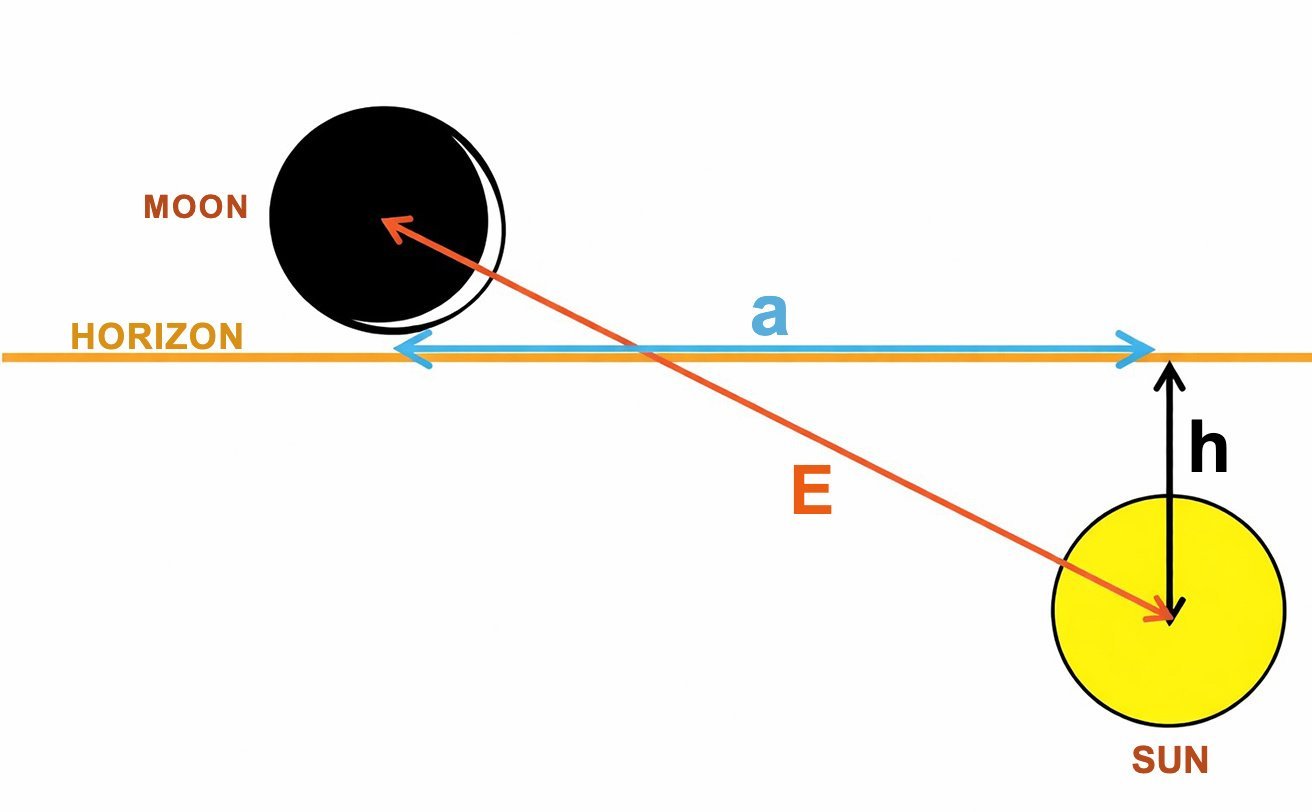
Visibility of the first crescent depends on several parameters, including:
- Solar depression angle below the horizon (h in the diagram).
- Elongation (E in the diagram).
- Moon-Sun azimuth difference (a in the diagram).
- Earth-Moon distance, which alters the Moon’s apparent diameter.
Now, we saw above that the Moon’s orbital speed varies. So the time needed for elongation to exceed 9° also changes. We can estimate the Moon’s age at first-crescent visibility within a range of about 17 to 23 hours. It also depends, of course, on the observation conditions mentioned above.
As an aside, the Moon’s age at first-crescent visibility has its own “record book”: Records of Young Moon Sightings, Quarterly Journal of Royal Astronomical Society (1993).
Is Hilaal always the same “size”?
By “size” we mean the crescent’s thickness. The answer is NO.
To simplify, let us momentarily ignore what we just saw about variable lunar orbital speed.
On day 1, we “miss” the first crescent by a few minutes because, for example, elongation is too small. So we must wait for day 2 to see the first crescent, and the visible lunar part is therefore thicker than if we had not waited those extra 24 hours. That does not make it day 2 of the month, however, but still day 1, because the crescent is seen for the first time only on that day.
Does the first lunar crescent span a 180° arc?
The answer is NO. An experiment conducted on 6 April 1989 by Bradley E. Schaefer, Professor of Physics and Astronomy at LSV (Louisiana State University), based on 65 observations (including 12 with the naked eye), found an average arc of 123°. According to Bradley E. Schaefer, this partial crescent visibility is not due to lunar topography, nor to the Moon’s non-perfect sphericity, nor to atmospheric turbulence blurring the “horns”, but to brightness per unit length being below human-eye detection threshold.
All of this means Hilaal visibility is harder to observe, because one has to look for only part of a full crescent (about 68%).
Should Ramadan be treated differently from other months?
Fair point: this is not an astronomy question, but I did not know where else to place it.
In theory, the answer is YES. Ramadan starts and ends by the same rules as other months. In practice, however, the answer is more nuanced, because the start of the month marks the start of fasting, and the start of the next month marks its end and Eid al-Fitr. Since these two events are of great importance, we will see that the required number of witnesses for first-crescent visibility is sometimes affected.
Qur’an, astronomy and Hilaal
Let us say it clearly: the Qur’an (al-Qur’an) is not very useful for specifying exactly how month starts must be defined and applied. And that is normal: for Muslims, the Qur’an is Allah’s literal word, and Allah does not set out technical procedures. It shows the path to follow, not how exactly to follow it.
It is a bit like asking the Council of Nicaea to set the rules for determining Easter’s date (see the study on this).
Still, we will read a few verses (surahs/chapters), precisely to see the path to follow and, above all, what is said about astronomy. Should astronomy be rejected?
Let us first recall verses already cited on the page devoted to the Muslim calendar:
The Sun is a source of light and the Moon is only illuminated
“105-5: It is He who made the sun a radiance and the moon a light, and determined its phases so that you may know the number of years and the reckoning (of time). Allah created this only in truth. He explains the signs for people of knowledge.
“25-61: Blessed is He who placed constellations in the sky and placed therein a lamp (the sun) and an illuminating moon!
The Moon is the measure of months
“2:189: They ask you about new moons. Say: “They are for people to measure time, and also for Hajj [pilgrimage]...”
So it is indeed the Moon that allows us to determine month lengths.
There are 12 months and no mention of intercalary months
“9:36-37: The number of months with Allah is twelve [months], in Allah’s decree, from the day He created the heavens and the earth... Deferring a sacred month is an increase in disbelief. By it disbelievers are led astray: one year they make it profane, another they make it sacred, to match the number of months Allah made sacred. Thus they make profane what Allah made sacred. Their evil deeds are made appealing to them. And Allah does not guide the disbelieving people.
Allah created Sun and Moon and made them subject to humankind. Neither is to be worshipped
“5-3: ... Today I have perfected your religion for you, completed My favor upon you, and approved Islam as your religion...
“14:32-33: Allah is He who created the heavens and the earth, and sent down water from the sky by which He produced fruits for your sustenance. He subjected to your service ships that sail the sea by His command. He subjected rivers to your service. And for you, He subjected the sun and the moon to constant motion. And He subjected night and day to your service.
“41:37: Among His signs are the night and the day, the sun and the moon: do not prostrate to the sun or the moon, but prostrate to Allah who created them, if it is Him you worship.
The full Moon
“84:18: and by the moon when it becomes full!
The Moon follows the Sun
“91:1-2: By the sun and its brightness! And by the moon when it follows it!
Now, let us see what the Qur’an says about astronomy:
Big Bang - Creation of heavens and Earth
“2:117: He is the Originator of the heavens and the earth from nothing! When He decrees a thing, He only says: “Be,” and it is.
Each celestial body has its orbit
“21:33: And He is the One who created night and day, the sun and the moon, each floating in an orbit.
Each celestial body has its function
“36:39-40: And the moon, We have determined phases for it until it becomes like an old date stalk. The sun cannot overtake the moon, nor can the night outstrip the day; each floats in an orbit.
Moon, Sun and stars obey rules set by Allah
“39:5: He created the heavens and the earth in truth. He wraps the night over the day and wraps the day over the night, and He has subjected the sun and the moon, each running for a fixed term. Truly He is the Almighty, the Oft-Forgiving.
“55:05: The sun and the moon [move] according to precise calculation.
“29:61: If you ask them, “Who created the heavens and the earth and subjected the sun and the moon?”, they will surely say, “Allah.” How then are they turned away?
The universe is expanding
“51:47: And the sky, We built it with power; and We are [constantly] expanding it in vastness.
Beginning of the day
“2-187. [...] eat and drink until the white thread of dawn becomes distinct to you from the black thread of night. Then complete the fast until night. [...]
The problem
It can be broken down into two questions:
- Must the first crescent necessarily be physically seen, or can it be based on astronomical calculation?
- When the first crescent is seen by a Muslim in one place, does the month begin only for Muslims there, or for all Muslims worldwide (taking time-zone differences into account)?
We will not give categorical answers to these two questions. More modestly, we will present the arguments on each side. Then everyone may form their own opinion.
Before examining these viewpoints, we need one more reading step.
Indeed, we have seen that while the Qur’an gives the structural rules of the calendar, it says nothing about how a new month begins (Ramadan in particular). Where, then, do people derive the rules they wish to apply?
Simply from the Hadiths.
We will not go into Hadith composition and classification scales here (in terms of authenticity). Those who want to know more can usefully read the clear explanations provided here.
For our purposes, we will use a description from Encyclopædia Universalis:
“Arabic term meaning narrative, statement or communication, hadith is used more specifically for statements attributed to the Prophet Muhammad. Initially, it had a narrower meaning, limited to oral communications from the Prophet. Later, it came to refer to any tradition reporting the Prophet’s words (aqwal), acts (af‘al), or tacit approval (taqrir) of words spoken or acts done in his presence. Al-hadith thus came to encompass the whole Muslim tradition (sunna). Originally, hadith and sunna had distinct meanings. In the terminology of Muslim jurists (al-fuqaha’), sunna denotes established community practice on a legal or religious point, whether or not there was an oral communication from the Prophet; in this sense, sunna is opposed to bid‘a (heretical innovation).
That said, let us list some hadiths (some are duplicates differing only by narrator) that address our issue and its two questions.
Since we will use these hadiths later and repeating them would be cumbersome, I label them H1, H2... These labels have no value outside this page.
H1 “Fast when you see the crescent. If you do not see it, complete Sha‘ban to thirty days. And break your fast when you see the crescent. If you do not see it, fast thirty days.” Reported by al-Bukhari (1220) and Muslim (2378-2379-...).
H2 “If two Muslim witnesses testify [that they saw it], then fast or break your fast.” Reported by Ahmad, Nassa’i and ad-Daraquni.
H3 “People were looking for the crescent. I informed the Prophet - may Allah pray upon him and grant him peace - that I had seen it. So he fasted and ordered people to fast.” Reported by Abu Dawud and others. Narrator: Ibn ‘Umar.
H4 “A Bedouin came to the Prophet (peace be upon him) and said: I have seen the lunar crescent. Al-Hasan adds in his version: that of Ramadan. He asked: do you testify that there is no god but Allah? He answered: yes. He asked again: do you testify that Muhammad is Allah’s messenger? He answered: yes, and testified that he had seen the lunar crescent. He said: Bilal, announce to people that they must fast tomorrow. Narrator: Abdullah ibn Abbas.” Reported by Abu Dawud.
H5 “We are an unlettered nation. We neither write nor calculate. Months are this and that, meaning sometimes 29 days and sometimes 30.” Reported by al-Bukhari and Muslim.
H6 “Abu Hurayra, ‘Aisha and others reported that the Messenger - may Allah pray upon him and grant him peace - said: Fasting begins the day you begin fasting; al-Fitr [‘Id] is the day you break your fast; al-Adha [‘Id] is the day you sacrifice.” Reported by Abu Dawud, at-Tirmidhi and others.
H7 Kurayb said: Umm al-Fadl daughter of Harith sent him (her son Fadl) on a mission to Mu‘awiya in Damascus. He fulfilled his mission and was still in al-Sham when Ramadan began. He saw the new moon on Friday evening. He returned to al-Madina near the end of the month. He met Ibn ‘Abbas, who asked when the new moon of Ramadan had been observed in al-Sham. Kurayb said: “We saw it on Friday night.” Ibn ‘Abbas asked: “Did you see it yourself?” Kurayb replied: “Yes, I saw it; and people saw it too. So they fasted, and Mu‘awiya also fasted.” Ibn ‘Abbas said: “But we saw it on Saturday night; so we will either continue fasting thirty days, or we will see [the new moon of Shawwal].” Kurayb asked: “Do you not accept Mu‘awiya’s observation and fasting?” Ibn ‘Abbas replied: “No! This is how the Messenger of Allah commanded us.” Narrator: Abdullah ibn Abbas. Reported by Muslim.
Observation or calculation?
To be precise, there are strong supporters of direct visual sighting (with the naked eye) of the first crescent only. Others, on the contrary, would replace it with astronomical calculation. And some support both, with calculation helping observation by confirming validity.
1) The arguments
a) for direct observation
Supporters of direct observation claim they need no argument: they simply apply Islamic Law. That law is based on known and exclusive sources: Qur’an, Sunna, ijma‘ as-sahaba, and qiyas.
Astronomical calculation is not mentioned in any of these sources.
H1 is explicit: “...when you see the crescent.“And when one reads in the Qur’an”Today I have perfected your religion for you” (5-3), the issue seems settled and Islamic law complete.
b) for astronomical calculation
Supporters of this method read H5 differently. When the Prophet says “We are an unlettered nation. We neither write nor calculate,” they see not a rule but a description of the context at that time.
So a change of context could justify a change of rule. Since astronomical calculation is now fully mastered, they see no issue in using calculations and tables to determine month starts.
Not to mention that a pre-calculated calendar would help both religious and economic life through better time planning.
c) observation validated by calculation
The argument here is simply to “declare null any observation considered impossible by science” (Assoubki, 14th century).
And as a more recent text says: “...hypothetical witness testimony cannot oppose certain scientific data, according to unanimous scholarly agreement.”
In short: one takes what is considered best (or worst!) from both systems and merges them.
2) The methods
a) direct observation
The method is as simple as can be and should cause no issue. Yet...
One just trusts one’s eyes to observe the first crescent. This observation is done with the naked eye, excluding instruments (binoculars, telescope...).
That does not prevent some, more “modern” or less “strict” depending on viewpoint, from using such instruments. And we know how highly valued astronomical observation was in the Muslim past. Let us mention, for memory’s sake, astronomers such as Ibn Tariq (796 BC), al-Khawarizmi (752-821), al-Djawhari (8th-9th centuries), Thabit ibn Qurra (836-871), al-Battani (848-888), az-Zarqali (983-1050), Ibn Abi Ridjal (896-1031), Abu al-Wafa (897-959), al-Biruni (942-1016), Ibn al-Haytham (965-1031), ‘Atir ad-Din al-Bahri (1012-1050), Nasir al-Din al-Tusi (1174-1242), Abu-Sukhr al-Maghribi, Ibn ach-Chatir (1277-1345).
So the issue is not competence, but a marginal question that, oddly enough, seems to lack historical basis: how many witnesses of first-crescent visibility are needed to validate the start of a lunar month?
We will not review all accepted opinions, which are too numerous (one witness, two witnesses, one witness for start of Ramadan but two for start of Shawwal, men, women...).
From hadiths H1 (“Fast when you see the crescent... and break your fast when you see the crescent”) and H4 (a Bedouin comes to the Prophet and says he saw the crescent; the Prophet says: Bilal, announce people must fast tomorrow), it seems there is no reason to treat the start of one month differently from another (even if ending the fast is at stake), and that one witness is enough. Reading H4 closely, the witness being a “just man” seems more important than the minimum number of witnesses, while witnesses must pronounce the shahada (profession of faith) in their testimony.
What religious authorities decide here or there is another matter, outside our scope. As is deciding whether one must follow state instructions to begin or end fasting. This study concerns the calendar only, not Ramadan fasting.
b) astronomical calculation
The phrase “astronomical calculation” can suggest these calculations provide the exact date and time of the first crescent.
That is not correct. Astronomical calculation can give us the exact time (to within a few minutes) of Moon/Sun conjunction for an observer at Earth’s center.
But as seen above, observing Hilaal depends on meteorological criteria (cloud cover, clouds...) and physiological criteria (when can a human eye detect a thin luminous crescent?).
The only way to approach reliable results is to multiply observations and build models, much like weather models used to estimate tomorrow’s weather.
That is why it would be more accurate to speak of “first-crescent visibility forecasts” rather than “astronomical calculations”. The real aim is to simulate the human eye by creating an average artificial eye, independent of weather conditions in the strict meteorological sense.
And naturally, depending on chosen physiological criteria, different methods arise. We briefly follow their historical development in the table below.
| Period and/or criterion name | Date | Criterion |
|---|---|---|
| Babylonian period | AD 500 | Moon age > 24 h Moonset/sunset delay > 48 min |
| Muslim astronomers: Ibn Tariq, Habash, Al-Khwarizmi, Al-Farghani, Al-Battani | 700-1100 | Creation of calculation tables. Criteria based on Moon altitude at sunset and Moonset/sunset delay |
| Fotheringham | 1910 | Moon altitude at sunset. Relative azimuth between Moon and Sun |
| Maunder | 1911 | Refines Fotheringham’s method |
| Indian scientists | 1970 | Refine Maunder’s method |
| Bruin | 1977 | Moon altitude at sunset. Crescent thickness |
| Ilyas A | 1984 | Moon altitude at sunset. Angular separation between Moon and Sun |
| Ilyas B | Variant of the Babylonian method with latitude compensation | |
| Ilyas C | 1988 | Modification of Ilyas A |
| RGO (Royal Greenwich Observatory) | 1980 | Based on best moment and best place to observe the first crescent. |
| SAAO (South African Astronomical Observatory) | ???? | Moon altitude. Relative azimuth between Moon and Sun |
| CFCO (Committee for Crescent Observation Intl.) | 1979 | Altitude, elongation, setting delay |
| Shaukat | 1995 | Topocentric Moon altitude. Crescent thickness |
| Yallop | 1997/1998 | Relative geocentric Moon altitude. Crescent thickness |
| Mohammad Odeh | 20?? | Relative topocentric Moon/Sun altitude? Crescent thickness?. |
Associated software
A few programs apply these criteria and display, as colored curves, the probability of seeing - or not... or maybe... - the first crescent depending on date, time, and location. Be careful: preference settings are not obvious.
We will just mention two:
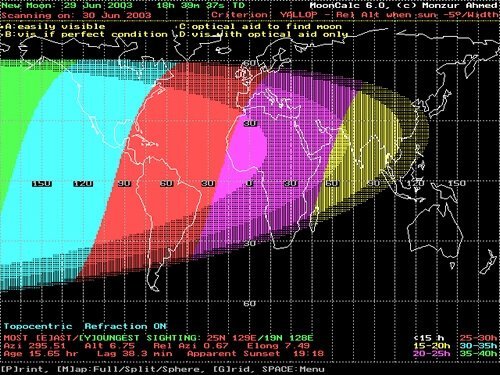
Mooncalc (under DOS) by Monzur Ahmed is certainly the best known. It includes all criteria in the table above except Odeh. Click here to download version 6.0; you will need DOSBox to run this old program. Download DOSBox here, or LaunchBox, which includes DOSBox.
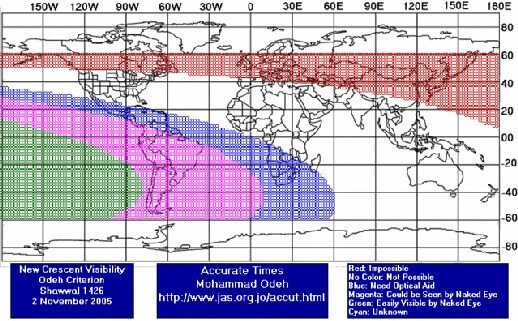
Accurate Times by Mohammad Odeh includes the Odeh, Yallop and SAAO criteria. It is available here: https://www.astronomycenter.net/accut.html?l=en, and you can also click here to download it directly.
c) Calculation and observation
As we guessed, this method partially uses “astronomical calculations” to determine Hilaal observation possibilities and reject fanciful sighting claims.
Still, one must know which calculation method is being used.
France, for instance, follows what was decided by the European Council for Fatwa and Research, but it is unclear which method is actually applied... and apparently impossible to find out. One of my internet correspondents got no answer after asking UOIF about it. That is a pity.
One can read in a UOIF calendar for the starts of Muharram and Safar 1427: “Muharram. According to universal astronomical data, the birth of the new moon of Muharram will occur on 29/01/06 at 14h15 GMT (15h15 Paris time). Therefore, sighting of the Muharram lunar crescent will not be possible on the evening of 29/01/06. Following the opinion of the European Council of Fatwa meeting in Cologne on 19-21 May 1999, UOIF informs Muslims in France that the first day of Muharram will be 31/01/06.”
“Safar. According to universal astronomical data, the birth of the new moon of Safar will occur on 28/02/06 at 00h33 GMT (01h33 Paris time). Therefore, sighting of the Safar lunar crescent will not be possible on the evening of 28/02/06. Following the opinion of the European Council of Fatwa meeting in Cologne on 19-21 May 1999, UOIF informs Muslims in France that the first day of Safar will be 01/03/06.”
We can see this “French method” appears to use none of the criteria listed in our table and relies only on published geocentric conjunction (new Moon) date/time (for example from IMCCE). Personally, I find this oddly simplistic, since for a new Moon on 29/01/06 at 14h15 GMT (15h15 Paris time) one must wait two days to begin a month, whereas only one day is needed when new Moon is on 28/02/06 at 00h33 GMT (01h33 Paris time) ???
One location or many?
Let us sharpen the question: if the crescent is seen in one region, must all regions of the world begin the month? Of course, time-zone differences are not disputed and must be accounted for.
This concerns month beginning and therefore fasting beginning. Since our topic is calendars, we will stay with the “month beginning” aspect.
We certainly will not settle this endless debate. We will simply frame the issue through a text whose interpretation is delicate: H7, which we quote again:
... Kurayb said: “We saw it on Friday night.” Ibn Abbas asked: “Did you see it yourself?” Kurayb replied: “Yes, I saw it; and people too. So they fasted, and Mu‘awiya also fasted.” Ibn Abbas then said: “But we saw it on Saturday night; so we will either fast thirty days or see [the new moon of Shawwal].” Kurayb asked: “Do you not accept Mu‘awiya’s observation and fasting?” Ibn Abbas replied: No! This is how the Messenger of Allah commanded us.
How should this final phrase be interpreted: “No! This is how the Messenger of Allah commanded us”?
- First interpretation: Ibn Abbas meant the Prophet had stated that each region must have its own sighting.
- Second interpretation: Ibn Abbas was recalling the rule that the crescent must be seen for the month to begin, and gave his own understanding: if the month begins when we have seen the crescent with our own eyes, we cannot begin it on a day when we did not see it in our region.
From this we get two positions:
- Either one adopts the first interpretation, or agrees with Ibn Abbas in the second interpretation: then crescent sighting in one place is valid only for Muslims in that region.
- Or one disagrees with Ibn Abbas in the second interpretation and considers that when the Prophet said “Begin when you see it...”, he addressed the whole Muslim community. Then sighting by Muslims in one place is valid for Muslims across the Earth.
Both positions coexist today. Since these are interpretations, it is almost impossible to say who is right.
By way of conclusion
Problems linked to determining the date when the first crescent becomes visible.
Problems linked to whether that date is local or universal.
Let us admit it is difficult to use a calendar whose months do not necessarily begin on the same day. For a civil calendar, it is more than difficult.
And for a religious calendar?... Well... a small question: even if the context differs somewhat, have Christians always celebrated and do they still always celebrate Easter on the same day? (see the study on Nicaea)