Overview
This study will take us from one country to another. In each case, we will try to understand how the Gregorian reform unfolded, when it was applied, and how different social groups experienced it.
So this page is not fully complete yet. I prefer to publish it progressively, as my research and reading move forward.
Background: the birth of the Gregorian calendar
On 24 February 1582, at Tusculum (now Frascati), Pope Gregory XIII issued the bull Inter gravissimas, instituting the reform of the Julian calendar. The Gregorian calendar was born. The text appears on this page, and also on Rodolphe Audette's site, whose translation I am again grateful to publish.
To make up the drift accumulated since the Council of Nicaea against the solar year, 10 days were to be removed from the calendar. The jump was set for the day after 4 October 1582, which would become 15 October 1582 instead of 5 October 1582.
Ten vanished days is no small matter. It obviously raises all kinds of problems (bills to pay, canceled feast days, disrupted agricultural work, etc.). The goal of this study is, as said above, to understand “how it actually happened” in the countries concerned. We will limit ourselves to present-day Europe and Russia.
Why Russia? Simply because no dedicated page covers it in the calendar section, and we do need to discuss how calendars evolved there.
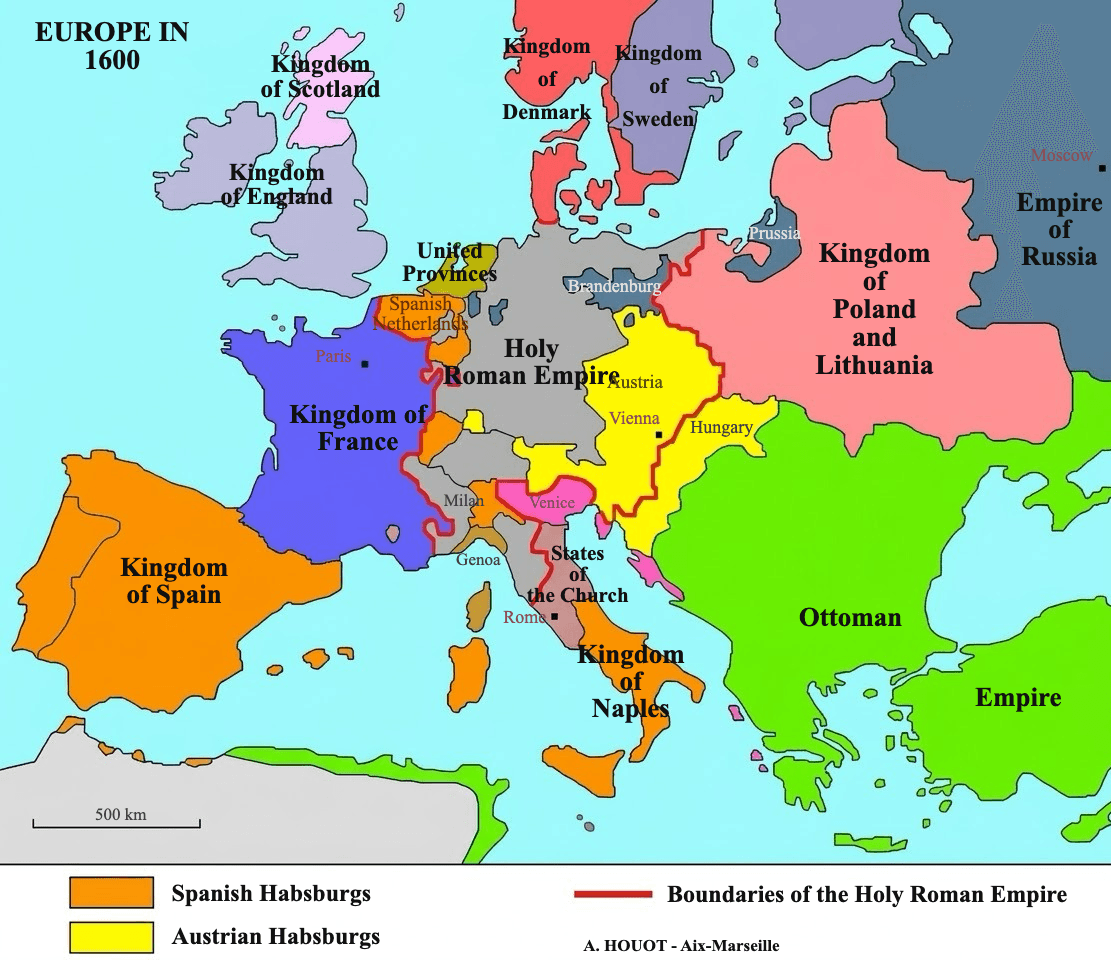
Since we will need to know the borders of the various countries, kingdoms and states at the time of the reform, here is one map. It was produced by Alain Houot, whose site is here, and I warmly thank him for allowing me to publish his maps.
The reform in general terms
The text of the bull was first sent to members of the Catholic Church. No issue there: the pope being supreme authority, those concerned only had to comply.
It was also sent to all Christian heads of state. Of course, these rulers were sovereign in their own realms, but as good Christians they were expected to “render this service” to the pope.
That left non-Christian states, or states that did not recognize papal authority. As we will see, both Protestant states and the Eastern Churches delayed for a long time before applying the Gregorian reform.
Reform in France: a slight delay
We owe Francesco Maiello (Histoire du calendrier de la liturgie à l'agenda - History of the Calendar from Liturgy to Agenda) and Jérôme Delatour (La réception du calendrier grégorien en France - The Reception of the Gregorian Calendar in France) for their extensive work on the reform in France. Adding our own comments, we will try to follow this reform and the importance attached to it.
Let us first recall the borders of France at that time. We are in 1582:
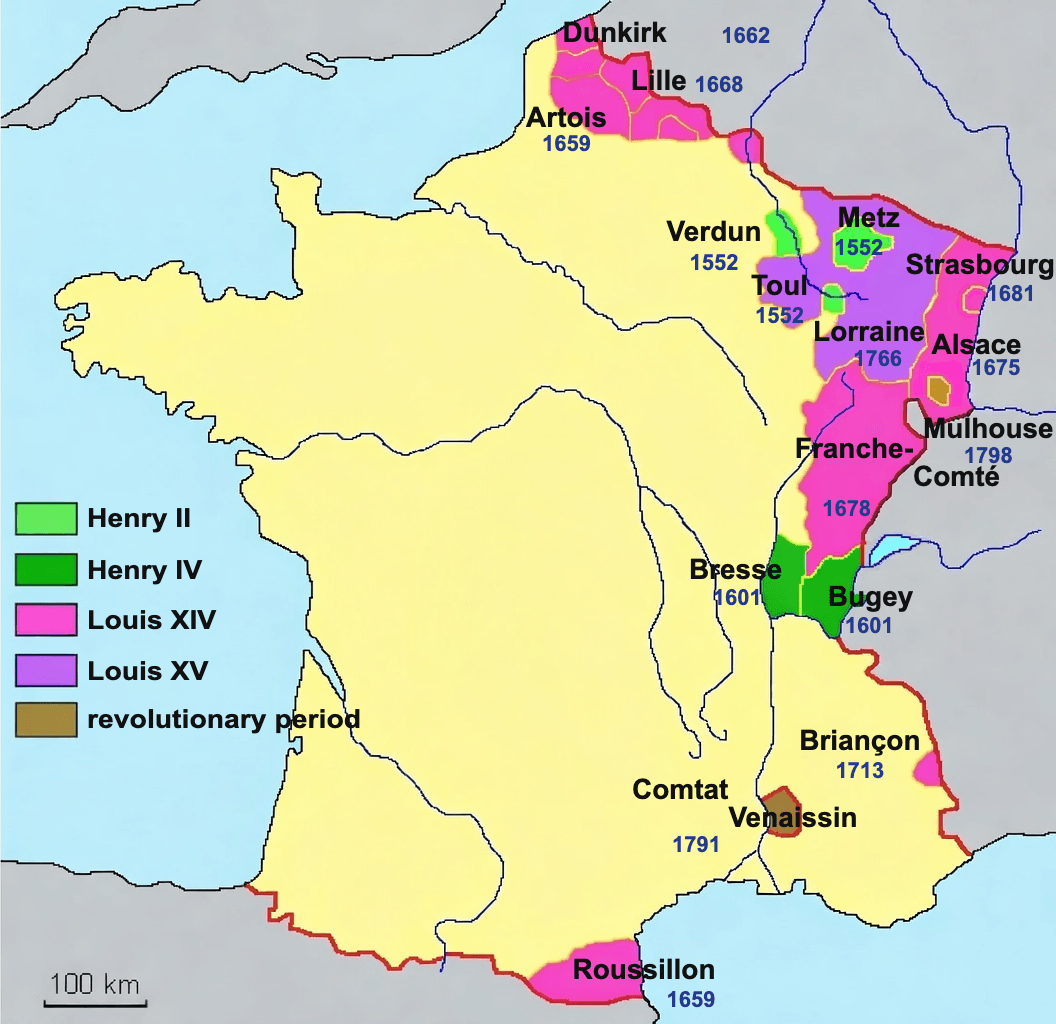
Let us say it plainly: in France, the 10-day removal planned by Inter gravissimas was carried out from 10 to 19 December 1582, so 9 December 1582 was followed by 20 December 1582. Yet, according to the bull, this should have happened in October, not December. Why this delay, when Italy, Spain and Portugal followed the planned schedule without difficulty? J. Delatour sees two, perhaps three reasons.
The convenient pretext: its name was Antonio Lilio. The pope had granted him the privilege to print and sell the new calendar. Through Antonio, the pope meant to reward Antonio's brother, astronomer Luigi Lilio, designer of the calendar, who died in 1576.
At the pope's request, this privilege was also granted to Antonio Lilio in France by Henry III. The problem: Antonio did not bother to print or distribute the calendar. Without a calendar, French printers were blocked. October, the official month for implementation, came and went with no translation and no printing.
The royal ordinance setting reform dates in France was issued on 3 November 1582. The next day, Henry III granted Jacques Kerver a printing privilege. It should also be said that he had discreetly granted another one on 16 September to Jean Gosselin, allowing French translations. But by mid-November, once the papal nuncio in France, Giovanni Battista Castelli, learned that the pope had canceled Lilio's privilege, nothing prevented anyone from finally printing the long-awaited calendar. And everyone got started: Pillehotte in Lyon, Kerver in Paris, and also Plantin in Antwerp, Basa in Rome.
The unspoken reason: perhaps Christophe de Thou, first president of Parliament. As Delatour notes, this remains hypothetical: unproven, based on a troubling date coincidence.
Christophe de Thou was powerful and respected. He disliked the Holy See interfering in Gallican Church matters. After a first warning shot (two years of “resistance”) during adoption of 1 January style in 1564 (1 January becoming the first day of the year), he was, according to his son Jacques-Auguste de Thou, determined to prevent adoption of the Gregorian reform. He opposed the king and... fell ill.
From there, Delatour notes the date sequence:
- 29 October: Christophe de Thou is dying; the Council issues its ruling on the calendar.
- 1 November: Christophe de Thou dies; two days later the king issues his edict and ordinance.
- 5 November: the bishop of Paris sets end-of-year feast order.
- 10 November: the edict is published.
- 12 November: Parliament returns from recess and can only note faits accomplis.
The awkward reason: feast days. For the reason(s) above or, as Paul de Foix (tasked with explaining matters to the pope) put it, "...that there was in this some hindrance I could not identify", replacement dates had to be found.
Ten days had to be removed. And above all Easter 1583 had to be celebrated on the same day in France and Rome. But the king also wanted Christmas observed simultaneously in Rome and Paris. So reform had to occur before 25 December 1582.
No question of removing 11 November: end of parliamentary recess, due date for rents and end of certain contracts, and too close to the Council decision.
No question either of touching the day when “everything takes root” (St Catherine, 25 November), nor St Andrew (30 November), nor St Nicholas (6 December), patron feast of wine merchants, coal porters, bargemen, etc., nor the Immaculate Conception (8 December). So they jumped, with limited damage, from 9 to 20 December.
And never mind cutting through Advent. In Paris, they simply moved Advent's start to 18 November 1582. Elsewhere, they managed as they could, even celebrating Advent Sundays... during the week.
And never mind the pope either, who had decided in late October/early November to remove 11-20 February 1583 in France. The French decision was already taken. So Gregory's decision was ignored. Did the king organize a huge procession in Paris on 9 December 1582 to please him? Or to celebrate the last Julian day in France?
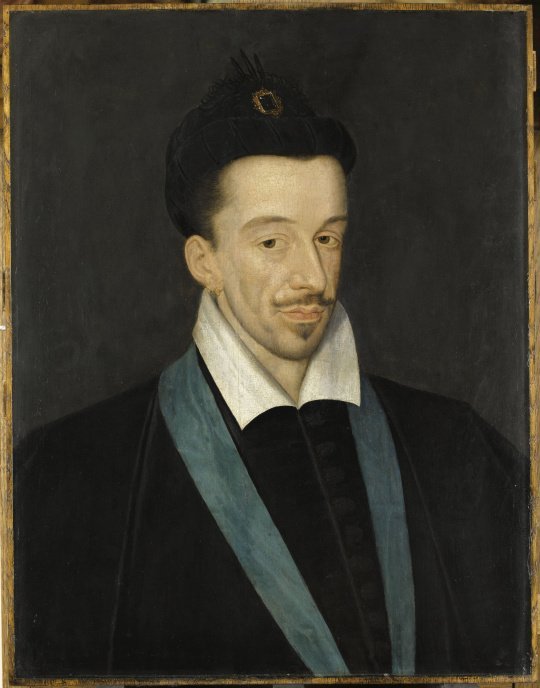
Henry III (1551-1589), son of Henry II, reigned from 1574 to 1589 and was the last Valois king. Below is the ordinance establishing the Gregorian calendar in France.
“Ordinance in the form of instructions addressed to city provosts concerning calendar reform.
The text orders that after 9 December 1582 has expired, the following day is to be counted as 20 December throughout the kingdom, then 21, 22, 23 and 24, so that Christmas is celebrated on what would otherwise have been the 15th. It also specifies that terms, feasts and ecclesiastical services are to be adjusted accordingly, and commands publication in churches and courts so no one can plead ignorance.
Paris, 2-3 November 1582, proclaimed by trumpet at Paris crossroads on the 10th.
How was reform received in France?
Francesco Maiello notes that only about a quarter of account-books kept around 1582 mention introduction of the Gregorian calendar. These livres de raison were personal records containing both economic information (household/craft accounts) and daily-life entries (family events, almanac notes, etc.), usually maintained by the head of household.
Maiello rightly concludes that our current way of orienting time by years, months and day numbers was far from socially established. Exact day references (for example 24 August 1572) were rare. Religious feast names (for the same example, St Bartholomew's) were more common reference points.
"In the French countryside, peasants found their way in time through seasonal phenomena but also through feast days, especially saints' days," writes Maiello. Proof: proverbs still known today, e.g. “On St Lucy's day, days begin to lengthen by a flea's jump.”
A less random example than it seems. Before reform, St Lucy fell on 23 December, just after the solstice. After reform, with ten days removed, St Lucy moved to 13 December, when days were still shortening.
In 1588, Etienne Tabourot des Accords tried replacing this saying with “The sun slips away on Christmas Eve”. To no avail.
Still, the new calendar also touched what was not strictly quantitative time, not to mention rent and debt due dates.
Delatour helps us better understand how reform was received across social classes.
Apart from a few insiders, most of the French population was caught off guard by a rather abrupt change. From the royal ordinance (2 November) to removal of ten days in December, very little time passed. How would we have reacted if the euro had been introduced the same way: suddenly and without explanation?
According to Delatour, reception varied both by education level and religion.
In contracts, things went relatively well. Parliament of Paris insisted terms would not be shortened by ten days. Royal courts ensured strict enforcement.
Educated groups generally welcomed the new calendar, while, as Delatour writes, often “blaming popular obscurantism”.
The best witness to this mixed reaction by class may be Montaigne, who at times complains:
"This new eclipse of ten papal days has caught me so low that I cannot properly adjust. I belong to years in which we counted otherwise. Such an old and long habit claims me back. I am constrained to be somewhat heretical for that. Incapable of novelty, even corrective novelty. My imagination, in spite of me, always throws itself ten days forward or backward, and grumbles in my ears."
and at times observes no real impact on farmers, who use another temporal framework:
"How many changes should follow this reform! It was truly to stir heaven and earth at once. Yet nothing moves from its place: my neighbors find sowing time, harvest time, business opportunities, harmful and favorable days, exactly where they had always placed them."
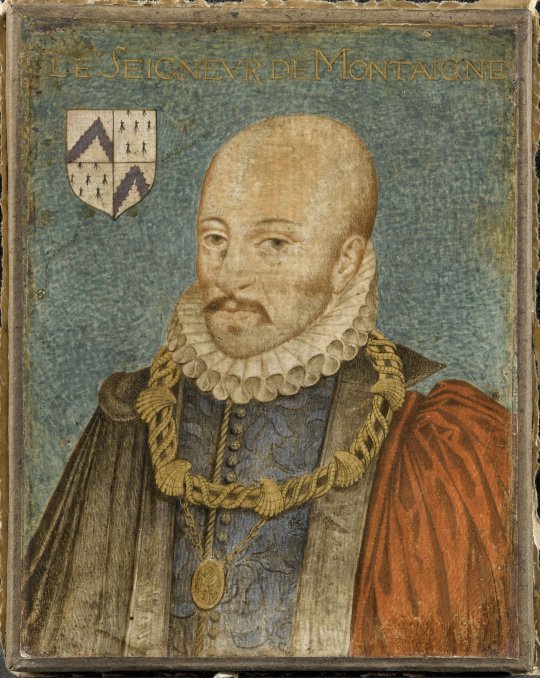
Michel Eyquem de Montaigne (1533-1592). After legal studies, he became a magistrate, first in Perigueux, then at the Bordeaux Parliament.
In 1571, he decided to retire to the “library” of his chateau (in Dordogne) to read and write. He was in a very good position to assess the impact of Gregorian reform on rural daily life.
And scholars? They quickly identified flaws in the reform (year still slightly too long, no compensation for excess days accumulated between Julian reform and Nicaea). Their reactions varied widely as well: measured for Protestant Scaliger, “inventor” of the Julian day; fierce for another Protestant, mathematician Francois Viete, who according to Delatour "accused Clavius of distorting Lilio's principles to the point of reducing the Gregorian calendar to a vulgar calendar". Clavius easily refuted arguments that ignored practical constraints.
Little by little, willingly or not, the Gregorian calendar prevailed in France.
Reform in England: “Give us back our eleven days!”
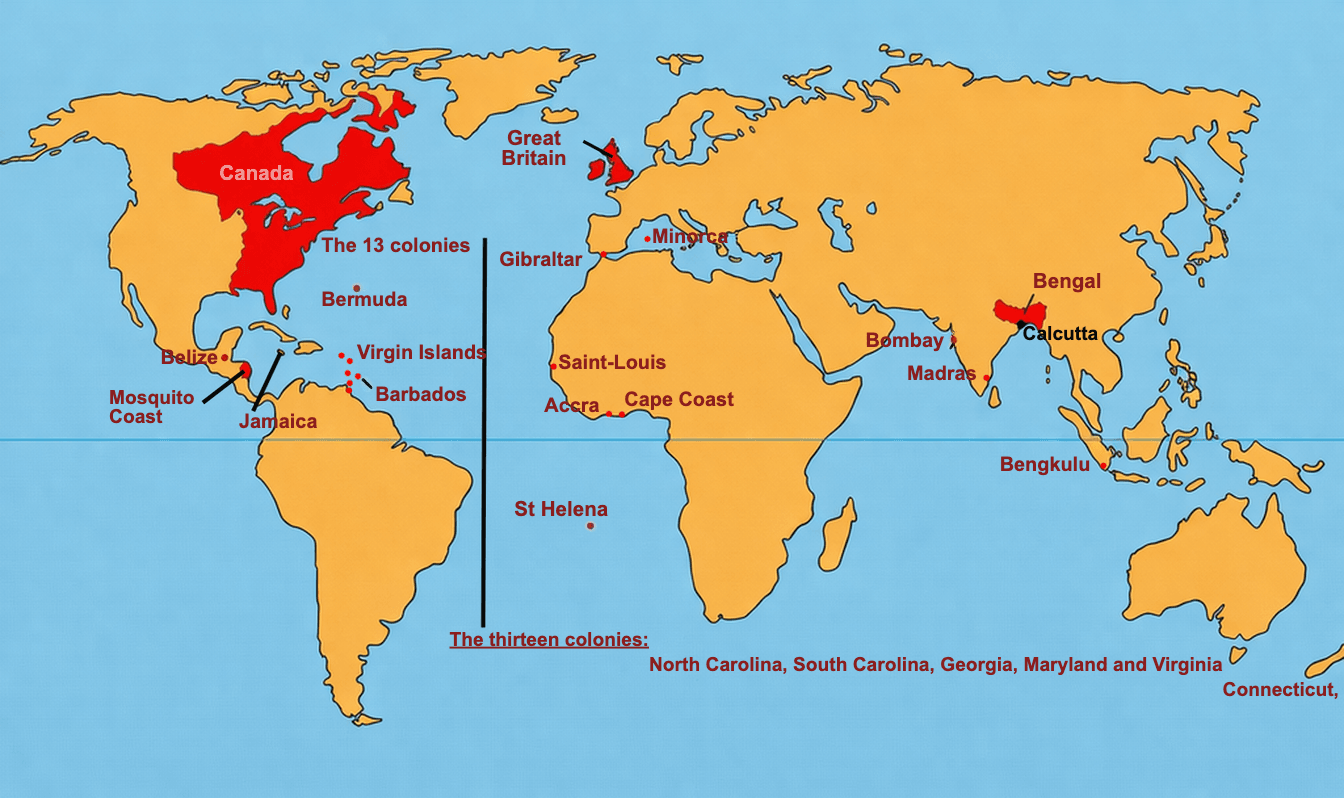
First, a map of Great Britain and its possessions in 1763, close to the reform period in Britain.
A precursor
We should not forget that if Pope Clement IV had listened in 1263 to Roger Bacon urging calendar reform, we might have ended up with a “Clementine” calendar.
Indeed, Bacon told the pope (in Opus Majus and Opus Tertium) that precession of the equinoxes makes the calendar year run ahead of the solar year by nearly 11 minutes per year - roughly one full day every 120 years - which shifts Easter to the wrong date.
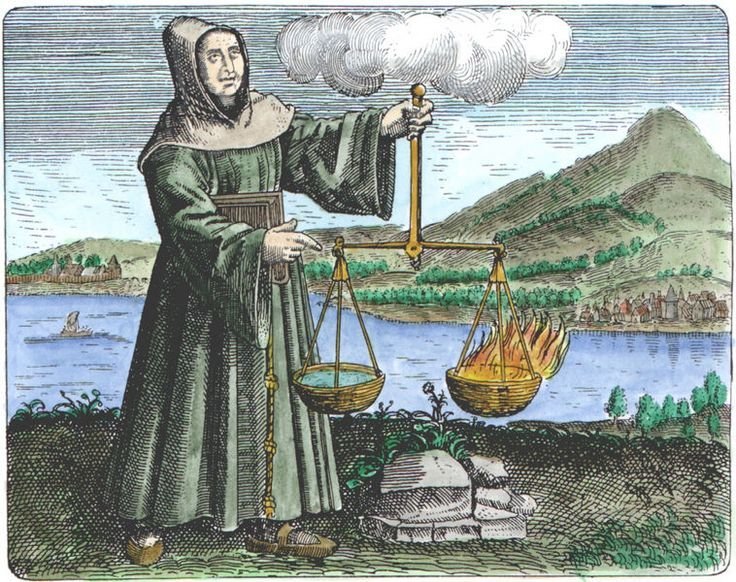
An indefatigable polemicist, bold philosopher, mathematician, logician, grammarian and accomplished experimenter, Roger Bacon (1212-1294) was the most original figure of 13th-century Franciscan thought.
Claiming to be “very learned in all sciences” and an Aristotelian reader “more than any before him”, he was both a pioneering promoter of experimental method and the greatest linguist of his time (Encyclopaedia Universalis).
Challenging Church teachings proved a mistake; Bacon's vehement pleas went nowhere.
A failed attempt
In 1582, Francis Walsingham, adviser to Queen Elizabeth I, received a copy of Inter gravissimas through diplomatic correspondence and forwarded it, on behalf of the Privy Council, to John Dee for expert opinion.
John Dee was a fascinating and unsettling figure: a first-rate scientist and mathematician who also practiced astrology. His horoscope for Mary I Tudor brought him to court. His influence was such that Elizabeth I, following his advice and predictions, fixed her coronation on 17 January 1559. Philosopher, magician, convinced Copernican - and yet he claimed to converse with angels.
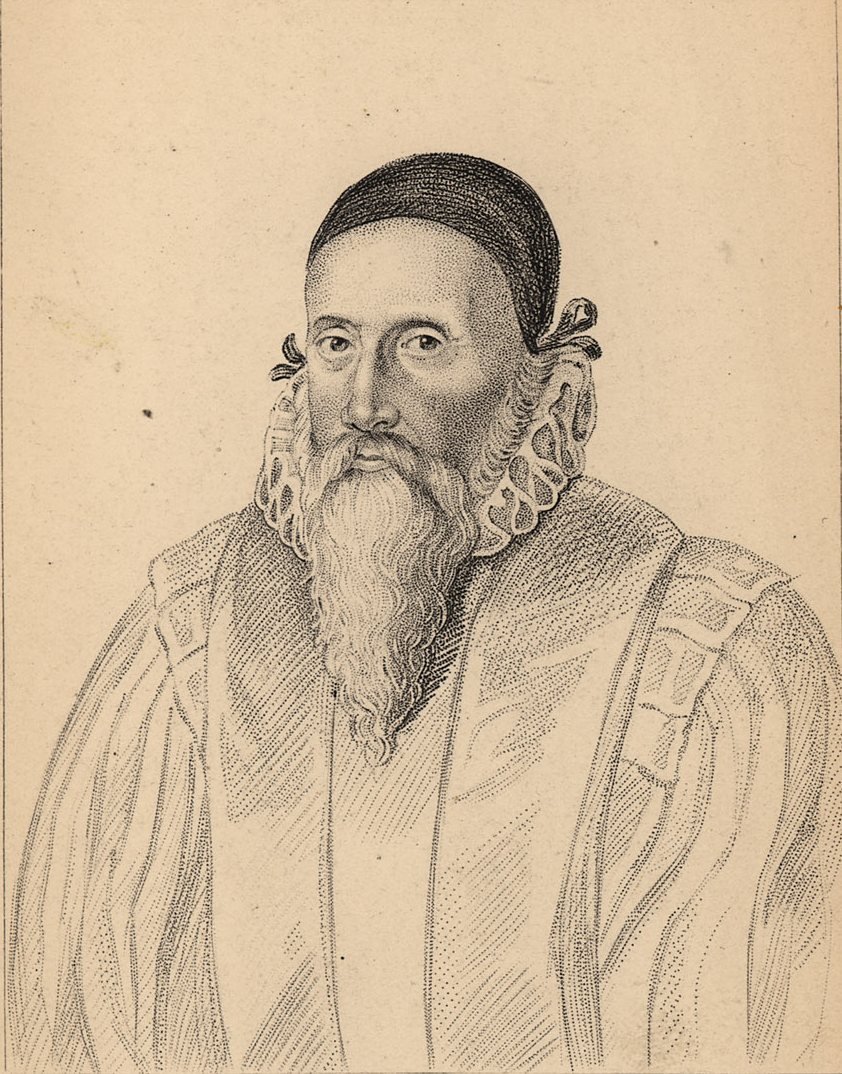
John Dee's scientific fame (1527-1606), astronomer, geographer and mathematician, was intertwined with alchemy, astrology and occultism. Appointed royal astrologer, he drew Elizabeth's horoscopes. As scientific consultant to the court, he was brought before the Star Chamber in 1553, accused (unsuccessfully) of sorcery and heresy. Thirty years later, a crowd frightened by his knowledge of black magic destroyed his house and library (the largest philosophical and scientific collection in Elizabethan England).
© 1993-2003 Microsoft Corporation. All rights reserved.
With one of the kingdom's richest private libraries and full awareness of astronomical publications, he was highly qualified to advise on the calendar question.
Dee tackled it enthusiastically and delivered to Lord Treasurer Burghley a 62-page treatise: "A loyall and humble supplication to our gratious Queene Elizabeth... concerning the needful reformation of the vulgare kalender for the civile yeare and dayes account, according to the trueth of time passed."
The title itself already contains most of his argument. A few key words:
- Humble advice. “Humble” is debatable when we read the title-page verse comparing Elizabeth to Caesar and Dee to Sosigenes. Flattery of the queen is one thing; likening oneself to Sosigenes is another.
- Verification of years: the first, highly theoretical part compares year lengths from ancient to modern astronomers (Copernicus, Maestlin, a firm critic of Gregorian reform).
- Civil days: Dee deliberately adopts a strictly civil and astronomical perspective. He does not propose moving religious feasts.
- According to time actually elapsed: Dee confirms a 10-day Julian drift since Nicaea. But as a Protestant, he gives no normative weight to Nicaea and counts from the birth of Christ: he says eleven days should be removed, not ten. He proposes catching up in 1583 by removing 2 or 3 days each month from May to September, hoping to avoid touching feast days and contract deadlines.
In the end, in a draft calendar for 1583, Dee removed only 10 days.
Why? Two explanations exist, both hard to verify.
First: Burghley may have submitted Dee's text to three other advisers. They accepted his calculations but preferred alignment with countries adopting Gregorian reform. Since Nicaea was initiated by Constantine, not the pope, Protestant honor was preserved.
Second: no one forced Dee; he revised his own model based on a 33-year leap-year cycle attributed to chaplain Richard Monk. He first drafted for 1582 (thus 11 days needed), then redrafted for 1583 and, with his leap-year logic, added a note that ten days were now enough because 1583 would be leap in his system. This needs careful verification.
In any case, Anglican Church approval was still required to implement reform. It was requested... and not granted.
The Church, through Edmund Grindal, Archbishop of Canterbury, delayed replying so long that the queen had to press him, then gave purely religious reasons: "Considering that the bishop of Rome is Antichrist, we cannot communicate with him in anything."
Dee rightly replied that astronomy makes calendars, not the pope. A bill was introduced: "An Act to geve Her Majestie auctorite to amende our kalender and to conforme it to the new kalender used in other countreyes."
And there the matter stalled.
It is reasonable to think Her Majesty did not want open conflict with her Church while already facing growing conflict with Spain.
Two further attempts (1645 and 1699) met the same negative ecclesiastical response.
Hence the oft-attributed remark by astronomer Johannes Kepler (1571-1630): “Protestants would rather be at odds with the Sun than in agreement with the pope.” The phrase is also attributed to Voltaire. I would very much like to know where.
A carefully engineered reform
Things did not completely stop there.
In 1700, the offset increased by one more day: leap year in the Julian calendar, not in the Gregorian.
In 1707, the Act of Union created the Kingdom of Great Britain (England, Scotland, Wales), precursor of the 1801 United Kingdom. Since Scotland had used 1 January style since 1600 (while staying Julian) and England still used 25 March style, dates differed by one year for three months.
By 1750, England was recognized as a major scientific nation and clockmaking power. Keeping a “primitive” calendar with no scientific justification looked increasingly untenable.
At the same time, England had become a global commercial and economic power. Even if the English muddled through by using Old Style and New Style in international correspondence, it was increasingly irritating for everyone.
In short, England was ripe for reform. It still needed a trigger and the will to act. Both appeared in 1750: the trigger was George Parker, the will Philip Dormer Stanhope, Earl of Chesterfield.
It began on 10 May 1750 at the Royal Society with a speech as dry as its title: "Remarks on the Solar and Lunar Years, the Cycle of Nineteen Years commonly called the Golden Number, the Epacts, and on the Method of Calculating Easter as used in most Nations of Europe."
Its author, George Parker, second Earl of Macclesfield, was an amateur astronomer and, no less, friend of royal astronomer James Bradley.
To those compatriots who were still awake, Parker explained how wrong their calendar was in year length and Easter computation - what Dee had already said 170 years earlier.
One man certainly not asleep was Lord Chesterfield, who, though no specialist, launched the reform.
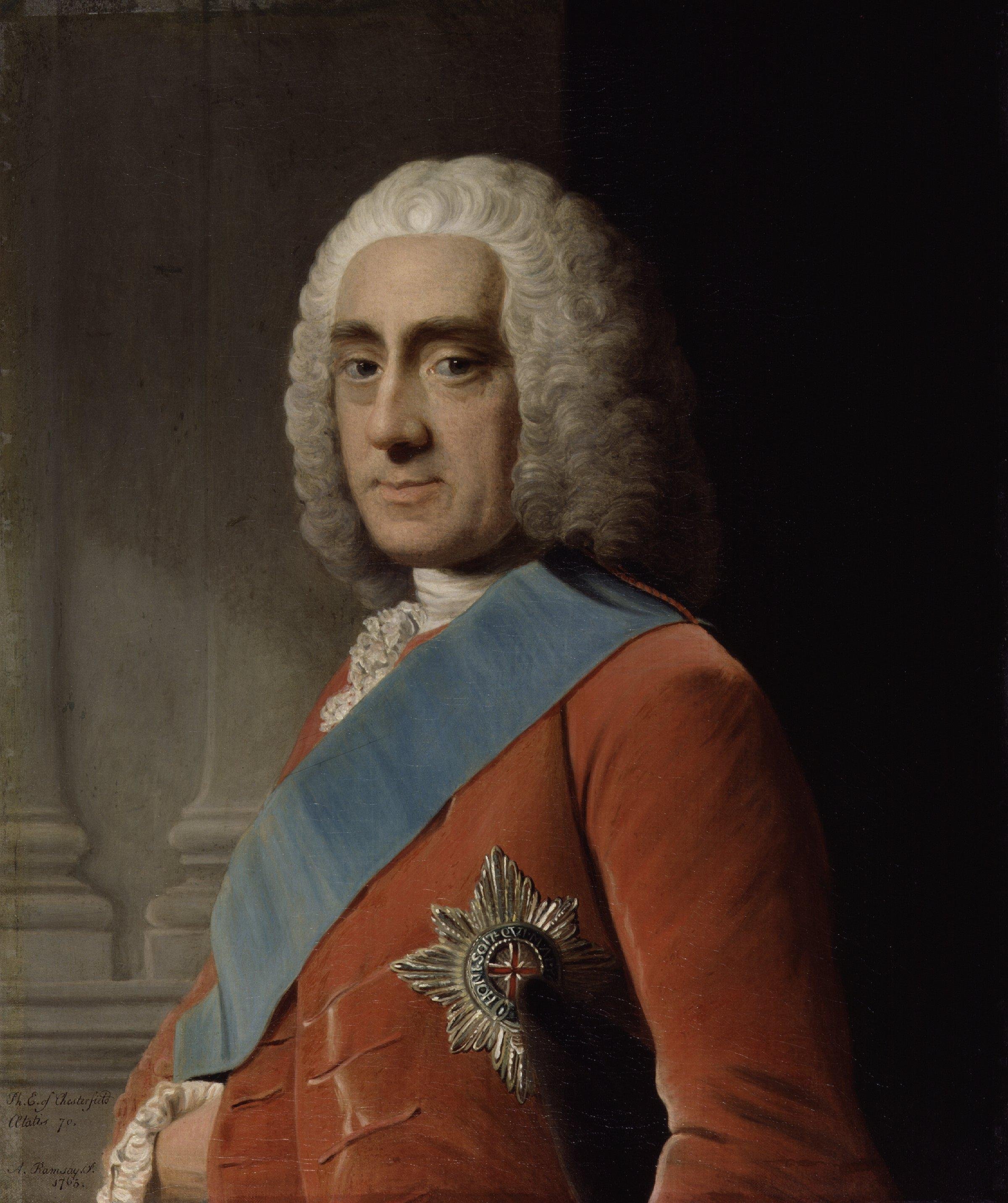
Chesterfield was born in London. After Cambridge, he entered politics (1715), sat in the Commons, then entered the Lords in 1726 after his father. Supporter of Robert Walpole, ambassador to the Netherlands (1728-1732), later dismissed for opposing a new tax, he joined the opposition. Between 1745 and 1764 he served as Lord Lieutenant of Ireland, seeking reconciliation among rival factions, then as Secretary of State under George II. He died in London on 24 March 1773.
He may have known little astronomy, but he was witty and shrewd. So he used a new communication tool: the press. Under a pseudonym, he published both didactic and entertaining pieces in The World, a London paper. In his own words, he became “a sort of astronomer in spite of myself” (“malgre moi” in French in the original).
He eventually secured his party's backing and introduced in the House of Lords a bill titled: "An Act for Regulating the Commencement of the Year; and for Correcting the Calendar now in Use."
His letter to his son is revealing about method: he first consulted top lawyers and astronomers, then presented a bill full of astronomical calculations he barely understood, deciding to seduce rather than convince by telling the history of calendars with entertaining anecdotes. People assumed he knew his subject because he did not bore them.
The strategy worked: as he wrote, it was his method that got a difficult text passed.
After the usual three readings, the Act passed on 17 May 1751 and was promulgated on 22 May 1751 by George II.
The text drafted by Parliament and Chesterfield was exemplary: concise, clear and comprehensive, unlike the inflated endless texts common at the time.
We will not reproduce it here (it is fairly long and includes details beyond our focus). Full paragraph-by-paragraph text is here.
What does the Act say?
First, the year would begin on 1 January from 1752 onward. Thus 1751 had only 282 days: 31 December 1751 was followed by 1 January 1752.
Second, it ordered removal of 11 days in 1752 in England and its colonies: Wednesday 2 September 1752 was followed by Thursday 14 September.
Third, the new calendar applied to all: clergy, civil authorities, public and private life.
Leap-year rules and Easter dating were aligned with the Gregorian method, without naming it.
Finally, the rest of the Act pre-empted economic, religious, legal and administrative consequences: assemblies, customs, trade dealings, fairs and markets, contracts, interest, rent, legal majority at 21, servants' terms, even prisoners near release. A remarkable inventory - unlike France, where courts addressed problems case by case. Everything was planned... except...
Except the Church's reaction. A firm opposition might have been expected. None came. Perhaps aware of 170 years of poorly justified refusals, the Church received reform with goodwill, even promoting the motto “New Style, true style”.
Except London bankers, who refused to pay taxes on the traditional date of 25 March 1753 and paid 11 days later, on 5 April 1753. That date remains the UK tax deadline.
Except demonstrations shouting “Give us back our eleven days!” These were far fewer than legend suggests: a few in London and Bristol, mostly from people worried about financial “interest”, feast-date changes, or losing eleven days' wages. How many truly believed eleven days of life had been stolen?
Still far from riot. The slogan might have been forgotten without William Hogarth's engravings. Look closely at the placard on the ground under the bald man's leg.
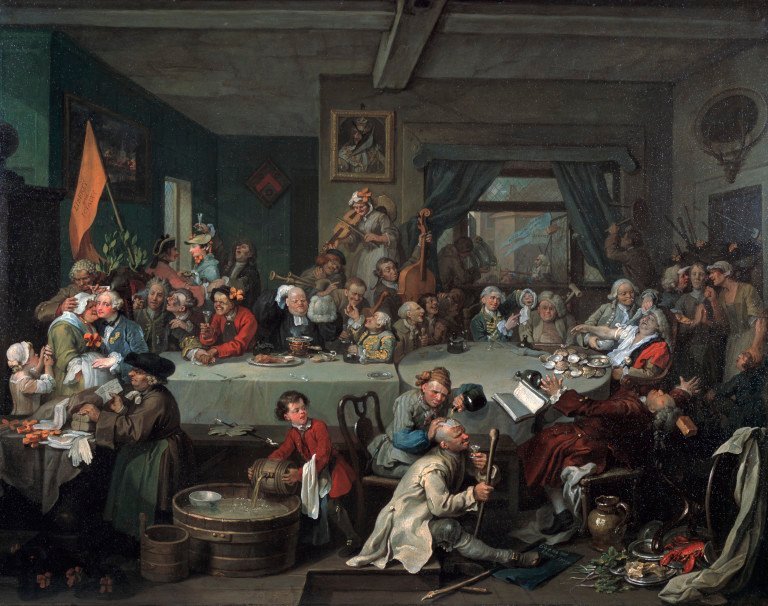
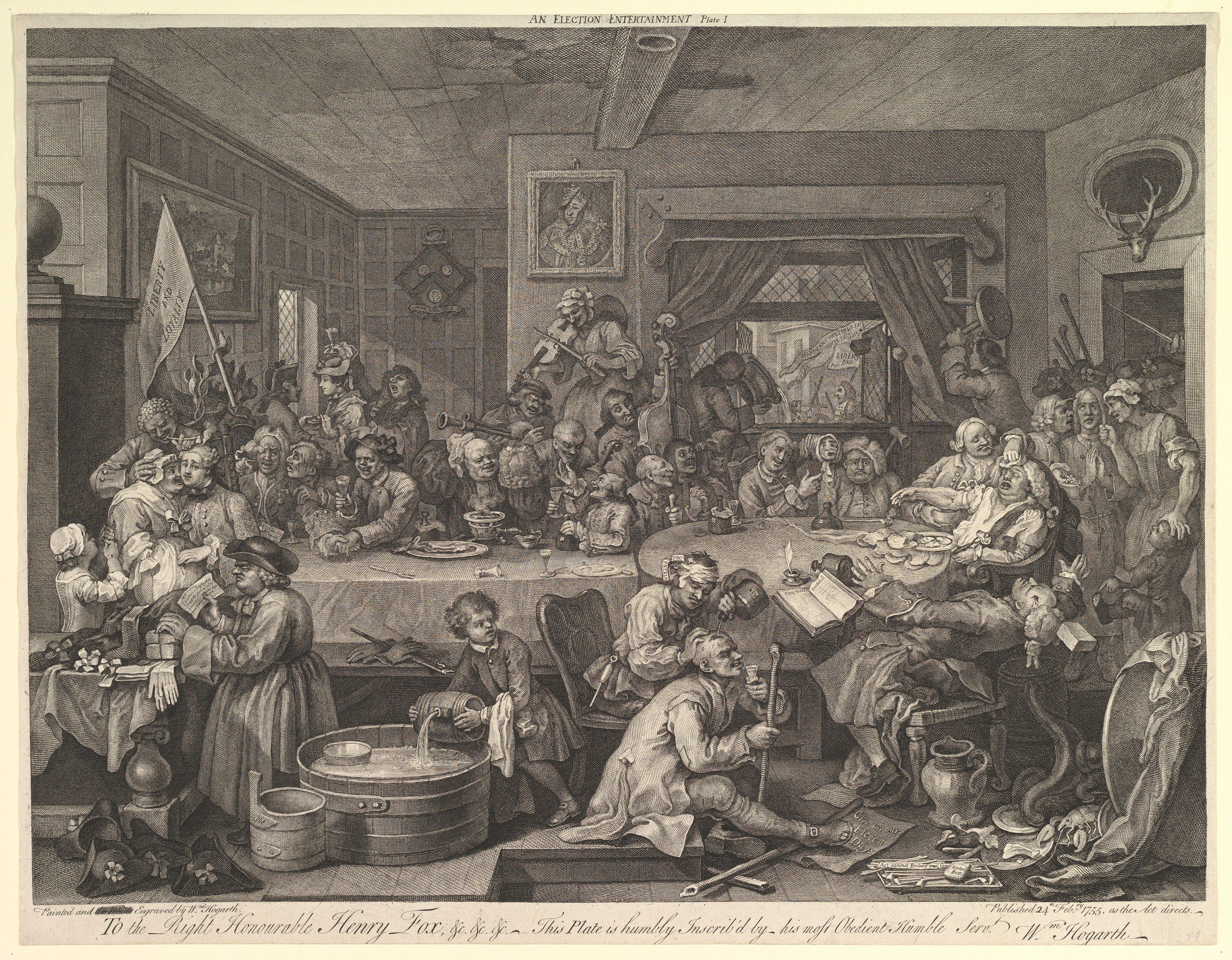
William Hogarth (1697-1764), an archetypal Englishman to the point of caricature - nationalist, Francophobic, attached to civil liberties and parliamentary monarchy - fully involved in economic rise, social change and intellectual debate in Georgian England. His works are often valuable historical documents, but his art is not limited to illustration of his age (Encyclopaedia Universalis).
Can we say the English adopted the Gregorian calendar in 1751-1752?
- If we look at outcomes, yes: English “new style” matches the Gregorian calendar point for point.
- But if we look at motivations, clearly no. As shown in our Gregorian-calendar study, Gregory XIII's sole aim was to fix Easter's date and prevent drift.
Lord Chesterfield's motivations were not religious but civil. So we may say England reformed the Julian calendar so it would coincide with other nations' Gregorian calendars. But this was not adoption of the Gregorian calendar as such.
Even if, in practice, the result was the same.
Reform in Switzerland: taking their time
If we started a stopwatch at the beginning of Gregorian reform in Switzerland (more precisely, in the Confederation of the Thirteen Cantons) in 1582, we would have to stop it in 1812 - over 230 years later.
Why such a long transition from Julian to Gregorian?
Mainly for two reasons:
- First, in 1582 Switzerland was still recovering from two religious wars (Catholics vs Protestants), ending with the Battle of Kappel (1531), and each canton could choose its religion. Catholicism prevailed in mountain regions, Protestantism in major cities and fertile valleys.
- Second, Confederation did not mean State. This created the issue of common bailiwicks (subject territories shared by several cantons). What happens when one owning canton is Protestant and another Catholic? And what happens when the Landsgemeinde (direct-democracy assembly institution present in certain cantons) adds its own constraints?
Before clarifying reform stages, let us recall key points in Swiss Confederation history that help explain them.
Structure of the Confederation of the Thirteen Cantons and confessions (16th-17th c.)
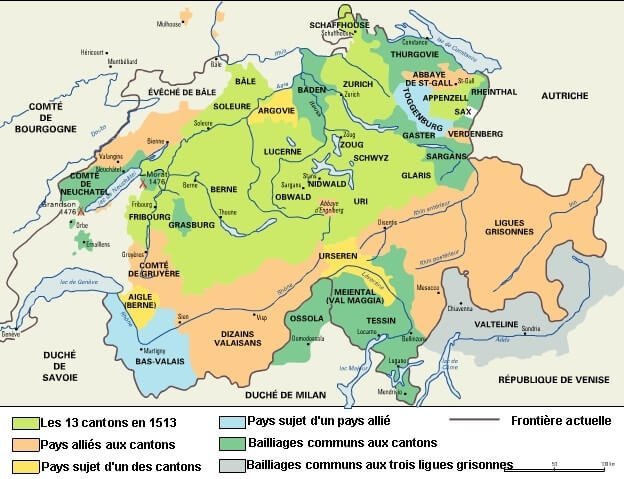
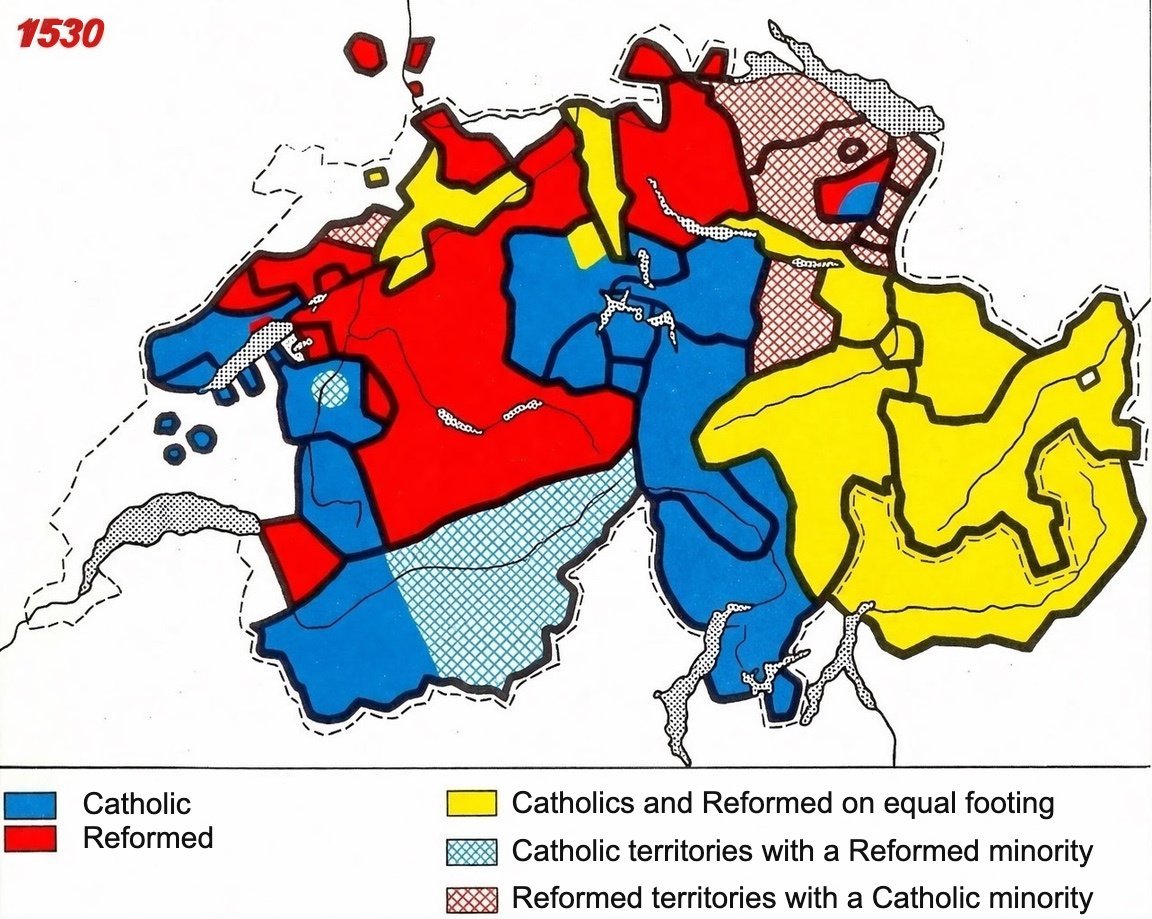
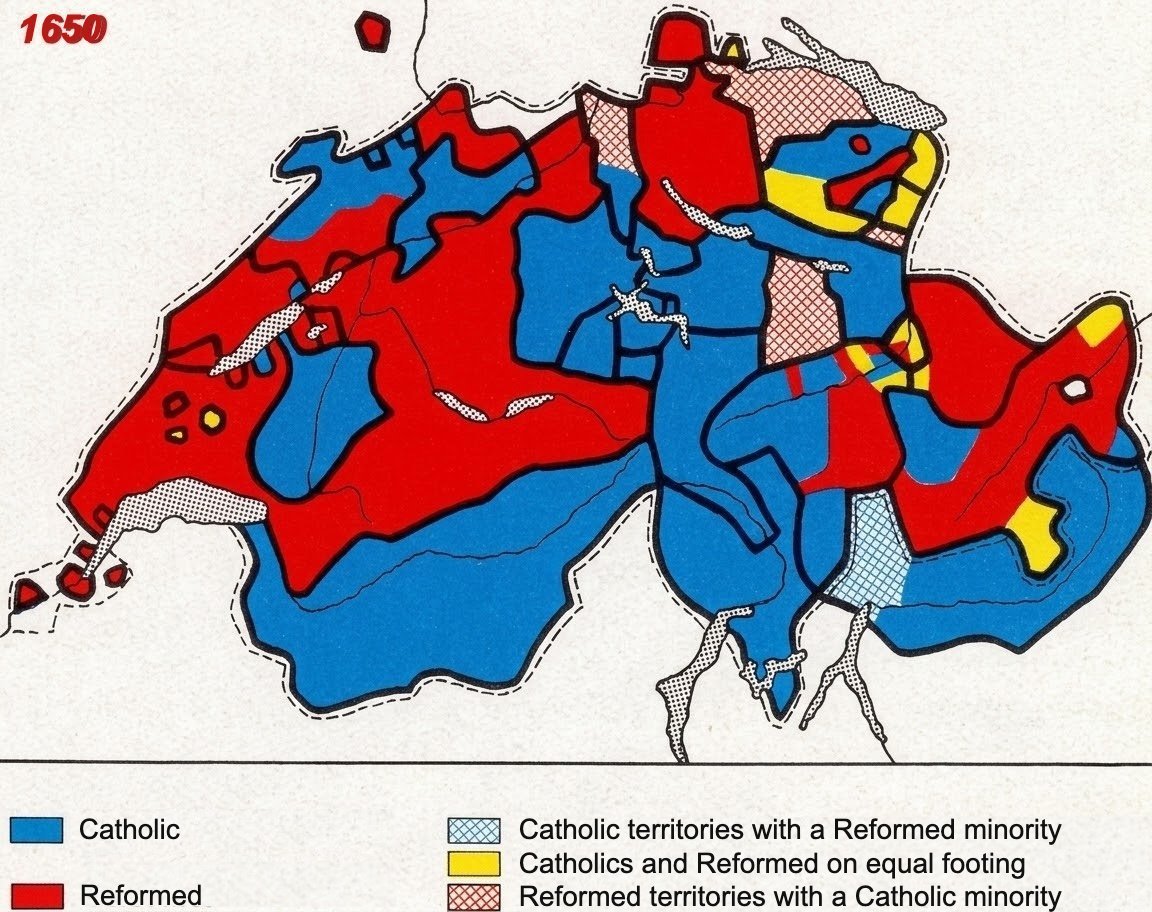
The Confederation therefore included
- 13 proper cantons:
- 7 Catholic (diet in Lucerne): Uri, Schwyz, the 2 Unterwald cantons (Obwald and Nidwald), Lucerne, Zug, Fribourg, Solothurn.
- 4 Reformed (diet in Aarau): Zurich, Basel, Bern, Schaffhausen.
- 2 mixed: Glarus and Appenzell (split between Protestant Ausserrhoden and Catholic Innerrhoden), plus common bailiwicks (Aargau and Ticino Catholic, Thurgau Protestant).
- Close allies: Biel, town and abbot of St Gall, participating in a 16-member diet.
- Simple allies:
- Valais (bishop pre-eminent) and the Three Leagues of Grisons (fairly autonomous municipal federation), allied with certain cantons.
- Principality of Neuchatel allied to Bern and Solothurn.
- Geneva allied to Bern and Zurich.
- Mulhouse allied with Protestants in 1586.
- Abbey of Engelberg and Gersau.
- Subject lands belonged to one or several cantons (common bailiwicks) or to an ally.
For current cantons, see the excellent Wikipedia page here.
Development of Gregorian reform
Let us recall Johannes Kepler's phrase: “Protestants would rather be at odds with the Sun than in agreement with the pope.”
Add the saying by a St Gallen resident: "If I wanted the thirteen cantons and allied lands to sign a declaration that we have snow in winter, a dozen referendums would not be enough," and the slow pace becomes clearer.
The reform was first presented to the general diet on 10 November 1583.
With delays due to the Landsgemeinde, most Catholic cantons obeyed the pope and moved from 11 January 1584 (last Julian date) to 22 January 1584 (first Gregorian date). Even Landeron, allied to Solothurn, followed.
Obwald and Nidwald delayed another month before adopting, after intervention by the Bishop of Constance, Markus Sittikus, with Inner-Rhoden faithful. Exact switch date is unknown. Outer-Rhoden waited until 1724, perhaps 1798. Even today, the village of Urnasch (about 2,500 inhabitants) celebrates New Year's Eve twice: 31 December and 13 January (see here).
“Small parenthesis on the diocese of Basel: by 1583 it had already lost the city of Basel and only became an ally of Catholic cantons in 1589.
According to the curator of AAEB (Archives of the former Bishopric of Basel), whom I warmly thank, date change occurred via two mandates: one dated 3 January 1584 (11 January 1584 Julian to 22 January 1584 Gregorian), but surprisingly preceded by another dated 15 October 1583 ordering a jump from 20 October to 30 October 1583. Since both reforms cannot have cumulatively applied, it would be interesting to know which population the October mandate concerned.
Naturally, Reformed cantons (including Reformed parts of the bishopric of Basel) refused the new calendar and drew allies into resistance led by powerful Zurich and Bern.
To add confusion came common bailiwicks (Thurgau, Aargau, etc.) under confessional pluralism, being subjects of cantons with different confessions.
After endless talks, a 1585 compromise emerged: “everyone does as they please”. General diets followed new style; religious feasts were celebrated in new style, but Protestants could keep certain feasts differently depending on local majority.
Protestant cantons, cities and allies kept the Julian calendar.
Thus in small shared-parish communities, feasts like Christmas or Easter could be celebrated ten days apart in the same church.
This cacophony lasted until 1700/1701, with sporadic local changes.
Lower Valais switched in 1622, while all Valais moved from 1 March 1656 (Julian) to 11 March 1656 (Gregorian) - except those already using the new calendar. One can imagine the chaos between 1622 and 1656, with many documents carrying dual dates.
On 13 February 1700, Geneva alerted Bern and Zurich that Protestant German states planned to switch on 1 March and asked their opinion. Bern, after consulting Zurich, replied essentially: no urgency, we will discuss at the next Evangelical cantons' conference.
This conference took place 10-14 April (Julian) in Aarau, with Protestant cantons Zurich, Bern, Basel, Schaffhausen, Protestant parts of Glarus and Appenzell, and allied cities Biel, St Gall, Mulhouse, Neuchatel and Geneva. A letter dated 30 December 1699 from participants at the Regensburg Diet announced their decision to adopt the new calendar for economic reasons.
At a further conference in Baden (July 1700), it was decided that year 1701 would begin on 12 January. So 31 December 1700 (Julian) was followed by 12 January 1701 (Gregorian).
Should we even call it “Gregorian”? The Baden conference carefully stated that Regensburg had adopted not the “Gregorian calendar” but the “reformed Julian calendar”.
Most Protestant and allied cantons meeting in Aarau implemented the reform, but some still delayed: city of St Gall waited to 1724, Reformed Glarus only adopted the reformed Julian calendar in July 1798.
In Graubunden, tracing reform evolution is nearly impossible. Roughly, Catholic municipalities switched around 1623/1624, while “mixed” municipalities moved in scattered order (mid-17th century for Catholics, about a century later or more for Protestants).
The long Swiss story ended in 1812, when two small Graubunden villages, Schiers and Grusch (Prattigau district), under constraint, adopted a calendar already nearly 250 years old. A European record for these last holdouts. Asterix had imitators.
Reform in Russia: more than three centuries of waiting
Let us begin by setting the scene.
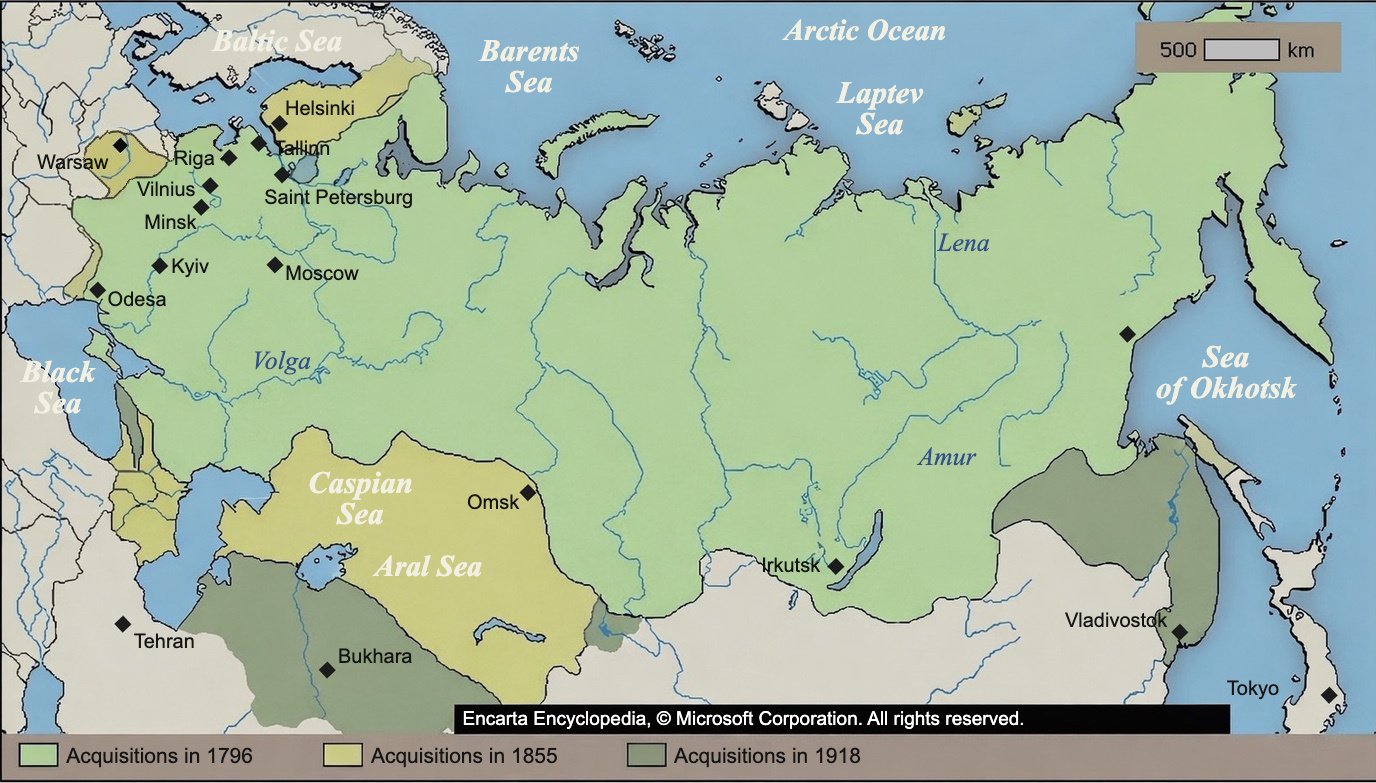
For those interested in Russian chronology, I recommend this site. Better than a random Wikipedia chronology that might make one miss Peter the Great.
Why not dedicate a full page to the Russian calendar alone?
I considered it, but whatever the period, the Russian calendar does not truly display unique structural traits making it a fundamentally original system. Often years, sometimes centuries late, Russia mostly adopted what other countries had long used.
Still, to miss nothing, we will follow its changes beyond the Gregorian reform itself.
First, a Byzantine calendar
Russians used the Julian calendar until the 20th century.
More precisely, they used the Byzantine calendar, basically Julian with a few variants:
- Year began on 1 September. One sometimes reads (with shaky references) that in old imperial Russia the civil year began on 1 March, then switched to 1 September under Ivan III (1462-1505).
- Epoch (year 1) was set at 5509/5508 BC, date of Creation in Byzantine (Constantinopolitan) era.
- Month names came from Greek transcriptions of Latin months. While we are at it, here are month and weekday names for that period.
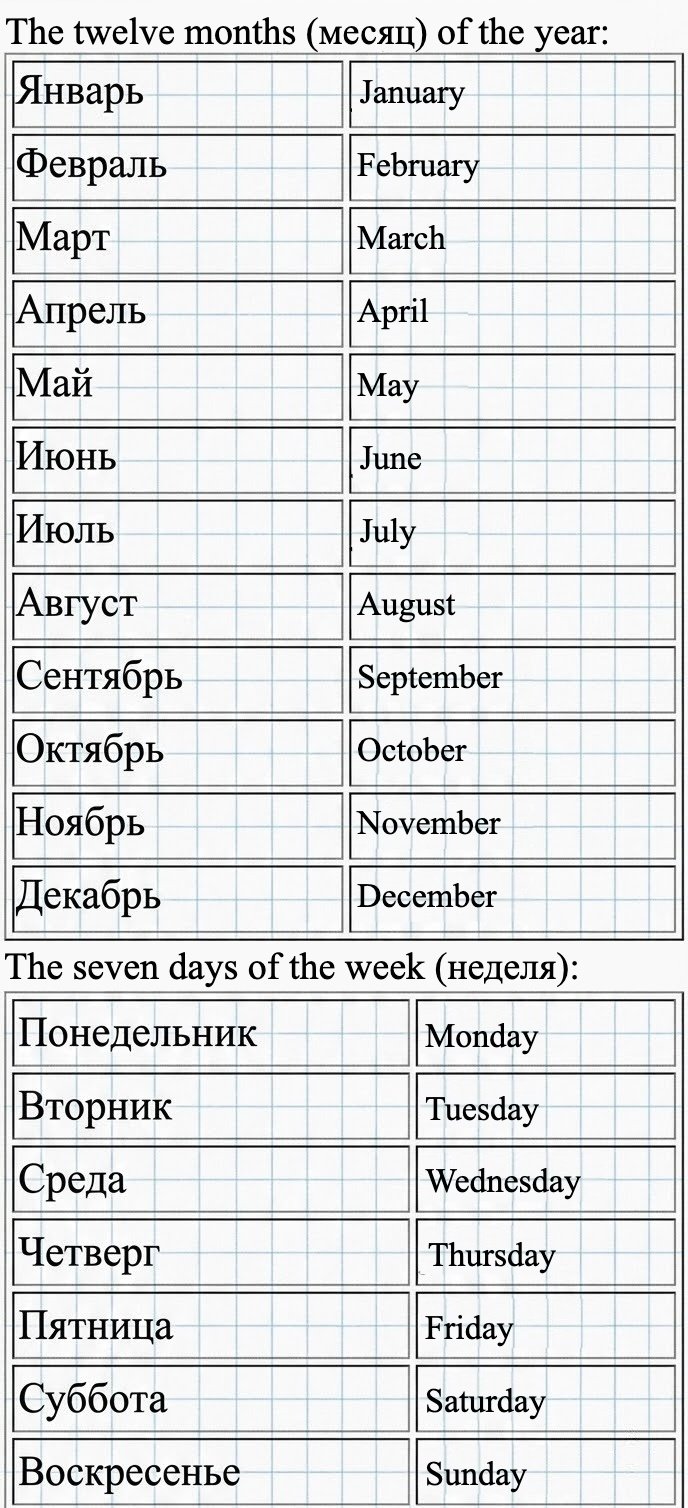
Two questions:
- What calendar type existed in ancient Rus before the Byzantine calendar? Simple answer: we do not really know.
- Where was leap day placed in Byzantine usage? Same as Julian: by doubling 24 February (the sixth day before the calends of March).
From Julian to Gregorian
Russians owe to Peter the Great (1672-1725) the modifications that turned the Byzantine calendar into a pure Julian one.
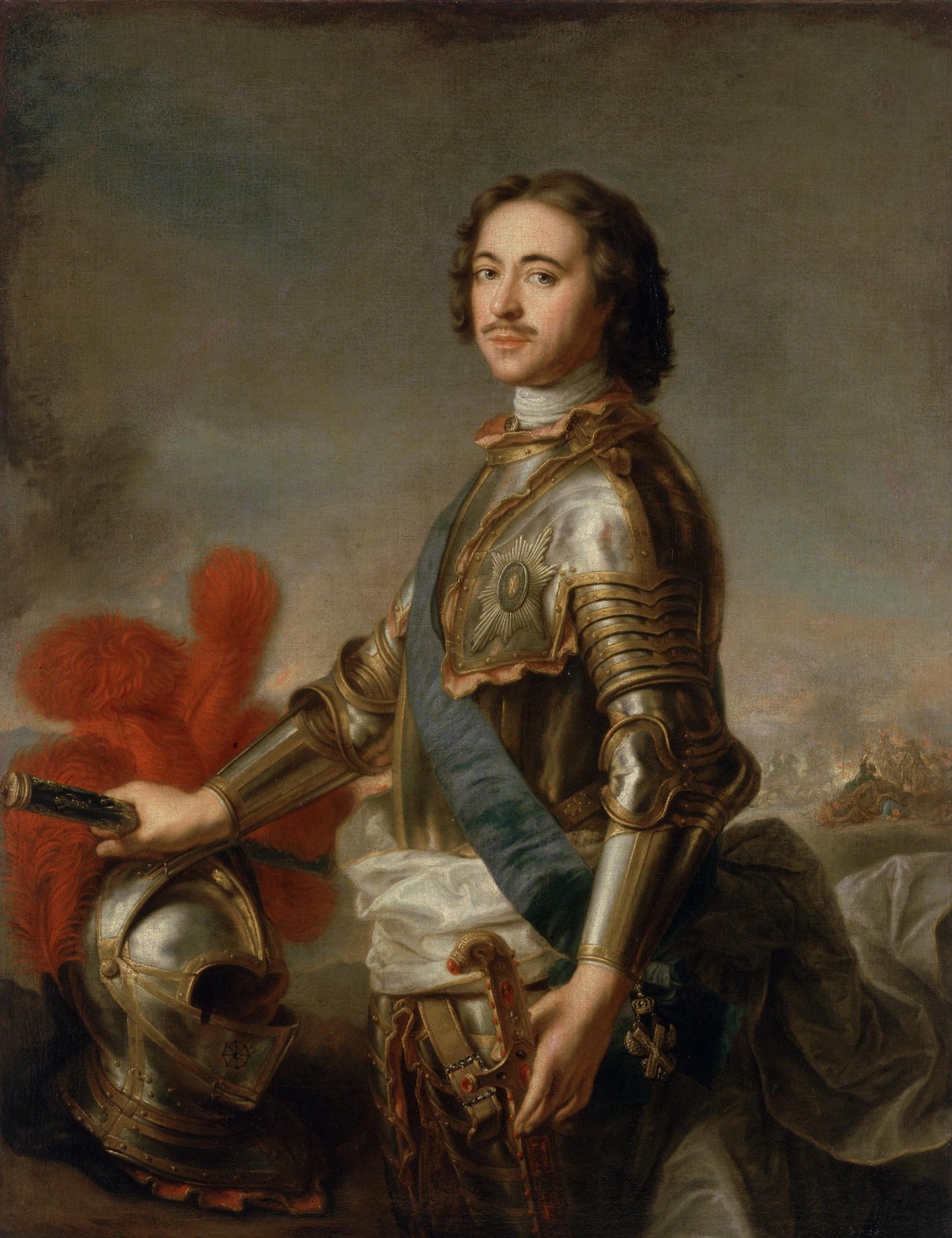
Peter I Alekseyevich, known as Peter the Great, first Emperor of all the Russias, born in the Moscow Kremlin on 9 June (30 May) 1672, died in Saint Petersburg on 8 February (28 July) 1725. Russians owe him major calendar changes, though he did not take the final Gregorian step.
Against Church opposition, he decreed year start on 1 January and year counting by the Christian era. 1 January 7208 thus became 1 January 1700, start of the year. This remained Julian, while Gregorian had existed for nearly 130 years. In 1709 the first Russian Julian calendar was printed, 127 years after Gregorian birth.
Still, it should be noted that since the 15th century the Russian foreign office had used the Gregorian calendar in diplomatic relations.
In 1829, a calendar-revision project was proposed by the Department of Public Instruction to the Academy of Sciences.
Prince Lieven (which one?) submitted it to Tsar Nicholas I and effectively torpedoed it, denouncing it as “premature, useless, and likely to produce upheaval and confusion among people”, adding that "the benefit would be slight and insignificant, while inconveniences and difficulties would be inevitable and great".
The Tsar wrote on the report: “Prince Lieven's comments are exact and fair.” The reform project ended there.
It took until 1918 for Gregorian reform to be implemented, more or less, in Soviet Russia.
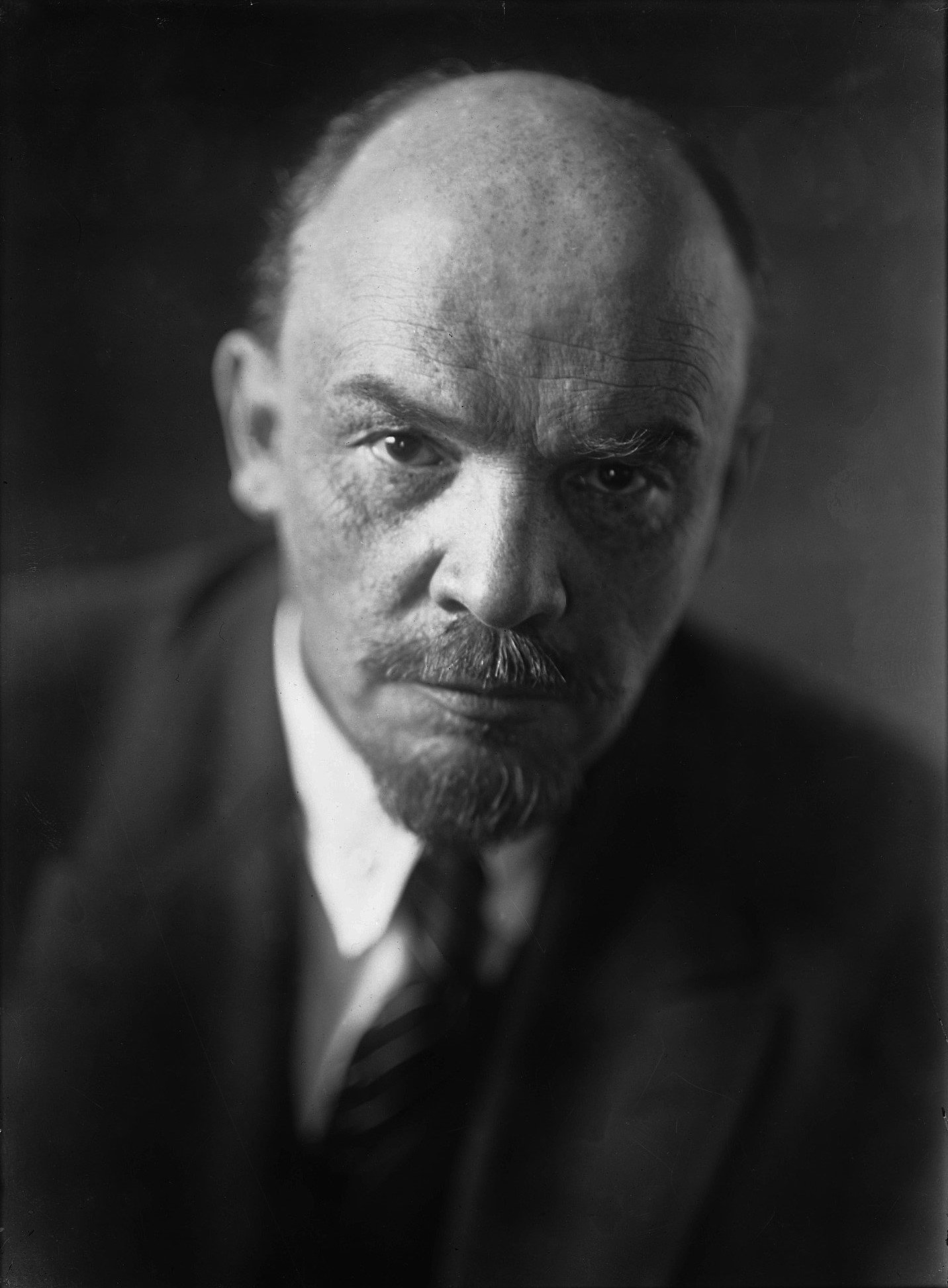
Vladimir Ilyich Ulyanov, known as Lenin (“the man of the Lena”) (22 April 1870 - 21 January 1924), founder of the Bolshevik party and of the Soviet Union, imposed Gregorian “new style” after the October Revolution.
The reform initiative came from Lenin, aiming, in his words, “to be in agreement with all civilized countries of the world”.
By decree of the Council of People's Commissars dated 24 January 1918, the corrected calendar called “new style” was adopted.
This required removal of 13 days, and 31 January 1918 (Julian) was followed by 14 February 1918 (new style).
While the Bolshevik government officially accepted this calendar, the Russian Orthodox Church did not and continued using the old Julian system.
And it was not only the Church. In 1918, Russia was in civil war: opposite Lenin's “Reds” stood “Whites” such as Kolchak, who continued using the Julian calendar after Bolsheviks had adopted Gregorian.
So, as in France, Switzerland and many other countries, adoption happened in dispersed order. The decree was applied immediately in Moscow and Saint Petersburg; Omsk waited until late October 1918; far-eastern republics only switched in 1920 as White forces were defeated.
A strange five-day week
Once Gregorian use was accepted for civil purposes, one might think no further major change would follow.
Quite the opposite: two successive upheavals concerning the week strongly affected the brand-new Russian Gregorian-style calendar.
Let us pass quickly over an aborted attempt to introduce a revolutionary calendar like in France. According to Toke Norby, this occurred in 1923.
The first real upheaval came in 1929. Eviatar Zerubavel, who studied it closely, details it in The Seven Day Circle (University of Chicago Press, 1985):
In May 1929, economist Yuri Larin (1882-1932) proposed at the fifth Congress of the Soviet Union replacing the 7-day workweek with a continuous production week (nepreryvka). The proposal drew limited enthusiasm but interested one man: Joseph Stalin.
The idea advanced quickly; opponents were soon labeled “counter-revolutionary bureaucratic saboteurs”. On 26 August 1929, by decree, the Council of People's Commissars announced that from 1 October 1929 all enterprises and offices would use a continuous “workers' week” replacing the traditional discontinuous week.
But what exactly was this upheaval, and why implement it?
The context: in 1928, forced industrialization under the first five-year plan. Production tools had to run seven days a week. A common weekly rest day for all workers prevented that. So workers had to rest on different days.
Larin, as economist, framed it as optimization (“300 or 360?”). The idea was to distribute weekly rest days across different weekdays via a new scheduling method so production would not stop.
What happened next is unclear, but according to Zerubavel, on 24 September 1929 - one week before implementation - the Council amended the 26 August project and added that the new week would have... 5 days, with one rest day within each 5-day cycle.
How did it work?
The 7-day week was replaced by a 5-day cycle with no common “weekly” day off. Rest days were spread across the population (Monday for some, Tuesday for others, etc.) so enterprises never fully stopped. Each day, about 80% of the population worked.
Workers were split into brigades, each with a different fixed rest day. Weekdays lost names (Monday, Tuesday...) and were replaced by ordinal numbers as in the table below.
To distinguish brigades, each day had a color: yellow, pink, red, purple, green from day 1 to day 5. As Zerubavel notes, people even wrote the “color” of acquaintances in address books to know when they were off.
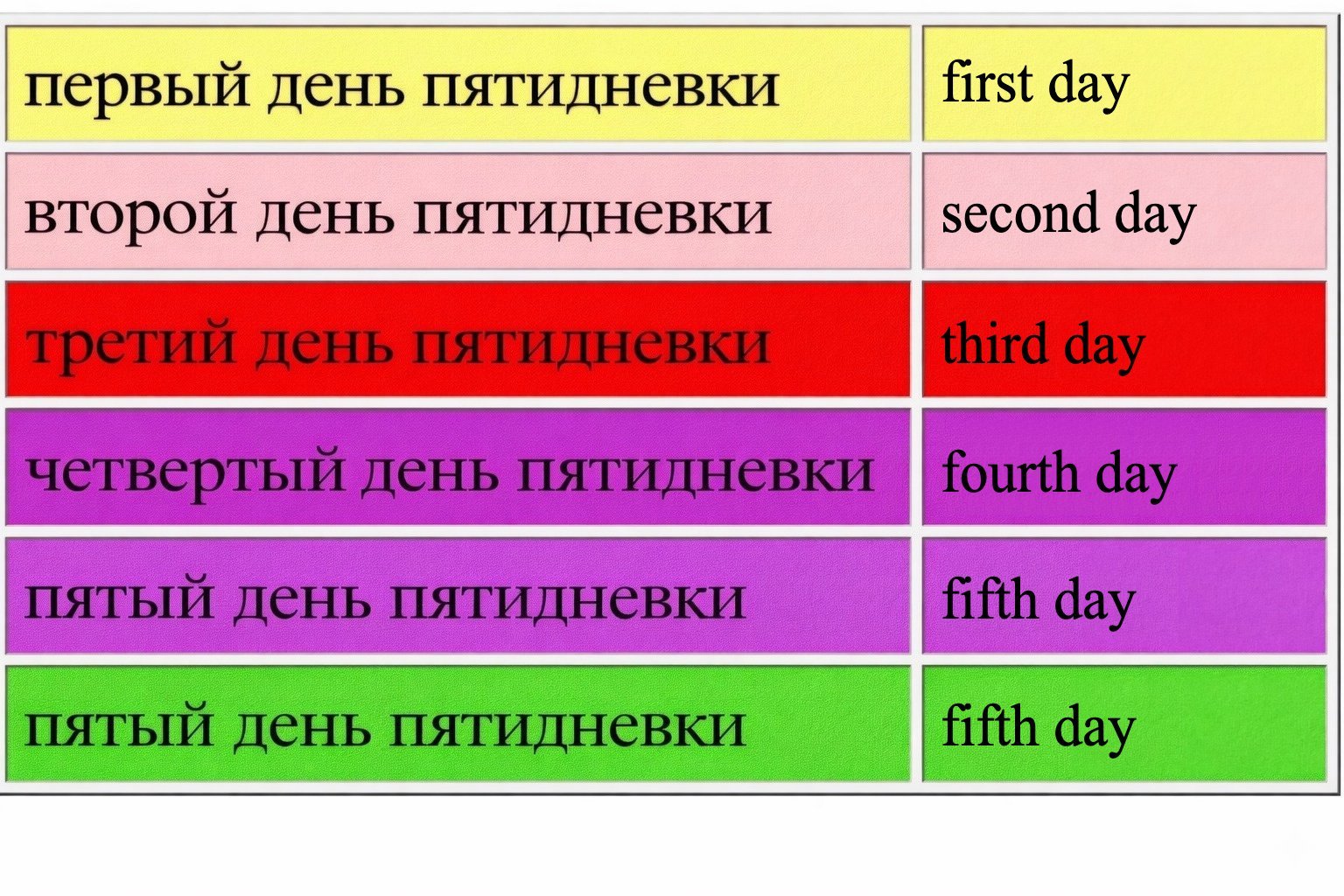
Two consequences (likely also part of the objective) were obvious:
- Removing Friday/Saturday/Sunday rest also reduced opportunities for religious practice, which Soviet authorities hardly disliked.
- It also weakened family cohesion: members of the same family might have different rest days. Even Pravda asked: "What can one do at home if wives are at the factory, children at school, and no one can visit...? It is no holiday if you must spend it alone."
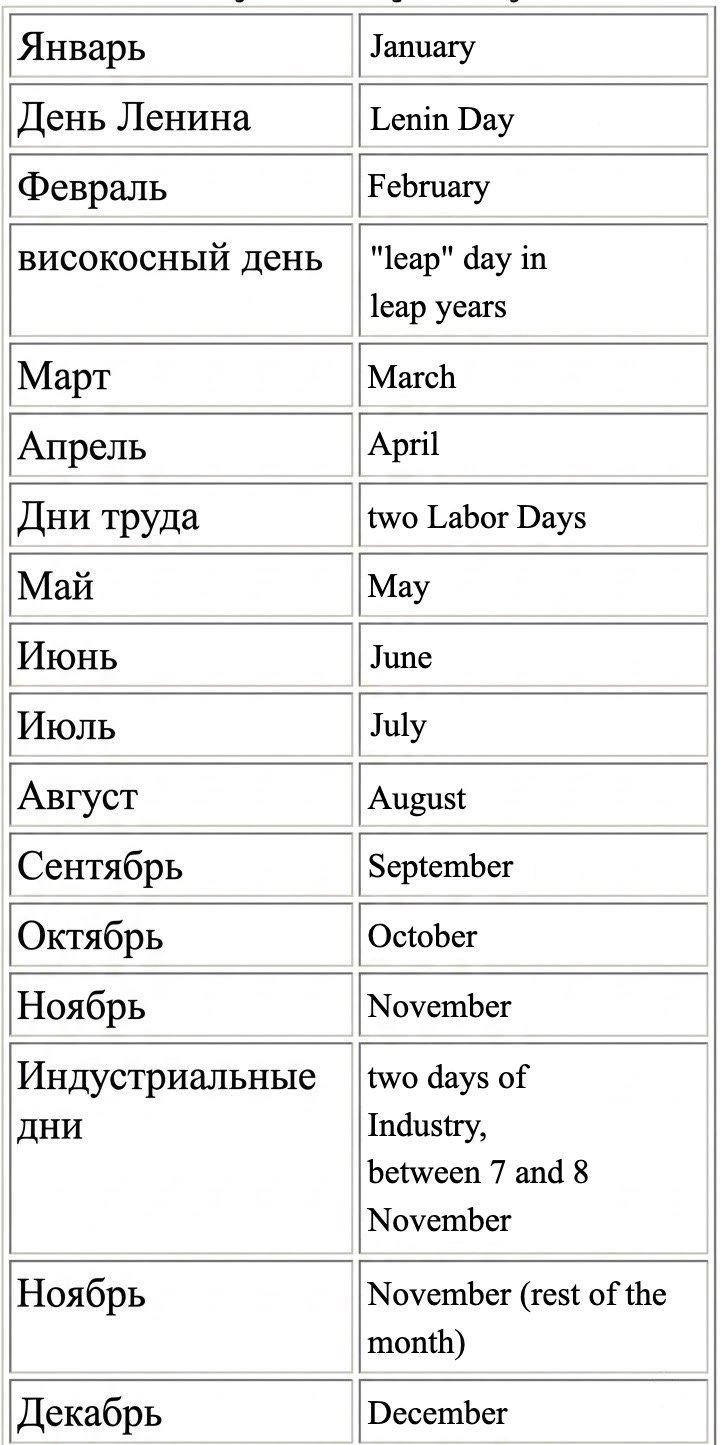
Add that weekly restructuring also altered annual structure into a “universal calendar”: 12 months of 30 days plus 5 (6 in leap years) out-of-month days, treated as holidays:
- Lenin Day after 30 January
- 2 labor days after 30 April
- 2 industry days after 7 November
- plus leap day after 30 February when applicable.
Did that mean the Gregorian calendar was dead?
Not so sure. Some Pravda issues still used traditional dates. Toke Norby, studying postal usage, found no postmark using this “workers' week”. And we saw that this system applied mainly to workers and white-collar staff, not everyone.
But the five-day week carried seeds of its own collapse:
- Gathering 80% of workers each day also meant 20% were disconnected from the others. No common meetings, fragmented personal workflow due to constant handovers, major monitoring difficulties for skilled work, loss of responsibility among both managers and workers, and a feeling of always “catching up” after rest days.
Even with a hybrid correction for specialists and managers (rest only on day 2 or 4, day 3 reserved for handover; days 1, 3 and 5 for meetings), the model was failing badly.
What had to happen happened: on 23 November 1931, a decree of the Council of People's Commissars suspended the five-day system. In practice: it died.
A strange six-day week
After this failure, did they return to seven days? Not at all.
From 1 December 1931, the Soviet Union moved to a six-day week, as shown in the calendar page below.
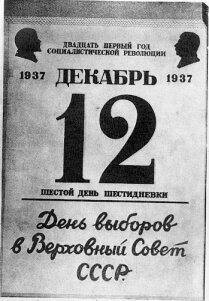
of the Socialist Revolution
1937 DECEMBER 1937
12
sixth day of the six-day week
Election Day
to the Supreme Soviet
of the USSR
In short, chestidnevka (six-day week) replaced nepreryvka.
First, the year layout was restored to Gregorian month structure. Then one rest day was set every six days. Days still had no names, only numbers. Rest days were therefore on the 6th, 12th, 18th, 24th and 30th of each month.
Since rules were not fully clear, the 31st could be either worked or off. Often 1 March was off to compensate non-existent 30 February. But in some places there were 9 consecutive workdays (even 10 in 1936 and 1940) between February and March.
Like its five-day predecessor, this system was unpopular. On 26 June 1940, the Presidium of the Supreme Soviet ended chestidnevka and returned to the traditional seven-day week, officially restoring Sunday as rest day.
This time, after a delay of centuries, the Gregorian calendar was truly established in the Soviet Union.
And, as Eviatar Zerubavel rightly notes, rural populations played a major role in preserving the seven-day week: first by resistance, and also because they were less directly concerned by a system designed mainly for industry.