Introduction
Whether they are solar, lunar or lunisolar, calendars are built around one main unit: the year.
Today it seems natural to orient ourselves in time - assumed to be linear - using year numbers. The Bastille was stormed in 1789. The Battle of Marignano took place in 1515. The Council of Nicaea was held in 325.
But if we could ask one of the fathers gathered at Nicaea in which year the council took place, he would likely answer: “under Constantine the Great, during the consulship of the illustrious Paulinus and Julian.” That may have been clear to them, far less so to us. Unless we know when Paulinus and Julian were consuls, we are not much further along. With such a system, it is hard to know which event comes before another.
Those are precisely the dating systems we will try to survey in this study, especially those that preceded the linear numbering of years as we know it.
This page does not claim to be a full chronology. Its only aim is to help us better understand how people located themselves in time before linear year numbering appeared and, perhaps, to appreciate our current system a little more.
Counting years in Mesopotamia
Over the centuries and through shifting influences, Mesopotamia used almost every dating system one can imagine. As we will see, these systems were sometimes successive, but often used at the same time.
Year names
The principle was to name the current year after a noteworthy event (often military or religious) that had occurred in the previous year.
So one finds years named like this:
“Year when Samsuiluna (became) king
Year when he established freedom (from taxes) in Sumer and Akkad
...
Year when the walls of Isin were demolished
Year under the command of Enlil
Year following the year under the command of Enlil
This excerpt from a British Museum tablet concerns the reign of Samsuiluna (King of Babylon, approximately 1749-1711 BCE), who succeeded Hammurabi.
Other lists exist - for example for the kings of the First Dynasty of Isin (approximately 2017-1794 BCE) - here.
This system, used by both Sumerians and Babylonians, was practiced from the kings of Agade (24th century BCE) to the end of the Old Babylonian period (1595 BCE).
These year-name lists, preserved in different cities, can be matched with other lists totalling regnal years of different kings (example here).
And while we are on links, one can also find here chronological lists of Mesopotamian rulers from 2700 to 525 BCE.
Names of individuals
This system was an Assyrian “specialty” (not used by the Babylonians). The year was named after a high-ranking official holding office that year. That person was the Limmu (or Limu). In practice, this was an eponym before the term existed.
The limmu was drawn from influential figures: commander-in-chief, grand vizier, chief musician, chief eunuch, or governors of cities and provinces. Naturally, the king himself was limmu in the first year of his reign.
Complete limmu lists exist for periods 1876-1784 and 858-700 BCE. They can be consulted here.
Sometimes a comment was added to the limmu's name. Thus, for the 858-699 list here, one reads that in the year named after the limmu Bur-Saggile, governor of Guzana, there was an eclipse in the month Simanu. This made it possible to date the event to 15 June 763 BCE.
Regnal years
This system, used as early as the Sumerian period, became the norm among Babylonians (and Persians) from the middle of the 2nd millennium BCE, and lasted into the Hellenistic age, when era-based counting was adopted (Seleucid or others, as here) without distinguishing the reigning ruler.
The principle is simple: years are numbered from the accession of the reigning sovereign.
The only difficulty is determining what to do with the accession year when accession happens mid-year, and what counts as year 1.
In fact, there are two systems; we will detail the second in the section on Egypt.
Babylonians and Persians called resh sharruti the part of year between the death (or other reign-ending event) of the former king and the beginning of the next full year. It was the new king's “accession year” without specific numbering. For the part already elapsed, it also remained the last numbered year of the former king.
Year 1 therefore begins on the first day of the following year.
Take an example from Parker and Dubberstein's Babylonian chronology.
Nabopolassar died on 8 Abu in the 21st year of his reign (12 April 605 BCE in the Julian calendar). His son Nebuchadnezzar II succeeded him on 1 Ululu of... his accession year (7 September 605 BCE in the Julian calendar).
Only on 1 Nisanu of the following year (22 March 603 BCE) do we enter the first regnal year of Nebuchadnezzar II.
So this accession-year system is not very complicated. The challenge for historians is to determine whether the documents they study were drafted under one system or the other.
Counting years in Egypt
Like the Babylonians, Egyptians used regnal-year counting.
However, their practice differed in that they treated the accession year itself as regnal year 1. The new sovereign was thus credited with that year, while the predecessor's final regnal year ended the year before. One even finds formulas such as: “in Athyr, in the second year of Hadrian, which is the first of Antoninus Caesar.”
One difficulty is knowing exactly what a regnal year corresponds to.
Usually it corresponds to the Egyptian civil year. But during the New Kingdom, it seems the beginning of the regnal year may have matched the accession anniversary.
And even when regnal year aligns with civil year, one must still ask whether that official year started on 1 Thoth. In the Ptolemaic period (before Ptolemy V, when Macedonian and Egyptian calendars were unified), the Macedonian calendar had become the official one.
If one considers all the variants, especially concerning year start, one better understands Chris Bennett (site) when he writes about the Ptolemaic period: "There were four dating systems [...]: Egyptian regnal years, Egyptian fiscal year, Macedonian regnal years, and Augustan regnal years."
Example: the Palermo Stone
As its name indicates, this basalt stone is in Palermo's archaeological museum.
It is in fact only a fragment (43 cm high, 25 cm wide) of a larger rectangular slab. Its two faces bear the Royal Annals, from the earliest Egyptian kings to the Fifth Dynasty.
Each “line” is divided into three parts containing, from top to bottom, the king's name, major events of each year, and Nile flood height.
Let us focus on the years. They are shown as rectangles separated by a line ending in a left-facing curve: the palm-leaf sign, symbol of the year.
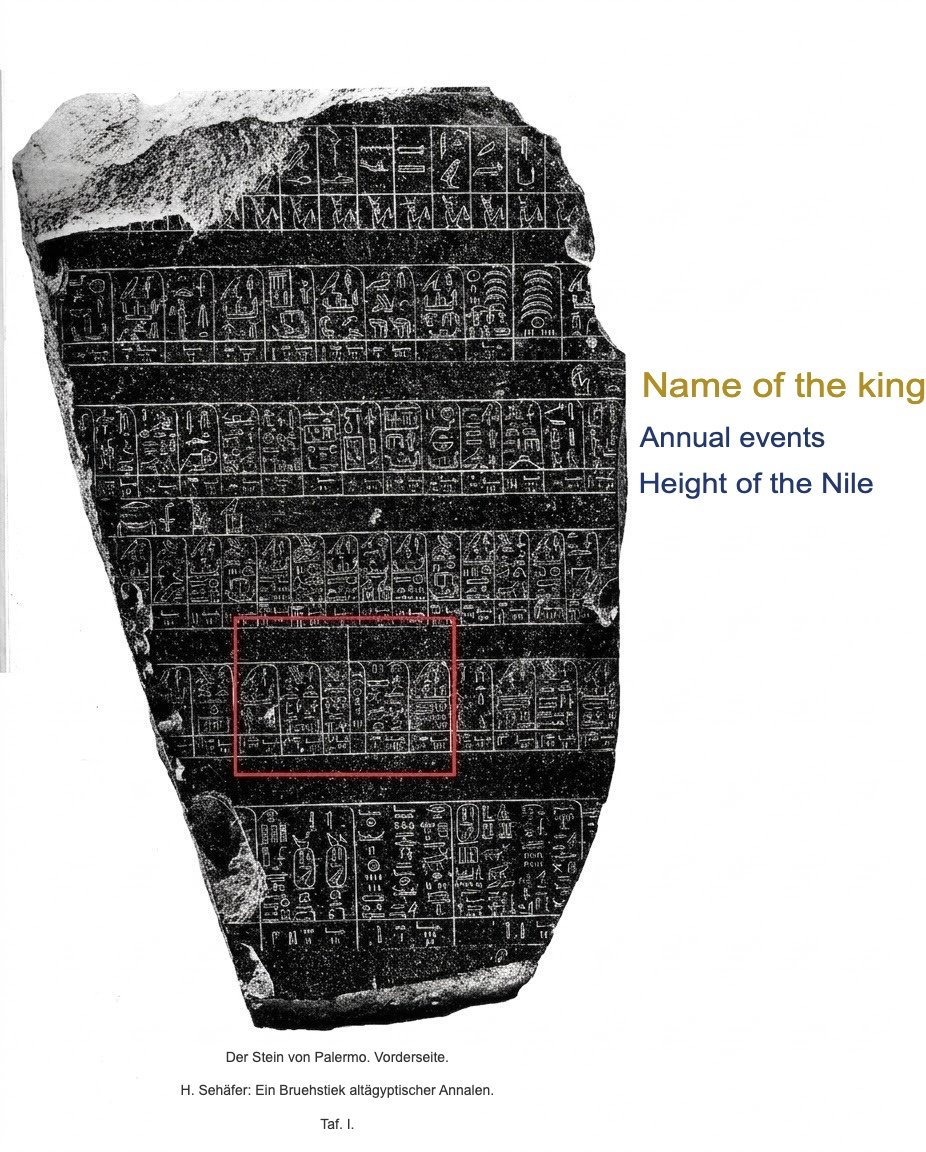
The contents of the red frame have been enlarged in the images below. H. Schäfer, Ein Bruchstück Altägyptischen Annalen, Berlin 1902, pl. 1
The years are represented as rectangles separated by a line ending in a left-facing curve: the palm-leaf sign, symbol of the year.
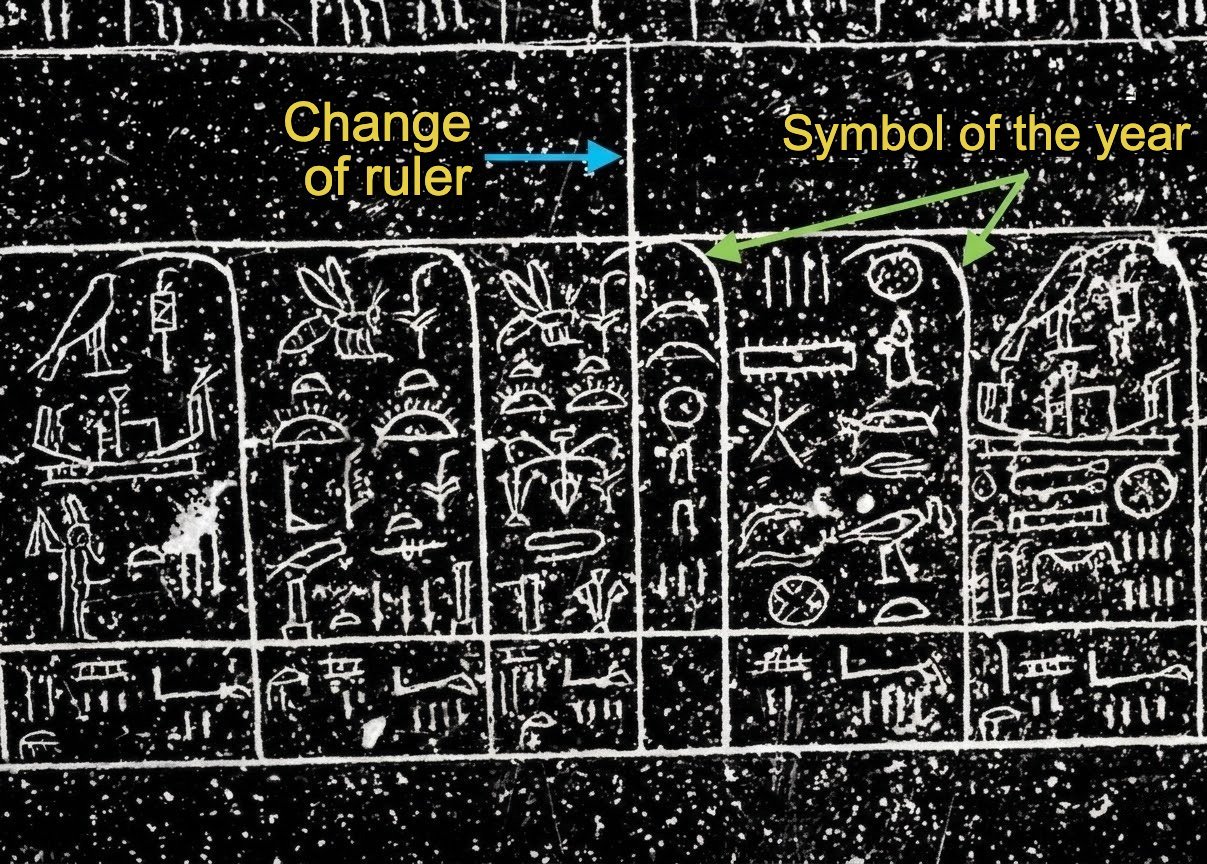
The middle year is split in two by a straight line extending vertically above the year rectangle. This line simply marks a change of ruler. Since hieroglyphs are read right to left, this marks the transition from Khasekhemwy (last ruler of the 2nd Thinite dynasty) to his son Djoser.
The event is dated in the right part of the rectangle: two crescents for 2 months, two inverted U-shapes for two times 10 days, and three vertical strokes for three days. So the change of reign occurred 2 months and 23 days after year start, i.e. 83 days.
This small example confirms what we saw earlier: a year can be both the first of a new reign and the last of the previous one.
Counting years in Greece
We will not return to Olympiads - a cycle used relatively late (2nd century BCE) - which we already discussed here, except to note that the Olympic year ran from mid-summer (probably summer solstice) to the following mid-summer.
In the absence of a site listing Olympiads, formulas to convert between cycle year and Julian year are:
Greeks also used a dating system corresponding to the Assyrian Limmu system.
Each year was associated with the name of a person simultaneously holding administrative, political or religious office.
And since coordination between city-state calendars was hardly a Greek specialty, a kind of chronological triangulation emerged to navigate year succession.
To see such eponym references, take examples from Thucydides' Peloponnesian War.
The best-known passage is likely this one: "In the fifteenth year, while Chrysis had been priestess at Argos for forty-eight years, Aenesias was ephor at Sparta, and Pythodorus had still four months to serve as archon at Athens [...]." 2.2.1
Here the triangulation is based on three names:
- Chrysis, priestess at Argos. Unlike the other two, this office was lifelong.
- Aenesias, ephor at Sparta. The ephor was one of five magistrates forming Sparta's government. Their term lasted one year.
- Pythodorus, archon at Athens. The eponymous archon was Athens' true civic head and held top authority in civil administration and public jurisdiction. Other archons existed, but this one gave us the very concept of eponymy. A list of Athens' eponymous archons can be found here.
Did assumption of archon and ephor office coincide with civil year start? Whoever can answer that with certainty is a lucky person.
The issue was so complex, even for Greeks, that Thucydides himself added a seasonal reference he considered more precise than archon terms:
“5.20.1-2: This peace was concluded at the end of winter, at the beginning of spring, immediately after the Dionysian festivals celebrated in the city [...] This method lacks precision, for an event may occur at the beginning, middle, or any point of their magistracy. But by counting, as I have done, by summers and winters, one sees that this first part of the war lasted ten summers and ten winters.
And this is not the end of year-giving eponyms, since one can also read:
“4.118.12: The Athenian people, with the tribe Akamantis in prytany, Psenippos as secretary, Niciades as epistates, on proposal of Laches, has decided as follows [...]
The functions of prytanes and epistates are explained here on Wikipedia. Here we are in a political year-counting system that can pinpoint an exact day, since the epistates changed daily.
Not easy to orient oneself in Greek years without memorising all those eponym lists.
Counting years in Rome
Although this eponym-list year numbering has the major drawback of requiring memorized lists, Rome used a similar system.
This time it was the consuls (two of them) who provided year reference points, however imperfectly.
These consul lists can be found on wiki. They are called consular fasti.
Livy relied heavily on them in his History of Rome (Ab urbe condita). He was himself a compiler of such lists, and complained about how difficult this work was:
“LIVY (II, 21), Death of Tarquin the Proud: [...] During the next three years there was neither real peace nor real war. The consuls were Quintus Cloelius and Titus Larcius; then Aulus Sempronius and Marcus Minucius, under whom the temple of Saturn was dedicated and the Saturnalia established. They were followed by Aulus Postumius and Titus Verginius. In some authors I find that only in that year did the battle of Lake Regillus take place; that Aulus Postumius, mistrusting his colleague, resigned the consulship and was made dictator. The diversity of traditions on magistrate succession gives rise to so many chronological errors that, at such a distance from events and historians, one cannot determine with certainty the consuls and events of each year.
One also finds regnal years, i.e. years of emperors' reigns.
Before leaving Rome, we should mention the cursus honorum (career of offices), which was not a general year-counting system but did provide chronological markers in one individual's life.
Offices followed a strict order with minimum ages:
- Consul (already discussed): minimum age 42.
- Praetor (justice): minimum age 40.
- Aedile (municipal responsibilities): minimum age 36.
- Quaestor (finance): minimum age 30.
- Censor (census duties): minimum age 44.
- Tribune of the plebs (people's representative): minimum age 27.
For more, see here.
From number of years held in office, one can establish a sort of profile:
“Tacitus - Annals, judgments on Augustus (1.9): Augustus himself became the subject of endless talk [...] They counted his consulships, equal in number to those of Marius and Valerius Corvus combined, his thirty-seven consecutive years of tribunician power, the title of Imperator received twenty-one times, and many other honors, often repeated or entirely new.
Counting years among Hebrews and Jews
Finding one's way through the different dating systems used by Jews over centuries is no small task.
So we will take a modest first approach to these systems, which intersect, complement, and sometimes contradict one another.
Even if we occasionally refer to the Bible, this study does not aim to sketch a biblical chronology. Personally, I fully agree with Christian Robin (Director of Ancient Semitic Studies, CNRS): “The Bible is not a history manual.”
Where to begin?
Perhaps best with a text listing the systems used, then examine them one by one and note related difficulties.
That text is by Rabbi Baruch Epstein (1860-1941), author of Torah Temimah, a Torah commentary: "Thus was the custom: years were counted from the Exodus until the building of Jerusalem's Temple by Solomon. Then they continued counting from that date. After its destruction, they counted according to years in exile. Later they counted by regnal years: second year of Darius II, second year of Nebuchadnezzar II, etc. Nowadays we count years from the Creation of the world."
This sentence includes key moments of Jewish history: Exodus, Temple construction, deportation. Missing are reconstruction and the Temple's second destruction. Nor can one ignore the jubilee/sabbatical system, which we will discuss later.
It is also striking that, apart from dating from the era of the world (Anno Mundi), which aims to be universal, and apart from regnal years, all other systems are distinctly Jewish.
A little sorting out
Unless one wants to see eras and dating systems everywhere, one cannot treat a single isolated temporal reference as a full “new system.” It must involve sustained, widespread counting from that event (reign or event).
So we will remove the Exodus from our list of true dating systems. True, one finds this reference in 1 Kings 6:1 ("in the four hundred and eightieth year after the Israelites came out of Egypt, Solomon built the house of the Lord"), but this is more an isolated reference.
The same holds for construction and destruction of the First Temple.
By contrast, according to Jack Finegan (Handbook of Biblical Chronology), one era was used even into medieval writings: the era of the Temple's destruction (Second Temple), whose beginning is:
| Era year | Start of year | End of year |
|---|---|---|
| 1 | 9 Ab = 5 August 70 | 30 Elul = 24 September 70 |
| 2 | 1 Tishri = 25 September 70 | 29 Elul = 13 October 71 |
| 3 | 1 Tishri = 14 October 71 | 30 Elul = 2 October 72 |
| 4 | 1 Tishri = 3 October 72 | 29 Elul = 21 September 73 |
| 5 | 1 Tishri = 22 September 73 | 29 Elul = 10 October 74 |
We will return later to 1 Tishri as year start from era year 2 onward.
Regnal years and the Seleucid era
A) Regnal years
Jews, like Babylonians and Egyptians, used the system of regnal years.
And since we already examined this system in detail, one might think it enough to say that year 1 is the accession year. But things are less simple, and we need to look closer at difficulties that still matter.
These difficulties boil down to one question: when does the regnal year begin? In other words, on what calendar date does one pass from one regnal year to the next?
A first answer comes from the Mishnah (codification of Oral Law, published around 200 CE), specifically tractate Rosh Hashanah, which says:
“"There are four new years: the first of Nissan is the new year for kings and festivals; the first of Elul is the new year for tithe on cattle (Rabbi Eleazar and Rabbi Shimon say first of Tishri); the first of Tishri is the new year for years, sabbatical years, jubilees, planting and vegetables; the first of Shevat is the new year for trees according to the school of Shammai, while the school of Hillel says the fifteenth of that month." Rosh Hashanah 1:1
The first year-start relevant here is 1 Nissan, thus the changeover for kings' regnal years. Biblical example:
“"in the four hundred and eightieth year after the Israelites came out of Egypt, in the fourth year of Solomon's reign over Israel, in the month of Ziv, the second month..." 1 Kings 6:1
Ziv was the second month in the old Canaanite calendar.
Epstein (again) confirms the counting rule already seen: "If a king accedes on 29 Adar, as soon as 1 Nissan arrives he is considered to have reigned one year. This teaches that Nissan is the new year for kings and that one day in a year counts as a year. But if he accedes on 1 Nissan, he is not considered to have reigned one year until the next 1 Nissan has passed." Epstein, BT 2.
As the Mishnah states clearly, this counting system - apart from festivals - applies only to kings.
Some rabbis even claim it applies only to kings of Israel. For other kings (Persian, Egyptian...), one should apply the second type of year starting on 1 Tishri, which is “the start of the year for years, for shemita years [sabbatical years]...”
To justify this, reference is made to two verses in Nehemiah:
“Neh. 1:1: The words of Nehemiah son of Hacaliah. In the month Kislev, in the twentieth year, while I was in Susa the citadel...
“Neh. 2:1: In the month Nisan, in the twentieth year of King Artaxerxes, when wine was before him, I took the wine and gave it to the king.
The argument is:
- The event in 1:1 is chronologically earlier than the event in 2:1.
- Therefore Kislev precedes Nisan, so Nisan cannot be first month.
- Therefore 1 Tishri marks regnal-year change for non-Israelite kings.
This argument only works if both verses are in the same regnal year (Artaxerxes' twentieth). It is thin evidence, though perhaps other arguments exist.
B) The Seleucid era
Among royal reigns used as chronological references by Jews, one deserves special attention - notably for its spread and longevity, since it became an era: the Seleucid era.
And this era itself causes issues because it has a variable origin date. Simplicity was rarely the rule.
“In fact, the Seleucid era, beginning on 1 Dios (7 October) 312 BCE, does not correspond to Seleucus I Nicator's accession, but to his victory over Demetrius Poliorcetes at Gaza. Seleucus became king of Babylon only in 305 BCE.
His son Antiochus I Soter did not restart regnal numbering; he continued his father's count, and subsequent kings did the same. The Seleucid era was born.
One may ask why this change occurred. A possible explanation is that Seleucus adopted the Babylonian calendar with its 19-year intercalation system. Technically, maintaining that cycle while resetting numbering at every succession would have been difficult.
The Seleucid era, widely used in Asia Minor and the East, required local adjustments so that day 1 of era month 1 matched day 1 of the adopting region's year.
Hence several variants, depending on whether local year began in spring or autumn. One can also add the system where the event year is treated as “year zero” (accession year) or as year 1.
Thus Jews of Babylonia and Chaldea shifted the date (1 Dios 312 BCE) to 1 Nissan (3 April) 311 BCE and carried that usage to Palestine, while Syria and Asia Minor kept 1 Tishri (7 October) 312.
So we get two abbreviations:
- SEB in the Babylonian calendar
- SEM in the Macedonian calendar
This Seleucid-era dating system, regardless of origin (SEB or SEM), was used early by Jews and remained in use for a very long time under different names: minian yévani (“Greek count”), malkhut yavan (“Greek kingdom”), malkhut parass (“Persian kingdom”), or minian shetarot (“era of contracts”).
All these names still indicate an external system, used by scribes and clerks for contracts and commercial acts. Jews in France writing business transactions in the Gregorian calendar tells us nothing about their religious calendar. Likewise, use of the Seleucid era and its calendar is not specifically Jewish practice; it is simply use of the ruling state's official calendar. This is likely why Seleucid dating is often combined with purely Jewish dating frameworks (Temple destruction or creation era).
How long did Jews use the Seleucid era?
- It starts very early, as seen for example in Maccabees - useful also because it shows double origin dating (SEB/SEM):
- “And King Antiochus died there in year 149.” 1 Macc 6:16 => SEB dating.
- "In year 148, on the twenty-fourth of Dioscorinthius [...] our father having been translated among the gods." 2 Macc 11:21-23 => SEM dating.
- Its abolition is said to have been decreed by David ibn Zimra in 1527. According to Sylvie Anne Goldberg (in her detailed and excellent book La Clepsydre), it was still used into the 20th century by Jews of Yemen.
C) Era of the World (Era of Creation, Anno Mundi = AM)
Although texts like Seder Olam Rabbah and the Talmud (which compile biblical lifespans, ages, and historical durations) provided all ingredients needed to create a creation era, that era as such appeared only late (5th century) and spread even later (Maimonides' period, 12th century).
To define an era's starting point, one must date it against another event already fixed in another calendar. Here, destruction of the Second Temple served as reference. For our part, we will use the Julian calendar (without year zero) to date the beginning of the creation era.
This is not simple. Depending on the texts converted and the period in which they were written, the same event gets different creation-era dates. For destruction of the Second Temple, texts give 3828, 3829, or 3830.
So we proceed step by step. Apologies to chronology specialists - this page was never aimed at them:-))
Before starting, recall a few basics:
- Hebrews and Jews divide the hour into 1080 halakim (hour fractions), so 1 halakim = 3 1/3 seconds.
- In Jewish reckoning, day begins at 18:00. So “our” Sunday 18:00 corresponds to Monday 0:00 in that system.
- Each Hebrew letter has a numerical value (Wikipedia table here).
- In Jewish time reckoning, molad is the moment of Moon-Sun conjunction, i.e. new moon.
Now to a mystery. Comparing texts (Genesis, Masoretic texts, Seder Olam...), one sees major disagreement in duration calculations, and around 200 different calculations reportedly place world-creation year start (biblically speaking) anywhere between 6984 BCE and 3483 BCE in Julian terms. So why year 3761 was ultimately retained as creation year (not saying year 1 of chronological counts) remains a mystery.
Still, let us take 3761 BCE. We must now determine what event starts the count and what first month that count uses.
As to month, from the four possible year-starts seen above, choice is between Nissan and Tishri. Despite some supporters of Nissan, the Talmud indicates year change should occur in Tishri. That settles it.
We now ask: from what moment do we launch the chronology allowing us to say the Flood was in xxxx, First Temple destruction in xxx, and the first round of France's 2007 presidential election in 5767 AM?
That question leads to three possible counts, all used at different times, involving year-zero usage (or not) and reference either to world creation or Adam's creation.
C-1) First count (AM1 in summary table)
This is the count currently used. It assumes, like the others and in line with texts, that Adam and Eve were created on 1 Tishri.
According to Genesis, man was created on day six. So there is a 5-day difference to account for. In AM1, those five days belong to the first year of creation; that becomes year 1 of the count.
Naturally, AM1 year 1 starts on 1 Tishri. But there is a problem: how to compute molad for a year in which the Moon was not yet created (created only on day 4)? By treating a large part of that year as purely virtual. Only on 25 Elul do we leave that “virtual world” and enter the real one: “In the beginning God created the heavens and the earth” (Gen. 1:1).
This “virtual world” notion is why the corresponding molad has a specific name: Molad Tohu, roughly “molad of chaos,” described in Genesis as: “The earth was without form and void” (Gen. 1:2).
This Molad Tohu also has a mnemonic name based on letter-number values: Molad BeHaR"D. Convert letters: B = 2, H = 5, R = 200, D = 4. The rest is filler. First number is weekday (1 Sunday, 2 Monday...), second is hour number, remaining numbers are halakim. So Molad Tohu corresponds to Monday (B=2), fifth hour (H=5), 204 halakim (R=200 + D=4), i.e. 11 minutes 20 seconds.
So molad of the virtual creation year is Monday 1 Tishri, 5h 11m 20s Jerusalem time in Jewish reckoning. Since Monday 0h in that system is Sunday 18h in Julian/Gregorian terms, this corresponds to Sunday 6 October 3761 BCE, 23:11:20.
In this first count, year 1 includes only 5 days and 14 hours belonging to the creation era. It is the only era that truly deserves the name, since year 1 starts from the very first moments of the universe's birth.
C-2) Second count (AA1 in summary table) and third count (AA2 in summary table)
These counts begin with Adam's creation, hence the term Anno Adami (AA). They are the counts used in older texts.
Their only difference is this:
- One (AA1) has no year zero and counts directly from Adam's creation (Talmudic indication).
- The other (AA2) starts counting only from the year Adam is one year old (according to Seder Olam).
Mnemonic values:
- AA1 = Molad VaYaD: V = 6 = Friday; YaD = 14 => Friday 14h in Jewish reckoning, i.e. Friday 8h in our hour count.
- AA2 = Molad G'K“B TT'V (wording uncertain): G = 3 = Tuesday; K”B = 22; TT'V = 876 => Tuesday 22h 876 halakim in Jewish reckoning, i.e. Tuesday 16h 48m 40s in our count.
To close this part, here is a summary table:
| Event / Era type | AM1 | AA1 | AA2 |
|---|---|---|---|
| Earth in "chaos" state (Genesis 1:2) | 1 AM | ||
| Creation of Adam | 2 AM | 1 AM | |
| Adam's 1st anniversary | 3 AM | 2 AM | 1 AM |
| Beginning of Seleucid era | 3,450 AM | 3,449 AM | 3,448 AM |
| Beginning of Christian era (1 BCE / 1 CE) | 3,761 AM | 3,760 AM | 3,759 AM |
| Destruction of the Second Temple | 3,830 AM | 3,829 AM | 3,828 AM |
Sabbatical years and jubilees
Like the week, both the sabbatical cycle and jubilee cycle revolve around the number 7.
Just as the week has seven days with a special seventh day (Sabbath), the sabbatical cycle has seven years with a special year (the sabbatical year, shemitta or shevi'it). In that sense one can speak of a “week of years.”
The jubilee cycle consists of seven such year-weeks.
A) The sabbatical cycle
As seen above in tractate Rosh Hashanah, years in this cycle begin in Tishri.
In this cycle, shemitta - the last year of the sequence - has a double specificity that, as S.A. Goldberg rightly writes (La Clepsydre, p. 311), “associates human temporality with that of the land.” Let us read biblical passages.
Land rest:
“Exodus 23:10-11: For six years you shall sow your land and gather its produce, but in the seventh you shall let it rest and lie fallow, so that the poor of your people may eat, and what they leave the animals of the field may eat. You shall do likewise with your vineyard and olive grove.
Though not our direct topic, note that a year without sowing pushes harvest to the ninth year. One must have deep trust in God to follow that rule. Scripture itself anticipates the objection:
“Leviticus 25:20-22: If you say, “What shall we eat in the seventh year, if we neither sow nor gather?” I will command my blessing in the sixth year, and it will produce for three years. When you sow in the eighth year, you will still eat old produce, until the ninth year, until its produce comes in.
Debt release and slave emancipation:
“Deuteronomy 15:1-2: At the end of seven years you shall grant a release. And this is the manner of release: every creditor shall release what he has lent to his neighbor; he shall not exact it of his neighbor or his brother, because the Lord's release has been proclaimed [...]
“Deuteronomy 15:12-15: If your Hebrew brother, man or woman, is sold to you, he shall serve six years, and in the seventh you shall send him free from you. And when you send him free, you shall not send him empty-handed; you shall furnish him liberally from your flock, your threshing floor and your winepress, as the Lord your God has blessed you. You shall remember that you were a slave in Egypt and the Lord your God redeemed you; therefore I command you this today.
This uninterrupted 7-year cycle can serve as a dating tool if one knows cycle number and first cycle start year. One funerary stele from the Zoar region reads: "Here rests the soul of Esther daughter of Edyo, who died in Shevat, in year 3 of the shemita, year 300 after the destruction of the Temple house. Peace. Peace."
When did the first sabbatical cycle begin, and how long was it observed?
As for duration, one may say up to the 5th century CE, though not necessarily continuously.
As for the first cycle, views differ. One can reasonably think it could not have started before the Hebrews entered Palestine and took possession of the land given to them by God.
The Jewish Encyclopedia mentions a first shemitta 21 years after arrival in Palestine. Talmudic calculations place first sabbatical year in 1240 BCE (2510 from creation). James Ussher (1581-1656), Anglican archbishop of Armagh, places first sabbatical year in 1445 BCE (2560 from creation).
In short, it is not risky to say no one truly knows when the first sabbatical year occurred. Attempts rely on biblical narrative, and there is a gap between narrative and history.
By contrast, from around the period of the Second Temple's destruction onward, data are clearer. In 1856, Benedict Zuckermann (Ueber Sabbatjahrcyclus und Jobelperiode) published a table of sabbatical years from 535/534 BCE (sabbatical according to him) to... 2238/2239 CE. This table is currently the most widely accepted.
In 1973, Ben Zion Wacholder published (The Calendar of Sabbatical Cycles during the Second Temple and the Early Rabbinic Period) a table from 519/518 BCE to 440/441 CE, based on newer archaeological evidence.
The two tables differ by only one year: Wacholder places sabbatical years one year later than Zuckermann.
Then in 1979 Donald Wilford Blosser supported Zuckermann in (Jesus and the Jubilee Luke 4:16-30: The Year of Jubilee and its Significance in the Gospel of Luke) with his own table for 171/170 BCE - 75/76 CE.
B) The jubilee cycle
The jubilee rhythm is tightly linked to the sabbatical rhythm, since jubilee year crowns seven sabbaths of years.
All sabbatical-year prescriptions apply to jubilee, which may be seen as a higher-intensity, higher-level “super sabbatical year.”
Additionally, in jubilee year, land sold had to return to its original owner, so no one could be permanently deprived of family inheritance.
How does jubilee rhythm work? Let us read the text:
“Leviticus 25
...
...
25:8 You shall count seven sabbaths of years, seven times seven years, and the days of these seven sabbaths of years shall be forty-nine years.
25:9 Then on the tenth day of the seventh month you shall cause the trumpet to sound; on the Day of Atonement you shall sound the trumpet throughout your land.
25:10 And you shall hallow the fiftieth year and proclaim liberty throughout the land to all its inhabitants; it shall be a jubilee for you; each of you shall return to his property and each of you shall return to his family.
25:11 The fiftieth year shall be a jubilee for you; you shall not sow, nor reap what grows of itself, nor gather from untended vines.
25:12 For it is jubilee; it shall be holy to you. You shall eat what the field produces.
25:13 In this year of jubilee each of you shall return to his property.
...
25:20 If you say: What shall we eat in the seventh year, since we shall not sow nor gather?
25:21 I will command my blessing on you in the sixth year, and it shall yield produce for three years.
25:22 You shall sow in the eighth year and still eat old produce, until the ninth year, until new produce comes in.
25:23 The land shall not be sold in perpetuity, for the land is mine; you are strangers and sojourners with me.
Things would be simple if jubilee year position within sabbatical cycles were clear. Unfortunately, the text is not fully explicit, and three interpretations emerged and seem to have been used.
In the tables below, sabbatical years are marked S and jubilee years J.
- First interpretation: jubilee year is the same year as the seventh sabbatical year of the seventh sabbatical cycle.
| 1/7 | ... | 7/7 | 1/7 | ... | 7/7 | 1/7 | ... | 7/7 | 1/7 | ... | 7/7 | 1/7 | ... | 7/7 | 1/7 | ... | 7/7 | 1/7 | ... | 7/7 | 1/7 |
| S | S | S | S | S | S | S J | New cycle | ||||||||||||||
| 7 years | 7 years | 7 years | 7 years | 7 years | 7 years | 7 years | |||||||||||||||
| 7 sabbaths of years = 49 years | |||||||||||||||||||||
This interpretation does not seem to match the text, which explicitly speaks of jubilee in the fiftieth year.
- Second interpretation: the year following seven sabbaths of years is jubilee year and at the same time first year of a new seven-sabbath cycle.
| 1/7 | ... | 7/7 | 1/7 | ... | 7/7 | 1/7 | ... | 7/7 | 1/7 | ... | 7/7 | 1/7 | ... | 7/7 | 1/7 | ... | 7/7 | 1/7 | ... | 7/7 | 1/7 |
| S | S | S | S | S | S | S | J | ||||||||||||||
| 7 years | 7 years | 7 years | 7 years | 7 years | 7 years | 7 years | New cycle | ||||||||||||||
| 7 sabbaths of years = 49 years | 50th year | ||||||||||||||||||||
| 50 years | |||||||||||||||||||||
Like the next option, this interpretation means two fallow years in succession every 49 years. Some exegetes justify that doubling by the biblical statement that in the sixth year God grants produce for three years.
- Third interpretation: jubilee year is inserted between two sabbath-of-years cycles.
| 1/7 | ... | 7/7 | 1/7 | ... | 7/7 | 1/7 | ... | 7/7 | 1/7 | ... | 7/7 | 1/7 | ... | 7/7 | 1/7 | ... | 7/7 | 1/7 | ... | 7/7 | 1/7 | |
| S | S | S | S | S | S | S | J | New cycle | ||||||||||||||
| 7 years | 7 years | 7 years | 7 years | 7 years | 7 years | 7 years | 50th year | 51st year | ||||||||||||||
| 7 sabbaths of years = 49 years | ||||||||||||||||||||||
According to S.A. Goldberg, Abraham bar Hiyya Ha-Nasi (1070-1136?), a Spanish Jewish mathematician, says these three interpretations were used over time:
- From 2552 AM (date of first shemita) to fall of Samaria in 3037 AM, 51-year cycles were used.
- These cycles were then interrupted, and jubilees occurred every 49 years until fall of Jerusalem in 3338 AM.
- During the Second Temple, the 50-year cycle (jubilee as both end and beginning point) was restored.
Still, other reconstructions exist. Which is correct? Who can say?