A little history
Thailand (called Siam until 1939, then again from 1945 to 1949) stretches 2,500 km from north to south at the center of the Indochinese peninsula; its maximum width does not exceed 800 km; its area is 513,115 km2 (roughly that of France), with a population of 64,265,276 (July 2003). It is the only state in Southeast Asia that was not subjected to direct colonial rule.
It is governed by a constitutional monarchy with a parliamentary-style government.
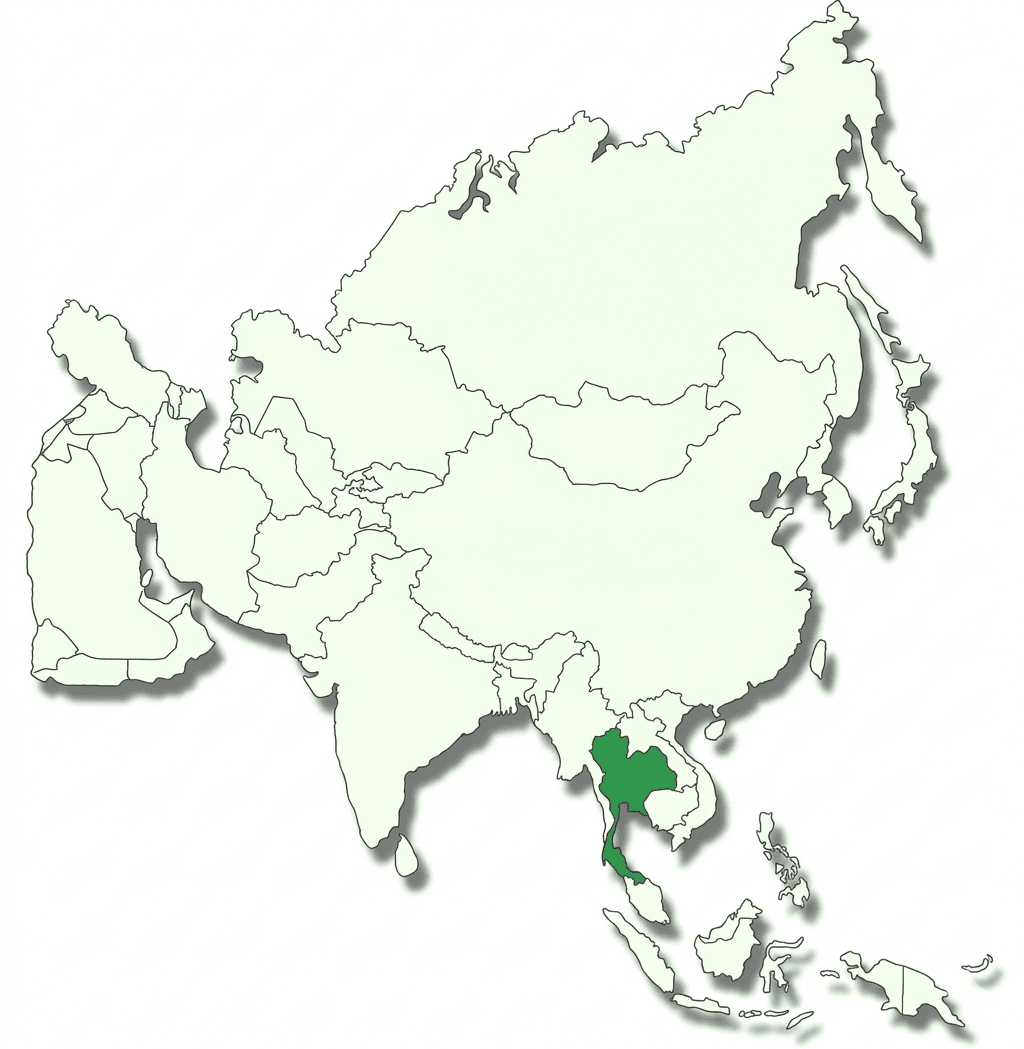
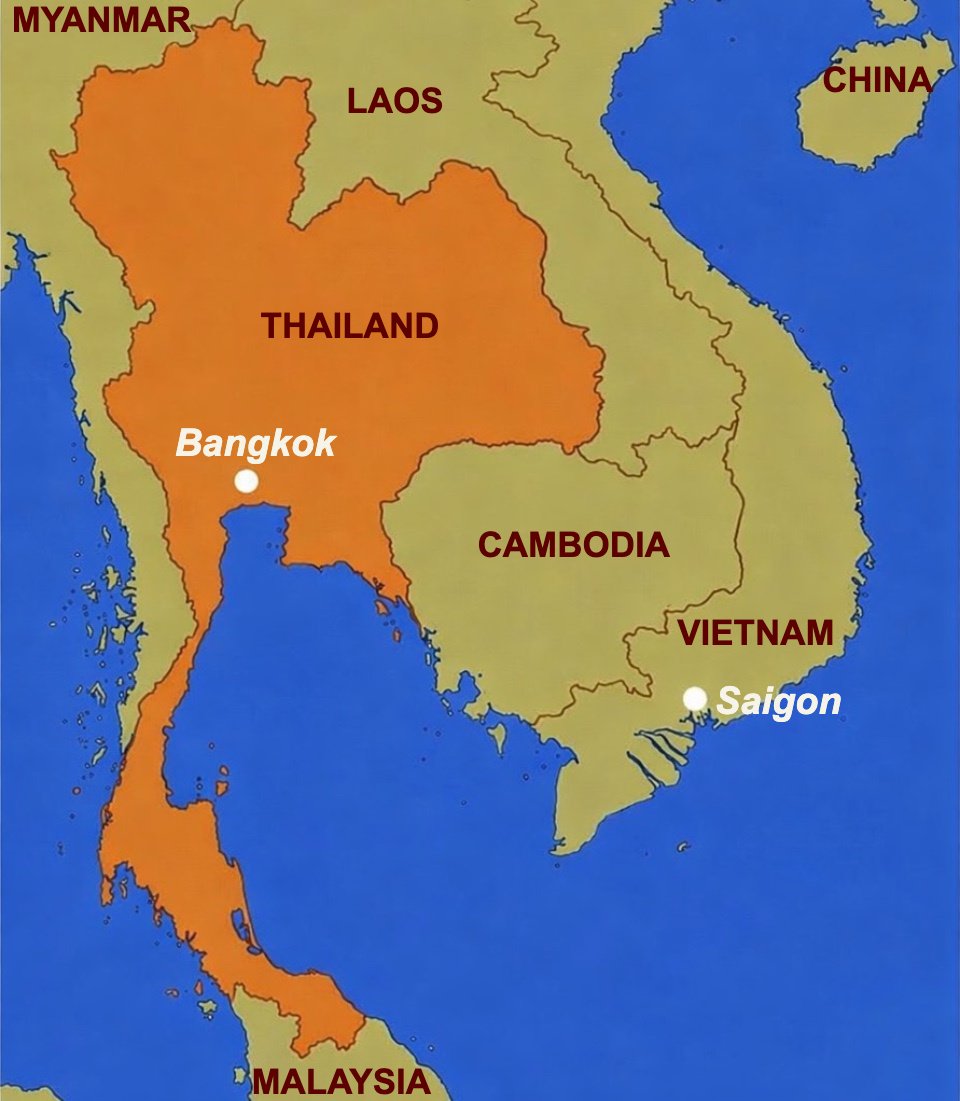
Thailand: world location and detailed map. Bangkok is the capital, main port, and largest city in the country, with an estimated population (including suburbs) of 5,876,000 in 1990.
Thai, belonging to the Tai-Kadai language family, is the country's primary language. There are four regional dialects. Lao, Chinese, Mon-Khmer, and Malay are also spoken in Thailand.
Freedom of worship is fully guaranteed in Thailand. The religious distribution is as follows: Theravada Buddhism (95%), Islam (3.8%), Christianity (0.5%), and Hinduism (0.1%).
Let us now look at part of its history, which will help us follow the evolution of its calendars over time. This historical overview takes us to the dawn of the 20th century (plus a few lines on contemporary history), and this is how it is presented in Microsoft Encarta:
“The Thai people, originally from western China, settled in Yunnan in the 2nd or 1st century BC. Taking advantage of the confusion following the collapse of the Han dynasty in AD 220, Thai leaders founded the kingdom of Nan Chao, which ruled until the Mongol conquest in the mid-13th century. However, long before then, the Thais had begun migrating southward, beyond the Malay peninsula and to the borders of Cambodia. At that time they came under Indian influence and adopted Buddhism. From the late 13th century, the Thais (known as Siamese) became a political entity and formed a nation. In 1350, a unified Thai kingdom was established under the ruler later given the posthumous name Ramathibodi. He founded the kingdom of Ayuthya. Despite intermittent conflicts with the Khmers and the Burmese, the kingdom of Ayuthya prospered for the next four centuries. The Thais also came into contact, not always friendly, with various European and Asian countries, including Portugal, the Netherlands, Great Britain, and China.
In 1767, after a four-year siege, Burmese troops captured Ayuthya and destroyed the city. Burmese domination over Siam was short-lived and ended with a Thai uprising led by General Phya Taksin, who proclaimed himself king. Upon his death, the crown passed to General Phya Chakri, founder of the current Thai royal dynasty, who reigned from 1782 to 1809 as Rama I. In 1826, the British and Thai governments concluded a commercial treaty granting Britain various rights and privileges that helped increase its influence across Siam during the 19th century.
Siam was not colonized like its neighbors because two of its rulers were outstanding statesmen. Passionately interested in Western civilization and science, King Mongkut, who reigned from 1851 to 1868 as Rama IV, invited many European advisers to help modernize his country. His son, King Chulalongkorn (Rama V), ruling at the height of European colonialism, continued and expanded these modernization efforts and preserved the country's independence, though at the cost of major territorial concessions. In 1893, Siam became involved in a border dispute with France, then the dominant power in Cochinchina, Annam, Tonkin, and Cambodia. The French sent warships to Bangkok and forced Siam to cede Cambodia and all of Laos east of the Mekong. France obtained further Siamese territories west of the Mekong in 1904 and 1907. Siam also ceded four Malay peninsula states to the United Kingdom in 1909. In return, the British gave up most of their extraterritorial rights in the rest of the kingdom. The Siamese government entered the First World War (1914-1918) on the Allied side in July 1917. Siam then became a founding member of the League of Nations.
[...] In January 2001, the party of billionaire Thaksin Shinawatra won the legislative elections. With 248 seats out of 393, his party, Thai Rak Thai (TRT) (“Thais love Thais”), founded in 1998, held a majority in the National Assembly. It was the first time in the country's parliamentary history that one party held a majority. The Democratic Party of outgoing Prime Minister Chuan Leekpai held 128 seats.
Of Chinese origin, this former police officer, who became the country's richest man after entering telecommunications, was 51 years old. With a nationalist and populist program - after promising debt moratoria for farmers and financial aid for the population - he easily rallied the majority of Thai votes, as voters sought change while the 1997 economic crisis had discredited the Democrats. However, found guilty of failing to declare part of his assets by the anti-corruption commission, he risked suspension of his civil rights.
Source: Microsoft (R) Encarta (R) 2004 Collection. (C) 1993-2003 Microsoft Corporation. All rights reserved.
The calendar
“The year is made up of twelve lunar months.” This is what we can read, concerning Thailand, in Description of the Thai or Siamese Kingdom written by Mgr PALLEGOIX, bishop of Mallos, apostolic vicar of Siam, in 1854.
This remained true until 1888, when Thailand moved from the lunar calendar to the Gregorian solar calendar. Still, the lunar calendar was not entirely abandoned, as it continued to determine the dates of religious and traditional festivals.
So, in studying the Thai lunar calendar as it existed until 1888, we are not doing purely antiquarian history.
Let us now look more closely at these two calendars.
The Thai lunar calendar, or Chantarakati calendar
Months
Like any proper lunar calendar, this calendar (called Chantarakati) has twelve months (month = duen) of 29 or 30 days (day = wan) to stay aligned with lunations.
Each month begins with the first visible crescent after the new Moon. It is divided into two main parts. The first (kuen) corresponds to the waxing-Moon period (from the very first crescent through the full Moon) and always has 15 days. The second (ram) corresponds to the waning-Moon period (until the next new Moon) and has 14 or 15 days depending on the month length.
The year alternates 29- and 30-day months, starting with a 29-day month. 29-day months are called Duen Khaad (meaning incomplete month), and 30-day months are called Duen Tem (complete month).
Months are not named, only numbered.
The seventh month can have 29 or 30 days. We will see why a little further down.
Let us summarize all of this in a table, noting that the year begins around late November / early December in our Gregorian calendar.
| Order | Name | No. of days | Gregorian |
|---|---|---|---|
| 1 | Duen Ai | 29 | November/December |
| 2 | Duen Yi | 30 | December/January |
| 3 | Duen Sam | 29 | January/February |
| 4 | Duen Si | 30 | February/March |
| 5 | Duen Ha | 29 | March/April |
| 6 | Duen Hok | 30 | April/May |
| 7 | Duen Jed | 29/30 | May/June |
| 8 | Duen Pad | 30 | June/July |
| 9 | Duen Kao | 29 | July/August |
| 10 | Duen Sib | 30 | August/September |
| 11 | Duen Sib-ed | 29 | September/October |
| 12 | Duen Sib-Song | 30 | October/November |
Days
Days of the month are counted by whether they belong to the waxing or waning Moon. So one says 4th day of the waxing Moon, or 5th day of the waning Moon. The 5th day of the waning Moon actually corresponds to the 20th of the month.
Some days have specific names:
- Wan Phen is full-Moon day (Wan Kuen Sib-ha Kham = 15th day of the waxing Moon)
- Wan Dub is the last day of the month (Wan Ram Sib-ha Kham if the month has 30 days, or Wan Ram Sib-si Kham if it has 29)
- Wan Phra: Buddhist monks' “holy” days occurring 4 times per month: Wan Kuen Pad Kham (8th), Wan Kuen Sib-ha or Wan Phen (15th), Wan Ram Pad Kham (23rd), and Wan Dub (last). In the end, these are a bit like our Sundays.
A Chantarakati date is structured like ours (day/month/year): day of Moon phase / month number / name of the year in a 120-year cycle (we will return to this).
Start of year and epoch of the Chantarakati calendar
A) Start of the year
We saw above that the start of the year (not to be confused with Thai New Year!!) would fall in late November / early December. True, but a bit too simple.
In some old Siamese kingdoms, the year could begin 1 or 2 months earlier. Even if late November / early December is accepted, it is more problematic that we do not clearly know which event (certainly astronomical or astrological, perhaps “agro-astronomical”) determines the start of the year and therefore day one of month one.
Let us briefly look at Songkran, which may give us at least a working clue.
Songkran is the traditional Thai New Year. It begins on 13 April in the current Thai calendar (thus Gregorian) and lasts three days. The 13 April festival is Maha Songkran and marks year-end, 14 April is Wan Nao, and 15 April is Wan Thaloeng Sok, beginning the new year.
Songkran is a Thai word meaning “change of place”, interpreted as the Sun moving from Aries into Taurus in the Western tropical zodiac (Thais use the sidereal zodiac: see page astronomy for details). This sign change occurs in April.
It is highly likely that before this April positioning, Thai New Year was naturally celebrated at the start of the lunar year, tied to a solar “change of place”. Under this assumption, the lunar year would begin with the first lunar crescent after the Sun moved from Scorpio into Sagittarius.
As for the drift of New Year from the start of the lunar year to the fifth month of that same year, it may result from a shift from Buddhist to Brahmanic beliefs. It is also likely linked to changing agricultural patterns during migrations from southern China to central or southern Thailand: ploughing seasons differ between north and south, yet calendar markers are often retained. This also helps explain the regional differences in year-start dates already mentioned.
B) Epoch of the Chantarakati calendar
Reminder: the starting point of an era is called its epoch. It is used to match dates across calendars.
For the Thai lunar calendar, since we are dealing with year cycles, we must determine the Gregorian date corresponding to day one of month one of year one of the first cycle.
The only date I found is the one used by Universal Calendar Calculator from Cumberland Family Software. As far as I know, this is the only software that converts between Gregorian and Thai calendars. I hope this page gives ideas to my compatriots: converting Gregorian dates to Thai dates and back seems more useful than giving the Maya long-count equivalent of today's date.
So I give this epoch with strong reservations: the Chantarakati epoch would correspond to 27 November 542 BC in the Julian calendar.
Personally, I would rather have started the era either in AD 78, the first era (Mahasakarat) found in Thai texts, or in AD 638, the beginning of the Chulasakarat era (abbreviated CS), which became the “official” era under King Chulalongkorn. But perhaps older traces exist...
Complementary days and months in the Chantarakati calendar
We now come to a major issue for any lunar calendar: how to stay aligned with the tropical year. A lunar year has 354 days, 8 hours and some minutes, versus 365 days, 5 hours and some minutes for the solar year.
Let us look more closely at the method that seems to have been used, known as the “Buddhist method”.
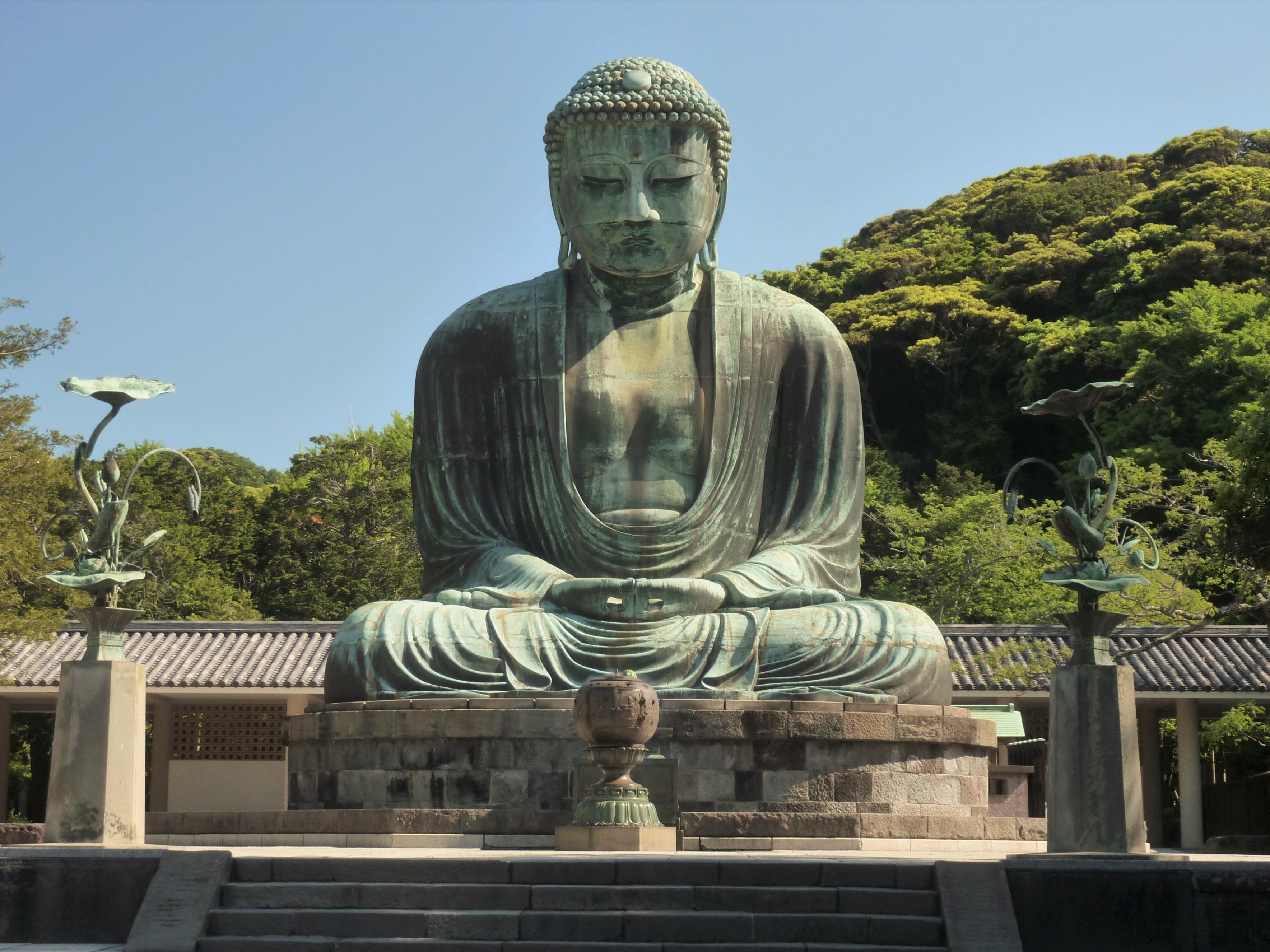
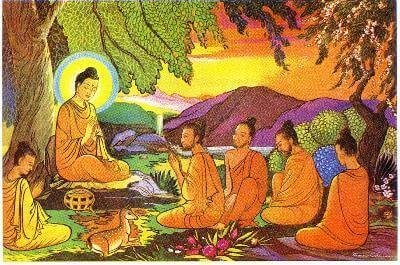
“Buddha (c. 563-c. 486 BC), born around the middle of the 6th century BC in the small Sakya tribe, whose main town was Kapilavastu, spent his youth there. Shortly after reaching adulthood, he left home and became a wandering ascetic. For several years he sought a solution to suffering and death, which haunted his mind, and suddenly found it, thus becoming an “awakened one” (buddha). Some time later, on the full-Moon day of the month of ASALHA, in Deer Park at ISIPATANA in the northern outskirts of Benares (today Sarnath), he delivered his first sermon before five ascetics who became his first disciples, thereby founding his monastic “community” (sangha). He spent the rest of his life traveling through the middle Ganges basin preaching his “teaching” (dharma), making many converts and organizing his community of monks. He died at an advanced age in Kusinagara (today Kasia, 175 km northwest of Patna), where he had stopped during a long journey on foot, around 480 BC. He then entered the unfathomable and final peace of “Complete Extinction” (parinirvana). Excerpt from Encyclopaedia Universalis, with additions by me.
This method allows adding to a regular year (called Prokatimas, prokati, meaning normal) either a complementary month (athikamas, from athika meaning additional and mas meaning month) or a complementary day (athikawan). By extension, athikamas and athikawan also name the corresponding year types. A year containing both an extra month and an extra day is not considered.
In a year with a complementary month (roughly every 3 years), the extra month is inserted after month eight and also has 30 days. This was the case in Gregorian-equivalent year 2002.
In a year with a complementary day (roughly every 5 years), this day is added to month seven, which then has 30 days.
We just saw that these intercalation rhythms are average values and that reality can differ. So how can one determine with certainty whether a year has an extra day or an extra month?
To do so, one would need to use the 27 lunar houses of Thai astrology. Here we will only explain the basic principle using zodiac signs more familiar to us. And for further simplification, we stick to the Western tropical zodiac.
Let us zoom in on the Chantarakati calendar and focus on two specific days:
- first, Asalabucha day (or Asanka Pucha), commemorating Buddha's first sermon (see image and caption above), which must fall on the full-Moon day of the 8th month of the Chantarakati calendar;
- second, the day after that, corresponding to the Buddhist “Lent” lasting three months, during which monks may not sleep outside their temples.
Now let us try to determine what type of year we are dealing with, using ephemerides or careful observation:
1) The day after full Moon, the Moon is in Sagittarius. The year is an ordinary year.
2) The day after full Moon, the Moon is not in Sagittarius. In that case, two further possibilities:
2-1) The following day, the Moon is in Sagittarius (so it is approximately in the “tail” of Scorpio). One day is added, and the year becomes an athikawan year.
2-2) The Moon is still not in Sagittarius on the following day. Then a full month is added, and the year becomes an athikamas year. In this case, Asalabucha is celebrated on full-Moon “day” of the second eighth month.
Simple, right? So, open your ephemerides. I am available for exact positions. While waiting for your messages, let us note in passing that older periods used another month/day intercalation system whose mechanics are not very well known.
The Thai solar calendar, or Suriyakati calendar
As part of a major modernization movement under Rama V, the solar calendar replaced the old lunar calendar in 1889 (Gregorian). Or rather, it became Thailand's official calendar, since, as seen above, the lunar calendar still determined the dates of certain festivals within the new solar framework.
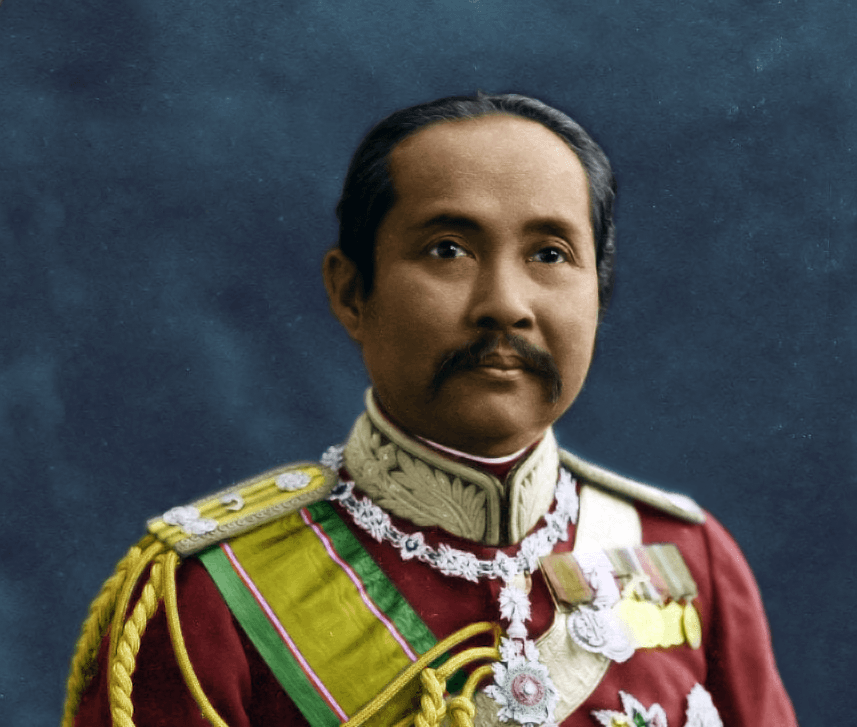
Chulalongkorn (1868-1910), also known as Rama V, dedicated his reign to modernizing the kingdom. He reorganized central administration by creating ministries no longer defined by territory but by function (finance, public works, justice, education, defense, foreign affairs); established new administrative divisions (circles, provinces, districts, communes); introduced military conscription; built a railway network and dug a canal between Bangkok and Ayuthya; and encouraged the creation of banks and processing industries. Such work required both foreign experts and the rapid training of Siamese able to support economic take-off. The king relied mainly on British experts and created law and medical schools as well as technical colleges. Because skilled labor was lacking, he systematically encouraged Chinese immigration. Chinese communities quickly prospered, establishing themselves as traders, planters, industrialists, exporters, and banking intermediaries. Encyclopaedia Universalis
We can add that Rama V was the one who preserved his country's independence in the face of European colonial expansion.
The adopted solar calendar was simply the Gregorian calendar. It was not yet the Suriyakati calendar, which rather corresponds to a Gregorian-style calendar with year beginning on 1 January. It was called the Ratanakosinsok calendar because the era began with the accession of the Ratanakosin dynasty in 1782 (Gregorian), represented by Rama I. Rama I founded the city of Ratanakosin that same year, which became Thailand's capital and would later be known as Bangkok. This is why the era is also known as the Bangkok era.
Another feature of this calendar was that the year started not on 1 January but on 1 April in the Gregorian calendar. Its epoch is therefore 1 April 1782 (Gregorian).
The Bangkok era did not last long: 30 years later, Chulalongkorn's own son, Vajiravudh, established the Buddhist era on 21 February 1912 (Gregorian).
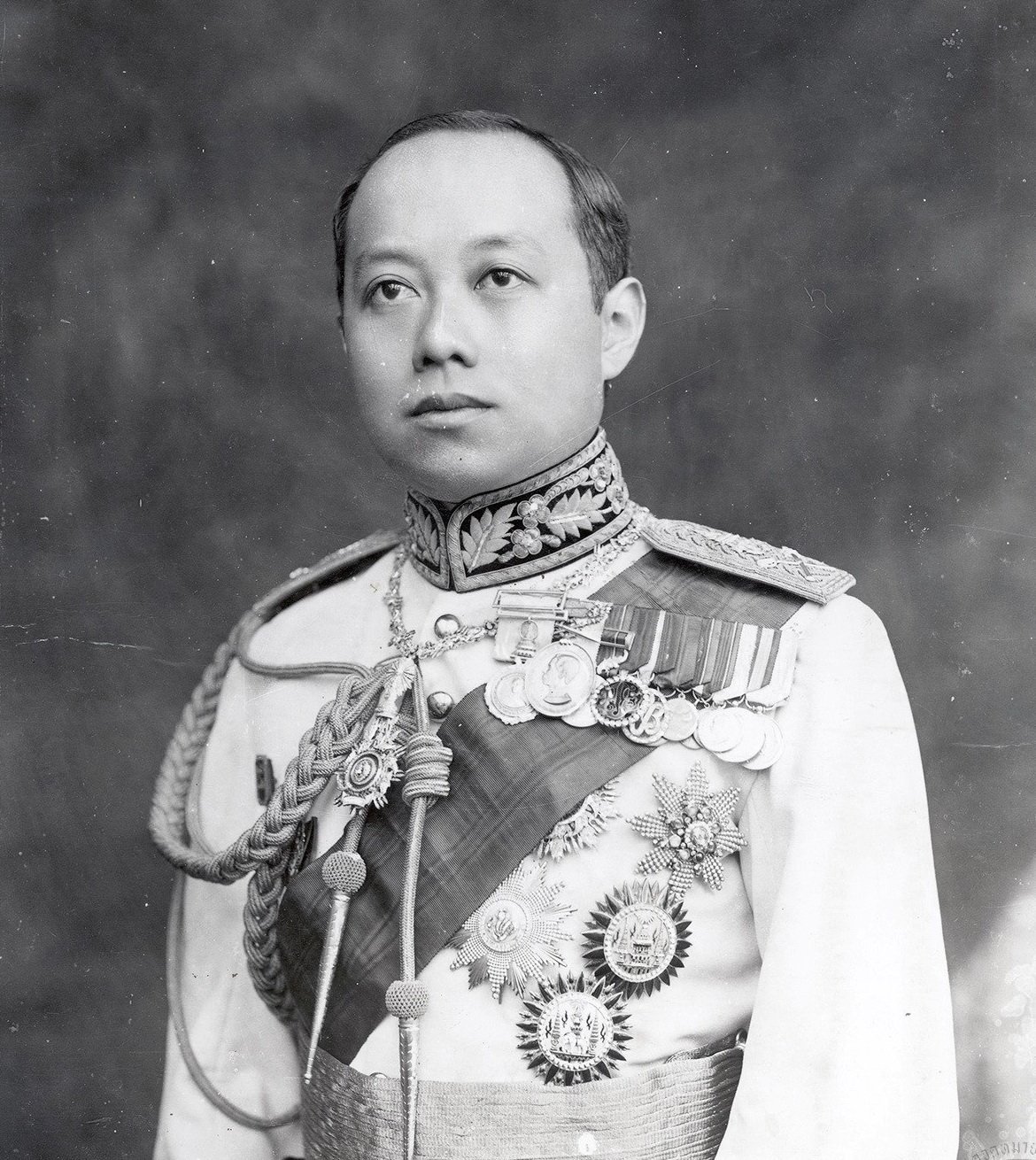
Vajiravudh Rama VI (1910-1925), far less imposing than his father Rama V, is credited with introducing the Buddhist era. 1 April 1912 became 1 April 2455 BE.
The era's beginning was set to 1 April 543 BC and corresponds, in year terms, to Buddha's passing into Nirvana, which can be briefly described as a state of supreme serenity.
This should not be seen as a mere royal whim to leave a reform legacy. Quite the opposite: it rooted Thai people in an ancestral history recalling a 5,000-year span between Buddha's entry into Nirvana and the supposed end of the material world. For this reason, year 1957 (2500 BE) represented an important midpoint for Thais.
The final adjustment came from Prime Minister Pibulsongkram in 1940, shifting year start to 1 January, like the Gregorian calendar. The following year, 1941 (Gregorian), the calendar truly became Suriyakati, and year 1940 contained only nine months, from 1 April to 31 December.
This change aimed only to align the Thai calendar with the Gregorian one, under vague historical pretexts, as shown by the implementing decree of 24 December 1940: "... Given Thailand's adoption of the international solar calendar, it is therefore logical that we observe 1 January as New Year in the same way as other countries... Adopting 1 January as New Year will make Thailand similar to other countries and brings us closer to our traditional Buddhist beliefs and customs, since this date is close to our old New Year day, which fell on the first day of the waning Moon, thus beginning the new year in winter."
Thus, 1 January 1941 Gregorian became 1 Moggarakom 2484 BE in Thailand. One therefore only has to add 543 to a Gregorian date to obtain the Buddhist-era date.
Since we have named the first month of this Suriyakati calendar, let us look at the year-month list.
| English | Thai | English | Thai | English | Thai |
|---|---|---|---|---|---|
| January | Moggarakom | May | Prues-saphakom | September | Gan-ya-yon |
| February | Goompaphan | June | Mithunayon | October | Tulakom |
| March | Meenakom | July | Garagadakom | November | Prues-sajigayon |
| April | May-sa-yon | August | Singhakom | December | Tanwakom |
We can see that 31-day months end in kom, while 30-day months end in yon. Except February, of course.
And about February, note that Thais also became familiar with a new word, Athikasurathin, which is simply 29 February.
Day and year cycles
Day cycles
We will not revisit day counting based on the waxing/waning Moon cycle. But we still need two additional cycles for a fuller picture.
- First, a 60-day cycle probably coming directly from China. It was used in early Siamese periods. Is it still used today?
It combines 10 “major” days (Mae Wan) and 12 “minor” days (Luke Wan) by pairing major and minor day names one by one. When the major-day name cycle ends, it returns to the first, while the minor-day series continues. Hard to explain, but it yields a system like 1-1; 2-2; 3-3; ...; 10-10; 1-11; 2-12; ...
This may be clearer in the following table, knowing that the “major” days are:
| No. | 1 | 2 | 3 | 4 | 5 | 6 | 7 | 8 | 9 | 10 |
|---|---|---|---|---|---|---|---|---|---|---|
| Name | Kab | Tab | Rwai | Muang | Burg | Gud | God | Ruang | Tao | Ka |
The “minor” days are:
| No. | 1 | 2 | 3 | 4 | 5 | 6 | 7 | 8 | 9 | 10 | 11 | 12 |
|---|---|---|---|---|---|---|---|---|---|---|---|---|
| Name | Jai | Pao | Yi | Mao | Si | Sai | Snga | Med | Sun | Rao | Said | Kai |
Summary table of the cycle:
| 1 | 2 | 3 | 4 | 5 | 6 | 7 | 8 | 9 | 10 | |
|---|---|---|---|---|---|---|---|---|---|---|
| 0 | KabJai | TabPao | RwaiYi | MuangMao | BurgSI | GudSai | GodSnga | RuangMed | TaoSun | KaRao |
| 10 | KabSaid | TabKai | RwaiJai | MuangPao | BurgYi | GudMao | GodSi | RuangSai | TaoSnga | KaMed |
| 20 | KabSun | TabRao | RwaiSaid | MuangKai | BurgJai | GudPao | GodYi | RuangMao | TaoSi | KaSai |
| 30 | KabSnga | TabMed | RwaiSun | MuangRao | BurgSaid | GudKai | GodJai | Ruangpao | TaoYi | KaMao |
| 40 | KabSi | TabSai | RwaiSnga | MuangMed | BurgSun | GudRao | GodSaid | RuangKai | TaoJai | KaPao |
| 50 | KabYi | TabMao | RwaiSi | MuangSai | BurgSnga | GudMed | GodSun | RuangRao | TaoSaid | KaKai |
- Then, the current 7-day cycle, which is simply the week and lets us see Thai day names and that the Thai week starts on Sunday.
| English | Thai |
|---|---|
| Sunday | Wan a-tit |
| Monday | Wan chan |
| Tuesday | Wan angjaan |
| Wednesday | Wan phut |
| Thursday | Wan paruhat |
| Friday | Wan suk |
| Saturday | Wan sao |
Year cycles
Like the Chinese, Thais use a 12-year cycle and name years after animals.
| Order | Year name | English | Order | Year name | English |
|---|---|---|---|---|---|
| 1 | Bee Chuad | Rat | 7 | Bee Mamia | Horse |
| 2 | Bee Chalu | Ox | 8 | Bee Mamaae | Goat |
| 3 | Bee Khal | Tiger | 9 | Bee Wog | Monkey |
| 4 | Bee Toa | Hare | 10 | Bee Raga | Rooster |
| 5 | Bee Maroang | Dragon | 11 | Bee Jau | Dog |
| 6 | Bee Maseng | Snake | 12 | Bee Goon | Pig |
AD 2004, or 2547 BE, would be Bee Wog in this 12-year cycle, i.e. Year of the Monkey.
It seems that, like the Chinese, Thais once used a 60-year cycle operating like the day cycle, later replaced by a longer 120-year cycle. One starts from the 12-year cycle and adds a suffix indicating the year's position in the 120-year cycle.
Given that ek=1, to=2, tri=3, jatawa=4, benja=5, cho=6, satawa=7, attha=8, noppa=9, and samriti=10, Bee Chuad To Sok is the second Rat year in the 120-year cycle.
Festivals in Thailand
Since this site is not meant to list every festival in every country, we limit ourselves here to festivals rooted in the lunar calendar and therefore changing date every year in the Thai solar calendar.
Festivals in the lunar calendar:
| Lunar month | Period | Name | Notes |
|---|---|---|---|
| variable | New Moon | Chinese New Year | Also celebrated in Thailand |
| 3 | Full Moon | Magha Bucha | 1,500 followers attend a sermon by Buddha |
| 6 | Full Moon | Vishaka Bucha | Buddha's passage into Nirvana |
| 8 | Full Moon | Asanka Pucha | Buddha's first sermon |
| 8 | Full Moon + 1 | Kao Phansa | Start of Buddhist Lent |
| 10 | last day | Sat | Food offering to monks at midnight |
| 11 | Full Moon | ok Phansa | End of Lent |
| 11 | Full Moon + 1 | Kathin | Offering of new robes to monks |
| 12 | Full Moon | Loy Krathong | Offerings to the Mother of Waters so the rains stop |
Let us still not forget Thai New Year (Songkran), which, although now fixed (13-14-15 April), has roots in the lunar calendar.