A Brief History
The Muslim, or Islamic, calendar discussed on this page is primarily religious in purpose. So this historical section goes straight to the event from which it emerged: the life of the Prophet Muhammad.
Muhammad (also Mohammed) was born in Mecca in the year 570, a few weeks after the death of his father, Abdallah.
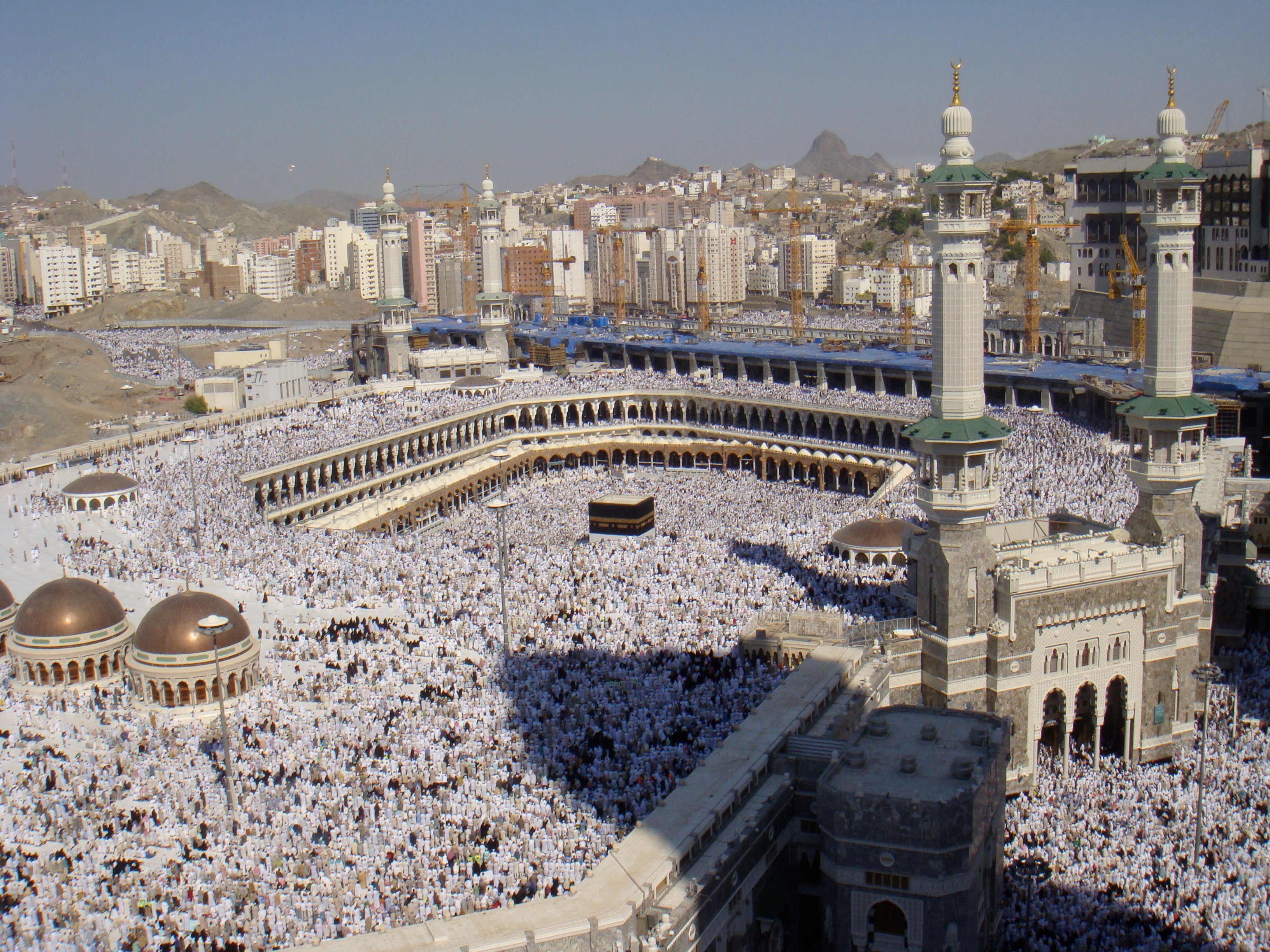
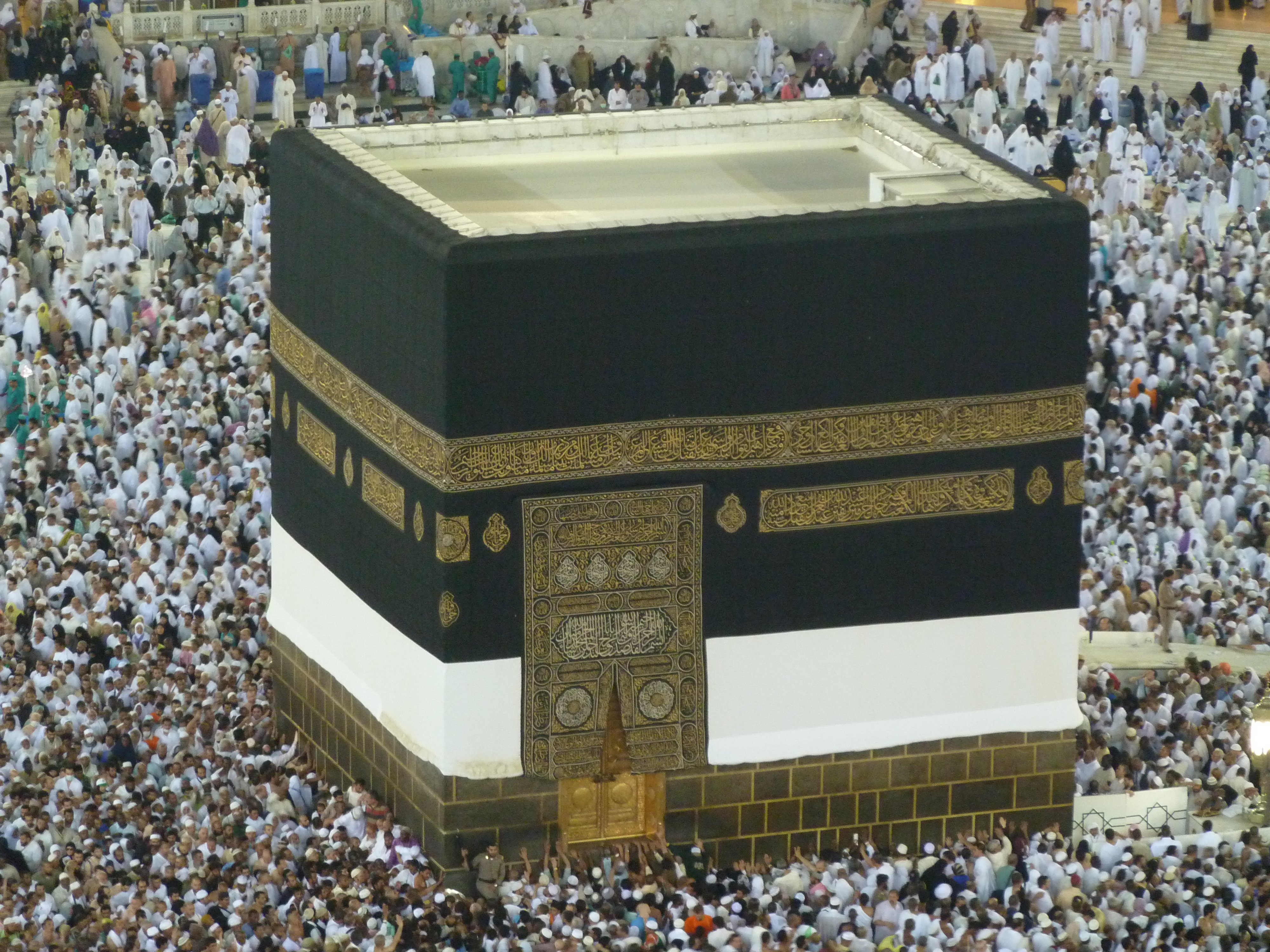
The Great Mosque of Mecca, toward which all Muslims turn for prayer and which, if they can afford it, they are expected to visit on pilgrimage at least once in their lifetime. The Black Stone (said to have been brought by the angel Gabriel) is set into a cube-shaped structure, the Kaaba, near the sacred Zamzam well, all within a sacred precinct (haram).
At around five years old, Muhammad lost his mother Amina and became an orphan. His grandfather first took him in, then died a few years later. Muhammad was then eight. He was adopted by his uncle Abu Talib, who owned a camel caravan. Naturally, Muhammad became a caravaneer at around twelve.
He later worked as a caravaneer for a wealthy woman, Khadija. When she became a widow, he married her. He was 25 and she was 40. They had five children. He also adopted Ali, a son of Abu Talib (who later became his son-in-law), as well as a young Syrian slave belonging to his wife.
At forty (in 610), he regularly withdrew to a cave on Mount Hira to meditate and pray. One day, during one of these retreats, the angel Gabriel appeared to him. Although Muhammad could neither read nor write, Gabriel dictated a divine message to him over 22 years: the Quran.
His first preaching efforts met little success, and he became the target of assassination attempts. In 622, he left for Medina where, despite rival clan struggles, he succeeded in establishing political and religious authority. He then led military campaigns to rally nomadic tribes and reunify the Arabs. In 630, the Muslim army entered Mecca.
Muhammad died in 632 on his return from pilgrimage.
The Quran, the holy book of Muslims, is divided into 114 chapters (surahs), themselves divided into verses (ayat). It prescribes:
- the profession of faith (shahada) in one God (Allah) and his Prophet Muhammad
- mandatory prayer (salat) five times a day
- the purifying alms tax (zakat) according to one’s means
- fasting (sawm) during Ramadan from dawn to sunset
- pilgrimage (hajj) at least once in a lifetime for every Muslim who can afford it
The Calendar
This Muslim or Islamic calendar is also called the Hijri calendar.
Before it, the Arabs used (before the rise of Islam) a lunisolar calendar, likely of Aramaic origin and, further back, Babylonian origin, with 12 months of 29 or 30 days and inserted intercalary months. So before Islam, Arabs inserted an extra month every two or three years to keep some synchronization between the lunar calendar and the solar year.
Quranic precepts gave this calendar a decisive turn, transforming it into a purely lunar calendar with a specifically religious function.
Since that is the key point, let us look at a few Quran verses to understand the structure of this calendar:
“Surah 9 - verse 36: The number of months with Allah is twelve [months], in Allah’s ordinance, from the day He created the heavens and the earth. Four of them are sacred. That is the right religion. So do not wrong yourselves during them. Fight the polytheists altogether as they fight you altogether. And know that Allah is with the righteous.
First conclusion: the year has twelve months.
It should also be noted that the names of these months differ from those of pre-Islamic Arab calendars. The following table gives the old and current names, bearing in mind that different transliterations from Arabic may produce different spellings. Sacred months are shown in red.
| No. | Old name | Current name |
|---|---|---|
| 1 | Mutamer | Muharram |
| 2 | Nadjir | Safar |
| 3 | Jawan | Rabi' al-awwal (Rabi I) |
| 4 | Sawan | Rabi' al-thani (Rabi' II) |
| 5 | Hinun | Jumada al-awwal (Jumada I) |
| 6 | Ronna | Jumada al-thani (Jumada II) |
| 7 | Asam | Radjab |
| 8 | Adel | Sha'ban |
| 9 | Natik | Ramadan |
| 10 | Waghel | Chawwal |
| 11 | Hewah | Dhu al-Qi'dah |
| 12 | Barak | Dhu al-Hijjah |
“Surah 9 - verse 37: The postponing of a sacred month is only an increase in disbelief, by which those who disbelieve are led astray: they make it lawful one year and sacred another year, to match the number of months Allah has made sacred. Thus they make lawful what Allah has made sacred. Their evil deeds are made appealing to them. And Allah does not guide the disbelieving people.
Second conclusion: adding intercalary months is out of the question.
“Surah 10 - verse 5: It is He who made the sun a shining light and the moon a light and determined for it phases, that you may know the number of years and the reckoning (of time). Allah did not create this except in truth. He details the signs for people who know.
“Surah 2 - verse 189: They ask you about new moons. Say: they are measurements of time for people and for the Hajj [pilgrimage]. And it is not righteousness that you enter houses from the back. Rather, righteousness is to fear Allah. So enter houses through their doors. And fear Allah that you may succeed.
Third conclusion: lunar phases determine the length of months and years.
“Surah 2 - verse 196: ...Eat and drink until the white thread of dawn becomes distinct to you from the black thread of night. Then complete the fast until night...
“Hadith of Muhammad: Begin fasting when you see the thin crescent and end fasting when you see it. If it remains hidden, then count 30 days for the month of Sha'ban.
Fourth conclusion: the start of Ramadan, and likewise of other months, is determined by visual sighting of the crescent. Each month begins when the crescent is visible after the new moon. In practice, two witnesses report this sighting to a judge who, if satisfied, conveys the announcement to the interpreter of Muslim law, the mufti.
This visibility may vary due to weather conditions or observer location. All the more so because some Muslims follow a local criterion while others follow the decision of the competent authority in the broader Islamic world.
It is almost certain that at the beginning of Islam this rule, starting each month with the first visible crescent, was strictly observed, which means years were 354 or 355 days long.
Calendars
The four conclusions we just reached establish the foundations of the Muslim calendar. Several calendar types emerged from them:
- Religious calendars that begin each month with the first visible crescent. The Moon is not unpredictable, but it is capricious enough that predicting (or observing) the first crescent is no trivial matter. The challenges of such calendars are discussed in detail in the study “The Beginning of Months in the Muslim Calendar”, available here.
- “Civil” calendars that retain a lunar year of 354 or 355 days with an arithmetic month structure alternating 29 and 30 days.
“Religious” calendars
They are discussed at length here, so we will not revisit them on this page, even though in practice it is sometimes hard to determine whether they are more religious than civil (or the reverse).
Tabular (arithmetic) calendars
This is sometimes called the Fatimid calendar because it is said to have been implemented by al-Hakim, the sixth Fatimid caliph. In reality, its creator was likely the Arab astronomer and mathematician al-Battani (c. 858-929), with a variant by Ulugh Beg (1393-1449) of the Timurid Persian dynasty. It is also called the misr calendar (in Egypt) or the hisabi calendar.
This civil calendar alternates months of 29 and 30 days, beginning with a 30-day month. That would produce a 354-day year if no correction were applied. But since 12 lunations actually total 354.367056 days, which makes the year too short, one extra day is regularly added to the last month, taking it from 29 to 30 days.
So there are 354-day years (common years) and 355-day years (abundant years, or kasibah).
All odd-numbered months have 30 days. The others have 29 days, except the last month (Dhu al-Hijjah), which may have 29 or 30 days.
To determine the length of the final month, and therefore whether the year has 354 or 355 days, one can use a 30-year “lunar cycle” (a year divisible by 30 is rank 0 in the cycle), and set the final month to 30 days in years of rank 2, 5, 7, 10, 13, 16, 18, 21, 24, 26 and 29. This cycle is called daur al-saghir.
If this 30-year cycle is applied, the “Muslim lunation” lags by 0.011680 day compared with a “real” lunation over the same period.
The year length is about 354.37 days versus 365.25 days for our civil year: on paper, a Muslim always appears younger than their age.
A few noteworthy details:
- Before the 30-year cycle became standard, Muslims (and for longer, the Turks) used an 8-year cycle in which years of rank 3, 6 and 8 were abundant (355 days). This 8-year cycle still appears in a Javanese variant (windu) of the hisabi calendar, with 30 days in months 2, 5 and 8 of the cycle. After 15 windu (120 years), one day is skipped to preserve synchronization with the hisabi calendar.
- In the Ulugh Beg variant, the 30-year cycle gave 30 days to the final month of years 2, 5, 7, 10, 13, 15, 18, 21, 24, 26 and 29.
The Muslim year is therefore structured as follows:
| No. | Month name | Number of days | Meaning |
|---|---|---|---|
| 1 | Muharram | 30 | To declare sacred |
| 2 | Safar | 29 | Harvest season |
| 3 | Rabi' al-awwal (Rabi I) | 30 | Autumn |
| 4 | Rabi' al-thani (Rabi' II) | 29 | Autumn |
| 5 | Jumada al-awwal (Jumada I) | 30 | Frost |
| 6 | Jumada al-thani (Jumada II) | 29 | Frost |
| 7 | Radjab | 30 | Camel sacrifice |
| 8 | Sha'ban | 29 | To branch out |
| 9 | Ramadan | 30 | Great heat |
| 10 | Chawwal | 29 | To remove (the heat?) |
| 11 | Dhu al-Qi'dah | 30 | To kneel |
| 12 | Dhu al-Hijjah | 29 or 30 | To head toward (the holy places?) |
Two observations can be made:
- Only 10 months have distinct names. Should this be interpreted as grouping within a base-10 system (the basis of Arabic numeration), followed later by an attempt to harmonize with the solar year? That is Jean Lefort’s view.
- The etymology of month names is linked to seasons. Surprising for a calendar whose months move through the solar year? Not so much if we remember that it was originally lunisolar.
Special case: Saudi Arabia’s Umm al-Qura calendar
The Saudi civil calendar does not use the tabular method, and it cannot simply be said to be based on crescent observation or calculation either. Its criteria have evolved over time.
- Up to 1420 AH (before 18 April 1999), the rule was:
If the Moon’s age at sunset is 12 hours or more after the (astronomical) new moon, then the previous day is the first day of the Islamic month, since the Islamic day begins at sunset and night comes before day.
Where sunset was calculated is debated: some say Mecca, others say Riyadh.
This rule often meant the lunar month began even before the astronomical new moon.
- From 1420 AH (17 April 1999) to 1422 AH (15 March 2002), the criterion became:
The day after day 29 of the current month is day 1 of the new month if the Moon sets after the Sun in Mecca. Otherwise, the next day is day 30 of the month, and the day after that day 30 is day 1 of the new month.
- After 1422 AH (15 March 2002), KACST (King Abdulaziz City for Science & Technology) revised the rules again:
If, on day 29 of the current lunar month, the following two conditions are met:
- geocentric conjunction occurs before sunset
- the Moon sets after the Sun
then the next day is day 1 of the new month.
Otherwise, the current lunar month has 30 days.
The Muslim era and the beginning of the year:
The Muslim era is not Muhammad’s own work but that of Umar during his caliphate (634-644). It is counted from the Prophet’s “emigration” to Medina on 16 July 622. This era of emigration or Hijra era is abbreviated A.H. (Anno Hijrae).
So 16 July 622 is written as 1 Muharram A.H. I. The year of emigration seems to have been chosen for two reasons. First, the Hijra marked a turning point in Muhammad’s mission. Second, the Prophet’s birth date is not known precisely, and the date of his death, being a moment of sorrow, could not appropriately begin an era.
Umar also decided that the year would begin with the month of Muharram, the month in which the decision to emigrate had been made.
1 Muharram A.H. I therefore corresponds to 16 July 622 (Julian calendar).
Division of months and the day
Muslims adopted the seven-day week. Unlike in France, however, the weekly day of rest and prayer is Friday (Youm el Djouma), and the first day of the week is Sunday (Youm el Ahad). Here are the Arabic weekday names:
| French day | Muslim day |
|---|---|
| Sunday | Youm el Ahad |
| Monday | Youm el Thani |
| Tuesday | Youm el Thaleth |
| Wednesday | Youm el Arbaa |
| Thursday | Youm el Thamis |
| Friday | Youm el Djouma |
| Saturday | Youm el Effabt (Youm as-sabt) |
The day begins at sunset, six hours ahead of our civil day.
The day names (except el Djouma and el Effabt) are cardinal numbers in Arabic (first, second, etc.). Before Islam, they were awwal (first), awhad (second), jubar (third), dubar (fourth), mu'nis (fifth), 'aruba (sixth), and shiyar (seventh).
Youm el Djouma or 'al-jumu'a (our Friday) means “assembly” or “gathering.” It is the most important day for Muslims (as Sunday is for Christians or the Sabbath for Jews): the day of communal prayer. Incidentally, the root Jumu'a is the same as Jama'a, from which Jami (mosque) is derived.
This day is so important that the Quran dedicates a surah to it, 'al-jumu'a (Friday), where one verse says: "O you who believe! When the call to prayer is made on Friday, hasten to the remembrance of Allah..." Quran 62:9.
Several interpretations explain this day’s special character:
- Muhammad may have chosen the sixth day both to establish a day devoted to worship, as in Judaism and Christianity, and to distinguish Islam from both.
- Before Islam, Arabs already held civil gatherings on Fridays.
- The day is linked to Muhammad’s flight from Mecca on Friday, 16 July 622. In fact, it was Thursday, but since days are counted from sunset, Friday began on the evening of the 16th.
Religious festivals
Since the Muslim calendar is mainly religious, this study would be incomplete without mentioning the religious feasts attached to it.
There are only two canonical feasts mandated by Muhammad: Id al-Fitr and A'id-Adha. The others are optional. Although not a feast, Ramadan fasting is also required by the Quran.
1 Muharram (Hijra or Muslim New Year): not celebrated as the first day of the year, but as a remembrance of the beginning of the Hijra.
12 Rabi' al-awwa (Mawlid al-Nabi): birth of the Prophet Muhammad. Instituted by Sultan Murad III in 1588, it has grown steadily in importance.
15 Radjab (Leilah-al-Ghaibah): anniversary of Muhammad’s conception.
27 Radjab (Leilah-al-Mijaj): the Prophet’s ascension to heaven.
15 Sha'ban (Leilah-al-Berat): commemoration of purification.
1 Ramadan: beginning of the fasting period. Theoretical date: see the appendix at the end of the page.
18 Ramadan: commemoration of the Battle of Badr.
27 Ramadan (Leilah-al-Qadr): first revelation of the Quran to the Prophet.
1 Chawwal (Id al-Fitr or Aïd el-Fitr): end of fasting.
10 Dhu al-Hijjah (A`ïd-Adha): Feast of Sacrifice. The first 13 days of this month are public holidays. Its three-day celebration commemorates Abraham’s sacrifice. A sheep, cow, or camel is sacrificed, and part is distributed to the poor.
Variants
The Hijra is the official starting point of the calendar in Saudi Arabia, Yemen, and the Gulf principalities.
Many Muslim-majority countries use both the Muslim and Gregorian calendars: Egypt, Syria, Jordan, Morocco, Turkey.
Turkey also uses very diverse “popular” calendars that may one day deserve a dedicated page.
Iran adopted a solar year with Persian month names. It uses the Muslim era while beginning the year on 21 March. This calendar is specific enough to warrant its own page.
In India and Pakistan, calendars derived from the Muslim calendar are in use, with Hindu particularities.
Appendix: the problem of setting the start date of Ramadan fasting
For more details on religious calendars, read the dedicated study here.
We will keep this brief, as the topic goes beyond strict calendar structure, except for one key question: which method should be used to determine the beginning of months.
We saw that months are fixed in the Muslim year and that common and abundant years are also fixed in the 30-year cycle. So the start of each month does not necessarily correspond exactly to the observed first crescent.
We also read: Begin fasting when you see the thin crescent and end fasting when you see it... (Hadith of Muhammad).
So Ramadan (the month) and Ramadan (the fast) should not be confused, because observation may mean the fast begins on the last day of the previous month, whose length has been somewhat “theorized.” The theoretical calculation sometimes clashes with empirical observation.
And if we add the fact that observation results differ from country to country (longitude, latitude, viewing conditions), varied fasting start dates are inevitable, especially since some rely on observed month starts rather than rule-based ones.
Thus in 2003, fasting began on Sunday, 26 October in Libya, Egypt, Jordan, Sudan, and Yemen. By contrast, it began on Monday, 27 October in Saudi Arabia, the Arab Gulf monarchies, and Algeria.
And in France? Before 2003, some followed the Paris Mosque, others their country of origin, and others Saudi Arabia.
This shows how fitting it is that the night when people try to see the first crescent is called the “night of doubt.”
In 2003, the start date of Ramadan in France was set for the first time (27 October 2003) by the French Council of the Muslim Faith (CFCM), founded in April 2003.
In 2004, CFCM announced the date (Friday, 15 October 2004) on Thursday, 14 October 2004. That same date had already been announced on 13 October 2004 by the Union of Islamic Organizations of France.
For the last eight years in France, the dates were as follows:
| Start of fasting | Date in the calculated "official" calendar |
|---|---|
| 27/11/2000 | 29 Sha'ban 1421 H |
| 16/11/2001 | 29 Sha'ban 1422 H |
| 6/11/2002 | 1 Ramadan 1423 H |
| 27/10/2003 | 1 Ramadan 1424 H |
| 15/10/2004 | 1 Ramadan 1425 H |
| 04/10/2005 | 1 Ramadan 1426 H |
| 24/09/2006 | 1 Ramadan 1427 H |
| 13/09/2007 | 1 Ramadan 1428 H |
| 01/09/2008 | 1 Ramadan 1429 H |
| 22/08/2009 | 1 Ramadan 1430 H |
For 2005, it seems the Union of Islamic Organizations of France again announced on 3 October that Ramadan would begin on 4 October 2005, reportedly “following the decision of the CFCM Executive Board.” Unless mistaken, the Executive Board of the French Council of the Muslim Faith was due to meet at the Paris Mosque on Monday, 29 Chaabane 1426 (3 October 2005).
So, observation or calculation for month starts and fasting starts? The question remains open.
On this point, here is a statement dated 24/11/2000 that raises the issue again and offers a somewhat mixed answer:
"The European Council for Fatwa and Research has studied the question of the day marking the beginning of fasting and the day marking its end for the year 1421. The Council reiterates its decision issued during the third session held in Cologne, Germany, from 19 to 22 May 1999.
During that session, the Council examined the means to be used in determining the beginning of lunar months, especially Ramadan because of fasting and Shawwal because of the breaking of the fast, and the role of astronomical calculation in this determination. The Council members addressed both the scientific and jurisprudential dimensions.
During the debates, several viewpoints emerged:
1. Those who advocate the exclusive and systematic use of astronomical calculation.
2. Those who categorically reject astronomical calculation.
3. Those who would use astronomical calculation not to announce the new moon, but to invalidate a visual claim deemed erroneous in light of that same calculation.
4. Those who favor aligning with the first country where new moon observation has taken place, even when incompatible with astronomical calculation.
The Council carried out a comprehensive deliberation of all these viewpoints. It concluded, in line with what it had already decided during its previous session held in Dublin, Ireland:
The beginning of Ramadan and its end are determined by visual means, whether with the naked eye or with an observing instrument. This observation is admissible in whichever Muslim country it may have occurred, in accordance with the authentic hadith stating: "Fast as soon as you see the moon (of Ramadan), and break the fast as soon as you see it (the moon of Shawwal announcing the end of Ramadan)," provided that astronomical calculations indicate that sighting is possible somewhere on the globe. If calculations show that no observation of the new moon is possible, any claim of sighting is deemed inadmissible. Eyewitness testimony is not definitive; it may result from illusion, error, or falsehood. It remains conjectural, unlike astronomical calculations, which are definitive. The conjectural cannot equal the definitive, let alone overturn it, according to unanimous scholarly opinion.
The Council insists that it advocates the use of scientifically established astronomical calculation, not astrological calculations, which are religiously condemned, nor dates appearing in commonly used calendars in Muslim countries, as some Muslim scholars seem to believe. By astronomical calculation, we mean results from contemporary astronomy based on deterministic mathematical foundations. This science, which has reached its peak in our times and has enabled humanity to go to the moon and other planets, is one in which many Muslim scholars from many countries have distinguished themselves..."