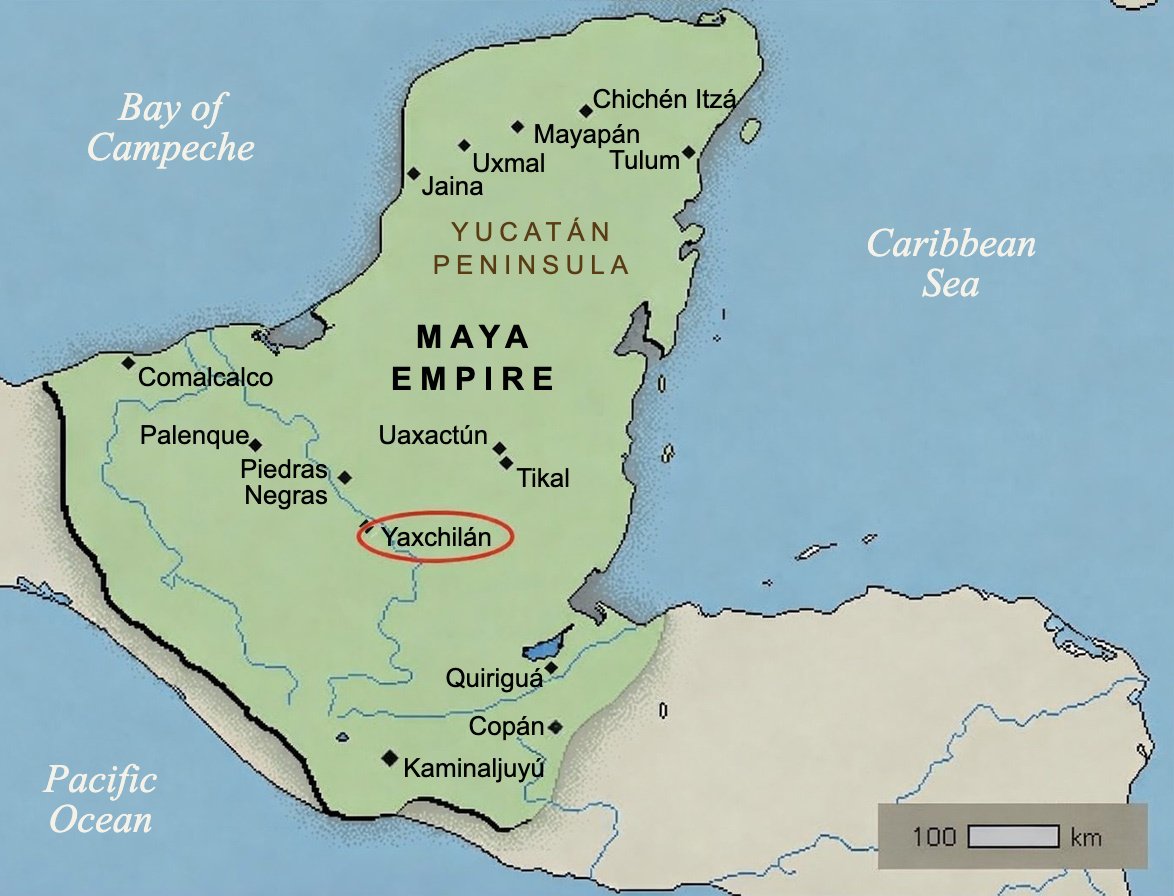
To try to understand the glyphs linked to the Long Count, we will look at one example: a stone lintel found at the site shown on the map, Yaxchilan.
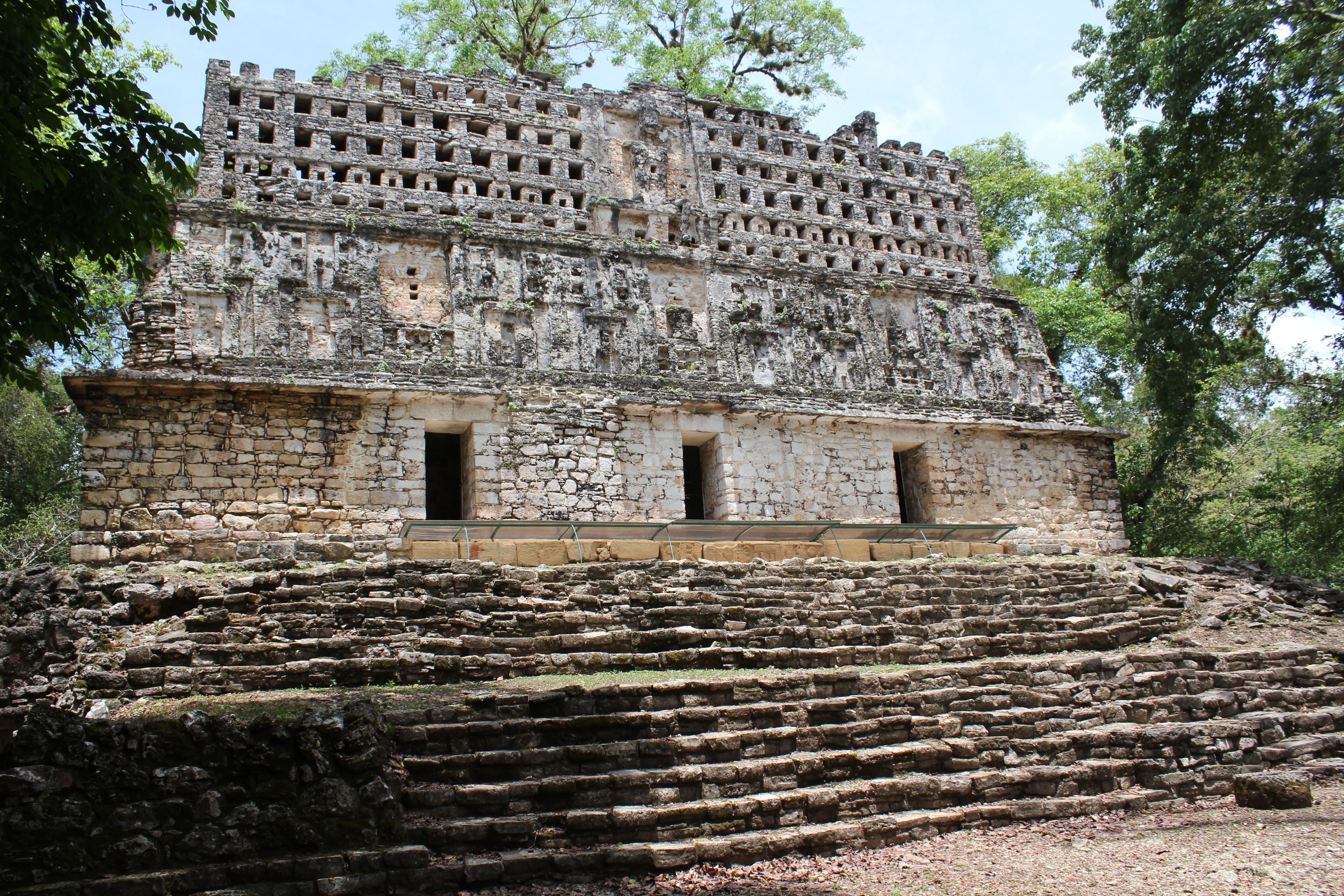
At Yaxchilan, we will study a Long Count inscription found on lintel 21.
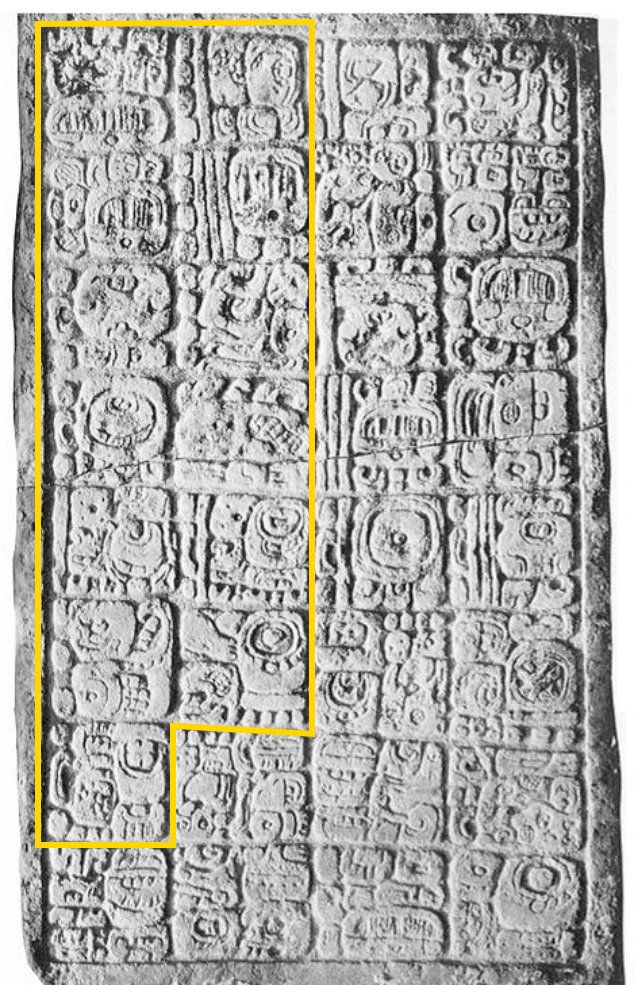
The framed glyphs make up the Long Count and its supplementary series, which we will examine closely. The text following the count narrates one event in the life of King Chan-Bahlun (Bird-Jaguar).
A bit of theory
If we sketch the Long Count glyphs and the complementary glyphs, we get roughly the following grid:
| ISIG | |
| BAKTUN | KATUN |
| TUN | UINAL |
| KIN | TZOLKIN DAY |
| G | F |
| Z | Y |
| E | D |
| C | X |
| B | A |
| HAAB MONTH | |
Reading is done line by line, left to right, then column by column (like our reading system): ISIG, BAKTUN, KATUN, TUN...
Let's call things by their names:
The Long Count is also called the Initial Series, and we already saw how it works on the main page dedicated to the Maya calendar. In the diagram above, it is the green section.
It is preceded by an ISIG glyph, or Initial Series Introductory Glyph, announcing that the following glyphs form a date.
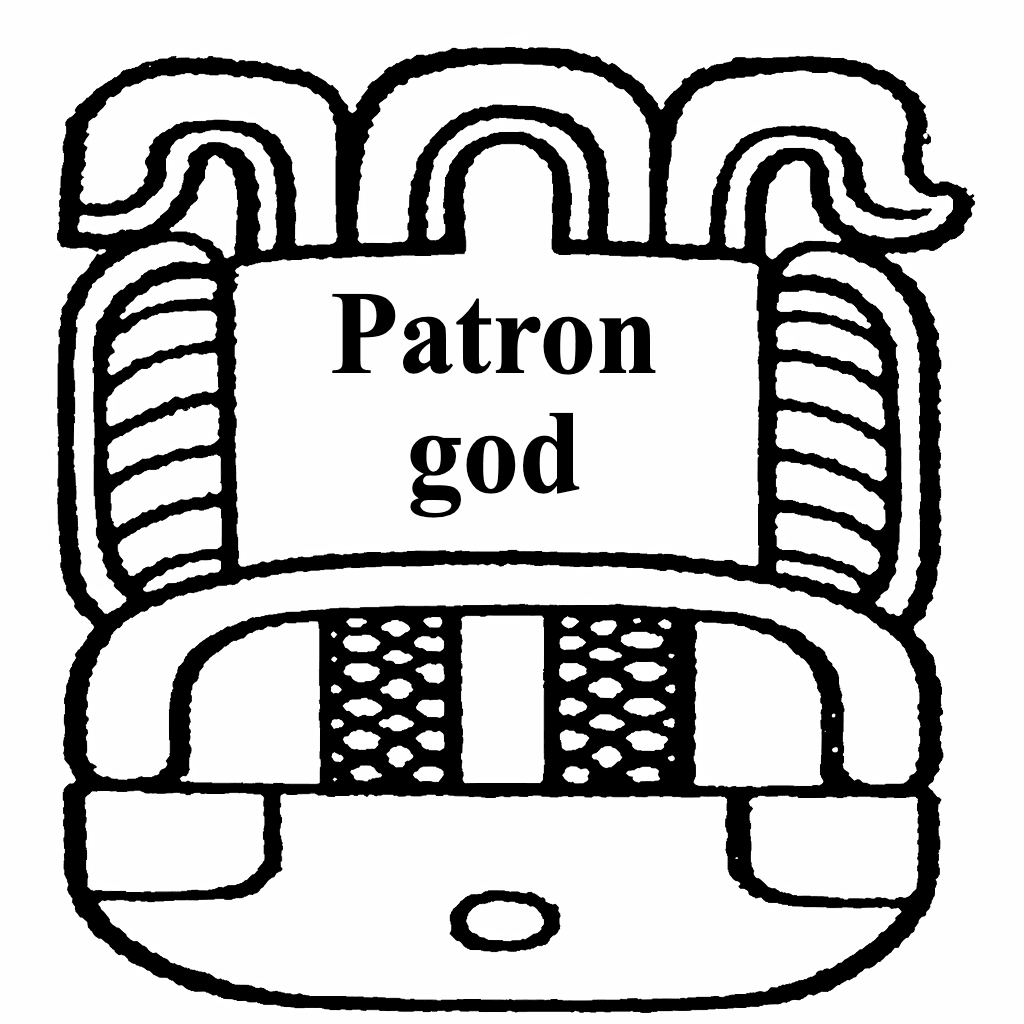
This ISIG glyph has two parts:
- a fixed “base”, shown on the left
- at the center of this base, another glyph is inserted, the month “Patron God” of the event dated by the Long Count
The light yellow glyph (to the right of KIN) corresponds to the event date in the Tzolkin calendar.
That date is repeated in the Haab calendar in the final dark yellow glyph.
As we saw on the Maya calendars page, those two dates together form the Calendar Round.
Between these two dates are inserted the so-called supplementary glyphs (red G-F on blue background) and lunar glyphs (blue letters on blue background).
The letters are not random. They follow a coding system established by specialists. Eight were assigned by a scholar named Morley: A, B, X, C, D, E, F and G. Y and Z were coded later. These glyphs have specific features:
- They are not always present.
- Two of them can be merged into a single glyph.
They are usually grouped in pairs and have the following meanings:
- G and F represent the gods of the night.
- Z and Y: meaning unknown.
- D and E indicate the age of the moon (number of days since the last new moon).
- C and X: position of the lunation in a 6-lunation cycle for C. Name of that lunation for X.
- B and A: B is u k'aba, meaning “its name”. A is the lunation length (29 or 30 days) in k'al (20) + 9 or 10 form.
These paired groupings do not necessarily mean two glyphs appear inside one sign, but that both elements in a pair are of the same type.
I can imagine you eager to jump straight to a concrete example. But a minimum of theory helps make sense of what follows, doesn't it?
And now we get to that next part.
Before that, one note: there are so many glyph variants that we will not always recognize each one compared to the main calendars page. But after all, do two people write in the same hand? So we simply need to trust the author when they say a glyph means this or that. Deal? Then let's do some practice.
The Yaxchilan Long Count
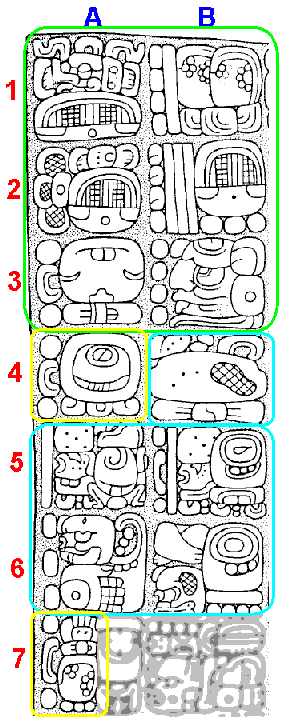 | On the left, we find the different elements defined in the previous paragraph, marked with colors matching the diagram. If we temporarily ignore glyph A1 (ISIG), we can quickly decipher the Long Count from the 5 glyphs that follow. Remember: a dot = 1 and a bar = 5. For example, in B1, left of the *BAKTUN* sign, we have 4 dots and 1 bar, so 4 + 5 = 9. | ||
| B1 | 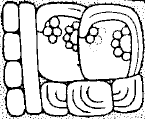 | 9 BAKTUN | |
| A2 | 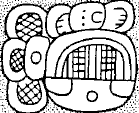 | 0 KATUN | |
| B2 | 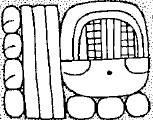 | 19 TUN | |
| A3 | 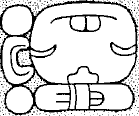 | 2 UINAL | |
| B3 | 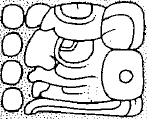 | 4 KIN | |
| The Long Count date is therefore 9.0.19.2.4, i.e. (144,000 x 9) + (7,200 x 0) + (360 x 19) + (20 x 2) + (4 x 1) = 1,302,884 days since the start of the Long Count computation. That corresponds to 14 October 454 (Gregorian), if the computation starts on 11 August 3114 BCE. | |||
Now let's return to glyph A1, the ISIG. Its main purpose is to introduce the Long Count, acting as its heading. Secondarily, it indicates the month of the event. As seen earlier, it has two parts, which we can identify here.
| | We do indeed find the "throne" on which the Patron God of the month rests, i.e. the month announced by the Long Count. In this case, it is YAX. | 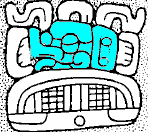 |
Now let's determine the Calendar Round, which, as we know, combines the date in the Tzolkin calendar and the same date in the Haab calendar.
To do this, we will use the two glyphs marked in yellow.
| A4 | 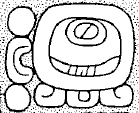 | Tzolkin calendar: 2 dots + the day sign KAN. Date in the Tzolkin calendar = 2 KAN. |
| A7 |  | Haab calendar: 2 dots + month sign YAX. Date in the Haab calendar = 2 YAX. We used only part of the glyph, which is not surprising since, as noted above, multiple glyphs can be grouped into one. |
| The Calendar Round date is therefore 2 Kan 2 Yax. | ||
And there we are. We have found the starting date of the event described in the remainder of the stone panel.
It is 9.0.19.2.4 2 Kan 2 Yax
Now we only need to try to decipher the supplementary glyphs inserted between the Tzolkin date and the Haab date. They are mainly linked to the Moon.
| Position | Glyph | Type | Translation |
|---|---|---|---|
| B4 | 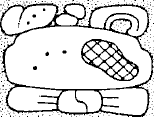 | G/F | Grouped glyphs. According to specialist Mr Teeple, glyph F may have no precise meaning for us. Glyph F could represent the number of a "god" among 9, a bit like our weekdays. Here, trust me, it is 8. So we would be on the 8th day of an X-week of 9 days or nights. |
| A5 | 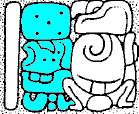 | Z/Y | As seen above, these recently identified glyphs are still undeciphered. We can see that Z's introductory sign is a bar, i.e. the number 5. 5 what? |
| B5 | 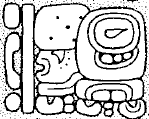 | D | D gives us the moon's age: two dots and one bar = 7. Date 9.0.19.2.4 is therefore 7 days after new moon. Here, glyph E is absent. When present, it adds 20 days (vigesimal system obliges) to the age derived from D. |
| A6 | 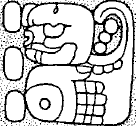 | C | Position of the lunation in a cycle of 6. Here it is 3, as shown by the three dots. Some believe this number was related to eclipses... |
| B6 | 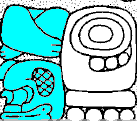 | X/A | X is usually grouped with C, for lack of better knowledge since its meaning remains unknown. Glyph A tells us whether the current lunation has 29 or 30 days. Its form is typical of lunar elements (concentric circles and three dots). The suffix (bottom) is either 9 or 10. Here it is 9. Note the absence of glyph B, which, when present, names the current lunation. |
If I had to give my view, I would say the most interesting parts of what we just unpacked are the Long Count and the Calendar Round. You probably need to be Maya, or a researcher, to be deeply interested in everything purely lunar. But that's just my view, and I will let you form yours.