NOTE: Because of its specific features, the Balinese calendar has a dedicated page. However, there is only one historical overview for all of Indonesia.
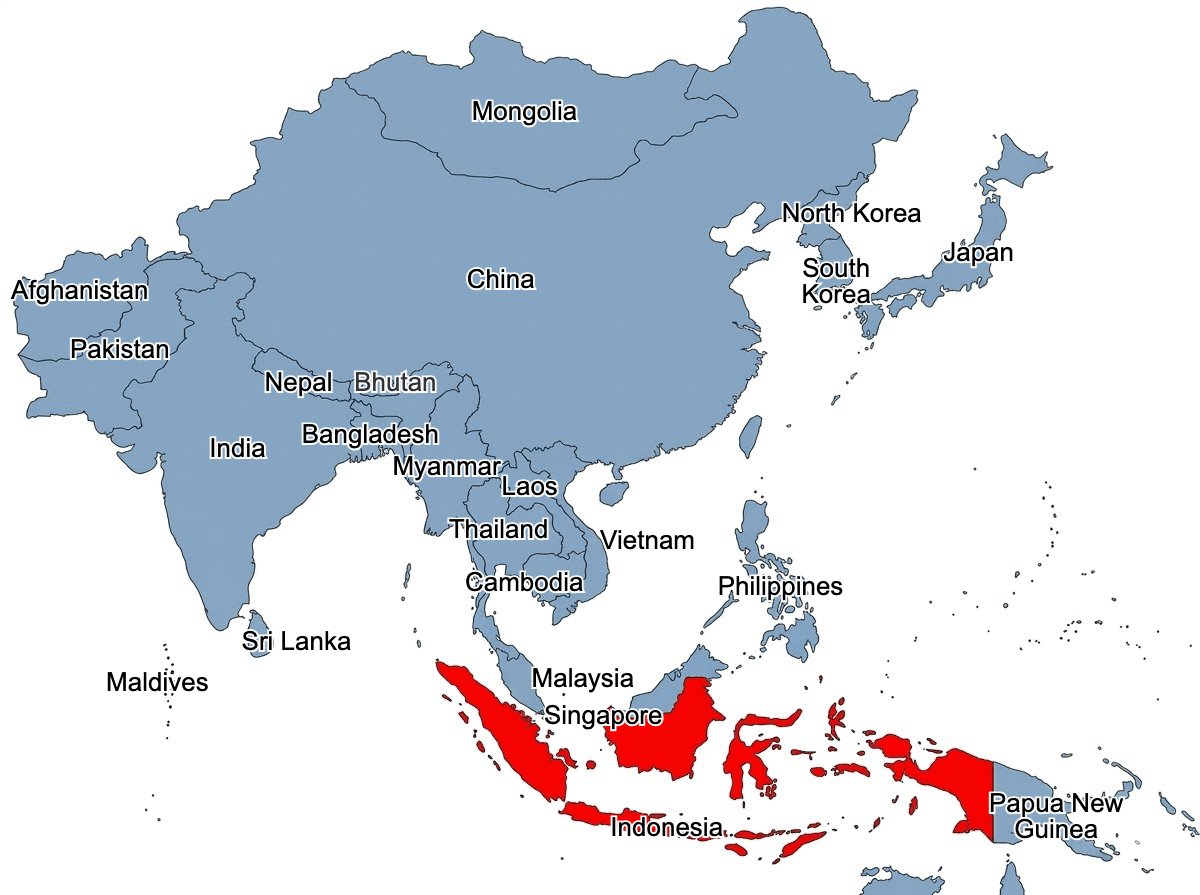
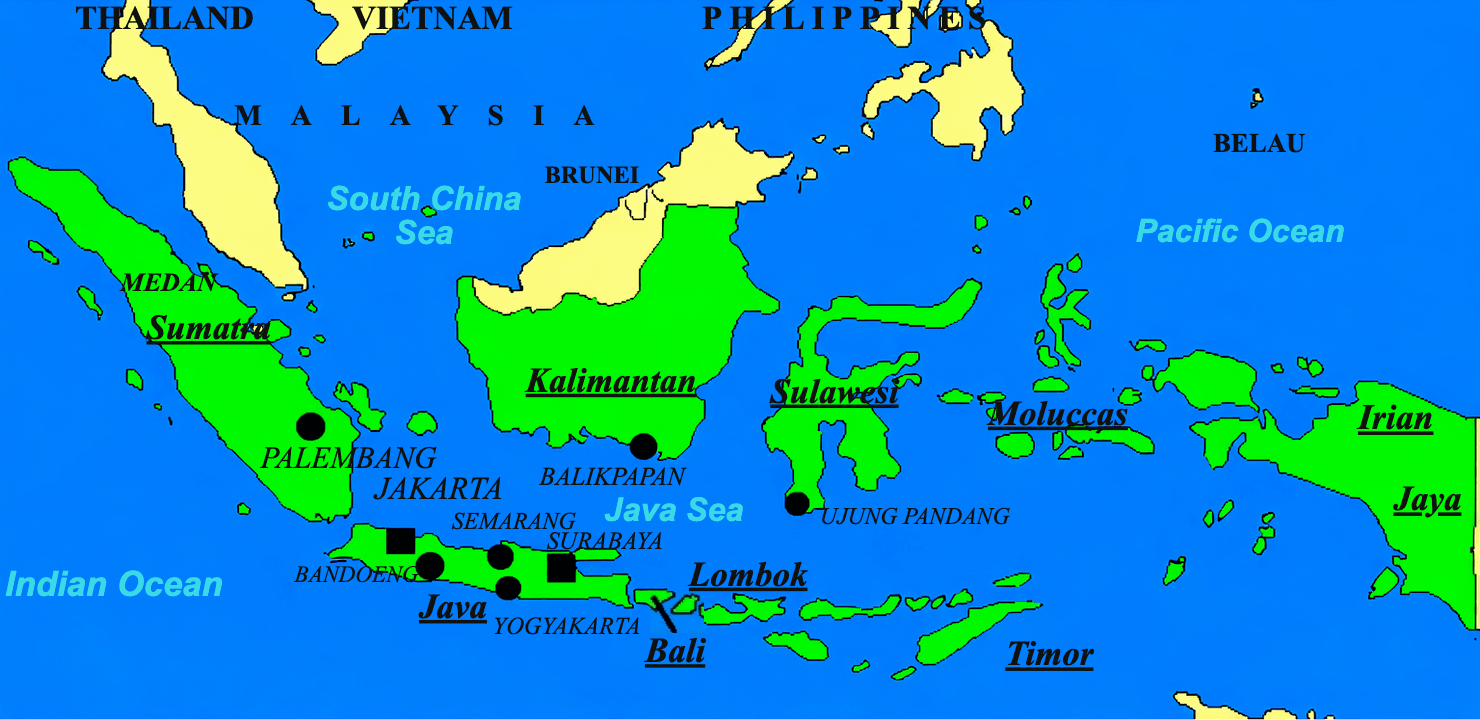
Maps
A little history
Indonesia is made up of a vast number of islands, usually estimated at around 17,500. Each of the main islands followed its own historical path, and the archipelago was only truly unified at independence in 1949.
Indonesian history begins a very long time ago. In 1892, remains dated to over one million years old were discovered in Java: Java Man, the famous Pithecanthropus. At that time, Indonesia was still connected to the Asian continent.
The Dong Son culture was the first civilization in Indonesia. It dates back about 3,000 years and has roots in Vietnam and southern China.
From the beginning of our era, Malay navigators maintained regular trade links between China, Southeast Asia and India.
Buddhism and Hinduism took root easily, and in the 7th century a Hindu kingdom appeared: Srivijaya in Sumatra. China entrusted the safety of its trade routes to its ships. The kingdom of Srivijaya dominated the area until the 12th century, before yielding to pressure from the Javanese empire of Majapahit, founded in the 13th century.
Islam had followed the trade routes, and by the 15th and 16th centuries Indonesian rulers converted, establishing Islam as the official religion.
Under Islamic influence, the kingdom of Majapahit collapsed in the 15th century, and part of its court took refuge in Bali, the only Indonesian island that remained Hindu.
Marco Polo seems to have stayed in Indonesia as early as 1292, but rivalry between Portugal, the Netherlands and England ended with Dutch victory and the establishment of the Dutch East India Company in 1619. The Dutch ruled Indonesia for 300 years.
In 1942, the Dutch were overwhelmed by the Japanese, and Indonesia came under Japanese control.
On 17 August 1945, two days after Japan's surrender, Sukarno and Hatta proclaimed the independence of the Republic of Indonesia and were chosen as president and vice-president.
The Dutch only recognized Indonesian independence in 1949.
Calendar(s) (excluding Balinese)
If we look at the ITC - Indonesian Times and Calendars site, we can see a monthly calendar (for May 2002, for example) that looks like this:
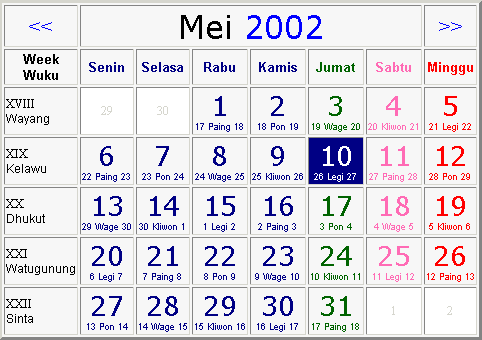
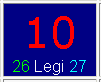
Detail for 10 May 2002. The figures were colored by me.
Still for 10 May 2002, we also find the following four dates (figures colored by me):
- Jumat Legi, 10 Mei 2002 M
- 26 Sapar 1935 Dal
- 27 Shafar 1423 H
- Xingqiwu, 28 Sha Gwee 2553 Shio Be
How do we make sense of all these dates?
You need to know that the Indonesian date system uses several calendars at the same time: a Masehi calendar (line 1), a Javanese calendar (line 2), a Muslim calendar (line 3), and a Buddhist calendar (line 4). The day numbers in the full dates (1-2-3-4) are repeated in each day box of the monthly view: 10 - 26 - 27 (see colors).
1) The Masehi calendar (Jumat Legi, 10 Mei 2002 M)
Used for civil purposes, it is simply the international Gregorian calendar. The day begins at midnight and the week begins on Monday.
However, since 1971, the days Monday to Sunday have been named Senin, Selesa, Rabu, Kamis, Jumat, Sabtu and Minggu.
The M at the end of the date indicates that it is the Masehi calendar.
2) The Javanese calendar (26 Sapar 1935 Dal)
- There are five so-called Pasaran days (instead of seven in the Gregorian week): Kliwon, Legi, Paing, Pon and Wage. This is the day shown in the monthly calendar boxes.
In Java, the 7-day week and the 5-day Pasaran cycle are combined to build the day label of a Masehi date. In our example, we therefore have Jumat Legi. This pair of day names helps Javanese people remember important events. For example, Sultan Agung was born on a Jumat Legi.
- This Sultan, Agung Hanyokrokusuo, king of the Mataram kingdom whose capital is today's Yogyakarta, issued a decree in 1663 that replaced Sanskrit month names with names aligned with Islamic month names. The 12 months of the Javanese calendar are therefore:
Suro, Sapar, Mulud, Bagdo Mulud, Jumadil Awal, Jumadil Akhir, Rejeb, Ruwah, Puasa, Sawal, Hapit, Besar.
To finish with the Javanese calendar and understand our date example, we now need to look at the year cycle or Windu.
Windu is an 8-year cycle including common and full (“leap”) years. Each year in the cycle is identified by an Arabic letter with a numeric value, and some of these years are considered full years.
This leads to the following summary table for Windu years:
| Windu year | Arabic letter | Javanese name | Numeric value |
|---|---|---|---|
| 1 | Alif | Alip | 1 |
| 2 (full) | Ha | Ehe | 5 |
| 3 | Jim | Jimawal | 3 |
| 4 | Za | Je | 7 |
| 5 (full) | Dal | Dal | 4 |
| 6 | Ba | Be | 2 |
| 7 | Wau | Wawu | 6 |
| 8 (full) | Jim | Jimakir | 3 |
- Javanese years are counted from year 78 of our era.
We can now understand example 2 and read a Javanese date.
Before moving to example 3 and Islamic dates, let us briefly look at the Pawukon week cycle, which we will examine in more detail on the Balinese calendar page.
For now, just note that there is a 30-week cycle (Wuku), and each time a Masehi year ends, the cycle starts again at week 1.
The names of these weeks, which should help us understand column 1 of our sample monthly calendar, are as follows:
| Week | Name | Week | Name | Week | Name |
|---|---|---|---|---|---|
| 1 | Sungsang | 11 | Madhangkungan | 21 | Watugunung |
| 2 | Galungan | 12 | Maktal | 22 | Sinta |
| 3 | Kuningan | 13 | Uye | 23 | Landep |
| 4 | Langkir | 14 | Menail | 24 | Ukir |
| 5 | Mandhasiya | 15 | Prangkakat | 25 | Kulantir |
| 6 | Julungpujud | 16 | Bala | 26 | Tolu |
| 7 | Pahang | 17 | Ugu | 27 | Gumbreg |
| 8 | Kerulut | 18 | Wayang | 28 | Warigalit |
| 9 | Merakih | 19 | Kelawu | 29 | Warigagung |
| 10 | Tambir | 20 | Dhukut | 30 | Julungwangi |
Question: Why does the ITC date move from 30 Shafar to 2 Mulud (14-15 May 2002), while the monthly calendar shows 30 then 1? Any lead is welcome.
- The day changes shortly after sunset. It can be considered to be around 18:00 WIB.
3) The Muslim Hijriyah calendar (27 Shafar 1423 H)
- This calendar starts on 15 July 622.
- It is identical to the international Islamic calendar.
- The H at the end of the date means the Hijriyah calendar is being used (equivalent to AH, Anno Hegirae, in the Islamic calendar).
- Day names are the same as in the Masehi calendar, except Minggu, which is replaced by Ahad.
- The month names are:
| Month | Name | Month | Name |
|---|---|---|---|
| 1 | Muharram | 7 | Rajab |
| 2 | Shafar | 8 | Sya'ban |
| 3 | Rabi'nl Awwal | 9 | Ramadhan |
| 4 | Rabi'nl Tsani | 10 | Syawal |
| 5 | Jumadil Ula | 11 | Dzul Qa'dah |
| 6 | Jumadil Tsaniyah | 12 | Dzul Tlijjah |
-
Years 2, 5, 7, 10, 13, 16, 18, 21, 24 and 29 in a 30-year cycle are full years.
-
The day changes (Imsak) around ten minutes before sunset.
4) The Buddhist calendar (Xingqiwu, 28 Sha Gwee 2553 Shio Be)
Xingqiwu is one of seven day names: xingiyi, xingier, xingisan, xingisan, xingqiwu, xingiliu, xingiri.
I have little information about month names and their order.
As for years, they use the same zodiac designations as the Chinese calendar:
Zi (Rat), Chou (Ox), Yin (Tiger), Mao (Rabbit or Cat), Chen (Dragon), Si (Snake), Wu (Horse), Wzi (Goat), Shen (Monkey), You (Rooster), Xu (Dog), and Hai (Pig or Boar).
5) Neptu
Each Javanese date, besides its designation in the calendars above, can also be characterized by a number called Neptu. This number results from combining the Masehi calendar and the Javanese calendar. In its long form DPST, it is used to determine dates for important life events, while its short form DP is used for less important matters.
DPST = Dino (Masehi day) + Pasaran (Javanese day) + Sasi (Javanese month) + Tahun (Javanese year)
In our example (10 May 2002), i.e. Jumat Legi, 10 Mei 2002 M or 26 Sapar 1935 Dal, we have: DPST = 6 + 5 + 2 + 4 = 17.
These figures come from a table that assigns a number to each element.
| Dino | Neptu | Pasaran | Neptu | Sasi | Neptu | Tahun | Neptu |
|---|---|---|---|---|---|---|---|
| Akad | 5 | Kliwon | 8 | Sura | 7 | Alip | 1 |
| Senen | 4 | Legi | 5 | Sapar | 2 | Ehe | 5 |
| Selasa | 3 | Paing | 9 | Rabingulawal | 3 | Jimawal | 3 |
| Rebo | 7 | Pon | 7 | Rabingulakir | 5 | Je | 7 |
| Kemis | 8 | Wage | 4 | Jumadilawal | 6 | Dal | 4 |
| Jumuah | 6 | 1 | 1 | Jumadilakir | 1 | Be | 2 |
| Setu | 9 | 1 | 1 | Rejeb | 2 | Wawu | 6 |
| 1 | 1 | 1 | 1 | Ruwah | 4 | Jimakir | 3 |
| 1 | 1 | 1 | 1 | Pasa | 5 | 1 | 1 |
| 1 | 1 | 1 | 1 | Sawal | 7 | 1 | 1 |
| 1 | 1 | 1 | 1 | Dulkaidah | 1 | 1 | 1 |
| 1 | 1 | 1 | 1 | Besar | 3 | 1 | 1 |
This overview of Indonesian calendars is now complete. Continue with the specific features of Balinese calendars.