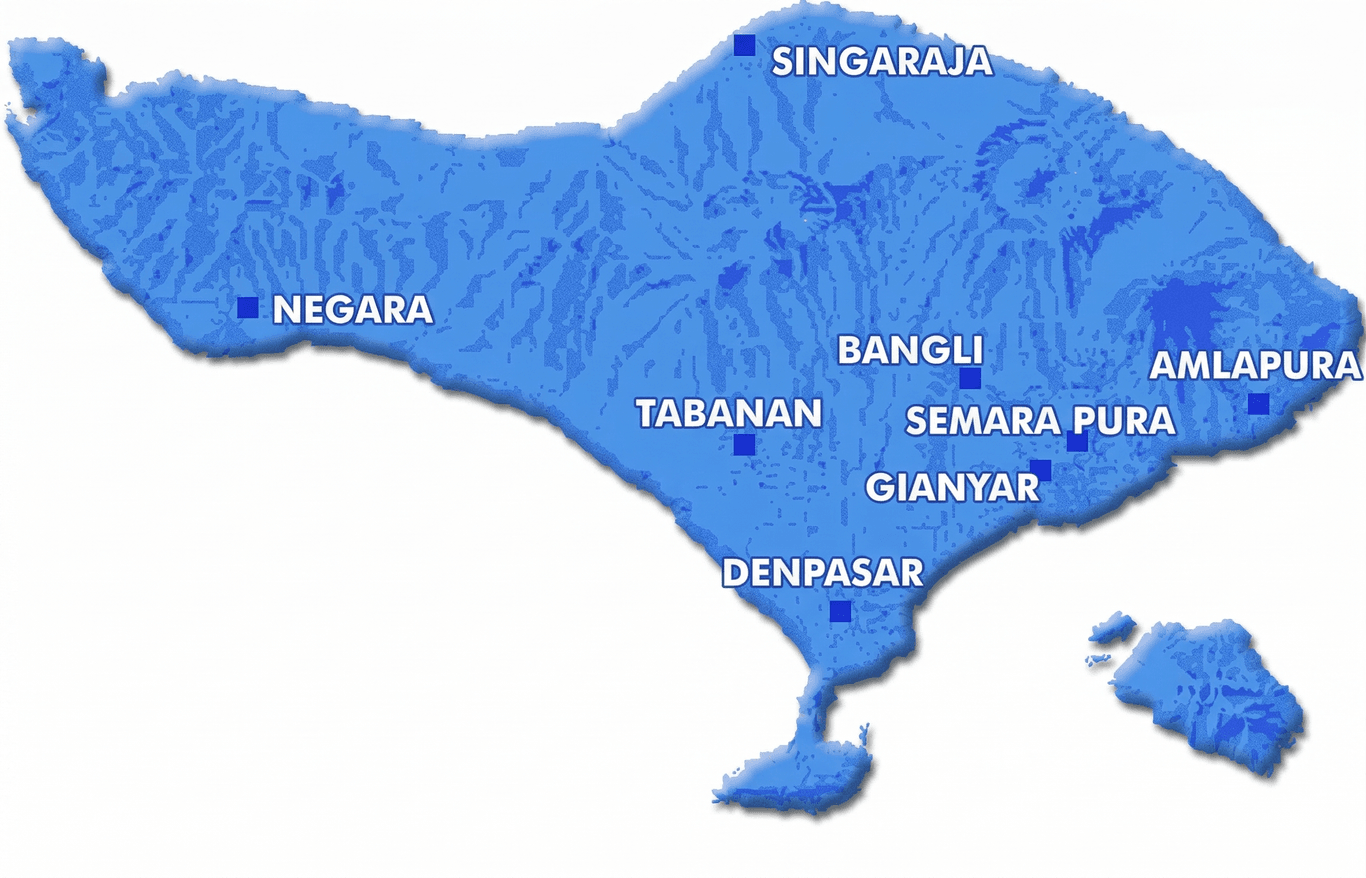
If we exclude the international Gregorian calendar, Balinese people, unlike other Indonesians, mainly use two calendars that work in perfect symbiosis:
- The Saka calendar, also called the Sasih Cycle or Çaka, of Hindu origin, which governs agricultural cycles.
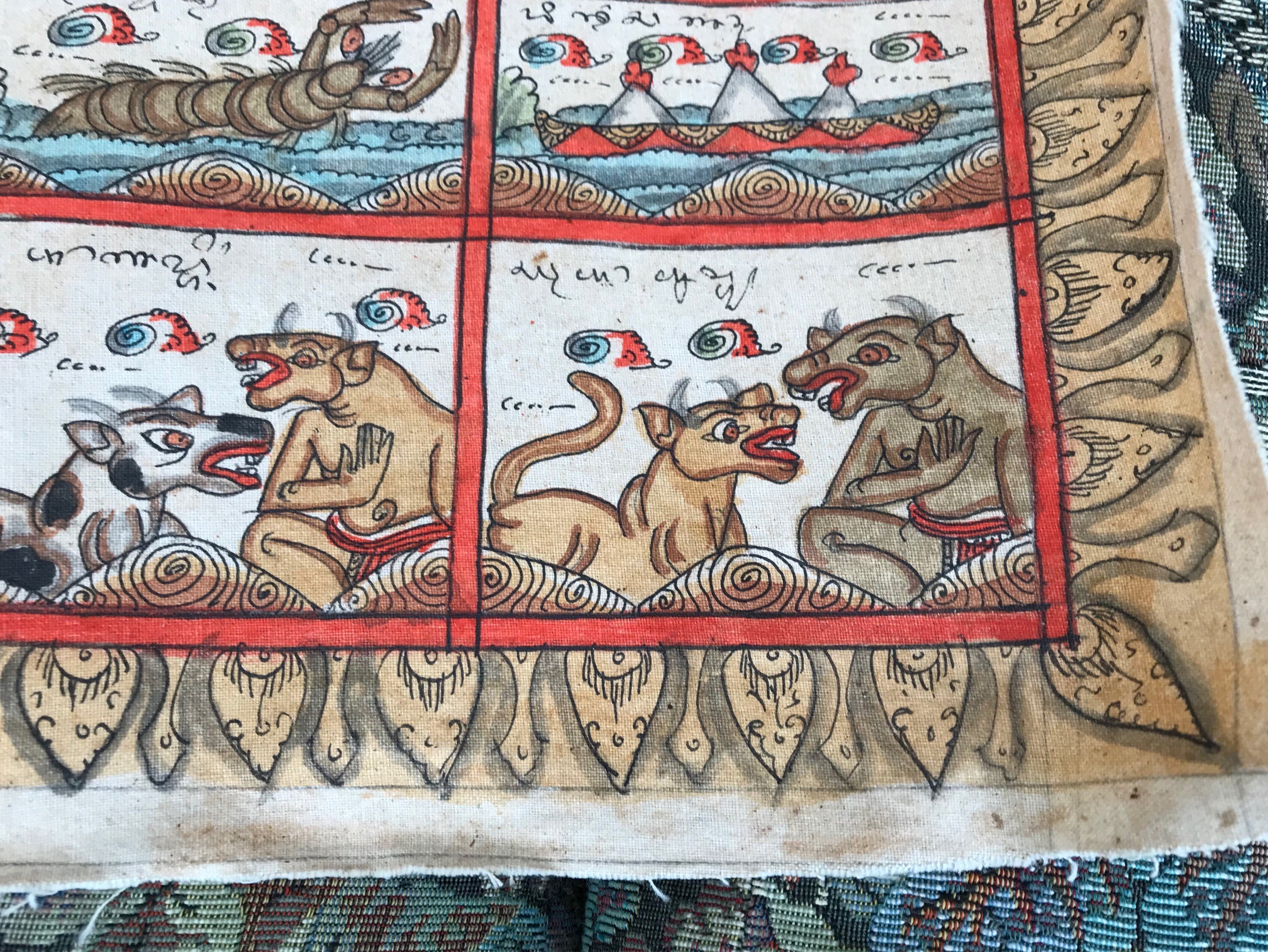
- The Wuku calendar, or Pawukon, to which the Balinese are especially attached.
1) The Saka calendar
The Saka calendar, used in India and Pakistan, is divided into lunar months (Sasih) but also takes the tropical year into account. Let us see how.
To start with, it began in the year 78 CE: Saka year 1901 began on 29 March 1979.
It is built around 12 Sasih months of 30 days each.
| Month | Name | Month | Name |
|---|---|---|---|
| 1 | Kasa | 7 | Kepitu |
| 2 | Karo | 8 | Kaulu |
| 3 | Ketiga | 9 | Kesanga |
| 4 | Kapat | 10 | Kedasa |
| 5 | Kelima | 11 | Desta or Jiyestha |
| 6 | Kenem | 12 | Sada |
A lunar month starts on the day after the new moon, called Tilem (the full moon is called Purnama).
The first 15 days of the waxing moon are called Tanggal. They are shown in red on calendars.
The next 15 days of the waning moon are called Penanggal. They are shown in black on calendars.
Years are numbered. Since the calendar starts in 78 CE, the year 2002, for example, is Saka year 1924 (2002 - 78 = 1924).
We have seen that the Saka calendar also aims to stay aligned with the tropical year. Yet, as shown on the Astronomy page, a lunation lasts about 29.5 days.
To correct this gap, the Saka calendar provides that every 63 days, one solar day “contains” two lunar days. In other words, one lunar month then corresponds to 29 solar days.
That day, which contains two lunar days, is called Pangunalatri and includes two lunar dates. It always falls on a Tuesday (it was a Wednesday before 01/01/2000).
That solves the monthly correction. We still need to address year length. A civil year lasts 365 or 366 days, while a “lunar year” lasts 354 days, almost 10 days fewer.
What better way to correct this drift than to add 30 days (one month) every three years?
This month is added after the 12th month in a common year and after the 11th month in a leap year. Its name is the name of the month to which it is added, preceded by Nampih (Nampih Desta or Nampih Jiyestha in common years, and Nampih Sada in leap years). Saka New Year: This is the first day of the 10th lunar month (Kedasa), and it is called Nyepi (Day of Silence). It is a day of rest, prayer and silence when everyone stays at home. Celebrations take place the day before, which is the last day of the previous year. This day usually falls in March.
Given the position of New Year, year numbering works as follows: if the date considered in the Saka year is before Nyepi, subtract 79; otherwise, subtract 78.
2) The Wuku or Pawukon calendar
Can we really call it a calendar when a system merely counts days cyclically, without numbering cycles and without a beginning? Personally, I do not think so.
Still, because of its originality, this “calendar” is worth looking at.
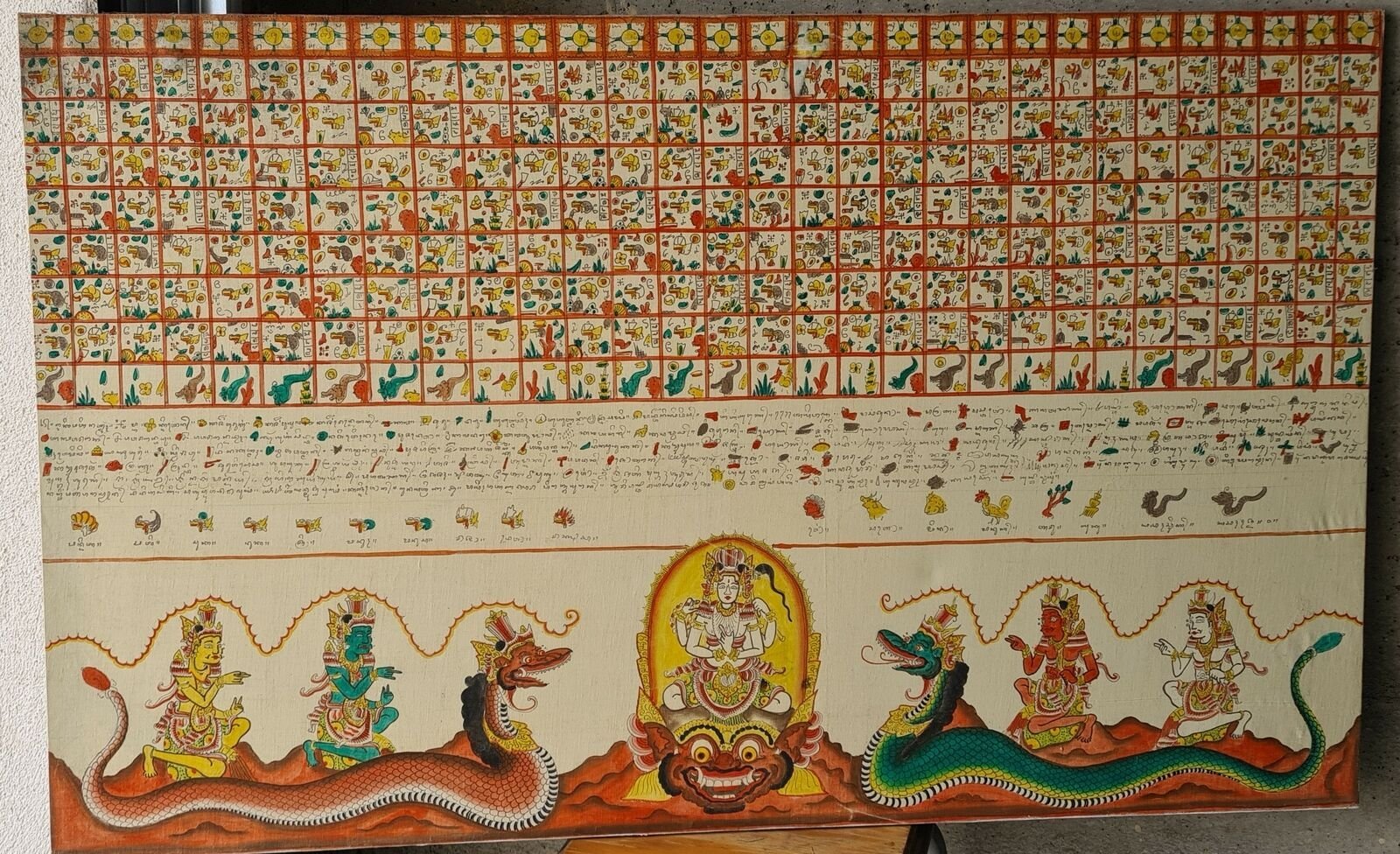
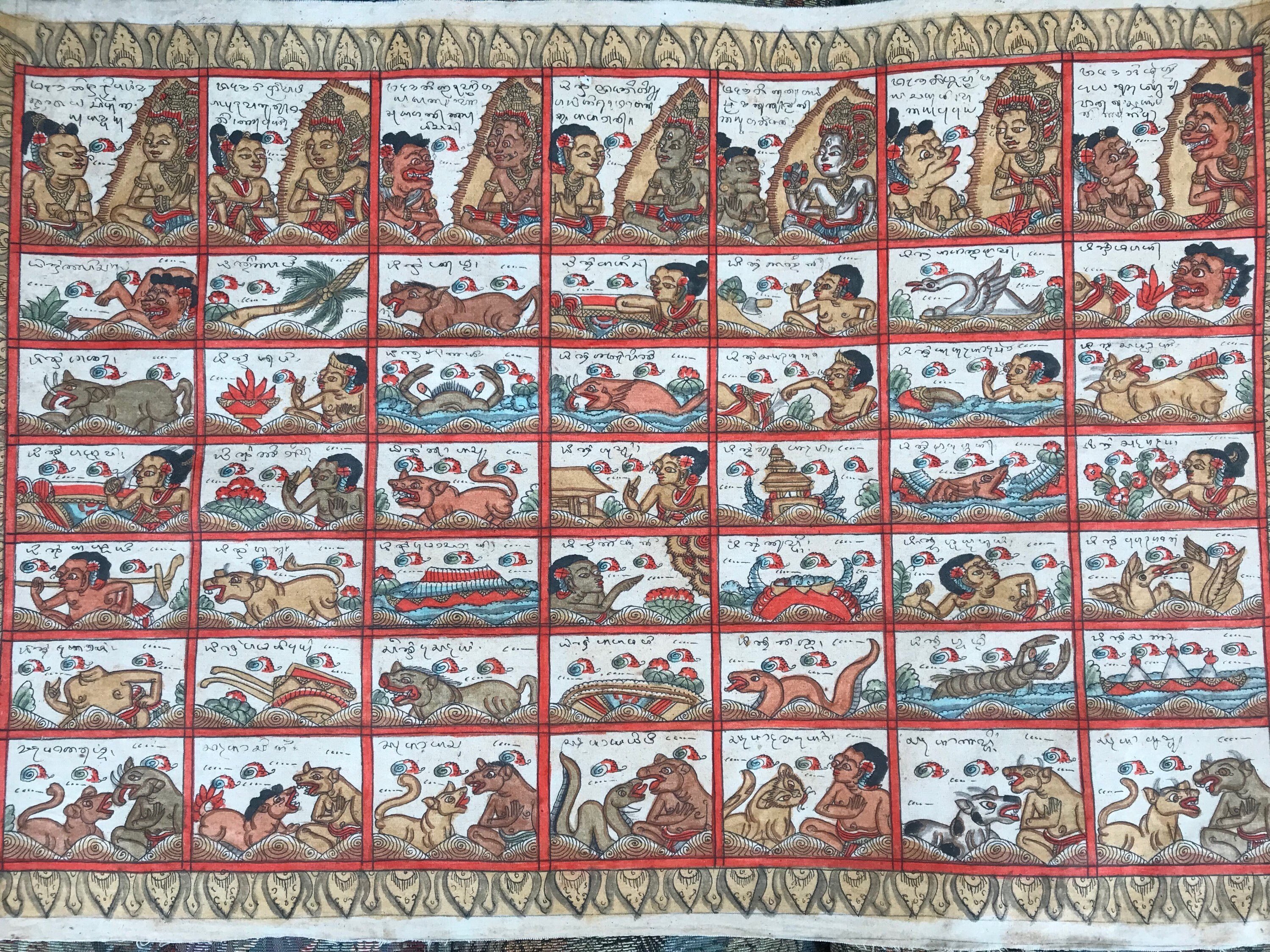
The Pawukon calendar is based on a 210-day cycle.
This cycle is divided into several “weeks” whose lengths vary from 1 to 10 days.
Each day of each week has its own name, and the seven-day weeks (30 weeks) also have their own names.
Here are the names of the 30 seven-day weeks:
| Wk. | Name | Wk. | Name | Wk. | Name | Wk. | Name | Wk. | Name |
|---|---|---|---|---|---|---|---|---|---|
| 1 | Sinta | 7 | Wariga | 13 | Langkir | 19 | Tambir | 25 | Bala |
| 2 | Landep | 8 | Warigadian | 14 | Medangsia | 20 | Medangkungan | 26 | Ugu |
| 3 | Ukir | 9 | Julungwangi | 15 | Pujut | 21 | Matal | 27 | Wayang |
| 4 | Kulantir | 10 | Sungsang | 16 | Pahang | 22 | Uye | 28 | Kelawu |
| 5 | Taulu | 11 | Dunggulan | 17 | Krulut | 23 | Pujut | 29 | Dukut |
| 6 | Gumbreg | 12 | Kuningan | 18 | Merakih | 24 | Prangbakat | 30 | Watugunung |
The following table gives day names according to the number of days in the week. Note that the one-day week actually contains two days, one of which has no name.
The 10 different week systems also have names: Sanskrit number + Wara, meaning “week”.
| W 1 d | W 2 d | W 3 d | W 4 d | W 5 d | W 6 d | W 7 d | W 8 d | W 9 d | W 10 d | |
|---|---|---|---|---|---|---|---|---|---|---|
| Ekawara | Dwiwara | Triwara | Caturwara | Pancawara | Sadwara | Saptawara | Astawara | Nawawara | Dasawara | |
| 1 | Luang | Menga | Pasah | Sri | Umanis | Tungleh | Redite | Sri | Dangu | Pandita |
| 2 | 1 | Pepet | Beteng* | Laba | Paing | Ariang | Coma | Indra | Jangur | Pati |
| 3 | 1 | 1 | Kajeng | Jaya | Pon | Urukang | Anggara | Guru | Gigis | Suka |
| 4 | 1 | 1 | 1 | Menala | Wagé | Paniron | Buda | Yama | Nohan | Duka |
| 5 | 1 | 1 | 1 | 1 | Kliwon | Was | Wraspati | Ludra | Ogan | Sri |
| 6 | 1 | 1 | 1 | 1 | 1 | Maulu | Sukra | Brahma | Erangan | Manuh |
| 7 | 1 | 1 | 1 | 1 | 1 | 1 | Saniscara | Kala | Urungan | Manusa |
| 8 | 1 | 1 | 1 | 1 | 1 | 1 | 1 | Uma | Tulus | Eraja |
| 9 | 1 | 1 | 1 | 1 | 1 | 1 | 1 | 1 | Dadi | Dewa |
| 10 | 1 | 1 | 1 | 1 | 1 | 1 | 1 | 1 | 1 | Raksasa |
* Beteng is also called Pekenan
Days are named by giving the day name from the seven-day week and the week name. Example: Sukra Ugu. Balinese people often add the day name from the five-day week. In that case, our example becomes Sukra Umanis d'Ugu.
How do we distribute the different days of the different weeks across a 210-day cycle?
What you should not do is take the table above and complete it by cycling the weeks up to 210 lines.
Indeed, on one hand, the distribution of certain days in one week depends on the distribution in another week. On the other hand, since 210 divided by 4, 8 or 9 does not yield an integer, we need to add intercalary days for the 4-, 8- and 9-day weeks.
Weeks that can be cycled as they are: 3-, 5-, 6- and 7-day weeks. Just take the table above and lay out the days continuously (example: five-day week Umanis....Kliwon, Umanis....Kliwon).
“Calculated” weeks: 1-, 2- and 10-day weeks. To calculate day positions, we will “index” the days in the 5-, 7- and 10-day weeks.
| Five-day week | INDEX | Seven-day week | INDEX | Ten-day week | INDEX | Pancawara | Saptawara | Dasawara |
|---|---|---|---|---|---|
| Umanis | 5 | Redite | 5 | Pandita | 1 |
| Paing | 9 | Coma | 4 | Pati | 2 |
| Pon | 7 | Angarra | 3 | Suka | 3 |
| Wagé | 4 | Buda | 7 | Duka | 4 |
| Kliwon | 8 | Wraspati | 8 | Sri | 5 |
| 1 | 1 | Sukra | 6 | Manuh | 6 |
| 1 | 1 | Saniscara | 9 | Manusa | 7 |
| 1 | 1 | 1 | 1 | Eraja | 8 |
| 1 | 1 | 1 | 1 | Dewa | 9 |
| 1 | 1 | 1 | 1 | Raksara | 0 |
And now, let us place our days:
- One-day week: if the seven-day week index + the five-day week index gives an odd number, the day name in the one-day week is Luang. Otherwise, the day name is blank.
- Two-day week: if seven-day index + five-day index = even number, the day is Menga.
- Ten-day week: add the seven-day week index and the five-day week index. Add 1 to the result. Divide this new result by 10. The remainder gives the day index in the ten-day week.
Finally, let us place the intercalary days for the 4-, 8- and 9-day weeks.
- 4- and 8-day weeks: insert two days at the beginning of the eleventh week (Dungullan): two Jaya for the 4-day week and two Kala for the 8-day week. These two weeks will therefore have three consecutive days with the same name.
- 9-day week: at the beginning of the cycle (week 1 Sinta), add Dangu three times, resulting in four consecutive Dangu days.
For those who want to build a Pawukon calendar, note that a cycle started on 10/02/2002.
Why such a 210-day cyclic calendar with so many weeks?
I think you would have to be Balinese to give a definite answer. Everything is an opportunity to celebrate in Bali. They hold festivals for the gods, for professions, or for one of the 20,000 temples found on the island. Each temple is celebrated once a year. Perhaps this festival fervor is where the need for the Pawukon calendar comes from.
We would go far beyond the scope of a calendar study if we tried to list every festival in Bali. So we will focus on a few examples to illustrate the usefulness of the Pawukon calendar.
One thing that stands out is that the most commonly used weeks are the 3-, 5- and 7-day weeks. For example, the last day of the 3-day week (Triwara) is market day in villages.
Also, some combinations of day names from two weeks are remarkable enough to have a specific name. They mark special festivals or celebrations. For example, an important Hindu festival occurs when Anggara (7-day week) coincides with Kliwon (5-day week): that day is called Anggar Kasih.
There can also be a combination of a specific day (born from the combination of two notable dates in weeks of different lengths) and a specific week.
For example, the pair Saniscara-Kliwon (7-day week - 5-day week) is called Tumpek.
There are 6 Tumpek in the 210-day cycle.
From the combination of that day with a week name, another day name is formed: for example, the day when Tumpek falls in week 7 (Wariga) is called Tumpek Uduh and is dedicated to caring for coconut trees.
Other major festivals: Galungan (Buda in the 7-day week, Kliwon in the 5-day week, week 11 Dunggulan): on that day, ancestors and all deities visit the living. Celebrations last 10 days and end on Kuningan (Saniscara in the 7-day week, Kliwon in the 5-day week, week 11 Kuningan).
I hope these few examples will make you want to look up festival and celebration dates in Bali, online or elsewhere.