A little history
Let us begin with a chronology of India (up to independence) so we can place ourselves in time. In the calendar column, you will find the names of the different texts underpinning the design of the various calendars.
| Dates | Events | Calendar |
|---|---|---|
| 3rd millennium | Indus civilization | |
| 2,000 to 1,500 BC | Aryan invasion of the Indian subcontinent | Around 1500 BC: writing of the Vedas, which contain astronomical references. The Vedas consist of four collections: - Rig - Yajus - Sava - Atharva Around 300-200 BC: appearance of the VEDANGAS (six disciplines to be studied in order to understand the Vedas). One of them deals with astronomy: JYOTISHA around AD 700-900: SURYA SIDDHANTA. The Hindus’ astronomical reference text, said to have been revealed by the Sun (Surya) |
| 599 - 527 BC | life and death of Mahavira, founder of Jainism | |
| 563 - 483 BC | life and death of Sakya-Muni (Siddharta), the Buddha | |
| 518 - 515 BC | Darius’s Persians reach the Indus | |
| 326 BC | Alexander the Great enters India | |
| 325 BC | Alexander leaves India, leaving Greek garrisons behind | |
| 320 BC | Chandragupta Maurya drives out the Macedonians and founds the Maurya dynasty (320 - 184 BC) | |
| 273 - 232 BC | Ashoka, great Indian emperor. Peak of the Maurya dynasty. India’s golden age. Ashoka converts to Buddhism. | |
| 185 BC - AD 500 | India’s Middle Ages | |
| 1st and 2nd centuries BC | Greek kingdoms of Bactria and Punjab | |
| AD 455 - 500 | the Huns invade India | |
| 712 | the Arabs occupy Sind, a province in the north of the kingdom (southern present-day Pakistan) | |
| 712 - 1000 | Muslim raids in India | |
| 1008 | Mahmud of Ghazni, an Afghan Muslim, devastates northern India | 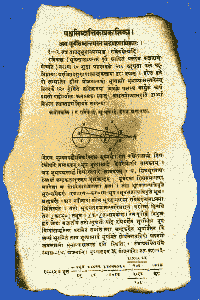 Extract from *Pancha-siddhantika*, dating from the 5th century |
| 800 - 1400 | Rajput kingdoms | |
| 1,192 | occupation of North India by Muslims. Delhi becomes the capital of the Muslim empire independent from India | |
| 1193 - 1526 | rule of the Delhi Sultanate | |
| 1288 - 1293 | Marco Polo crosses India | |
| 1398 | the Turk Tamerlane sacks Delhi | |
| 1469 - 1538 | life and death of Nanak, founder of Sikhism, then a non-violent doctrine | |
| 1498 | Vasco da Gama lands off Calicut, on the Malabar Coast | |
| 1510 | the Portuguese occupy Goa | |
| 1526 | foundation of the Mughal Empire by Babur (1483 - 1530), descendant of Tamerlane; later expanded by his grandson Akbar. The capital is Delhi | |
| 1556 - 1605 | reign of Akbar “the Great” | |
| 1569 | foundation of Fatehpur Sikri, Akbar’s new capital | |
| 1600 | opening of English trading posts on the western and eastern coasts | |
| 1628 - 1658 | Shah Jahan, “Great Mughal” in Western terminology | |
| 1631 | death of Mumtaz Mahal, wife of Shah Jahan | |
| 1639 | foundation of Madras by the English | |
| 1664 | the English found the East India Company | |
| 1707 | end of the Mughal Empire. Fragmentation of the country: local Muslim and Hindu rulers | |
| 1742 - 1754 | Dupleix founds the French Empire in India | |
| 1763 | end of the Franco-British war. British supremacy | |
| 1857 - 1858 | Sepoy revolt: major rebellion against British rule. Territories occupied by East India Company troops pass under British control. The Mughal ruler bows to the British. | |
| 1869 | birth of Gandhi | |
| 1877 | Queen Victoria becomes Empress of India | |
| 1885 | creation of the Indian National Congress, an opposition movement to British rule | |
| 1911 | King George V transfers the capital of British India from Calcutta to New Delhi | |
| 1915 | Gandhi returns from South Africa | |
| 1920 | Gandhi advocates non-violent struggle against the British | |
| 1930 | civil disobedience movement, with Gandhi | |
| 1942 | Gandhi launches the “Quit India” campaign | |
| 1947 | India’s independence is proclaimed on 15 August. Jawaharlal Nehru becomes Prime Minister. The former British Empire splits into two states: the Republic of India and the Islamic Republic of Pakistan. |
Calendars
No doubt about it: here we are studying Hindu calendars in the plural. In 1953, Nehru counted 30 calendars in India.
Why such a multitude?
First, because many religions coexist in India, each with its own calendar. In this study, however, we will limit ourselves to calendars that are purely Indian by design. Even so, this will probably be the most complex study of all the pages on this site.
Second, because different types of calendars coexist (solar and lunisolar), with many variants caused by multiple reference texts (Veda or Surya Siddhanta), different astronomical calculation methods (old or modern), different month names, many possible New Year dates, many ways to intercalate additional months, countless eras, and so on.
Still, let us try to bring clarity to all these versions and proceed logically.
We will examine old calendars first, then modern calendars. We will call “old” those calendars whose sources are the Vedas and the Vedangas, and “modern” those whose source is the Surya Siddhanta.
One thing is certain for all calendars in India: they are ASTRONOMICAL calendars. If we group calendars into two categories, arithmetic and astronomical, Indian calendars belong to the second category. Our Gregorian calendar is arithmetic (or calculated): the year has 365 or 366 days, the number of days in each month is known in advance, we know where leap day falls, etc.
Astronomical calendars, by contrast, depend entirely on astronomical events that are observed (or astronomically calculated): position of a celestial body (star, planet, moon, sun...) or conjunction between these bodies at a given moment. Depending on the period, either true values or mean values are used.
Ancient Vedic-era calendars
In the Rigveda texts, there is mention of a 360-day calendar divided into 12 months of 30 days.
The month is divided into two parts: krsna (waning moon) and shukla (waxing moon). The new moon is called amavasya and the full moon purnimas.
Although the notions of intercalary month and cycle are only truly explained in the Jyotisha Vedanga, they seem to have been known much earlier.
Indeed, there is a five-year cycle called Yuga, in which each of the five years has a specific name. Two of these years are already found in Rigveda texts. It is therefore very likely that the intercalary month was known too.
The names of the five years in the cycle vary slightly from one text to another: samvatsara, parivatsara, idavatsava, iduvatsara (or idvatsara) and vatsara.
Intercalary months are explicitly mentioned in Brahmanas and Mahabharta texts.
The Jyotisha Vedanga gives more information about Yuga, the five-year cycle. This cycle consists of 62 candramashas (synodic months), 1,830 days and 1,860 tithis (1/30 of a synodic month), and begins at the winter solstice. There are two intercalary months in one Yuga: samvatsara and parivatsara.
The year had two major divisions: uttarayana (sunrises shift northward toward the winter solstice) and daksinayana (sunrises shift southward toward the summer solstice).
The year was also divided into three periods of four months, themselves divided into two seasons. So we end up with six seasons, listed in the table below. I have also added the month names of these ancient Vedic calendars and the Sanskrit names of the same months as designated in the Jyotisha Vedanga.
| Month no. | “Vedic” name | Season | “Sanskrit” month | Gregorian |
|---|---|---|---|---|
| 1 | Madhu | Vasanta (spring) | Chaitra | mid-March to mid-April |
| 2 | Madhava | Vaisakha | mid-April to mid-May | |
| 3 | Sukra | Grisma (hot season) | Jyaishtha | mid-May to mid-June |
| 4 | Suci | Ashadha | mid-June to mid-July | |
| 5 | Nabhas | Varsa (rains) | Sravana | mid-July to mid-August |
| 6 | Nabhasya | Bhadrapada | mid-August to mid-September | |
| 7 | Isa | Sharad (autumn) | Asvina | mid-September to mid-October |
| 8 | Urja | Karttika | mid-October to mid-November | |
| 9 | Sahas | Hemanta (winter) | Margasirsha | mid-November to mid-December |
| 10 | Sahasya | Pausha | mid-December to mid-January | |
| 11 | Tapas | Shishira (dew season) | Magha | mid-January to mid-February |
| 12 | Tapasya | Phalguna | mid-February to mid-March |
These “ancient” calendars were most certainly arithmetic and based on calculated mean values.
Modern calendars
We now reach the most interesting - and perhaps the most complex - part of Indian calendars: modern calendars, meaning those whose construction rules are found in Surya Siddhanta texts dating from AD 700-900.
Since the structure is clear and logical, we will split this study into two parts: solar calendars and lunisolar calendars.
1) Solar calendars
From now on, the calendar is no longer built on arithmetic computation. It is built on astronomical calculations and observations. We will also see the problems this entails.
If we remember the site’s astronomy page, we know there are several types of solar years. Two of them matter for the Indian calendar: the sidereal year, leading to a nirayana system, and the tropical year, generating a sayana system.
The solar calendar based on the sidereal or nirayana system is the traditional solar calendar used by four “dominant schools”, each with its own rules.
The solar calendar based on the tropical or sayana system is the official civil solar calendar, born from a desire to standardize calendars (which was the least that could be done!) by the Calendar Reform Committee created in November 1952. We will come back to this national calendar, introduced on 22 March 1957. But first, let us look at the traditional nirayana solar calendar and its variants.
I did say this study would be complicated. No panic, let us keep breaking it down.
1-a) Traditional solar calendars
These calendars concern the regions or states shown on the map below.
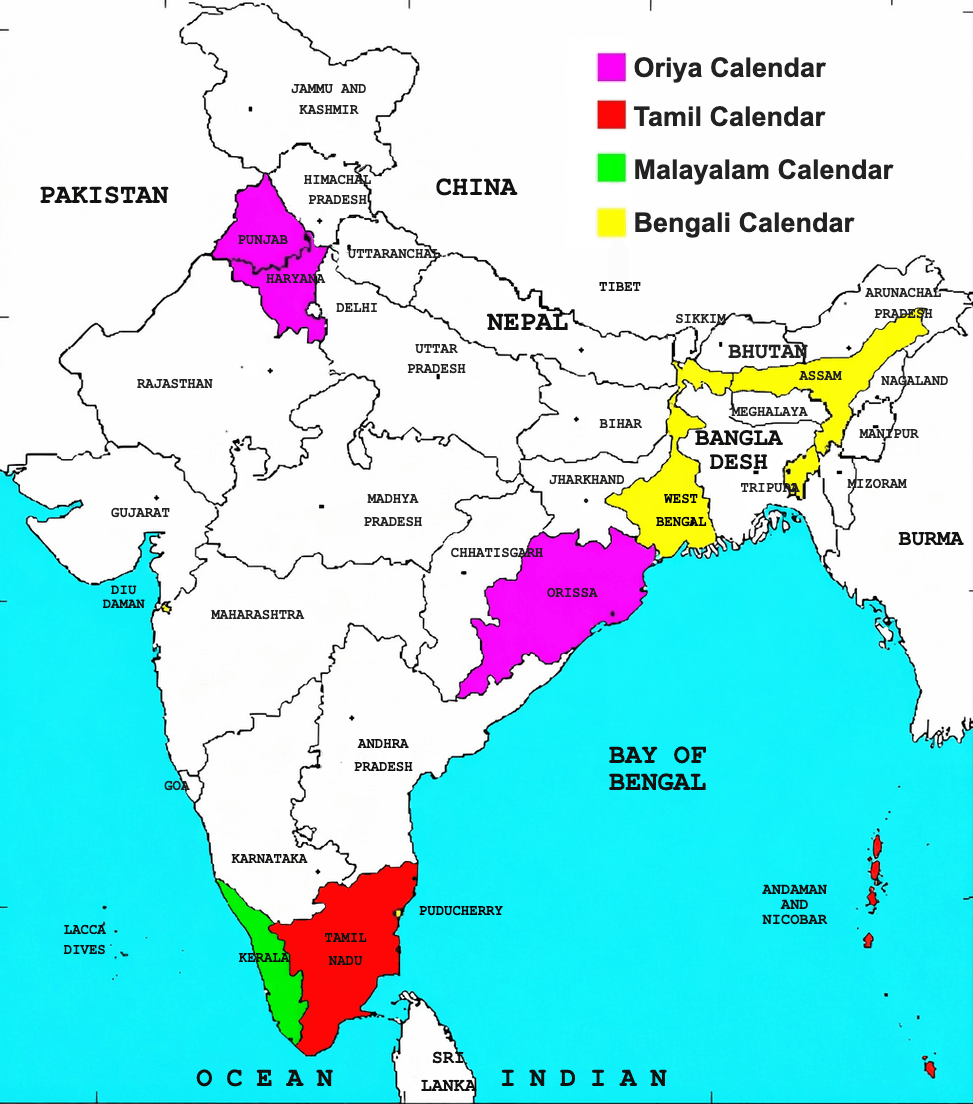
These maps are based on a study by Leow Choon Lian, student of Professor Helmer Aslaksen in the mathematics department of the Faculty of Science at the University of Singapore. After cross-checking, this study also inspired the text on these pages about the Indian calendar. Many thanks to Professor Helmer Aslaksen for the consistently high quality of his texts and those of his students.
Let us immediately clarify that a solar day (vasara or panchang) runs from one sunrise to the next.
The year
The year is a sidereal year. For those who may have forgotten, here is the principle: it is the duration of one Earth revolution around the Sun, i.e. the time from when a supposedly fixed star, the Sun and the Earth are aligned to when all three return to the same position. The average sidereal year is about 365 days, 6 hours, 9 minutes and 12.96 seconds, i.e. 365.2564 days. So it is about 20 minutes longer than the tropical year.
In the traditional Hindu solar calendar, the fixed point to consider is defined in Surya Siddhanta: it is the point directly opposite the bright star Chitra (Spica in Virgo, or for astronomers alpha Vir, HR5056). Chitra’s longitude from this point is therefore 180°. In AD 285 this point matched the spring equinox. Due to the precession of the equinoxes, it is now about 23°50 from the initial point.
The duration of the nirayana year defined in Surya Siddhanta was 365.258756 days, which is 3'27 longer than current measurements.
On this subject, there are two schools (yes, another one!) for calculating Hindu panchang (or panjika). The panchang is a kind of almanac containing information about festivals, as well as astronomical and astrological data. The modern school uses modern astronomical calculation methods, while the “old hard-line school” sticks to the rules laid down in Surya Siddhanta. Fortunately, the old school seems increasingly inclined to adopt modern methods.
Solar months
The ecliptic is divided into 12 equal 30° sectors, identical to the Babylonians’ zodiac signs. Each sector is called a rasi. The Sun’s entry into a rasi is called samkranti, and the first samkranti obviously corresponds to the beginning of the nirayana year.
A month’s length corresponds to the time the Sun takes to move from one samkranti to the next, and therefore to cross one full rasi. In most solar calendars, the month takes the name of the rasi crossed by the Sun. But here too there are variants. Month length is determined by astronomical calculation and varies because Earth’s orbit is elliptical.
Before going further, let us look at average month lengths, month names, and the names of the rasi.
| Rasi | Latin | Month name in most calendars | Tamil month name * | Malayalam month name | Average duration | Western calendar |
|---|---|---|---|---|---|---|
| Mesha | Aries | Vaisakha | Chittirai | Mesha | 30.9 | April-May |
| Vrisha | Taurus | Jyaistha | Vaikasi | Vrisha | 31.4 | May-June |
| Mithuna | Gemini | Ashadha | Ani | Mithuna | 31.6 | June-July |
| Karkata | Cancer | Sravana | Adi | Karkata | 31.5 | July-August |
| Simha | Leo | Bhadrapada | Avani | Simha | 31.0 | August-September |
| Kanya | Virgo | Asvina | Purattasi | Kanya | 30.5 | September-October |
| Tula | Libra | Kartika | Arppisi | Tula | 29.9 | October-November |
| Vrischika | Scorpio | Agrahayana Margasirsha | Karthigai | Vrischika | 29.5 | November-December |
| Dhanus | Sagittarius | Pausha | Margali | Dhanus | 29.4 | December-January |
| Makara | Capricorn | Magha | Thai | Makara | 29.5 | January-February |
| Kumbha | Aquarius | Phalguna | Masi | Kumbha | 29.8 | February-March |
| Mina | Pisces | Chaitra | Panguni | Mina | 30.3 | March-April |
* Note that the Tamil calendar has its own specific features, which we will examine later. The months highlighted in yellow are the first months of the year.
In practice, Hindus assign an integer length to months: if the decimal part of the duration is greater than or equal to 0.5, the month has a number of days equal to the integer part + 1.
A month can therefore have between 29 and 32 days.
There are several rules, depending on the calendar type, for setting the day that starts a month. Here are the four main ones:
- Rule for the Oriya calendar: the solar month starts on the same day as the samkranti.
- Rule for the Tamil calendar: the solar month starts on the same day as the samkranti if the samkranti occurs before sunset on that day. Otherwise, it starts the next day.
- Rule for the Malayalam calendar: the solar month starts on the same day as the samkranti if the samkranti occurs before aparahna on that day. Otherwise, it starts the next day. Aparahna is the time located at 3/5 of the interval between sunrise and sunset.
- Rule for the Bengali calendar: if the samkranti occurs between sunrise and midnight on day J, the month starts on J+1; otherwise, the month starts on J+3. This is the general rule, which may be adjusted in specific circumstances.
Whatever rules are used, most years have 365 days. Since the sidereal year is actually 365.2564, the simple calculation 1/(365.2564 - 365) = 3.9002 shows that we will have a 366-day year every four years. Because counting rules differ, these 366-day years do not occur simultaneously in all calendars. Easy to keep track of, right?
1-b) The national solar calendar
This official national calendar was created on 22 March 1957 precisely to put an end to this multiplicity of calendars. Did it succeed? Knowing the strength of tradition, especially when rooted in the sacred, one may doubt it and wonder whether India simply ended up with one more calendar.
Let us look at its features:
- Its era origin is the Saka era, which begins in AD 78.
- The reference year is the tropical year.
- The year starts on the day after the spring equinox. The starting rasi is therefore the one corresponding to the spring equinox. As a result, the first month of the year is Chaitra.
- Month lengths are fixed (except for Chaitra). The five months following Chaitra have 31 days, and the others 30 days.
- There are leap years of 366 days. In those years, Chaitra has 31 days instead of 30.
- Leap-year periodicity is aligned with leap years in the Gregorian calendar.
This gives us the following table:
| Month no. | Name | Length | Start date in the Gregorian calendar |
|---|---|---|---|
| 1 | Chaitra | 30 or 31 | 21 or 22 March |
| 2 | Vaisakha | 31 | 21 April |
| 3 | Jyaishtha | 31 | 22 May |
| 4 | Ashadha | 31 | 22 June |
| 5 | Sravana | 31 | 23 July |
| 6 | Bhadrapada | 31 | 23 August |
| 7 | Asvina | 30 | 23 September |
| 8 | Kartika | 30 | 23 October |
| 9 | Agrahayana or Margasirsha | 30 | 22 November |
| 10 | Pausha | 30 | 22 December |
| 11 | Magha | 30 | 21 January |
| 12 | Phalguna | 30 | 20 February |
I suggest we continue our study of Hindu calendars by examining, in sequence:
- lunar calendars
- the Indian week
- the various cycles
- the many eras
- festivals and celebrations.
Note: both pages have been merged into one; below is the second page.
2) Lunisolar calendars
From this point onward, calendars are no longer built on arithmetic computations. They are built on astronomical calculations and observations. We will also see the issues this creates.
As in every lunisolar calendar, the moon is the basic unit: the year consists of 12 lunar months. Since 12 lunar months are not equal to one solar year, an additional month is intercalated from time to time.
A month is therefore the interval of time the moon needs to return to the same state x days later.
Among its phases, the moon has two especially noticeable ones: full moon and new moon.
Given the variety of Indian calendars, we should have expected that some define the lunar month from new moon to next new moon and others from full moon to next full moon. Exactly so.
So we will study two major types of Indian lunisolar calendars:
- The amanta calendar, where the month begins at new moon.
- The purnimanta calendar, where the month begins at full moon.
2-a) Amanta calendars (or mukhyamana)
These calendars concern the regions or states shown on the map below.
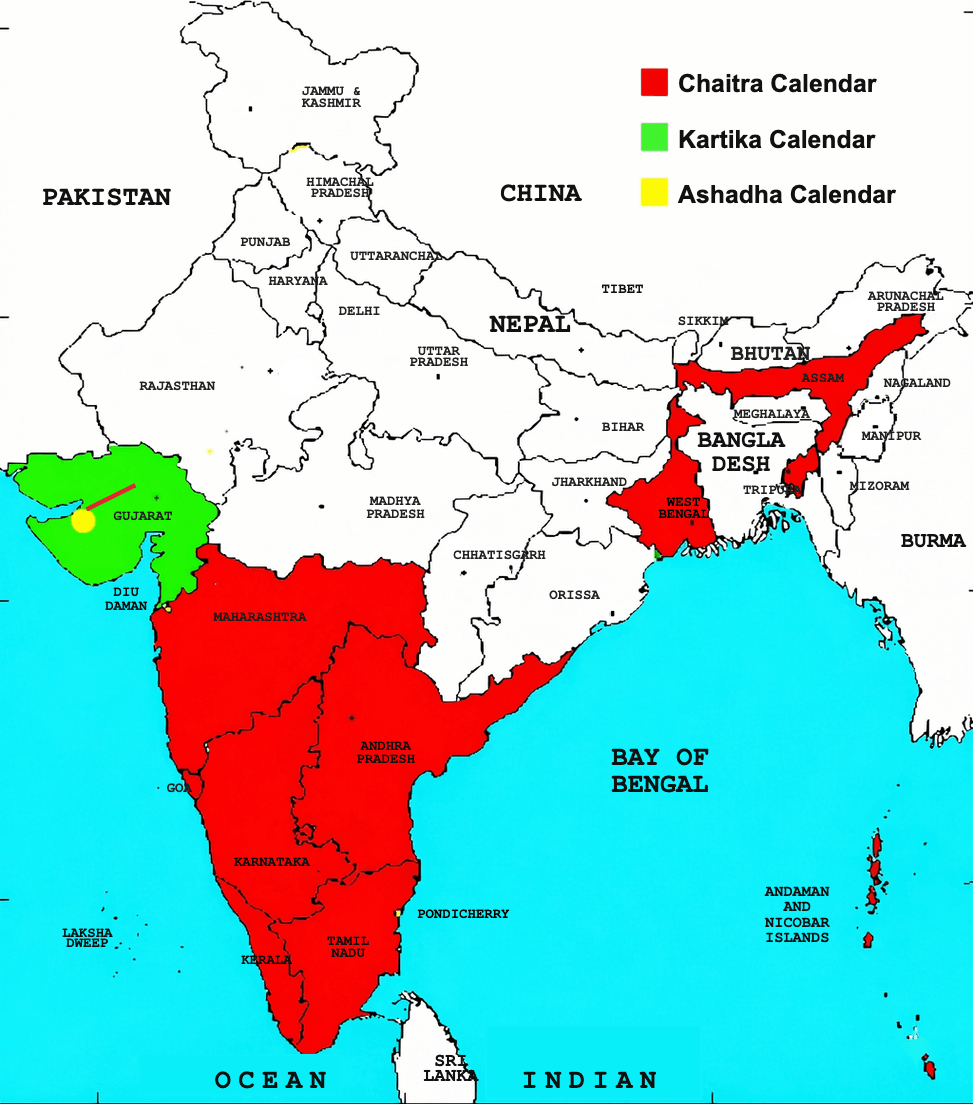
Each month in the amanta calendar has an integer number of days.
The calendar is designed to stay in phase with the nirayana year.
For this, the amanta lunar month generally takes the name of the solar month in which its first day falls. The relevant solar month begins exactly when it enters its samkranti and ends when it reaches the next samkranti.
As expected, there are variants. They concern both the name of the month that starts the year and the beginning of the era. The following table summarizes these variants:
| “Chaitra” calendar | “Kartika” calendar | “Ashadha” calendar | ||
|---|---|---|---|---|
| Months | 1 | Chaitra | Kartika | Ashadha |
| 2 | Vaisakha | Agrahayana or Margasirsha | Sravana | |
| 3 | Jyaishtha | Pausha | Bhadrapada | |
| 4 | Ashadha | Magha | Asvina | |
| 5 | Sravana | Phalguna | Kartika | |
| 6 | Bhadrapada | Chaitra | Agrahayana or Margasirsha | |
| 7 | Asvina | Vaisakha | Pausha | |
| 8 | Kartika | Jyaishtha | Magha | |
| 9 | Agrahayana or Margasirsha | Ashadha | Phalguna | |
| 10 | Pausha | Sravana | Chaitra | |
| 11 | Magha | Bhadrapada | Vaisakha | |
| 12 | Phalguna | Asvina | Jyaishtha | |
| Era * | Saka era (often) Vikrama era (sometimes) | Vikrama era | Vikrama era | |
* For more on eras, see the end of the page.
For the remainder of the amanta calendar section, and for clarity, we will stick to the chaitra calendar. You can adapt what follows to other amanta types.
As already noted, an amanta year (lunar year of 12 lunar months) is shorter than a nirayana year (sidereal solar year). To keep the lunar year aligned with the solar year, one lunar month must periodically be added to the lunar year to “catch up” lost time. This embolismic year therefore has 13 months instead of the usual 12. But how and when do we intercalate this extra month?
Using arithmetic rules in an “astronomical” calendar is out of the question. So no Metonic cycle rule here. Fortunately, indirect astronomical events help solve the problem.
We saw in the first part that solar month lengths vary. We will see later that lunar month lengths vary too. We also saw that a lunar month takes the name of the solar month in which it starts (new moon).
Because solar and lunar months differ in length, it can happen that a solar month fully “contains” a lunar month. Therefore, this solar month “contains” two new moons. Since by rule a solar month should contain only one new moon, this gives us the event we need to insert the famous additional month:
The amanta month beginning with the first new moon contained in that solar month is treated as the additional month, and its name gets the prefix adhika (or mala). The month after this “special” month is the regular month and its name gets the prefix suddha (or Nija).
Example: solar month Vaisakha contains two new moons N1 and N2. The third new moon N3 falls in the next solar month. The lunar month N1-N2 is called adhika-Vaisakha, and N2-N3 is called suddha-Vaisakha.
This additional month is generally inserted every 2 years and 4, 9, 10 or 11 months, giving an average of 2 years and 8.2 months. A quick calculation over 19 years gives 7 additional months in that period. The Metonic cycle reappears: astronomical calculation meets arithmetic calculation.
Unfortunately, this clever system for naming months and intercalating extra months also creates a drawback for the amanta calendar.
The reverse process can occur: the “double new moon in one solar month” can fail for the three shortest solar months (Agrahayana, Pausha or Magha). A solar month may contain no new moon at all, leaving the lunar month “orphaned” (kshaya for Indians). This is rarer than the adhika event (at intervals of 4, 19, 65, 76, 122, 141 years), but it still requires a solution.
Before discussing solutions, let us clearly state the two issues of double-named months and nameless months:
- For double-named months, this is an opportunity to keep the solar and lunar calendars in phase by adding one month, and secondarily to name that additional month.
- For the nameless month, this is an unwelcome phenomenon that must be solved by naming the orphan month without challenging the principle of a 12-month lunar year.
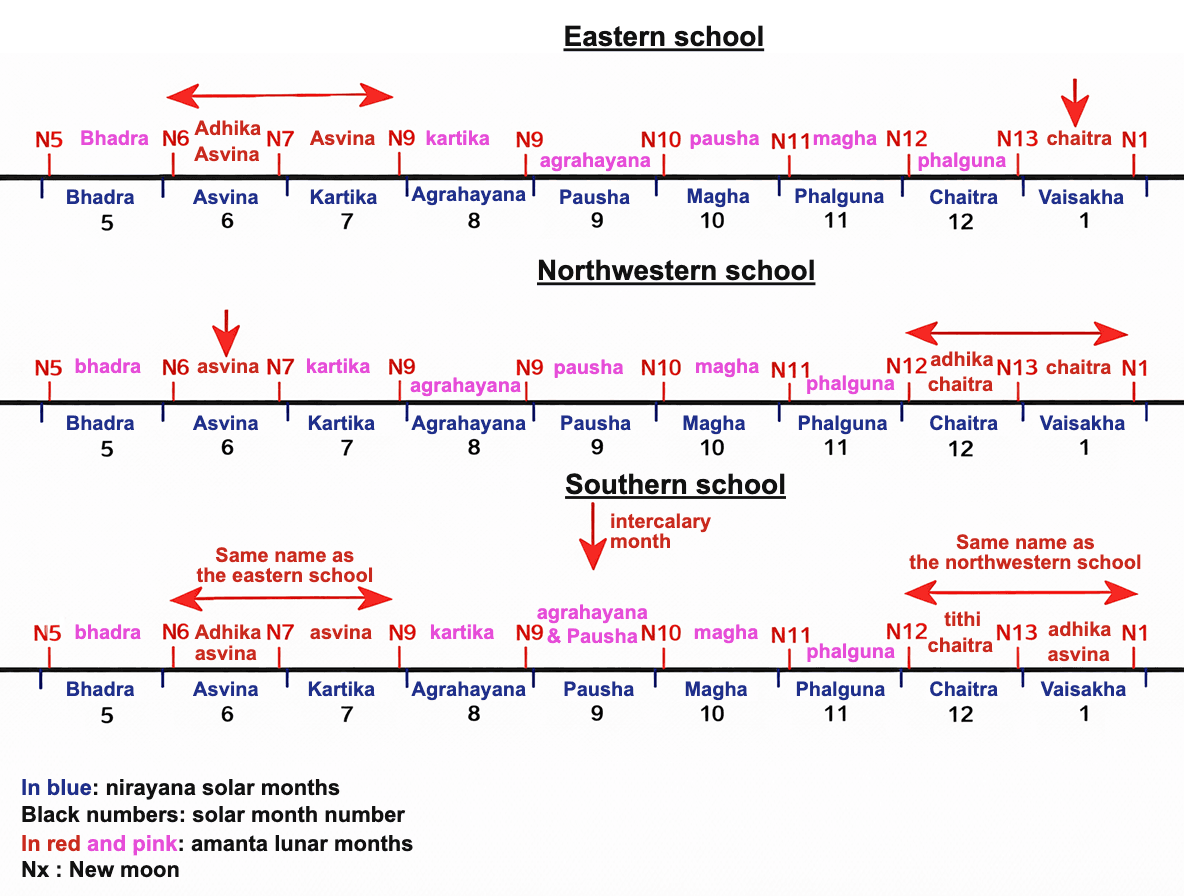
Let us visualize the issue:

In the figure, solar month 9 (Pausha) contains no new moon, so the corresponding lunar month becomes kshaya. It must therefore be given one of the twelve known names.
First, note one thing: month 6 (asvina) and month 12 (chaitra) each contain two new moons.
This is systematic: a kshaya lunar month is always preceded by an adhika month and followed by an adhika month (within a three-month range before and after). This observation leads to the naming solution for the orphan lunar month.
And of course, different schools handle this in different ways:
- “Eastern school” solution: treat the first adhika month as additional and the second as regular.
- “North-western school” solution: treat the first adhika month as regular and the second as additional.
- “Southern school” solution: reconciles both by adopting rules from both schools. Both adhika months are treated as additional months. The amanta month containing two samkranti is considered jugma (double month). Each tithi (we will discuss this below) in this month is doubled. The first half of the tithi is the tithi of the first month of the double month, and the second half is the tithi of the second month. The amanta month before the double month bears the same name as under the eastern school rules, while the amanta month after the double month bears the same name as under the western school rules.
To make this clearer, let us name the months according to these three schools:
Month divisions in the amanta calendar: the tithi
The start and duration of the lunar day (tithi) are based on the longitude difference between the Sun’s position and the Moon’s position.
There are 30 tithis in an amanta month, and one tithi corresponds to the time during which the Moon’s angular distance from the Sun increases by twelve degrees (1/30 of 360°). They are numbered from new moon.
The first 15 tithis make up sukla paksha, corresponding to the waxing period. They are numbered 1 to 15 with S as prefix.
The last 15 tithis make up krishna paksha, corresponding to the waning period. They are numbered 1 to 15 with K as prefix.
Each tithi of sukla paksha and krishna paksha with the same number has the same name, except tithi 15.
| No. | Prefix letter | Name | Moon phases |
|---|---|---|---|
| 1 | S or K | Pratipada | 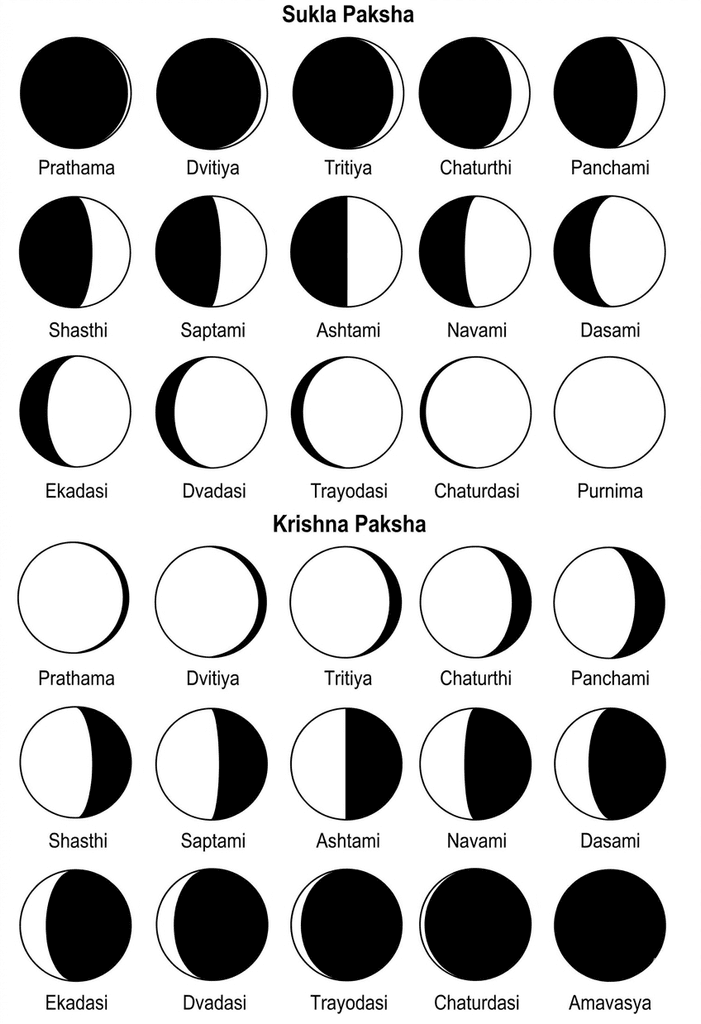 |
| 2 | S or K | Dvitiya | |
| 3 | S or K | Tritiya | |
| 4 | S or K | Charturthi | |
| 5 | S or K | Panchami | |
| 6 | S or K | Sashthi | |
| 7 | S or K | Saptami | |
| 8 | S or K | Ashtami | |
| 9 | S or K | Navami | |
| 10 | S or K | Dasami | |
| 11 | S or K | Ekadasi | |
| 12 | S or K | Dvadasi | |
| 13 | S or K | Trayodasi | |
| 14 | S or K | Chaturdasi | |
| 15 | S | Purnima | |
| 30 | K | Amavasya |
Because movements of the Moon and Sun (as seen from Earth) are not uniform, tithis do not all have the same duration. The average is 23h37m30s (23.625 hours), but it can vary from 19.48h to 26.78h.
Each of the 29 or 30 days in the amanta calendar is assigned the number of the tithi in progress at sunrise.
Here we find the same phenomenon as with the months of the year. A tithi can start after sunrise and end before the next sunrise. In that case, its number is skipped in the calendar, creating a kshaya day. Likewise, one tithi day may include two sunrises; in that case, the tithi day number is assigned to both days, the second being a complementary day. Day numbering in an amanta month is therefore not continuous.
2-b) The purnimanta calendar (or gaunamana)
This calendar concerns the following regions or states:
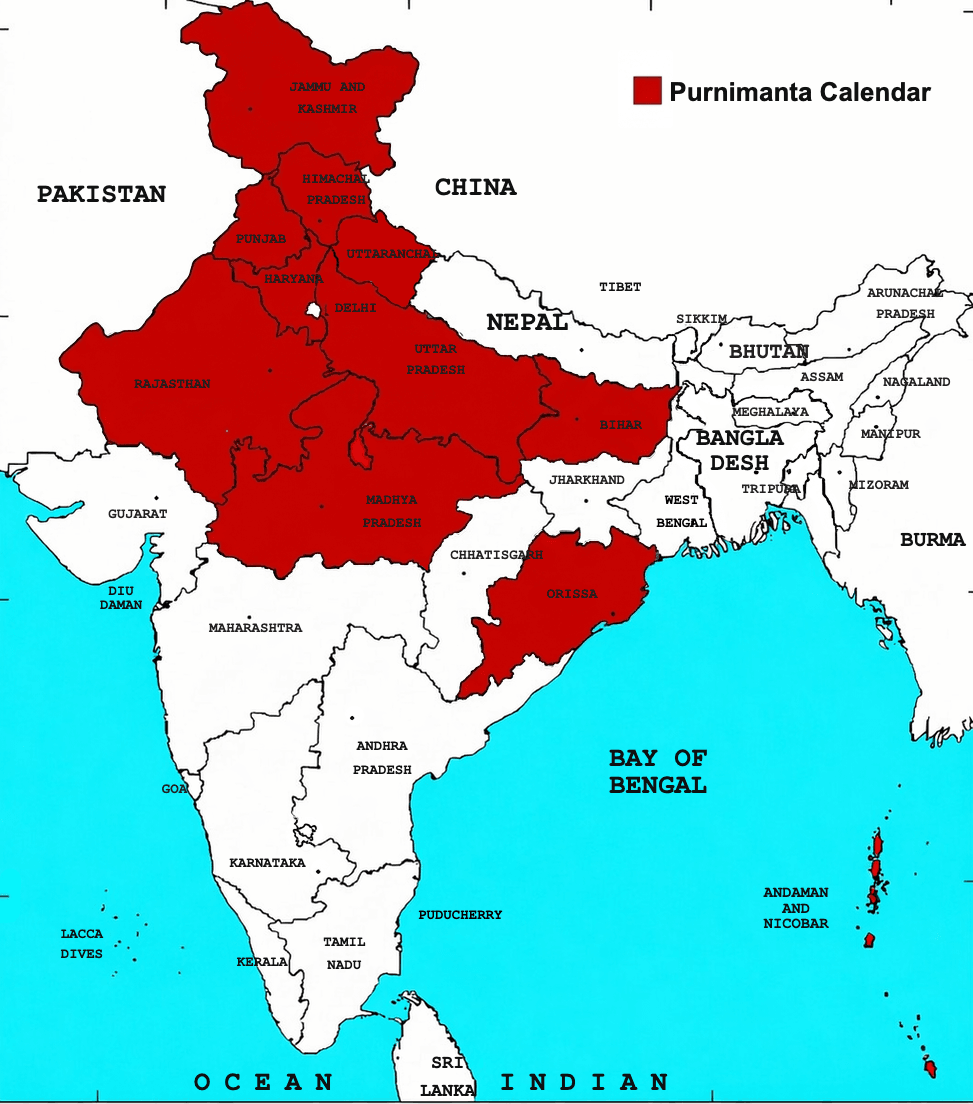
Like the amanta calendar, the purnimanta calendar uses lunar months to build the lunar year. So these two calendars share common features:
- They remain synchronized with the nirayana year.
- They use the same eras (see above).
- Same month division into two main parts: krishna paksha (vadi) and sukla paksha (sudi).
- Same handling system for additional months and “orphan” months.
But as you remember: while an amanta month runs from one new moon to the next, the purnimanta calendar covers the period between two full moons.
The purnimanta month begins about 15 days before the corresponding amanta month (month names are the same in both calendars).
Because of this shift, a purnimanta month “covers” at least half a solar month.
The purnimanta year starts at the same time as the chaitra-type amanta year. This means it begins in the middle of the month of Chaitra in the purnimanta calendar. The first half (vadi) of Chaitra therefore belongs to the year preceding the current year.
One may wonder what the advantage is of such a purnimanta year, which seems to be a near copy of the amanta year with added drawbacks, notably starting the year in the middle of a month. If anyone has a convincing benefit of the purnimanta year, let me know.
The Indian week
Like us, Indians use a seven-day week, and like us, they start it on Monday.
The day names are as follows:
| French | Indian |
|---|---|
| Monday | Somavara |
| Tuesday | Mangalavara |
| Wednesday | Budhavara |
| Thursday | Vrihaspativara or Guruvara |
| Friday | Sukravara |
| Saturday | Sanivara |
| Sunday | Ravivara |
Cycles
The main cycle of years is the mahayuga or chaturyuga of 4,320,000 years. It is divided into four periods counted in human years and divine years (360 human years). Here are this cycle and its periods:
| Cycle | Duration |
|---|---|
| Mahayuga | 4,320,000 years |
| Satyayuga or Golden Age | 1,728,000 human years 4,800 divine years |
| Tretayuga or Silver Age | 1,296,000 human years 3,600 divine years |
| Dvaparayuga | 864,000 human years 2,400 divine years |
| Kaliyuga or Iron Age | 432,000 human years 1,200 divine years |
The current Kaliyuga began at midnight on 18 February 3102 BC. Needless to say, we are still in it for quite some time.
Eras
We will stick to the main eras directly linked to the calendars studied here. The number of eras in India is very large. Some are linked to calendars of foreign origin, others to local variants of solar or lunar calendars.
| Era | Start in the Gregorian calendar | Regions |
|---|---|---|
| Solar calendars | ||
| Kali | Year + 3101 from mid-April to December Year + 3100 from January to mid-April | For all solar and lunar calendars |
| Saka national calendar | Year - 78 from 22 March to December Year - 79 from January to 21 March | Only in the national calendar |
| Saka traditional | Year - 78 from mid-April to December Year - 79 from January to mid-April | Tamil Nadu, Orissa, Punjab. |
| Bengali San | Year - 593 from mid-April to December Year - 594 from January to mid-April | West Bengal, Assam, Tripura |
| Kollam | Year - 824 from mid-August to December Year - 825 from January to mid-August | Kerala |
| Lunisolar calendars | ||
| Salivahana Saka | Year - 78 from March/April to December Year - 79 from January to March/April | Maharashtra, Andhra, Pradesh, Karnataka. |
| Vikram Samvat (Chaitradi) | Year + 57 from March/April to December Year + 56 from January to March/April | Uttar Pradesh, Madhya Pradesh, Bihar, Rajasthan and north-western India |
| Vikram Samvat (Kardikadi) | Year + 57 from October/November to December Year + 56 from January to October/November | Gujarat and part of Rajasthan |
| Vikram Samvat (Ashadadi) | Year + 57 from June/July to December Year + 56 from January to June/July | Kutch and part of Kathiawar |
Reading this table, we can see there is no direct link between calendar structure and adopted era. The Vikram era is used in northern India, where the purnimanta calendar is used, but also in Gujarat, which uses the amanta calendar. The Saka era is used in southern India, where amanta calendars are used. It is also used where solar calendars exist.
Kali ahargana
Indians have long had a system of continuous time reckoning independent of any calendar: ahargana. It is the equivalent of our Julian day. It was invented by the Hindu astronomer Aryabhata I (born 476), and its starting point is 17 February -3101 at midnight. The current reference time is Indian Standard Time (IST).