By Way of Introduction
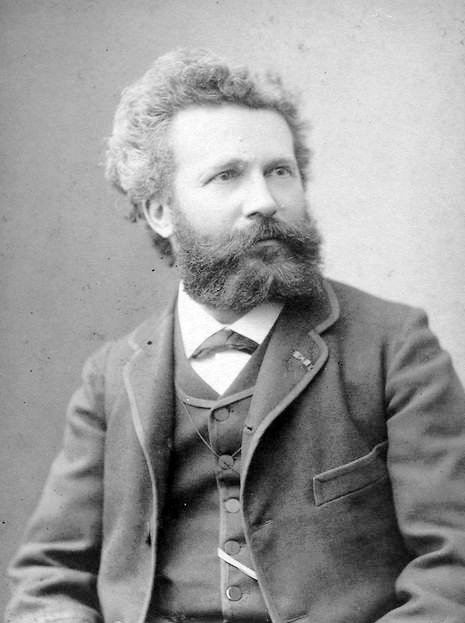
In 1884, Camille Flammarion organized a competition in the journal L'Astronomie, with the aim of proposing a reform of the Gregorian calendar that could make it perpetual.
Thanks to a donation from an anonymous patron, the competition offered a prize of 5,000 francs.
The rest of this page reproduces the texts published in L'Astronomie, which make it possible to follow the history of this reform project, a project that was ultimately never carried forward.
Nicolas Camille Flammarion, better known as Camille Flammarion, born on 26 February 1842 in Montigny-le-Roi (Haute-Marne) and died on 3 June 1925 in Juvisy-sur-Orge, was a French astronomer. He was a very active member of many learned societies and associations devoted to popularizing the sciences. The mystical and spiritual dimensions of some of his works also contributed to his fame. His scientific discoveries placed him, and still place him today, among the foremost science popularizers. (Excerpt from Wikipedia)
Published Texts
CALENDAR REFORM PROJECT.
ORIGIN OF THE COMPETITIONS OPENED FOR THIS REFORM.
MEMOIRS SUBMITTED. TRANSFER OF AUTHORITY TO THE ASTRONOMICAL SOCIETY OF FRANCE.
GENERAL REPORT AND AWARDS GRANTED.
I
OPENING OF THE COMPETITION
(Excerpt from L'Astronomie, September 1884).
For several years now, but especially since the foundation of our Popular Astronomy Review, we have received from all parts of the world, and particularly from America, a great many requests and proposals for Calendar Reform. Absorbed by unceasing work, we had not until now been able to devote to this study the attention it deserves. But today, the importance and urgency of this reform seem so indisputable that we do not hesitate to open our columns to it. In this age of progress, as abundant as it is rapid in every field, it is inconceivable that agreement has not yet been reached, especially among the most civilized peoples of Europe, Asia and the New World, to improve, refine and unify calendars, all of which, without exception, are highly defective. Today we call upon scholars from every country and all governments, and we hope this appeal will be heard, just as the one made here two years ago for the urgent adoption of a universal meridian. These two advances complement one another. Certainly, mankind has always had to reckon with the heavens in the regulation of time; but the Sun and the Moon, which govern our calendars, must serve us, not enslave us. Is it not time for the human mind to take astronomical and geographical possession of our planet, instead of being blindly led by it?
As for us, from this day forward, we shall hold high and firm the banner of Calendar Reform.
The need for a definitive reform is now understood by everyone. The question must be examined from its various angles, and corrections must be brought to the calendars currently in use in order to make them as general, perpetual and as close to perfect as possible. This great subject, of such universal interest, can be opened as a competition; and this is, without doubt, the best way to set out the practical difficulties of reform and the conditions under which such a project could be adopted without major disruption to established habits.
We have just received, from a highly competent man who asks us not to disclose either his name or his country, the sum of FIVE THOUSAND FRANCS, to be awarded as a prize to the best project for reforming the civil calendar.
The editorial committee of L'Astronomie therefore opens a competition, effective today, in the hope that the scholars who undertake this work will produce a simple, definitive project applicable to all peoples.
CAMILLE FLAMMARION.
II
GENERAL OUTLINE OF THE QUESTION
(Excerpt from L'Astronomie, November 1884).
DEAR DIRECTOR,
For a long time I had concerned myself with the various questions related to Calendar reform, but only as an amateur, with no hope of ever putting my work to use. Like the Jews waiting for the Messiah, I awaited a man of science, a man whose authority, like yours, rests on numerous works and whose writings are spread across the five parts of the world, to take the initiative in this reform and raise the standard.
So I read, with a joy I cannot conceal, the appeal you have just made to all friends of progress in favor of Calendar reform. Many others, more competent than I, will certainly hasten to respond. As for me, I simply rummaged through my files, where they had long lain in dust, and pulled out old notebooks in which I had gathered documents on the subject from ancient and modern authors, English, Russian, French, German and Italian, who had addressed the same matter. I have made from them a very concise summary, considering the reform only from one angle, the practical angle, which seems to me the most important and the easiest to accept; and I have the honor of sending it to you, hoping you will receive it favorably and give it a place in your Review.
Please accept, dear Director, the expression of my gratitude and my highest esteem.
§ 1 - Historical Overview
The civil Calendar (or Yearbook) is nothing other than the official statement of time division, promulgated by civil authority and regulating the year, months, days, hours, etc.
From the earliest times, people understood the need to govern by law the division of time and the naming of its parts. A Calendar appeared to them as useful as money, weights and measures. Thus all peoples, even the most ancient, have had their Calendar. Improving or reforming the Yearbook has always been a concern of lawmakers. Numa, Julius Caesar and Gregory XIII are the most famous names in the history of this reform.
The constant aspiration of all centuries toward a perfect Calendar, the sustained efforts of all peoples to improve it, and the discomfort they have always felt, and still feel, because of its imperfections, clearly show that the Calendar is not merely a work of art and science, an object of luxury, or simply a useful and convenient invention, but a real necessity for people living in society with one another: an indispensable aid for work and business, social relations, history, and the celebration of religious or national feasts. The Calendar is, in a sense, like geography, and perhaps even more so, the eye of history: it concerns everyone alike, and everyone consults it constantly, because it is needed every day by everyone.
In a way, the Calendar is a clock that sets out, in order, the divisions of the year, the number and sequence of days, months and weeks, while recalling many memories and providing useful information at the proper moment. Just as a clock showing the number and sequence of hours and minutes is all the more useful and perfect when it always indicates them in the same way, without variation, and presents simple, easy and consistent divisions, so too the perfection of a Calendar, from a practical standpoint, has always been seen above all in the regularity and uniformity of all its arrangements: the fewer changes it undergoes from one year to the next, the more useful and convenient it is.
As Fabre d'Eglantine said in his report to the Convention, the chief merit of a Calendar is to display a strong character of simplicity, with natural, constant and easy-to-remember divisions.
That is the goal toward which scholars and lawmakers involved in composing or reforming yearbooks have always directed their efforts. Nature, of course, was humanity's first guide in dividing time and itself provided the first and principal elements of the Calendar. Two celestial bodies, particularly related to the Earth, measured time with great regularity, indicating days and nights, months, seasons and years; unfortunately, those two heavenly clocks did not agree with each other in every respect, and they measured time only very incompletely. Much therefore remained for scholars and lawmakers to do, in order to set into law the Calendar of nature and complete it.
They first sought to regulate the duration of the civil year and to align it as closely as possible with the celestial year. Historians suppose that for a time years of one day, then one month, then one season were attempted; but a duration more in keeping with the annual revolution of the Sun or Moon was soon adopted, and years of approximately 354, 360, or 365 days were obtained, with an endless variety of supplementary days whose placement long drove astronomers to despair.
They then sought to fix the point at which the year should begin, and this starting point varied so greatly that hardly any month has not at some time had the honor of being first. It was only under Charles IX, in 1564, that January decisively took first place and, despite legitimate protests, has retained it to this day.
Lawmakers also had to choose between the lunar year and the solar year, or to reconcile them through mutual concessions. The struggle was long and is not over.
They also understood the need to divide the year into units large enough to serve as resting points for the mind within that long series of 365 small units we call days. After brief hesitation between seasons and months, division by months, deemed more convenient, was generally adopted.
Once months were accepted, it became necessary to fix their number of days and establish some balance among them. The problem was undoubtedly difficult, since even today it has not been solved in a fully satisfactory way.
The month itself then appeared too large a unit; the need was felt for other intermediate units and, depending on time and place, there were ides, nones and calends, weeks and decades. But the week, although rather inconvenient, prevailed almost everywhere for reasons unrelated to astronomy.
Finally, it still remained to regulate, simply and conveniently, the beginning and end of the civil day, and the number and length of hours. For a long time people regulated themselves by the Sun; and depending on the hour at which it happened to rise or set, days began and ended earlier or later; likewise, according to season and month, hours were sometimes shorter and sometimes longer. In the end, however, the inconvenience of such arrangements was understood, and it was decided to fix invariable beginning and end points for the day, from midnight to midnight, divided into 24 always equal hours of 60 minutes, and minutes of 60 seconds.
Thus, only after an infinite number of attempts, trials, experiments and successive advances did we manage to regulate the division of time and coordinate its various parts in a manner somewhat less irregular and somewhat more in line with nature and our needs. Our Calendar, which is none other than the Julian Calendar reformed in 1582 by Gregory XIII, is therefore in a sense the work of all centuries, the summary of all the efforts of ancient and modern astronomers and the reforms of the greatest lawmakers, and it has rightly become the Calendar of almost all civilized peoples. Yet, though more perfect than most of its predecessors, our Calendar still leaves much to be desired, and it in turn requires reform to make it simpler and more regular, more useful and above all less inconvenient.
§ 2 - Main Defect of Our Calendar
Among all the defects that can be reproached to our Calendar, and perhaps even to the calendars of all peoples, there is one I especially wish to point out, precisely because the authors, writers and publicists who, especially at each new year, do not spare it their criticism, seem, with few exceptions, not to have noticed it, or at least not to have formally charged it: and yet it is the most justified and most serious reproach we may make, namely this: under the current Calendar, years follow one another without resembling one another.
Indeed, the Calendar of the year beginning is wholly different from the Calendar of the year ending. The 365 days, changing place each year, no longer coincide with the same weekdays. Thus 1 January, which was a Tuesday in 1884, will be a Thursday in 1885, a Friday in 1886, a Saturday in 1887, and so on; and all other days up to 31 December undergo the same shift. One may therefore say that our Calendar is constant only in its perpetual inconstancy. This is what compels us to publish a new almanac every year, as those of previous years can no longer be used.
Now such disorder is obviously contrary to the essential purpose of any Calendar and to the principles that should govern all its arrangements. It constantly disturbs our habits through unending shifts and changes; it creates confusion in all our affairs; it prevents us from ordering our time, occupations and social relations; and it clouds our memory through perpetual contradictions and recurring anachronisms. Thus what has always been most admired in the Calendar, otherwise so little universal and so impracticable, of the French Republic of 1793, is that it displayed such symmetry, both overall and in detail, that all years resembled one another, all calendars were uniform, and month dates constantly matched the same day of the decade. In this respect everyone agrees that the Republican Calendar had undeniable advantages, stemming from its admirable regularity.
The reform we propose therefore consists mainly in giving the Calendar the simplicity, and above all the uniformity, that it lacks. To this end, we propose that each year, as it follows the previous one, should resemble it as much as possible: that New Year's Day, for example, should always be a Sunday, the 2nd always a Monday, and so on up to 31 December, so that the 365 days of the year always fall on the same weekdays as in preceding years.
But how can this reform be carried out?
To do that, let us first identify where the problem comes from: what is the cause of the defect we would like to remove? Here it is: if the civil year had exactly 364 days, which divided by 7 gives exactly 52 complete weeks, all years would repeat endlessly with perfect uniformity. Unfortunately, Julius Caesar, to align the civil year with the celestial year, made it 365 days, and sometimes, in leap years, 366, i.e. 52 weeks plus one or two days.
And it is precisely this 365th day that creates the entire difficulty. It alone disturbs the harmony that would exist with 364 days; it alone prevents the desirable uniformity in the succession of years; and by shifting the first day of each new year by one position, it necessarily shifts and displaces all the others, thereby perpetuating disorder.
What then should be done with this 365th day? I am neither Joshua, to stop the Sun at the end of the 364th day and immediately begin a new year, nor Apollo, to hold back my steeds; I must therefore accept the laws of nature that give the year 365 days. Now, if I keep this 365th day as it stands in our Calendar, it will continue to cause inconvenience and disruption; if I remove it absolutely, that yearly suppression of one day will quickly disturb the harmony that must remain, at least to some extent, between the civil year and celestial motions.
At first sight the problem seems difficult, almost impossible to solve. Yet the solution may be simpler than one might think. Could one not, while preserving the 365th day, prevent it from causing disorder and disruption? To do so, it would suffice, following the example of the ancient Egyptians, to make the 365th day a complementary day that would not disturb the order of days in the following year. Or, if one disliked admitting a complementary day that might seem to break the chain of sacred seven-day periods, could one not adopt the following arrangement: years would have 364 days, i.e. 52 full weeks without any complementary day; but each year the 365th day, and likewise the 366th in leap years, would be set aside in order to form, at periods fixed in advance by astronomers and for centuries at a time, one full complementary week.
For example:
Year 1884 (leap year) would have 2 days set aside.
»   1885                »    1    »          »
»   1886                »    1    »          »
»   1887                »    1    »          »
»   1888 (bissextile)   »    2    »          »
Total                         7 days set aside.
Year 1888 would therefore have a complementary week. This week, which astronomers would place in the most practical and suitable way, would thus reappear roughly every five or six years.
Moreover, for this unfortunate day (the 365th), we would only be doing what our Calendar has always done, since Julius Caesar, with the six excess hours that remain at the end of each year. Astronomers ignore them each year, despite the Sun's demands, and wait four years for those accumulated six hours to make one full day, which they then place as an extra day at the end of February; otherwise the year would begin sometimes at midnight, sometimes at 6 a.m., sometimes at noon, and so on, each hour taking its turn, with the same disorder repeated throughout the year. It is therefore wisely, reasonably, and in the essential interest of order and regularity that they wait, as we have just said, until those accumulated six hours make a full day, which they place every four years at the end of February. Now what we ask here is that they likewise set aside each year the 365th day, and the 366th in leap years, and account for them only when they can form a full week.
However, simple though this system may be, we do not propose it as exclusive; we are convinced that Science may discover others that are simpler still and will no doubt deserve preference.
§ 3 - Advantages of the Proposed Reform
With these constant, invariable arrangements, we would finally have a truly perpetual, immutable Calendar. There would no longer be any need to change it every new year, and the same Calendar would serve us indefinitely throughout our lives, from birth to death, just as the same watch serves us every day and then continues to serve our descendants. In that sense, whereas we now have and can only have cardboard calendars, the new perpetual calendar could be engraved in marble, bronze, gold, silver or ivory, and placed on the facade of public monuments, because in a thousand years and beyond it would still be the same.
This reform would be all the more easily accepted because, unlike almost all reforms, it would not conflict at all with old usages, routine, or long-established habits; one would scarcely even notice the change, because it would be less a change than the end of all the changes we are currently forced to endure each year. Moreover, its real usefulness and all its advantages would be understood at once, together with its remarkable simplicity. Freed from all the complications and imperfections of the current Calendar, the new Calendar would answer a need now felt more than ever: order, economy and stability in the organization of one's time.
With the new Calendar, everyone could plan in advance, and over many years, the use of their time in a fully constant, uniform and regular manner, and therefore a more useful one.
This immense advantage would be especially appreciated:
- In public and private administrations, where countless arrangements must be redone each year, almost day by day, because perpetual calendar shifts prevent setting them once and for all in advance.
- In colleges, schools, and all institutions of public instruction, where order is so necessary and where even the most foresighted people always find that, because of the Calendar, they failed to foresee and organize many things.
- In industry, commerce, accounting, and the scheduling of working days, etc.
- In railways, for comparative weekly revenue statements, where so-called corresponding weeks in fact correspond very poorly because of the Calendar.
- Likewise for the very important scheduling of fair and market days; whereas today, whether one fixes a specific weekday or follows a month date, calendar oscillations create many obstacles that disrupt everything and force postponement, anticipation, or complete cancellation of what was intended, not to mention the continual calculations and reckonings that cause countless errors and omissions.
- Finally, in an infinite number of situations where one is daily inconvenienced by the lack of year-to-year correspondence between month dates and weekdays.
- Let us not forget associations that must hold meetings at regular times and could then choose fixed, invariable dates.
- The same would apply to families that like to gather on days fixed in advance.
- And for anniversaries, for the cult of remembrance: when celebrating events on their month date, one would like to celebrate them on the same weekday too; under the current Calendar this happy coincidence almost never occurs. Many examples could be given, and in fact they recur millions of times each year for millions of people.
- This reform would also facilitate the teaching of history by giving chronologies of public or family events a chronological exactness they have lacked until now, and by removing the practical anachronism we commit despite ourselves when, for example, recalling on a Monday an event that happened on another weekday.
- Lastly, religions and various forms of worship, whose feasts and ceremonies are upset each year by calendar inconstancy, would gain in every respect.
But the advantages of the proposed Reform are too obvious, too indisputable, for longer detail to be necessary. We therefore leave it to science, history, religion, agriculture, industry, trade and the arts, for whom time is always and everywhere a necessary element, to proclaim its benefits.
§ 4 - Various Observations
From the standpoint of Science, we have found no serious objection to this reform project. The balance, indeed, remains the same or is soon restored between civil year and solar year, and we account for days, hours, minutes and seconds as exactly as before. If one nevertheless wished to object seriously that this project might produce a temporary difference of a few days in one year or another, or one season or another, I would answer that such a difference has no importance in itself, would pass entirely unnoticed, and would cause no disruption to our habits; and even if the difference were larger, there would still be no reason for concern. Our intention, moreover, has been to create a practical and convenient calendar rather than an astronomical one, a calendar for everyone's use rather than for the Observatory's; finally, the perfection of a civil calendar does not consist strictly in greater conformity to the Sun, as proven by the Gregorian calendar itself, which includes many arrangements not very conforming to nature, adopted solely because they were more convenient.
One may well ask how we have waited until now to carry out a reform that seems so simple and so useful. That fact alone could create prejudice against the project, and we therefore had to account for it. Without dwelling on general reasons, namely that progress is slow in almost all things, that precisely the simplest and most useful reforms are often those delayed the longest, and that past centuries, as they pass and pay their tribute to progress, seem always to leave something for future centuries to do, it seems to us, with history in hand, that for a long time the principal purpose of the Calendar had almost been forgotten. People thought only of putting it into perfect agreement with the solar year; and when Gregory XIII fulfilled this scientific aim, it was believed everything was finished and that after that reform nothing remained to be reformed. Since that time, most authors have merely pointed out in passing the defects of the Gregorian calendar without calling for reform, and lawmakers do not appear to have seriously engaged with it either. One exception should be noted: the Convention (France, 1793), which understood the need for a new yearbook. Unfortunately, alongside some wise and useful provisions, it mixed in absurd and impious ones, and the Republican calendar survived only a few years.
As for our own time, men of Science, I confess, scarcely seem aware that a great task still remains for them; but from the day they are consulted on this point, I do not doubt they will at once identify all the imperfections of the civil calendar, indicate the easiest ways to correct them, and proclaim, far better than a few rare writers have done, the necessity and the advantages of reform.
You are therefore a thousand times right, dear Director, to wish above all to submit this important question to an international Congress that would call upon the most skilled economists, scholars of every country, and the most distinguished astronomers. And when Science has delivered its verdict, lawmakers' consciences will be fully enlightened; then, after the infinite number of trials made over so many centuries by so many brilliant minds, they will be able, in full knowledge of the facts, to carry out the greatest, most logical, most useful, and at the same time simplest of all reforms, and to give all inhabitants of our planet the most perfect of all Calendars, one that would one day necessarily become a universal Calendar, the Calendar of all peoples.
A. B. C.
III
OBSERVATIONS ON CALENDAR REFORM
(Excerpt from L'Astronomie, August 1885).
DEAR DIRECTOR,
I have read with the keenest interest, in the astronomical Review you direct, two articles concerning one of the most interesting questions that certainly exists from a practical point of view: I mean the reform of the civil Calendar.
In an initial communication dated last September, you yourself, dear Director, appealed to all goodwill in order to hasten the solution of a problem that you quite rightly consider essential for social relations of every kind, and above all for relations between persons belonging to different nationalities.
Your appeal was heard, and in the November issue of L'Astronomie I followed, with great satisfaction, the progress of the major scientific campaign of which you made yourself the instigator.
It is not for me to grant to the anonymous author of the remarkable article I refer to all the praise he deserves, and which he will certainly receive from the public and from the scholarly world. Nor will I attempt to revisit the curious historical details contained in that interesting memoir. But I hope, dear Director, that you will allow me to add my modest stone to the edifice of which you are the architect, and that you will kindly grant the hospitality of your columns to the few observations that follow.
Please accept, etc....
JULES BONJEAN,
Doctor of Law, Lawyer at the Court of Appeal - Paris
§ 1 - Essential Foundations of a Standard Calendar
If one analyzes in broad terms the different systems successively adopted, both in antiquity and in modern times, to regulate time reckoning, one notices, not without surprise, that even the most illustrious reformers achieved only relatively imperfect results. And yet, at first glance, nothing would seem easier for a lawmaker vested with sovereign power than to impose on populations rules that are absolutely methodical and fully satisfactory in every respect concerning the Calendar.
What, then, is the source of such considerable difficulties, which the greatest minds of every age have never fully overcome? Why has no system of time reckoning ever yet been established that satisfies all interests and all requirements?
The cause of these perpetual changes and constant failures is, in our view, easy to identify: it is the multiplicity of viewpoints from which a lawmaker can and must proceed when organizing the different divisions of time. For indeed, he must simultaneously take account of: 1) the duration of principal astronomical cycles; 2) the customs, and even entrenched prejudices, of the population; 3) finally and above all, the necessities of practical life.
Now, in most cases, it is impossible to satisfy these different categories of considerations at the same time, and the creator of a new Calendar is often forced to choose between considerations that are equally respectable yet opposed. It follows necessarily that, in this conflict of interests of different kinds, one viewpoint is almost always sacrificed to another; this explains the gaps and imperfections that inevitably appear in all Calendars.
Faced with this impossibility of reaching a result absolutely satisfactory in all respects, what course should the reformer follow? Must he confine himself exclusively to pure Science, considering only planetary evolutions, i.e. only the astronomical point of view? Or should he, imitating the Roman Pontiffs, allow himself to be guided by respect for tradition, to the point of preserving computational methods rejected alike by pure Science and practical common sense? In short, should he place himself exclusively in the traditional viewpoint? Or, on the contrary, disregarding both scientific principles and the most respectable historical considerations, should he focus solely on creating convenient divisions suited to life's needs, and adhere only to the practical viewpoint?
In our opinion, none of the three methods we have just indicated can by itself yield satisfactory results; and to be convinced of this, one need only consider the absurd consequences that would follow from adopting any one of these three systems exclusively.
Suppose, indeed, that we consider only the astronomical viewpoint. At once we encounter insurmountable difficulties: the beginning and end of each planetary cycle that must be taken into account do not coincide exactly. The solar year is composed of neither an exact number of lunar months nor even an exact number of days. More than that, solar days are not strictly equal to one another.
- If one were to adhere exclusively to sidereal phenomena, one would have to draw up astronomical tables usable only by scholars, and in no way constituting a Calendar in the true sense of the word.
- But that is not the only drawback of such a system. Even if the longest astronomical cycles were exact multiples of the shortest, one still would not obtain a result satisfactory in all respects. Let us imagine, for a moment, that the solar year were composed exactly of 365 days and 5 lunar months, each of 73 days: what would follow from so favorable a hypothesis?
- We might obtain divisions that are very scientific, perhaps, but certainly inapplicable to the diverse needs of social life. How could one be content with a system where none of the periods is easily divisible; where one can distinguish neither a half-year containing an exact number of months, nor a half-month containing an exact number of days; especially when one considers the enormous distance between a year of 365 days and a month of 73, and between a month of 73 days and a single day?
- This simple hypothesis therefore shows that, even assuming perfect coincidence between the various cycles of the heavenly bodies, one still cannot withdraw exclusively into the domain of Science, on pain of producing a work wholly inapplicable to practical life, not to mention the upheaval such an innovation would bring to customs and habits.
Must we then, rejecting all scientific thinking and despairing of ever reaching a methodical solution, merely apply as faithfully as possible the rules handed down by our predecessors and limit ourselves to following tradition? In our view, such an opinion cannot be seriously defended.
- Certainly, there are in our current Calendar certain provisions which, though scarcely justifiable from a logical point of view, are nevertheless respectable because they accord with customs and practices deeply rooted in the population; but, conversely, one must recognize that several other rules, also based on tradition alone, could be reformed without in any way harming national habits.
- Thus, for example, while one can understand reluctance to suppress the week, a traditional period par excellence, it is hard to explain, except by a very singular spirit of routine, why one still insists on assigning only 28 days to February, while the number of 31-day months exceeds that of 30-day months.
Given this impossibility of guiding ourselves solely by scientific data or by traditional usages, it may at first seem that the only course is to confine ourselves to practical considerations; but here again we would strike another reef.
- Suppose, indeed, that we set aside all scientific and historical considerations: what would happen? We would be content to construct artificial periods of absolute convenience, easily divisible into one another: for example, a year of 100 days comprising 10 months of 10 days each; or again, a year of 240 days subdivided into 12 months of 20 days, each split into small 5-day periods.
- There is no need to dwell on the drawbacks of such a Calendar: though very convenient for computing delays, due dates, and time elapsed since a fixed date, it would provide no basis for assessing the return of the most essential phenomena, even from a practical standpoint; and besides, it would be in no way suited to the customs and mental habits of populations.
What principles should be adopted, then, to establish the basis of a Calendar that is truly good and useful, if not perfect? We have just seen that it is impossible to place ourselves exclusively in one of the three viewpoints: astronomical, traditional, or practical. We must therefore combine these various elements, sacrificing each as little as possible.
But in case of conflict between considerations of different kinds, what criterion should be adopted? In our view, the practical viewpoint must always prevail. For what is the essential purpose of the calendar? Is it to inform scholars of the exact moment when astronomical phenomena occur? Is it to perpetuate memories of usages and prejudices long vanished? This cannot be seriously maintained. Above all, when reforming the Calendar, one must attend to the necessities of ordinary life: seek to create simple divisions, easily divisible, as coherent as possible with one another, and sufficiently varied so that one or another almost always corresponds to a duration convenient for arranging our affairs, our work, or our rest. Certainly, these utilitarian considerations themselves require taking scientific data into account and respecting tradition to some extent; but one should abandon simple and convenient divisions only as a last resort, and only when it is absolutely demonstrated that omitting an astronomical or traditional consideration would lead to a serious practical inconvenience.
§ 2 - Critique of the Various Subdivisions of the Gregorian Calendar
The Gregorian calendar, currently in use among most civilized nations, is unquestionably one of the best, if not the best, of those employed to date. We therefore will not retrace all past ages, nor analyze the various methods adopted in every period for time reckoning. Pursuing an essentially practical goal, we shall confine ourselves to studying in detail each subdivision of our current Calendar, assessing them according to the principles set out in our first paragraph.
1. THE DAY. The day is the very base, the primordial unit, of any calendar. The succession of light and darkness, at least in almost all habitable climates, makes the Earth's rotation the most necessary subdivision of time for ordinary life. It is true that the astronomical day does not rigorously coincide with the mean day by which our clocks are set; but since the difference remains within very narrow bounds, one may say that this first division is at once consistent with scientific data, with practical requirements, and moreover sanctioned by universal agreement among nations.
2. THE WEEK. The matter is different for the week. This period corresponds to no astronomical cycle exactly; moreover, it has a double drawback: first, it contains a number of days that is indivisible; second, it is not an exact fraction of the year. Nevertheless, we believe that here, even from a practical standpoint, respect for tradition imposes itself strongly. Indeed, the three defects just noted are not as serious as they appear at first sight. First, although the week is of no value as an indicator of recurring climatic phenomena, one must admit that no astronomical period of roughly similar length would offer greater advantage in that respect; yet it is indispensable to create intermediate subdivisions between day and year, the only scientific elements absolutely necessary because of the profound modifications they bring to ordinary life. As for the second objection to a 7-day period, it should no more stop us than the first: while it is true that 7, being essentially indivisible, seems ill-chosen for a practical subdivision of time, one must not forget that a constant usage, reinforced in most peoples by religious prescriptions, dedicates one day of the week to rest, so that ordinary days are reduced to six, a convenient and easily divisible number. We are therefore left with only one truly serious inconvenience: the lack of concordance between the year's duration and an integer number of weeks. This is indeed a very grave defect, and one perfectly brought out by the author of the remarkable article published in this Review last November; but that same author placed the remedy beside the harm by setting out an artificial method intended to suppress the inconvenience he identified. In our opinion, the expedient he proposed would be entirely acceptable; however, in the following paragraph we will allow ourselves to propose, in turn, an empirical method of another kind, which might perhaps achieve the same goal without presenting the same disadvantages.
We thus see that the week presents fewer drawbacks than first appears, both scientifically and practically. And if we now consider the need to respect tradition as much as possible, perhaps no period imposes itself more absolutely than the 7-day one. Indeed, among most civilized peoples, customs, inherited practices and religious doctrines make this subdivision of time one of the most essential regulatory bases for work, worship, business, and leisure. One must therefore abandon the idea of replacing the week with another, more methodical period of 5, 6, or 10 days, for example, on pain of deeply disturbing the population's habits and creating only a work destined to perish quickly, like the Calendar of the French National Convention, however excellent it was in other respects.
3. THE MONTH. Properly speaking, the month in the Gregorian calendar is, like the week, a purely artificial subdivision. First, it corresponds exactly to no astronomical cycle. Moreover, months are not equal to one another, and none has even the advantage of being a determined fraction of the year. This drawback is made even more obvious by the inconceivable routine that still assigns only 28 days to February, while the number of 31-day months exceeds that of 30-day months. Finally, although four months of the year do have the advantage of containing a simple and easily divisible number of days, the other eight, i.e. the majority, contain 31, 28, or 29 days and are therefore very defective in this respect.
We therefore believe reform is imperative on this point. Certainly, we do not regret that the Calendar month does not correspond to the lunar month. Unlike the Earth's rotational and orbital motions, the Moon's motion around our planet has no practical consequences important enough to justify sacrificing the simplicity and usefulness of another method of reckoning. We therefore accept that the civil month may fail to coincide with the lunar month and should be merely an artificial division, one twelfth of a year. But once this principle is accepted, and all scientific considerations set aside, the practical side of the question must receive as much satisfaction as possible. For here, unlike the week, we are no longer constrained by the need to respect traditions deeply rooted in the population's mind; the anomalies in month lengths can be explained only by memories of usages and prejudices long since vanished. On this point, then, one should follow only common sense and restore to the month its character as an artificial but practical and convenient division of the year. In the following paragraph we shall see how, in our view, this result could be achieved.
4. THE YEAR. Unlike week and month, the year is a period for which one must carefully consider astronomical data. If we have been able to neglect lunar phases, since they do not produce major practical effects on ordinary life, we cannot do the same regarding our planet's motion around the Sun. Just as Earth's rotation necessarily imposes the day as a fundamental time unit by bringing successive darkness and light, so too Earth's course around the Sun periodically brings back, at most latitudes, climatic phenomena of extreme practical importance. However, because the solar year does not contain an exact number of days, empirical procedures are required to establish concordance between these two essential elements of the Calendar. We do not propose to examine all methods used so far to achieve this; but it seems to us that the Gregorian calendar can be considered as satisfactory as possible on this point, except for the odd placement assigned to the complementary day, which rests only on excessive respect for tradition.
§ 3 - Plan for Calendar Reform
We have just seen the strengths and the shortcomings of the Gregorian Calendar; we must now examine how one might preserve the former while remedying the latter. We do not, of course, claim to present a perfect project in every respect: we simply submit to readers the changes that seem to us both possible and necessary for our present Calendar. But for greater clarity of presentation, we are compelled to give this final part of our work the character of an overall plan.
In our view, the reformed Calendar should be based on the following principles:
The year would have 365 days, with complementary days introduced according to the principles of the Gregorian Calendar.
It would be divided into 12 months, alternating 30 and 31 days, as follows:
January . . . . . . . . . . . . . . 30 days.
February . . . . . . . . . . . . . 31 -
March . . . . . . . . . . . . . . . 30 -
April . . . . . . . . . . . . . . . 31 -
May . . . . . . . . . . . . . . . . 30 -
June . . . . . . . . . . . . . . . .31 -
July . . . . . . . . . . . . . . . . 30 -
August . . . . . . . . . . . . . . .31 -
September . . . . . . . . . . . . . 30 -
October . . . . . . . . . . . . . . 31 -
November . . . . . . . . . . . . .  30 -
December . . . . . . . . . . . . .  30 -
TOTAL . . . . . . .  . . . . . . . 365 days.
In leap years, the month of December would receive a 31st day, bringing the number of 31-day months to six, equal to the number of 30-day months.
The first day of the year would always be a Sunday; then weekdays would follow in their present order up to 30 December, the last day of the year in our system, which would also be a Sunday, so that both the first and the last day of the year would be days of rest. In leap years, 31 December, as a complementary day, would receive a special designation, or simply be treated as Sunday. Finally, the civil day would remain governed by current rules, without any modification.
It seems to us that such a Calendar would present considerable advantages and, in several respects, would be superior to the Gregorian Calendar. What exactly are the reforms we are proposing?
As regards months, the current Calendar divides the year into 7 months of 31 days, 4 months of 30 days, and 1 month of 28 or 29 days; moreover, it places the 31-day months in so peculiar an order that one is often forced to use empirical tricks to know whether a given month has 30 or 31 days. February, excessively shortened, forces an increase in the number of 31-day months and makes the 30-day month the exception, when it should be the rule. The method currently followed thus clearly lacks logic. In our system, by contrast, 30-day months, by far the most convenient, are the majority and alternate regularly with 31-day months, making them easy to distinguish. In addition, the oddity of a truncated month, as with present-day February, disappears entirely. Finally, the complementary leap-year day naturally fits at year-end, turning the twelfth month into a 31-day month.
On this first point, it seems to us that the reform we propose offers little room for criticism. As for the system we set out above concerning weeks, we would more readily accept discussion. We do not conceal from ourselves the empirical nature of the theory we advance, and we know we may be accused of creating a week with two Sundays, or even three Sundays, close kin to the famous “week with four Thursdays.” But we were persuaded by the prospect of making the various subdivisions of the Calendar concord with one another. Is it not regrettable to see the present lack of connection between day of week and day of year? Who has not repeatedly felt the theoretical and practical inconvenience of such a method? Certainly one may reproach our proposal for turning the year's last week into a week that is not truly one, a week of 8 or even 9 days, and thereby breaking the chain of 7-day periods. This is undeniably a valid criticism; but we can answer that objection with arguments no less serious.
First, one should note that, to make the year's duration coincide with an exact number of weeks, we use a procedure strictly analogous to the one already used to make solar years coincide with whole numbers of days. Just as every four years a complementary day is added to the leap year, making it a period of 366 days while the normal year has 365, so we make the 52nd week of each year a special week of 8 days instead of 7. The two methods are therefore equivalent, and one is neither more empirical nor stranger than the other. In addition, one must consider that this slight disturbance in public habits, caused by the immediate succession of two Sundays, would occur precisely at a time of year generally devoted to exceptional festivities, according to the customs and mores of almost all peoples. Finally, even if our proposed reform carried certain disadvantages, would it not still be better to accept these minor inconveniences than to leave in place a state of affairs that is clearly defective?
In summary, the new Calendar whose adoption we propose would prevail over the Gregorian Calendar by the following qualities: permanent concordance between days of year and days of week; month equality and regularity as great as possible; and the absence of any oddity justifiable only by routine. Moreover, it would offer the immense advantage of almost entirely respecting the deeply rooted habits of the population, so that the reform would bring no disturbance to ordinary daily life while achieving considerable improvements, almost unnoticed in practice.
JULES BONJEAN.
IV
CLOSING OF THE COMPETITION
(Excerpt from L'Astronomie, May 1886).
The competition, opened in September 1884, was closed, as announced, on 1 January 1886. Fifty memoirs, sent from various parts of the world, were reviewed in a first reading and classified. The report will shortly be submitted to a high commission, amended if necessary, and adopted as the formal presentation of the desired reform PROJECT; it will then be published together with the prizes awarded. We may already assume that the five-thousand-franc prize cannot be awarded to a single author, but will be shared among several.
Several scholars have asked us whether this project also aimed at reforming the religious Calendar, assuring us that such reform would be very useful and was in fact generally desired by all Christians, Catholic or Protestant. We cannot personally affirm anything on that point; however, we do know members of the English Parliament who intend to propose this reform in the House of Commons, especially with a view to fixing parliamentary recess at the same time every year. We could mention one in particular, known everywhere for his immense fortune and above all for his boundless benefactions in England and France, and who endowed Paris with the public fountains that bear his name.
But it will be for the Congress, which we hope will convene for civil Calendar reform, to decide whether it should also express a wish regarding reform of the religious Calendar. As for us, we can concern ourselves only with the civil Calendar. Besides, it seems to us that reform of the religious Calendar pertains to the head of the Christian religion. Gregory XIII, with the support of the scholars of his century, proposed three centuries ago a reform that was successively accepted by almost all Christian states; Leo XIII, rightly regarded as a friend of science and progress, may in turn, if he deems it useful, decide on the advisability of a new reform.
V
REPORT ON THE PROJECTS SUBMITTED TO THE COMPETITION (1)
(1) As just noted, this competition was closed on 1 January 1886. The Astronomical Society of France having been founded and having held its first meeting on 28 January 1887, Mr Flammarion, at the second meeting (28 February), transferred his full powers to the Society, which immediately appointed a commission charged with submitting to it a report on the projects presented and on the distribution of the five-thousand-franc prize. (This report, written by Mr Gerigny, secretary of the Society, is published here.) The competition opened in 1884 by L'Astronomie for a project to reform the civil Calendar produced the results one was entitled to expect from a universal appeal on a question of such clear importance. From various parts of the world, fifty memoirs were sent to Mr Flammarion. Some contain several different projects. A number show high scientific value; several display serious quality and undeniable merit. Before entering into a detailed discussion of these many works, it is important, we believe, to define clearly the basis on which the reform should be examined. Everyone agrees that the Gregorian Calendar, as currently in use, has serious imperfections; but the relative importance of those imperfections has been judged very differently by authors who submitted memoirs to the competition, and the means devised to remedy them are numerous and varied.
It emerges from reading the projects that the defects attributed to the Gregorian Calendar, rightly or wrongly, are:
- The inequality of civil years, which have sometimes 365 and sometimes 366 days.
- The imperfection of the Gregorian 400-year cycle, which makes the mean civil year 365d.2425 whereas the tropical year is 365d.2422, producing a one-day discrepancy after roughly 3,500 years.
- The arbitrary nature of division into twelve months, a period of about 30 days, which does not correspond, even approximately, to any astronomical period and does not even have the advantage of being one twelfth of a year.
- The inequality of these months, which have 31 days, 30 days, and even 28 or 29.
- The empirical and inconvenient character of the 7-day week, whose sole justification is the antiquity of its origin.
- The lack of correspondence between weekdays and dates of the year, forcing fairly laborious calculations when one wishes to know which weekday matches a given date.
- The lack of correspondence between weekdays and dates of the month.
- The absence of decimal divisions in time measurement.
- The arbitrary origin of the year, fixed since Charles IX on 1 January, a date that corresponds to no noteworthy astronomical phenomenon.
- The overly particular character of the Christian era, which relates to a religious event, can offend the sentiments of non-Christian populations, and whose origin does not even coincide with the year of Jesus Christ's birth.
- The arbitrary and illogical character of adopted names.
These are the imperfections competitors sought to eliminate, each giving priority to the one that seemed most serious. It is important to discuss these eleven grievances and examine whether they are all truly founded, and whether the indicated defects can be corrected without introducing worse ones.
I
There is first a decisive consideration, one that must prevail over all others and that creates a fundamental difference between measuring time and measuring other quantities: the Earth's double motion, around its axis and around the Sun, brings back, at roughly equal intervals, varied phenomena that play a major role in our entire existence. Units of length and weight can be arbitrary without inconvenience, and those we use indeed are; but the succession of day and night compels us to organize life according to the Sun's apparent diurnal motion, and imposes the solar day on us as an absolute unit of time. It is true that the solar day, not being constant, does not strictly possess the essential character of a measurement unit; but we know how astronomers solved the difficulty by replacing the true solar day with the mean solar day. We will not dwell on this ingenious arrangement, which in any case lies outside our subject and resolves the issue in the happiest and most complete manner; one may say that the mean solar day, as defined in Astronomy, is for civil use a definitive unit of time.
But the mean solar day is too short a unit for longer durations; one might then think of using a decimal multiple of the fundamental unit, for example a period of 100 days or 1,000 days, just as one uses the hectometre or kilometer for route distances. If all days were alike, this would obviously already have been done and the Calendar problem would not exist (in a world without seasons, like Jupiter, one hardly notices a year and the day cycle may be arbitrary). Yet the cycle of seasons alternately brings us long days and long nights, suffocating heat and harsh cold, activity and dormancy in plant life. We are obliged to reckon with this diversity of surrounding phenomena to organize our occupations; the period of their succession imposes itself as a unit of time with authority no less absolute than the day-night cycle. And that is exactly where the first difficulty arises: this period, which astronomers call the tropical year, is not composed of an exact number of days; it is about 365 and a quarter days (365d.242217), and even varies slightly across centuries. Fortunately, that variation is so slight that there is no need to account for it, at least over several thousand years.
It is obviously impossible, for civil use, to keep a year not made of an exact number of days. Since we also cannot give up reckoning time by seasons and replace the year with a decimal period of 100 or 1,000 days, only two options remain. The first is to form the civil year from the integer number of days closest to the fractional value of the tropical year, namely 365 days. This was the solution adopted by the ancient Egyptians. That year, invariably composed of 365 days and called the vague year, has the indisputable advantage of always being equal to itself; but we know the inconvenience caused by the neglected fraction. Since the civil year is about a quarter-day too short, seasons shift by one day every four years; the spring equinox date, for instance, advances by one day every four years, by one month every roughly 120 years, and in about 1,460 years the seasons have gone all around the year. Ancient Egyptians saw no inconvenience in this annual drift; on the contrary, they considered this reckoning advantageous, because at the end of the 1,460-year cycle all seasons had been sanctified by the various religious feasts celebrated on fixed dates. Modern civilization, however, would not accommodate such a system. The Calendar is not merely an arbitrary table assigning names or numbers to successive days; it is also a classification of days to come, by which we distribute in advance our work and pleasures, our private and professional occupations; it governs our plans and habits. It is an image of the succession of seasons, indicating in advance predictable particulars such as sunrise and sunset times, equation of time, etc. We would not accept that the same seasons should no longer recur on the same dates, because then we would have to modify our habits and shift the dates of our various occupations as seasons moved across civil-calendar dates.
The two great historical Calendar reforms had precisely the aim of bringing the civil year as close as possible to the tropical year. Since we cannot accept the vague year, we must resign ourselves to the second solution, adopted both by Julius Caesar and Gregory XIII: combine 365-day and 366-day years so that the mean is as close as possible to 365d.2422. By this method, solstitial and equinoctial points do shift by a few hours during 365-day years, which are too short; but when a 366-day year arrives, which is too long, the equinox is abruptly shifted back in the other direction and returns roughly to its original place. One may debate how to distribute 365-day and 366-day years; one might even propose, if useful, years under 365 days (defective years) combined with years over 365 days (abundant years). But the very principle of combining civil years of different lengths, to ensure periodic return of seasons on the same calendar dates, must remain absolute and beyond dispute. The first and most essential condition the Calendar must meet is agreement with the tropical year: the duration of the mean year must be as close as possible to 365d.2422.
II
Alongside this fundamental obligation, imposed on us by a numerical relationship between natural phenomena and wholly beyond the reach of human will, there is another key condition that must not be overlooked in preparing a reform project, one that depends on entirely different considerations linked to three distinct orders of ideas:
- The Gregorian Calendar, used among the most civilized nations, is not the one-day creation of a legislator; it is, so to speak, the result of centuries of work by many generations. It is none other than the old Roman Calendar, whose origin is lost in the mists of the legends of Romulus and Numa Pompilius, reformed repeatedly in line with scientific progress, yet never wholly transformed. A brief summary of this Calendar's history may therefore be useful.
Romulus' year consisted of ten months and counted 304 days. Numa introduced January and February, bringing the year's total to 355 days. Later, people recognized the inconvenience of a civil year far shorter than the tropical year, and imagined adding every two years an extra month called Mercedonius. By an almost inconceivable oddity, this month was inserted in full between 23 and 24 February; but even with Mercedonius, the year remained poorly aligned with the Sun. In despair, they decided to leave it to the Great Pontiff each year to determine whether there would be a Mercedonius month and how long it would be. This only worsened the disorder it was meant to avoid: pontiffs abused their power to lengthen or shorten the year according to caprice or interest. Masters of advancing or delaying deadlines, and the renewal of magistracies, they had turned the Calendar into an instrument of corruption and fraud. By Julius Caesar's time, disorder was such that harvest festivals fell in mid-winter and spring saw feasts called autumnalia. To remedy this and prevent its return, the dictator undertook the reform that bears his name. He sought the advice of an Egyptian astronomer, SOSIGENES, and established the Julian Calendar, fully in line with the current one except for month division into Calends, Nones and Ides, and the leap-year intercalation rule, which was to bring a leap year every four years without exception. It may be worth noting that the additional leap-year day was inserted where the former Mercedonius month had been, i.e. between 23 and 24 February. Since 23 February was called sextus dies ante kalendas Martis (sixth day before the Calends of March), the intercalary day took the name bissextus dies (second sixth day), from which comes the term bissextile for 366-day years. Moreover, to return seasons to their expected dates, the reform year was assigned a duration of 445 days; this year, later called the year of confusion, was year 709 from the founding of Rome, or 46 BC. Add that the pontiffs responsible for applying the reform failed in early years to understand that one leap year had to be made in each four-year group; counting the previous leap year within those four years, they effectively repeated leap years every three years. The resulting error from this misapplication was corrected under Augustus by removing the excess counted days.
The mean Julian year was 365d.25, exceeding the tropical year by 0d.007783, or about 11 minutes. That difference appears very small; but as it accumulates, it amounts to one day after 130 years. As a result, the spring equinox, which at Caesar's reform fell on 25 March, shifted to 24 March after 130 years, then 23 March, and by 325, at the Council of Nicaea, it had reached 21 March.
The Julian Calendar was adopted by the Council of Nicaea to regulate Church feast dates. The spring equinox was likewise fixed at 21 March, and Easter on the Sunday after the first full moon following 20 March; thus Easter can be celebrated at the earliest on 22 March and at the latest on 25 April. The year's length was still taken as 365d.25, so the equinox date continued to move backward by one day every 130 years.
By the end of the 16th century, the error had reached 10 days, meaning the spring equinox occurred on 11 March instead of 21 March. Had things been left as they were, Easter would eventually have been celebrated in summer, then in autumn, etc. To remedy this, Pope Gregory XIII, at the urging of the Council of Trent, consulted astronomers and replaced the old Calendar with what is called the Gregorian Calendar. The Gregorian reform is as follows:
The equinox was brought back to 21 March by suppressing 10 days, so that the day after 4 October 1582 became 15 October. Then, to avoid recurrence of such disorder, it was decided that three leap years would be removed in each 400-year period, and for this purpose the following rule was adopted: in the Julian Calendar, leap years were those whose year number is divisible by 4. Consequently, century years were all leap years, since they end in two zeros. The Julian rule was kept for ordinary years; but century years were to be leap years only if their century number (after removing two zeros) remained divisible by 4. Thus 1600 was leap; 1700, 1800, 1900 are not; 2000 is. Clearly, suppressing three leap years every 400 years amounts to reducing each year's duration by 3/400, so that in the end the civil year in the Gregorian Calendar is:
365,25 - 3/400 = 365,25 - 0,0075 = 365,2425;
it differs from the tropical year, 365d.2422, only by an insignificant amount amounting to barely one day in 4,000 years.
Despite its undeniable defects, the Gregorian Calendar has on its side, in practice, the authority of a twenty-century tradition and the deeply rooted habits of civilized populations. However strong our desire to see odd or even illogical arrangements disappear, it would be unreasonable to impose a radical change on habits so old and deeply entrenched. Reform should therefore be restricted to the most essential points and to modifications whose practical benefit is sufficiently indisputable to outweigh the temporary inconveniences necessarily attached to any reform attempt of this kind.
- Even apart from any feeling of justice or respect for old customs, strict necessity requires extreme caution in any reform project. The issue is not to devise, from a theoretical or speculative standpoint, a Calendar that appears most rational, most scientific, and most perfect. The issue is a practical reform that we wish to see implemented in reality for the greatest convenience of future generations. It is therefore essential that we focus on making reform possible and acceptable.
However perfect our project might be in terms of reason or Science, it would be useless and illusory if those concerned, that is, most of the world, refused to accept it. We must even admit that in this respect we face conditions far less favorable than those faced by reformers of past centuries. The two great historical reforms, Julian and Gregorian, were accomplished by men able to speak as masters and impose their will. Julius Caesar was dictator of Rome and master of the civilized world; his orders met no resistance. In 1582, the pope enjoyed major influence in Europe. As head of the Church, he could authoritatively fix the rules for determining feast dates, and this was the reform's most important purpose in his mind. In any case, he was sure of obedience from Catholic countries, and those countries then had enough power and influence to force other nations soon to imitate them. Yet Protestant countries resisted for a long time, preferring disagreement with the Sun to agreement with Rome. Germany, Denmark, Sweden and Switzerland accepted reform only in 1600; England in 1751. Even today, Eastern Europe has preserved the Julian Calendar, and Russian or Greek dates remain 12 days behind ours.
There is also a third reform attempt worth recalling. This time it involved a radical change in distributing the year's days: the Republican Calendar. Needless to say, although it functioned for thirteen years, this Calendar never gained general favor, even in France; Napoleon's decree restoring the Gregorian Calendar was instead received with keen satisfaction. The Republican Calendar was never applied outside France. Yet in 1793 the era was remarkably suited to significant reform. The all-powerful Convention could impose its will with certainty of obedience, without resistance and even with joy, among much of the population. A desire for change, a fever for innovation, had seized all active minds; this wish to modify everything and rebuild on new foundations produced great achievements. To cite only one: the metric system. It is deeply regrettable that the authors of the Republican Calendar went far too far in that direction and did not limit themselves to a few major improvements, instead overturning from top to bottom the Calendar of past centuries and of the whole world. Among all reforms owed to the French Revolution, calendar reform might likely have remained lasting and definitive, despite succeeding governments; but the Republican Calendar, despite very real qualities, clashed too strongly with common habits and offended the religious feelings of too many people to survive even a slight reaction.
Be that as it may, today's circumstances are entirely different from those that governed those three great historical reforms. No one can now think of invoking the all-powerful authority of a monarch, assembly, or pontiff to impose new rules for reckoning days and years on the world. We can expect nothing except free consent of peoples represented by their governments or by appointed delegates. Any reform attempt will certainly meet resistance, stronger or weaker, and we must minimize it as much as possible by avoiding new provisions in our project except those justified by indisputable practical benefit. That benefit must be obvious enough to strike every eye and largely offset inconveniences resulting from change. Only at that price can we hope for sufficiently broad adhesion to carry reform through successfully. Hence the need to refrain from modifications of purely theoretical or speculative character; we must resign ourselves to leaving in place those imperfections of the Gregorian Calendar that do not create material inconvenience, and focus exclusively on those that in everyday life create nuisance, irritation, or wasted time.
- To obtain that general consent, which is indispensable, the reform project must also possess an essential quality demanded by the spirit and tendencies of modern civilization: it must be universal. One of the gravest inconveniences of the current day-counting method is precisely that peoples of Eastern Europe have not yet accepted the Gregorian reform. As for Asia, China and Japan, that important part of the world may not remain forever outside the European scientific concert. One may even say that, for the current attempt, this is fortunate: those peoples will more readily agree to change old usages and adopt a universal Calendar when they see other nations also willing to sacrifice their own centuries-old habits to the common good.
What should be understood by this word universal? It necessarily implies absence of any provision specific to a particular nation, religion, or climate; but it also means the new Calendar must be adaptable to the usages of all peoples, so each can use it to organize activities according to its own climate, civil law, and religious prescriptions. The most essential characteristic it should have may be to recall nothing specific to any one nation. National pride is among the most irritable human sentiments, and any reform project that offends it, even slightly, is doomed to fail. Recall repeated failures in attempts to establish an international meridian. Among all reasons for the failure of the Republican Calendar, one must first cite its exclusively French character; month names tied to French meteorological phenomena would have been misplaced in other parts of Europe and true nonsense in the southern hemisphere. The year's start had been fixed at the autumn equinox far more to honor the anniversary of the Republic's proclamation than to follow any indication from the Sun's apparent motion. Had strictly astronomical considerations prevailed, it would have been more logical to start the year either at the winter solstice or at the spring equinox. Finally, did not the strange name sans-culottides given to supplementary days seem designed expressly to discredit the Convention's work?
The Gregorian Calendar, by contrast, enjoys this quality of universality to a high degree. Nothing in it recalls either the seasons of a particular climate or the history of any specific nation. Only the feasts spread across the year make it appear Catholic, but clearly that feast question lies wholly outside our subject; feasts do not constitute the Calendar proper. Nothing prevents replacing Catholic feasts with those of another religion, and that is necessarily what non-Catholic peoples have done; they did not thereby modify the Calendar. One may even, as several competitors propose, replace religious feasts with civil feasts and saints' names with names of illustrious figures whose memory would be honored successively throughout the year; this would still not be Calendar reform. We have said many times already: our Calendar project must provide a classification of coming days and years; each person can then organize time and days according to habits and conscience, dedicating them to veneration of saints, memory of great people, or remembrance of great events in national history. What is at issue here is an astronomical work. Let us examine the question from that viewpoint.
III
Drawing on the principles just recalled, we now discuss the grievances our competitors level against the Gregorian Calendar:
-
The inequality of years, some 365 days and some 366, derives from the astronomical fact that the tropical year is not composed of an exact number of days. Human will can do nothing about it; we have already sufficiently explained why we are compelled to accept years of unequal length so that seasons, on average, always return on the same dates.
-
The Gregorian year is 365d.2425, whereas the tropical year is 365d.242217. The difference is therefore
365.242217 - 365.2425 = 0.000283.
After 1,000 years, the mean equinox date will therefore have shifted by 0d.283, and for that date to shift by a full day one must wait 1/0.000283, i.e. 3,533 years. Only after this long period would one extra day have been counted. It seems to us that under these conditions the Gregorian year represents the tropical year with all desirable approximation. What interest would people in the year 5400 have in receiving the equinox on exactly the same date as in the year of grace 1886? If they care greatly, nothing prevents them then from suppressing one leap year to cancel that extra day. In any case, we must concern ourselves primarily with present generations, and foreseeing too far ahead is not always beneficial. We therefore judge that nothing should be changed in the Gregorian cycle. Add that the intercalation rule is extremely simple and ingenious, and it seems almost impossible to imagine another combining this same degree of simplicity and convenience. We know leap years are those divisible by 4, except century years, which are leap only if the number of centuries in the year is itself divisible by 4. This rule, leaving nothing arbitrary, constitutes almost the whole Gregorian reform by itself; it is certainly superior to the rule of the Republican Calendar, under which leap years were to be made regularly every four years until mean equinox date shifted by one day, at which point one leap year would then be suppressed. It is therefore wise not to revisit this intercalation rule and to keep it as it is.
- The month obviously originates in the cycle of lunar phases; Muslim peoples, Arabs and Persians still use calendars whose months are, on average, roughly equal to the duration of a lunation. The Jewish religion still uses a lunar calendar today. The same was true of the ancient Greek calendar. Since the tropical year does not contain an exact number of lunations, it was extremely difficult to build a lunar calendar that also remained aligned with the Sun. The Muslim year, made invariably of 12 lunar months, is much too short, and seasons therefore return on all dates after only a small number of years. The ancient Greeks solved this only by combining defective years of 12 months and abundant years of 13 months, suitably distributed across the 19 years of the Metonic cycle. The Romans did not hesitate for long to abandon day reckoning by lunar motion and, so that the year would contain an exact number of months, they made months 30 or 31 days without further concern for lunar phases. Thus the month as we know it today was formed. It certainly no longer corresponds to any astronomical period; month succession is no longer in step with lunar motion or return of phases. But does this create any practical inconvenience? Given our way of life and habits, are lunar phases of such importance to us that we must use them to count time? Who would think to prefer to our Calendar the purely lunar calendar of Muslim peoples? And as for the ancient Greek lunisolar calendar, with abundant years exceeding defective years by 29 days, is it necessary to demonstrate how inconvenient it was?
It has also been said that months are not even twelfths of a year, since they are sometimes 30 days and sometimes 31. Certainly, but since 365 is not divisible by 12, it is impossible to divide the year into 12 equal-day parts. Is that a reason to abolish months? We think far from it. As an intermediate duration between day and year, the month is a very convenient kind of unit for rough approximations. It is useless in exact computation, but very useful in civil life. One might, of course, since its length no longer relates to any natural phenomenon, try another division of the year. In several memoirs we found a division into 13 equal months of 28 days plus one complementary day, which would have the advantage of making month length an exact number of weeks; but at what cost? Prime number 13 does not allow useful partition of the year: neither half, nor third, nor quarter of a year would correspond to an integer number of months. Number 12, by contrast, provides these secondary divisions very conveniently: half-year is 6 months, quarter is 3, third is 4, etc. Note in this regard that the ability to divide 12 into 2, 3, 4 and 6 equal parts is surely why this number was used for subdivisions in old measurement systems. One may even regret that numeration was not originally based on 12 rather than on 10, which likely imposed itself from the number of fingers on our hands. As for dividing the year into 10 months, it would have the same drawbacks as 12-month division (since 365 is not divisible by 10) without its divisibility benefits. Add that decimal systems are convenient only for exact calculations and written operations, where the month is of no use anyway. For approximate mental calculation, duodecimal division is certainly more advantageous. In short, suppressing months, or changing the year's mode of division, would bring more drawbacks than advantages, besides entirely disrupting the hardest habits to change. No modification should therefore be attempted in this direction.
-
The situation is very different regarding distribution of the year's 365 days across its 12 months. It is truly absurd that we have 7 months of 31 days, 4 of 30, and 1 of 28 raised to 29 in leap years. This arbitrary distribution, justified only by superstitious notions dating back to the Roman Republic, has persisted through centuries despite obvious inconvenience; it destroys the symmetry of the four quarters and complicates calculation of elapsed days between dates. Moreover, the shortness of February is a source of nuisance and delay for people whose activities depend on monthly succession and recurrence. Each year one must make a conscious effort, often forgotten, to remember that on 27 February only one day remains before March returns. Symmetrical distribution of days and months is certainly one of the points the proposed reform must address.
-
The week, like the month, is not based on any natural phenomenon; yet use of this seven-day period is so universal that one can think neither of suppressing nor modifying it. A short periodic span is absolutely necessary to organize recurring activities that do not happen every day. Working people also need a day of rest, or at least variation, after several days of more or less hard labor, and return of that day must be periodic. This is necessary both for physical health and for mental integrity. As for length of the period, it depends on physiological constraints that limit it and economic constraints that prevent rest days from being too numerous or too close together; one cannot deny that a week with rest every seven days meets both conditions very well. The Convention tried to replace it with the ten-day decade, but the decade was too long; in practice it was split in two and people rested every five days. The week has been criticized for containing a prime number of days and therefore not being divisible; on the contrary, if Sunday is set aside, the six working days can easily be partitioned into two or three groups, very convenient for activities recurring every two or three days. In any case, this short period must have proved very convenient for its use to spread so universally. Any attempt to modify the week would clearly be poorly received and would have no chance of success.
-
The lack of concordance between weekdays and year dates is certainly the most serious defect of the calendar currently in use: feasts fixed on invariable dates fall on all weekdays depending on the year. Our activities are thus governed by two independent reckonings, dates and weekdays, forcing people to look up the correspondence each time. This is a source of inconvenience and miscalculations: due dates and appointments fixed in advance may fall on Sunday, causing delay and lost time. All these inconveniences would disappear if weekdays and year dates could be reconciled, in short if one built a Calendar identical for all years and symmetrically arranged enough to be easily memorized. This is precisely what should constitute the central part of the proposed reform.
-
All inconveniences arising from mismatch between weekdays and year dates recur, though to a lesser degree, owing to mismatch between weekdays and dates of each month. It would clearly be very desirable for the same day-number in each month to fall on the same weekday across all twelve months; unfortunately, such a combination is almost impossible without introducing inadmissible upheavals into the Calendar. This question will be studied later.
-
We have already sufficiently explained how and why decimal division of the most commonly used time periods is impossible to implement; it is obvious that such division could not be reconciled with the Gregorian year, the month, or the week.
9° The date on which the year begins has often changed over the centuries. The ancient Romans began the year on 1 March. From that came the names quintilis, sextilis, september, october, november and december, applied respectively to what were then the 5th, 6th, 7th, 8th, 9th and 10th months. February, devoted to the cult of the dead and funeral ceremonies, ended the year. Toward the end of the Roman Republic, month quintilis was dedicated to Julius Caesar and took the name Julius. Later, sextilis was dedicated to Emperor Augustus under the name Augustus, which contracted into the French name for August. Finally, under the Empire, a few emperors tried to consecrate one of the last four months to themselves; but those ridiculously vain attempts were not ratified by posterity, and those four months have kept, across the centuries, the names they received from their rank in the Roman Calendar. Charlemagne, wishing the beginning of the year to be sanctified by an important religious ceremony, fixed the start of the year at Christmas, although Christmas, falling on 25 December, did not coincide with the beginning of any month.
Under the Capetian kings, Christmas was replaced by Easter, even though Easter is movable and far from recurring every year on the same date. That singular custom produced perpetual irregularity in years. Thus, year 1347 began on 1st April and ended only on 20 April of the following year, so that all dates between 1 and 20 April were repeated twice in the same year, once in the first month and once in the thirteenth. Such a situation was obviously very inconvenient and remains, for chronologists, a continual source of error. To end it, Charles IX issued an edict in 1563 prescribing that year 1564 and subsequent years should begin on 1 January. He thereby restored an old practice that had once been followed in Germany, then abandoned and finally resumed in 1500.
The Church long refused to submit to a rule that seemed to place the first days of the year under the invocation of a pagan deity, Janus, to whom January had been dedicated in the Calendar of the ancient Romans; but in the end, reasons of convenience prevailed over superstitious motives, and today almost all civilized nations begin the year on 1 January.
England did not resign itself until 1751 to adopting this rule, already followed for two centuries by all continental peoples. It was Lord Chesterfield who promoted the bill under which the year 1752 was to begin on 1 January instead of 25 March, as in previous years. As a result, year 1751 was cut short and had only nine months. The English people at that time were so ignorant and superstitious that they accepted only with difficulty the idea of “growing a year older in nine months.” Lord Chesterfield nearly became a victim of popular fury, pursued through riots by crowds shouting desperately: Give us back our three months, as if a change in the way years are counted could produce any real change in anyone's age.
This explains the events through which the oddities and illogical names arose that remain one of the most striking imperfections of our current Calendar. Thus the months named September, October, November and December are in reality the ninth, tenth, eleventh and twelfth months of the year. Admittedly, 1 January had nothing especially recommending it as a starting date. It is certainly regrettable that Charles IX's edict did not set the year start on 1 March, which on the one hand would have been close to spring and on the other would have preserved the numerical logic of the four months named from numbers. It would still be preferable for the year to begin at a date marked by a particular astronomical circumstance in the Earth's motion around the Sun.
If we were preparing a purely theoretical Calendar project, or if we were free to extend reform as far as we might wish, we should obviously determine the year's beginning according to astronomical considerations. We would then have a choice between two systems: the first would choose as year-start the mean date of one of the two equinoxes or one of the solstices; in that case the spring equinox seems the most rational date. The second would divide the year into four periods, each centred on one of those four astronomical points. That solution was proposed in one of the Memoirs; it seems inferior to the first, because the four periods into which the year is divided, though fairly symmetrical with respect to the Earth's motion and day/night length (which depend only on solar declination), are much less so from the standpoint of meteorological phenomena and temperature distribution. Temperature variations undeniably have far more influence on vegetation and vital phenomena, and far more practical importance, than simple day and night lengths. Meteorological phenomena display a considerable and well-understood delay relative to the astronomical phenomena that generate them. To cite only one example, the annual maximum temperature occurs long after the summer solstice, which therefore has no claim to the name mid-summer. Likewise, one cannot meaningfully call spring the period from 3 February to 5 May. We would therefore prefer the first method, as more consistent with the sequence of meteorological phenomena. But in practice, a reform of this kind would have a serious drawback. If it were only a matter of moving the year's beginning from 1 January to the beginning of another month, the inconvenience would be limited to shortening or lengthening by several months the year in which reform occurred. But equinoxes fall on the 20th, 21st or 22nd of March and September: one of those months would therefore have to be reduced to 20 or 22 days so that the equinox coincided with the start of the new month. Such modification would significantly disrupt habits; it would become a source of errors and would complicate, for later years, calculation of days elapsed between an old-style date and a new-style date. This would certainly create resistance among populations, and that resistance could compromise success of the reform.
We would nevertheless not hesitate to propose that change if it would subsequently produce advantages sufficient to compensate temporary drawbacks caused by reform. But we must acknowledge this: fixing year-start to an astronomical date would provide only a speculative satisfaction to those with an orderly and symmetrical cast of mind and some knowledge of Astronomy. One can hardly imagine any material advantage resulting from it. In practice, equinox day does not differ from neighboring days. Meteorological phenomena unquestionably follow the Earth's motion in their general manifestations; yet local and accidental disturbances are so large that the spring equinox day in one year may not resemble that of the next at all. Add that, because years alternate between too-short 365-day years and too-long 366-day years, the equinox does not fall every year on the same day of the month; it currently varies between 19 and 21 March. That astronomical circumstance is unavoidable; the reform's purpose would therefore not be fully achieved, and the equinox would fall sometimes on the last day of the year, sometimes on the first and even the second. Finally, the spring equinox in the northern hemisphere is the autumn equinox in the southern hemisphere, and reasons for preferring one or the other would in any case apply only to one hemisphere. For these reasons, we consider the year's starting date a secondary issue and see no reason to increase, on that point, the difficulties accompanying any reform project. We judge it prudent to leave this point outside the proposed reform and to keep 1 January, now so universally adopted. To align the names of the last four months with their order, the future may alter those names, just as the past altered others. For future chronological calculations, that would be simpler than beginning the year on 1 March, a pleasant date for our hemisphere but not for the southern hemisphere.
10° The Christian era has been sharply criticized in a number of Memoirs. It is undeniable that choosing this era is essentially arbitrary and was motivated by considerations drawn from a religion that, though widespread, is not that of all civilized peoples on Earth. The choice clearly lacks the universality that would be so desirable. Moreover, the Christian era does not even match its own definition; the best chronological reckonings agree in placing the birth of Jesus Christ in year -3. From a practical standpoint, use of the Christian era has the inconvenience of splitting historical dates into two categories: A.D. dates, or positive dates, and B.C. dates, or negative ones. This forces use of different calculation methods depending on whether one compares two positive dates, two negative dates, or dates of different kinds. Add that no year 0 was counted, year +1 immediately following year -1 in customary chronology. It follows that, to calculate, for example, the number of years elapsed from a negative date, it is not enough to add the two year numbers; one must also subtract one from the result. Thus, the date of the founding of Rome in old Roman chronology corresponds to year -753 of the Christian era. From the founding of Rome to the present year 1886, therefore, 1886 + 753 - 1 = 2638 years have elapsed. These inconveniences are not very serious; but they clearly show in what direction a reform intended to remove them should proceed.
Many people attach great importance to questions of origin choice. For people accustomed to exact sciences, that is quite a false idea. Choice of an origin is generally an essentially arbitrary choice. We saw one example just above concerning the year's beginning; here we find another. Certainly there are cases where choice may be guided by considerations of convenience: for example, the start of the day fixed at midnight, or the choice of the prime meridian on Earth's surface, on which civilized peoples have still not managed to agree. But most often, such considerations do not exist. The best origin is then the one accepted by everyone, and the qualities to seek in a new choice are: 1) that the proposed origin recall no circumstance specific to one people rather than another, so nothing opposes universal adoption, since that is the main objective; 2) that the origin be remote enough to avoid, as far as possible, use of negative numbers. Beyond those two conditions, there is generally nothing that can reduce arbitrariness.
It is obvious that an era beginning at a date closer to us than the birth of Christ would increase inconvenience due to positive and negative dates. On the contrary, one should adopt a conventional era beginning at an arbitrary but sufficiently distant date so that most events in world history are represented by positive dates. Since in some rare cases one might still need negative dates, one should also agree to count a year 0 between the two types of dates. As for projects proposing a new era beginning with some great historical event of modern times, such as the era of the French Revolution, the Renaissance era, the era of the invention of printing, or the discovery of America (all found in several memoirs), these projects rest on sentimental ideas that are clearly respectable, but on which we cannot dwell given the practical considerations developed above. Besides, the era question is entirely distinct from the Calendar question. As we have already said many times, the issue here is to distribute in the most convenient and symmetrical way the 365 days composing the year. That can be done independently of any rule for numbering successive years. We therefore consider that there is no need to modify, for this purpose, habits nearly twenty centuries old, and that reform should not cover this point. The era question will thus be reserved rather than rejected, and nothing will later prevent proposing, if deemed useful, a new reform which in any case would reduce to adding 3000 or 4000 units to the year numbers of all years in the Christian era.
11° We explained above the origin of the main incoherences in month names. We must now say a word about names assigned to the seven weekdays. Apart from Sunday, a contraction of dominica (dies), day of the Lord, these names are taken from names of planets: Lunae dies, Martis dies, Mercurii dies, Jovis dies, Veneris dies and Saturni dies, etc. People have asked why they do not follow the order of increasing distance of planets from the Sun.
Here is the reason: according to Dion Cassius, it goes back to a practice once used by the ancient Egyptians, namely dedicating successive hours of the day to different planets. It was assumed that the seven planets then known, including the Moon and Sun, revolved around the Earth and were farther away in proportion as they took longer to complete their revolution. Their order, by decreasing distance, was therefore: Saturn, Jupiter, Mars, Sun, Venus, Mercury, Moon. The first hour of a certain day was, for example, dedicated to Saturn, the second to Jupiter, and so on. Thus the 1st, 8th, 15th and 22nd hours were dedicated to Saturn, the 23rd to Jupiter, the 24th to Mars, and the first hour of the next day to the Sun. Calculating similarly, one sees that the first hour of the following day was dedicated to the Moon, and so forth. As each day took the name of the planet presiding over its first hour, continuing the calculation reproduces the very order of weekdays, provided one matches Sunday to the Sun, following ancient usage that has left traces in the name of Sunday in certain languages: Sunday in English, Sonntag in German. We can see how far back the denominations of our Calendar go, and what odd reasons, poorly aligned with modern ideas, contributed to their adoption. We do not believe they should nevertheless be changed. People are so used to them that they are no longer shocked by them, and their disappearance would produce no effect other than purely intellectual satisfaction. It is certain those names are the cause of no practical inconvenience. Add that the naming issue should remain completely outside our work. Unfortunately, more people than one might think attach exaggerated importance to words, and believe they have really changed or improved something when they have merely changed a name. For us, our task is to distribute months and days through the year; each people will then give them whatever names suit it, and that is not our affair. Besides, we confess we find a certain charm in those old bizarre and incoherent names that transport us to vanished ages and make us think of legends and superstitions of those distant times: it is like an echo of past centuries returning periodically to remind us that, after all, we are the sons of those earlier men, and that the civilization of which we are so proud is the slow work and hard-ripened fruit of efforts by the generations before us.
IV
There is another point that a certain number of authors thought they should address in their Memoirs: the division of the day into hours. The old division into twenty-four hours, recommended by its antiquity and universality, has the drawback of not lending itself easily to duration calculations. Everyone who has had to perform calculations of this kind knows how laborious it is to convert seconds, minutes and hours into decimal fractions of a day, and vice versa. It is deeply regrettable that the ideas that guided revision of the old system of weights and measures and establishment of the metric system did not lead to a complete reform of time reckoning and institution of decimal hours. A few moments of reflection on principles of spherical astronomy are enough to see that day division is linked to circumference division, and that a reform of time measurement should entail, or rather necessarily accompany, a reform of angle measurement. Strictly speaking, however, this question, though clearly related to that of the Calendar, is nevertheless distinct from it, and we consider there is no need to approach it at present; we think acting otherwise might not conform to the spirit of the generous donor whose benefactions gave rise to the many works submitted to our appraisal. We nevertheless mean that the question remains entirely open, and we believe we may be allowed to state our view on it. For our part, we would be glad if angle measurement returned to division of the right angle into 100 equal grades, in accordance with the wish of the former Metric System Commission, and if, as a necessary corollary, one adopted division of the mean day into 40 hours, each hour corresponding to an apparent diurnal rotation of the mean Sun of 10 grades. But, we repeat, we state this only as a simple wish, because we consider the question outside the subject of this report.
V
It seems to us that the foregoing discussions show the proposed reform must remain strictly within the limits indicated by the authors of the two articles in L'Astronomie, November 1884, p. 409, and August 1885, p. 287.
The only problem to solve, then, is to distribute year-days so that month lengths differ as little as possible, and above all so that the same dates always fall on the same weekdays. Regarding this latter condition, it is clear that only two solutions are possible. The first consists in composing the year from an exact number of weeks. We know that 365 days make 52 weeks and 1 day. Under that approach, one would establish defective years of 52 weeks and abundant years of 53 weeks; distribution of abundant years among defective years would require a special study, analogous to the one used for intercalating leap years in the Gregorian Calendar. The intercalation rule would need to be simple and convenient, and mean cycle year duration as close as possible to the tropical year. Arithmetic provides a very easy solution to such a problem. It is enough to express year duration in weeks and develop the resulting number as a continued fraction. Successive convergents provide approximate durations whose denominator gives the number of years in the cycle, while the numerator gives the number of weeks to distribute across all years of the cycle; skill of the project author lies chiefly in an effective distribution of that number of weeks. But convergents as directly supplied by arithmetic may lead to inconvenient intercalation rules; one may advantageously replace a convergent with a nearby fraction that, though less close to true tropical year duration, still provides sufficient approximation while yielding a simpler and more convenient intercalation rule. We received two projects conceived in that spirit; we will return to them later. For now, we do not insist further, because we think this solution has too many drawbacks to be practically acceptable. The Gregorian year is already criticized for being sometimes 365 days and sometimes 366. What would one say if the new Calendar year were sometimes 364 and sometimes 371 days? Would that intercalary week not be a source of inconvenience and disruption in business transactions and in settling wages or fees based on elapsed time? It seems to us we must reduce to a minimum the duration difference between successive years, since the year serves as a unit of time and the proper nature of a measuring unit is to remain equal to itself. The one-day difference cannot be avoided; it should not be increased deliberately.
The second solution requires that at a given moment the uninterrupted sequence of weekdays be broken. We do not conceal from ourselves that this is a serious matter and may appear difficult to accept for many people; but on reflection one recognizes that the week does not deserve the inviolable character often ascribed to it. We explained above why we wish to preserve it; yet an occasional, infrequent break in the sequence of seven traditional days seems to us to offend only deeply rooted prejudices, indeed, but prejudices all the more uprootable since the proposed measure could pass almost unnoticed and would certainly cause no positive inconvenience. Common years would have to be composed of 52 weeks plus one day receiving none of the seven established names and counted outside every seven-day sequence; leap years would have two such additional days. It is clear that the most convenient time for this intercalation, necessarily repeated every year, would be at the year's renewal, since New Year's Day is a feast day during which usual activities are suspended and to which no weekday name is generally attached. One might almost say that, even now, New Year's Day is truly outside the week and leaves a gap in it. That is the gap we propose to fill. Then the problem would be solved, at least for common years. As for leap years, the question would be slightly more delicate; but would there really be great inconvenience in giving that complementary day, returning only every four years, a holiday character similar to New Year's Day? We believe the public would quickly get used to having two festive days instead of one every four years. The solution just indicated is fundamentally the same as the one developed in the second of the two articles recalled earlier. We believe it is the only practical and acceptable solution, and that its adoption by the majority of civilized nations would constitute true Calendar reform. It remains, of course, to distribute the year's 52 weeks in the most symmetrical way possible; and this is what differentiates projects whose authors adopted that approach and which, consequently, seemed to us most worthy of attention.
VI
STUDY OF THE VARIOUS PROPOSED PROJECTS.
The projects fully conforming to the program we have just developed number three. The one that seemed to us most happily designed bears No. 39 in our collection; here is its structure:
The year is divided into four equal quarters of 91 days each, distributed into three months, the first having 31 days and the other two 30. Each quarter thus contains exactly 13 weeks. It follows that the same weekdays return on the same dates not only every year but even every quarter. This simplification seemed highly advantageous to us, in that, with the forced habit produced by continual use of this Calendar, it will not be difficult to learn by heart the distribution of the 91 days into three months; corresponding months in each quarter being absolutely identical, only three months must be learned. The year's twelve months, whose names are kept, thus total 364 days; to complete the year, the 365th day is placed at the year's beginning outside both week and months; it may be given any name, the author proposes none. It could be, if one wishes, “New Year's Day” or January 0. But this New Year's Day will be neither the first of January nor the first day of the first week. January will begin on a Monday that is the year's second day; it will have 31 days. April, July and October will likewise begin on a Monday and have 31 days; February, May, August and November will begin on a Thursday and have 30 days; the other four months will begin on a Saturday and have 30 days. The author attaches some importance to having the first day of each month be a working day, for easier transactions and settlement of due dates so often fixed on the 1st; this consideration indeed seems to us valuable in practical terms. As for the 366th day of leap years, it would be placed at year-end under any chosen name, but the author asks that it be placed outside months as well as outside weeks, and that it not be treated as a 31 December.
The author addresses, though without insisting, the question of year-start; he thinks, as we do, that it would be desirable to advance year-start by about ten days to place it near the solstice. He also sees an advantage in that, by accepting such a sacrifice of our habits, we might more easily bring peoples of Eastern Europe to adopt the common Calendar. One might object that by not changing year-start, Slavic peoples would need to suppress only 12 days to agree with us, while in the indicated hypothesis they would have to suppress 22. But we need not insist on this topic, since the author himself is alarmed by the difficulty of having this second reform accepted and, as he says, mentions it only “for the record.” As we can see, this project is fully in keeping with the ideas that should, in our view, dominate the spirit of reform, and distribution of days and months shows the happiest symmetry. We do not believe there would be much resistance to accepting the counting, outside months, of days as exceptional as New Year's Day and the complementary day of leap years.
Project No. 24 has much in common with the previous one. The author sent only a simple table, without explanatory text; but we cannot blame him for that sobriety. As in No. 39, the year is divided into four equal quarters whose three months have respectively 31, 30 and 30 days, making exactly 13 weeks, so here again the four quarters are absolutely identical. There is, however, an exception for December, which has 31 days in ordinary years and 32 in leap years. The year begins on a Sunday, 1 January. Thus four months begin on Sunday; the second month of each quarter begins on Wednesday and the third on Friday; 30 December is a Saturday; the 31st receives no weekday name and is called completudi or compledi; the 32nd, in leap years, bissextudi or bissexdi. This project seemed somewhat inferior to the previous one for two main reasons: first, the day receiving no weekday name is not the traditional New Year's feast day; second, aside from January, three months begin on Sunday: April, July and October. We think it more advantageous for business practice that all months begin on working days. Finally, we do not much like a 32-day month, and we prefer the arrangement placing additional days outside the months. As for starting the year on a Sunday, we know that according to Judeo-Christian tradition Sunday is the first day of the week; but in practice one is rather inclined to regard the rest day as the last of the seven-day cycle, and in any case one should not be guided by such a tradition. One must above all consider conveniences that may result from the project as a whole.
No. 1 still answers fairly well the program we thought we should adopt. This project reached us as a printed table dated 1881. The author did not adopt the convenient, symmetrical division into four equal quarters. The twelve successive months alternate 30 and 31 days, except the twelfth, which should therefore have 31 but has only 30 in common years and 31 in leap years. Months are designated by simple ordinal numbers, the author having decided to reserve entirely both the naming question and that of year-start. As in No. 39, New Year's Day has no weekday name; for this day the author proposes annidi or heliodi, or even equinodi or solstidi, if one wants the year to begin at an equinox or solstice. This New Year's Day counts as day one of month one; the second day of month one is a Monday, and the common year ends on a Sunday. In leap years, the 31st day of the last month is likewise outside the week, under the name bissextidi. This project does not offer the remarkable symmetry of the previous two: the twelve months begin indifferently on all weekdays. Moreover, we must consider it incomplete, since the author gives no view on year-start date and suppresses usual month names without saying what should replace them. We nonetheless think it deserves distinction, though to a lesser degree than the previous two.
Beyond these three projects, which meet to varying degrees the requirements we have developed at such length, several works drew our attention and seemed worthy of special mention: project No. 19 first ensures concordance between weekdays and months by placing outside the week the first day of the year, which it names annidi and which is also day one of month one. Day two of that same month is a Monday, and the common year ends on Sunday. In leap years, day 366 is called bissexdi. The author attaches great importance to making the Calendar, as it were, an image of the Earth's annual journey around the Sun. Accordingly, since he mainly considers the northern hemisphere, which is more populated, he wants summer months to last longer and, to achieve this, distributes 31-day months more heavily in that season. In addition, he insists that solstice and equinox dates, which he regards as mid-season points, should fall in the middle of months. He therefore asks that year-start be moved to the midpoint of the interval from winter solstice to spring equinox, namely today's 4 February. He keeps month names, but the first month of his year is called March, so all months would be shifted forward by an average of 35 days. The respective month lengths are: March 30 days; April 30; May 31; June 30; July 31; August 31; September 30; October 31; November 30; December 31; January 30; February 30. Finally, solstice and equinox days are designated as civil feasts under names such as mid-spring, mid-summer, etc. This set of arrangements is clearly recommended by serious qualities and constitutes a well-studied system whose details are perfectly justified from a theoretical standpoint. But from the practical standpoint, which is above all the one we must consider, one cannot deny that this Calendar would not offer the same convenience as Nos. 39 and 24, and one must acknowledge that proposed modifications, especially as to year-start and month displacement, go beyond what is necessary and probably beyond what is feasible. In projects No. 6 and 25, the authors sought to establish concordance between weekdays and year dates by composing the year from an exact number of weeks. Consequently, their years are either defective or abundant: defective years have 52 weeks (364 days), abundant years 53 weeks (371 days). They also had to define a rule for intercalating abundant years among ordinary years. The two authors settled on somewhat different combinations, but both assign the mean year a duration equal to the Gregorian mean year; that is, their cycle covers 400 years and counts exactly as many days as the Gregorian cycle of equal length. Indeed, note that 400 years of the Gregorian cycle contain an exact number of weeks: they contain (365 x 400 + 97) days, or (364 x 400 + 497) days. Since 364 is a multiple of 7, so is 364 x 400. The remaining 497 days form exactly 71 weeks. Distributing these 71 weeks over 400 years was the problem both authors tried to solve. The solution in No. 25 seems preferable, because it uses only two types of year: 52-week and 53-week years. According to that project, abundant years would be those whose year number is divisible by 5 without being divisible by 40, unless divisible by 400. Thus the number of extra weeks counted over 400 years would be:
400/5 - 400/40 +1 = 80-10+1=71
In No. 6, the author, attracted by greater apparent regularity, suppresses the quinquennial abundant year only every 50 years instead of every 40; but this forces him, at the end of the 400-year cycle, to create a year one might call bi-defective, containing only 51 weeks. Thus, in his system, abundant years are those divisible by 5 but not by 50, with the exception that any year divisible by 400 has only 51 weeks. The number of intercalary weeks is still 71:
400/5 - 400/50 -1 = 80-8-1 = 71.
This system has the drawback of creating differences between years of up to 14 days; equinox date would then oscillate within a 14-day range, from 10 to 24 March, whereas in No. 25 this oscillation is reduced to 7 days. Another difference separates the two projects: No. 6 asks for complete suppression of months and proposes simply numbering the year's weeks from 1 to 52. One would date, for example, Wednesday 43. We have explained at length why we cannot accept this proposal. No. 25 keeps months, but makes them alternately 28 days (4 weeks) and 35 days (5 weeks), to ensure concordance between weekday and day-number for all months. It also asks that the year begin in March; its arrangement is as follows:
DEFECTIVE OR COMMON YEAR.
| March | 28 | 91 | September | 28 | 91 |
| April | 35 | October | 35 | ||
| May | 28 | November | 28 | ||
| June | 28 | 91 | December | 28 | 91 |
| July | 35 | January | 35 | ||
| August | 28 | February | 28 |
The defective year is thus split into four equal and similar quarters; in abundant years, February, the last month of the year, is extended to 35 days. Both projects are carefully developed and, especially No. 25, seem to realize the best possible approach from their authors' standpoint. But the changes they would force into established habits, and the inequality between 364-day and 371-day years, make them clearly inferior, in our view, to the previous ones.
No. 25 is not the only project seeking perfect concordance between weekdays and month dates by introducing 28-day and 35-day months; we have four others to mention. In those, the Gregorian cycle is fully preserved and concordance is restored at the end of each year by introducing one complementary day. No. 30 is perhaps the best among projects built on this system. The complementary day is placed at the year's beginning, outside both week and month: it is New Year's Day. The rest of the year is divided into four equal and similar quarters, formed by a first month of 28 days, a second of 35, and a third of 28. Leap years also have an anonymous 366th day; the author does not say where he places it. The second day of the year, which is the first day of the quarter, is a Sunday; the common year therefore ends on a Saturday.
In No. 26, the complementary day is placed at the end of the year, which is divided into four quarters; the first month of each quarter has 35 days and the other two 28, except the twelfth and last month, which has 29 days in common years and 30 in leap years. The author of No. 26 is the only one who considered when reform should be introduced. He recommends introducing it in a year that begins on Sunday, since all his years begin on that day.
No. 13 does not specify where the complementary day should be placed; it asks that the year begin at the spring equinox. We received and classified under No. 4 a bundle containing no fewer than twelve projects conceived from very different ideas. Among them, three follow the principle of the previous two and differ only by the position of the 35-day month within the quarter; clearly this 35-day month can be first, second, or third in the quarter. In all cases, the author of No. 4 starts the year on Sunday and places the complementary day at the end of the final month. We will not dwell on this project. It seems to us that by sending twelve very different projects, including years of 4, 6, 8, 12, 13, and even 16 and 24 months, one is bound to hit upon a few successful combinations. In our view, the chief merit in a question of this kind is knowing how to choose among the many combinations that readily present themselves. For that reason, we limit ourselves to noting the last three No. 4 projects. Finally, regarding Nos. 26, 13 and 4, we note it is regrettable that their authors did not place the complementary day at the year's beginning rather than at its end.
It remains for us to say a few words about the other projects submitted to the competition; we will do so as briefly as possible. We have classified these projects by category, according to the type of modifications proposed; we now review them, beginning with the least desirable.
FIRST CLASS
Calendars not conforming to the length of the tropical year.
No. 40. Decimal calendar. We have already discussed what to think of this idea; but the author of the present project seems to make it even less admissible, if possible. He takes as fundamental time unit not the day but one twentieth of a day, which he calls an hour; then comes a 20-hour day, then a 5-day period called centisthour, a 50-day month called hilosthour, and a 500-day year called kilosthour. Seasons are not addressed at all; all days of the myriasthour are instead dedicated to great men, with details set out at length across three vast sheets of fine paper decorated with a splendid clock dial divided by 12 and by 10, to show concordance between old and new hours.
No. 3. Yet another decimal calendar. The author sees advantage in making the Calendar independent of seasons. He therefore proposes the following time divisions:
-
- The decade of 10 days,
-
- A month of 10 decades, or 100 days,
-
- A year of 10 months, or 1,000 days.
Finally, he asks that a new era be established and begun in our own time, in honor of Astronomy, which for the first time enlightens us on the constitution of the universe and makes us live in knowledge of truth.
No. 34. This is the old Egyptian vague year of 365 days; the author says nothing about week or month, and only wants all years to be equal.
No. 44. All years have 366 days; vast handwritten tables accompany the project; we were unable to understand why the author preferred 366 to 365.
SECOND CLASS
This class does not contain reform projects properly speaking; authors sent perpetual calendars or tables intended to facilitate date and weekday reckoning for distant past or future periods.
No. 6, already discussed, is accompanied by a very well-constructed table of this type.
No. 7 consists of a similar table, but more complete and quite ingenious, allowing easy retrieval of the weekday for any date across an extended period of the Gregorian era. The same table also gives movable-feast dates in that period.
No. 8 is similar to the preceding one, but much less ingenious and says nothing about movable feasts.
No. 43 is a biblical, mystical and bizarre computation. It discusses years of 364, 365 and 367 days, but offers no reform project.
No. 32, mentioned later, is accompanied by a table that is simply the perpetual calendar sold to schoolchildren for a few cents.
THIRD CLASS
Modification of the Gregorian cycle to bring the mean year closer to the tropical year.
No. 9, discussed again later, proposes a 33-year cycle with 8 leap years, producing one day of error in 4,800 years.
No. 37 proposes a 128-year cycle containing 31 leap years: the mean year is then 365d.24219, and a one-day error appears only after about 30,000 years. Unfortunately, leap-year reckoning is complicated, all the more because the author distributes these years through the 128-year cycle in a way that is neither simple nor convenient. The same project asks to abandon the Christian era in favor of an Era of Creation, and includes empirical rules for calculating lunar phases at any date. The author bases his calculations on the assertion, made with total certainty, that the first New Moon of the first year of Creation occurred on the fifth day at 5h39m10s in the afternoon. Year 1 of the Christian era corresponds, according to his reckoning, to year 6305 of Creation.
No. 41 also adopts a 128-year cycle, but at least leap years are distributed every four years across the 32 years divisible by 4, except the cycle's last year, which remains common. By exact calculations, the author finds this cycle would produce a one-day difference after 28,800 years, and he naively proposes restoring, at the end of that period, the 32nd leap year at the end of the 128-year cycle. We will return to this project, where the year is divided into 13 months (5th class).
FOURTH CLASS
Reform projects that suppress the week.
First, Nos. 3 and 40, already noted in the first class.
No. 9 proposes three reforms called radical, intermediate and moderate. In the first, there would be a 33-year cycle, the Era of Creation (-6640), 12 months numbered primestre, secundimestre, etc., with alternating 30 and 31 days, divided either into three decades or into alternating 7-day and 8-day weeks, with the 31st day outside decade or week. The year would begin in spring. Finally, the day would be divided into 10 hours, with decimal minutes and seconds. In the intermediate reform, the common era and Gregorian 400-year cycle are retained. The moderate reform is reduced to starting the year in spring and alternating 30- and 31-day months. This work lacks a precise conclusion.
No. 10 contains two projects. The first changes nothing in current month distribution; but each month is split into three decades whose days take Republican-calendar names, plus an extradi in 31-day months; decadis and extradis are holidays, yielding six pairs of consecutive two-day holidays in the year. The last decade of February remains incomplete.
The second belongs to the fifth class.
No. 15 divides months into alternating weeks and eight-day spans. This project had been drafted several years earlier by the author of No. 19 mentioned above. It was sent to us by another person as a printed booklet; since the author abandoned it and replaced it with No. 19, it appears here only for record.
No. 17 would start the year at the winter solstice and divide it into 73 cinquennes or into 12 months of three decades.
No. 20 seeks to harmonize the week with lunation. To do so, it imagines alternating 7-day and 8-day weeks, four of which together form a period fairly close on average to an astronomical lunation; but is the usefulness of such reform really evident? Add that it changes weekday names and, more seriously, makes months alternate 30 and 31 days, thereby removing February's irregularity.
In No. 22 we find 6-day weeks named primus, secundus, ..., sextus; 12 months of 30 days; 5 or 6 complementary days at year's end; a universal era beginning in 1901; and finally decimal division of the day into 20 hours.
No. 23 forms a 366-day year divided into 12 months of 30 and 31 days, with one defective 360-day year every 8 years, and two every 800 years, yielding the same average as the Gregorian Calendar; but what a strange intercalation. The year would begin in spring, and the week would be reduced to 6 days so that an exact number fit in the year.
No. 27 is a very long memoir leading to 12 months: the first seven of 30 days, the last five of 31, with the final one having 32 in leap years. Weeks are replaced by 6-day periods; the 31st day of abundant months lies outside that period and is called festat; the leap-day is also outside and called sextile; months receive new names, fairly well formed.
No. 36 forms 60 weeks of 6 days distributed in 12 months of 30 days, plus one extra 6-day week; every 8 years there are only 60 weeks, to remove surplus counted days.
Variants. 60 weeks of 6 days, with a final 5-day sequence and 6 days in leap years. Another variant keeps the ordinary week and therefore falls into the next class.
No. 29 is a long memoir aiming to prove the excellence of the Republican Calendar, proposed without change.
No. 38 is a very long memoir, otherwise very interesting, on the history of the Republican Calendar. It borrows that calendar's month names and decade, but keeps only 10 months of 36 days, beginning with a civism day and containing two and a half decades; the decade restarts each month. There are three variants for start of year. Overall, this project is clearly inferior to the Republican Calendar.
No. 35 is an absolutely extraordinary work, standing apart from all the others through extreme originality. The year is divided into 4 quarters of 90 or 92 days, themselves divided into decades each containing two consecutive rest days. The year begins at the winter solstice. All names are changed, and the new denominations are borrowed from the old Celtic language. The author goes into great detail about how occupations should be distributed for each day of the year; he accompanies every line of the Calendar with a maxim or a useful precept, and takes great care over the distribution of civil festivals throughout the year. He even provides the full program for all these festivals. Thus, "the leap day will be dedicated to the great astronomical festival every four years. It will be given a special name, short, meaningful and above all euphonious: Ilanaddez, made from han (solstice), ad (addition root) and dez (day); astronomers will organize the daytime festival as they see fit, but the night festival will include:
-
- A spherical radiant Sun, 2 m in diameter, lighting up a 2 km radius,-
-
- A lunicyclide or lunar cinethmy (sic), a device intended to represent the Moon's movements.
As the area around the Observatory is not large enough to receive all Parisians at once, they will pass through district by district, and the movement of the lunicyclide will be repeated several times during the evening."
During the Festival of Industry, celebrated in the second quarter, there will be a float on which "the lovely Télopre will sit enthroned, wearing an ivy crown with an upper row of mignonette; her bust will be encircled by a corset with eight embossed-leather breasts (sic), a symbol of the abundance that should result from proper use of the eight working days of the decade." We stop the quotations here: what precedes gives a fair idea of the spirit in which this 48-page Memoir was written.
FIFTH CLASS.
Reform projects preserving the week but overturning the months.
We must first note, for the record, Nos. 6, 25, 13, 26 and 30, as well as three projects from No. 4, all of which were already mentioned before the classification.
Among the others, the most numerous are those dividing the year into 13 months of 28 days; the authors were seduced by the convenience of months containing exactly 4 weeks, but did not take sufficient account of the inconvenience of dividing the year into 13 parts instead of 12. In this line of thought, we find No. 12, described as the Employees' Calendar, because monthly-paid employees would, according to the author, be delighted to receive their monthly salary 13 times instead of 12.
No. 41, already noted in the third class, names the 13th month Rectember.
No. 31 places the additional day outside the week, on the first day of the year, and the intercalary day of leap years on the second day of the year. The author wants the year to begin at the spring equinox and asks for the day to be divided into 20 hours. He designates the months with numerical names, and changes the order of weekdays so they match the order of the planets' distances from the Sun.
No. 16 gives its 13 months names of astronomers and its 7 weekdays names of inventions, which it does not specify, except for electrodi, cited as an example. It would like the year to begin at the autumn equinox. Finally, the author proposes the Himalaya meridian as the first international meridian because, he says, it is the longest.
Finally, No. 18 establishes concordance between weekdays and year dates by introducing a complementary day with no weekday name at year-end. It gives its 13 months names drawn from the Republican Calendar and calls the weekdays: pridi, duodi, tescli, carcli, quindi, etc. All months begin on a quindi.
Now we come to those adopting a different division of the year:
No. 2 has 10 months of 36 days, with 5 or 6 complementary days at year-end. The author insists on the commercial convenience of a fictional 360-day year; he would accept a 12-month year provided those 12 months were all 30 days and the 5 or 6 complementary days were relegated to the end or the beginning of the year.
No. 28 also has 10 months of 36 days, comprising 5 weeks and one complementary day that receives no weekday name and is called final.
No. 10 (2nd project) divides the year into four quadrins of 91 days, except the last, which has 92 or 93. It changes all denominations and proposes various variants differing by the time of year at which the year starts. Each quadrin contains exactly 13 weeks, and at the end of each year there are one or two nameless days.
No. 36 is similar to the preceding ones, except for denominations and start of year, which it keeps as at present. It does not say where it places the intercalary day in leap years.
No. 33 proposes 10 months of 35 days and an eleventh of 15 days; the final day of the year is outside the week; the year begins on a Monday.
Finally, No. 4, already mentioned, contains calendars of 6, 8, 16 and 24 months.
SIXTH CLASS.
Minor reforms concerning the year's starting point, number of days in months, denominations, etc., and not seeking to establish concordance between week and year.
No. 5 merely changes current denominations, makes months alternate between 30 and 31 days, and replaces the common era with a so-called Renaissance Era beginning in the year 1400, the date of Gutenberg's birth. The author appears to want all years to have 366 days; he says nothing about leap years.
No. 9. The year would begin in spring, and months would alternate 30 and 31 days.
No. 11 begins the year at the winter solstice; months have 30 or 31 days; 31 days in summer seasons, 30 in winter seasons. Non-leap years have a first month of 30 days. It wishes to return to Republican-calendar month names; failing that, it keeps the usual names except September, October, November and December, which it replaces with Pythagoras, Copernicus, Kepler and Christopher Columbus. It would begin the new era with the discovery of America.
In No. 12, the proposal is limited to indicating civil festivals every Sunday and replacing saints' names with names of famous figures.
No. 14. Spring and summer months have 31 days; the others 30, except the last winter month, which has only 29. It begins the year at the winter solstice, reuses Republican-calendar month names, or else Primose, décimose, tertiose; Qnartinal, quintial, etc. Weekdays have color names!
No. 21 begins in spring, divides the year into months according to solstices and equinoxes, and changes month names:
- Vernal, bivernal, trivernal, 31 days
- Fugal, bifugal, trifugal, 31 days
- Médial, bimédial, trimédial, 30 days ...
- Nodal, binodal, trinodal, 30 and 29 days.
Weekdays are given numerical names.
In No. 32, months alternate 31 and 30 days, except the last, which has 29 or 30 depending on the year; names are changed to primile, deutérile, etc., and the names are not the same in the two hemispheres!
No. 45 changes the date at which the year begins and names months after the signs of the Zodiac. It says nothing about the week.
VII
PRIZES TO BE AWARDED
Consequently, we propose to divide the five-thousand-franc prize as follows:
-
- A prize of fifteen hundred francs to Memoir No. 39;
-
- A prize of twelve hundred francs to Memoir No. 24;
-
- A prize of one thousand francs to Memoir No. 1;
-
- A prize of eight hundred francs to Memoir No. 19;
-
- A prize of two hundred and fifty francs to Memoir No. 25;
-
- The same prize of two hundred and fifty francs to Memoir No. 6.
These prizes will consist of medals, with the balance of the awarded prize paid in cash.
VIII
SUMMARY AND CONCLUSION.
Calendar reform is desirable.
Years can all be equal to one another. Instead of changing every year, the Calendar can be perpetual.
In the reform project adopted here, years would consist of twelve months split into four equal quarters, made up of three months of 31, 30 and 30 days, each quarter containing exactly 13 weeks.
The 365th day, or additional day beyond the 52 weeks, would be considered outside weeks and months and would be called “New Year's Day” or January 0.
In leap years, there would be two festival days at the turn of the year.
All years could begin on a Monday, all would look alike, and the same dates would indefinitely correspond to the same weekdays. It is desirable that an international Congress should meet on the occasion of the 1889 Exhibition to agree on the advantages and timeliness of this reform, which, important though it is, would be all the more easy to apply because it would pass almost unnoticed.
The Rapporteur,
PHILIPPE GERIGNY.
PRIZES AWARDED
SESSION OF 14 DECEMBER 1887.
The Commission, composed of the Society's Board for 1887;
- MM. CAMILLE FLAMMARION, President;
- PAUL HENRY, Vice-President
- PROSPER HENRY, Vice-President
- General PARMENTIER, Vice-President
- E. L. TROUVELOT, Vice-President
- PHILIPPE G2RIGNY, Secretary
- A. GUNZIGER, Assistant Secretary
having approved the preceding report, distributed the first prize of five thousand francs as follows at the session of 44 December 1887:
-
- Mr G. ARMELIN, Paris, vermeil medal. Prize of 1,500 francs.
-
- Mr HANIN, Auxerre, silver medal. Prize of 1,200 francs.
-
- Mr DE ROUCY, Compiègne, silver medal. Prize of 1,000 francs.
-
- Mr BABNOUT, Paris, silver medal. Prize of 800 francs.
-
- Mr Rémy THOUVENIN, Nancy, bronze medal. Prize of 250 francs.
-
- Mr BLOT, Clermont, bronze medal. Prize of 250 francs.
CALENDAR REFORM
Project awarded first prize for conformity with the principles set out at the end of the competition (p. 69). Author: Mr G. ARMELIN.
When one examines the Calendar question and proposes to reform the Gregorian system, one must first internalise this necessity: any reform, to have any chance of success, must be easy to apply, that is to say simple and practical.
The question of month naming and that of making the start of the year coincide with the start of a season, both purely speculative in nature, certainly deserve examination, but they are not the points that should attract the greatest attention.
The most important practical defects of the Gregorian Calendar are as follows:
-
- Lack of clearly defined correlation between weekdays and month dates. A given day-number falls one year on a Monday, another year on a Tuesday, and so on. Years always begin on different weekdays. Finally, within a single year, all the different months likewise begin, and in no order at all, on various weekdays.
-
- Lack of order in the arrangement of 30-day and 31-day months. Sometimes they alternate perfectly, sometimes two 31-day months follow one another.
-
- The anomaly of February, which without reason has only 28 or 29 days.
-
- Finally, the business inconvenience that the 1st and 15th of different months, dates generally chosen for due dates, quite often fall on a Sunday.
After considering these points, one must clearly appreciate how important it is to preserve the seven-day week, a division that has become part of our customs since the Egyptians of remote antiquity and which could not be suppressed without offending sentiments, harming interests, and disrupting deeply rooted habits that the fatigue of labor itself justifies.
Now, if one divides the year into 4 seasons or 4 quarters, the quotient gives 91 days plus a fraction; and the whole number 91, fortunately divisible by 7, gives per quarter a whole number of weeks, namely exactly 13 weeks. This makes it possible to have equal and identical quarters all starting on the same day, for example a Monday.
- The first month of each quarter, starting on a Monday, would have 31 days.
- The second month of each quarter, starting on a Thursday, would have 30 days.
- The third month of each quarter, starting on a Saturday, would have 30 days.
Since these four quarters, because of the necessarily neglected fraction, provide only 364 days, the 365th would be placed outside month and week, in order not to break the perfect harmony of years. It would be a complementary day, falling on New Year's Day, effectively day 0.
Every four years there would be a leap day, also complementary, outside month and week, and placed at the end of the fourth year. (Except, of course, for three century years out of four, according to the Gregorian method.)
Thus all years and even all quarters would resemble one another, and the perpetual Calendar would be reduced to the following table:
| 1. NEW YEAR'S DAY | ||
|---|---|---|
| First month of each quarter. January April July October | Second month of each quarter. February May August November | Third month of each quarter March June September December |
| 1 Monday 2 Tuesday 3 Wednesday 4 Thursday 5 Friday 6 Saturday 7 Sunday 8 Monday 9 Tuesday 10 Wednesday 11 Thursday 12 Friday 13 Saturday 14 Sunday 15 Monday 16 Tuesday 17 Wednesday 18 Thursday 19 Friday 20 Saturday 21 Sunday 22 Monday 23 Tuesday 24 Wednesday 25 Thursday 26 Friday 27 Saturday 28 Sunday 29 Monday 30 Tuesday 31 Wednesday | 1 Thursday 2 Friday 3 Saturday 4 Sunday 5 Monday 6 Tuesday 7 Wednesday 8 Thursday 9 Friday 10 Saturday 11 Sunday 12 Monday 13 Tuesday 14 Wednesday 15 Thursday 16 Friday 17 Saturday 18 Sunday 19 Monday 20 Tuesday 21 Wednesday 22 Thursday 23 Friday 24 Saturday 25 Sunday 26 Monday 27 Tuesday 28 Wednesday 29 Thursday 30 Friday | 1 Saturday 2 Sunday 3 Monday 4 Tuesday 5 Wednesday 6 Thursday 7 Friday 8 Saturday 9 Sunday 10 Monday 11 Tuesday 12 Wednesday 13 Thursday 14 Friday 15 Saturday 16 Sunday 17 Monday 18 Tuesday 19 Wednesday 20 Thursday 21 Friday 22 Saturday 23 Sunday 24 Monday 25 Tuesday 26 Wednesday 27 Thursday 28 Friday 29 Saturday 30 Sunday |
| Every four years, one leap day after 30 December | ||
With this Calendar system, the same quarter repeats indefinitely, always identical.
- All years resemble one another.
- Only three days, Monday, Thursday and Saturday, can begin months, and in a regular, constant order.
- 31-day and 30-day months also recur in a regular, constant order.
- Knowing a given month's position within the quarter, one will always know how many days it has and on which day it starts; accordingly, the whole month is known.
- The 28-day month is suppressed.
- Neither the 1st nor the 15th of any month ever falls on a Sunday.
- The same dates fall on the same weekdays every year.
- The week aligns with the quarter.
If this were easy to implement, it would be logical to move the start of the year to the winter solstice, a rational starting point for us, since that is when days begin to lengthen, and in any case a time very close to our current New Year's Day. As for month names, it would be desirable to replace them, at least the last four, with names of scientists or zodiac signs. But as these two points are harder to apply and could jeopardize practical implementation of the reform, they should be set aside and are mentioned here only for the record.