This page could just as well have been called The Icelandic calendar or even The Scandinavian calendar.
Indeed, although I admit I have not verified every detail, I believe it corresponds to the old calendar of the Scandinavian countries (Sweden, Norway, Denmark and Iceland).
Still, let's admit that The Viking calendar has an adventurous ring to it. In any case, it has the advantage of clearly framing the period we are about to study.
A touch of history
The origin of the word Viking is not very clear. The most likely etymology links it to Old Norse vik, meaning bay. A vikingr would therefore have been a pirate who frequented bays.
According to historians, the Viking period runs from 793 - the Danish sack of Lindisfarne Abbey in England - to around 1050. Some place its end in 1066, with the death of Harald Hardrada at the Battle of Hastings, won by William the Bastard (or the Conqueror) over Harold of Wessex. But that is in fact a Norman-vs-Norman event.
Like every page on this site, this one is not meant to provide a detailed history of the Vikings. There are excellent websites for that, including Patrice Vaineau's, which covers Viking history thoroughly. If we still picture them as a barbaric and uncultured people, it is worth making that detour.
Our aim here is more modest: to understand the context in which the Icelandic calendar developed.
And if we start from the obvious principle that astronomical knowledge is essential for navigation and coastal sailing, we are in for a lot. Since no calendar can be built without astronomy, we have a few questions to ask.
Meanwhile, let us begin with a short historical outline and break Viking history into major phases.
- The first phase (800-850) is marked by early predatory expeditions by Scandinavian seafarers. They used hit-and-run tactics: land, plunder, leave. They sailed in knorr and skeid vessels - in short, anything but the mythical drakkar.
- Between 850 and 900, they organized into bands and laid siege to major cities (Paris, London...).
- Between 900 and 980, they began settling permanently in some countries and colonizing others.
- Between 980 and 1050, expeditions became more militarized and war-oriented. The Viking phenomenon eventually faded with the Christianization of Nordic countries and the rise of strong kings aligning with southern customs.
Viking “expeditions” during these phases followed three distinct routes:
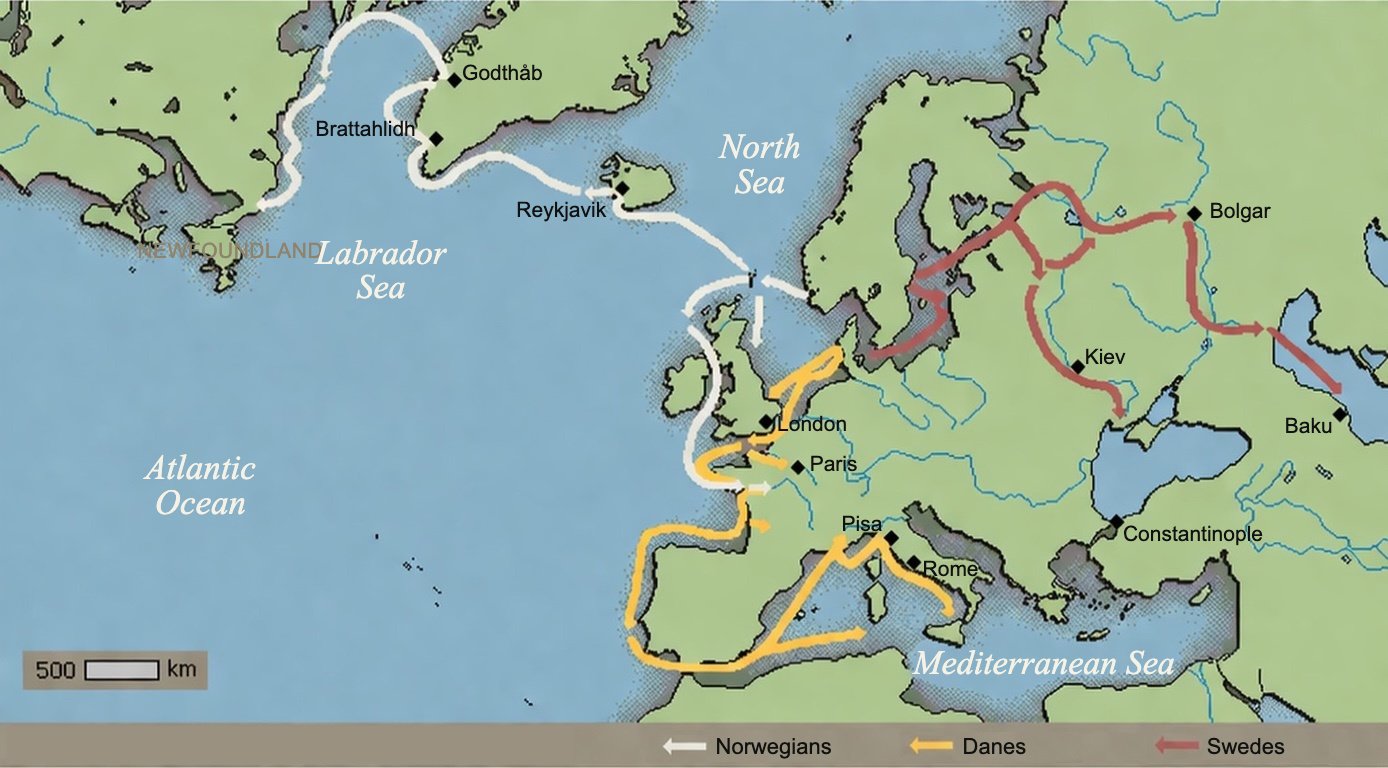
- The northern route (nordrvegr), with coastal sailing along the Baltic shores including Denmark and Sweden, plus crossings into the Atlantic.
- The western route (vestrvegr), from Denmark and Norway toward North Atlantic islands, Iceland (871-930), Greenland, North America, and coastal sailing along the shores of the Netherlands, Belgium, France, Spain, Italy and Greece.
- The eastern route (austrvegr), from Finland toward the Russian lakes and the Caspian Sea.
The calendar
To better understand the structure of the Icelandic calendar, we need to set aside our modern notions of month and year and adopt two others:
- The first is linked to the latitude of the countries where the Viking calendar was used. At those latitudes, oversimplifying greatly, the Sun hardly sets for six months and hardly rises for the other six.
- The second is that Viking-age populations were strongly attached to the number 7 (a religious reason?) and therefore to a 7-day week.
First division of time
From this, we better understand why their first time division was the “season” called Misseri. Each misseri represented roughly half of our year. One was called sumar (summer), the other vetr (winter). But let us not be misled: these misseri are less seasons in the climatic sense than labels for time periods.
In the Poetic Edda (the older Edda, containing poems composed between the 7th and 14th centuries), we find a few lines about this division of the “year” into two periods. More precisely, in Vafþrúðnismál (“The sayings of Vafþrúðnir”), we read a conversation between Odin (Oðinn) and Vafþrúðnir:
“26. [Oðinn says:]
"Tell me fourth,
Since all call you wise,
If you know, Vafþrúðnir,
Whence came winter
Or warm summer
The first time, clever giant?"27. [Vafþrúðnir says:]
But Svasuðr fathered summer."
"Vindsvalr is called
He who fathered winter,
A side note for the record: in that same Edda, we also learn that Mundilferi is father of the Moon (Mani) and the Sun (Sol). But contrary to what one might expect, the Moon is the son and the Sun is the daughter.
Second division of time
As seen above, the second division of time was naturally the week. Each day had a name, and we can present the weekday table.
| English day | "Viking" day | Meaning |
|---|---|---|
| Sunday | Sunnudagr | Sun's day |
| Monday | Mánadagr | Moon's day |
| Tuesday | Týsdagr | Tyr's day |
| Wednesday | Oðinsdagr | Odin's day |
| Thursday | Þórsdagr | Thor's day |
| Friday | Frjádagr | Freya's day |
| Saturday | laugardagr | "Washing" day |
Coexistence of both divisions
For lack of a better term, we will call year the unit made up of the summer-winter misseri pair.
That year had 364 days grouped into 52 weeks. 26 of those weeks formed the summer misseri, and the other 26 formed the winter misseri. At least for regular years, because we can clearly expect longer years, since 364 days are far from 365.25 days (the length of a tropical year).
Months
Yes, we must say it: months also existed in the Icelandic calendar. And here, two schools propose different hypotheses.
The first hypothesis is that the Icelandic month matched our modern notion: a precise period of the year with a fixed number of days. The year would have had 12 months of 30 days, plus 4 out-of-month days, two in summer and two in winter. This echoes the Egyptian calendar with its 12 months of 30 days. The difference lies in epagomenal days: 4 in the Icelandic system (because of the week structure), versus 5 in the Egyptian one.
The second hypothesis is that the Icelandic month had little to do with our modern notion and referred instead to a period without sharply fixed limits - a bit like saying “during the summer holidays.” We understand the period without strictly bounding it.
But why bother with months at all? The explanation may be that a lunar calendar was imported to Iceland, perhaps brought by Vikings. Inhabitants used it when possible - especially in winter, when the Moon was observable. For the rest of the year, they relied on the week. This may have lasted until the week alone replaced the week/month pair. Of course, months came back strongly with adoption of the Julian calendar.
Let us set out the month table without over-specifying start dates, just giving the approximate span in the Gregorian calendar.
| Month | Covered period | Month | Covered period |
|---|---|---|---|
| Mörsugur | December-January | Sólmánuður | June-July |
| Þorri | January-February | Heyannir | July-August |
| Góa | February-March | Tvímánuður | August-September |
| Einmánuður | March-April | Haustmánuður | September-October |
| Harpa | April-May | Gormánuður | October-November |
| Skerpla | May-June | Ylir | November-December |
Supplementary weeks
As we saw in our historical section, Viking peoples were too advanced in astronomy to be satisfied with a 364-day year. It seems that, at first, they occasionally added one or two days to avoid too much drift. But that solution was unsatisfactory: it did not anchor the calendar stably in time, and added days were necessarily outside any week.
The solution came from the Althing, the annual general assembly held outdoors at Thingvellir (“assembly plains”) in southwest Iceland, founded in 930.
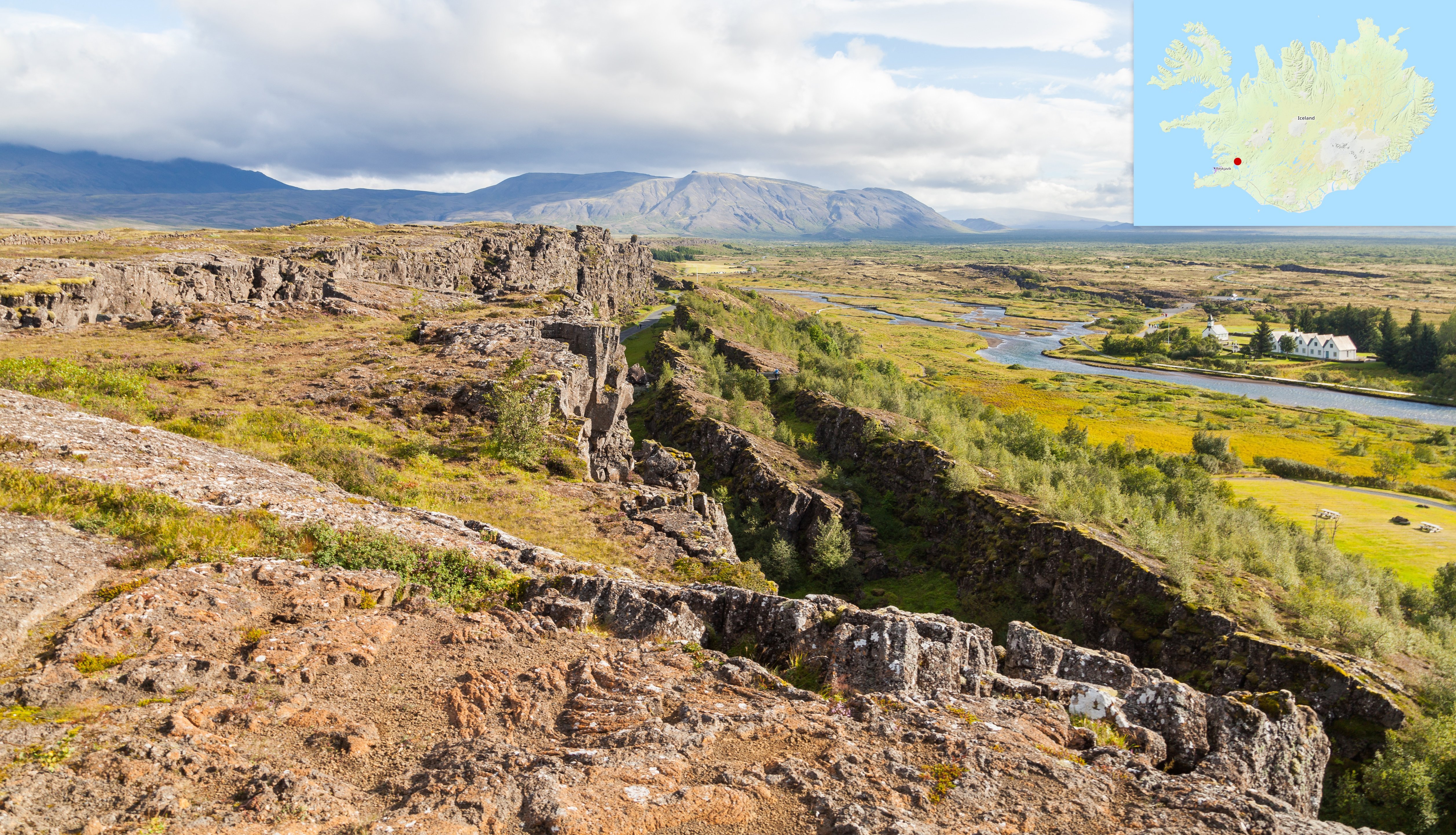
Ari Þorgilsson “the Wise”, in his History of Iceland (Islendingabók), written around 1120, recounts the reform implemented by the Althing in 955:
“... the wisest men of the country had counted 364 days or 52 weeks in two half-years - but observed, by the movement of the Sun, that summer was shifting toward spring...*
There was a man named Thorsteinn the Black, a very wise man. When they came to the Althing, he sought a remedy: they should add one week every seventh summer and see how it worked...
In a correct count, there are 365 days in a year, except leap years, which have one more. But in our count there are 364 days. Yet when in our count one week is added every 7 years, 7 years are of the same length in both counts. But if there are two leap years between two years to be increased, then increase the sixth.
To summarize clearly: Thorsteinn the Black proposed adding one week (called Sumarauki) to the summer misseri every 7 years. This method, different from Julian leap years, had the huge advantage of preserving the week structure.
In the second part of his text (in red), Ari Þorgilsson explains adjustments made when Iceland moved to the Julian calendar around the year 1000: if there are two Julian leap years between years that should receive an extra week (Icelandic calendar), the supplementary week is inserted after the sixth summer rather than the seventh.
The first rule gives an average year of (7 X 364) + 7 = 2555/7 = 365 days.
The second rule, not very easy to interpret, tends to bring the average year closer to the tropical year.
But why not simply insert one week every six years? That would give an average year of (6 X 364) + 7 = 2191/6 = 365.17, then apply the second rule.
That is the question Þorsteinn Vilhjálmsson raised in a 1991 Archaeoastronomy article. He wondered whether “in seven years” should be understood in the old sense, counting the starting year as year 1. A bit like still saying “in eight days” to mean “in a week” - i.e. in seven days. The debate remains open.
Still, over a 28-year cycle, the system effectively inserts 5 full years of 371 days.
In the Gragas (13th-century legal and customary compilation preserving older codes), we find the practical rule that the first day of sumar (summer misseri) always starts on a Thursday between 9 and 15 April. Vetr (winter misseri) starts on a Saturday between 11 and 18 October. If these conditions are not met, one week is added.
Start of the year and epoch
- What was the epoch of the old Icelandic calendar, i.e. the Gregorian (or Julian) date corresponding to day 1 of year 1?
The answer is simple: we do not know. Some suggest the summer solstice of 955 as 01/01/0001. Why not? - What was the first day of the year? There are several answers: some favor the winter solstice, others the summer solstice. The question remains open.
Note that the Julian calendar was progressively adopted from around year 1000, and the Gregorian transition happened in Iceland in 1700.
The primstav
We cannot leave Scandinavian calendars without mentioning the primstav, a calendar engraved on a square-section staff or a two-sided stick.
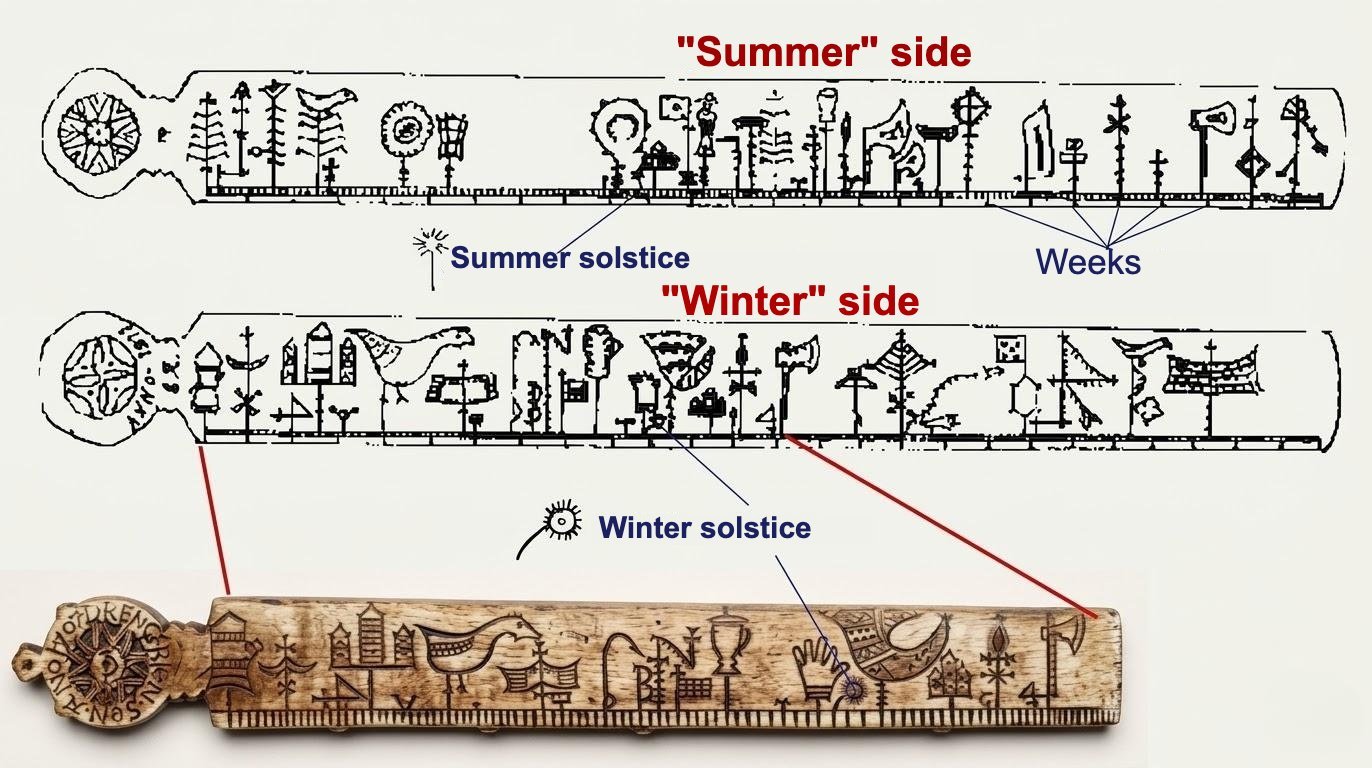
The first known examples date from around 1200, i.e. after the Viking period. They were used until around 1700.
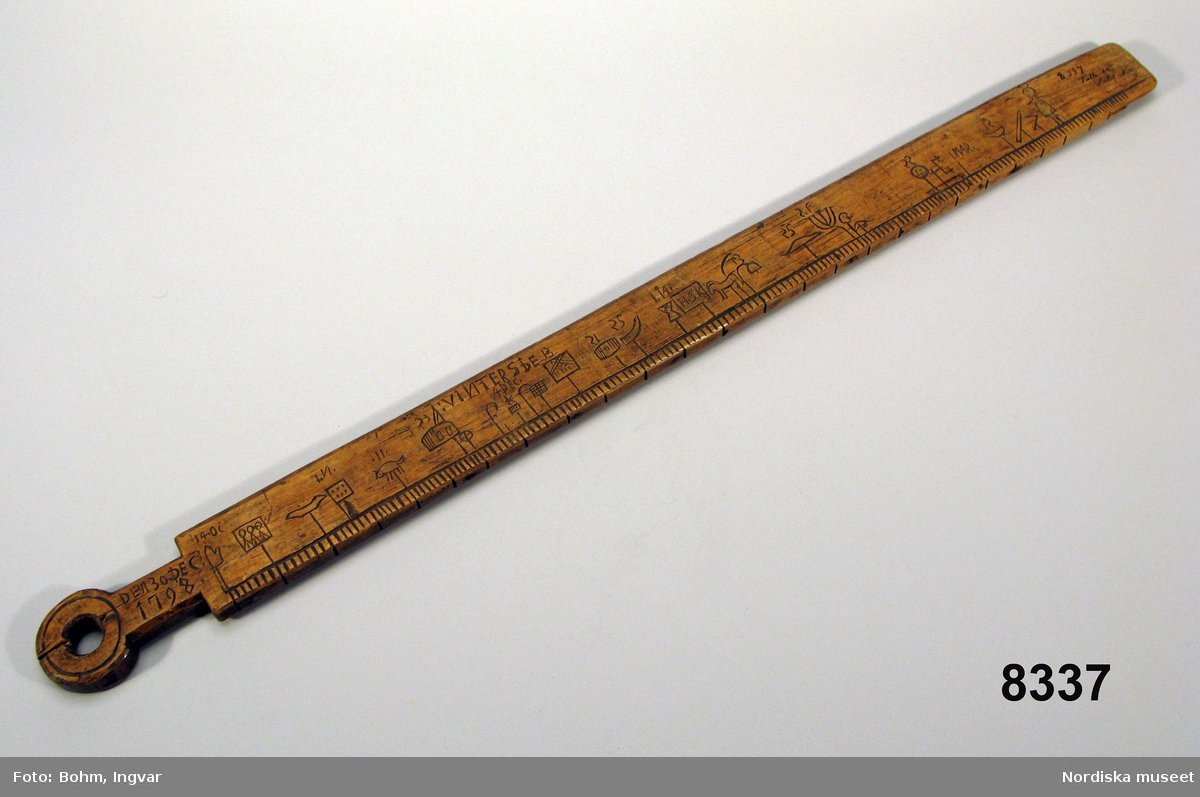
Primstav, Rimstock, Runstaf depending on country (Clogs in England): these calendars were all built on the same model.
Each side represented a season (4 sides for those built according to the Julian system, 2 sides for those in the “classic” model). The lower part of each side was marked in weeks, with days above.
They were engraved with symbolic motifs, probably as familiar then as road signs are to us now. They made it possible to orient oneself in time, in the season, and in the year.
For anyone who wants the full detail on these symbols, it is here.