History and calendar
For once, and unlike the other pages on this site about different calendars, we will not begin with a touch of history. Since the birth of the Republican calendar unfolded quickly over several months, it seems more useful to follow that birth chronologically, without separating it from the other events.
The beginnings of the Republican calendar
Before jumping onto the train of the Revolution, we still need to mention an event that took place in 1788: at the start of that year, a certain Sylvain Maréchal published an Almanach des Honnêtes Gens (Almanac of Honest People). In this calendar, saints' names were replaced by those of scholars and men of letters, “benefactors of humanity”, on the date of their birth (n) or death (m).
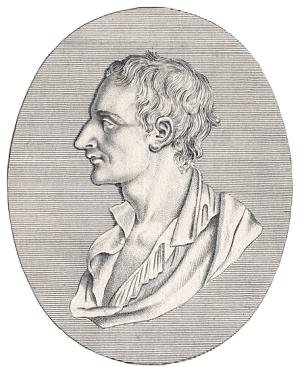
This Almanac followed two earlier publications:
- In 1780, an anonymous, openly atheistic work, Fragments d'un poème moral sur Dieu (Fragments of a Moral Poem on God), where the cult of Virtue replaced that of God and faith gave way to reason.
- In 1784, in Livre échappé au déluge (Book Escaped from the Flood), he parodied the Bible and opposed religion.
Did this Almanach des Honnêtes Gens influence the future Republican calendar? Hard to say, but one can see that anti-clerical sentiment was already there, and that the cult of Virtue still had bright days ahead of it.
As for Sylvain Maréchal (1750-1803), his Almanac caused scandal and failed badly, earning him three months in Saint-Lazare prison. If you want to know more about him, see here.
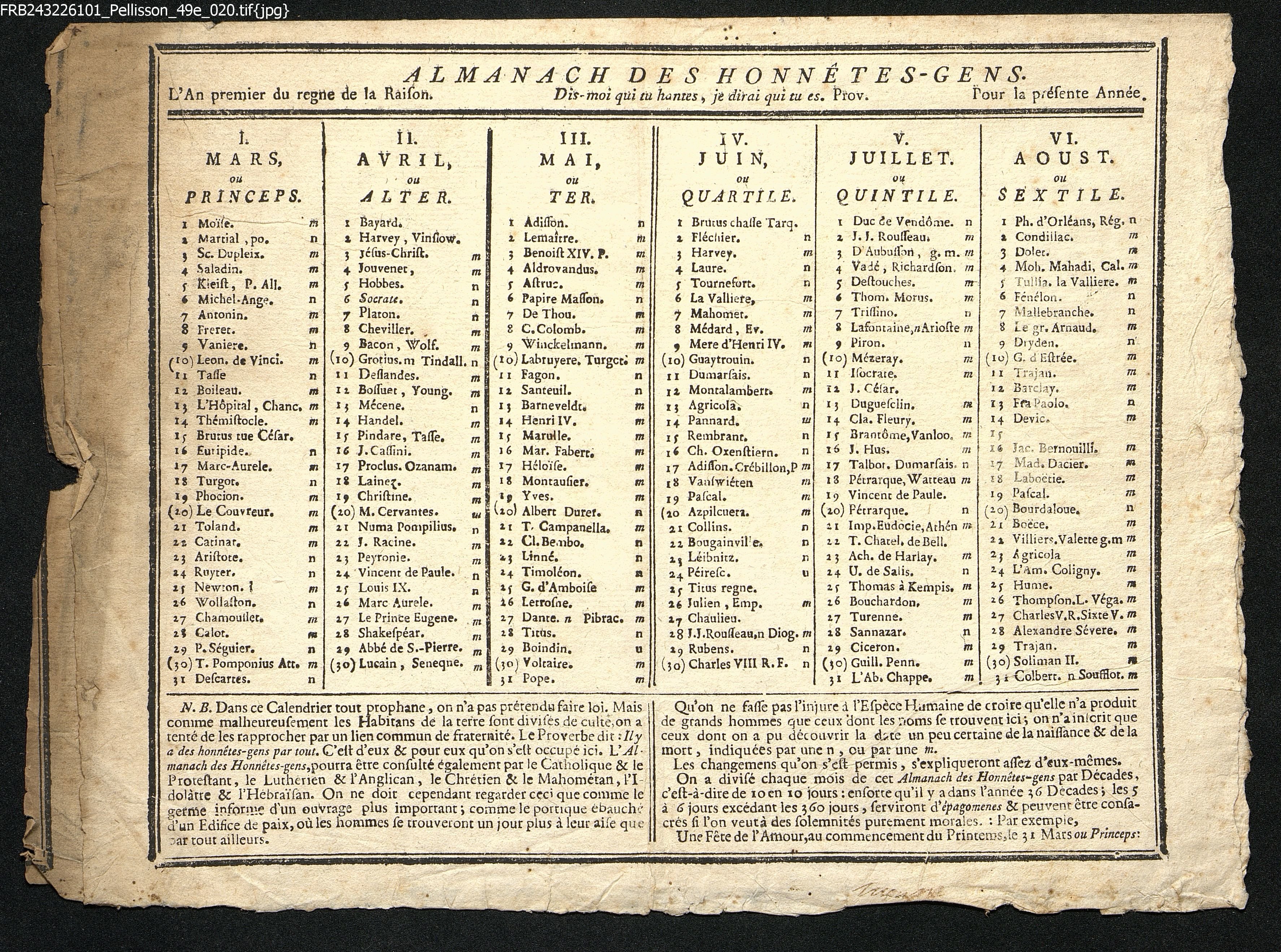
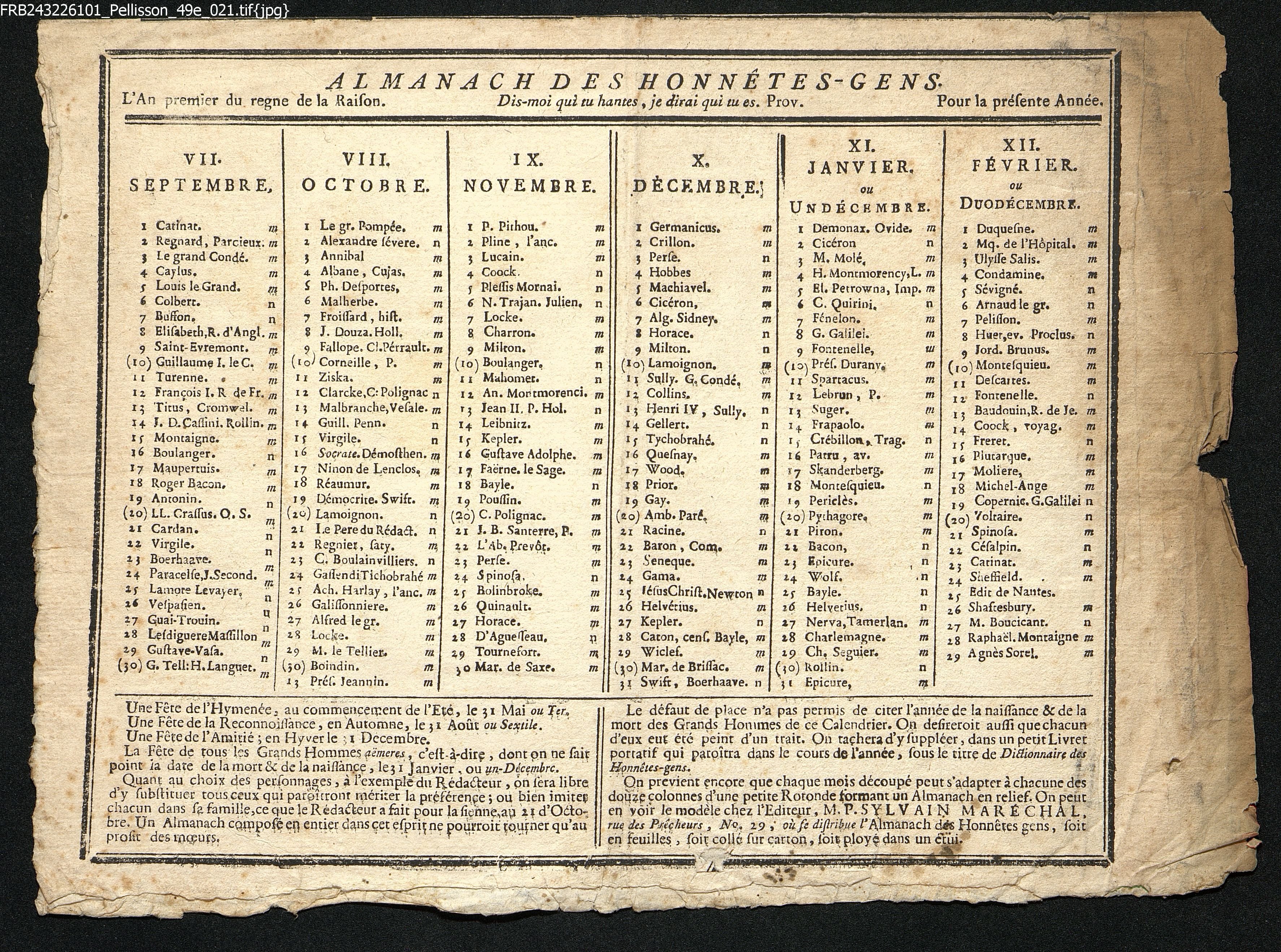
Front and back of Sylvain Maréchal's Almanach des Honnêtes Gens. Note the month names (... Quintile, Sextile...). The date 15 August has no name: it was Sylvain Maréchal's birth date. Modesty, or ambition?
The birth of the Republican calendar
From 1788, let us quickly move to 1793, noting key events along the way. Calendar-related events are in bold.
5 May 1789: opening of the Estates-General.
17 June 1789: the Third Estate proclaims itself National Assembly.
9 July 1789: the National Assembly becomes the Constituent Assembly.
14 July 1789: Storming of the Bastille. From the very next day, 1789 was called Year I of Liberty.
26 August 1789: Declaration of the Rights of Man.
12 July 1790: Civil Constitution of the Clergy.
14 July 1790: Festival of the Federation in Paris. The Moniteur carries the mention: “1st day of the second year of Liberty”
21 June 1791: arrest of the royal family at Varennes.
1 October 1791: opening of the Legislative Assembly.
14 October 1791: Decree establishing the Committee of Public Instruction. This Committee, made up of 24 members (mathematicians and astronomers such as Romme, Monge and Lakanal, painters such as David, poets such as Chénier...), would play a major role in drafting the new calendar.
29 November 1791: Decree of the Legislative Assembly against refractory priests.
2 January 1792: The Legislative Assembly decrees: "All public, civil, judicial and diplomatic acts shall bear the inscription of the era of Liberty. Year IV of the era of Liberty began on 1 January 1792."
10 August 1792: The Tuileries Palace is stormed. The king and his family seek refuge with the Assembly, which abolishes the monarchy and imprisons the royal family at the Temple. A National Convention is convened.
20 September 1792: First sitting of the Convention. Victory at Valmy.
22 September 1792: The National Convention decrees: “All public acts are henceforth dated from Year I of the Republic.”
And so we are in 1793, a year Louis XVI would not see to the end, as he would be cut in two on 21 January by the very device whose improvement he had helped with. From this point, we leave “great history” aside and focus on the history of our Republican calendar.
Year 1793 begins with a decree of 2 January: “The second year of the Republic begins on 1 January 1793.”
Looking back, we see we first had the era of Liberty - whose first year may have begun on 14 July, though unclear - then the era of the Republic, which for now begins on 1 January each year.
The National Convention tasked the Committee of Public Instruction with preparing a new calendar. The Committee, in turn, appointed a working group formed by Romme (rapporteur), Dupuis, Guyton, Ferry, Lagrange and Monge to draft a proposal.
But why create a new calendar? Proof that the Gregorian calendar was “technically sound” is that it is now used almost worldwide.
For the first time in calendar history, we are witnessing the birth of a calendar driven by pure ideology: it was necessary to put an end to the powers of the Church, and its symbol, the Gregorian calendar, with its saints' feasts and Lord's day, would pay the price. Rational values had to replace them.

An inkwell from the Revolution period: temporal powers of the Church had to end. Creating a new calendar was part of that project.
The group for which Romme was rapporteur worked in this direction, and Romme was able to present the proposal to the Committee of Public Instruction on 14 September 1793.
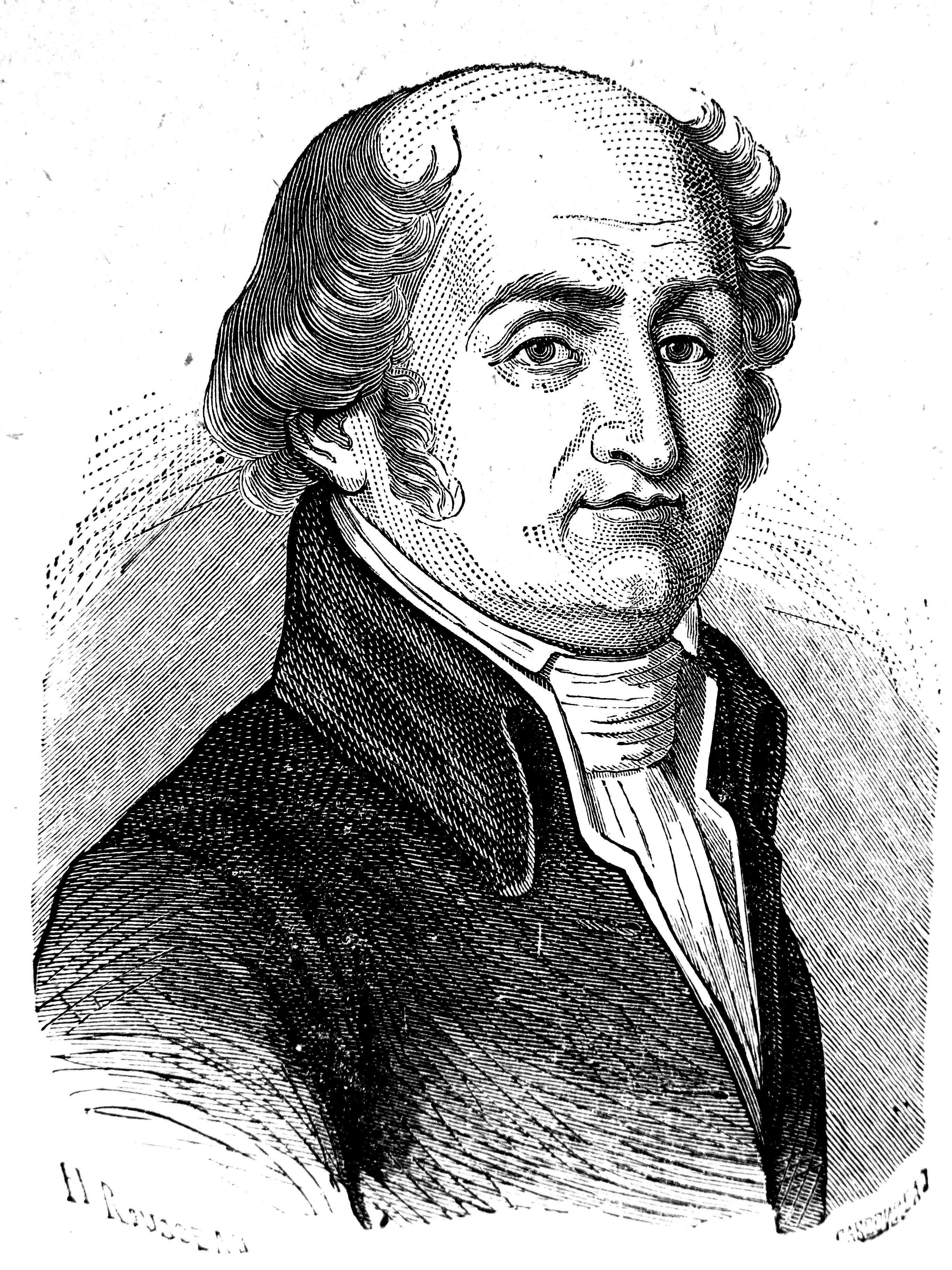
Charles Gilbert ROMME (1750-1795) Mathematician, trained at the Oratorian college in Riom. He was sent by Puy-de-Dôme to the Legislative Assembly, then to the Convention where he sat with the Montagnards. Sentenced to death, he committed suicide before execution.
The Committee approved the proposal, and Romme presented it to the Convention on 20 September 1793.
Session of the National Convention of 20 September 1793
I will not reproduce the full text here, as it is quite long and includes several tables. Here are the most important parts:
A brief introduction on why a new calendar: "The common era was the era of cruelty, lies, perfidy and slavery; it ended with monarchy, source of all our evils. The Revolution has reforged the French soul, and each day forms it in republican virtues. Time opens a new book to history; and in its new course, majestic and simple like equality, it must engrave with a fresh and pure chisel the annals of regenerated France."
Length of the year: "The Egyptians, from highest antiquity, and the Babylonians 746 years before the common era, approached true principles by making their year 365 days, distributed into 12 equal months of 30 days and 5 epagomenal days."
Beginning of the year: "[...] 22 September was decreed the 1st of the Republic; and on that same day, at 9 hours 18 minutes 30 seconds in the morning, the Sun reached the true equinox, entering Libra. Thus the equality of day and night was marked in the sky at the very moment when civil and moral equality was proclaimed by the representatives of the French people as the sacred foundation of their new government. [...] We propose to decree that the day of the true autumn equinox, which was the day of the Republic's foundation, is the era of the French and the first day of their year, and at the same time to abolish the common era for civil uses."
Divisions of the year
Month: "Known peoples, except perhaps the Romans, divided the year into 12 months. [...] No doubt 12 was chosen because it expresses how many times the Moon passes before the Sun while the Earth completes one revolution. This division is convenient and cannot be seriously challenged. But what reason rejects, and must finally remove from our calendar, is the odd inequality of months, which tires the mind with constantly recurring difficulties in knowing whether a month has 30 or 31 days. [...] The most enlightened Egyptians of high antiquity made all months equal, each with 30 days, then added five epagomenal days at year's end. This division is simple, offers major domestic and civil advantages, and therefore suits the new calendar of the French."
Week: "You have recognized all the advantages of decimal numbering. You adopted it for all weights and measures, as well as for the currency of the Republic: we propose introducing it into month division, which, being 30 days, will be divided into three parts of 10 days each, to be called a decade. [...] The decade day will always indicate the same days of month and year. This advantage cannot be obtained with the week."
Day: apart from a few comments on day-start in different countries or ancient civilizations, Romme made no proposal.
Division of the day: "Dividing the hour into sixty minutes and the minute into sixty seconds is highly inconvenient in calculations. [...] Improvement will be complete when time is subjected to the simple and general rule of decimal division in all things. [...] However, since the changes required in clockmaking can only be gradual, we propose making this mandatory for civil use only from the third year of the Republic."
Intercalation of a sixth epagomenal day (Romme calls it “Olympiad”): "If reason requires us to follow nature rather than slavishly drag ourselves in the erroneous tracks of our predecessors, we must fix our intercalary day invariably at the moment required by the equinox's position. After an initial arrangement, made necessary by consistency with astronomical observation, the period will always be 4 years. [...] We propose to call it the Olympic Day."
That is the “theoretical” part of the new Republican calendar as presented by Romme to the Convention. We shall later see that the intercalation system imagined was incompatible with year-start set at midnight, true time of Paris Observatory, preceding the autumn equinox.
We now move to the “practical” part of this new calendar under Romme's proposal: nomenclature.
"We propose a new nomenclature that is neither celestial nor mysterious; it is entirely drawn from our Revolution, presenting either its main events or its purpose and means."
Then follows a history of the Revolution from which certain names are drawn for months. Here is the beginning so you can get the idea:
"The French, weary of 14 centuries of oppression, alarmed by the fearful progress of corruption encouraged and exemplified by a long-criminal court, feel the need for regeneration. Court resources were exhausted; it convoked the French, but their gathering became their salvation..."
Same principle for epagomenal days: "The last five days correspond to 17, 18, 19, 20 and 21 September and may be devoted to national festivals. We believe their names may be taken from the concise statement of the moral aim of our new institutions. [...] They will be examined as artists or soldiers, and receive due rewards; fatherhood will be encouraged and considered; old age will be honored. [...]"
As for names of decade days: "Every citizen, every friend of country and arts that make it flourish, must daily surround himself with the attributes of industry and liberty."
I summarize all this new nomenclature in the table below, with the symbol represented by decade-day names:
| Rank | Correspondence | Name | Decade | Symbol |
|---|---|---|---|---|
| 1 | 22 Sep-21 Oct | The Republic | Level Day | Equality |
| 2 | 22 Oct-20 Nov | Unity | Cap Day | Liberty |
| 3 | 21 Nov-20 Dec | Fraternity | Cockade Day | National colors |
| 4 | 21 Dec-19 Jan | Liberty | Pike Day | Weapon of the free man |
| 5 | 20 Jan-18 Feb | Justice | Plough Day | Tool of our land wealth |
| 6 | 19 Feb-20 Mar | Equality | Compass Day | Tool of our industrial wealth |
| 7 | 21 Mar-19 Apr | Regeneration | Bundle Day | Strength born of unity |
| 8 | 20 Apr-19 May | Gathering | Cannon Day | Tool of our victories |
| 9 | 20 May-18 Jun | Tennis Court Oath | Oak Day | Emblem of generation; social virtues |
| 10 | 19 Jun-18 Jul | The Bastille | Rest Day | |
| 11 | 19 Jul-17 Aug | The People | ||
| 12 | 18 Aug-19 Sep | The Mountain | ||
| Epagomenal days | Correspondence | Name | ||
| 1 | 17 Sep | Adoption | ||
| 2 | 18 Sep | Industry | ||
| 3 | 19 Sep | Rewards | ||
| 4 | 20 Sep | Fatherhood | ||
| 5 | 21 Sep | Old Age | ||
| 6 | intercalary | Olympic Day |
Note that this proposal was the second in a series of seven. The first was very “neutral”, simply numbering days and months.
The fifth proposal was “for the whole Globe”, showing the ambition of the new calendar's authors. Decade-day names were “Latinized” (Prime-di, Deux-di, tri-di, etc.). Epagomenal days were numbered and month names were those of zodiac signs.
The decree establishing the new calendar was voted by the Convention on 5 October 1793. Here it is:
Decree of the National Convention concerning the era of the French
Dated 5 October 1793, Year II of the French Republic, one and indivisible.
The National Convention, having heard its Committee of Public Instruction, decrees as follows:
ARTICLE I The era of the French shall be counted from the foundation of the Republic, which took place on 22 September 1792 of the common era, the day when the Sun reached the true autumn equinox, entering Libra at 9 hours 18 minutes 30 seconds in the morning, for the Paris Observatory.
II. The common era is abolished for civil uses.
III. The beginning of each year is fixed at midnight, beginning on the day on which the true autumn equinox falls for the Paris Observatory.
IV. The first year of the French Republic began at midnight on 22 September 1792 and ended at midnight separating 21 from 22 September 1793.
V. The second year began at midnight on 22 September 1793, the true autumn equinox having occurred, for the Paris Observatory, at 3 hours 7 minutes 19 seconds in the evening.
VI. The decree fixing the beginning of the second year at 1 January 1793 is repealed. All acts dated Year II of the Republic, made from 1 January up to and excluding 22 September, are regarded as belonging to the first year of the Republic.
VII. The year is divided into twelve equal months of thirty days each, followed by five days to complete the ordinary year, which belong to no month; they are called complementary days.
VIII. Each month is divided into three equal parts of ten days each, called decades, distinguished as first, second and third.
IX. Months, decade days and complementary days are designated by ordinal denominations: first, second, third, etc. month of the year; first, second, third, etc. day of the decade; first, second, third, etc. complementary day.
X. In memory of the Revolution which, after four years, brought France to republican government, the four-year leap period is called the Franciade. The intercalary day ending this period is called the Day of the Revolution. This day is placed after the five complementary days.
XI. The day, from midnight to midnight, is divided into ten parts; each part into ten others, and so on to the smallest commensurable portion of duration. This article shall only be binding for public acts from the 1st day of the 1st month of Year III of the Republic.
XII. The Committee of Public Instruction is charged with printing the new calendar in different formats, with a simple instruction to explain its principles and most familiar uses.
XIII. The new calendar and the instruction shall be sent to administrative bodies, municipalities, tribunals, justices of the peace and all public officers, teachers and professors, armies and popular societies. The provisional executive council shall transmit them to French ministers, consuls and other agents in foreign countries.
XIV. All public acts shall be dated according to the new organization of the year.
XV. Professors, teachers, fathers and mothers, and all those directing children's education in the Republic shall hasten to explain the new calendar to them, in accordance with the attached instruction.
XVI. Every four years, or every Franciade, on the Day of the Revolution, republican games shall be celebrated in memory of the French Revolution.
The new calendar was to take effect the day after this implementing decree, but a later decree (22 October 1793) fixed the dates when different administrations had to adopt it:
From the 1st day of the 2nd month of Year II of the French Republic, one and indivisible.
The National Convention, having heard its finance committee, decrees:
ARTICLE I For all administrations with accounting by fiscal years, the one begun 1 January 1793 shall continue until day 1 of month 1 of year 3 of the Republican year.
II. All administrations whose receipts, expenditures and operations were divided by quarter shall adopt the Republican calendar so that the current quarter ends on the last day of month 3 (20 December 1793, old style).
III. All administrations whose receipts, expenditures and operations were divided by month and portions of month shall adopt the Republican calendar so that it takes full effect on day 1 of month 3.
IV. All administrations whose receipts, expenditures and operations were divided by weeks shall adopt division by decades of the Republican calendar so that it takes full effect on day 1 of decade 1 of month 3.
What can be said about these two texts? The second resolves administrative issues meant to avoid interrupting financial periods. There is little more to add.
By contrast, a few observations can be made on the first text compared with Romme's proposal:
- The idea of Olympiad is replaced by Franciade, and Olympic Day becomes Day of the Revolution.
- Although causing clockmaking difficulties, the day is divided into ten parts.
- Year day one is adopted and fixed to the true autumn equinox.
- The whole nomenclature section is dropped: months and days are numbered.
In fact, nomenclature is not dropped but heavily debated within the Convention itself, as shown by an excerpt from the Journal of Debates and Decrees of the Convention session of day 27 of month 1, year II (18 October 1793):
“Romme submits to the Convention a nomenclature for decade-day names. [...] the first day would be primile, second bisile, and so on. [...] These sounds did not seem to please listeners' ears. It had also been proposed to say primedi, and so on. This was no better. [...] Other members proposed assigning days and months names linked to moral ideas, or images drawn from the most pleasing aspects of nature. To reach this goal, a commission was proposed composed of Romme, Fabre d'Eglantine, David, Chénier.
A new commission to study new nomenclature was therefore created on 18 October 1793, and a new name appeared (the others were already in the Committee of Public Instruction):
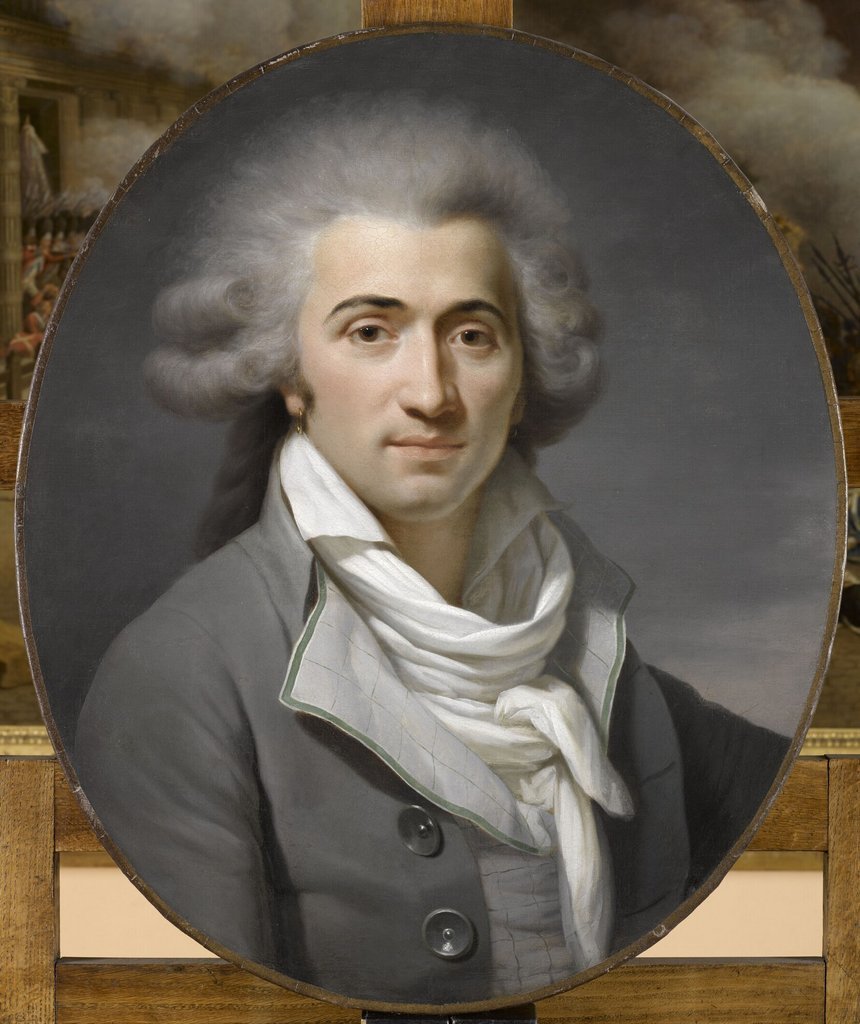
Philippe FABRE (1750-1794) Son of a draper from Carcassonne, Philippe Nazaire François Fabre was a traveling actor-writer. He won a golden flower at Toulouse's Floral Games, earning the nickname Fabre d'Eglantine.
The popular song Il pleut, il pleut bergère... comes from one of his operettas.
He is also cited as having received money from the king on the eve of 10 August 1792. After that day, he published a wall journal: he encouraged the September massacres and even tried to extend them to the provinces.
Entering the Cordeliers Club, later the Jacobin Club, he allied with Danton, becoming his secretary at the Ministry of Justice in 1792. He later became a Montagnard deputy (for Paris) at the Convention.
Accused of falsifying a Convention decree concerning liquidation of the former East India Company, he was arrested on 18 March 1794, tried alongside Danton on 30 March, and guillotined on 5 April.
The new commission worked quickly and, though we do not know each person's exact role in developing nomenclature (likely influenced by Fabre and Chénier given its “poetic” style), was able to present its work to the Convention as early as 24 October 1793.
Again, as the text is very long, here are the essential passages:
Session of the National Convention of day 3 of month 2 of year II (24 October 1793)
"A member (Fabre d'Églantine), in the name of the commission formed for nomenclature of months and days [...]"
"[...] You should seize this happy opportunity to bring the French people back to agriculture through the calendar, the most commonly used book of all."
After long anti-clerical lines come the nomenclature explanations:
"[...] the core idea on which we based ourselves is to dedicate, through the calendar, the agricultural system and bring the nation back to it by marking periods and fractions of the year with intelligible or visible signs drawn from agriculture and rural economy. [...] We imagined giving each month a characteristic name expressing its proper temperature, current type of earthly production, and at the same time signalling in which of the four seasons it lies. [...] Thus month names of autumn have a grave sound and medium measure, winter a heavy sound and long measure, spring a cheerful sound and short measure, summer a resonant sound and broad measure." That was polished, wasn't it? Ah! Sorry!!
Month names of the year are therefore as follows:
| Autumn | Winter | Spring | Summer |
|---|---|---|---|
| Vendemiaire | Nivose | Germinal | Messidor |
| Brumaire | Pluviose | Floreal | Thermidor |
| Frimaire | Ventose | Prairial | Fructidor |
Note that, according to authors of Le calendrier républicain (source of these texts), published by Bureau des Longitudes, the text presented to the Convention originally used Fervidor rather than Thermidor for summer's second month. Fabre is said to have replaced Fervidor with Thermidor on his own between reading and publication. As those authors rightly note, "Thermidor has the drawback of introducing a Greek-origin term into a nomenclature whose other names are all Latin."
Now for decade explanations:
"We thought that [...] we should create names for each day of the decade; we also thought that since these names repeat 36 times a year, they should be stripped of imagery [...] Finally we realized memory would be greatly helped if, while distinguishing decade days from ordinal numbers, we still preserved those numbers' meaning in a compound word, so that in the same word we could use both numbers and a name different from numbers."
And Fabre, in good “salesman” fashion, explains in every way the benefit of having a decade word that is not a number but recalls one. He then reaches the “main course”: naming each day of the year, which he calls “the fourth movement, the annual movement”.
"Here we enter our fundamental idea: to draw from agriculture what can refresh memory and spread rural instruction in year reckoning and flow. [...] We believed that after driving out this crowd of canonized figures from its calendar, the Nation should find there all objects composing true national wealth, objects not of worship perhaps, but of cultivation, useful products of the earth, tools used to cultivate it, and domestic animals, faithful servants in this labor, animals no doubt far more valuable in reason's eyes than beatified skeletons from Rome's catacombs."
I leave you to appreciate that ending as it deserves! I do not think I spoil the story by saying the Republican calendar did not last long, but I wonder what would have happened had it achieved universal posterity. Hard to see the Rooster recognized by Lapps as one of their familiar animals. And one of my friends will surely be surprised to learn couch grass counts among “national wealth”. Maybe that's why no specific weedkiller has yet been found for that pest! But enough jokes, and back to Fabre's speech.
He explains that each day is attached to a plant name “the time and day when nature offers it”. Each half-decade is marked by a domestic animal useful at that moment, and each decade by a farming tool used by the farmer at that moment. Fabre explains placing that tool on a rest day by saying “the ploughman on his day of rest finds the tool he must pick up again tomorrow.” He adds: "an idea, it seems to me, that can only move our providers and show them at last that with the Republic has come the time when a ploughman is valued more than all kings of the earth together..." For my part, I suggest Sundays be named Airbus, Caravelle, Concorde... maybe that would spare us a few strikes?
Only the complementary days remained to be named:
"It remains to speak of days first called epagomenal, then complementary. [...] We thought these five days needed a collective denomination with a national character capable of expressing joy and spirit of the French people in the five festival days celebrated at each year's end. [...] We shall therefore call these five days collectively the sansculottides. The five sansculottides, forming a half-decade, shall be named primdi, duodi, tridi, quartidi, quintidi and, in leap year, sixth day sextidi."
Names were assigned to these six festival days. The second was to be “day of deeds” while the first was “festival of genius”. After Robespierre's anger, deeds became virtue and came before genius. Final denomination became:
| Rank | Day | Name |
|---|---|---|
| 1 | Primdi | Festival of virtue |
| 2 | Duodi | Festival of genius |
| 3 | Tridi | Festival of labor |
| 4 | Quartidi | Festival of opinion |
| 5 | Quintidi | Festival of rewards |
| 6 | Sextidi | The Sanculottide |
The text of the session of 24 October 1793 ends with this decree:
“The National Convention, repealing Article 9 of the decree of the 14th of month one (5 October 1793), decrees that nomenclature, denominations and positions of the new calendar shall conform to the table annexed to this decree. N.B.: by amendment, the Convention decrees that the festival of deeds shall be celebrated on primdi of the sansculottides under the name festival of virtue, and the festival of opinion on quartidi of the sansculottides.
As this page is already very long (you can read the continuation of the Republican calendar on another part), I spared you here the list of day names for each month. But since it is interesting, you will find it here.
The new calendar and its nomenclature were therefore adopted by the Convention.
Some amendments were proposed.
On 19 Brumaire, the Convention decided all calendar decrees would be merged into one.
At a session of the Committee of Public Instruction on 29 Brumaire, Year II (19 November 1793), a member requested appointing two commissioners to present a complete system of festivals for the Republican year. David and Romme were given this task.
The recast of the major decree was presented by Romme, in the name of the Committee of Public Instruction, to the Convention on 4 Frimaire, Year II. It was adopted by the Convention.
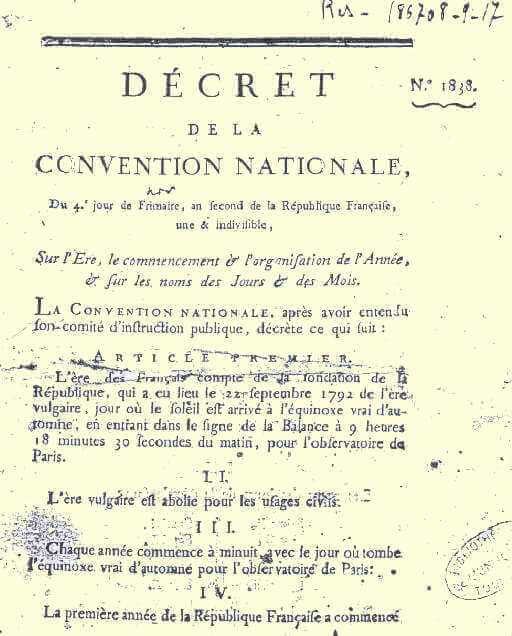
Here is the text
Decree of the National Convention on the New Era, the beginning and organization of the Year, and the names of Days and Months.
Dated 4 Frimaire, Year II of the French Republic, one and indivisible.
1. The era of the French is counted from the foundation of the Republic, which took place on 22 September 1792 of the common era, the day the Sun reached the true autumn equinox, entering Libra, at 9 hours 18 minutes 30 seconds in the morning at the Paris Observatory.
2. The common era is abolished for civil uses.
3. Each year begins at midnight, with the day on which the true autumn equinox falls for the Paris Observatory.
4. The first year of the French Republic began at midnight on 22 September 1792 and ended at midnight separating 21 from 22 September 1793.
5. The second year began at midnight on 22 September 1793, the true autumn equinox having occurred that day, for the Paris Observatory, at 3 hours 11 minutes and 38 seconds in the evening.
6. The decree fixing the start of the second year at 1 January 1793 is repealed; all acts dated Year II of the Republic, made from 1 January to 21 September inclusive, are considered part of the first year of the Republic.
7. The year is divided into twelve equal months of thirty days each; after the twelve months come five days to complete the ordinary year; these 5 days belong to no month.
8. Each month is divided into three equal parts of ten days each, called decades.
9. Names of decade days are: primidi, duodi, tridi, quartidi, quintidi, sextidi, septidi, octidi, nonidi, decadi. (note: primdi becomes primidi)
Month names are, for autumn, vendemiaire, brumaire, frimaire; for winter, nivose, pluviose, ventose; for spring, germinal, floreal, prairial; for summer, messidor, thermidor, fructidor.
The last five days are called sans-culotides.
10. The ordinary year receives one additional day, according to equinox position, to maintain coincidence of civil year with celestial motions. This day, called day of the Revolution, is placed at year end and forms the sixth sans-culotide. (note: Sanculottide becomes day of the Revolution and sanculottides become sans-culotides)
The four-year period after which this addition is usually necessary is called franciade, in memory of the Revolution which, after four years of effort, brought France to republican government. The fourth year of the franciade is called sextile. (note: the word bissextile, wrongly used by Fabre in his report of 24 October, is replaced by sextile)
11. The day, from midnight to midnight, is divided into ten parts or hours, each part into ten others, and so on to the smallest commensurable portion of duration. The hundredth part of the hour is called decimal minute; the hundredth part of the minute is called decimal second. This article shall only be mandatory for public acts from 1 Vendemiaire, Year III of the Republic.
12. The Committee of Public Instruction is charged with printing the new calendar in different formats, with simple instruction explaining principles and usage.
13. The calendar, along with instruction, shall be sent to administrative bodies, municipalities, tribunals, justices of the peace and all public officers, armies, popular societies, and all colleges and schools. The provisional executive council shall send it to French ministers, consuls and other agents in foreign countries.
14. All public acts shall be dated according to the new organization of the year.
15. Professors, teachers, fathers and mothers, and all those directing children's education shall hasten to explain the new calendar to them, in accordance with attached instruction.
16. Every four years, or every franciade, on day of the Revolution, republican games shall be celebrated in memory of the French Revolution.
Republican festivals
It was neither Romme nor David who proposed a project on festivals, but a certain Mathieu, deputy for Oise, during a Committee of Public Instruction session of 9 Ventose, Year II (27 February 1794):
“It shall celebrate every year the most memorable events and moments of the Revolution. Five festivals shall be instituted to recall them to the French. These festivals shall be: 1) 14 July 1789; 2) 10 August 1792 and 1793; 3) 6 October 1789; 4) 21 January 1793; 5) 31 May 1793.
Added to this proposal were: the Revolution festival every 4 years (6th day of sans-culottides), the other 5 sans-culottides, and one festival every decadi of the year.
The proposal was retained by the Committee of Public Safety, and decade festivals were named as follows:
| To the Supreme Being and to Nature | To heroism |
| To humankind | To selflessness |
| To the French people | To stoicism |
| To benefactors of humanity | To love |
| To martyrs of liberty | To marital fidelity |
| To liberty and equality | To paternal love |
| To the Republic | To maternal tenderness |
| To liberty of the world | To filial piety |
| To love of country | To childhood |
| To hatred of tyrants and traitors | To youth |
| To truth | To manhood |
| To justice | To old age |
| To modesty | To misfortune |
| To glory and immortality | To agriculture |
| To friendship | To industry |
| To frugality | To ancestors |
| To courage | To posterity |
| To good faith | To happiness |
At the Convention session of 18 Fructidor, Year II (4 September 1794), Thibeaudeau (do you know him?) presented a report following a proposal made at the Committee of Public Instruction session of 15 Fructidor, Year II (1 September 1794).
He proposed suppressing the 5 sans-culottides festivals and making only the fifth a rest day, combining festival of virtue, genius, labor, opinion and rewards.
This proposal was adopted by the Convention on 19 Fructidor, Year II (5 September 1794).
Sextile years
Following Articles 4 and 10 of the decree of 4 Frimaire, Year II (above on this page), a table had been attached giving sextile years for the next 13 years of the Republic: Year III, Year VII and Year XI.
But according to astronomer Delambre's calculations (not consulted in 1793), sextile years do not recur so regularly, and three times per century the interval between two sextile years would be... 5 years. Also, given the imprecision of calculations at the time, he noted it would be impossible to know in advance whether equinox would fall before or after 24 hours when computed equinox time was too close to midnight.
Delambre proposed returning to Gregorian intercalation, communicated conclusions to Lalande and Laplace, who alerted Romme: Articles 3 and 10 needed revision.
Romme, in turn, seized the Committee of Public Instruction, which asked him to study the question and gather all available expertise: Delambre, Lagrange, Pingré, Laplace, Lalande, Messier, Nouet.
Delambre presented his proposal to them on 29 Germinal (18 April 1795), and it was adopted.
Romme presented a draft decree on 19 Floreal, Year III (8 May 1795) during a Committee of Public Instruction session:
ARTICLE ONE. The fourth year of the era of the Republic shall be the first sextile: it shall receive a sixth complementary day and end the first franciade. ART. 2. Sextile years shall follow one another every four years and mark the end of each franciade. ART. 3. Of four consecutive centurial years, the first, second and third are excepted from the previous article and shall be common; only the fourth shall be sextile. ART. 4. So it shall continue every four centuries until the fortieth, which shall end with a common year. ART. 5. An instruction shall be annexed to this decree to facilitate applying the rule it contains and explain the principles underlying it. ART. 6. Every year, an almanac shall be extracted from Connaissance des temps and presented to the National Assembly for civil uses: computed from exact observations, it shall serve as model for calendars distributed throughout the Republic. ART. 7. The Commission of Public Instruction is charged with accelerating, by all means at its disposal, dissemination of the new time measures. It is authorized to renew each year nomenclature of useful objects accompanying the almanac for each day, and for which instructive notes shall be made for school use.
If you read the last sentence carefully, you will see Romme finally took into account the remarks I made in the first page on the Republican calendar: we could finally change names of plants, animals and other objects from time to time! Some “Sundays” could be dedicated to Wolf, Ferguson or Black and Decker (one end of decade for Black, another for Decker).
But I am joking - and ashamed of it, because this was not quite the moment. We are in 1795. Romme is among 14 representatives ordered arrested by the Convention on 1 Prairial. He is imprisoned in Château du Taureau in Brittany and sentenced on 29 Prairial (17 June 1795). His tragic end prevents him from putting a final full stop to “his” calendar.
On 7 Messidor (25 June 1795), the Bureau des Longitudes is created.
This Bureau began with a puzzling about-face: on 8 Thermidor, Year III (26 July 1795), it asked the Committee of Public Instruction to adopt Romme's and the astronomers' intercalation mode. On 14 Thermidor, Year III (1 August 1795), it proposed, on the contrary, changing nothing in existing provisions.
The sextile issue was therefore buried without ever being resolved.
End of the Republican calendar
The Republican calendar had been born little by little through decrees and amendments. It would die the same way, through criticism. Its death, like its birth, was political.
We will look at this, but I still ask myself one question: aside from civil acts, was it truly used by the French people in so few years? Seeing how difficult it can be for some (myself included, I fear) to switch to the euro, one may wonder.
As for criticism, here are excerpts from deputy Lanjuinais' opinion on 30 Thermidor, Year III:
“First, it is a problem to know which day starts the year in the new calendar. [...] new month names are true in the north and perpetual falsehood in the south. [...] Decadi does not agree with nature. Neither men nor animals can endure nine consecutive days of labor. [...] Why is the most solemn religious feast in Romme and Fabre d'Eglantine's calendar the Day of the Dog? [...] I therefore vote that the calendar of France's assassins should not constitutionally be the calendar of the French people.
Bonaparte's idea was to make Catholic religion a state religion.
From that point, for reasons opposite to those that had imposed it, the Republican calendar had to be dismantled.
He begins by breaking decadi: by decree of the Consuls on 7 Thermidor, Year VIII, only civil servants remain subject to decadi. On 18 Germinal, Year X, civil servants' rest day is fixed to Sunday. The week becomes legal again.
On 28 Floreal, Year XII (18 May 1804), the Senate proclaims Napoleon Emperor of the French, and Pius VII consecrates the event on 13 Frimaire, Year XIII (4 December 1804).
Then on 22 Fructidor, Year XIII (9 September 1805), shortly before Pius VII's arrival, the Senate decrees that “from next 11 Nivose, the Gregorian calendar shall be restored throughout the French Empire”. 11 Nivose was 1 January 1806.
Laplace himself presented the report of the commission “for examination of the senatus-consult project restoring the Gregorian calendar”.
And through his voice, the Republican calendar did not die “in shame”: "It is not a question of examining which, among all possible calendars, is the most natural and simplest. We shall only say that it is neither the one to be abandoned, nor the one proposed to resume..."
In short, neither yes nor no. Laplace successively accepted the title of Count from Napoleon and then Marquis from Louis XVIII.
The Republican calendar was reinstated during the Commune, from 6 to 23 May 1871... and entered French history.
“Reinstated” may in fact be excessive. One mainly finds dates expressed in Republican form on a poster from the start of the “bloody week” of 23 May 1871 (noted 3 Prairial Year 79), and three others in the Journal Officiel (Paris edition) concerning three decrees of 6 May 1781:
- A decree concerning delegation for war. (15 Floreal)
- A decree concerning destruction of an “expiatory” chapel for Louis XVI. (16 Floreal)
- A decree concerning railway organization. (16 Floreal)
These few events show more a will to make a symbolic statement than to truly restore the Republican calendar.