A little history
The history of Madagascar
Let us quickly look at Madagascar's history through our “calendar-focused” lens, which will help us identify the key milestones needed to anchor the Malagasy calendar in time. And, of course, let us pay particular attention to the origins of the Malagasy people, based on Encyclopaedia Universalis sources.
Centuries of mixing and internal migration have shaped a genuinely “Afro-Asian” people, as shown, against a real backdrop of cultural and even linguistic unity, by the range of eighteen officially recognized ethnic groups, some including specific sub-groups and clans. From the late 19th century onward, colonization encouraged the lasting settlement of foreign minorities - European and especially French (the Vazaha), Chinese, Indo-Pakistani Muslim (the Karana), and Comorian communities. These groups were modest in number (a few tens of thousands in total), yet economically powerful, sometimes even dominant...
The question of Madagascar's settlement is still debated and researched, but two points now seem established: the Malagasy subcontinent shows no trace of pre-hominids, whereas neighboring southern and eastern Africa has strong palaeontological claims as the cradle of humankind; and the original settlement of the Great Island, resulting from migrations from Asia and Africa, appears relatively recent (8th-13th centuries CE).
The anthropological diversity of Malagasy people is obvious. Some types evoke Indonesia, others Africa; mixed types are the most frequent, reflecting multiple layers of intermixing, ancient and more recent, between populations of Asian and African origin, themselves further nuanced by other Asian and European inputs. A diversity that unfolds over an undeniable common foundation, and one that gives Malagasy identity and personality its originality. The poet Jacques Rabemananjara summed it up this way (Présence de Madagascar - Presence of Madagascar, 1957): "Malay, Asian, African and European visitors left their marks and types there, together or in turn. Out of this centuries-long blending emerged an intermediate people, not easy to define, yet unmistakably recognizable: the contemporary Malagasy." For President Tsiranana, the Malagasy were “the only true Afro-Asians.” More schematically, the traditional distinction between Merina and Coastal peoples points back to distant origins: Indonesia (or rather Austronesia, in today's terminology) for the former, Africa for the latter. But that still requires nuance.
So it would have been Indonesians (Austronesians) who arrived first. Some have suggested outrigger-canoe sailors coming via southern Asia and the African coast, where an initial mix may have occurred before reaching Madagascar. Others have proposed a later arrival of Indonesians with larger vessels, who first launched raiding, even colonizing expeditions on the African coast before reaching the Great Island.
The language, meanwhile, is of Indonesian origin (formerly called Malayo-Polynesian). This gives Madagascar a very real linguistic unity despite dialectal variations and African (Bantu) vocabulary and Arabic terms that gradually enriched the language, whose written transcription only appeared in the 19th century.
Europeans, for their part, reached this region much later than Asian and Arab navigators, only in the early 16th century. After the Portuguese (who named the island they discovered Saint-Laurent) and the Dutch, who left little impact, came the English and French as part of colonial competition for control of islands in the south-western Indian Ocean, notably the Mascarenes. The travel narratives of these explorers and/or conquerors are the first written elements of Madagascar's history, naturally from a European perspective (or Eurocentric, as we now say), based on limited observations and oral information.
For around twenty years, the journal Omaly sy Anio (Yesterday and Today), published by the history department of the University of Tananarive, has admirably maintained historical analysis and critical work under increasingly difficult material and academic conditions, without which no country has a history.
Madagascar has, in fact, a rich and turbulent modern and contemporary history. As early as 1820, the Great Island, whose first political unity dates back to the reign of King Andrianampoinimerina (1787-1810), appeared as an internationally recognized state, while in neighboring Africa most countries were, from a European perspective, merely “masterless territories” (res nullius). Andrianampoinimerina restored Merina political unity: after long wars, he - having usurped one kingdom - managed to seize the other three. He moved his capital from Ambohimanga, which remained a sacred hill, to Antananarivo, on a hill thirty kilometers away.
In the 17th century, the country - now called Imerina (“land seen from afar in daylight”) and whose inhabitants were called Merina - developed on every level: economic, demographic and political. Made famous by its successive queens, the Merina monarchy, which had opened itself to the Western world and Christianity (despite Queen Ranavalona I's resistance, 1828-1861), ultimately yielded to French colonial conquest in 1896: a colony under the Third Republic, then an overseas territory (T.O.M.) under the Fourth Republic. Madagascar became an autonomous state within the Community created by the French Fifth Republic in 1958, and finally gained independence in 1960.
Over roughly thirty years, three political regimes followed one another. First came the First Malagasy Republic, led until 1972 by President Philibert Tsiranana, who openly aligned with Western democracies. After a regime crisis that dragged on in confusion until late 1975, a Second Republic emerged, claiming revolutionary socialist ideology. Led by President Didier Ratsiraka, this Democratic Republic of Madagascar (R.D.M.) gradually sank into economic and political disorder. After many twists and turns, Madagascar returned in 1992 to a moderate pluralist regime within a brand-new Third Republic, then in the process of being installed. The year 1993 thus opened an unprecedented political period in Madagascar after a turbulent democratic transition. Yet uncertainties remained, because it ultimately meant building a new social contract in a society deeply disrupted since 1972... source: Encyclopaedia Universalis.
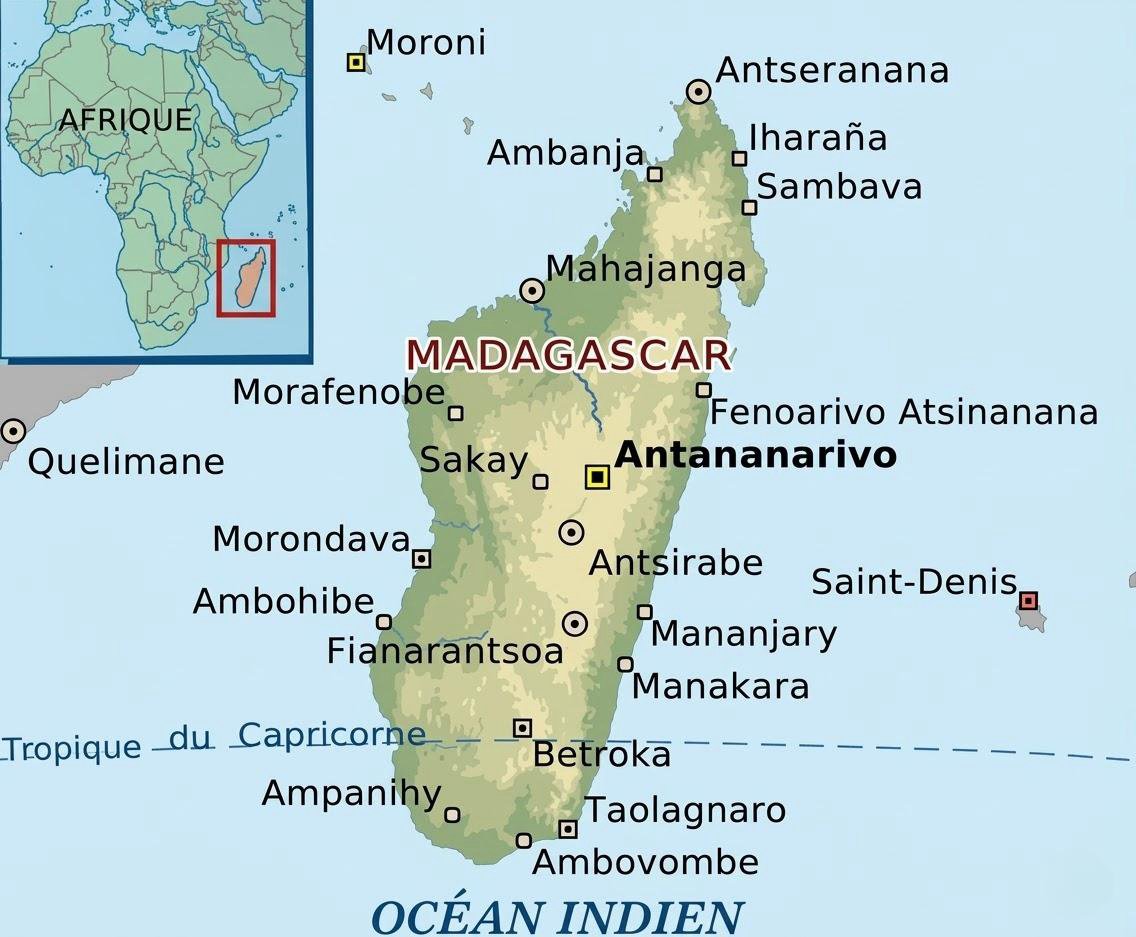
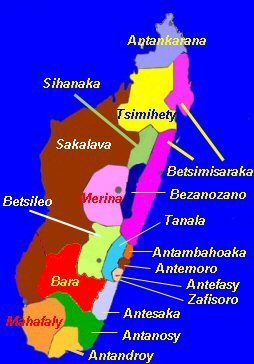
And to conclude this section, let us look at Madagascar's geographical map and the map of its ethnic groups, whose multiplicity plays a major role in Malagasy calendars.
A few general facts
- Official name: Repoblikan'i Madagasiraka (Republic of Madagascar)
- Area: 587,041 km2 (slightly larger than France). The world's third-largest island, if Australia is excluded as a continent.
- Capital: Antananarivo
- Population: 16.5 million inhabitants (July 2002)
- Ethnic groups: The Malagasy people comprise 18 ethnic groups of Indo-Malay or African origin, plus French, Comorian, Indian, Pakistani and Chinese minorities. That terminology is still as inadequate as calling Bretons, Basques, Alsatians or Provençals “ethnic groups” in France. Each people on the island has its own traditions and group identity, but they all consider themselves Malagasy and share one common language spoken across the country.
- Languages: Malagasy and French
- Religions: Christianity, traditional religion and Islam
- Political institutions: Presidential system
- President: Marc Ravalomanana
- Prime minister: Jacques Sylla
- Currency: Malagasy franc (FMG)
The calendar
By way of introduction
I must admit that never, since I started studying calendars, have I had so much difficulty obtaining information on a traditional calendar. Most replies - when there were any - from people I thought might have answers were too vague, and written sources are very scarce.
So if any Malagasy reader can contribute directly - or by asking elders - to our “investigation,” please do not hesitate. It would be greatly appreciated.
The calendars
Given all of the above, and if you do not mind, we will not approach the Malagasy calendar the way we usually do. Instead, we will proceed more like an investigation. We will start from written records (few in number) and, based on what we know from other calendars, see what can reasonably be concluded.
Let us be clear right away: several pieces are still missing, and anyone who can help strengthen this reconstruction is more than welcome. Feel free to send me a message if you think you have even the smallest element that might support, challenge or complete these conclusions.
Shall we begin?
Our investigation starts with three texts published in Malagasy newspapers or online.
Alahamady: the Malagasy New Year will be celebrated next week
Source: Midi Madagasikara
Friday, 21 November 2003, by TIM France
“This year, Malagasy New Year falls on 24 November, i.e. at the beginning of next week. Like the Chinese, the “old-time” Malagasy celebrated New Year on a day other than 1 January in the Gregorian calendar. For us, the notion of space-time is linked to the notion of destiny, and that concept governs our socio-cultural world.
Daily Malagasy life is thus based on the stars and on the relationship with the moon. Characterized by the Royal Bath and ancestor worship since the reign of Ralambo (1575-1610), across all sacred places in the center of the country, Alahamady is synonymous with ablution and purification. During this period, friends and enemies shake hands, fraternity and conviviality are the watchwords, disagreements and grudges are cast aside...
In general, the year, which lasts 354 days, is divided into 12 lunar months of 28 days, and the Malagasy week begins on Thursday and ends on Wednesday. For example, the first month, Alahamady, of the year 2003 began on 4 December and ended on 1 January. For the coming year 2004, it will run from 24 November to 22 December... For three days, dances, music, hiragasy, various games, abundant zebu meat, lanterns and kabary will animate the few communities that still celebrate it. Alahamady may no longer be celebrated with former splendor, but it is still marked across the island, especially in Imerina and the Antemoro region...
Wanadoo Madagascar
Two new moons for Alahamady, the Malagasy New Year
16-03-2004 / 00:48
“The first day of Malagasy year 2004, or Alahamadibe, corresponds to 21 March in the Gregorian calendar. The Malagasy ephemeris is designed according to astral movement, and this year the New Year is quite unusual, according to explanations by Henri Randrianjatovo, director of the House of Malagasy Culture, and David Rakoto, member of the Jaky Mena association.
Indeed, the moon and the sun will meet that day, around 1:45 a.m., in the zodiac group Alahamady, corresponding to the sign of Aries. This phenomenon had occurred only once before, in 1909, and will occur for the third time only in 2023. Moreover, this year will be marked by two new moons of Alahamady, on 21 March and 29 April. According to the two speakers at a conference organized with Radio Feon'Imerina at Tranompokonolona Analakely last Saturday, this is a sign of glory.
In addition, Alahamadibe is a major event in Malagasy tradition. It marks the end of the rainy period, or Fararano, and the beginning of the harvest. In a way, it marks the end of hardship. Alahamadibe also coincides with the commemoration of the birthdays of three Malagasy sovereigns: Ralambo, Andriamasinavalona and Andrianampoinimerina. For all these reasons, Malagasy New Year is celebrated in joy and jubilation, as it should be, at each beginning of the year.
V. A.
© Midi-Madagasikara
Malagasy New Year
Dated 15/03/2004:
“The traditional Malagasy New Year will come on 21 March 2004 at 1:42 in the morning. At that moment, the sun and moon will enter together and at the same time into the zodiac sign Alahamady, or Aries. This conclusion comes from the Jaky Mena association (bringing together descendants of the last rulers, namely the Zanakandriana, Zazamarolahy and Andriamasinavalona), from Trano Koltoraly Malagasy and from Radio Feon'Imerina.
Last Saturday, these three entities organized a public presentation on this Malagasy New Year at Tranompokolona Analakely. It was an effort to raise awareness and preserve the memory and celebration of this legendary date.
According to the explanations given, this very rare event has occurred, and will occur, only 4 times in 150 years (from 1890 to 2050): in 1909, 1928, 2004 and 2023. Indeed, every year, while the sun always enters the Alahamady sign on 21 March, the moon enters later, and their alignment as seen from Earth produces a total solar eclipse, also called the new moon of Alahamady or Tsinan'Alahamady, which is the Malagasy New Year (the first day of the first month). This year, both the sun and the moon will enter Alahamady (at angle 0°). Their alignment will occur simultaneously on 21 March. According to astronomy specialists, there will be two Tsinan'Alahamady this year. Indeed, the sun and moon will align once again in the zodiac sign Alahamady on 19 April 2004 at 4:22 p.m. These are scientific facts unrelated to faith or any form of worship.
The first Hebrew month, called Nissan or Abib, is exactly similar to the first Malagasy month, with one difference: Jews celebrate the full moon of that month at Passover; Christians celebrate Easter on the first Sunday after the full moon of the Hebrew month.
The speakers noted that when people have nothing of their own, they willingly borrow from others. Nature abhors a vacuum, and any people without reference points is a people without a future.
Mbolatiana R
At first reading, these texts raise at least two reactions:
- How many New Years do the Malagasy have?
- The last two texts are so similar that one might perhaps ignore one of them. True. But since we are only at the beginning of our investigation, we will still compare them before discarding one or merging both.
Analysis of the first text: a lunar calendar
Let us first pull out two short phrases: ...for us, the notion of space-time is linked to the notion of destiny... Daily Malagasy life is thus based on the stars and its relationship with the moon.
This relationship with the Moon naturally makes us think of a lunar calendar. The rest of the text confirms it:
In general, the year, which lasts 354 days, is divided into 12 lunar months of 28 days, and the Malagasy week begins on Thursday and ends on Wednesday. For example, the first month, Alahamady, of the year 2003 began on 4 December and ended on 1 January. For the coming year 2004, it will run from 24 November to 22 December*.*
Back to the calculator. 12 x 28 = 336. So 12 lunar months of 28 days do not make 354 days. Where are the missing days? Let us try another way. From 04/12/2003 to 02/01/2004, exactly... 30 days pass. Aha.
Let us follow two tracks: one astronomical, one astrological.
- The astronomical track confirms we are indeed dealing with a lunar calendar. The ephemerides on the BDL (Bureau des longitudes) site show that 04/12/2003, 02/01/2004, 24/11/2004 and 23/12/2004 were new-moon days. But then why say a month has 28 days?
- The astrological track gives more detail on that issue. On a specialized site (the only one I know of), we can read (translation by someone who wishes to remain anonymous):
“Unlike the Western calendar, the length of a Malagasy month (which corresponds to the lunation) is variable.
This lunation can last between 26 and 30 days. One counts 28 days for Adaoro, Adizaoza, Alahasaty, Asombola, Alakarabo, Alakaosy, Adalo, Alohotsy, whereas for Alahamady, Asorotany, Adimizana and Adijady one must sometimes wait up to 31 days before the new moon appears.
The 28th day is the conjunction day, and one must count 1 day between it and the appearance of the new moon - even 2 days for Alahamady, Asorotany, Adimizana and Adijady. These extra days are called, in astrology, “returning days,” and 1 day - or 2 days - is “killed” depending on the month.
The Malagasy month depends heavily on the lunation, and any astrologer worthy of the name must take this into account.
The months are represented as follows: Alahamady, Asorotany, Adimizana and Adijady correspond to the 4 major lunar astrological divisions, i.e. the 4 corners of a house. Each has 3 destinies: “vava,” “vontony” and “vodiny,” whereas the other months - placed on the side walls (2 on each side) - each include only 2 destinies (vava and vodiny).
The calculation is therefore as follows.
In 1964, Alahamady began on 13 February 1864 at 16:02. But since this was past the time when the sun is perpendicular to the roof ridge (i.e. at zenith, therefore noon), counting must start from the next day, i.e. the 14th.14 - 1 vava alahamady 18 - 5 vody adaoro
15 - 2 vt " 19 - 6 vv adizaoza
16 - 3 vd " 20 - 7 vd
17 - 4 vv adaoro 22 - 8 vv asorotany:
And so on until your birth date...The lunation therefore lasts 29 days, except for the mother destinies where one must count 30 or even 31 days before the new moon appears. Hence a 352-day year. It is therefore different from the European calendar which, based on the solar cycle, lasts 365 days (this method was adopted by the Antalaotra).
Bingo. Even if this text contains a few astronomical absurdities (for example, a lunar month cannot be shorter than 28 days), it still tells us a lot about this calendar, which we must indeed consider a lunar calendar.
Let us summarize what we have established: experience with calendars tells us astrologers have never invented a calendar from scratch. They rely on what already exists. Here, that basis is a lunar calendar. From a strictly astrological standpoint, any day in a lunar month beyond day 28 is “killed” and has the same meaning as day 28.
The year has 354 or 355 days (not 352, as the text says) and begins on the first day of the first month (named Alahamady).
The first day of the month is the day of the new moon if it occurs before 12 noon. Otherwise, the first day is the next day.
The month names are: Alahamady, Asorotany, Adimizana, Adijady, Adaoro, Adizaoza, Alahasaty, Asombola, Alakarabo, Alakaosy, Adalo, Alohotsy. Apart from the first - Alahamady - we still know nothing about their order.
But why did we follow this astrological track?
Simply because of the mention of destiny in the first text; and we find that same idea again in our astrologer's text, with more detail, since we learn that months “contain” destinies (Vintana). Three destinies for four months and two for the others. That gives (3 x 4) + (8 x 2) = 28 destinies. Interesting. Even though astrology is not the topic of this page or this site, one cannot help noticing the parallel with the 28 mansions of Arabic astrology.
We also cannot ignore how central this concept of destiny is in Malagasy life. These destinies, under lunar influence, define each person's personality, daily life and... destiny. Twenty-eight destinies for the year, but also for the month (hence the 28-day astrological month), and for the day, shaping each individual's daily path.
Even the construction of traditional Malagasy houses is influenced by these 28 destinies. The Moon's different positions during the year are associated with cardinal points, and the walls and corners of the house (oriented north-south) are a miniature representation of the lunar year.
What is the origin of the month names?
As expected, the month names we discovered are of Arabic origin. In fact, they are Malagasy adaptations of the Arabic zodiac sign names. Let us list them in calendar order.
| Malagasy | Arabic | Sign | Gregorian equivalent |
|---|---|---|---|
| Alahamady | Al-h' amal | Aries | March-April |
| Adaoro | Ath-thaûr | Taurus | April-May |
| Adizaozo | Al-dzaûza | Gemini | May-June |
| Asorotany | As-sarat ân | Cancer | June-July |
| Alahasaty | Al-asad | Leo | July-August |
| Asombola | As-sumbula | Virgo | August-September |
| Adimizana | Al-mizan | Libra | September-October |
| Alakarabo | Al-aqrab | Scorpio | October-November |
| Alakaosy | Al-qaûs | Sagittarius | November-December |
| Adijady | Al-djadi | Capricorn | December-January |
| Adalo | Ad-dalû | Aquarius | January-February |
| Alohotsy | Al-h'ût | Pisces | February-March |
To be precise, let us note that in a 1911 study, E.F. Gautier states that these Arabic words originally referred to destinies distributed in groups of three across the four seasons, and only later became month names.
Where was this lunar calendar used?
According to E.F. Gautier: "In present-day Madagascar, in the 19th and 20th centuries, Imerina - long the focus of attention - is perhaps the only province that had a wholly lunar calendar; it apparently owed this to Comorian Muslims, with whom it had easy and sustained contact."
Before closing this section on the lunar calendar, let us ask a few questions:
- The first, answered in the analysis of the next two texts: why were Arabic zodiac names used for months, rather than the Arabic month names themselves?
- For the second, the texts we examined provide no answer. A lunar year (354 or 355 days) is shorter than a solar year (365 or 366 days). Under those conditions, how can the Malagasy lunar calendar still have the same year numbering as the Gregorian calendar? The only answer we can suggest is that today this calendar is a purely astrological instrument, no longer intended for calendar computation. Has it always been that way? A mystery. If not, when did that shift begin?
Analysis of the last two texts: a lunisolar calendar
What do these texts have in common?
- Malagasy New Year 2004 falls on 21 March 2004 in the Gregorian calendar.
- The Moon and the Sun enter the zodiac sign Aries together, around 1:45 for one and 1:42 for the other. In reality, it was 1:43 - but we will not quibble.
What differs between the two texts?
- In the third text, the author says the event occurs in 1909, 1928, 2004, 2023. In the second text, it is 1919, 2004 and 2023. Wrong. If the rule is to identify new moons on 21 March, this happened in 1909, 1928, 1939, 1985, 2004, and will happen in 2023.
- Also, regarding text 3, these are not scientific facts but astrological ones. The scientific fact is that the Sun enters a given constellation on a given date. And for over 2,000 years, the Sun has no longer entered Aries on 21 March. It is still in Pisces and enters Aries only on 19 April. And on 19 April the Moon also entered Aries, producing a partial (not total) solar eclipse. There was never a total solar eclipse visible from Earth on 21/03/2004.
With that clarified, what can be inferred from the text?
One crucial point: the year would begin at the new moon during the period when the Sun enters - or has just entered - Aries. So we are dealing with a lunisolar calendar, since the number of (lunar) months depends on the Sun's position: 12 or 13 months depending on the year.
We still need to verify that, and solve a serious issue. Let us start with the issue.
How can one practically know that the Sun enters Aries? We have seen that the zodiac used here is tropical, not sidereal. Which means observing the sky is of no use, because during the relevant period the Sun is still somewhere in Pisces.
Of course, one could simply say: wait for the new moon from 21 March onward. But it is somewhat odd to rebuild an old calendar... from a modern one.
So what should be done? Wait for the new moon on or after the autumn equinox (we are in the Southern Hemisphere)? Keep counting months from the very first month of the very first year in which the Sun truly entered Aries, checking whether an extra month is needed? The question remains open, and the text merely modernizes an old calendar without really asking why.
According to E.F. Gautier, a study was carried out by Fr Thomas and published in the Bulletin de l'Académie malgache (Bulletin of the Malagasy Academy). Fr Thomas reportedly made two major discoveries.
The first: before bearing Arabic names, the months had Sanskrit-derived names. Those month names were, “in all probability, used throughout the entire island.” It was only from the 17th century onward that those names gradually disappeared in favor of the ones we know today.
The second: the calendar is indeed lunisolar. According to one Flacourt, in a work titled Histoire de la grande île de Madagascar (History of the Great Island of Madagascar, 1661), which I tracked down, “the first month begins with the new moon of March.” True, he does not explicitly say the calendar is lunisolar, but for a Frenchman used to solar calendars, that may have gone without saying. And as Gautier rightly points out, when Flacourt mentions Ramadan, he does not forget to note that “this fast has no fixed month and takes place now in one month, now in another.” Gautier therefore justly concludes that in a purely lunar calendar, the fast would always be observed in the same month.
And since we are talking about Ramadan, let us return to a question we can now probably answer: why were Arabic zodiac signs used to name months instead of Arabic month names?
Simply because, as Gautier writes, "Months are divisions of the lunar year; zodiac signs are divisions of the solar year. Only the latter were usable by Malagasy people, because their lunar months had to be aligned, as best as possible, with a solar year."
E.F. Gautier drew up a comparative table of month names in their various forms, which is useful to reproduce as is so that all cards are on the table.
| First nomenclature (borrowed from Arabic; zodiac signs) | Second nomenclature (borrowed from Sanskrit) | French month (corresponding months in Antaimoro country, in 1904) |
|---|---|---|
| Alahotsy (Pisces) | Asaramasay | March |
| Alahamady (Aries) | Asarabe | April |
| Adaoro (Taurus) | Vatravatra | May |
| Adizaozy (Gemini) | Asotry | June |
| Asorotany (Cancer) | Hatsiha | July |
| Alahasaty (Leo) | Volasira | August |
| Asombola (Virgo) | Fosa | September |
| Adimizana (Libra) | Maka | October |
| Alakarobo (Scorpius) | Hiahia | November |
| Alakaoza (Sagittarius) | Fisakamasay | December |
| Adijady (Capricornus) | Fisakavy | January |
| Adalo (Aquarius) | Volombita | February |
The key double question we must ask is:
- Why specify in Antaimoro country?
- Why is the year's first month Alahotsy (later Alohotsy) and not Alahamady?
Fr Thomas gives the answer: "In Maravoay, according to information gathered by Mr Mathieu, the festival of Sakalava royal tombs was always held in the month of Volambita... and corresponded to our month of June. Commander Leblanc reports that among the Antandroy the first month of the year is Volambita, which always falls in August... Around November, at the start of the rainy season in the Amborombe region, the first moon is Vatravatra. In Anosy, the first moon is in March."
In short, this is yet more proof that the year is indeed lunisolar, but the start of the year seems to vary greatly by region and/or ethnic group.
We will end our investigation - very provisionally, because many questions remain unanswered - with one final question: since the year is partly solar, how is a 13th month intercalated?
Two answers, which may converge in practical life:
The first is agricultural, again from Fr Thomas: "one of the Antaimoro months (Alahamaly in Arabic nomenclature) governs the alignment of the year with the seasons, because this month must always correspond to the beginning of the dry season and the end of the rains. And if the Antaimoro observe... that the rainy season still persists in full strength at the end of Alahamaly, they duplicate that month... Another month may also be duplicated. Thus, in the current year (1904), there will be 13 months. The month of Alakarabo will in fact have sixty days, because by the time it was about to end, it would not have matched lychee ripening if it had had a normal length."
The second is scientific, from Jean-Paul Parisot and Françoise Suagher in Calendriers et chronologie (Calendars and Chronology, 2002): "... They (the Malagasy) monitor Antares and the star beta Scorpii. Observations are made from March to July, facing south. If the full moon is close to beta Scorpii and if the previous new moon occurred in Aries, then the year must have 13 months."
A 60-day month? Two 30-day months? Name of the intercalary month? Should the “midday” rule used in the lunar calendar also apply to the lunisolar one? How is the start of the year truly determined? So many unanswered questions.
Day names and chronology
Day names are Arabic.
| Day | Name |
|---|---|
| Sunday | Alahady |
| Monday | Alatsinainy |
| Tuesday | Talata |
| Wednesday | Alarobia |
| Thursday | Alakamisy |
| Friday | Zoma |
| Saturday | Sabotsy |
According to Flacourt, “years are counted by days of the week: the year of Sunday, then that of Monday, and so on.”
The Antaimoro thus created “weeks of years,” somewhat as the Romans created Olympiads (4 years) or lustra (5 years).
And as with lustra or Olympiads, this leaves us without a linear and uninterrupted chronology - either because there is no higher-order cycle of year-weeks, or because there is no fixed computus starting point.
In conclusion
In the absence of interlocutors truly well informed about Madagascar's history, we have to acknowledge that many questions remain unresolved regarding Malagasy calendar(s). Perhaps that is precisely what still makes them mysterious, and what makes one want to learn more.
And it also proves that it can sometimes be easier to “make the Maya or Mesopotamians speak” than one's own contemporaries.
Latest news (13/07/2004)
I have just found this text on La Gazette de la Grande Ile:
“01/04/2004
So when exactly is it?
For some time, Malagasy New Year has been the subject of several discussions. On one side, after an in-depth study, the Jaky Mena association concluded that Malagasy New Year was on 21 March. They were categorical. On the other side, Norbert Rakotomalala, a “Zanadranavalona” and also a designer of agricultural calendars, noted that 21 March is only the beginning of the Aries zodiac sign, which does not mean “Alahamady” at all. March was Alahasaty, contrary to Jaky Mena's studies claiming it was Alahamady. The month Alahasaty would end on 19 April 2004, with the new moon appearing at 4:22 p.m. In his view, Malagasy New Year should be celebrated on 12 November 2004. That is the next “Tsinan'Alahamady.” In 2003 it was 24 November, he says. Norbert Rakotomalala believes that “Aries” is in no way equivalent to Alahamady in Malagasy astrology. Moreover, it is not customary among Malagasy people to celebrate “Tsinan'Alahamady.” Before colonization this was the Malagasy national festival, called “Fandroana.” According to oral traditions, the first Fandroana was marked in the time of Ralambo in Imerina (1575-1660). In any case, one wonders: what is the exact date?
Mbolatiana R
Yes, one does wonder.
So if Mr Norbert Rakotomalala has the honor of reading these lines, I would very much like him to explain how he matches Malagasy month names to Arabic month names, and why he mixes zodiac with new moon.
For my part, I still think that as long as zodiacal calendar and lunisolar calendar are mixed together, and as long as people keep trying to handle the Malagasy New Year issue the same way across the whole island, we will be asking for a long time yet: what is the exact date?