A bit of history
Let us leave it to Caesar to define these Gauls we are going to study through their calendar: "All Gaul is divided into three parts: one inhabited by the Belgae, another by the Aquitani, and the third by the people who in their own language are called Celts, and in ours Gauls. All these peoples differ from one another in language, customs, and laws. The Gauls are separated from the Aquitani by the Garonne, and from the Belgae by the Marne and the Seine." The Gallic War I-1
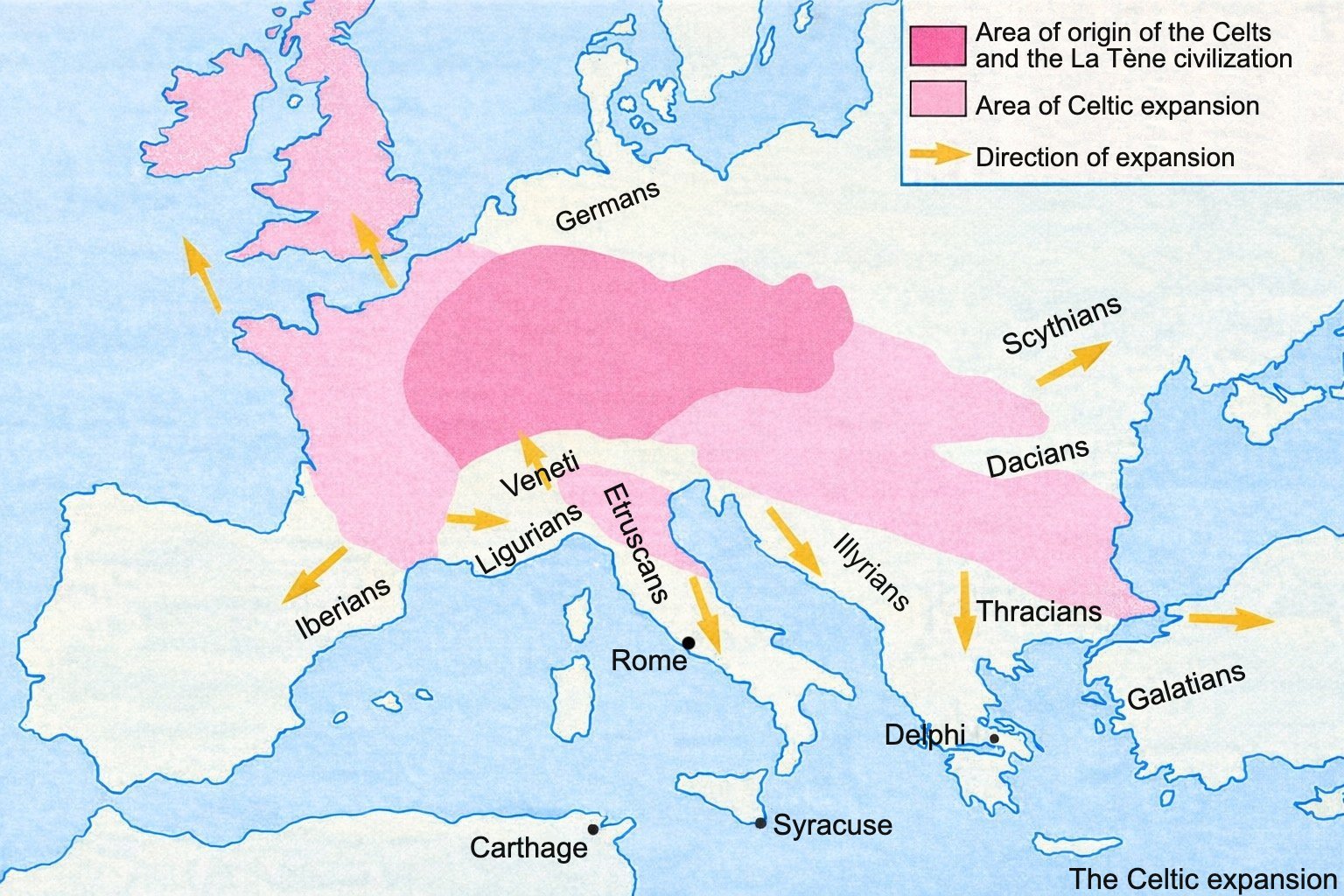
Around 1200 BCE, the Celts, descended from Indo-Europeans, reached Gaul. Around 600 BCE, the Hallstatt civilization spread across all Gaul, followed around 500 BCE by the La Tène civilization in southern and western Gaul.
We can map Celtic expansion at its peak:
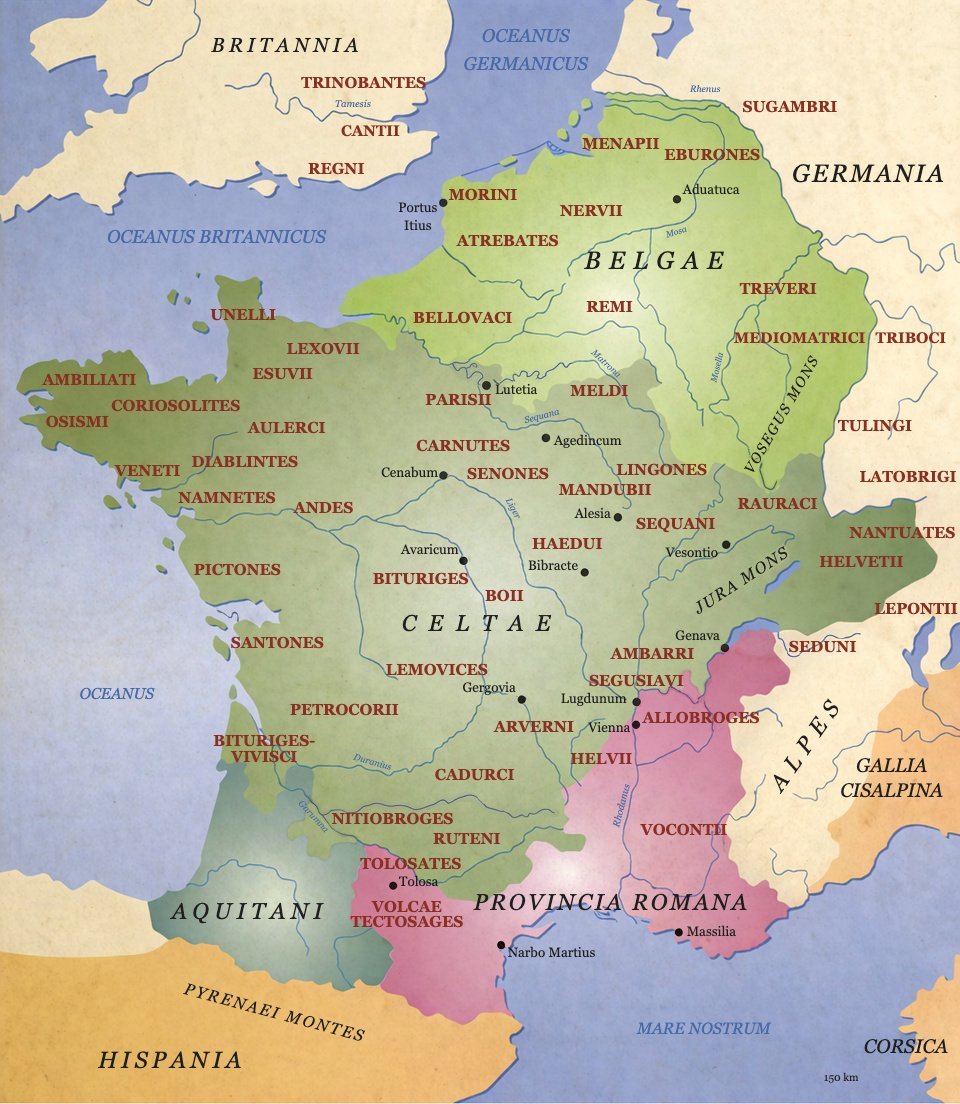
From 58 BCE to 52 BCE, Caesar undertook the conquest of Gaul, with Vercingetorix's victory at Gergovia in 52 BCE followed by defeat at Alesia.
From 25 BCE to 13 BCE, the three Gauls were organized as shown on the following map:
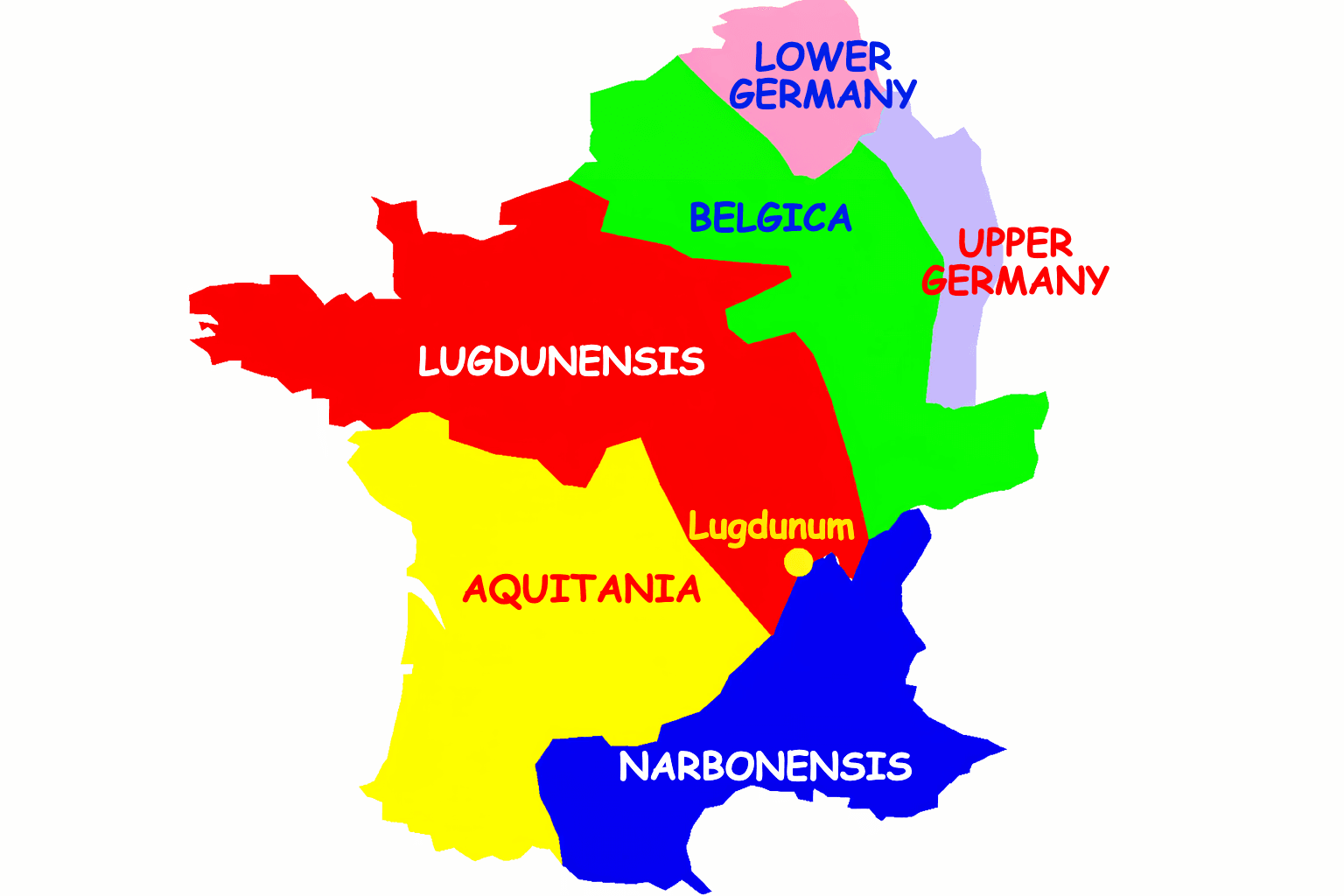
What happened next is another story, beyond the scope of this study of the Gaulish calendar and, to be clear, of the Coligny calendar.
A brief word, though, about the druids, who matter for our topic:
- Caesar describes them as people who "... discuss at length the stars and their courses, the size of the world and of the earth, the nature of things..." Commentarii (Book VI, Chapter XIV).
- They passed down their doctrine mostly orally, which may explain the lack of direct written sources from this period of our history. They spent more than twenty years in school, memorising vast numbers of verses, on the grounds that religion did not allow the substance of their teaching to be committed to writing. They could write Greek, but used it only for public and private accounts.
The calendar
In November 1897, a farmer discovered bronze fragments at Verpoix, in the municipality of Coligny (Ain), about 30 centimeters underground and near the Roman road Lugdunum-Vesontio (Lyon-Besancon). This was in the territory of the Ambarri Gauls.
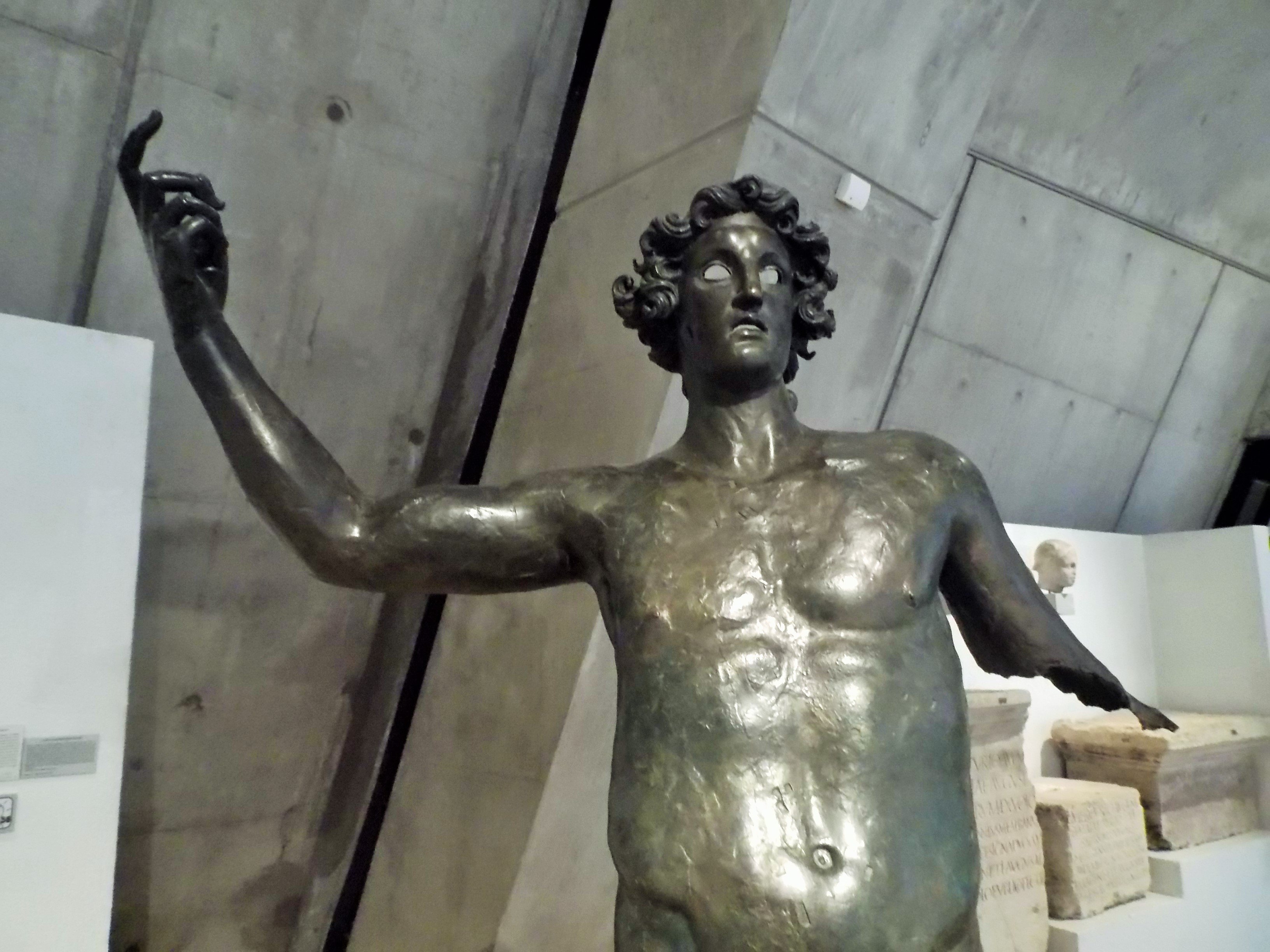
Assembling the fragments made it possible to reconstruct two objects: on one hand, an almost complete statue of Mars; on the other, a bronze calendar table.
Unfortunately, this table, measuring 1.50 m by 0.90 m, is far from complete: its roughly 150 inscribed fragments represent only about two-thirds of the whole. Nearly 120 of these fragments are engraved; the rest forms a 5-centimeter frame (also bronze). Although engraved in Roman letters and numerals, the reconstructed words (around sixty of them) turned out to be in the Gaulish language.
As we have seen, druids almost refused writing altogether, so the Coligny calendar is still today the longest text (2,200 lines) written in Gaulish. Strictly speaking, “list” would be more accurate than “text”.
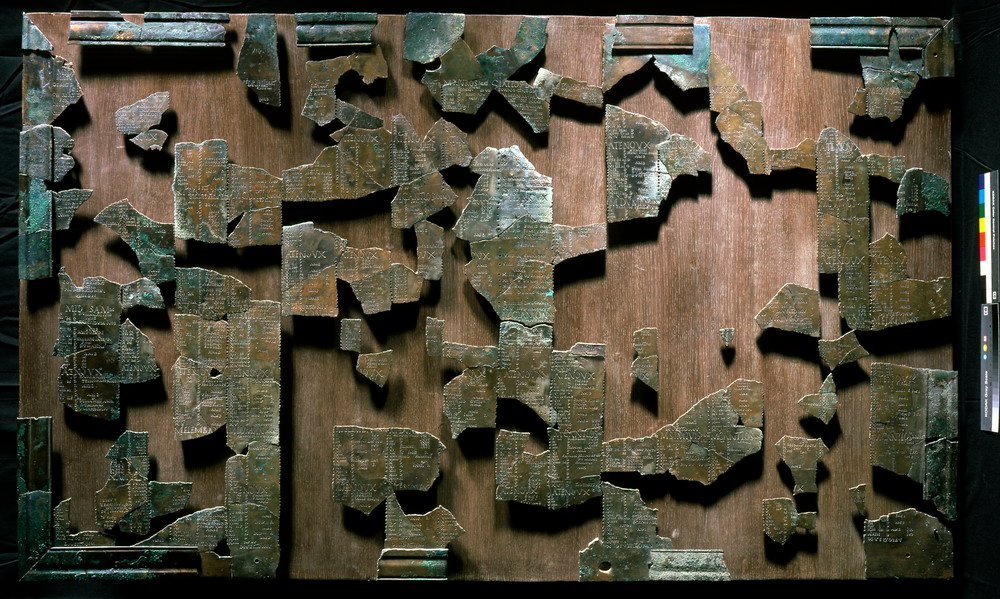
As we will see in more detail below, this calendar gives the sequence of days and months over five years (one lustrum).
It is almost the only “document” we have on the Gaulish calendar. I say “almost” because in 1802, a fragment of a bronze table similar to the Coligny calendar was found in Lake Antre, in Villards d'Heria (Jura), some sixty kilometers from Coligny.
Is the Lake Antre fragment a missing piece of the Coligny table? The question remains, and we may wait a long time for an answer, since the Antre fragment was lost.
I have another question: given the druids' aversion to writing, why suddenly a bronze calendar table? A working tool? But then why a frame? What event could justify a plate of such dimensions? I do not know.
And while we are asking questions: when does this plate date from? Opinions vary, ranging from the second half of the last century BCE to two centuries later.
To get an idea of our ancestors' calendar, we therefore have only an incomplete table, not yet fully translated (Gaulish never had its Champollion), showing the days and months of five years whose exact dating is unknown.
Not entirely. We also have Roman texts that help us understand the Gaulish calendar.
One is from Caesar: "All Gauls claim descent from Dis Pater: this, they say, is a tradition of the druids. Because of this belief, they reckon time not by the number of days but by the number of nights; birthdays, and the beginnings of months and years, are counted by making the day begin with the night." Julius Caesar, The Gallic War VI-18
Note: Dis Pater is the god of night and death.
The other is from Pliny the Elder: "... [mistletoe] is cut with great religious ceremony; above all it must be on the sixth day of the moon, which among them marks the beginning of months, years and ages that last thirty years, a day chosen because the moon is already in full strength without yet being at mid-course." Pliny, Natural History, XVI, 249-251, trans. Jacques Andre, 1962, Paris, Les Belles Lettres.
Now that we have all the cards in hand, let us examine one part of the Coligny calendar closely:
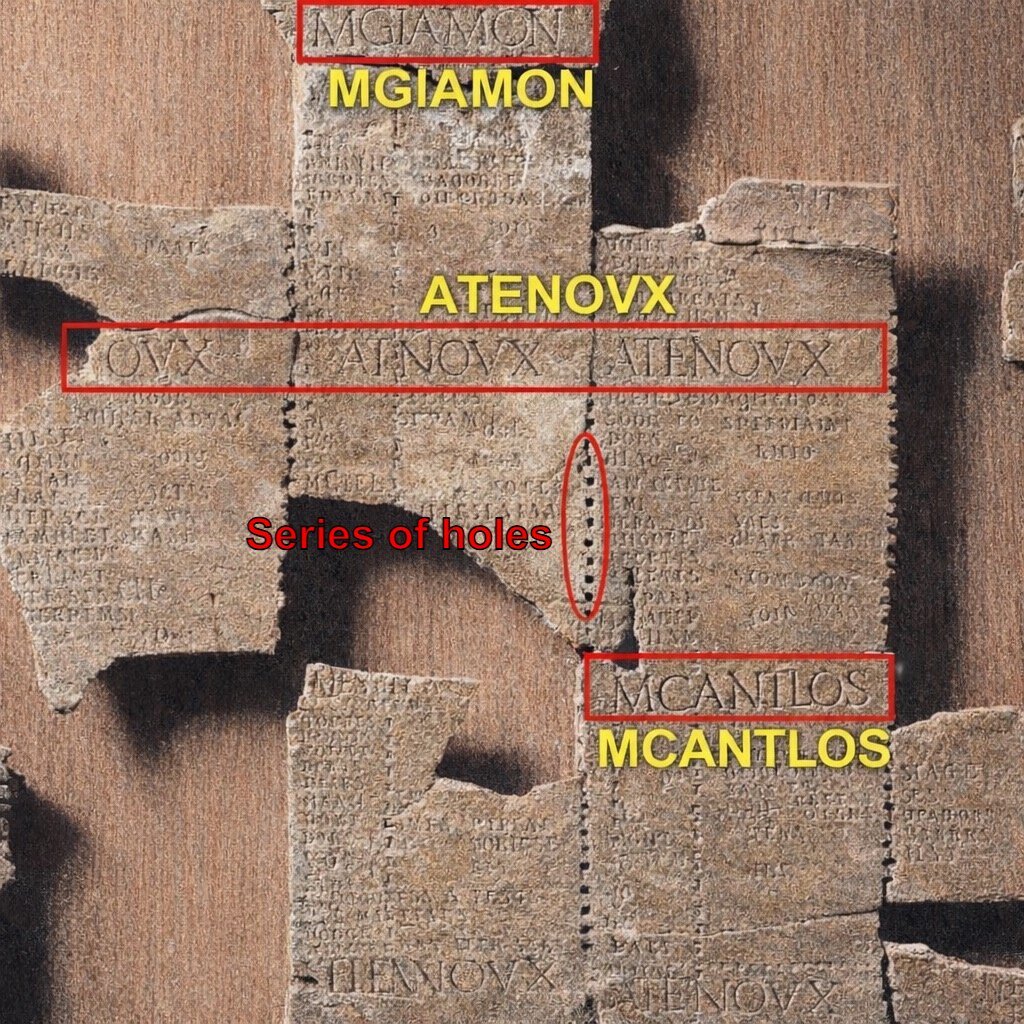
We can see:
- A series of holes dividing the calendar, making it look like a sheet of stamps without horizontal perforations. The bronze plate is thus divided into 16 vertical bands. As a side note, these holes seem to have reinforced the plate and perhaps also contributed to its destruction. It is reasonable to assume they were meant to hold markers.
- Words that recur regularly in horizontal lines. They separate, vertically, two series of Roman numerals: ATENOVX. We will see later that they mark mid-month.
- Other names, such as M GIAMON and M CANTLOS, which appear five times on the plate and are in fact month names (except for the letter M, which has its own meaning).
Let us see what the plate looks like when all identifiable months are shown.
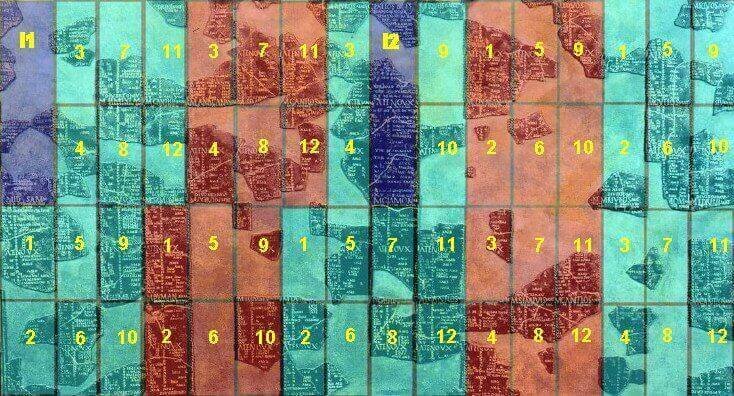
We can observe that the plate is arranged in 16 columns and 4 rows. Two months (I1 and I2) occupy two rows. These are intercalary months used to catch up the lunar calendar with the solar calendar.
The remaining 60 months are 12 months repeated 5 times (alternating colors), i.e. over one lustrum. The surviving fragments show months of 29 or 30 days, but nothing proves that their lengths were fixed.
Each month name is preceded by M or MID, the Gaulish word for month.
Let us zoom in again to look closely at one full month (samon) and the markings shown there. Then we will step back once more to understand how this Gaulish calendar works.
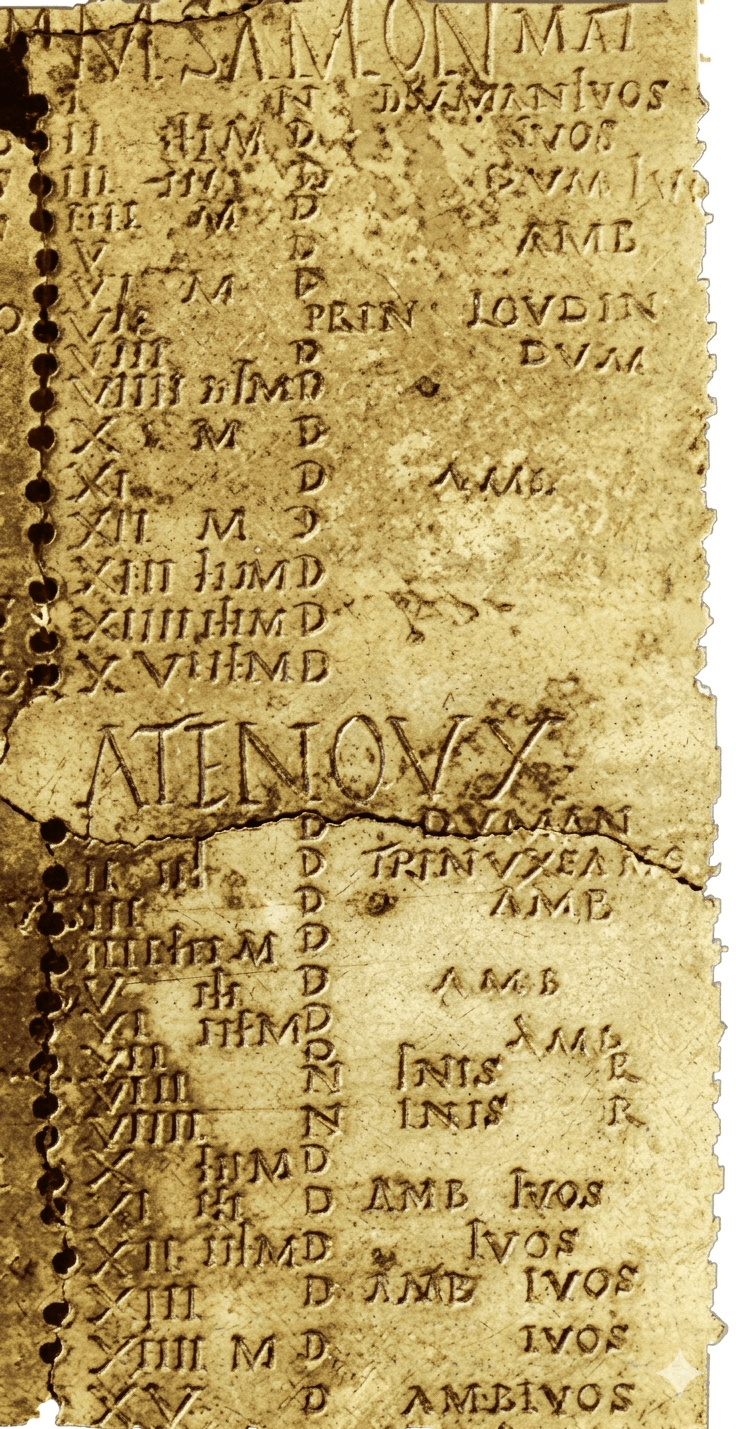
| M SAMON MAT | |||||
| o | I | I+I | N | DUMAN | |
| o | II | +II | M D | IVOS | |
| o | III | D | DUM | IVOS | |
| o | IIII | M D | IVO | ||
| o | V | I+I | D | AMB | |
| o | VI | I+I | M D | ||
| o | VII | PRIN | LOUDIN | ||
| o | VIII | D | DUM | ||
| o | VIIII | II+ | M D | ||
| o | X | M D | |||
| o | XI | D | AMB | ||
| o | XII | M D | |||
| o | XIII | +II | M D | ||
| o | XIIII | I+I | M D | ||
| o | XV | II+ | M D | ||
ATENOVX | |||||
| o | I | D | DUMAN | ||
| o | II | II+ | D | TRINUXAMO | |
| o | III | D | AMB | ||
| o | IIII | +II | M D | ||
| o | V | I+I | D | AMB | |
| o | VI | II+ | M D | ||
| o | VII | D | AMB | ||
| o | VIII | N | INIS R | ||
| o | VIIII | N | INIS R | ||
| o | X | +II | M D | ||
| o | XI | I+I | D | AMB | IVOS |
| o | XII | II+ | M D | IVOS | |
| o | XIII | D | AMB | IVOS | |
| o | XIIII | M D | IVOS | ||
| o | XV | D | AMB | IVOS | |
In the header, the month name is preceded by the letter M and followed either by MAT (as with SAMON above) or by ANM / ANMAT. In Celtic languages, MAT means good, auspicious. We may assume AN is a negative prefix, so ANMAT would mean bad, inauspicious.
From the second line onward, to the right of the holes, there are two series of Roman numerals separated by ATENOVX. Across the whole plate, the first series has fixed length (I to XV), while the second runs either from I to XIIII or from I to XV. This gives months of 29 or 30 days.
Also note that the “missing day” in 29-day months is replaced by DIUERTOMU, with no Roman numeral and no hole.
Across the whole plate, 29-day months are labeled ANMAT, while 30-day months are labeled MAT. One exception: EQUOS, which is labeled ANMAT despite having 30 days. Was this month of variable length (like our February)?
Let us look at the month names and their lengths:
| Month | Length | Qualifier |
|---|---|---|
| X.. (1st intercalary month) | 30 d | MAT |
| SAMON | 30 d | MAT |
| DUMAN | 29 d | ANMAT |
| RIUROS | 30 d | MAT |
| ANAGANTIO | 29 d | ANMAT |
| OGRON | 30 d | MAT |
| CUTIOS | 30 d | MAT |
| CIALLOS B.I.S 2nd intercalary month | 30 d | MAT |
| GIAMONI | 29 d | ANMAT |
| SIMIVIS | 30 d | MAT |
| EQUOS | 30 d | ANMAT |
| ELEMBIU | 29 d | ANMAT |
| AEDRINI | 30 d | MAT |
| CANTLOS | 29 d | ANMAT |
Back to month details: to the right of the Roman numerals, we sometimes find triple stick-like signs, one higher than the other two and crossed about one third up. It seems to shift one step to the right relative to the other two, something like +II I+I II+ +II ....
I will repeat what I wrote above: the Coligny calendar still keeps many mysteries. Apart from J. Monard, who in his Histoire du calendrier gaulois (History of the Gaulish Calendar) claims to have understood everything (even writing “the present work gives a complete elucidation” before launching into highly convoluted explanations), other researchers of the Coligny calendar are much more cautious in their hypotheses. I should mention the massive nearly 500-page work by Paul-Marie Duval and Georges Pinault, Recueil des inscriptions gauloises, les calendriers (Collection of Gaulish Inscriptions: Calendars), CNRS editions.
All this to say that the triple signs mentioned above still have no certain explanation. The same is true of almost the whole text. Even month names have no exact translation, which, as we shall see, creates problems in determining the start of the year.
Still, we can observe that for some days in a month, the name of another month appears. In the month we are examining, we find DUMAN on day I of each fortnight. It is the name of the month following SAMON.
Months, year and lustrum in the Coligny calendar
The month
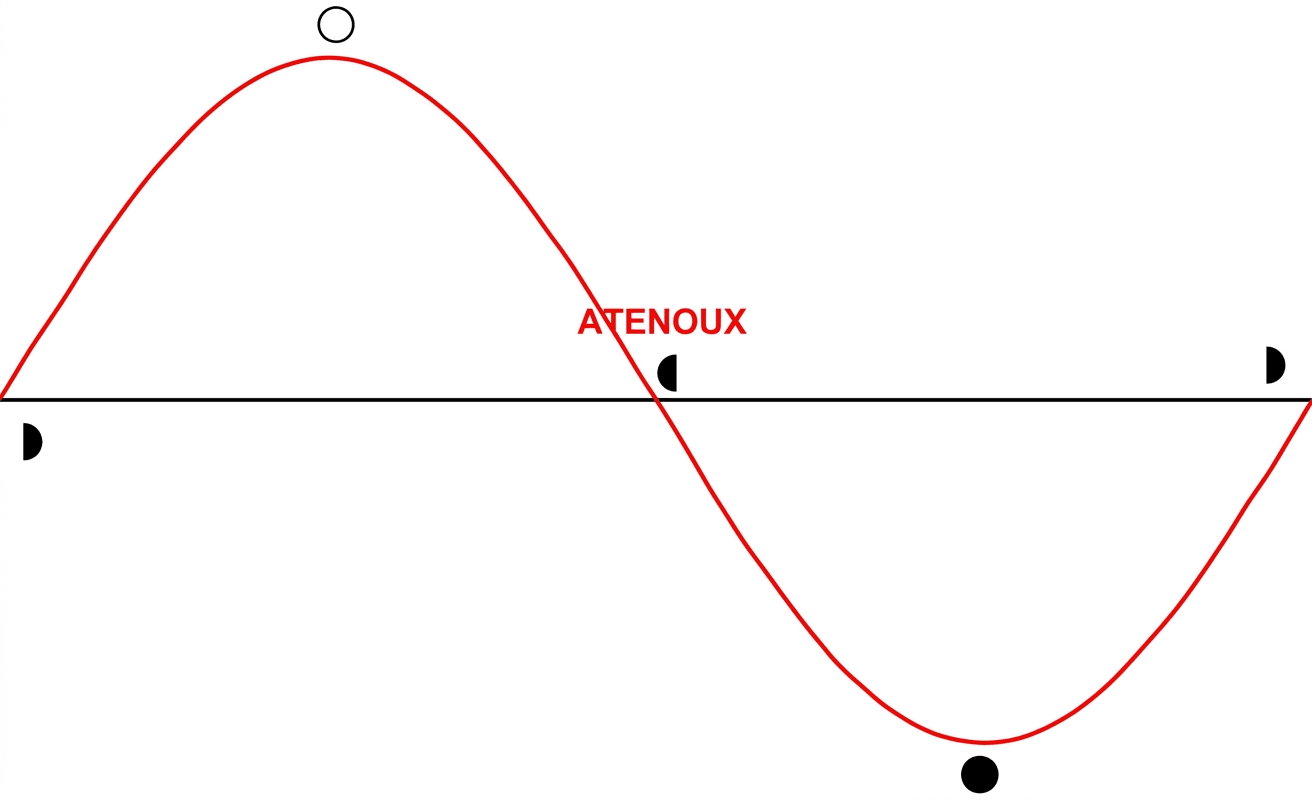
We have just seen that the month is split into two halves separated by the word ATENOUX: the first of fifteen days, the second of 14 or 15 days.
If we remember what Pliny wrote, the month starts at the first quarter moon. The two fortnights are therefore centred successively on the first new moon and the full moon. ATENOUX would correspond to the last quarter, not to the new moon itself as some have argued. ATENOUX can be broken down as ATE, meaning “re”, and NOUX, which can be translated as “new”. This mid-month renewal may be the passage point between a period whose peak is the full moon and another whose passage point is the new moon.
The year
How do Gaulish months correspond to our current months? In other words, which present-day month starts the Gaulish year?
Two theories oppose each other:
- the first translates samon as summer and giamoni as winter. Samon would fall in May and giamoni in September, each introducing the summer and winter seasons respectively in Celtic tradition.
- the second supports the opposite: samon (“recapitulation of summer”) would be in November and giamoni (“recapitulation of winter”) in summer. The notation TRINUXAMO on day two of the second half of samon would come from trinox samoni sindiu, translated as the three nights of samon today, recalling the “three nights of Samain”, an old Irish festival held in November.
Another argument for the second theory comes from Caesar's text quoted above: "... the beginnings of months and years are counted by making the day begin with the night." Priority would thus be given to darkness and night. In that case, winter, the dark and cold half of the year, would mark the beginning.
Adjustment of the calendar to lunar and solar cycles:
Let us recall a few numbers: the tropical (solar) year is 365.2422 days, and a lunation is 29.5305 days.
A year in the Coligny calendar seems to contain 355 days, which makes a lustrum (355 X 5) + (30 X 2) = 1835 days. But 62 lunations are 1830.89 days. The Gaulish lustrum would therefore be too long.
An Irish scholar, Mac Neill, who studied the Coligny calendar soon after its discovery, proposed an appealing hypothesis to explain how this gap may have been corrected.
We saw that the ninth month, equos, had 30 days and still bore the label AMT, apparently reserved for months shorter than 30 days. The table fragments allow reconstruction of only three equos months (all 30 days long).
Mac Neill then asked: what if the missing equos months (those in the second and fourth years) had only 28 days?
That would produce a 1,831-day lustrum, very close to 62 lunations (1,830.89 days).
If we accept this hypothesis, the lunar part of the calendar is corrected against lunations.
Now we must examine the “solar” side of the Gaulish calendar.
It is clear that the two additional months in a lustrum are there to correct the calendar against the tropical year. Evidence: an inscription after the name of the second intercalary month:
SONNOCINGOS AMMAN M MXIII (..) LAT CCC LXXXV (..) ANTARAN.M which could be translated as “the sun is once again in its place”.
Back to our calculations: 5 tropical years equal 365.2422 X 5 = 1826.211, giving a drift of nearly 5 days compared with the “Mac Neill-style” calendar.
But now let us bring in the 30-year “century” mentioned by Pliny. Thirty tropical years contain 371 lunations (365.2422 X 30 = 10957.266 / 29.5305 = 371). A thirty-year “century” contains 372 lunations (6 lustrums X 62 = 372).
So every thirty years, if we start the first lustrum of the new “century” with samon and no intercalary month, the Gaulish calendar remains aligned with the sun.
Weren't those Gauls clever? Well... at least if they did what we have just done here, and all this remains hypothetical.
The lustrum
As for the lustrum, it would consist of two sets of 5 half-years (30 months), separated by the second intercalary month. The full lustrum is thus made of 60 months, to which the 2 intercalary months must be added.
Many things remain to be clarified in the Coligny calendar, and therefore in the Gaulish calendar. I have not mentioned, for example, that some month names appear inside another month through concordance series, or that the names of “regular” months reappear in the intercalary month through a kind of incremental rotation.
No, the Coligny calendar has not yielded all its secrets, and it will be difficult to make it do so unless we find another “document” that would allow cross-checking.