A little history
Many thanks to the webmaster of the NetArmenie website, who authorized me to use his Armenian chronology (NDW: the site no longer exists).
We will focus in particular on Armenian history from its beginnings to the end of Lesser Armenia in the 13th century. This is the period during which successive calendars were developed and established.
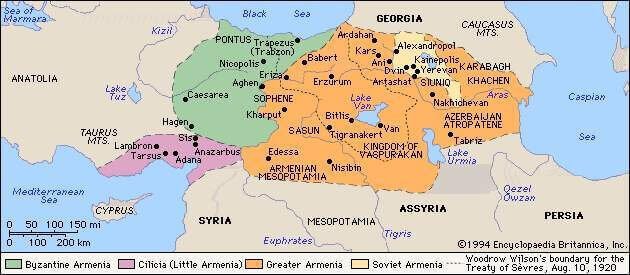
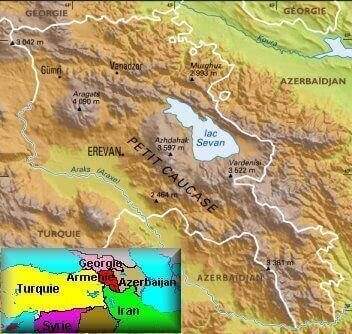
Present-day Armenia covers 29,800 km² and has a population of about 3,327,000 inhabitants, including 1,250,000 in the capital, Yerevan. More than 94% of the population belongs to the Armenian Apostolic Church, which is independent from other Christian churches. Its head is the Catholicos, who resides in Echmiadzin near Yerevan.
According to the Bible, Noah's Ark came to rest at the summit of Mount Ararat. Noah's grandson, Hayk, gave his name to the country: Hayastan.
His descendants, the Armenians, still call each other Hays. In fact, Hayk probably came from Sumer, in the time of Lugal-zagesi, king of Umma and Uruk.
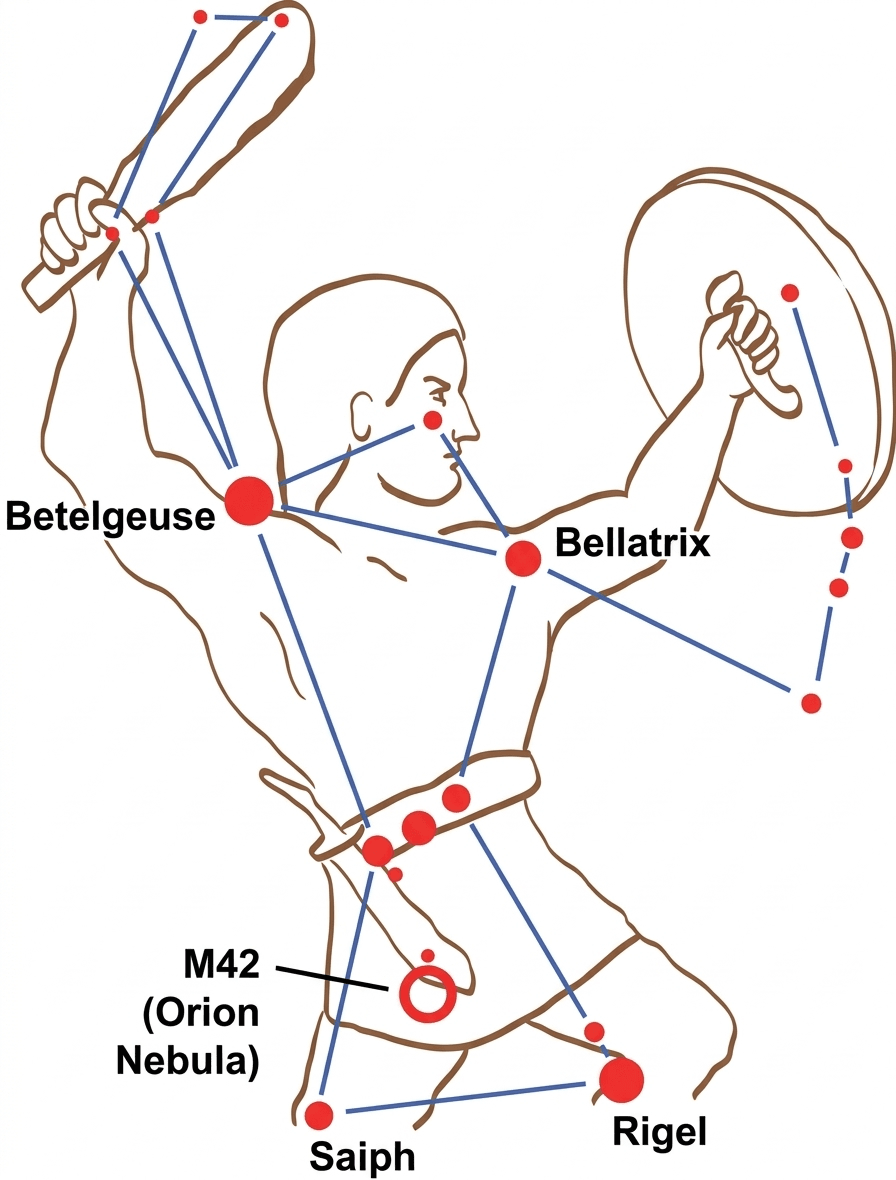
But Hayk is also the name Armenians gave to the constellation Orion, which they regarded as the “Heavenly Father”, and whose main star, Betelgeuse, would play a major role in the calendar.
Let us review a few dates from ancient Armenian history:
Early Armenia
- 3500 BC: Early Bronze Age. Beginning of Kura-Araxes culture.
- 2600 BC: arrival of nomadic populations, including Hayk.
- 1165 BC: proto-Armenians in the Euphrates region.
Pre-Christian Armenia
- 8th-6th centuries BC: an Indo-European people, the Thraco-Phrygians, mixed with native populations settled on the southern slope of Mount Ararat.
- 950 BC: foundation of the kingdom of Urartu. Cuneiform writing.
- 782 BC: foundation of Erebuni (future Yerevan) by Urartian king Argishti I.
- 580-550 BC: end of the kingdom of Urartu, swept away by the Medes. Ervandid dynasty, then Iranian domination.
- 520: Behistun inscription mentioning, for the first time, the names Armenia and Armenians.
- 547-331 BC: domination by Achaemenid Persians.
- 330 BC: conquests of Alexander the Great.
- 3rd century BC: Ervandid-Orontid dynasty returns to power. Hellenistic cultural influence and Roman tutelage.
- 190 BC: Armenia gains independence from the Seleucids.
- 95-55 BC: King Tigranes the Great founds a vast empire, Greater Armenia, including Transcaucasia, northern Mesopotamia and Persia, Cilicia and Syria.
- 1st century: division of Armenia between Parthians and Romans. Armenian polytheism abandoned in favor of Persian Mazdaism.
- AD 77: construction of the temple of Garni.
Christian Armenia
- End of the 1st century: according to tradition, preaching of apostles Thaddeus and Bartholomew.
- AD 301 (or 314): Armenia becomes the first country in the world to adopt Christianity as state religion.
- Beginning of the 4th century: foundation of Etchmiadzin Cathedral.
- 387: dislocation of Greater Armenia, which falls under Persian rule (Sassanid dynasty).
- Between 400 and 430: monk Mesrop Mashtots creates the Armenian alphabet.
- 451: Battle of Avarayr against Sassanid Persia. Armenians fight under Vartan Mamikonian to defend faith and homeland.
- 451: Armenian theologians do not endorse the Council of Chalcedon.
- 552: Council of Dvin; the Armenian Church becomes autocephalous.
- 628: reconquest of Armenia by Byzantine emperor Heraclius.
- 642: beginning of Arab incursions.
- 654-884: domination of Armenia by Islamized Arabs.
- 7th century: rise of architecture. Numerous constructions:
- Around 618: church of St Hripsime
- Around 630: church of St Gayane
- Around 640: cathedral of Mrens
- Around 650: cathedral of Zvartnots
- Around 670: cathedral of Aroutj
Medieval and post-medieval Armenia
- 885: establishment of the Bagratids. Construction of Ani, capital of Armenia.
- 9th to 11th centuries: installation of the Bagratid dynasty allows independent kingdoms to emerge.
- 1045-1071: Armenia falls under Byzantine rule.
- 1064: arrival of Seljuk Turks - capture of Ani.
- 1071: Turkish victory over Byzantium (Battle of Manzikert). Massive Armenian exodus toward Byzantine territories.
- 1073: an independent state, known as “Lesser Armenia”, is founded in Cilicia under Prince Rouben I.
- 1198: foundation of the Armenian Kingdom of Cilicia by Levon I the Magnificent.
- 1200: reconquest of Northern Armenia by Georgia, under the Zakarian princes.
- 1230: Mongol invasion.
- 1238: destruction of Ani by the Mongols.
- 1266: first Mamluk invasion in Cilicia.
- 1375: capture of Sis and fall of Lesser Armenia, devastated by the Mamluks of Egypt.
I invite you to read the continuation, which concerns calendars less directly, on NetArmenie.
The calendar
Curiously, there are few references to the Armenian calendar. Worse still, when references do exist, they are often contradictory. It is as if no serious study had been carried out, and each author offered a personal interpretation. As usual on this site, these interpretations are all presented.
One often reads, here and there, that the Armenian calendar is “like the Egyptian calendar”.
So let us still try to learn more about its origins. As I said, sources are scarce, and for the early phase of its development I rely on the work of Grigor Broutian, author of a study dedicated to this calendar.
For this ancient period, before Christianization, two major hypotheses emerge - sometimes with internal variants.
The “classical” hypothesis
According to B.E. Toumanyan, author of a book on Armenian astronomy history, Armenians first used a lunisolar calendar of Babylonian type: a year of 12 lunar months, each beginning announced by priests. Those same priests inserted an extra month from time to time so that the start of the year remained aligned with the spring equinox. The year had three seasons of four months each, and the week had 7 days.
Later, in 460 BC, Armenians are said to have adopted the Egyptian-type year, with 12 months of 30 days plus 5 epagomenal days, called aveliats by them. To keep “contact” with the Sun, they added days from time to time. Here again, two hypotheses appear.
The first holds that they added one 30-day month every 120 years.
The second, defended by B.E. Toumanyan, is that they knew the Egyptian Sothic period, which they called Hayja-scirtchan (Cycle of Hayk), or Orion cycle, since it was Betelgeuse rather than Sirius that served as marker. At the end of this 1,460-year cycle, ancient Armenians would intercalate one full extra year.
The “Broutian” hypothesis
According to Grigor Broutian, the first Armenian calendar was solar. Beliefs of the time attributed its creation to “God the Father”. It was a 10-month calendar of 30 days each. The year length matched the period during which Betelgeuse was visible in the sky. Its start corresponded to the week before the summer solstice, i.e. the heliacal rising of Betelgeuse. This event was marked by a week of festivities. The star Betelgeuse disappears from Armenian skies for 70 days. That period did not belong to the year.
This calendar would have been modified in 2341 BC. The year then had 12 months. The 70 days just mentioned were integrated into the year by dividing them into two 30-day months plus five aveliats. The start of the year still corresponded to the heliacal rising of Betelgeuse.
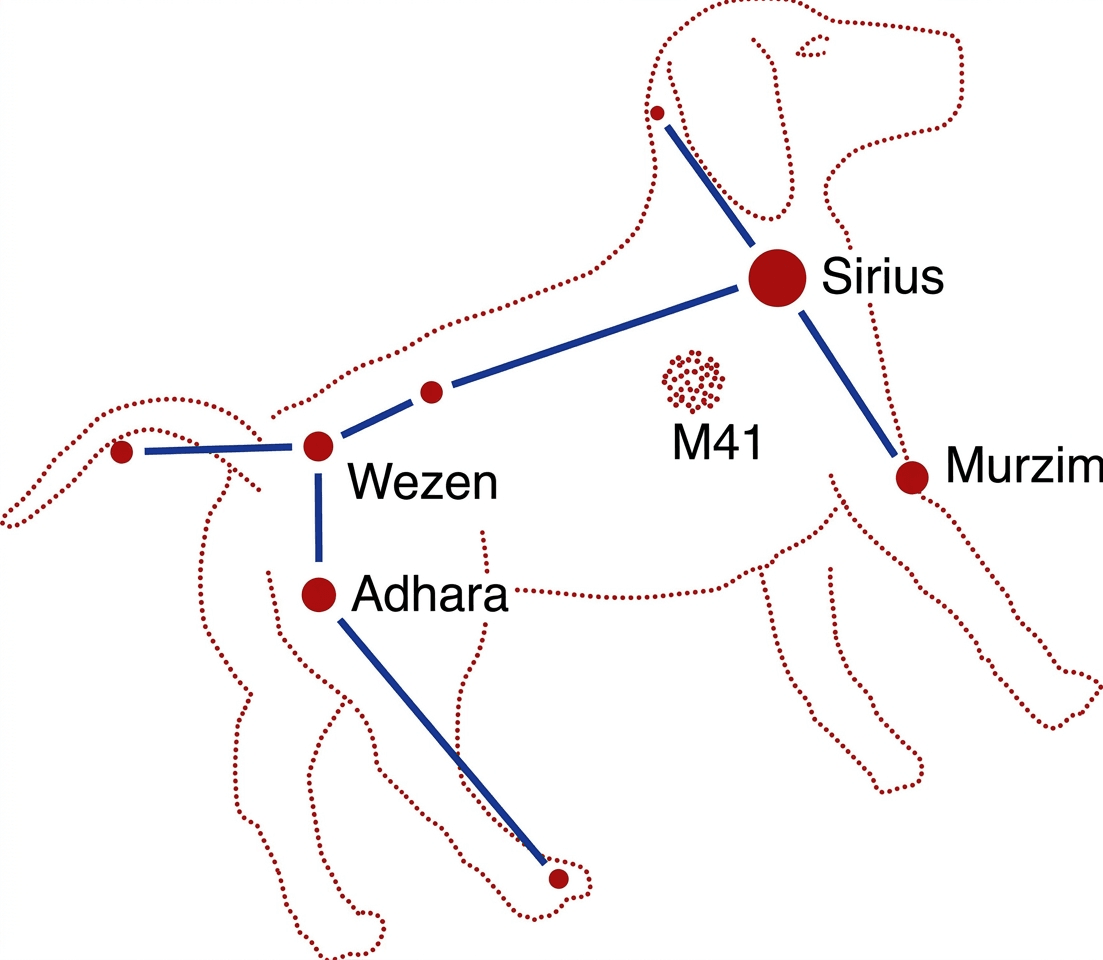
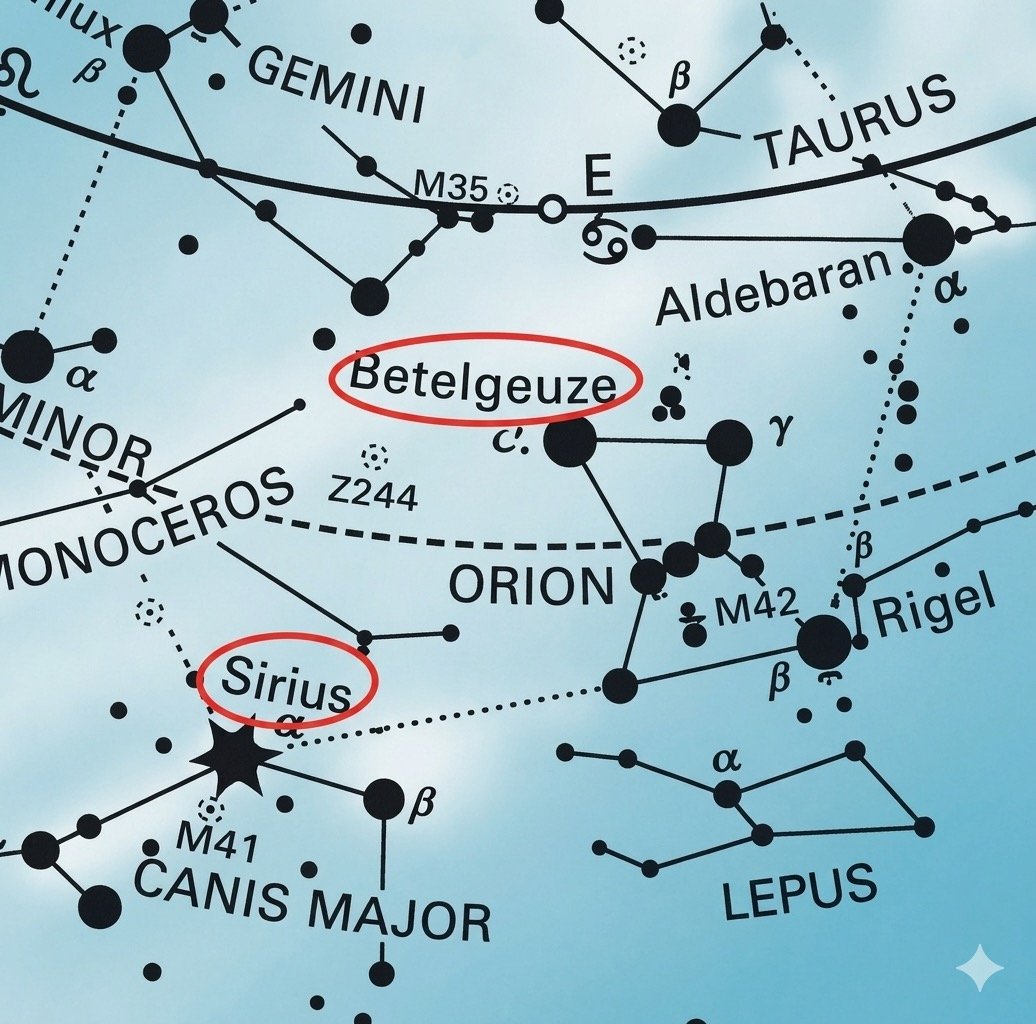
When looking at a sky map, one can see in the middle image that Sirius (Canis Major constellation on the left) is not far from Betelgeuse (Orion constellation on the right). The start of the ancient Egyptian and Armenian years was therefore close.
This second-generation calendar would have remained unchanged until the 3rd century, when Armenians converted to Christianity.
Evolution of ancient calendars
In AD 551, at the request of Catholicos Movsess Taronatzi, Athanas Taronatzi fixed the start of the year at day 1 of the month Navarsadi. This marked the beginning of the Great Armenian Era, corresponding to 11 July AD 552 in the Julian calendar. Years would no longer be counted from each king's accession to the throne. Naturally, this calendar was as “wandering” as the Egyptian one.
In the 7th century AD, at the request of Catholicos Anastass Akorretzi, Anania Shiraktzi attempted to “stabilize” the calendar by drawing up 532-year tables showing months and days of major feasts. He also introduced an additional year. This reform was not validated by the Armenian Church.
However, some Armenian thinkers used these tables, creating serious confusion.
To put an end to it, Jovhannes Sarkavag established a second 532-year table set. This marked the birth of the Little Armenian Era, whose beginning was fixed at 11 August 1084. Sarkavag removed the additional year and replaced it with one additional day every 4 years, inserted between the months Mehekan and Areg.
The Little Era never became very popular, and the civil calendar continued using the Great Era principle: a year of 12 months of 30 days + 5 days, without extra leap day.
The Gregorian calendar was adopted for both civil and religious use on 6 November 1923.
I should point out that some documents mention an epoch (in the sense of chronology starting point) whose practical use, time and method remain unclear to me. Its date would have been 11 August 2492 BC, supposedly corresponding to the foundation of the Armenian nation by Hayk.
Let us now look at month and day names in ancient and modern Armenian calendars.
Months
According to legend, ancient month names were those of sons and daughters of Hayk. Here is the list at the time when the year began in August.
| Start (Julian date) | Month name |
|---|---|
| 11 August | Navasart |
| 10 September | Hori |
| 10 October | Sahmi |
| 9 November | Dreh |
| 9 December | Kaghotz |
| 8 January | Aratz |
| 7 February | Mehegan |
| 9 March | Arek |
| 8 April | Ahegan |
| 8 May | Mareri |
| 7 June | Markatz |
| 7 July | Hroditz |
| 6 August | Havelouatz * |
* Havelouatz or aveliats corresponds to the “month” of the 5 epagomenal days, each of which also had a name: Pailatzu, Arusiak, Hrat, Lusntag, Everag.
Current month names are as follows
| French month | Armenian month | French month | Armenian month | French month | Armenian month |
|---|---|---|---|---|---|
| January | Hounvar | May | Mayis | September | Sebdemper |
| February | Pedrvar | June | Hoonis | October | Hokdemper |
| March | Mard | July | Hoolis | November | Noyemper |
| April | Abril | August | Ocosdos | December | Tegdemper |
Days of the month
Ancient Armenians named not only months, but also days of the month.
| Rank | Name | Rank | Name | Rank | Name | Rank | Name |
|---|---|---|---|---|---|---|---|
| 1 | Arek | 9 | Tsobaper | 17 | Asag | 25 | Tzron |
| 2 | Hrant | 10 | Mourtz | 18 | Masis | 26 | Nbad |
| 3 | Aram | 11 | Yerazgan | 19 | Anahid | 27 | Vahakn |
| 4 | Markar | 12 | Ani | 20 | Arakadz | 28 | Sim |
| 5 | Ahrank | 13 | Barkhar | 21 | Krkour | 29 | Varak |
| 6 | Mazteh | 14 | Vanadour | 22 | Gortouk | 30 | Kisheravar |
| 7 | Asdghig | 15 | Aramazt | 23 | Ztmag | ||
| 8 | Meeher | 16 | Mani | 24 | Lousnag | ||
Names of weekdays
| French | Armenian |
|---|---|
| Sunday | Miashapti then Garagi |
| Monday | Yergooshapti |
| Tuesday | Yerekshapti |
| Wednesday | Chorekshapti |
| Thursday | Hinkshapti |
| Friday | Vetshapti then Ourpat |
| Saturday | Shapat |
At first, days were designated by ordinal number (first, second, etc.), with Shapat meaning day of rest. Then Vetshapti became Ourpat, meaning “prepare for Shapat”. Later still, Miashapti became Garagi (“day of the Lord”), and therefore day of rest.
Names of hours
To conclude, hours were also named:
| Hour (night) | Name | Hour (day) | Name |
|---|---|---|---|
| 18 h | Khavarag | 6 h | Ayk |
| 19 h | Aghchamoughch | 7 h | Tzayk |
| 20 h | Mtatzial | 8 h | Zoratzial |
| 21 h | Shaghavod | 9 h | Jarakaytial |
| 22 h | Gamavod | 10 h | Sharavighial |
| 23 h | Pavagan | 11 h | Yergradess |
| 24 h | Khotapial | 12 h | Shantagogh |
| 1 h | Kizag | 13 h | Hragat |
| 2 h | Lousagn | 14 h | Hourpaylial |
| 3 h | Aravod | 15 h | Taghantial |
| 4 h | Lousapayl | 16 h | Arakod |
| 5 h | Paylatzou | 17 h | Arpogh |
The current Armenian liturgical calendar
Let us immediately note that for liturgical use, the Julian calendar remains in use in Tbilisi and in the Armenian Patriarchate of Jerusalem, because of the “status quo of the Holy Places”.
Do not worry: we are not going into this calendar day by day for all 365 days. That would be rather laborious and, in any case, outside this site's scope.
So we will simply outline its main principles and major moments.
The specific feature of the Typikon (Armenian: tonatsouits, book of feasts) is that all feasts are movable, except for six fixed ones:
- 6 January: Theophany and Nativity
- 14 February: Presentation of the Lord in the Temple
- 7 April: Annunciation of the Holy Virgin
- 8 September: Nativity of the Holy Virgin
- 21 November: Presentation of the Holy Virgin
- 8 December: Conception of the Holy Virgin
Why this mobility? Quite simply because of an old tradition according to which this liturgical calendar is built around a weekly cycle in which saints' feasts can never be celebrated on Sunday, Wednesday or Friday. So, necessarily, these feasts have to move each year.
The Armenian weekly cycle
Armenian tradition recognizes three types of commemoration during the week:
- Terowni (Sunday feast): all Sundays are dedicated to feasts of the Lord.
- Srbots (saints' feasts): saints' feasts are assigned to Mondays, Tuesdays, Thursdays and Saturdays. Notable saints are commemorated on Saturdays.
- Pahots (days of abstinence): Wednesdays and Fridays are abstinence days, during which saints are not commemorated. The office on these two days has a penitential character. Wednesdays are dedicated to the Annunciation and Incarnation; Fridays to the Crucifixion.
The Armenian yearly cycle
The liturgical year of the Armenian Church is divided into four sections, which themselves define eight major periods or seasons (shown in parentheses):
- The Theophany Period (Theophany and Nativity)
- The Great Easter Period (Lent [the 50 penitential days before Easter], Easter, Pentecost)
- The Transfiguration Period (Transfiguration)
- The Great extra-Paschal Period (Translation of the Mother of God and Exaltation of the Holy Cross) Added to these is the Fore-period [or Fifty Days: the 50 penitential days preceding Nativity].
Finally, note that tonatsouits includes 99 days dedicated to God, 5 to the Holy Mother of God, 120-130 to saints and martyrs, 5 dedication days (navakatiqh: vigil fast before great feasts), and 150-157 days of fasting or abstinence.
Easter is celebrated on the first Sunday after the spring equinox on 21 March (earliest 22 March, latest 25 April).